
At the bottom, underneath a set of bedsheets that Lauren never touches because she claims they smell old, there is a false bottom. I built that compartment twenty-two years ago.
Back then, my home had become the center of the catering business. Cash payments. Contracts. Event deposits. Supplier records. Too many important things came through those doors, and I learned early that the safest place for certain items was one nobody thought to look for.
I slid my fingers beneath the narrow edge and lifted the wooden panel.
Inside were three things.
A sealed envelope.
A small black notebook.
And a brass key ring.
Lauren knew about none of them.
She especially did not know what those keys opened.
I sat on the edge of my bed for a moment and looked at them in my palm.
My hands were steady.
That surprised me.
Maybe I should have been frightened.
Maybe eighty-year-old women who have just been locked inside their own rooms by their daughters are supposed to panic.
But I had spent too much of my life solving disasters while everyone else lost their heads.
A wedding cake collapsing thirty minutes before the bride arrived.
A delivery truck breaking down with food for two hundred guests.
A kitchen fire during a charity banquet.
An abusive vendor once trying to intimidate me into paying twice.
Every time, someone around me would say, “Adelaide, what are we going to do?”
And every time, I would answer the same way.
“First, we stop panicking.”
So I stood.
I slipped the black notebook into my handbag.
I placed the envelope beside it.
Then I chose the smallest brass key.
Lauren had replaced the bedroom lock two years earlier, claiming the old one was “unsafe.”
What she did not know was that the old house had interior service locks installed long before she was born.
There was a narrow connecting door between my bedroom wardrobe and the linen room.
It had been hidden behind built-in shelving during a renovation.
Hidden from everyone except me.
I moved two hanging jackets aside.
Then pushed against the wooden panel.
It opened with a soft groan.
The smell of cedar and dust came through first.
I stepped carefully into the narrow passageway.
My cane tapped once against the floor.
I stopped.
No footsteps came from the hall.
Down below, voices were rising.
Lauren was shouting.
I could not make out the words.
Then a man’s voice boomed back.
“Where is Adelaide?”
I smiled.
That sounded like Mr. Gregory.
He was seventy-seven, stubborn as a mule, and had never once lowered his voice for anybody.
I walked through the linen room.
From there, another service door led into the upstairs hallway.
The key turned.
Click.
I stepped out.
My own bedroom door stood locked ten feet away.
For a strange second, I almost laughed.
Lauren had imprisoned an empty room.
I moved down the hallway.
At the top of the stairs, I stopped.
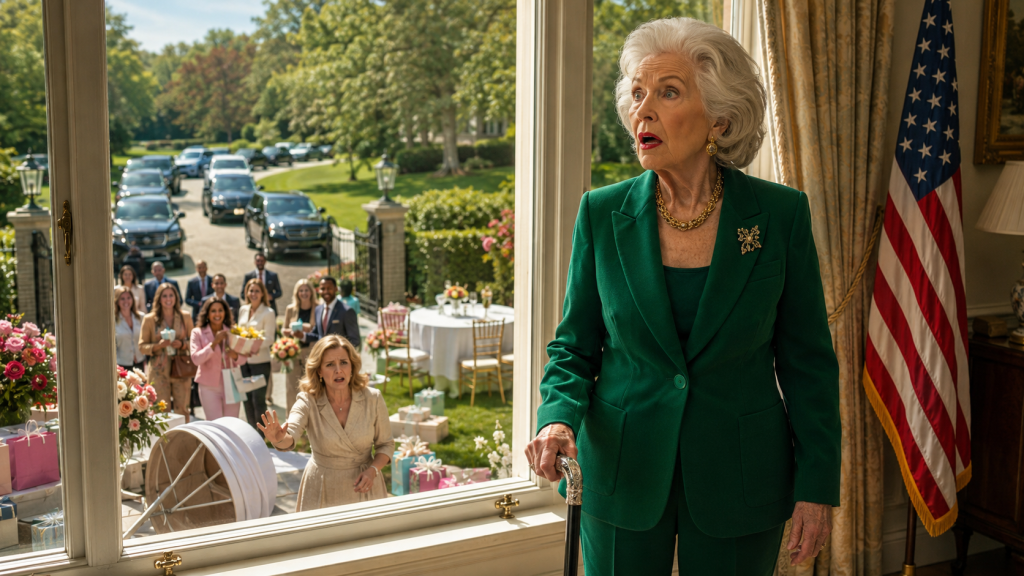
The foyer below was filled with flowers.
People were standing shoulder to shoulder near the front entrance.
Former employees.
Neighbors.
Old clients.
Suppliers.
Two women from the church.
The Ramirez family.
My old bookkeeper, Celeste.
Even Dr. Wallace, whose daughter’s wedding I had catered twenty-four years earlier, stood near the doorway holding a bottle of champagne.
And right in the middle of them was Lauren.
Her face was red.
Her arms were waving.
“I’m telling you, she isn’t feeling well.”
Mr. Gregory crossed his arms.
“You said she canceled.”
“She did.”
“No, you called me.”
A woman near the door lifted her phone.
“You called me too.”
Another voice joined in.
“And me.”
Lauren’s mouth tightened.
“She changed her mind.”
“Then let her tell us herself,” Celeste said.
Lauren looked toward the stairs.
And saw me.
Everything stopped.
Her face changed so quickly I almost felt sorry for her.
Almost.
“Mom?”
I descended one step at a time.
The whole room turned toward me.
Then someone began clapping.
I do not even know who started it.
Within seconds, the foyer erupted.
People cheered.
Someone shouted, “Happy birthday, Adelaide!”
Another voice called, “There she is!”
By the time I reached the bottom step, I had tears in my eyes.
Not because I was weak.
Because for ten minutes upstairs, my daughter had tried to convince me I had become irrelevant.
Now fifty people were proving otherwise.
Mr. Gregory came forward first.
He kissed my cheek.
“Eighty,” he said. “You look seventy-nine.”
I laughed.
“You always were a terrible liar.”
He grinned.
Then Celeste hugged me.
Then the Ramirez sisters.
Then two of my former kitchen workers.
Lauren stood several feet away.
Nobody looked at her.
That bothered her more than anger would have.
Finally, she stepped toward me.
“Mom, you need to go upstairs.”
The room went silent again.
I looked at her.
“Why?”
“You’re overwhelmed.”
“I’m not.”
“You don’t understand what’s happening.”
“I understand perfectly.”
She lowered her voice.
“Please. Don’t embarrass yourself.”
I glanced around the room.
“By having guests at my own birthday?”
Her jaw tightened.
“People weren’t supposed to come.”
“I noticed.”
She looked at the crowd.
Then back at me.
“Mom, I canceled this.”
“Yes.”
“You need rest.”
“No.”
“You’re confused.”
“No.”
Her face twitched.
There it was.
That word.
Confused.
She had used it more and more lately.
At the pharmacy.
At the bank.
With relatives.
Any time I disagreed with her.
Any time I asked questions.
Any time I refused to hand over control.
She would tilt her head, soften her voice, and say something like, “Mom gets mixed up sometimes.”
It was clever.
Cruel.
And effective.
People become uncomfortable arguing with someone who claims an old woman is losing her mind.
So I decided that day would be the last time Lauren ever used that trick on me.
I reached into my handbag.
I removed the black notebook.
Lauren stared at it.
“What is that?”
“My notes.”
Her expression hardened.
“Mom—”
“I’ve been keeping them for six months.”
She went pale.
I continued.
“Every call you blocked. Every check you moved. Every appointment you canceled without telling me. Every time you told someone I was confused after I disagreed with you.”
The room became very still.
Lauren looked around nervously.
“This is ridiculous.”
“Maybe.”
I opened the notebook.
“April third. You told my cousin Ruth I was too sick to attend her anniversary dinner.”
“You were tired.”
“I was not.”
“Mom—”
“April nineteenth. You called my bank and tried to change the mailing address on my statements.”
Her face tightened.
“That was for convenience.”
“May second. You told my physician I had memory problems.”
“You do.”
Dr. Wallace cleared his throat.
Lauren looked toward him.
He was not my doctor.
But he was still a physician.
And his expression had changed.
I turned another page.
“May twenty-sixth. You canceled lunch with Celeste and told her I forgot.”
Celeste shook her head slowly.
Lauren’s eyes flashed.
“This is private family business.”
“No,” I said. “It became public when you locked me in my room and lied to fifty people outside my gate.”
A murmur moved through the crowd.
Lauren’s mouth opened.
Then closed.
That was when her husband, Daniel, walked in from the garden.
He had probably been hiding.
Daniel was not cruel like Lauren.
He was worse in a different way.
Passive.
He watched things happen and then called his silence “staying out of it.”
He stopped when he saw the crowd.
“Adelaide.”
I looked at him.
“Daniel.”
He glanced at Lauren.
“What happened?”
Mr. Gregory answered before I could.
“Your wife locked her mother upstairs.”
Daniel looked startled.
Lauren snapped, “That is not what happened.”
I raised one eyebrow.
“Was my door locked from the outside?”
She stared at me.
Daniel looked at her.
“Lauren?”
She threw up her hands.
“She was agitated.”
“I was wearing lipstick.”
“That doesn’t mean you were stable.”
A gasp moved through the room.
Even Daniel flinched.
Lauren heard herself too late.
I let the silence sit.
Then I reached into my handbag again.
The sealed envelope came out next.
Lauren stared at it.
“What is that?”
“The reason you have been so interested in controlling me.”
Her face changed.
Just slightly.
But I saw it.
So did Celeste.
Celeste had done my books for thirty years.
She knew money fear when she saw it.
I opened the envelope.
Inside was a copy of my updated estate plan.
Not the original.
That was somewhere much safer.
I held the pages calmly.
“Three months ago, I changed my will.”
Lauren’s eyes widened.
Daniel looked at her.
“Changed it?”
“Yes.”
Lauren laughed once.
A brittle sound.
“That’s impossible.”
“Why?”
“You didn’t tell me.”
“Exactly.”
Her face hardened.
“Mom, give me that.”
“No.”
She stepped closer.
Daniel caught her arm.
“Lauren.”
She jerked away from him.
“This is insane. She doesn’t know what she’s doing.”
There it was again.
The whole room heard it.
I looked at Dr. Wallace.
Then at Celeste.
Then at Mr. Gregory.
Finally, back at my daughter.
“I knew exactly what I was doing when I met with my attorney.”
“You have an attorney?”
That question almost made me laugh.
“Lauren, I ran a company for forty-two years.”
She said nothing.
“Yes. I have an attorney.”
I turned to the others.
“Her name is Evelyn Hart.”
Celeste’s eyebrows rose.
She knew the name.
Evelyn had represented several well-known families in estate and elder law.
Lauren knew the name too.
Her face fell.
I continued.
“Six months ago, Evelyn advised me to begin documenting certain behavior.”
Lauren whispered, “You’ve been talking about me to a lawyer?”
“I’ve been protecting myself.”
She looked genuinely wounded.
That almost hurt.
Because once upon a time, this was my little girl.
The child who climbed into my bed during thunderstorms.
The teenager who cried when she failed her driving test.
The young woman whose wedding I paid for when I could barely afford it.
I had not stopped loving her.
But love does not require surrender.
I held up the papers.
“My previous will left this house, the commercial kitchen building, and most of my remaining business investments equally to Lauren and her brother, Michael.”
Lauren swallowed.
Everyone knew Michael lived three states away.
Lauren had spent years telling people he “never bothered” with me.
That was another lie.
Michael called every Sunday.
Lauren simply did not know because I used the landline in my study.
“Under the new will,” I continued, “the house no longer goes directly to either child.”
“What?” Lauren said.
“It goes into a family trust.”
She stared at me.
“And the trustee is not you.”
“Who is it?”
“Michael.”
Lauren actually laughed.
“Michael? He barely visits!”
“He visits when I ask him to.”
“You always defend him.”
“No. I protect facts.”
Her eyes filled with rage.
“So he gets everything?”
“No.”
I folded the papers.
“That is the part you never understood. You think inheritance is a prize awarded to whichever child controls the most.”
She stared at me.
“The trust will provide for both of you, but neither of you can sell the house or remove me from it while I’m alive.”
Lauren looked stunned.
Then suspicious.
“Why would that matter? We weren’t going to remove you.”
The entire room looked toward the upstairs hallway.
Toward the locked bedroom.
I did not need to say anything.
Lauren’s face burned.
Daniel lowered his eyes.
I continued.
“The commercial building is different.”
She froze.
Ah.
There it was.
The real wound.
The building.
Thirty years earlier, I had bought an old warehouse near downtown and turned it into the headquarters of Adelaide’s Table.
Industrial kitchen.
Storage.
Offices.
Delivery bays.
When I retired, I leased most of the building to three businesses.
The property was worth more than the house.
Lauren had asked about it at least once a month.
“Is the building still in the family?” she would say.
“What happens to it later?”
“You should simplify.”
“Selling now would be smart.”
Always casually.
Always for my own good.
I looked at her.
“I transferred the commercial property into a charitable foundation.”
Her face went blank.
“What?”
“The building will fund culinary scholarships for single parents and low-income students.”
She stared at me.
“You gave it away?”
“No.”
“I assigned it a purpose.”
“You gave away our inheritance.”
Mr. Gregory made a sound under his breath.
I kept my eyes on Lauren.
“Your inheritance?”
She realized the mistake immediately.
I waited.
Then said softly,
“There it is.”
She looked around.
“I didn’t mean—”
“Yes, you did.”
Her voice rose.
“Mom, that building is worth millions.”
“Yes.”
“You worked your entire life for it.”
“Yes.”
“And you’re just giving it to strangers?”
“Not strangers.”
“Then who?”
“People like I was.”
That stopped her.
I was nineteen when my husband left.
Two children.
No savings.
No degree.
I started cooking from a church basement because I needed rent money.
The first year nearly broke me.
The second taught me.
The third changed my life.
I knew exactly what one opportunity could do for someone standing at the edge of desperation.
I looked around the room.
“Half the reason this business survived was because people gave me chances I had not yet earned.”
Mrs. Ramirez wiped her eyes.
I continued.
“So yes, the building will help people learn a trade. Start businesses. Feed families. Become independent.”
Lauren shook her head.
“You’re doing this to punish me.”
“No.”
“Then why now?”
“Because I finally realized that leaving property without purpose can destroy people.”
She stared at me.
“And because for six months, I have watched you behave as if I were already dead.”
That landed.
Hard.
Daniel whispered her name.
“Lauren.”
She spun toward him.
“Don’t.”
He looked exhausted.
“I think we should go.”
She laughed.
“Go where? This is my house too.”
“No,” I said.
She turned toward me.
“It is not.”
Her face went still.
I continued.
“You and Daniel moved in after your kitchen renovation took longer than expected.”
“That was three years ago.”
“Yes.”
“You told us to stay.”
“I did.”
“So we live here.”
“You are guests.”
Her eyes narrowed.
“You can’t throw us out.”
“I’m not throwing anyone out today.”
She gave a bitter smile.
“Because you can’t.”
“No.”
I reached into my handbag one final time.
This time, I took out my phone.
“I’m not throwing you out today because my attorney advised me to give you written notice.”
Lauren stared at me.
I unlocked the screen.
Then showed her the email.
Thirty days.
Formal notice terminating her permission to reside in my home.
Daniel read it first.
He closed his eyes.
Lauren looked at the screen.
Then at me.
“You already planned this?”
“I hoped I would not need to use it.”
“When did you send it?”
“This morning.”
Her face twisted.
“Before any of this?”
“Yes.”
That confused her.
“You were already going to make us leave?”
“Yes.”
“Why?”
I looked toward the stairs.
“Because two weeks ago, you tried to have me declared incompetent.”
The room erupted.
Lauren’s face collapsed.
Daniel looked genuinely shocked.
“What?”
She turned toward him.
“Don’t listen to her.”
He stared.
“Did you?”
“It wasn’t like that.”
I pulled a folded letter from the notebook.
“Evelyn received this from a geriatric assessment service.”
Lauren tried to speak.
I raised one hand.
“You scheduled an evaluation without telling me.”
“I was worried.”
“You wrote that I forget names, wander at night, mishandle money, and become aggressive.”
Somebody gasped.
None of it was true.
Not one word.
I continued.
“And you listed yourself as the proposed financial guardian.”
Daniel backed away from her.
“Lauren.”
She looked desperate now.
“I was trying to protect her.”
“No,” I said.
“You were trying to replace me while I was still alive.”
Her eyes filled with tears.
Maybe they were real.
That did not make the damage less real.
“I’m your daughter.”
“Yes.”
“How can you humiliate me like this?”
The question stunned me.
Not because it was cruel.
Because she believed it.
I looked at her for a long moment.
Then said,
“I am not humiliating you.”
“You’re doing this in front of everyone.”
“You locked me in a room before my own birthday party.”
Her mouth tightened.
“You forced me to make this public.”
“I didn’t force you to do anything.”
“No.”
I nodded.
“You’re right.”
She looked surprised.
“I should have stopped you sooner.”
Silence.
Then I turned toward the guests.
“My apologies.”
Mr. Gregory barked out a laugh.
“For what?”
“For making you all stand in the foyer while my family holds a board meeting.”
That broke the tension.
People laughed.
Even I did.
I clapped my hands once.
“Now, someone tell me whether my garden has survived Lauren’s demolition.”
Mrs. Ramirez smiled.
“We rebuilt it.”
I blinked.
“You what?”
She pointed through the back doors.
I walked slowly toward the garden.
People moved aside.
And when I stepped outside, I stopped.
The tables were back.
Not the same ones.
Better ones.
Neighbors had brought folding tables.
My former employees had covered them in white cloth.
Flowers were everywhere.
Yellow roses.
Peonies.
Hydrangeas.
The musicians had set up beneath the old maple tree.
A cake stood in the center.
Three tiers.
White frosting.
Gold piping.
And across the top, in elegant letters, were the words:
Eighty Years of Adelaide.
My hand rose to my mouth.
Celeste came beside me.
“You thought we were going to let her cancel this?”
I looked around.
“When did you do all this?”
“About fifteen minutes.”
“That fast?”
Mr. Gregory shrugged.
“You trained half these people.”
I laughed until I cried.
Not delicate tears.
Full, messy tears.
The kind that come when grief, relief, anger, and love all try to leave the body at the same time.
People hugged me.
Someone poured champagne.
Someone else brought me a plate.
The band began playing an old song I loved.
And for the next two hours, I had a birthday.
A real one.
People told stories.
Mrs. Ramirez reminded everyone about the wedding where I had made six hundred empanadas after the original caterer disappeared.
Dr. Wallace told the story of how I had delivered dinner to his family for two weeks after his wife had surgery.
Celeste stood and told everyone how, during a bad winter twenty-seven years earlier, I had paid salaries out of my own savings rather than lay off my kitchen staff.
I had forgotten some of those things.
Not because my mind was failing.
Because life gets busy.
You do what needs doing and move on.
But other people remember.
That afternoon taught me something I wish more people understood.
A life is not measured only by what you own.
It is measured by what remains in other people after you leave the room.
At five o’clock, Michael arrived.
He came through the garden gate carrying a small suitcase.
Lauren saw him.
Her face went hard.
“What are you doing here?”
He looked at her.
“Mom called.”
“You knew about this?”
“Some of it.”
She laughed bitterly.
“Of course.”
He walked past her and hugged me.
Tight.
“Happy birthday, Mom.”
I held him longer than usual.
Then whispered,
“Thank you for coming.”
He pulled back.
“You didn’t think I would miss eighty, did you?”
I smiled.
“No.”
Lauren stood ten feet away.
For the first time all day, she looked less angry than lost.
That hurt more.
Because beneath all her control, there was fear.
Fear of being left out.
Fear of losing money.
Fear of losing importance.
But fear does not excuse cruelty.
Eventually, she walked toward me.
Her voice was quieter.
“Can I talk to you?”
I nodded.
We stepped away from the others.
She folded her arms.
“You really want us gone?”
“Yes.”
Her eyes filled.
“After everything I’ve done for you?”
I took a slow breath.
“You have done things for me.”
She looked vindicated.
“And you have also done things to me.”
Her face fell.
“I don’t hate you, Lauren.”
She looked away.
“I don’t even want to punish you.”
“Feels like punishment.”
“It feels like consequences.”
She stared at the grass.
“What if I apologize?”
“I hope you do.”
“Will that change the notice?”
“No.”
She looked at me.
“Then what is the point?”
“The point is becoming someone who does not need a reward to do the right thing.”
She laughed bitterly.
“You always have an answer.”
“No.”
I looked toward the garden.
“I just finally stopped being afraid of yours.”
She cried then.
For real.
I knew because I was her mother.
I knew every kind of crying she had.
The manipulative tears.
The angry tears.
The tired ones.
These were grief.
I let her cry.
I did not rush to comfort her.
That was new for me.
All her life, the moment Lauren hurt, I ran toward her.
Sometimes love becomes unhealthy when one person is never allowed to experience the full weight of their choices.
After a while, she wiped her face.
“What happens now?”
“You move out.”
“And then?”
“You live.”
She stared at me.
“That’s it?”
“That’s plenty.”
She almost smiled.
Then stopped.
“Do you still love me?”
The question cracked something inside me.
I reached for her hand.
“Yes.”
She looked down.
“Even now?”
“Especially now.”
She squeezed my fingers.
“But loving you does not mean giving you my house, my money, my dignity, or my freedom.”
She nodded slowly.
For once, she did not argue.
Thirty days later, Lauren and Daniel moved into a townhouse across the city.
Their marriage survived.
Barely.
Daniel later admitted he had known Lauren was becoming controlling but had been afraid of confronting her.
I told him fear was understandable.
Silence was still a choice.
Michael stayed with me for two months.
Not because I needed a babysitter.
Because I wanted company.
There is a difference.
Lauren and I did not speak for six weeks after she moved out.
Then one morning, a letter arrived.
Handwritten.
Not an email.
Not a text.
A letter.
Mom,
I have rewritten this twelve times.
I keep wanting to explain myself, but every explanation sounds like an excuse.
I thought I was helping.
Then I started enjoying the control.
That is hard to admit.
I told myself you were getting older, so I had to manage things.
The truth is, I was afraid.
Afraid you would leave more to Michael.
Afraid the business would disappear.
Afraid everything you built would go somewhere else and I would be left with nothing.
I became so focused on what I might inherit that I stopped seeing what I still had.
You.
I am ashamed of that.
I do not expect you to change the will.
I do not expect you to forgive me quickly.
But I am sorry.
Not because I lost the house.
Because I almost lost my mother while she was still standing in front of me.
Love,
Lauren
I read it twice.
Then I folded it.
I put it in the same hidden compartment where I had kept the keys.
Not because I wanted to hide it.
Because some things deserve to be kept.
Lauren began seeing a therapist.
Months later, we started having lunch.
Public places at first.
Then my house.
She never touched my mail again.
Never asked about my will.
Never used the word confused.
Not once.
On my eighty-first birthday, she arrived early.
She brought flowers.
Then asked,
“Do you want help setting up?”
I looked at her.
“Help?”
She smiled.
“Meaning you tell me what to do and I do it.”
I laughed.
“That sounds dangerous.”
She laughed too.
We set the garden tables together.
At noon, cars began arriving.
Not fifty this time.
Maybe thirty.
Enough.
Mr. Gregory brought wine.
Celeste brought cake.
Michael flew in.
The Ramirez family filled half the garden.
And Lauren stood beside me as I greeted everyone.
Not in front of me.
Not speaking for me.
Beside me.
At sunset, I sat beneath the maple tree with a glass of champagne.
Lauren came over.
“You tired?”
“A little.”
“Want to go inside?”
I looked at her.
She caught herself.
Then smiled.
“Sorry.”
I smiled back.
“I’ll decide when.”
“Right.”
She kissed my cheek.
“Happy birthday, Mom.”
I looked around the garden.
The tables.
The lights.
The people laughing.
The house glowing behind us.
For years, I thought growing old meant slowly giving things away.
Control.
Privacy.
Authority.
Voice.
But age did not make me less of a person.
It made me more certain which parts of myself were no longer negotiable.
Lauren learned something too.
Inheritance is not love.
Control is not care.
And protecting someone does not mean taking away their right to choose.
The funny thing is, those hidden keys never opened anything valuable in the way Lauren imagined.
Not money.
Not jewelry.
Not a secret safe.
They opened doors.
And that day, that was exactly what I needed.
A way out of a room someone else had decided I belonged in.
Sometimes the most important thing a person can keep hidden is not wealth.
It is an exit.
A choice.
A little piece of freedom no one else can take without permission.
On my eightieth birthday, my daughter locked me in my room because she thought age had made me powerless.
By sunset, I had my home back.
My voice back.
My guests around me.
And my life firmly in my own hands.
She thought fifty cars were coming for a party.
They were not.
They were coming for me.
And that made all the difference.
THE END! THANKS FOR READING!