

The courtroom went still.
I will never forget that answer.
The last major witness was Detective Ruiz.
By then, the jury had seen the school letter.
The receipt.
The note.
The video.
Relevant messages.
Photographs from the house.
They had heard the timeline.
They had heard Ethan contact his mother before she arrived.
They had heard evidence that Lily’s backpack was removed from its normal location.
They had heard that the dropped glass happened after Margaret was already on her way.
That mattered.
Because the defense could no longer pretend the punishment had begun with a broken glass.
The glass was merely the moment Ethan chose to perform the punishment he had already discussed.
When Detective Ruiz stepped down, Ethan asked to speak to his attorney.
They whispered for several minutes.
Court recessed.
Naomi met me in the hallway.
“What’s happening?”
“Possibly nothing.”
“You think there’s a deal?”
“The criminal attorney may be discussing options.”
My hands started shaking.
“Would that mean no verdict?”
“It depends.”
“I want a verdict.”
Naomi looked at me.
“I know.”
“I want people to say what he did.”
“They already have.”
“It’s not the same.”
“No.”
She paused.
“But remember something: your healing cannot depend on twelve strangers giving you a sentence you like.”
I hated that advice too.
The best advice was often the kind I hated first.
Court resumed.
There was no deal.
Closing arguments began the next morning.
I will not repeat them all.
Some words belong in courtrooms and nowhere else.
The prosecutor ended with the school worksheet.
A large image appeared on the screen.
What should you do when someone tells you to keep a scary secret?
Below it, in Lily’s handwriting:
Tell anyway.
The prosecutor faced the jury.
“That child did what every adult tells children they should do.”
She paused.
“She told.”
Then she sat down.
The jury deliberated.
I waited with my mother.
Mr. Carter.
Nathan.
Mrs. Dalton.
Naomi.
Detective Ruiz came and went.
Nobody said much.
Hours passed.
At one point, I went to the restroom and stared at myself in the mirror.
I looked older.
Not worse.
Older.
There is a difference.
The woman staring back at me knew things the woman from the kitchen had not.
She knew a marriage license was not a promise to endure cruelty.
She knew peace should not depend on one person’s mood.
She knew fear was information.
She knew children notice what adults normalize.
She knew love without safety is not enough.
When I returned, Naomi stood.
“They’re back.”
My knees nearly failed.
We entered the courtroom.
Ethan was already seated.
The jury came in.
Nobody looked at him.
The clerk began.
I watched Ethan’s face instead of the jurors.
The first verdict was read.
Guilty.
His jaw tightened.
Another.
Guilty.
Another finding.
Another count.
The legal language became noise.
My mother grabbed my hand.
I did not cheer.
I did not smile.
This was not victory.
My daughter had still spent nights afraid beneath her own bed.
She had still asked whether dropping a glass made her bad.
No verdict could erase that.
But the truth had survived.
That mattered.
Outside the courtroom, reporters waited.
I had known they might.
The case had attracted local attention.
Naomi asked whether I wanted to leave through another exit.
“Yes.”
I had no statement.
No speech.
No interest in turning Lily’s pain into public spectacle.
We left through a side hallway.
Mr. Carter followed.
Nathan followed.
My mother walked beside me.
Outside, the sky was bright.
Almost painfully bright.
My phone vibrated.
A message from Dr. Patel.
Lily was with her.
I opened it.
Dr. Patel had only written:
She’s okay. Take your time.
I started crying.
My mother hugged me.
“It’s over.”
I shook my head.
“No.”
She looked at me.
“The trial is over.”
That was different.
The criminal case had reached its answer.
Our lives still had to continue.
Sentencing came later.
So did final divorce orders.
So did long-term decisions about parental rights and contact.
I won’t pretend every ruling felt perfect.
Courts are made of laws, evidence, procedures, limits.
Healing is made of different things.
Time.
Safety.
Truth.
Repetition.
Boundaries.
Choice.
Lily never had to sit in a courtroom and face Ethan.
For that, I will always be grateful.
Margaret received consequences of her own under the agreement she entered and the findings in her case.
Some members of Ethan’s family stopped contacting me.
Others quietly apologized.
A few never did.
I learned that apologies are nice when they come.
But healing cannot depend on them either.
One person surprised me.
Louise.
Margaret’s sister.
The woman who had publicly called me vindictive.
She sent one letter.
Unlike Ethan’s, I read hers.
It said:
Claire, I defended my sister before I knew the facts because believing her was easier than accepting what happened. I repeated things about you that I had no right to repeat. I am sorry. You do not need to answer.
I never answered.
But I kept it.
Not because I needed her apology.
Because it was the rare example of someone changing direction when evidence challenged loyalty.
That became meaningful to me.
Lily finished third grade.
On the last day of school, Mrs. Dalton gave each child a folder containing work from the year.
Inside Lily’s was the original My Safe Place assignment.
The school had kept a copy for records.
The original drawing showed Lily beneath a bed.
When she saw it, she became quiet.
I waited.
She carried it to the kitchen table.
Then she asked, “Can I draw another one?”
“Of course.”
She took a new piece of paper.
For twenty minutes, she worked silently.
When she finished, she handed it to me.
This time, she had drawn a yellow bedroom.
A big open window.
A dog.
A desk.
A bookshelf.
Me.
Herself.
And a purple door.
Above it she wrote:
My safe place is where people listen when I say stop.
I had to sit down.
“That’s beautiful.”
She pointed at the dog.
“We still need that part.”
I laughed through tears.
“Yes. I noticed.”
Two months later, we adopted a dog.
Not because I lost the argument.
Because I was ready.
He was a scruffy little mutt with one ear that stood up and one that flopped sideways.
Lily named him Waffles.
Waffles was terrible.
He chewed one shoe.
Then another.
He knocked over a trash can.
He stole an entire sandwich from my mother.
Three days after we brought him home, he knocked a ceramic bowl from the coffee table.
It shattered.
The sound rang through the room.
Lily froze.
So did I.
Waffles stared at the broken bowl.
Then wagged his tail.
Lily looked at me.
I looked at her.
For one terrifying second, I wondered whether the old fear would swallow the room again.
Then Lily said, “Waffles.”
He wagged harder.
“That was Grandma’s bowl.”
My mother called from the kitchen, “I heard that!”
Lily covered her mouth.
Then she started laughing.
My mother walked in, surveyed the pieces, and put both hands on her hips.
“That dog owes me eight dollars.”
Lily laughed harder.
I grabbed the broom.
Lily grabbed the dustpan.
Together we cleaned it up.
No screaming.
No punishment.
No fear.
When we finished, Lily looked at me.
“That’s all?”
I smiled.
“That’s all.”
Two years after the kitchen incident, we moved into our own house.
Not big.
Not fancy.
A small three-bedroom place at the end of a quiet street.
The paint peeled near the back porch.
The dishwasher sounded like an airplane.
The yard needed work.
But Lily’s bedroom had two enormous windows.
Windows that opened.
That mattered.
We painted the walls yellow.
She chose purple curtains.
Waffles slept beneath the window every afternoon.
My mother lived fifteen minutes away by then.
She had moved closer after everything happened.
Mr. Carter visited once.
He brought a housewarming gift.
A box.
Inside were plastic cups.
I stared at him.
He grinned.
“Figured we’d reduce the household glass emergency rate.”
Lily laughed so loudly Waffles barked.
Then she hugged him.
Mr. Carter looked embarrassed.
He had never been good with emotional moments.
“Okay, okay,” he said. “You’re welcome.”
Before leaving, he stood on the porch.
I said, “I never properly thanked you.”
He sighed.
“We’ve done this.”
“I know.”
“Claire.”
“If you hadn’t been outside that day—”
“But I was.”
“If you hadn’t believed me—”
“But I did.”
My eyes filled.
He looked at me.
“You opened the door.”
I frowned.
“What?”
“That day.”
He nodded toward the front entrance.
“You opened the door and yelled.”
I remembered.
Ethan standing in front of me.
Margaret ordering me to hang up.
Lily shaking.
Me realizing nobody inside that house was going to help us.
So I opened the front door.
And screamed.
Mr. Carter said, “People heard because you opened the door.”
After he left, I stood there for a long time.
The door.
It had become a symbol in my mind without my realizing it.
For years, Ethan’s abuse existed behind closed doors.
A broken plate nobody saw.
A whispered threat nobody heard.
A child hiding beneath a bed.
A wife explaining away bruises on walls.
A mother-in-law calling cruelty discipline.
Secrets survive in closed rooms.
That afternoon, I opened one.
And once it was open, Ethan could no longer control who saw him.
Three years passed.
Lily turned eleven.
She became tall.
Confident.
Funny.
Still cautious sometimes.
Still in therapy when she needed it.
Healing did not erase memory.
It changed its power.
She joined the school art club.
She loved science.
She hated multiplication.
She became obsessed with astronomy for six months and informed everyone that most of what we thought of as “shooting stars” were actually meteors.
She corrected me constantly.
I loved every second.
One afternoon, I found her standing in the kitchen staring at the cabinet.
“What are you doing?”
“Getting a glass.”
She reached.
Paused.
Then smiled at me.
“An actual glass.”
I understood.
For a long time, we had mostly used plastic.
Not because I feared breakage.
Because she did.
Eventually we stopped talking about it.
Lily took down a glass.
Filled it with water.
She drank.
Then washed it and put it in the drying rack.
Completely ordinary.
That was the miracle.
Not grand triumphs.
Ordinary things becoming ordinary again.
When Lily was twelve, she finally asked the question I had been expecting for years.
“Do you hate Dad?”
We were driving home from the grocery store.
Waffles was in the back seat with his head out the window.
I took my time.
“I hate what he did.”
“That’s not what I asked.”
Twelve-year-olds are excellent at spotting evasions.
I sighed.
“I don’t spend much time thinking about whether I hate him anymore.”
“Really?”
“Really.”
“How?”
I looked through the windshield.
“Because hating someone can still make them the center of your life.”
She was quiet.
“Do you forgive him?”
“No.”
That answer surprised her.
I continued.
“Forgiveness is personal. Some people need it. Some people don’t. I don’t need to forgive him to live peacefully.”
“Dr. Patel says I don’t have to forgive anybody.”
“Dr. Patel is smart.”
“Do you think he’s sorry?”
There it was.
The harder question.
“I don’t know.”
“He said he was.”
I glanced at her.
Years earlier, there had eventually been tightly controlled communication through legal channels, handled by professionals when Lily became old enough to ask certain questions.
She had read one apology letter with Dr. Patel present.
It had affected her less than I feared.
Maybe because she had learned the difference between words and change.
“What do you think?” I asked.
She stared out the window.
“I think he’s sorry things happened to him.”
I swallowed.
“That’s a thoughtful answer.”
“But I don’t know if he’s sorry things happened to me.”
Neither did I.
At the next red light, Lily said, “I don’t want to talk to him.”
“You don’t have to decide anything for forever today.”
“I know.”
“And nobody gets to rush you.”
“I know.”
The light changed.
We continued home.
That evening, she dropped a glass.
It shattered beside the dishwasher.
Waffles ran away from the noise.
I walked into the kitchen.
Lily looked down.
For a split second, I saw seven-year-old Lily in her face.
Then it was gone.
She looked at me and said, “Well.”
I waited.
“We clean it up.”
I smiled.
“We clean it up.”
She grabbed the broom.
And that was that.
Years after everything happened, Detective Ruiz retired.
She invited us to a small gathering.
I almost didn’t go.
Lily wanted to.
By then, she was fourteen.
Nearly as tall as me.
Ruiz recognized her immediately.
“My goodness.”
Lily smiled.
“You got shorter.”
Ruiz laughed.
“Definitely you who got taller.”
They hugged.
Later, while Lily was eating cake, Ruiz stood beside me.
“She looks happy.”
“She is.”
“So do you.”
I smiled.
“I am.”
Ruiz looked across the room.
“Do you remember the first night at the hospital?”
“Every second.”
“I asked you who knew the second bottle was coming.”
“Yes.”
“You looked like you were going to fall through the floor.”
“I felt like it.”
She nodded.
“I wondered what would happen to you.”
“So did I.”
She looked at Lily.
“You did okay.”
I laughed softly.
“We made a lot of mistakes.”
“That’s usually how people do okay.”
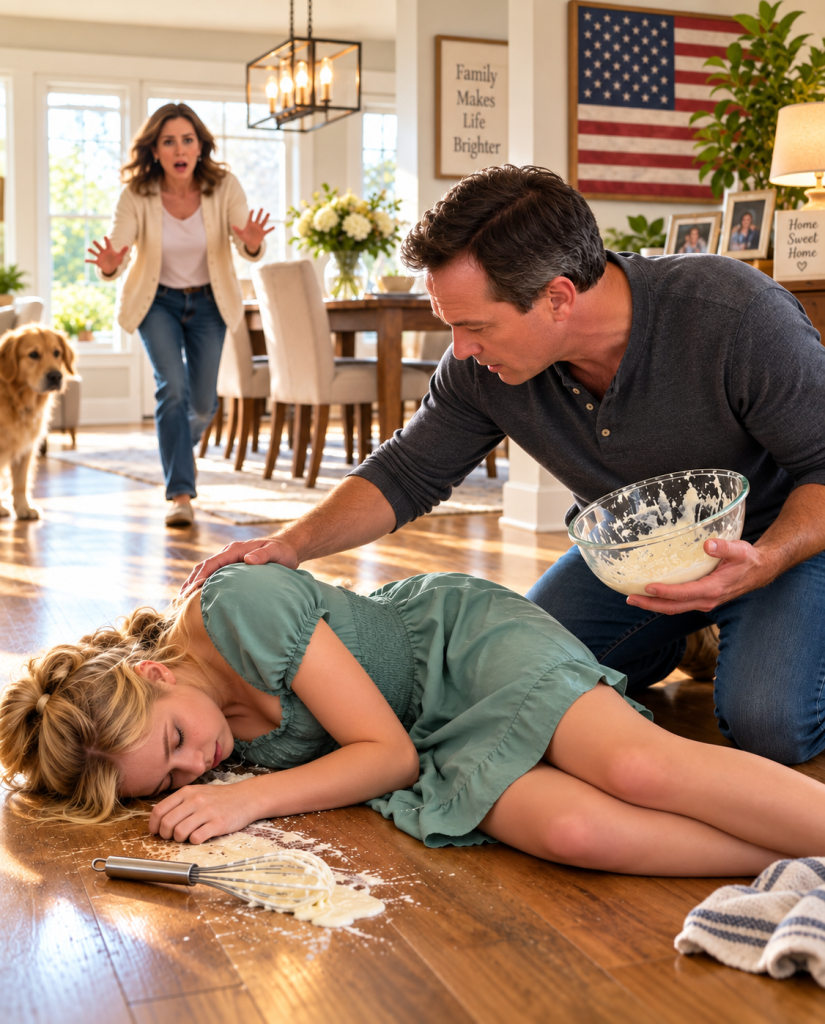
Before we left, Lily asked Ruiz a question.
“Did you know Dad was guilty when you first saw us?”
Ruiz answered carefully.
“I knew something serious had happened.”
“But did you believe my mom?”
“I believed there was enough reason to investigate.”
Lily nodded.
Ruiz continued.
“And I believed you needed to be safe while we figured out what happened.”
That answer mattered.
Not because it was dramatic.
Because it was respectful.
She had not turned Lily into a symbol.
She had treated her like a child whose safety mattered before adults finished arguing about blame.
On the drive home, Lily said, “I want to do that.”
“What?”
“Be a detective?”
“No.”
She stared out the window.
“I want to be the person who believes kids enough to check.”
My throat tightened.
“You could do that in a lot of jobs.”
“I know.”
Years later, she would remember that sentence.
But I’m getting ahead of myself.
Because before Lily grew up, there was one more thing we had to do.
When Lily was fifteen, the old house went up for sale.
Our old house.
The house with the kitchen.
I discovered it accidentally.
A real-estate listing appeared online.
Fresh paint.
New floors.
Staged furniture.
Bright photographs.
The description called it:
A warm family home filled with natural light.
I stared at that sentence until I laughed.
Natural light.
The kitchen had been remodeled.
Different counters.
Different cabinets.
Different table.
You would never know.
Lily walked behind me.
“What are you looking at?”
I closed the laptop instinctively.
Too late.
She saw the address.
Her face went blank.
“That’s our old house.”
“Yes.”
“Why are you looking?”
“It came up online.”
She sat beside me.
“Can I see?”
“You don’t have to.”
“I know.”
I opened the listing.
We clicked through the photographs.
Living room.
Dining room.
Hallway.
Her old bedroom.
It had been painted gray.
She stared at it.
“I forgot that window was so small.”
Then the kitchen appeared.
She stopped.
Neither of us spoke.
Finally Lily said, “It looks different.”
“Yes.”
“Do you think another family will live there?”
“Probably.”
“Kids?”
“Maybe.”
She studied the photograph.
Then she said something that surprised me.
“I hope they’re happy.”
I looked at her.
“You do?”
“It’s not the house’s fault.”
I started crying.
Lily rolled her eyes.
“Mom.”
“I know.”
“You cry at everything.”
“I absolutely do not.”
“You cried during a dog-food commercial.”
“The dog found his owner.”
“It was thirty seconds.”
“He had been lost.”
She laughed.
Then she closed the laptop.
We never looked at the listing again.
Someone eventually bought the house.
I hope they were happy too.
Because Lily was right.
Houses don’t create terror.
People do.
And people can create safety somewhere else.
On Lily’s sixteenth birthday, my mother gave her a box.
Inside was the purple glitter pen Mrs. Dalton had given her years earlier.
It no longer worked.
Lily looked confused.
“You kept this?”
My mother pointed at me.
“Your mother did.”
I smiled.
“I found it in a drawer when we moved.”
Lily turned the pen over.
“Why give it to me now?”
My mother handed her another envelope.
Inside was a new glitter pen.
Same shade of purple.
And a card.
Lily read it aloud.
“Keep telling anyway.”
She stopped.
Her eyes filled.
For years, Tell anyway had been connected to the worst day of her childhood.
That birthday, we changed it.
Tell anyway.
Tell someone when you’re scared.
Tell someone when you need help.
Tell someone when you are being hurt.
Tell someone when something feels wrong.
Tell someone even if the person hurting you says nobody will believe you.
Tell someone even if keeping quiet seems easier.
Tell someone even when the person responsible is someone you love.
Tell anyway.
Lily hugged my mother.
Then me.
That evening, after everyone left, she stood beside the kitchen sink.
“Mom?”
“Yes?”
“Can I ask you something bad?”
“There are no bad questions.”
“Did you know?”
I knew immediately what she meant.
“About Dad?”
She nodded.
I did not lie.
“I knew he scared me.”
“But did you know he scared me?”
“Not enough.”
Her eyes lowered.
“I knew he could be too harsh. I knew he yelled. I knew you got quiet around him sometimes.”
“Why didn’t you leave?”
There are questions parents desperately want to answer in ways that make themselves look better.
I refused.
“I was afraid.”
“Of him?”
“Yes.”
“Then why stay?”
“Because fear changes how you think. And because he wasn’t cruel all the time.”
Lily frowned.
“That sounds weird.”
“It is weird.”
I sat beside her.
“He could be kind. Funny. Generous. Then cruel. Then sorry. Then kind again. I kept believing the kind version was the real version and the cruel version was something we could fix.”
“Was it?”
“No.”
She stared at the table.
“I wish you left sooner.”
“So do I.”
She looked at me.
No excuses.
No defensiveness.
Just truth.
“I’m sorry I didn’t.”
She nodded.
Then she said, “But you left eventually.”
“Yes.”
“You opened the door.”
My breath caught.
Mr. Carter’s words.
I had told her that story once.
“Yes.”
She reached across the table.
“I’m glad you opened it.”
So am I.
Lily is twenty-one now.
That sounds impossible.
She is in college.
She is studying social work and child development.
She says she does not know exactly what she wants to do yet.
I tell her she has time.
Waffles is old.
Gray around the muzzle.
He sleeps more than he runs.
My mother complains about her knees but still refuses to let anyone carry groceries for her.
Mr. Carter moved to Florida and sends Lily a birthday card every year.
Mrs. Dalton retired.
Dr. Patel still gets a Christmas card.
Detective Ruiz gets one too.
Nathan rebuilt a relationship with Lily slowly, carefully, and completely on Lily’s terms.
He has never once pressured her to talk about Ethan.
That is probably why she trusts him.
As for me?
I never remarried.
Not because I swore off love.
Not because Ethan ruined it.
I simply stopped believing a woman’s life required a husband to be complete.
I dated.
I laughed.
I traveled.
I changed careers.
I bought furniture because I liked it without asking whether someone else thought it was stupid.
I painted my kitchen blue.
Ethan hated blue kitchens.
I chose blue partly because I loved it.
And, for the first week, partly because I knew he would have hated it.
Healing is not always noble.
Sometimes it is paint.
One spring afternoon, Lily came home from college for the weekend.
She walked into my kitchen carrying two bags of laundry and announced, “Your favorite child has returned.”
“You are my only child.”
“Exactly. Undefeated.”
She dumped the laundry beside the stairs.
Waffles shuffled toward her.
She dropped to the floor.
“My baby!”
I watched them.
This child.
This young woman.
For years, I had feared that one terrible afternoon would become the central story of Lily’s life.
It didn’t.
It became part of her story.
An important part.
A painful part.
But not the whole thing.
She had birthdays afterward.
Friendships afterward.
Bad grades.
Good grades.
Crushes.
Heartbreak.
Prom.
College applications.
Road trips.
Inside jokes.
A terrible haircut at thirteen.
A much better one at seventeen.
Life continued.
That may be the greatest revenge against people who try to reduce you to fear.
You become more than the thing they did.
That evening, Lily helped me make dinner.
She chopped vegetables.
I cooked pasta.
Music played from her phone.
At some point, she reached for a glass from the cabinet.
It slipped.
For half a second, time stopped.
The glass hit the floor.
Shattered.
Waffles jumped.
I stared at Lily.
Lily stared at me.
Then she slowly looked down at the broken pieces.
“Oh no.”
I raised an eyebrow.
“That was one of the nice ones.”
She gasped dramatically.
“Am I disowned?”
“Immediately.”
“Do I have thirty seconds to pack?”
“Twenty.”
She laughed.
I grabbed the broom.
She grabbed the dustpan.
We cleaned it together.
When the last piece was gone, Lily leaned against the counter.
“Mom?”
“Yeah?”
“Do you ever think about that day?”
I knew which one.
“Yes.”
“Me too.”
She looked toward the front door.
The same direction I had run all those years ago in another house.
“I used to think the important part was what Dad did.”
I rested the broom against the wall.
“What do you think now?”
She smiled.
“I think the important part is what happened next.”
I felt tears coming.
She pointed at me.
“Do not start.”
“I’m not.”
“You’re literally crying.”
“There’s onion.”
“We chopped onions forty minutes ago.”
“Delayed reaction.”
She laughed.
Then she became serious.
“You got me out.”
“I should have gotten you out sooner.”
She shook her head.
“We’ve already talked about that.”
“I know.”
“You’re doing the guilt thing.”
“I know.”
“Dr. Patel would give you the look.”
I smiled.
“I know.”
Lily walked toward me.
She wrapped both arms around my waist.
I held her.
For one second, she was seven again.
Small.
Terrified.
Shaking against my chest.
Then the memory changed.
She was twenty-one.
Strong.
Warm.
Alive.
Safe.
She pulled away.
“We need more glasses.”
“We do.”
“Plastic?”
I looked at her.
She grinned.
“No.”
I laughed.
“Definitely not.”
That night, after Lily went upstairs, I stood alone in the kitchen.
The house was quiet.
Waffles snored in the living room.
Rain tapped softly against the windows.
I thought about all the doors in my life.
The bedroom door I used to close when Ethan was angry.
The bathroom door Lily once hid behind.
The hospital door I watched all night.
The courtroom doors.
The therapist’s door.
The front door of our first rental.
The purple door Lily drew in her safe-place picture.
And the door I opened that afternoon when Ethan told me not to leave.
He had stood between me and safety.
His mother had ordered me to hang up.
My daughter was in my arms.
For years, I thought strength would feel like not being afraid.
I was wrong.
I was terrified when I opened that door.
My hands were shaking.
My heart was pounding.
I had no plan beyond the next ten seconds.
But I opened it anyway.
That was strength.
Not fearlessness.
Movement.
One step toward the outside.
One scream loud enough for another person to hear.
One refusal to keep someone else’s secret.
By morning, the rain had stopped.
Lily came downstairs wearing one of my old sweatshirts.
She opened the back door for Waffles.
Sunlight spilled across the kitchen floor.
She stood there watching him wander into the yard.
The door stayed open behind her.
I almost told her to close it.
Then I stopped.
Fresh air moved through the house.
Curtains lifted.
Somewhere down the street, a child laughed.
A lawn mower started.
A bird landed on the fence.
Nothing terrible entered.
The world simply came in.
Lily turned around.
“You okay?”
I smiled.
“Yeah.”
She pointed outside.
“You want coffee on the porch?”
“Absolutely.”
We carried two mugs out.
Real ceramic mugs.
Breakable.
Ordinary.
Lily sat beside me.
Waffles collapsed in a patch of sunlight.
And for a while, neither of us said anything.
We didn’t need to.
Because years earlier, when my husband tried to make fear the final lesson of our daughter’s childhood, he made one mistake.
He thought the story would end inside that house.
He thought he could close the door.
He thought everyone would believe him because they always had before.
He thought Lily would learn to stay quiet.
Instead, she learned something else.
She learned that a broken glass is only a broken glass.
That fear is not respect.
That cruelty is not discipline.
That blood does not give anyone the right to hurt you.
That love is supposed to make room for your voice.
That the truth may tremble when it comes out…
but it is still the truth.
And above everything else—
she learned the lesson written in her own seven-year-old handwriting before any of us understood how much those two little words would matter.
When someone tells you to keep a scary secret—
tell anyway.
And if the people hurting you try to close every door—
keep looking.
Because sometimes freedom begins with nothing more dramatic than a frightened mother holding her child, turning a handle, and refusing to stay inside.
I opened that door.
Lily walked through it with me.
And we never closed ourselves inside fear again.
THE END! THANKS FOR READING!❤️🙏