

“I did.”
“You didn’t know.”
“I should have.”
“Nora.”
She looked at me.
“We are not going to spend whatever time we get now punishing you for what someone else did.”
Her eyes filled.
“You make it sound simple.”
“It won’t be.”
I squeezed her hand.
“But that part is.”
A while later, Michael came in.
Nora stood as soon as she saw him.
For a moment Michael just stared.
He had been in Nora’s life since she was seven.
He taught her to ride a bicycle after I lost patience.
He helped build the ridiculous volcano for her seventh-grade science fair.
He once drove forty minutes at midnight because Nora left her favorite stuffed bear at my mother’s house and refused to sleep without it.
Now he stood in the doorway with both hands shaking.
“Hey, kiddo.”
Nora covered her mouth.
Michael immediately started crying.
She crossed the room and hugged him.
He wrapped his arms around her.
Then, because some parts of a person survive almost anything, Nora said against his shoulder:
“You got old.”
Michael laughed so hard he had to sit down.
That first meeting lasted only forty-three minutes.
Nora became overwhelmed.
She apologized.
I told her never to apologize for needing space.
When we left, she did not come with us.
That was hard.
I won’t pretend otherwise.
I wanted her in our car.
I wanted to take her home.
I wanted her bedroom waiting.
I wanted pancakes the next morning.
I wanted normal.
But Nora needed medical care.
Counseling.
Legal protection.
New identification.
Time.
Most of all, she needed control over what happened next.
So I left without her.
For the first time in eight years, leaving my daughter somewhere did not mean losing her.
I kept repeating that to myself.
This time I know where she is.
This time she can call.
This time she is choosing.
Three days later, we went to my mother’s grave.
Nora asked me to take her.
It was early morning.
No reporters.
No police.
Just Nora, Michael, and me.
My mother’s grave sat beneath an oak tree.
Nora stopped about twenty feet away.
She couldn’t move.
I stayed beside her.
After several minutes, she whispered, “She really waited?”
“Yes.”
“Until the end?”
“Yes.”
I reached into my bag.
“I brought something.”
Nora looked at me.
I handed her an envelope.
Inside was a letter.
My mother had written it two months before she died.
She made me promise not to read it.
The front said:
FOR NORA WHEN SHE COMES HOME.
Nora stared at the handwriting.
Her knees buckled.
I caught her.
She pressed the envelope against her chest.
“I can’t read it.”
“You don’t have to.”
“What if…”
She stopped.
“What?”
“What if she says she forgives me?”
My heart broke.
“Then she’ll be wasting ink.”
Nora looked at me.
“Because there was nothing to forgive.”
We sat beneath the tree.
Eventually, Nora opened the letter.
I looked away.
It belonged to her.
She read silently.
Halfway through, she started laughing.
Then crying.
Then laughing again.
Later, she let me read one line.
My mother had written:
The little yellow sun was never crooked. Your grandmother was simply ahead of modern art.
That was my mother.
Even dying, still arguing about her sewing.
Nora folded the letter carefully.
Then reached into her jacket pocket.
She pulled out a small piece of turquoise thread.
“What is that?”
“From the cover-up.”
Before police collected it as evidence, one loose thread had caught around Nora’s finger.
She kept it.
She placed the thread beneath a small stone on Grandma’s grave.
Then touched the headstone.
“I came back,” she whispered.
I turned away because some grief deserves privacy.
Caleb Rusk was indicted two weeks later.
The investigation expanded quickly.
The search of his house uncovered boxes of records.
Old phones.
Photographs.
Fake identification.
Newspaper clippings.
Documents showing that over the years he had moved across several states.
Police also found evidence connecting him to another missing young woman from more than a decade earlier.
I will not tell her story because it is not mine.
But because Nora survived and spoke, another family finally received answers they had been denied for years.
That mattered to Nora.
More than revenge.
More than seeing Caleb punished.
She told me once:
“If I stayed alive long enough to stop him from doing it again, then at least that part belongs to me.”
The legal process took eighteen months.
Those months taught me that rescue is not the end of a story.
Sometimes it is the beginning of the hardest chapter.
Nora had nightmares.
Crowded places terrified her.
Locked doors terrified her.
Unlocked doors sometimes terrified her more.
She hated people standing behind her.
She could not sleep if she heard a truck outside.
For months, she kept food hidden in drawers.
Crackers.
Granola bars.
Bottled water.
The first time I noticed, I almost cried.
Then I remembered something her therapist had told us.
Don’t turn survival habits into shame.
So I started keeping extra snacks in the pantry.
No questions.
No comments.
One morning, I found three granola bars tucked beneath a couch cushion.
I left them there.
Two weeks later, they were gone.
Eventually, fewer things needed hiding.
Nora did not move into her old bedroom.
She tried once.
We stood in the doorway together.
Nothing had changed enough.
And everything had changed too much.
Her high school books sat on the shelf.
A faded concert ticket remained pinned beside her mirror.
The ugly moon poster still hung above her bed.
Her sixteen-year-old life waited for her like a museum exhibit.
Nora stood there for less than a minute.
Then walked out.
“I can’t sleep in there.”
“That’s okay.”
“You’re disappointed.”
“No.”
“You kept it all this time.”
“For you.”
“I’m sorry.”
I touched her arm.
“Nora.”
She looked at me.
“You don’t owe that room anything.”
She started crying.
We packed it together.
Not all at once.
One drawer at a time.
Nora kept some things.
Donated others.
Threw away an astonishing number of dried-up markers.
We found old notes from friends.
Photographs.
A detention slip I had never seen.
I held it up.
“You got detention?”
Nora snatched it from my hand.
“That is irrelevant.”
“For skipping algebra?”
“I had reasons.”
“At fifteen?”
“Complex political reasons.”
I laughed until I cried.
She rolled her eyes.
And for one second, I saw sixteen-year-old Nora.
Not because she had gone backward.
Because that girl still existed inside the woman she had become.
Eventually Nora rented a small apartment twelve minutes from our house.
At first, I hated the idea.
I wanted her close.
Under my roof.
Somewhere I could protect her.
Then I realized I was trying to solve my fear by limiting her freedom.
Caleb had done enough of that.
So Michael helped her assemble furniture.
Badly.
I brought dishes.
Too many.
Nora stood in her new kitchen looking at three full sets of plates.
“Mom.”
“What?”
“I live alone.”
“You may have guests.”
“Thirty-six guests?”
“You never know.”
She laughed.
On her first night there, I drove home crying.
Michael pretended not to notice until I said:
“You can say it.”
“You bought her thirty-six plates.”
“Not that.”
“She’s twelve minutes away.”
“She’s twelve minutes away.”
He took my hand.
“Eight years ago, we didn’t know which direction she went.”
I nodded.
“Tonight we know her address.”
I cried the rest of the way home.
Nora testified at Caleb’s trial.
I sat behind her.
She wore a dark blue dress.
No turquoise.
When Caleb entered the courtroom, Nora’s hands started shaking.
I saw it from three rows back.
For one terrible second, I wanted to run to her.
She looked over her shoulder.
Our eyes met.
I mouthed:
I’m here.
Nora turned forward again.
And spoke.
She did not tell the jury every detail.
She didn’t need to.
She told them enough.
She told them her name.
She told them she was sixteen.
She told them how Caleb used my name to lure her behind the maintenance building.
She told them about the van.
The threats.
The fake identities.
The locked rooms.
The years.
She told them about the newspaper clipping.
Then the prosecutor asked:
“Why did you keep the turquoise garment for eight years?”
Nora went silent.
I stopped breathing.
Finally she said:
“My grandmother fixed it.”
The prosecutor waited.
Nora touched her hands together.
“When I was sixteen, I thought the patch looked stupid.”
A few people in the courtroom smiled sadly.
Nora continued.
“But after he took me, it was the only thing I owned that someone who loved me had touched.”
I lowered my head.
Michael grabbed my hand.
Nora’s voice trembled.
“So I kept it.”
The courtroom was silent.
Caleb never looked at me.
I was grateful.
I wasn’t sure what I would have felt if he had.
People expected rage.
I had rage.
But sitting there, looking at the man who stole eight years from my daughter, I also felt something stranger.
He looked small.
Not physically.
Ordinary.
Painfully ordinary.
For eight years he had existed in my imagination as a monster without a face.
But monsters having ordinary faces does not make them less dangerous.
It makes them easier to miss.
That was the terrifying part.
Caleb was convicted.
At sentencing, Nora chose to speak.
She stood in front of the courtroom.
Then looked directly at him.
“I used to think surviving you meant I had to become the person I was before you.”
Her voice was steady.
“But that girl is gone.”
My eyes filled.
“I used to hate you for that.”
A pause.
“Now I understand something.”
Caleb finally looked at her.
“You took years.”
Nora’s shoulders straightened.
“You did not get the rest.”
That was all.
She sat down.
I have never been prouder of another human being.
Caleb was sentenced to spend the rest of his meaningful life in prison.
The exact number stopped mattering to me.
There is no sentence that gives back a sixteenth birthday.
Or graduation.
Or Grandma’s funeral.
There is no courtroom order that restores eight Christmas mornings.
Justice could stop Caleb.
It could acknowledge what happened.
It could protect other people.
But it could not return time.
So we stopped asking it to.
We began building something new instead.
Two years after Nora came home, she asked me a question I never expected.
“Do you want to go to the beach?”
I stared at her.
“What beach?”
She knew exactly what I meant.
“The one.”
My stomach tightened.
“No.”
Nora raised an eyebrow.
“You didn’t even think about it.”
“I did. No.”
“Mom.”
“No.”
She laughed.
“You know I’m an adult, right?”
“Technically.”
“I’m twenty-six.”
“Debatable.”
“I have a lease.”
“So do college students.”
“I pay taxes.”
“Unfortunately.”
Nora smiled.
Then became serious.
“I want to go back.”
I looked at her.
“Why?”
She thought about it.
“Because every time I remember that place, I remember leaving.”
My chest tightened.
“I want one memory where I come back.”
I couldn’t argue with that.
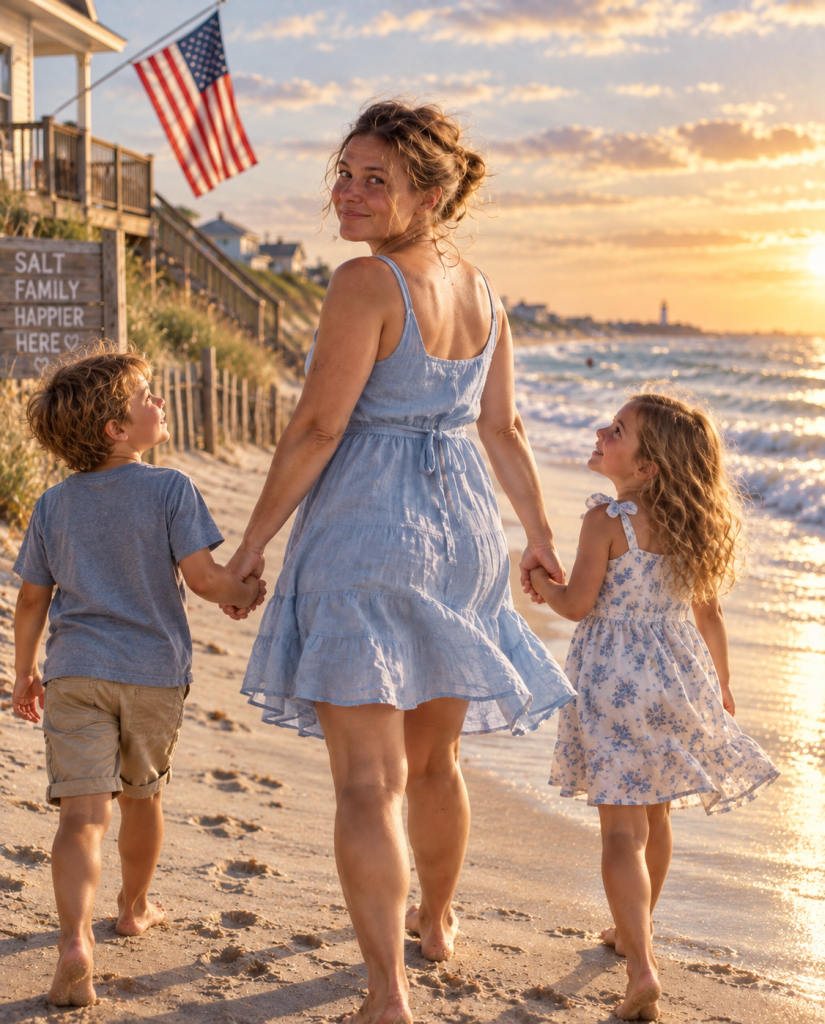
So we went.
Michael came too.
We chose an early weekday morning in September.
The beach had changed.
The old ice cream stand was gone.
The maintenance building had been replaced.
New hotels stood farther down the shoreline.
But the ocean was exactly the same.
That made me angry for reasons I couldn’t explain.
How dare the water keep moving?
How dare the sand still be warm?
How dare families still laugh beneath umbrellas where my life had once ended?
Nora stood beside me.
She slipped off her sandals.
I almost told her not to wander.
The words rose automatically.
Then I swallowed them.
Nora looked at me.
“You were going to say something.”
“No.”
“You were.”
“Maybe.”
“What?”
I hesitated.
“Nothing.”
She smiled.
“Good job.”
Then she walked toward the water.
I let her.
That was harder than it sounds.
Every step activated something inside me.
Ten feet.
Fifteen.
Twenty.
The distance between us grew.
My body remembered a sixteen-year-old girl disappearing through a crowd.
But this was not that day.
Nora turned around.
She waved.
I waved back.
She reached the water.
A wave rolled over her feet.
She jumped because it was cold.
Then she laughed.
Michael stood beside me.
“You okay?”
“No.”
“Me neither.”
We watched her.
After a while, Nora walked back.
She reached into the canvas bag she had brought.
“I have something.”
“What?”
She pulled out the turquoise cover-up.
I stared.
Police had returned it after the trial.
The fabric had faded.
The hem was frayed.
The yellow sun remained crooked.
“What are you doing with that?”
Nora looked toward the ocean.
“For years I thought about burning it.”
“You don’t have to keep it.”
“I know.”
She touched the yellow stitching.
“Then I thought maybe I’d frame it.”
“That sounds less alarming.”
She smiled.
“But I don’t want it hanging on a wall either.”
“What do you want?”
Nora held the cover-up out toward me.
“Help me.”
“With what?”
“Take the sun off.”
I stared at her.
“You’re serious?”
“Yes.”
We sat on the sand.
Nora had brought a small sewing kit.
Of course she had.
My mother would have been delighted.
I used tiny scissors to cut carefully around the yellow patch.
The stitches were surprisingly strong after all those years.
“Grandma really overdid this,” Nora said.
“She expected her repair work to survive civilization.”
“It almost did.”
Finally the crooked yellow sun came free.
Nora held it in her palm.
Then she folded the turquoise fabric.
“What are you going to do with the rest?”
“Throw it away.”
I looked at her.
“Sure?”
“Yes.”
She stood.
Walked to a trash container near the boardwalk.
Dropped the cover-up inside.
Then returned.
No ceremony.
No dramatic speech.
Just a piece of fabric she no longer needed.
But the yellow sun remained in her hand.
“What about that?”
I asked.
Nora smiled.
“Keeping it.”
“Why?”
She looked at the crooked stitches.
“Because he doesn’t get to decide what the memory means.”
My throat tightened.
Nora slipped the patch into her pocket.
We stayed on the beach for almost three hours.
We ate terrible boardwalk fries.
Michael complained about the price of parking.
Nora bought an ice cream.
That part nearly destroyed me.
She came back carrying two cones.
One for herself.
One for me.
“Chocolate?”
I asked.
“You always get chocolate.”
“You remembered?”
Nora gave me a look.
“Mom, I disappeared. I didn’t get amnesia.”
I laughed.
Then cried.
“Please stop doing that every time I remember something.”
“I’m trying.”
“You’re terrible at it.”
“I know.”
We sat on a bench.
Nora ate her ice cream.
People passed in front of us.
Children ran toward the water.
A teenage girl complained to her mother about sunscreen.
A father dragged a cooler through the sand.
Ordinary life.
For years, I thought ordinary life was something our family had lost forever.
I was wrong.
Ordinary life does not return all at once.
It comes back in pieces.
A text asking whether I have extra laundry detergent.
A forgotten birthday card.
A fight about holiday plans.
A daughter saying she is too busy for dinner on Tuesday but can come Thursday.
A phone ringing and my heart not assuming disaster.
Nora missing a call because she is in the shower.
Nora getting annoyed when I send three messages in ten minutes.
Once, about six months after she got her apartment, she didn’t answer me for four hours.
I drove there.
She opened the door wearing pajamas.
“Mom?”
“I was worried.”
“My phone died.”
“You could have—”
She stared at me.
I stopped.
“I’m sorry.”
Nora softened.
“I know why.”
I looked down.
“I’m trying.”
“I know.”
Then she held up her phone.
“Buy me a charger for every room if it makes you feel better.”
I bought seven.
She made fun of me.
She kept all seven.
Healing looked like that.
Not beautiful every day.
Not inspiring every day.
Sometimes ridiculous.
Sometimes painful.
Sometimes both.
Three years after Nora came home, she enrolled in community college.
She chose social work.
I asked whether she was sure.
She said:
“No. But normal people are allowed to be unsure about college, right?”
“Yes.”
“Then stop looking terrified.”
She eventually began volunteering with a crisis-response organization.
Not because surviving something obligated her to help anyone else.
She hated when people said that.
“You don’t have to turn trauma into a career,” she once told a reporter.
But Nora wanted to help people who had been missing from their own lives.
People without identification.
People escaping control.
People afraid no one would believe them.
Linda became part of our family.
Every year on the anniversary of the day I saw the cover-up, we met for lunch.
The first year, Linda apologized again for taking it from the donation pile.
Nora looked at her.
“Why are you apologizing?”
“If I hadn’t—”
“If you hadn’t taken it, Mom wouldn’t have seen it.”
Linda started crying.
Nora smiled.
“So technically your questionable fashion decisions saved everybody a lot of time.”
Linda threw a napkin at her.
Even Detective Ruiz came to dinner once.
She refused to discuss the case.
Michael spent twenty minutes trying to convince her that his barbecue sauce was famous.
She asked:
“Famous where?”
He said:
“In several neighborhoods.”
Nora laughed until she nearly fell out of her chair.
Those sounds became precious to me.
Not because Nora had survived.
Because she was living.
There is a difference.
Survival is staying alive long enough to reach tomorrow.
Living is complaining about the weather.
Forgetting to buy milk.
Falling in love.
Changing jobs.
Getting a parking ticket.
Laughing in restaurants.
Making plans far enough into the future that you believe you will be there to keep them.
Five years after Nora came home, she showed up at my house holding a small gift bag.
“What’s this?”
“Open it.”
Inside was a square of white fabric.
Sewn in the center was the crooked yellow sun.
Around it, Nora had embroidered three words.
SHE CAME HOME.
I couldn’t speak.
Nora sat beside me.
“I’m making a quilt.”
I touched the stitches.
“Grandma would criticize these.”
“Grandma criticized everything.”
“She called it advice.”
“She was wrong.”
I laughed.
Nora leaned her head against my shoulder.
For a while, neither of us spoke.
Then I asked something I had spent years being afraid to ask.
“Do you ever wish I hadn’t seen Linda that day?”
Nora lifted her head.
“What?”
“If you had needed more time.”
She stared at me.
“Mom.”
“I know you weren’t ready.”
“I wasn’t.”
My heart tightened.
Nora took my hand.
“But I don’t think anyone is ready to get their life back.”
I looked at her.
“You just start.”
She squeezed my fingers.
“And then you keep going.”
I looked down at the yellow sun.
A little crooked.
A little uneven.
Still holding together.
I thought of my mother sitting at the dining room table.
Nora at sixteen watching her sew.
“It looks ruined now.”
“It looks unique.”
For eight years, I believed the photograph I took that afternoon was the final picture of my daughter.
It wasn’t.
There are hundreds now.
Nora at twenty-four holding a terrible cup of hospital coffee after a long appointment.
Nora at twenty-five standing inside her first apartment surrounded by boxes.
Nora at twenty-six laughing on the beach.
Nora at twenty-seven beside Grandma’s grave holding yellow flowers.
Nora at twenty-eight graduating.
Nora at twenty-nine asleep on my couch with a book open on her chest.
Nora yesterday, standing in my kitchen, stealing strawberries before dinner.
She still hates when I take pictures.
She still raises her hand toward the camera.
“Mom.”
Click.
“Seriously.”
Click.
“Stop.”
Click.
Some things, thank God, survive.
People occasionally ask me what the strangest part of getting Nora back was.
They expect me to say recognizing the cover-up.
Or learning that Caleb had been interviewed in the original investigation.
Or discovering that the clue we searched the entire country for had spent eight years folded behind insulation, beneath floorboards, inside flour tins, wherever Nora could hide it.
But none of those things are the strangest.
The strangest thing is that hope can hurt almost as much as grief.
For eight years, hope kept me alive.
Then one afternoon, six hundred miles from the beach where my daughter disappeared, hope was suddenly standing in front of me wearing turquoise fabric.
I almost didn’t recognize it.
I thought it was coincidence.
Then the wind lifted the hem.
And I saw my mother’s crooked yellow sun.
That small repair had survived eight years.
It survived Caleb.
It survived locked rooms.
False names.
Threats.
Distance.
Fear.
It traveled almost six hundred miles.
And somehow, on one ordinary afternoon, it found me.
People like to say everything happens for a reason.
I don’t say that anymore.
There was no reason Nora was taken.
No lesson worth those eight years.
No purpose that could justify what happened.
Some terrible things are simply terrible.
But I do believe something else now.
Love leaves evidence.
Sometimes it is obvious.
Sometimes it is hidden.
Sometimes it looks like an old photograph folded inside a backpack.
Sometimes it is a letter waiting beside a dying woman’s bed.
Sometimes it is thirty-six unnecessary dinner plates in a one-bedroom apartment.
Sometimes it is seven phone chargers.
And sometimes it is six uneven stitches forming a crooked yellow sun.
Nora keeps that patch inside the quilt on her bed now.
Not hidden.
Not because she is afraid someone will take it.
Simply because she wants it there.
Last Sunday, she came over for dinner.
Michael burned the chicken.
Nora complained.
I told her to eat around it.
She stole half my dessert.
Afterward, she stood on the back porch beneath the old blue wind chimes.
They are still there.
The silver spoon is still hanging among them.
It makes an awful sound when the wind blows.
Nora touched it.
Then looked at me.
“You really never took these down?”
“Never.”
“For eight years?”
“Never.”
She shook her head.
“That must have driven you crazy.”
“It did.”
“Why keep them?”
I looked at my daughter.
Because the answer had become so simple.
“I wanted you to hear them when you came home.”
Nora’s eyes filled.
The wind moved through the porch.
Blue glass touched silver.
That ridiculous spoon rang against the chimes.
Nora closed her eyes.
For a moment, she was sixteen again.
And twenty-four.
And twenty-nine.
Every version of my daughter standing in one place.
Then she opened her eyes.
“I heard them.”
I smiled.
“I know.”
She leaned against me.
Inside, Michael shouted that the smoke detector was going off.
Nora laughed.
I laughed.
The wind chimes kept ringing.
And this time, when my daughter walked through the door ahead of me, I didn’t watch her because I was afraid she might disappear.
I watched because I could.
Because she was there.
Because she was home.
And because eight years after I watched a turquoise figure vanish into a crowded beach, a crooked yellow sun had led my daughter all the way back to me.
Not unchanged.
Not unhurt.
Not sixteen.
But alive.
Free.
And finally living under her own name again.
Nora Vance.
My daughter.
The girl who disappeared.
The woman who came home.
And this time, no one was ever going to erase her name again.
💬THE END! THANK YOU FOR READING! ❤️🙏