

So I looked at Officer Reyes.
“What do you need from me for the report?”
Dileia stared at me.
“Seriously?”
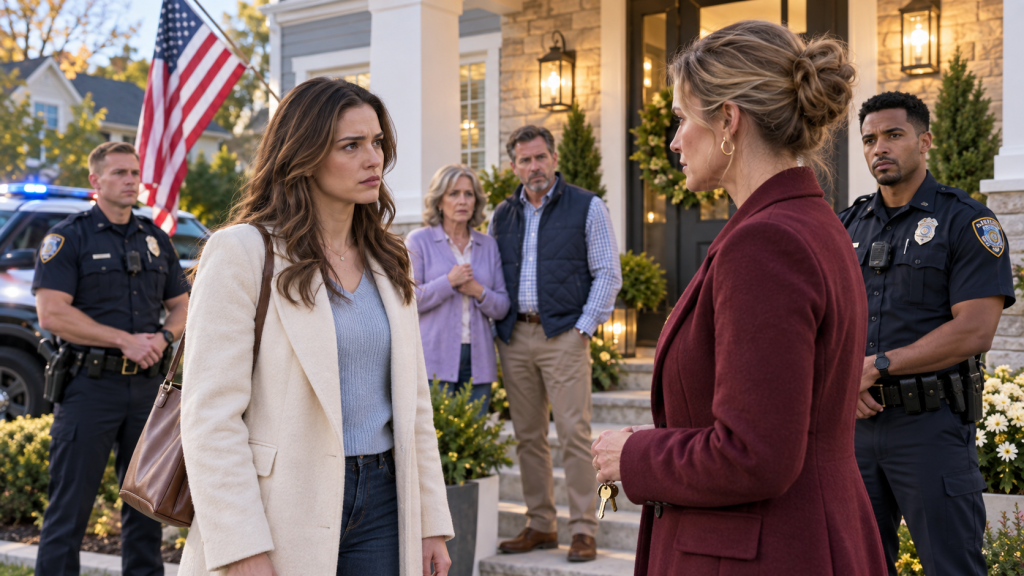
“Yes.”
“You’re going to treat me like a criminal?”
“I’m going to document what happened.”
“We’re family.”
“You remembered that after the police arrived.”
Greg and Sandra were released because they had entered in good faith believing they were attending a legitimate showing.
Before leaving, Greg emailed me screenshots of his messages with Dileia.
Sandra apologized again.
I told her not to worry.
Then the Holts drove away.
Dileia stayed.
“You embarrassed me in front of clients.”
I stared at her.
“They were not your clients for this property.”
“You know what I mean.”
“No. I don’t think I do.”
She stepped closer.
“Nothing would have happened without your signature anyway.”
That stopped me.
“What did you just say?”
She blinked.
“I said nothing could close without you.”
“So you knew you had no authority.”
“I knew eventually I’d have to bring you in.”
“Eventually?”
She sighed.
“I would’ve brought you the offer.”
“You were going to market my property, show my property, negotiate with buyers, then surprise me with paperwork?”
“You’re making it sound bad.”
“I’m describing it.”
She had no answer.
That night, I changed every exterior lock.
I changed the mailbox lock.
I changed the garage lock.
I reset the security codes.
I added alerts for every door.
Gretchen came over to help me document everything.
Before reporting the listing, we photographed it.
The price.
The description.
The posting date.
The photographs.
Dileia’s agent information.
Her brokerage.
Everything.
The listing disappeared before midnight.
It did not matter.
I had screenshots.
The next morning, I called Patricia Oay.
She remembered me.
“How’s landlord life?”
“My sister tried to sell my duplex.”
There was a long silence.
“Start from the beginning.”
I did.
When I finished, Patricia asked three questions.
“Do you have the security footage?”
“Yes.”
“Listing screenshots?”
“Yes.”
“Police report?”
“Yes.”
Then she asked, “Is your sister’s real estate license active?”
“As far as I know.”
Patricia went quiet.
“The issue isn’t whether you can prove what happened. You can. The issue is what result you want.”
That question mattered.
I did not want revenge.
I did not want Dileia homeless.
I did not want to ruin her career because I was angry.
But I also knew exactly what would happen if I let my family handle this privately.
Mom would cry.
Dad would tell us life was short.
Dileia would apologize for the “miscommunication.”
Eventually the story would become that she had simply tried to help and I had overreacted.
So I said, “I want it documented that she has no ownership interest, no authority to enter, and no authority to list, lease, advertise, sell, or represent anything involving Caldwell Street.”
“Good,” Patricia said. “That’s clear.”
She prepared a formal notice.
She also recommended that I file a complaint with Dileia’s brokerage and the state real estate regulator.
That part bothered me.
“I don’t want her life destroyed.”
“You are not deciding the outcome,” Patricia said. “You’re reporting the facts. The people responsible for licensing decide what those facts mean.”
I had barely finished reading Patricia’s draft when Mom called.
Her voice was already tense.
“Dileia told us you called the police on her.”
“She entered my property without permission.”
“She said she was showing it to buyers.”
“Yes.”
“So why didn’t you just call her?”
“Because I discovered strangers inside a property nobody in this family was supposed to know I owned.”
Mom sighed heavily.
“She made a mistake.”
“A mistake is forgetting an appointment.”
“Ranata.”
“She created a real estate listing.”
“She thought she was helping.”
“No.”
“Why do you always have to be so absolute?”
“Because ownership is absolute.”
Mom was silent.
Then she said, “Don’t destroy your sister’s career over one mistake.”
Before I could answer, Dad’s voice came from the background.
“Ask her why she hid a duplex from her own family.”
There it was.
The shift.
Dileia’s behavior was suddenly less important than my secrecy.
Dad got on the phone.
“You bought a building and never told us?”
“Yes.”
“Why?”
“Because I knew exactly what would happen.”
“What’s that supposed to mean?”
“It means everybody would immediately have ideas about what I should do with it.”
“That’s insulting.”
“It’s also happening right now.”
Mom came back on.
“We’re your family.”
“That doesn’t make you shareholders.”
She gasped.
“Ranata.”
“I’m not trying to be cruel. But this property belongs to me.”
Then Mom said something that changed the entire conversation.
“Dileia says you promised her part of it years ago.”
I went still.
“What?”
“She said you two discussed investing together.”
“No, we didn’t.”
“She said—”
“Ask her for proof.”
“Why would she lie?”
I almost laughed.
“Mom, we are having this conversation because she listed property she doesn’t own.”
Mom went quiet.
I said, “Ask her for one text. One email. One document. Anything showing that I promised her ownership.”
“She said it was verbal.”
“Of course she did.”
“Ranata, don’t talk like that.”
“I’m going to file the complaint.”
Mom inhaled sharply.
“You’re serious.”
“Yes.”
“She could lose her license.”
“That is for the commission to decide.”
“You’re choosing a building over your sister.”
“No. I’m choosing facts over a lie.”
I hung up.
Within minutes, Dileia texted.
You’re really doing this?
Then:
Mom is crying.
Then:
You always turn everything into rules and paperwork.
I stared at that message for a long time.
Rules and paperwork.
She said it like those were character flaws.
But rules were what defined ownership.
Paperwork was what stopped people from rewriting the past.
So I filed the complaint.
I attached the security footage.
The screenshots.
The police report number.
My deed.
Patricia’s letter.
Then I went to work.
Three days later, Dileia’s broker called me.
His name was Harold Kim.
“Ms. Harris, I oversee your sister’s license at our office.”
“All right.”
“We became aware that a listing was entered using our brokerage information without a valid listing agreement.”
“That’s correct.”
“I want you to know that our office did not authorize it.”
“I understand.”
“We are investigating internally.”
He sounded deeply embarrassed.
Then he said something nobody in my family had said.
“I’m sorry this happened.”
I closed my eyes.
“Thank you.”
He asked whether I would provide copies of the listing screenshots.
After checking with Patricia, I sent them.
Two days later, Dileia was suspended by the brokerage pending investigation.
That was when the family pressure became relentless.
My aunt called.
“You only have one sister.”
My cousin messaged.
Family disputes should stay private.
Dad texted in capital letters.
FAMILY SHOULD NOT DESTROY FAMILY.
I responded with one sentence.
Please ask Dileia how she got the key.
No one answered.
Then Ben called.
My downstairs tenant.
“Ranata, I think I need to tell you something.”
“What?”
“Your sister has been here before.”
The room seemed to tilt.
“When?”
“A couple times.”
“How many?”
“At least twice that I noticed.”
“Why didn’t you call me?”
“She said you sent her.”
I closed my eyes.
“What exactly did she say?”
“The first time she said she was checking upstairs for you.”
“And the second?”
“She had a guy with her.”
“What guy?”
“I don’t know. Contractor maybe. He had one of those measuring devices.”
I immediately called Gretchen.
We checked the archived security footage.
The cloud storage retained thirty days.
There she was.
Twenty-six days before the unauthorized showing.
Dileia entered alone.
She stayed fourteen minutes.
Eighteen days before the showing, she returned with a man carrying a laser measuring tool.
They went room to room.
He photographed walls.
Measured spaces.
Opened the kitchen cabinets.
This was not impulsive.
It had been planned.
I sent the clips to Patricia.
She amended our documentation.
Then Marcus called.
The agent who had helped me buy Caldwell Street sounded uneasy.
“I got a weird question.”
“About what?”
“Your duplex.”
My stomach tightened.
“From who?”
“An investor I know.”
“What did he ask?”
“Whether Caldwell Street had a title issue.”
I sat down.
“What title issue?”
“He heard there might be some off-market transfer happening.”
“What does that mean?”
“He wasn’t clear.”
“Marcus.”
“I pushed him. Apparently Dileia had talked about arranging some kind of investor deal.”
My mouth went dry.
“Did she forge anything?”
“I don’t know.”
I called Patricia immediately.
She ordered a fresh title search.
Those twenty-four hours were miserable.
I imagined forged deeds.
Fake liens.
Documents I had never seen.
Someone trying to borrow against the property.
The title search came back clean.
No unauthorized liens.
No transfers.
No competing ownership claims.
For the first time in days, I slept.
The licensing investigation continued.
Several weeks later, Patricia and I attended an interview.
The investigator asked calm, specific questions.
Had I ever hired Dileia?
No.
Had I ever discussed giving her ownership?
No.
Did she contribute to the down payment?
No.
Did she pay for renovations?
No.
Did she have permission to access the upstairs unit?
No.
Had I given her a key?
No.
Did I know how she obtained one?
“No.”
At the time, that was still the biggest mystery.
Then, about a month later, Mom called.
Her voice sounded different.
Not angry.
Not defensive.
Tired.
“Can you come here Saturday?”
“Why?”
“I found something.”
“What?”
“I don’t want to explain over the phone.”
Saturday morning, I drove to Greensboro.
Dad was sitting at the dining table.
Mom stood beside him.
Dileia was not there.
A small plastic bag sat on the table.
Inside was a brass key.
Mom pushed it toward me.
“Is that one of yours?”
I examined it.
It looked like the same type used at Caldwell Street.
“Where did you get this?”
“Dileia’s desk.”
“You searched her desk?”
“She asked me to find tax paperwork.”
Mom put down another item.
A hardware store receipt.
The date was five weeks before the showing.
Two key copies.
My stomach dropped.
Mom sat down.
“I confronted her.”
“What did she say?”
“She said you gave her permission.”
“I didn’t.”
“I know.”
“How?”
Mom looked ashamed.
“Because I remembered something.”
She rubbed her forehead.
“The weekend you stayed here after that family cookout, you left your keys in the hallway.”
I remembered.
At the time, the plumbing in my apartment building had been shut off overnight.
I had stayed with my parents.
My Caldwell Street spare key had been clipped to my key ring because I had visited the duplex before driving north.
Mom said quietly, “Dileia borrowed my car while you were showering.”
The answer became obvious.
“She took my key.”
Mom nodded.
“She admitted copying it.”
Dad stared at the table.
His jaw was tight.
“Why?” he said.
Mom looked at him.
“She said she knew Ranata had bought something in Charlotte and wanted to see it.”
I stared at them.
“She knew?”
Mom nodded.
“How?”
“She saw an email.”
“What email?”
“You had sent me an insurance document around that time. Apparently when she used my laptop, she saw an email preview with the Caldwell Street address.”
I leaned back.
“So she searched public records.”
“That’s what she says.”
I felt strangely calm.
The mystery was solved.
She had discovered the property.
Looked up the deed.
Waited until she had access to my keys.
Copied one.
Visited secretly.
Then started planning how to profit from something I owned.
Mom started crying.
“I’m sorry.”
I said nothing.
She reached for my hand.
“I should have believed you.”
“You should have believed the evidence.”
“I know.”
“No, Mom. That’s the point. This wasn’t about choosing between daughters. There were videos. A deed. A listing. Police. And somehow everyone still asked me to treat it like a misunderstanding.”
She wiped her face.
“I didn’t want to believe she would do something like that.”
“I understand.”
“But that doesn’t make it okay.”
“No.”
Dad looked at me.
“I owe you an apology too.”
I waited.
He swallowed.
“I was angry that you bought property without telling us.”
“I know.”
“I thought it meant you didn’t trust us.”
I looked at him.
“I didn’t.”
That hurt him.
I could see it.
But it was true.
“And after everything that happened,” I continued, “can you honestly tell me I was wrong?”
He looked down.
“No.”
Mom cried harder.
Normally, I would have immediately moved beside her.
I would have reassured her.
I would have softened what I had said.
I did not.
For years, I had been the person who made discomfort disappear for everyone else.
That habit was part of the problem.
Mom finally asked, “Are you going to drop the complaint?”
“No.”
She closed her eyes.
“I had to ask.”
“I’m not changing my statement. I’m not telling anyone it was a misunderstanding.”
Dad nodded slowly.
“That’s fair.”
Mom looked at him in surprise.
He continued.
“She has to deal with what she did.”
For the first time since this started, I felt like my father was standing beside me instead of between us.
The brokerage terminated Dileia several weeks later.
The state real estate commission imposed disciplinary action after its investigation.
Her license became inactive for a period, and she was required to complete additional education and satisfy conditions before returning to active practice.
I did not celebrate.
I did not post about it.
I did not tell relatives, “I told you so.”
I simply read the letter, forwarded a copy to Patricia, and filed it away.
Dileia reacted differently.
She sent me one message.
Hope your precious duplex was worth losing your sister.
I read it several times.
Then I replied.
Caldwell Street didn’t cost me my sister. Your decisions did.
After that, we did not speak for nine months.
At first, the silence hurt.
Then it became peaceful.
I rented the upstairs unit to a nurse named Simone.
She was twenty-six, worked night shifts, and wanted somewhere quiet.
Ben and Yolanda renewed downstairs.
The duplex did exactly what I had intended it to do.
The rent covered the mortgage, insurance, taxes, maintenance reserves, and left a modest monthly profit.
Nothing dramatic.
No overnight wealth.
Just steady progress.
I repaired the gutters.
Painted the exterior trim.
Replaced the garage door.
Improved the landscaping.
Every project reminded me that Caldwell Street was real.
Mine.
Not because I shouted about it.
Because I had bought it.
Nine months after our last conversation, Dileia appeared outside my apartment.
Not the duplex.
My personal apartment.
I opened the door but did not invite her inside.
She stood there holding an envelope.
“I need five minutes.”
I crossed my arms.
“You have five.”
She handed me the envelope.
Inside was a cashier’s check for $1,200.
I recognized the amount immediately.
Money she had borrowed from me three years earlier.
“What’s this?”
“Something I owe you.”
“You’ve owed it for three years.”
“I know.”
“Why now?”
She looked down.
“I’m trying to start fixing things.”
I did not respond.
She took a breath.
“I was jealous.”
That was not what I expected.
She continued.
“You were younger than me. You had the stable job. Savings. Then you bought property.”
“You didn’t know I bought it until you snooped.”
“I know.”
“So what happened?”
“I saw the Caldwell Street address in Mom’s email. I looked it up. I found your name on the deed.”
“And?”
“I got angry.”
“At me?”
“At everything.”
She rubbed her hands together.
“My real estate career wasn’t going well. I kept telling everyone I was about to have a big month, but most months I was barely covering my bills. Then I saw you had bought an entire duplex.”