

My MIL Called 911 When I Refused to Let Her Move In—Then the Officer Asked Who Owned the House At 4:17 on a Thursday afternoon, my husband texted me: “Mom’s moving in. It’s already decided.”
I was sitting at the kitchen table finishing a quarterly report when the message appeared across my screen. For a few seconds, I genuinely thought I had misunderstood it.
I read it once.
Then again.
Then a third time.
Mom’s moving in.
It’s already decided.
Not “Can we talk about Mom staying with us?”
Not “Would you be comfortable if Mom stayed for a few weeks?”
Not even “We have a problem and I need your help.”
Apparently, a decision involving my home, my office, my privacy, and potentially several months of my life had already been made.
And I had been informed after the fact.
I immediately called Mark.
He answered on the fourth ring.
“What does ‘already decided’ mean?”
There was traffic noise behind him.
He sounded distracted.
“Mom needs somewhere to stay for a while.”
“How long?”
“I don’t know. A few weeks. Maybe a couple months.”
I slowly closed my laptop.
“And when exactly were you planning to ask me?”
“Claire, come on.”
“No. I’m serious.”
“She’s my mother.”
“I know who she is.”
He sighed.
That sigh irritated me more than the text.
It was the sigh Mark used when he had already decided I was making something unnecessarily difficult.
“Her rent went up,” he said. “She hates the apartment. She’s lonely. The neighborhood isn’t great anymore. Lisa can’t take her.”
“Why not?”
“Lisa needs her spare room for work.”
I stared at the wall across from the kitchen table.
“So Lisa’s office is protected, but mine isn’t?”
There was another pause.
Then Mark said, “You’re home three days a week. We can move your desk upstairs.”
That was the moment I realized he had already chosen my office for his mother.
He hadn’t just told Diane she could stay.
They had apparently discussed where she would sleep.
Probably where her things would go.
Possibly even how long she would stay.
And somehow none of those conversations had included me.
“You already made the entire plan,” I said. “I’m just finding out what my part is.”
“You’re turning this into something it isn’t.”
“Really? What is it?”
“My mother needs help.”
“And your solution was to volunteer my house without asking me.”
“Our house.”
I looked down at my wedding ring.
That phrase landed differently than he intended.
“Our house.”
For most couples, it was affectionate.
For Mark, lately, it had become a convenient way of treating anything I owned as shared whenever he wanted access to it.
I lowered my voice.
“Call your mother before she arrives.”
“We’ll talk when I get home.”
“No. Call her now.”
Another pause.
A longer one.
Then something in my stomach tightened.
“Mark.”
“What?”
“Is she already on her way?”
Silence.
“Mark?”
The call ended.
He had hung up.
I sat there staring at my phone.
For nearly five years, I had convinced myself Mark’s worst habit was conflict avoidance.
Whenever his mother became demanding, he gave her whatever she wanted because it was easier than dealing with the consequences of saying no.
Whenever Lisa needed money, transportation, babysitting, storage space, or a favor, Mark somehow found a way to make it happen.
But until that afternoon, most of the consequences had been minor.
A canceled dinner.
A weekend interrupted.
A holiday schedule rearranged.
A loan that took months to be repaid.
I had tolerated it because marriage involved compromise.
At least that was what I told myself.
I also told myself Mark understood there were limits.
My home was one of them.
I had bought that house seven years before I met him.
It wasn’t enormous.
It wasn’t a mansion.
But it was mine.
A three-bedroom brick colonial with maple floors, a deep backyard, and a kitchen I had renovated myself after saving for almost four years.
My grandmother had left me a modest inheritance when she died.
I combined that money with savings from nearly a decade of working in corporate compliance and bought the house outright.
No mortgage.
No family loan.
No help from Mark.
When we married, I offered to add him to the deed.
He refused.
At the time, I thought it was romantic.
“Your grandmother helped you build this,” he said. “It should stay yours.”
I loved him for saying that.
Years later, I would remember those words and wonder exactly when he stopped meaning them.
At 5:11, a silver SUV pulled into the driveway.
I was standing at the front window.
Diane climbed out first.
Then Mark’s sister, Lisa.
That was when I knew this had all been arranged long before Mark sent that text.
Lisa opened the trunk.
Together they started unloading.
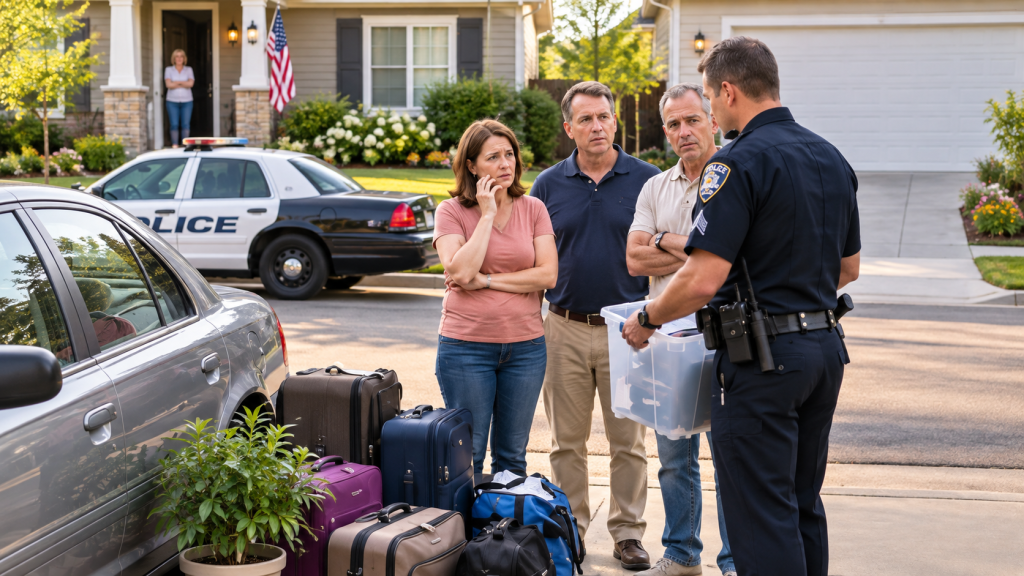
One suitcase.
Then another.
Then a third.
Storage bins.
A garment bag.
A toiletry case.
A grocery bag filled with prescription bottles.
A box labeled WINTER CLOTHES.
And, unbelievably, a peace lily.
I stared at the plant through the window.
Nobody packed a houseplant for a two-week visit.
The doorbell rang.
I opened the door.
Diane stood there smiling like she was checking into a hotel.
“Hi, sweetheart.”
“Hello, Diane.”
She glanced over my shoulder.
“Which room did Mark clear out?”
“He didn’t.”
Her smile disappeared.
Behind her, Lisa sighed dramatically.
“Oh, Claire. Don’t start.”
I looked at the mountain of luggage covering my porch.
“You two are standing here with enough stuff to relocate permanently.”
Diane frowned.
“Mark said I could stay here.”
“You’re welcome inside as a guest. You’re not moving in today.”
“My son lives here.”
“Yes.”
“Then move, sweetheart. These bags are heavy.”
I stayed exactly where I was.
“The luggage stays outside until Mark and I have an actual conversation.”
Lisa laughed.
“She’s seventy-four.”
“Yes, Lisa. Mark mentioned that. It continues to be true.”
Lisa’s expression sharpened.
Diane stepped closer.
“My son does not need permission to let his mother into his house.”
That sentence caught my attention.
His house.
Not our house.
Not the house.
His house.
There had been little comments over the years.
Diane telling friends I was “lucky Mark provided so well.”
Lisa joking that I had “married up.”
Diane once asking whether I felt guilty spending “Mark’s money” on renovating the guest bathroom.
I had corrected her that time.
She had waved it off.
I assumed she was being forgetful.
Now I wasn’t so sure.
Lisa pulled out her phone and began recording.
“What are you doing?”
“Documenting this.”
“For what?”
“In case we need proof of how you treat Mom.”
Diane folded her arms.
“Mark said I could stay here.”
“I heard you.”
“And I am his mother.”
“I also heard that.”
“You don’t seem to understand.”
“No, Diane. I understand perfectly. You believe Mark can move another adult into this house indefinitely without discussing it with me.”
“Because it’s his home.”
I almost corrected her.
Almost.
But something stopped me.
Maybe it was curiosity.
Maybe anger.
Maybe I wanted to understand exactly what Mark had been telling his family.
Diane took out her phone.
“Who are you calling?” I asked.
“911.”
Lisa looked pleased.
I genuinely thought Diane was bluffing.
She wasn’t.
I heard the dispatcher answer.
Diane raised her voice.
“Yes, hello. My daughter-in-law has locked me out of my son’s house and refuses to let me inside.”
I leaned against the doorframe.
I could have ended the argument immediately.
The deed was in the filing cabinet twenty feet behind me.
Property tax records.
Insurance paperwork.
Closing documents.
Everything.
But by that point, I wanted Mark to explain it himself.
The dispatcher apparently asked whether Diane lived at the address.
“I’m moving in today,” Diane said.
That was not the question.
The dispatcher must have repeated it.
Diane frowned.
“No, I haven’t lived here before.”
Another pause.
“Yes, my son lives here.”
Another.
“Well, his wife is being extremely hostile.”
I almost laughed.
Instead, I stepped back into the house and waited.
Lisa kept recording.
“You’re really going to make the police deal with this?”
“I didn’t call them.”
“You caused it.”
“No. Your mother called emergency services because I wouldn’t let her move into my house.”
Lisa rolled her eyes.
“You always have to control everything.”
That accusation was so absurd I actually smiled.
“Interesting choice of words.”
At 5:34, Mark’s car pulled into the driveway.
Almost at the exact same moment, a police cruiser turned onto our street.
Mark parked.
He climbed out.
Then he saw his mother.
Lisa.
The luggage.
The peace lily.
And the flashing lights.
For the first time all afternoon, he looked like he understood just how badly he had miscalculated.
He walked toward us quickly.
“What happened?”
Diane threw her hands up.
“Your wife happened.”
Officer Ruiz stepped out of the cruiser.
He appeared to be in his forties.
Calm expression.
Professional posture.
Tired eyes.
The kind of officer who had probably seen twenty family arguments more dramatic than ours before lunch.
Diane hurried toward him.
“Officer, thank goodness.”
He glanced at the luggage.
Then at the house.
“Who called?”
“I did.”
“Can you tell me what happened?”
“My daughter-in-law is refusing to let me into my son’s house.”
Lisa folded her arms.
“She’s being completely unreasonable.”
Officer Ruiz looked at me.
“Ma’am?”
“Claire Bennett. I live here.”
“Does Mrs. Bennett live at this address too?”
Diane answered before I could.
“I’m moving in today.”
Ruiz looked back at her.
“Have you ever lived here before?”
“No.”
“Do you receive mail here?”
“No, but my son told me I could stay.”
“Do you have a lease?”
“No.”
“A key?”
“No.”
He nodded slowly.
Then turned toward Mark.
“Sir?”
Mark stepped forward.
“I’m Mark Bennett.”
Officer Ruiz asked the question that changed everything.
“Do you own the property?”
It was such a simple question.
That was what made the silence so ugly.
Mark looked at me.
Then his mother.
Then Lisa.
Then Officer Ruiz.
“Claire,” he said, “can we please stop embarrassing everybody?”
There it was.
Not:
“Mom, you misunderstood.”
Not:
“Officer, the house belongs to Claire.”
Not even:
“I handled this badly.”
Apparently, I was the one embarrassing everybody.
Officer Ruiz waited.
“Sir, I still need an answer.”
Mark rubbed the back of his neck.
Then finally said:
“No.”
Diane blinked.
“What?”
Mark looked miserable.
“No. I don’t own the house.”
Lisa lowered her phone slightly.
Officer Ruiz glanced toward me.
“Who does?”
Mark swallowed.
“Claire.”
Diane stared at him.
“The deed is in Claire’s name,” he continued. “She bought it before we got married.”
The change in Diane’s face was immediate.
Confusion.
Then disbelief.
Then anger.
“You told me this was your house.”
“I said we lived here.”
“You said, ‘Come stay at my house.’”
“It’s how people talk, Mom.”
“No.”
Her voice rose.
“You let me believe you owned this place.”
Lisa turned toward her brother.
“Wait. You don’t?”
Mark snapped, “Does it matter?”
“Yes,” Diane said. “It matters!”
Officer Ruiz cleared his throat.
“Mrs. Bennett?”
He meant me.
“Yes?”
“Can you verify ownership?”
“I can.”
I stepped inside and returned with the folder.
He looked over the deed.
Then compared my ID to the name.
“That’s sufficient.”
Diane looked at the papers.
“But Mark pays the mortgage.”
I looked at her.
“There is no mortgage.”
She stared.
“What?”
“I bought the house outright.”
“With whose money?”
The question was so insulting that Officer Ruiz actually looked at her.
“With mine.”
I continued.
“My grandmother left me part of it. I saved the rest.”
Diane looked at Mark.
“You told me you were paying for this house.”
Mark’s face went red.
“I said I contribute.”
“To utilities,” I said quietly.
He looked at me sharply.
But by then I had stopped protecting him from his own lies.
It wasn’t that Mark contributed nothing.
He paid for groceries.
He covered the internet.
Some utility bills.
We split vacations.
He had purchased furniture.
He had helped with landscaping.
But he had never paid a mortgage because there wasn’t one.
He had never paid property taxes.
He had never paid homeowner’s insurance.
And until that afternoon, I had never imagined he was presenting any of that differently to his family.
Diane’s mouth tightened.
“So you’ve been letting us think you provided all this.”
“Mom—”
“You let me brag about you!”
Lisa looked uncomfortable.
Officer Ruiz stepped slightly between them.
“Ma’am, I understand this is upsetting, but this is becoming a family disagreement rather than an emergency.”
Diane pointed at me.
“She still won’t let me inside.”
Ruiz looked at me.
“Do you want her to enter?”
“As a temporary visitor tonight, yes. As a resident moving belongings into the house, no.”
Diane scoffed.
“I’m not sleeping in some hotel.”
Officer Ruiz said calmly, “Ma’am, if the homeowner doesn’t consent to you establishing residence, I can’t force her to allow it.”
“My son lives here!”
“That doesn’t override the property owner.”
Mark suddenly spoke.
“I live here too. I should be allowed to have guests.”
Officer Ruiz nodded.
“You can invite guests, depending on household agreements and applicable law. But from what I’m hearing, your mother is not attempting to visit for dinner. She arrived with belongings intending to establish residence.”
Diane gestured toward the suitcases.
“For a few months!”
I looked at Mark.
“A few months?”
He avoided my eyes.
Originally he had said weeks.
Maybe months.
Apparently Diane had already been promised months.
Officer Ruiz looked between us.