

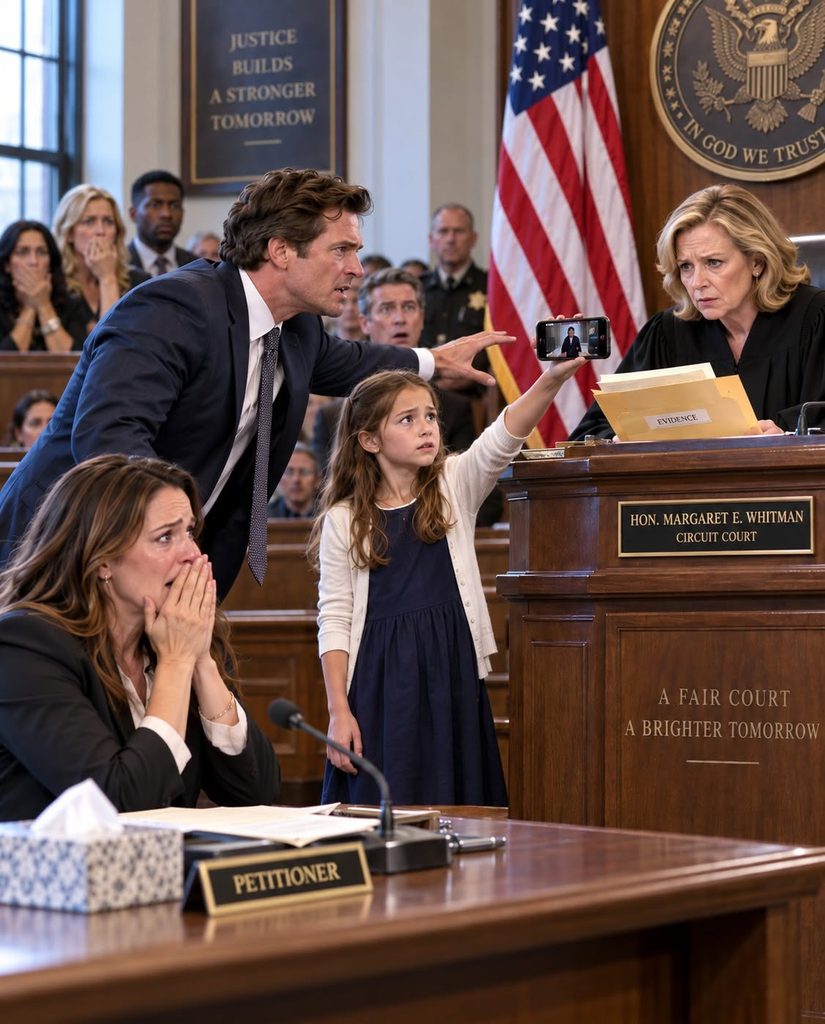
My husband stood up so quickly that his chair slammed backward into the railing behind him. For one terrifying second, nobody moved. His eyes were locked on the object in our daughter’s hands. Not on me. Not on the judge. On her. “Give me that.” His voice was low.
Almost a growl. My daughter instinctively pulled the object against her chest. That was when I finally saw what it was. A small black external hard drive.
Nothing special.
Nothing expensive.
Something you could have bought at any electronics store.
But my husband looked at it as though our ten-year-old daughter were holding a loaded weapon.
He took one step toward her.
The bailiff moved instantly.
“Sir.”
My husband stopped.
The bailiff positioned himself between my daughter and the table.
The judge’s voice became sharper.
“Mr. Bennett, sit down.”
My husband didn’t move.
His attorney whispered his name.
“Daniel.”
That was the first time I had ever heard his lawyer sound frightened.
“Sit down.”
Daniel slowly lowered himself back into his chair.
But his face had changed.
The confidence was gone.
The carefully rehearsed sadness was gone.
The concerned-husband expression he had worn through every hearing was gone.
All that remained was panic.
My daughter walked toward the judge.
Her hands were shaking.
I wanted to reach for her.
I wanted to tell her none of this was her responsibility.
I wanted to take that little black drive and throw it through the nearest window so she would never have to think about divorce lawyers, custody hearings, recordings, evidence, or adults lying again.
Instead, I stayed where I was.
Because something told me that if I interrupted her now, she might lose whatever courage had carried her this far.
She placed the hard drive on the judge’s desk.
“This was in Dad’s office.”
Daniel shot to his feet again.
“That is stolen property.”
The judge looked at him.
“Sit down.”
“She went through my private belongings.”
“Mr. Bennett.”
“My attorney needs to object to this.”
“Daniel.”
His lawyer grabbed his sleeve.
“Stop.”
The courtroom became silent.
The judge looked at my daughter.
His voice softened.
“What is on this?”
She swallowed.
“I don’t know everything.”
Daniel closed his eyes.
“But I know some of it.”
The judge leaned back.
My daughter looked toward me.
There was guilt in her face.
That hurt more than anything else.
Ten years old.
And she looked guilty for discovering something adults had hidden.
“I’m sorry, Mommy.”
I shook my head immediately.
“No.”
My voice cracked.
“You have nothing to be sorry for.”
Daniel turned toward me.
“This is exactly what I’ve been talking about.”
I stared at him.
He continued.
“She has encouraged this behavior. She has turned our daughter against me.”
I felt something inside me change.
For months, every accusation had made me defensive.
Every lie had made me desperate to explain.
Every time Daniel called me unstable, manipulative, emotional, vindictive, or controlling, I had tried to prove that I wasn’t.
I had walked into every meeting carrying explanations.
I had answered questions nobody had asked.
I had apologized for crying.
I had apologized for becoming angry when he lied.
I had apologized for raising my voice after discovering money missing from our savings account.
I had apologized for sending too many text messages when he disappeared overnight.
I had apologized for asking my own husband where he had been.
Somewhere along the way, I had become so focused on proving I wasn’t crazy that I had forgotten the simplest truth.
I knew what had happened in my own marriage.
I looked at him now.
And for once, I didn’t defend myself.
I simply said,
“Stop using her.”
Daniel’s mouth tightened.
The judge raised his hand.
“That is enough from both sides.”
Then he looked at my daughter.
“You said you know some of what is on this drive. Tell me why.”
She looked down at her shoes.
“Because we had cameras at home.”
My heart skipped.
I knew about the cameras.
Daniel had installed them two years earlier.
One faced the driveway.
One was above the back door.
Another covered the living room because we had been worried about a babysitter stealing after several things went missing.
Eventually we stopped using most of them.
Or at least I thought we had.
My daughter continued.
“Dad said the cameras didn’t work anymore.”
Daniel stared at the table.
“But sometimes the little green light was still on.”
Nobody spoke.
“I asked him about it once.”
“What did he say?” the judge asked.
“He told me not to touch them.”
“And this drive?”
“He took it out of the box in the closet.”
Daniel’s attorney closed his eyes.
My daughter pointed toward the drive.
“He put it in his office drawer.”
Daniel finally spoke.
“This is completely inappropriate.”
The judge’s eyes moved toward him.
Daniel immediately stopped.
My daughter continued.
“After Dad left the house, I went looking for my school tablet because he took it away.”
I remembered that.
About three weeks before he filed for divorce, my daughter told me she couldn’t find her tablet.
Daniel claimed she had misplaced it.
She had cried for nearly an hour because a school project was saved on it.
“I opened the drawer.”
Her voice became quieter.
“And I saw the drive.”
“What made you think it was important?”
“Because there was tape on it.”
“What did the tape say?”
My daughter looked at Daniel.
He didn’t look at her.
Then she looked at the judge.
“House.”
One word.
But Daniel flinched.
The judge noticed.
So did I.
“I plugged it into Dad’s old computer.”
Daniel’s lawyer stood.
“Your Honor, I need to make an objection regarding how any potential material was accessed and whether—”
“I understand.”
The judge held up his hand.
“We are not making a final ruling on admissibility at this second.”
He looked toward the clerk.
“We will preserve the device. Counsel will have an opportunity to address foundation, authentication, privacy, and any other appropriate issues.”
Then he looked at my daughter again.
“But I need to understand why this child believed she needed to bring it into my courtroom.”
Those words changed everything.
Not evidence.
Not strategy.
Not winning.
Why did a ten-year-old child believe she had to bring a hard drive into court?
My daughter began crying.
Quietly.
She wiped her face with the sleeve of her sweater.
“I heard Dad telling Aunt Lisa that everyone would believe him because Mom cries.”
Daniel’s sister.
Lisa.
The woman who had sat behind him during our first hearing.
The woman who had hugged me at Christmas.
The woman who texted me after Daniel filed for divorce and said:
I hope you both remember Emma comes first.
I almost laughed when I remembered it.
My daughter continued.
“He said Mom would get scared and talk too much.”
Daniel’s face had turned white.
“And he said that made her look guilty.”
My knees weakened.
For months, Daniel’s attorney had asked questions in a way that left me scrambling.
Why had I sent twenty-three messages one night?
Because Daniel had not come home.
Why had I withdrawn cash?
Because my debit card suddenly stopped working.
Why had I contacted his employer?
Because he disappeared with our joint savings and told me there had been a payroll problem.
Why had I driven to Lisa’s house?
Because my daughter called from Lisa’s bathroom crying and asking me to pick her up.
Each answer became another question.
Each question became another accusation.
Eventually I began sounding exactly the way Daniel wanted me to sound.
Frantic.
Confused.
Defensive.
Too emotional.
I looked at him across the courtroom.
He finally looked back.
And I knew.
Not suspected.
Not wondered.
Knew.
He had understood exactly what he was doing.
The judge looked toward the clerk.
“We’re going to take a recess.”
Daniel’s attorney immediately stood.
“Your Honor—”
“A recess.”
The judge’s tone left no room for argument.
He pointed toward the drive.
“The device remains with the court.”
Daniel stood again.
“I do not consent to—”
“You are not being asked to consent.”
Daniel stopped.
The judge looked at both attorneys.
“I want counsel in chambers in fifteen minutes.”
Then his expression softened as he looked at my daughter.
“And I want this child out of the middle of this.”
Those words nearly broke me.
Because that was exactly where she had been.
In the middle.
Not because I had placed her there.
Not because she wanted to be there.
Because Daniel had built the middle around her.
The judge rose.
Everyone stood.
The moment he disappeared through the door, Daniel turned toward our daughter.
“What have you done?”
His voice was barely above a whisper.
I moved before I realized I was moving.
I stepped between them.
“Do not.”
He looked at me.
“You have no idea what she has done.”
“No.”
I shook my head.
“She has no idea what you did.”
His jaw tightened.
His attorney came around the table.
“Daniel, don’t say another word.”
But Daniel wasn’t listening.
He stared over my shoulder at Emma.
“That drive has private business files on it.”
Emma started crying harder.
I turned toward her.
“Sweetheart, come here.”
She ran into me.
I wrapped both arms around her.
She buried her face against my stomach.
“I’m sorry.”
“No.”
I crouched beside her.
“Look at me.”
Her eyes were wet.
“You are not responsible for what happens between me and your father.”
“But I saw—”
“I know.”
“I didn’t want you to lose me.”
That sentence destroyed something inside me.
“What?”
She struggled to breathe through her tears.
“Dad said they might make me live with him because you were sick.”
The room disappeared around me.
I heard Daniel’s attorney whisper something.
I heard chairs moving.
I heard the bailiff open a door.
But all I could see was my daughter.
“What did he tell you?”
She looked terrified.
“He said you were sick in your head.”
Daniel spoke from behind me.
“That is not what I said.”
I stood.
I turned slowly.
Emma grabbed my hand.
Daniel’s lawyer immediately stepped between us.
“Everyone needs to stop talking.”
I didn’t scream.
I didn’t threaten him.
I didn’t give him the reaction he had been waiting months to use against me.
I simply stared at the man I had once trusted enough to sleep beside every night.
The man whose hand I had held when our daughter was born.
The man I had defended when my mother warned me his temper was getting worse.
The man I had believed every time he told me I remembered things incorrectly.
And I said,
“You told our ten-year-old daughter that her mother was mentally ill so she would be afraid of losing me.”
Daniel shook his head.
“You’re twisting this.”
For once, the words didn’t work.
I didn’t question my memory.
I didn’t wonder whether I had misunderstood.
I didn’t search his face for confirmation of reality.
I just looked down at Emma.
She was still holding my hand.
That was reality.
The bailiff approached us.
“Ma’am, there’s a conference room across the hall. You and your daughter can wait there.”
I nodded.
As we walked toward the door, Daniel called her name.
“Emma.”
She stopped.
I didn’t pull her.
I let her decide whether to turn.
She did.
Daniel stood beside his attorney.
For just a second, he looked like the man from our family photographs.
Her father.
The man who taught her to ride a bicycle.
The man who built a cardboard castle in our living room when she was six.
The man who once drove through a snowstorm because she had forgotten her stuffed rabbit at my parents’ house.
Then he said,
“You need to tell them your mother put you up to this.”
Emma stared at him.
His attorney closed his eyes.
The bailiff muttered,
“Sir.”
But my daughter answered first.
“No.”
One word.
Daniel’s expression hardened.
Emma squeezed my hand.
“Mommy didn’t even know.”
And we walked out.
The conference room smelled like old coffee and printer paper.
There was a rectangular table.
Six chairs.
A box of tissues.
A faded painting of a lighthouse hanging crooked on the wall.
Emma sat beside me.
For several minutes, neither of us spoke.
I held her hand.
She stared at our fingers.
Eventually, she whispered,
“Are you mad?”
“No.”
“Not even a little?”
I turned toward her.
“I’m worried.”
She looked down.
“I’m worried that you felt like you had to fix this.”
“I didn’t.”
“What do you mean?”
“I wasn’t trying to fix the divorce.”
She wiped her nose.
“I just wanted them to stop saying you were lying.”
That hurt in a completely different way.
I pulled her against me.
“Baby.”
“I heard Dad tell Aunt Lisa you would lose because you get confused.”
I closed my eyes.
“He said if you got mad enough, the judge would know you were crazy.”
My stomach twisted.
“When did you hear that?”
“The night before he left.”
I remembered that night.
Daniel had intentionally started an argument over our credit card.
He had accused me of spending almost four thousand dollars.
I had opened the banking app and discovered three transfers I had never made.
He told me I was imagining things.
I demanded the password to another account.
He refused.
I raised my voice.
He took out his phone.
And suddenly his entire demeanor changed.
Calm.
Measured.
Almost gentle.
“Rachel,” he had said, “you’re scaring me.”
At the time, I thought he was mocking me.
Then I noticed his phone was recording.
The next day, that fourteen-minute argument became Exhibit C in his first attorney’s letter.
Only the part where I was angry.
Not the twenty minutes before it.
Not the missing money.
Not his accusations.
Not the way he smiled when I finally lost my temper.
Only me.
Angry.
I opened my eyes.
Emma was watching me.
“Mom?”
“I’m here.”
“Are you sick?”
The question came out so softly that I almost missed it.
I felt my heart fracture.
“No.”
Then I stopped.
I didn’t want to teach her that being mentally ill would somehow make a person less worthy of love or less capable of being a parent.
So I corrected myself.
“I’ve been very stressed.”
She listened.
“I’ve cried a lot.”
She nodded.
“And sometimes I got angry.”
Another nod.
“But having feelings doesn’t mean the things your father said about me were true.”
“Dad said your doctor gave you medicine.”
There it was.
Another piece.
I had been prescribed medication for anxiety after my father died three years earlier.
I took it for six months.
Daniel knew.
Apparently, he had turned grief into evidence.
“Yes.”
I squeezed her hand.
“A doctor helped me when Grandpa died because I was having a hard time sleeping and feeling calm.”
“Does that mean you’re crazy?”
“No.”
She looked embarrassed.
“I’m sorry.”
“Don’t be sorry.”
I brushed her hair away from her face.
“Getting help when you’re hurting is not something shameful.”
She considered that.
Then she whispered,
“I think Dad wanted me to be scared of you.”
I couldn’t answer immediately.
Because saying yes would place even more weight on her.
Saying no would make her doubt what she had experienced.
So I told her the only thing I knew for certain.
“Your dad said things to you that he should never have put on your shoulders.”
She nodded.
“I still love him.”
The tears finally came.
I pulled her into my arms.
“I know.”
“I don’t want him to go to jail.”
“I know.”
“I don’t want him to hate me.”
“He shouldn’t.”
“What if he does?”
I held her tighter.
“Then that is something he will have to work through. You are the child. He is the parent.”
She cried against me.
“I wasn’t trying to hurt him.”
“I know.”
“He was hurting you.”
I closed my eyes.
For months, I had been obsessed with what Daniel was doing to me.
It had never occurred to me that Emma was watching.
Children always watch.
They see the pauses between sentences.
They hear the arguments through vents.
They notice when one parent becomes quieter.
They know when the atmosphere in a room changes before either adult raises a voice.
Emma had been watching our marriage collapse.
And while Daniel and I fought over who would be believed, she had been carrying her own version of the truth.
We stayed that way until someone knocked.
My attorney, Melissa Grant, stepped inside.
Her expression was different from anything I had seen during the case.
Not excited.
Not triumphant.
Serious.
Very serious.
“Rachel.”
I stood.
“What happened?”
She looked at Emma.
“Could I speak with your mom for a moment?”
Emma stiffened.
“No.”
The word surprised all of us.
Melissa crouched slightly.
“That’s okay.”
Emma looked at me.
“I don’t want anybody making me leave.”
“You’re not leaving.”
I sat beside her.
Melissa took the chair across from us.
“The judge has ordered the drive preserved.”
I nodded.
“Daniel’s attorney is objecting to the court reviewing anything further today without proper procedures.”
“What does that mean?”
“It means nobody is going to plug that drive into a random courtroom computer and start clicking files.”
That made sense.
“And the envelope?”
Melissa took a breath.
“The envelope is a problem for him.”
I looked at Emma.
She was listening.
Melissa chose her words carefully.
“Rachel, do you remember asking me about money missing from your joint investment account?”
“Yes.”
“How much did you think was missing?”
“About seventy thousand.”
“It appears to be more.”
My mouth went dry.
“How much?”
“We don’t know yet.”
“Melissa.”
She hesitated.
“The documents Emma brought appear to show transfers totaling approximately one hundred and eighty-six thousand dollars.”
I stared at her.
“That’s impossible.”
“It may not be.”
“Our account never had that much.”
“Not at one time.”
I felt cold.
“The transfers appear to have happened gradually.”
“To where?”
“A company.”
“What company?”
Melissa looked directly at me.
“Bennett Strategic Holdings.”
I laughed.
Not because anything was funny.
Because I had never heard the name before.
“What is that?”
“That is what we are going to find out.”
“Who owns it?”
“We have documentation showing Daniel signed organizational paperwork connected to it.”
My daughter looked confused.
“What does that mean?”
Melissa smiled gently.
“It means grown-ups are going to look very carefully at some money.”
Emma nodded.
Then Melissa turned back to me.
“There’s something else.”
Of course there was.
“There is always something else.”
“The earliest transfer we can see happened almost eleven months before Daniel filed.”
I stopped breathing.
Eleven months.
Daniel had told everyone our marriage ended suddenly.
He claimed he filed after months of emotional volatility.
He said my behavior became impossible to predict.
He said he finally made the painful decision to leave because he needed to protect Emma.
Eleven months before filing, he had already begun moving money.
“He planned it.”
Melissa didn’t answer immediately.
“We need to verify everything.”
“He planned this.”
“I understand why you’re saying that.”
“He stood in court and said he made the decision after Christmas.”
“I know.”
“He started moving money in April.”
“I know.”
Emma squeezed my hand.
That brought me back.
Melissa noticed.
“This isn’t something Emma needs to carry.”
She was right.
I wiped my face.
“What happens now?”
“The judge is considering several temporary orders.”
“About custody?”
“Yes.”
My stomach twisted.
Melissa leaned forward.
“Listen to me carefully. Today is not about punishing Daniel. The court’s immediate concern is Emma.”
I nodded.
“The judge is very concerned about what she says she was told.”
I looked at my daughter.
“And about Daniel trying to approach her after she produced the drive.”
“He wasn’t going to hurt me,” Emma said.
Melissa nodded gently.
“I understand.”
Emma looked at me.
“Dad has never hit me.”
“I know.”
“And he never hit Mom.”
Melissa remained calm.
“No one said he did.”
Emma relaxed slightly.
That mattered.
Because truth mattered even when the truth wasn’t convenient.
Daniel had never hit me.
He had never hit our daughter.
I wasn’t going to rewrite our marriage into something it wasn’t just because he had lied about other things.
What he had done was quieter.
He had manipulated.
Hidden.
Recorded.
Provoked.
Controlled information.
Moved money.
And, apparently, tried to convince our daughter that her mother was unstable.
That was enough.
The truth didn’t need embellishment.
A knock came at the door.
The bailiff appeared.
“Counsel.”
Melissa stood.
“Yes?”
“Judge wants everyone back.”
My heart started pounding again.
Emma’s fingers tightened around mine.
“Do I have to go?”
Melissa answered before I could.
“No.”
Emma looked surprised.
“The judge specifically said you do not need to come back into the courtroom.”
She looked at me.
“Will Mommy come back?”
“Yes.”
“Promise?”
I crouched beside her.
“I promise.”
Melissa arranged for a court staff member to remain nearby while Emma waited in the conference room.
Before I walked out, Emma grabbed my wrist.
“Mom.”
I turned.
“There’s another video.”
The room became still.
“What?”
“On my phone.”
I stared at her.