

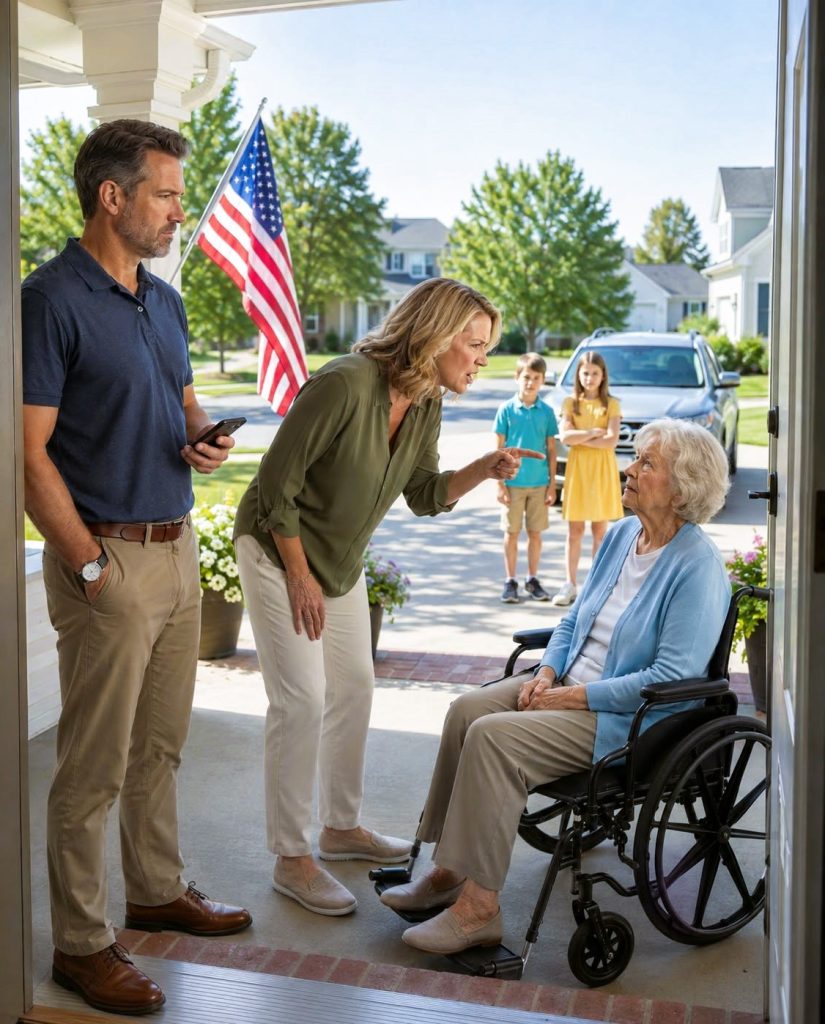
I came to my son’s house in a wheelchair, begging for a place to stay. He looked at me like I was a burden and closed the door in my face. The next morning, I found an old card that had belonged to my late husband and took it to the bank. When the manager saw it, he stood so fast his chair fell backward. “Ma’am,” he whispered, “there is something you need to see.”
Eight months after my husband, Arthur, died, I thought the hardest part of widowhood was surviving on a small Social Security check. Then one rainy afternoon, I fell outside a grocery store and broke my hip badly enough to require three surgeries and months of rehabilitation.
After that, my wheelchair became part of my life. My two story house became impossible to manage. Every bedroom, bathroom, and closet I needed was upstairs. I slept on the living room couch, washed myself at the kitchen sink, and relied on neighbors for groceries and laundry.
My son, Daniel, visited only twice after the accident. Each visit was shorter than the last. He blamed work, the children, and his busy schedule. His wife, Melissa, barely looked up from her phone and made quiet comments about how depressing my house looked.
When I finally admitted I could not live that way anymore, I called him.
“Daniel, I need help.”
“What kind of help, Mom?”
“I need somewhere to stay. Just temporarily, until I figure things out.”
He paused.
“I’ll talk to Melissa and call you back.”
He never called.
The next day, I packed a small suitcase, hired a wheelchair accessible cab, and went to his house. I hoped seeing me alone in a wheelchair would remind him that I was not asking a stranger for charity.
I was asking my son.
Daniel opened the door with irritation on his face.
“Mom, what are you doing here?”
“I came to see my family and ask for help.”
“You can’t just show up like this.”
He stepped outside and closed the door behind him. Melissa watched through the window while my grandchildren were quickly sent away before they could even speak to me.
“I can’t live in my house anymore,” I said. “I can’t climb the stairs. I only need a place for a week or two.”
“You’ll get help,” Daniel replied. “But this isn’t the answer. Melissa has dinner planned. The kids have homework. We have a routine.”
A routine that apparently had no room for his mother.
I reminded him that Arthur and I had helped him buy that very house years earlier.
“That was different,” he said. “It was a loan. We paid it back.”
He knew they had repaid only a small part of it.
Melissa came outside wearing a practiced smile.
“Helen, I wish we could help, but the children have soccer, piano, and family commitments. Besides, the guest room is being renovated.”
One glance through the doorway told me that was a lie. The guest room was perfectly intact. Fresh flowers stood beside the bed.
Daniel softened his voice as if kindness could make rejection less cruel.
“Maybe we can help you find assisted living.”
“That costs three thousand dollars a month,” I said. “I receive eight hundred.”
“There are government programs,” Melissa replied brightly. “I’m sure someone in your situation qualifies.”
Someone in my situation.
Not Daniel’s mother.
Just an old woman who belonged in someone else’s care.
I nodded and turned my wheelchair toward the cab.
“Don’t worry. I’ll figure something out.”
Daniel called after me.
“Mom, don’t be like that.”
“Like what?”
“Unrealistic.”
That word stayed with me all the way home.
That night, I lay awake on the couch and accepted what I had tried not to believe for months.
I was alone.
The following morning, I decided to clean Arthur’s old office, hoping the distraction would steady me. Most drawers held only receipts, tax forms, and forgotten papers.
Then my fingers touched an elegant business card hidden behind a folder.
The card belonged to a private banking division I had never heard of. On the back, Arthur had written an account number and four words.
Emergency access only.
I called the number.
The receptionist became silent when I read the account information. She transferred me directly to the branch manager, a man named Mr. Whitmore.
“Mrs. Callahan, do you have the original card?”
“Yes.”
“Please come to the bank today. Bring identification, your marriage certificate, and your husband’s death certificate.”
“Is something wrong?”
Another pause followed.
“I would prefer to explain in person.”
My neighbor, Ruth, drove me downtown. She had been helping me since the accident, bringing casseroles and collecting my mail without ever making me feel helpless.
When we arrived, a security guard escorted us past the regular teller counters to a private elevator. The fourth floor looked more like a quiet hotel than a bank.
Mr. Whitmore was waiting outside his office.
The moment he saw the card in my hand, he stood so quickly that his chair fell backward.
“Ma’am,” he whispered, “there is something you need to see.”
He locked the office door, lowered the blinds, and placed a thick folder on the desk.
The first page bore Arthur’s full name.
Beneath it were the words Callahan Family Trust.
The reported value was $39,842,117.
I read the number three times before looking up.
“There must be a mistake.”
“There is no mistake,” Mr. Whitmore said. “Your husband established this trust twenty seven years ago. It contains investment accounts, commercial properties, municipal bonds, and ownership interests in several companies.”
“My husband repaired elevators.”
“That was his original profession. He later patented a safety mechanism used in thousands of commercial elevator systems. He licensed the design rather than selling it. Over the years, the royalties were invested.”
I could hardly breathe.
Arthur had always lived modestly. He drove the same truck for seventeen years. He repaired our appliances himself and complained whenever I bought expensive coffee.
“Why didn’t he tell me?”
Mr. Whitmore turned to another document.
“He left instructions explaining that. Before we discuss them, I need to show you something more urgent.”
Three weeks after Arthur’s death, someone had attempted to replace me as the trust beneficiary. The request included documents supposedly signed by me, stating that I was unable to manage my affairs and voluntarily appointing Daniel as my financial representative.
The bank had rejected the request because the signature did not match the verified sample Arthur had placed on file.
The application was submitted again after my accident.
This time, it included a letter claiming I had developed dementia.
A photocopy lay on top of the file.
My hands went cold when I recognized Daniel’s signature.
“There’s more,” Mr. Whitmore said. “Yesterday, your son returned with an attorney. He demanded access to the trust and claimed you were mentally incompetent.”
Before I could answer, someone pounded on the office door.
Daniel’s angry voice echoed through the hallway.
“I know she’s in there. Open this door.”
Ruth moved beside my wheelchair and rested a hand on my shoulder.
Mr. Whitmore pressed a button beneath his desk. Two security officers arrived within seconds.
The pounding stopped, but Daniel continued shouting.
“You don’t understand. My mother is confused. She doesn’t know what she’s doing.”
I had never heard him speak about me with such confidence or contempt.
Mr. Whitmore opened the door only after security stood on either side of it.
Daniel entered with a thin man carrying a leather briefcase. Melissa followed, dressed in a cream suit and wearing the diamond earrings Arthur had given me for our thirty fifth anniversary.
I had lent them to her for a charity dinner two years earlier.
She had never returned them.
“Mom,” Daniel said, acting relieved. “Thank goodness. We’ve been worried sick.”
“Were you worried yesterday when you closed your door in my face?”
His expression tightened.
“This is exactly what I mean. You’re confused and emotional.”
Melissa stepped forward.
“Helen, you should not make financial decisions without family present.”
“I didn’t know there were financial decisions to make.”
The attorney cleared his throat.
“My name is Preston Hale. Daniel retained me because of serious concerns regarding your mental capacity.”
“Did Daniel also retain you to forge my signature?”
Mr. Hale looked at Daniel.
Daniel’s face turned pale.
“No one forged anything,” he said. “Dad wanted me to handle the family money. He told me all the time.”
“Then why am I the sole beneficiary?”
“Because he never updated the paperwork.”
Mr. Whitmore calmly closed the folder.
“Mr. Callahan, this conversation is over. Your mother is the trust beneficiary. You have no authority here.”
“She cannot even take care of herself.”
My cheeks burned, but I refused to look away.
“I asked for a temporary room, Daniel. Needing help after three surgeries does not make me incompetent.”
He leaned toward me.
“You have no idea how complicated this is. Dad’s businesses need management. Taxes need to be paid. Properties need maintenance. You’ll lose everything.”
Mr. Whitmore answered before I could.
“The trust already employs professional managers, accountants, attorneys, and property administrators. It has done so for decades.”
Daniel had no response.
Melissa’s expression changed first. Her concern disappeared, replaced by calculation.
“Helen, we should discuss this privately. We are family.”
“You remembered that quickly.”
“We were overwhelmed yesterday,” she said. “You arrived without warning. The house was chaotic.”
“The guest room looked ready.”
“We could make arrangements now,” she replied. “You can come home with us today.”
Daniel nodded eagerly.
“We’ll clear out the downstairs office. You can stay as long as you want.”
The same people who had refused me shelter when they believed I had eight hundred dollars a month were now offering me a permanent home because they had discovered I was worth nearly forty million.
I turned to Mr. Whitmore.
“Please ask them to leave.”
Daniel stared at me.
“Mom, don’t do this.”
“Yesterday you asked me to be realistic. Today I am.”
Security escorted them away.
Daniel shouted that I would regret embarrassing him. Melissa said nothing, but her eyes remained fixed on the folder until the elevator doors closed.
Once they were gone, my strength collapsed.
I covered my face with both hands.
Ruth knelt beside me.
“You are not alone,” she said. “Do you hear me? You are not alone.”
Mr. Whitmore gave me time to recover before bringing in a woman named Evelyn Shaw, the attorney Arthur had appointed as trust counsel.
Evelyn was in her sixties, with silver hair and a calm voice.
“Arthur spoke about you often,” she said.
“You knew my husband?”
“For twenty three years.”
“Then perhaps you can tell me why a man who shared everything with me hid an entire fortune.”
She opened a sealed envelope.
My name was written across the front in Arthur’s familiar handwriting.
Inside was a letter.
My dearest Helen,
If you are reading this, I am gone, and circumstances have forced you to learn what I was too afraid to explain while I was alive.
I never hid this money because I did not trust you. I hid it because I trusted you completely.
You loved me when I had nothing. You built a life with me before the patent, before the properties, and before anyone considered my work valuable. I feared that wealth would invite people into our lives who would see only numbers.
Years ago, Daniel discovered part of the truth. He was twenty four and deeply in debt. He begged me for access to the trust. I paid what he owed on the condition that he receive counseling and never gamble again.
He promised.
He broke that promise.
Since then, I have watched him become increasingly concerned with appearances, status, and money. I hoped age and fatherhood would change him. I am ashamed to say it did not.
The trust was designed to protect you. You are the only person entitled to control it. Daniel cannot access the principal without your voluntary written approval.
Do not allow guilt to become the key he uses to open the door.
You spent your life caring for others. Please spend whatever remains caring for yourself.
All my love,
Arthur