
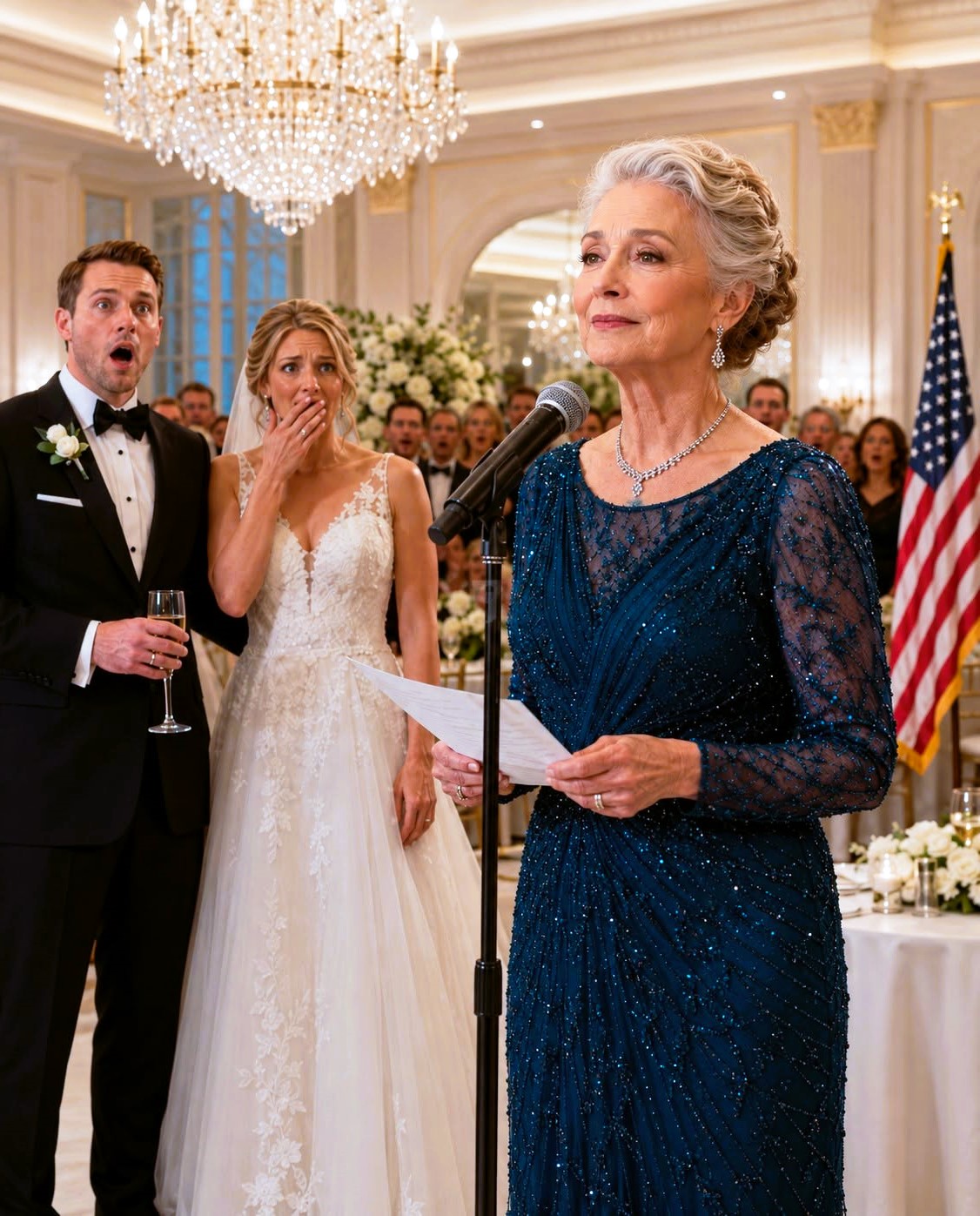
Jackson’s hands trembled during the vows.
When the officiant asked whether he took Natalie as his wife, he hesitated so briefly that I wondered whether I had imagined it.
Then he said yes.
At the reception, I remained beside Judith.
Guests complimented my navy dress and asked why I had changed my hairstyle. I gave polite answers and watched Natalie move through the ballroom like a queen receiving subjects.
During cocktail hour, I entered a quiet sitting room and overheard her speaking near the doorway.
“She shaved her own head,” Natalie told two older women. “Jackson and I are extremely concerned.”
One woman expressed sympathy.
Natalie lowered her voice.
“She has been emotionally unstable since her husband died. We may need to arrange professional care for her after the honeymoon.”
My hands went cold.
“She still controls everything,” Natalie continued. “The company shares, the properties, the family trusts. It’s becoming unsafe.”
She was no longer satisfied with humiliating me privately.
She was rewriting my identity in public before taking my son and my husband’s legacy.
That was when my restraint ended.
I stepped into an empty hallway, called my financial adviser, and stopped the transfer.
“Cancel everything,” I said.
“Eleanor, are you certain?”
“Completely.”
The adviser warned me that Jackson had already signed preliminary documents and that the bank might ask questions because of the amount.
“Tell them the donor withdrew consent.”
He promised to begin immediately.
Then I called Martin.
“Cancel the transfer,” I said. “And investigate every document Natalie or Jackson has requested involving my assets during the past year.”
Martin became quiet.
“There is something else,” he said.
“What?”
“My investigator found a file in the guesthouse office.”
The guesthouse stood behind my main residence and was often used by Jackson and Natalie when they visited. Natalie had stored wedding materials there for months.
“What kind of file?”
“A petition seeking temporary guardianship over you.”
I leaned against the wall.
Martin continued.
“The draft claims you suffer from cognitive decline, paranoia, and financial recklessness. It requests authority for Jackson to manage your personal and financial affairs.”
“Jackson?”
“His name is listed as petitioner, but the document appears to have been prepared by an attorney representing Natalie’s family.”
I closed my eyes.
“When was it created?”
“Three weeks ago.”
“Has Jackson signed it?”
“There is a signature.”
I could not answer.
“Eleanor, I need you to remain calm. The signature may be forged.”
“Or it may not.”
“We also found a letter from a physician stating that you display signs of dementia.”
“I have not been examined for dementia.”
“I know.”
“Who is the physician?”
“Dr. Samuel Keene.”
The name was unfamiliar.
Martin said the doctor worked at a private wellness clinic partially owned by Natalie’s uncle.
The plan became horrifyingly clear.
Once the $120 million transferred, Natalie intended to portray me as incompetent, place Jackson in control of my remaining assets, and remove me from the business Frank and I had built.
The shaved head was not simply cruelty.
It was part of the evidence.
Natalie would claim I had done it to myself during an episode of confusion.
My destroyed dress and missing jewelry would become examples of erratic behavior.
My anger at the wedding would be used as proof of instability.
“Bring the file,” I told Martin.
“I’m already on my way.”
When I returned to the ballroom, the chandeliers glowed above tables decorated with white roses and crystal candles.
The band played softly.
Natalie smiled as though every part of her plan had succeeded.
A young waiter approached me discreetly.
He was barely older than twenty, with nervous eyes and a trembling hand.
“Mrs. Bennett?”
“Yes?”
“My name is Daniel. I’m sorry to bother you, but I heard something.”
He glanced toward Natalie.
“She and the maid of honor were in the service corridor earlier. They were laughing about your hair.”
I waited.
“Natalie said you slept through the whole thing. She said Camille held the flashlight while she used the clippers. Then she said your money would belong to her by morning.”
“Would you repeat that to my attorney?”
His fear was obvious.
“I could lose my job.”
“You will not. And if the hotel punishes you for telling the truth, I will personally hire you.”
He nodded.
Twenty minutes later, Martin arrived with the guardianship petition, copies of the security records, and two police officers waiting discreetly in the lobby.
He did not want the officers entering until we had presented the evidence.
The maid of honor finished her speech, and the master of ceremonies announced the mother-of-the-groom toast.
The room turned toward me.
Natalie gave me one final victorious smile.
I rose with her handwritten note inside my purse, steadied my hand, and walked toward the microphone.
For a moment, I simply looked at Jackson.
He sat beside his new wife beneath an arch of white flowers. His face was tense, his champagne untouched.
I remembered the day he was born.
Frank had cried before I did. He held our son and promised that no matter how successful we became, Jackson would grow up understanding that money meant responsibility.
Somewhere along the way, we had failed to teach him that love also required courage.
I adjusted the microphone.
“When Frank and I were married,” I began, “we had less than three hundred dollars between us.”
Several guests smiled.
“We could not afford flowers, a band, or a hotel ballroom. Our reception was held behind my parents’ house. It rained, the cake collapsed, and Frank forgot half of his vows.”
Laughter moved through the room.
Jackson’s expression softened.
“But it was the happiest day of my life because I knew the man beside me respected me. I knew that whatever challenges came, we would face them without cruelty, deception, or fear.”
Natalie’s smile faded slightly.
“Today, I hoped to welcome a daughter into my family. Instead, I learned that generosity without judgment can become an invitation to exploitation.”
The ballroom fell silent.
Jackson stood halfway.
“Mom, don’t.”
I removed the folded note from my purse.
“This was left beside my bed after someone entered my home, drugged me, shaved my head, destroyed my dress, and stole my jewelry.”
Gasps spread across the room.
Natalie rose.
“She’s lying!”
I unfolded the note.
“Now you finally have the look that suits you, you ridiculous old woman. Do everyone a favor and stay home.”
Camille stared down at the table.
Natalie laughed sharply.
“That proves nothing. Anyone could have written it.”
I removed my wig.
The room erupted in shocked whispers.
Red scratches remained visible across my scalp.
“My security system shows that Natalie’s access code disarmed my alarm at 1:17 this morning. My housekeeper saw her leaving my bedroom. A hotel employee heard her boasting about what she had done.”
Daniel stepped forward from beside the service doors.
Natalie’s face changed.
“You little liar,” she hissed.
Everyone heard her.
Daniel’s voice trembled, but he continued.
“She said Mrs. Bennett slept through the haircut. She said Camille helped. She also said the money would belong to her by morning.”
All eyes turned toward Camille.
Camille began crying.
Natalie grabbed her arm.
“Don’t you say anything.”
That command was more damaging than any confession.
Jackson stared at his wife.
“Tell me he’s lying.”
Natalie looked at him.
For the first time all day, she seemed unable to produce tears.
“It was a joke,” she said.
“A joke?”
“Your mother constantly humiliates me. I wanted her to understand how it felt.”
“You drugged her.”
“I only put something mild in her tea.”
The room became completely silent.
Jackson stepped backward as though she had struck him.
“You admitted it.”
Natalie realized her mistake.
“I didn’t mean drugged. I meant Rosa probably gave her something. She takes medication.”
Rosa stood near Judith.
“No, Miss Natalie. You asked me what tea Mrs. Bennett drank before sleeping. I told you because I thought you wanted to buy her a gift.”
Natalie’s eyes darted toward the exits.
Martin stepped beside me and placed a folder on the podium.
“This,” I said, “is a draft petition seeking control over my personal and financial affairs.”
Jackson’s face drained of color.
I opened the file.
“It claims I suffer from dementia. It includes a letter from a doctor I have never met and requests that Jackson be appointed my guardian.”
I looked at my son.
“Did you sign this?”
He stared at the document.
“No.”
“Your signature appears on the final page.”
“I never saw it.”
Natalie spoke quickly.
“You signed several financial documents last month. You never read anything.”
Jackson turned toward her.
“What did you do?”
She lifted both hands.
“I was protecting us.”
“From my mother?”
“From losing everything when she became incapable of managing it.”
“I am not incapable,” I said.
Natalie’s voice sharpened.
“You are sixty-eight. You live alone. You control billions while making decisions based on feelings. Someone needed to plan ahead.”
“Planning ahead does not include forging medical evidence.”
“It would have been temporary.”
Martin addressed the guests calmly.
“The physician who signed this letter has never examined Mrs. Bennett. The petition includes false statements, a forged medical assessment, and what appears to be a falsified signature.”
Jackson pulled the paper toward himself.
He studied the signature.
Then he looked at Natalie.
“You forged my name.”
“I did it for our future.”
“Our future?”
“Yes! The company should be yours. The properties should be ours. She has had enough time.”
A horrified murmur moved through the ballroom.
Natalie seemed to hear herself only after the words had escaped.
She turned toward me.
“You were going to give us the money anyway.”
“Was.”
The single word stopped her.
“What do you mean?”
“The $120 million transfer has been canceled.”
Her face emptied.
“You can’t do that.”
“I already did.”
“You promised.”
“I changed my mind.”
“You cannot humiliate me in front of everyone and then steal our money.”
“It was never your money.”
Natalie grabbed Jackson’s sleeve.
“Tell her to fix this.”
He did not move.
“Jackson!”
He looked at her as though seeing a stranger.
“You shaved my mother’s head.”
“She was trying to destroy us.”
“You drugged her.”
“It was harmless.”
“You forged my signature.”
“You would have signed if I explained it properly.”
“You tried to have her declared incompetent.”
“So you could finally control what belongs to you!”
Jackson pulled away.
“Nothing she owns belongs to me.”
Natalie’s composure shattered.
She swept her arm across the table, sending champagne glasses and flowers crashing to the floor.
Guests screamed.
“You weak, pathetic man!” she shouted. “Do you think I spent three years pretending to adore your grieving family so I could live on your salary? You promised me a life nobody else could give me!”
Jackson stared at her.
“I promised to love you.”
“Love does not buy houses in Monaco.”
The police officers entered the ballroom.
Natalie stepped backward.
“What are they doing here?”
One officer approached her.
“Mrs. Bennett would like to report a burglary, assault, theft, and suspected fraud.”
Natalie looked at me.
“You called the police on your son’s wedding day?”
“No. I called the police on the woman who entered my home and attacked me.”
Camille suddenly stood.
“I’ll tell them everything.”
Natalie spun toward her.
“You helped me!”
“You said it would only be a prank. You said Eleanor had agreed to a makeover.”
“You held the flashlight.”
“Because you told me she had taken a sleeping pill voluntarily. I didn’t know you put something in her tea.”
The officer separated them.
Camille began describing the night in broken sentences.
Natalie had stolen clippers from the hotel spa. She used my alarm code, entered through the side door, and crushed two sleeping tablets into my tea after Rosa left the room during the rehearsal dinner preparations.
Camille admitted taking my jewelry box but insisted Natalie had told her the jewelry belonged to Jackson and was needed for wedding photographs.
Natalie denied everything even as the evidence multiplied.
The officers arrested her in front of the guests she had invited to witness her perfect day.
She screamed while they led her away.
She accused Camille, Jackson, me, the hotel, and eventually Frank, who had been dead for two years.
The ballroom doors closed behind her.
Silence followed.
Jackson stood beneath the flower arch with his wedding ring still shining on his hand.
He looked smaller than I had ever seen him.
“Mom,” he whispered.
I replaced the wig.
“Not here.”
Judith escorted me from the ballroom while Martin handled the police statements.
Outside, rain had begun falling over the city.
I sat in the back of the car and watched water run down the windows.
For the first time that day, I cried.
Not because of my hair.
Not because of the money.
I cried because my son had looked at my wounded head and chosen the easier lie.
The wedding ended without dancing, cake, or a farewell.
By midnight, photographs and videos had appeared online. Some guests posted sympathetic messages. Others spread exaggerated rumors that Natalie had attempted to poison me or steal the entire company.
Martin advised me to say nothing publicly.
The next morning, instead of transferring $120 million, I sat in a private hospital room while a doctor examined the scratches on my scalp and ordered blood tests.
The results showed traces of a prescription sedative.
The dose had not been high enough to kill me, but combined with other medication or alcohol, it could have caused serious harm.
Natalie had not known what prescriptions I took.
She had simply gambled with my life.
Police recovered my jewelry box from Camille’s car. Most pieces remained inside, although Natalie had hidden my grandmother’s pearls in her bridal suitcase.
Investigators also searched the apartment Natalie shared with Jackson.
They found copies of my financial statements, property records, company documents, and a detailed calendar tracking my routines.
There were photographs of medication bottles taken inside my bathroom.
There were notes describing incidents that could be presented as evidence of confusion.