
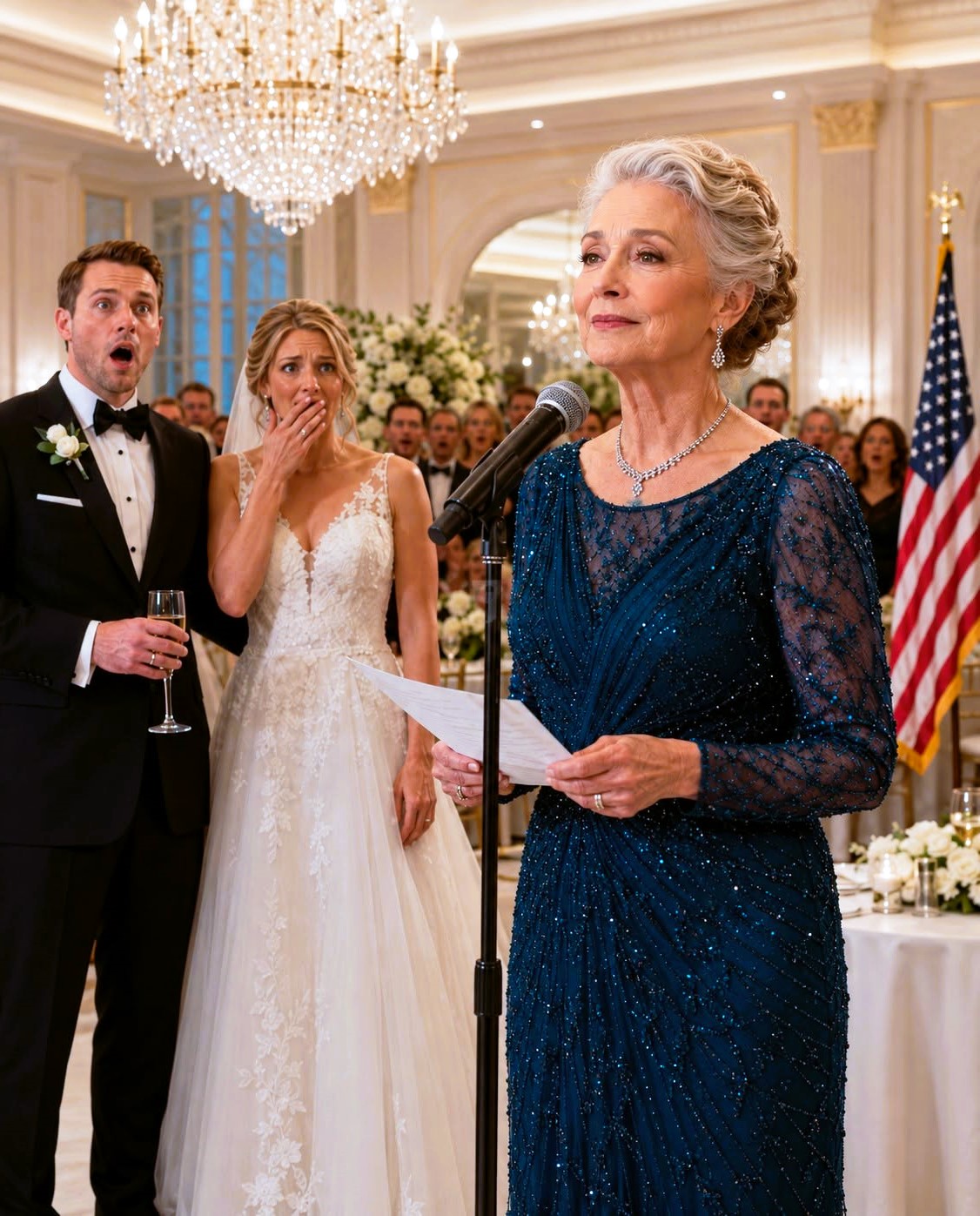
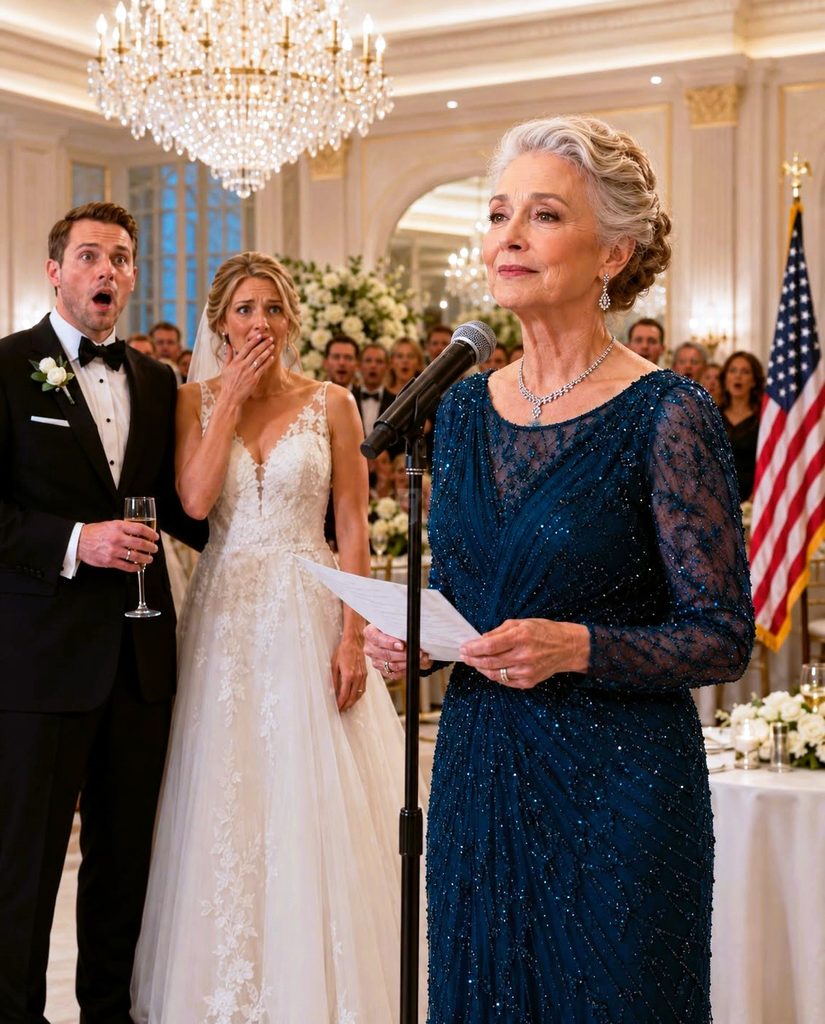
I woke up bald on my son’s wedding morning with a note from my future daughter-in-law telling me I finally looked the way an old woman should. Only hours later, I was supposed to transfer $120 million of our family inheritance to the bride and groom.
By the time the wedding toast began, however, I was no longer the one about to be humiliated. At sixty-eight, I believed I understood the difference between an uneasy feeling and a complete disaster. I had survived the death of my husband, hostile business takeovers, dishonest partners, and years when our company came so close to failure that Frank and I counted every dollar before buying groceries.
But nothing prepared me for waking on Jackson’s wedding morning, reaching for my silver hair, and touching nothing but smooth skin.
At first, my half-awake mind refused to understand what my fingers were telling me. I touched my scalp again, expecting to find the loose bun I had worn to bed. Instead, my palm slid across bare skin.
I sat upright so quickly that the room tilted.
Strands of silver hair covered the pillow and carpet. More lay beside the bed in uneven piles, as though someone had gathered them and deliberately scattered them around me.
I ran barefoot toward the bathroom mirror.
My head had been shaved entirely while I slept.
Not carefully. Not kindly.
There were small red scratches near my ears and at the base of my neck. One patch above my right temple looked irritated, as though the clippers had been pressed too hard.
I stared at my reflection and tried to remember the previous night.
After the rehearsal dinner, I had returned home shortly before ten. My housekeeper, Rosa, had left herbal tea beside my bed. I drank half of it, answered several messages from the wedding planner, and fell asleep more heavily than usual.
I remembered nothing after that.
A folded note sat on the nightstand.
I recognized Natalie’s handwriting immediately. She wrote with dramatic loops and unusually long strokes beneath her words, the kind of handwriting designed to be admired.
I unfolded the page.
“Now you finally have the look that suits you, you ridiculous old woman. Do everyone a favor and stay home.”
For several seconds, I could not breathe.
My hands began trembling so violently that the paper rattled.
Nobody attending the wedding knew what I had arranged for the following morning.
My late husband, Frank, and I had built our fortune from the ground up. We started with one struggling construction company and eventually developed commercial properties across five states. We worked together for forty-two years, raised Jackson, survived recessions, and created more wealth than either of us had imagined possible.
Before Frank died, we agreed that when Jackson married, I would give our son lasting financial security.
One hundred twenty million dollars.
The transfer was scheduled for nine the morning after the ceremony. The money would be placed into a new investment account benefiting Jackson and Natalie jointly. They planned to purchase a home, expand Jackson’s technology company, and establish what Natalie repeatedly called their “new family legacy.”
Finding her note made that promised gift feel less like generosity and more like a confession of my own foolishness.
I had genuinely tried to love Natalie.
After Frank died, Jackson buried himself in grief and work. He stopped visiting friends, ignored invitations, and rarely laughed. Then he met Natalie at a charity gala, and my son seemed alive again.
She was beautiful, polished, and charming. She remembered everyone’s name. She sent handwritten thank-you cards. She spoke about supporting children’s charities and preserving historic buildings.
During our first lunch together, she held my hand and said she hoped we could become close.
I wanted to believe her.
But small things unsettled me.
Her jokes about my age.
Her remarks about my clothing.
The way she corrected me in front of waiters.
The way her smile disappeared whenever Jackson looked away.
Every conversation eventually returned to money, property, and the luxurious life they imagined once they moved far away from me.
During the wedding planning, she dismissed my grandmother’s pearls as “funeral jewelry.” She removed Frank’s favorite dish from the menu because she said roast lamb smelled old-fashioned. She mocked our traditional family venue and insisted on the Westbrook Hotel, where the ballroom rental alone cost more than many people earned in several years.
Anything connected to Jackson’s father or our family history seemed to offend her.
The truth became impossible to ignore at the rehearsal dinner.
I had stepped into the restroom after dessert. Before leaving the stall, I heard Natalie enter with two bridesmaids.
They did not know I was there.
One woman joked that at least I was paying for the wedding.
Natalie laughed.
“There are one hundred twenty million reasons to tolerate her.”
The bridesmaids giggled.
Then Natalie said that once the money arrived, everything would change. According to her, Jackson had already agreed that they needed distance from me.
“She’ll expect weekly dinners and holiday visits,” Natalie complained. “But after the transfer, we’re moving. I refuse to spend my thirties babysitting some needy old widow.”
Another woman asked whether Jackson would really abandon me.
Natalie’s answer stayed with me all night.
“Jackson does whatever I tell him when I make him think it was his idea.”
I should have confronted him immediately.
Instead, I promised myself I would wait until after the honeymoon. I told myself the conversation might have been exaggerated. I told myself brides sometimes became stressed and said cruel things they did not mean.
By morning, my hesitation had become punishment.
After finding the note, I called Jackson.
The call went straight to voicemail.
I sent him a message explaining that something terrible had happened and that I needed him urgently.
Natalie answered from his phone.
“Jackson is preparing for his special day,” she said. “Please don’t create another crisis.”
“Another crisis?”
“You’ve been emotional for months. Maybe you should stay home rather than appear at the wedding looking for sympathy.”
I gripped the phone.
“You came into my house last night.”
She gave a soft laugh.
“I have no idea what you’re talking about.”
“My hair is gone.”
There was a pause, followed by a carefully performed gasp.
“Oh, my God. What did you do?”
The question was so calculated that it removed my final doubt.
“You know exactly what happened.”
“I know you’ve been struggling since Frank died,” she replied. “Please don’t blame me for something you did to yourself.”
Then she ended the call.
I opened my closet.
My pale-blue mother-of-the-groom dress had been cut into strips. The pieces hung from the hanger like ribbons.
My jewelry box was gone, including my grandmother’s pearls, Frank’s wedding gift to me, and a diamond bracelet that had belonged to my mother.
I checked the security records on my phone.
The alarm had been disarmed at 1:17 in the morning using the temporary code I had given Natalie months earlier when she helped organize a birthday dinner for Jackson.
The alarm had been reset at 2:06.
I called Rosa.
She answered sleepily, then became silent when I explained what had happened.
“Mrs. Bennett,” she whispered, “I saw Miss Natalie last night.”
My heart sank.
Rosa had returned after midnight because she had forgotten her medication in the kitchen. She saw Natalie’s car near the side entrance and assumed she was collecting something for the wedding.
“She told me you asked her to come,” Rosa said. “She was carrying a black bag when she left your bedroom.”
“Was she alone?”
“I think another woman waited in the car. I couldn’t see her face.”
“Why didn’t you wake me?”
“She said you had taken a sleeping pill and needed rest. I am so sorry.”
“You have nothing to apologize for.”
After ending the call, I sat on the edge of the bed, feeling every one of my sixty-eight years.
The mirror reflected someone exposed and humiliated.
For one terrible moment, I considered staying home. I imagined the whispers, the cameras, and Natalie’s friends staring at my bare head.
Then something inside me shifted.
I had built a business.
I had buried the man I loved.
I had survived everything life had placed before me.
I would not allow a woman who confused kindness with weakness to erase me.
I called my sister, Judith.
Then I called my attorney, Martin Hale.
Judith arrived first, carrying a silver wig, a navy dress, and enough strength for both of us.
She took one look at my head and began crying.
I did not.
Not anymore.
While she helped me dress, Martin arrived with his associate and a private investigator who had worked for our company for years.
Martin read Natalie’s note twice.
“Do not give this to anyone,” he said. “Place it in an envelope. We’ll document everything.”
He photographed my scalp, the destroyed dress, the missing jewelry box, and the hair scattered across the room. He downloaded the security records and took a statement from Rosa.
Then he asked whether I still intended to transfer the money.
“I don’t know,” I admitted.
Martin studied me.
“You do know. You simply haven’t accepted your answer yet.”
The drive to the Westbrook Hotel passed in silence.
Judith held my hand while the city moved outside the car windows. My navy dress was elegant but severe. The silver wig matched the hair Natalie had stolen from me so closely that, from a distance, nobody would notice the difference.
But I noticed.
Every time the wig touched the scratches on my scalp, I remembered waking beneath those piles of hair.
At the hotel, I found Jackson in a private suite with his groomsmen.
He looked painfully similar to his father.
The same dark eyes. The same nervous habit of adjusting his cuff links when frightened. For one second, I saw him at eight years old, standing beside Frank at a company picnic.
Then he looked at my dress.
“What happened to the blue one?”
“We need to speak privately.”
His expression tightened.
“Mom, the ceremony starts in forty minutes.”
“This cannot wait.”
The groomsmen left reluctantly.
When we were alone, I locked the door and removed my wig.
Jackson stared at me.
His face lost its color.
“What happened?”
“Natalie entered my house while I was sleeping, drugged me, shaved my head, destroyed my dress, and stole my jewelry.”
He stepped backward.
“No.”
I showed him the note.
He read it quickly, then read it again.
“This isn’t possible.”
“It is her handwriting.”
“Someone could have copied it.”
“The security system records her code.”
“She may have gone there for something else.”
“Rosa saw her leaving my bedroom.”
His jaw tightened.
“You’re accusing the woman I’m marrying of drugging you?”
“I’m telling you what happened.”
He began pacing.
“This is insane. Natalie wouldn’t do this.”
“She did.”
“You’ve disliked her from the beginning.”
“I tried to welcome her.”
“You criticized everything she chose for the wedding.”
“I paid for everything she chose.”
“That doesn’t give you the right to control us.”
The accusation stunned me.
“This is not about control. Look at me.”
“I am looking at you!”
“Then see me.”
He turned away.
Before I could say anything else, the door opened.
Natalie entered in a white satin robe, followed by her maid of honor, Camille.
She stopped dramatically when she saw my bare head.
“Oh, Eleanor,” she whispered. “What have you done to your hair?”
I held up the note.
“You already know.”
Her eyes moved toward Jackson.
“This is exactly what I warned you about.”
“Warned him about what?”
Natalie’s lower lip trembled.
“That you would do something extreme to stop the wedding.”
I looked at Jackson.
He would not meet my eyes.
Natalie approached him slowly.
“Last week she told me nobody could replace Frank in this family,” she said. “She said marriage would take you away from her.”
“I never said that.”
“You called me a gold digger.”
“I asked whether you loved my son or his inheritance.”
Jackson flinched.
Natalie began crying.
Camille moved beside her protectively.
“Mrs. Bennett, this is cruel,” Camille said.
I turned to Jackson.
“Did Natalie tell you she entered my house last night?”
“She said she went to collect your grandmother’s pearls because you promised she could wear them.”
“I did not.”
Natalie lifted her chin.
“You forget things.”
The room became very still.
“What did you say?”
“You’ve been forgetting things for months. We’ve all noticed.”
Jackson finally looked at me.
His expression contained fear, pity, and anger.
That was when I understood what Natalie had been doing.
She had not merely been insulting me behind my back.
She had been preparing him to doubt me.
Every misplaced appointment, every misunderstanding, every story about my supposed emotional instability had been carefully planted.
Natalie touched Jackson’s arm.
“Your mother needs help. But this is our wedding day. We can’t allow her condition to destroy it.”
“My condition?” I asked.
Jackson rubbed his forehead.
“Mom, please put the wig back on. We’ll discuss everything tomorrow.”
“The money transfers tomorrow.”
His eyes flickered.
Only for a second.
But I saw it.
“So that is what this is about,” I said.
“No.”
“Then tell Natalie the transfer is postponed while we investigate.”
Natalie’s tears stopped.
Her expression hardened before softening again.
“You promised us.”
“I promised my son security. I did not promise you ownership of my life.”
Jackson’s voice rose.
“You can’t threaten us every time you feel ignored.”
“I was attacked in my own bed.”
“And you’re choosing today to make accusations!”
That hurt more than losing my hair.
I replaced the wig carefully.
“You have made your choice,” I said.
Then I opened the door and walked out.
The ceremony passed in a blur.
Hundreds of white flowers surrounded the ballroom chapel. A string quartet played while guests turned toward Natalie’s entrance.
She walked down the aisle smiling beneath a cathedral-length veil.
Nobody looking at her would have imagined that she had stood beside my son less than an hour earlier and called me unstable.