

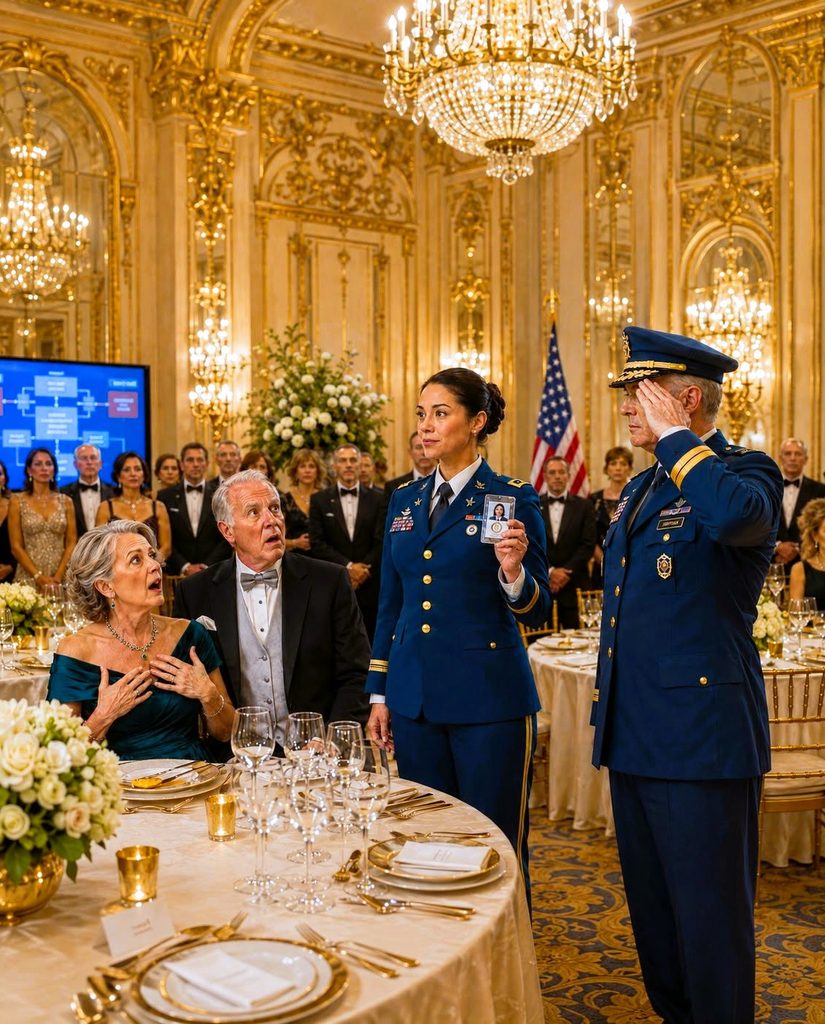
My parents had ignored me for years. But the moment my father saw a photograph of me stepping out of a $78,000 Tesla, he suddenly wanted a “family meeting.” He thought he was about to shame the daughter he had always treated like a failure.
He had no idea that by the end of the night, his spotless reputation, my brother-in-law’s hidden crimes, and every lie our family had protected for decades would collapse in front of the very people they had spent their lives trying to impress.
Four days before the meeting, an Atlanta business magazine published a photograph of me arriving at a national cybersecurity conference.
I was stepping out of my Tesla in a dark government coat, my hair pinned into a regulation bun, answering a secure call from Washington.
The caption identified me only as Colonel Ava Lane, a Department of Defense cybersecurity adviser.
It did not mention the Whitmore family.
That omission was intentional.
For years, my parents had treated my accomplishments as embarrassing inconveniences. When I graduated from West Point, they did not attend because my older sister, Marissa, was hosting an engagement party that same weekend.
When I was promoted to major, my mother sent me a text asking whether military women were allowed to wear attractive clothes.
When I became a colonel, my father told one of his church elders that I “worked with computers somewhere near the Pentagon.”
He never asked what I did.
He never asked where I had served.
He never asked why I sometimes woke in the middle of the night unable to breathe.
My family preferred stories in which Marissa was the successful daughter and I was the stubborn disappointment who had run away to join the Army.
Then the photograph appeared.
Two hours after it was published, my father called.
“Ava,” Reverend Charles Whitmore said without greeting me, “I saw something interesting online.”
There was no pride in his voice.
Only suspicion dressed as concern.
“We’re having a family meeting tomorrow evening,” he continued. “Your mother has questions about where your money came from.”
My father had ignored me for years. Now he wanted answers because I looked successful.
“Where?” I asked.
“The Oakwood Legacy Club. Seven o’clock.”
The Oakwood Legacy Club was not a place our family used for private conversations. It was an exclusive venue where my father entertained donors, politicians, business owners, and members of his church board.
If he had invited me there, he was not planning a family meeting.
He was planning a public humiliation.
“I’ll be there,” I said.
He paused, apparently surprised that I had agreed so easily.
“Wear something appropriate,” he added. “Your mother will send you suggestions.”
He hung up before I could answer.
A minute later, my phone buzzed.
My mother had sent photographs of three designer dresses, each more expensive and uncomfortable-looking than the last.
Beneath them, she wrote, “Please try not to embarrass us.”
I stared at the message for several seconds.
Then I forwarded it to Brigadier General Nora Pierce.
Her reply came immediately.
“Wear the uniform under your coat.”
The next evening, I arrived at the Oakwood Legacy Club at exactly 6:55.
My Tesla rolled beneath the entrance canopy, and a valet hurried to open my door.
My older sister, Marissa, and her husband, Blake Harrington, were waiting outside.
Marissa wore a pale blue gown and enough diamonds to finance a small military unit. Her blond hair was twisted into an elaborate knot, and her smile looked as carefully arranged as the flowers beside the entrance.
Blake stood next to her in a tailored tuxedo.
“So the Tesla really belongs to you?” he asked with a smug smile.
“That’s right.”
He walked around the car as though inspecting stolen property.
“Seventy-eight thousand dollars,” he said. “That’s a lot of money for a government employee.”
“I saved for it.”
He laughed.
“People who suddenly come into money usually make bad decisions.”
If only he knew.
For months, federal investigators had been quietly studying his finances.
Gambling debts.
Shell companies.
Falsified investment statements.
Suspicious transfers disguised as charitable donations.
I already knew far more about his life than he realized.
Marissa touched my coat sleeve.
“Mom told you to wear the green dress.”
“I’m comfortable.”
“You look like you’re going to a funeral.”
I looked past her toward the ballroom doors.
“Maybe I am.”
She frowned, but Blake laughed as if I had made a joke.
Inside, my mother, Celeste, greeted me with the same cold smile I remembered from childhood.
“What are you wearing?” she whispered.
“A coat.”
“I can see that. Take it off.”
“No.”
Her mouth tightened.
“Ava, there are important people here tonight.”
“There usually are when Dad wants witnesses.”
She glanced around quickly to make sure no one had heard.
“This meeting is for your own good.”
“Of course it is.”
“Your father is concerned. You disappeared for years, refused to discuss your finances, and now photographs of you with an expensive car are circulating online.”
“I didn’t disappear. You stopped calling.”
“That isn’t fair.”
Fairness had never survived long in our family.
When Marissa wanted dance lessons, my parents paid for private instruction.
When I wanted to join the science club, my father said the membership fee was wasteful.
When Marissa failed a college course, my mother blamed the professor.
When I earned a military scholarship, they accused me of choosing a dangerous career simply to embarrass them.
In our family, appearances mattered more than truth.
Then my father arrived, greeting donors with the polished smile that had made him famous as a respected pastor.
Reverend Charles Whitmore had built his reputation on sermons about honesty, sacrifice, and family values.
His church broadcasts reached hundreds of thousands of people.
His foundation funded food drives, scholarship programs, housing projects, and international missions.
At least, that was what the brochures claimed.
“There she is,” he announced, placing a hand on my shoulder. “My youngest daughter works with computers for the government.”
Computers.
That was all he thought I did.
He did not know that I had helped defend military networks during overseas operations.
He did not know that I advised federal agencies on cyberattacks targeting critical infrastructure.
He did not know that I had spent the previous eighteen months assisting a joint task force investigating one of the largest charitable fraud networks in Georgia.
And he certainly did not know that the trail led directly to his favorite son-in-law.
Dinner began with speeches about honesty, family, and integrity.
Listening to my father preach those words almost made me laugh.
He stood at the center of the ballroom beneath a gold chandelier, surrounded by donors who trusted him.
At the nearest table sat state legislators, real-estate developers, church elders, and local television hosts.
Several people greeted Blake warmly.
He shook hands, posed for photographs, and joked about an upcoming charity golf tournament.
No one seemed to notice that he checked his phone every thirty seconds.
No one except me.
At 8:10, my father called me onto the stage.
“Many of you saw Ava’s photograph this week,” he said into the microphone. “As parents, we were surprised.”
A few guests smiled politely.
My mother lowered her eyes in rehearsed embarrassment.
“Military service is honorable,” my father continued. “But sudden displays of wealth naturally create questions. Our family believes in accountability.”
There it was.
The trap.
He intended to imply that I had stolen money or accepted bribes. He would present himself as a courageous father demanding honesty from his wayward daughter.
Every eye turned toward me.
Exactly what he wanted.
He expected me to defend myself.
Instead, I walked onto the stage and took the microphone.
“I’ll answer that,” I said. “But first, Dad, I have one question for you.”
His smile faded slightly.
“When did you first learn that the Whitmore Legacy Foundation received millions of dollars through organizations connected to Blake Harrington?”
The ballroom fell silent.
Blake shot to his feet.
“What are you talking about?”
Before anyone could answer, the screen behind me lit up.
Financial records appeared.
Shell companies.
Transfer diagrams.
Account numbers.
Money trails.
One chart showed charitable donations entering the Whitmore Legacy Foundation, moving through construction contractors controlled by Blake, and disappearing into private accounts in the Cayman Islands.
Another showed church money paying inflated consulting fees to businesses that had no employees, no offices, and no legitimate operations.
My father stared at the screen.
“What is this?” he demanded.
“Your accountability meeting.”
Blake moved toward the stage.
“Turn that off.”
Then the ballroom doors opened.
Two federal agents entered, followed by an assistant United States attorney and my commanding officer in full Army dress uniform.
Brigadier General Nora Pierce stopped beside the stage.
“Colonel Lane,” she said.
My mother froze.
My sister’s mouth fell open.
Blake went white.
I removed my military identification from my purse and held it up.
General Pierce faced the room.
“Colonel Lane is not under investigation,” she said. “She has been assisting a federal task force examining cyber-enabled fraud, money laundering, and theft involving defense contractors and charitable organizations.”
Whispers raced across the ballroom.
My father gripped the podium.
“This is a misunderstanding,” he said. “Our foundation helps families.”
Assistant United States Attorney Marcus Reed opened a folder.
“Then perhaps you can explain why more than three million dollars passed through accounts controlled by your son-in-law before reaching your ministry.”
Blake rushed toward the nearest exit, but the agents blocked him.
One calmly instructed him to step away from the door.
Marissa began crying.
“Ava, stop this,” she pleaded. “You’re humiliating us.”
I looked at my sister.
I remembered every birthday she had forgotten, every achievement she had mocked, and every time she had defended Blake while calling me jealous.
“I didn’t create this,” I said. “I only stopped protecting it.”
Then the screen changed.
A scanned ledger appeared in my mother’s handwriting.
Beside several transfers were the initials C.W.
Celeste Whitmore.
My mother’s face drained of color.
My father slowly turned toward her.
“What did you do?”
Before she could answer, an elderly donor named Harold Mercer stood from his table.
He held a folded statement in one trembling hand.
“My retirement savings disappeared after I invested through Blake,” he said. “He told me the foundation guaranteed the project.”
Several other guests stood.
A widow said she had lost the insurance money her husband left her.
A business owner said Blake had convinced him to invest in a housing development that was never built.
A former church employee shouted that she had been fired after questioning invoices.
The polished gathering disintegrated into anger and confusion.
My father struck the podium with his palm.
“Everyone, please sit down.”
No one listened.
For the first time in his life, Charles Whitmore could not control the room.
Blake pointed at me.
“She hacked us!”
Agent Daniel Kim stepped forward.
“Colonel Lane did not obtain these records illegally. They were recovered through warrants, subpoenas, cooperating witnesses, and court-authorized forensic examinations.”
Blake’s expression changed.
He had expected to dismiss the evidence as a family dispute.
Now he understood that this was larger than me.
Agent Kim held out his hand.
“Mr. Harrington, please turn around.”
Marissa screamed.
“You can’t arrest my husband in front of everyone!”
Blake looked toward my father.
“Charles, tell them.”
My father stared back at him.
Something unspoken passed between them.
Fear.
Recognition.
And betrayal.
That single look told me what months of investigation had not yet proven.
My father knew more than he had admitted.
Blake saw the realization on my face.
“You said she didn’t know anything,” he snapped.
My father’s shoulders stiffened.
The ballroom became silent again.
I stepped closer.
“What exactly did Dad say I didn’t know?”
Blake’s mouth opened, but my mother interrupted.
“Don’t.”
It was not a plea to me.
It was a warning to Blake.
He laughed bitterly.
“So now you want me quiet?”
Agent Kim took Blake by the arm.
Blake pulled away.
“Ask your perfect father who approved the transfers,” he shouted. “Ask him who told me which accounts to use.”
My father’s face hardened.
“You are confused and frightened.”
“No, Charles. I’m finished taking the blame for your family.”
Marissa stared at her husband.
“What are you saying?”
Blake looked at her, and for the first time that night, his arrogance disappeared.
“I’m saying your parents knew.”
My mother sank into a chair.
My father reached for the microphone, but General Pierce removed it from the stand before he could speak.
“You will have an opportunity to answer questions in the appropriate setting,” she said.
“This is my event,” he snapped.
“Not anymore.”
The federal agents placed Blake under arrest.
As they guided him toward the doors, donors backed away from him as though dishonesty were contagious.
Marissa followed, sobbing and demanding to accompany him.
He did not look back at her.
At the doorway, he turned toward my father.
“You promised the foundation would protect us.”
The agents led him away.
The ballroom erupted.
Reporters who had been invited to cover the charity dinner rushed toward the stage.
Camera flashes exploded.
Church elders surrounded my father.
Donors demanded their money.
My mother remained motionless, staring at the ledger projected behind her.
Then my father looked at me with pure hatred.
“You did this,” he said.
“No. You did.”
“You brought federal agents into a private family matter.”
“Fraud involving millions of dollars isn’t a private family matter.”
He stepped closer.
“You have always wanted to destroy us.”
That accusation struck a place inside me that I had spent years learning to protect.
When I was twelve, I discovered that my father had used money from my college account to pay for Marissa’s private school.
When I confronted him, he called me selfish.
When I was seventeen, one of his church associates cornered me in an office after a youth event. I escaped before anything worse happened, but when I told my parents, they warned me not to ruin a good man’s reputation.
When I left for West Point, my father told everyone I had been rebellious and unstable.
For years, I wondered whether they were right.
Maybe I was difficult.
Maybe I was ungrateful.