
 Reading Time: 21 minutes
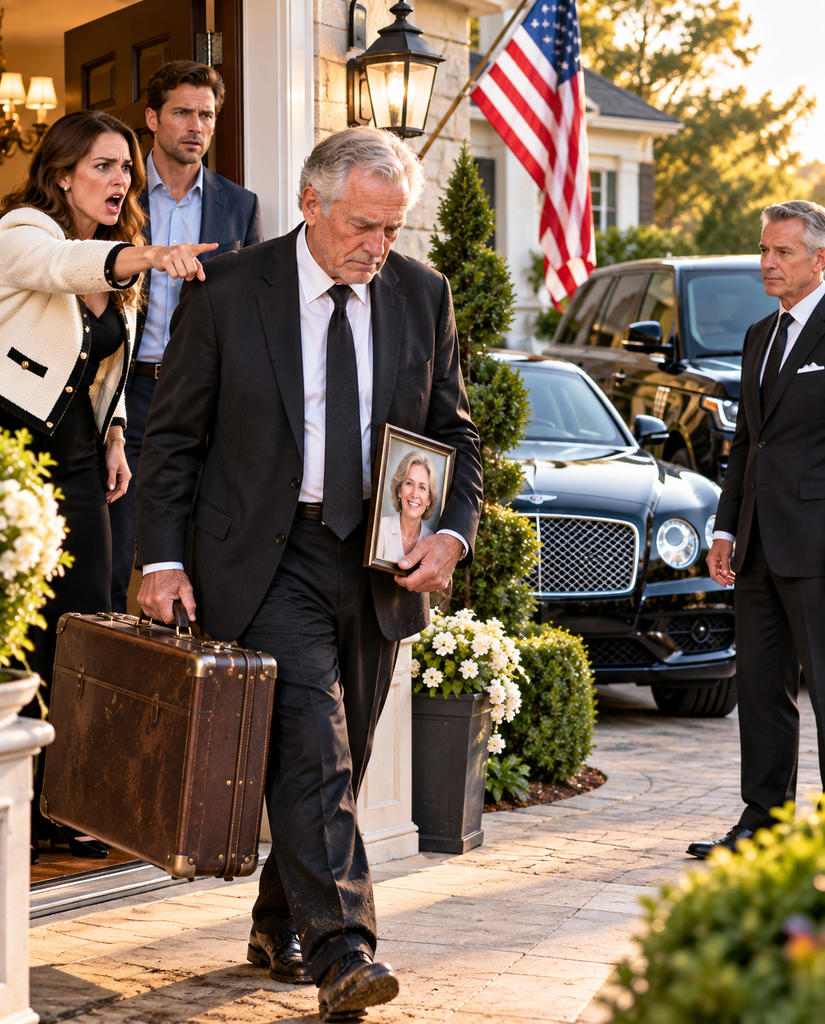
The dirt from my wife’s grave was still on my shoes when my daughter-in-law pointed toward the front door and said, “You’ve never paid for anything in this family. Pack your bags and get out.”
For a moment, I thought grief had made me hear her wrong. We had buried Eleanor less than an hour earlier. The black tie around my neck still felt too tight.
My hands still smelled faintly of damp earth because, after the cemetery workers lowered her casket, I had knelt beside the grave and pressed my fingers into the soil.
I don’t know why.
Maybe I needed to touch the last place she would ever be.
Maybe I needed proof that the woman I had loved for forty-six years was truly gone.
Whatever the reason, I had barely stepped back inside the house when Madison decided it was time to throw me out.
My name is Thomas Hale.
I was sixty-eight years old, recently widowed, exhausted, and apparently much easier to underestimate than I had realized.
My son, Eric, stood near the fireplace staring at the hardwood floor.
Madison stood a few feet away with her arms crossed.
She was still wearing the black dress she had worn to Eleanor’s funeral, though she had already kicked off her heels and replaced them with slippers.
The transformation bothered me more than it should have.
Eleanor had been buried less than an hour earlier, and Madison had somehow already moved on to housekeeping.
“Madison,” Eric said quietly, “not today.”
“Especially today,” she snapped.
Eric looked at her.
She lowered her voice only slightly.
“We’ve talked about this.”
I watched my son’s face.
He looked older than his forty-two years.
He also looked ashamed.
But he did not tell her to stop.
Madison turned back to me.
“I’m not trying to be cruel, Thomas.”
Whenever someone begins a sentence that way, cruelty is usually exactly what comes next.
She continued.
“But Eleanor was the reason we tolerated this arrangement.”
Tolerated.
That word stuck somewhere deep inside me.
For twelve years, Eleanor and I had lived in the guest wing of that house.
At least, that was what Madison called it.
“The guest wing.”
In reality, it was a spacious two-bedroom suite on the first floor with a small sitting room and its own garden entrance.
When Eric’s construction business nearly collapsed twelve years earlier, Eleanor and I had stepped in quietly.
We bought the house through one of my holding companies.
We paid the mortgage.
We paid the insurance.
We paid the property taxes.
When the roof needed replacing, I paid for that too.
When Eric’s company was short on payroll, I made a “private loan” through another corporation and never asked for repayment.
Madison knew none of that.
She believed Eric had bought the house himself during what she proudly described as “his first successful year.”
She told friends that she and Eric had taken in his aging parents because “family takes care of family.”
Sometimes, at dinner parties, she would pat Eleanor’s arm and say, “We’d never put them in some facility.”
Eleanor always smiled.
I usually looked down at my plate.
Afterward, I would ask my wife why she allowed Madison to talk that way.
Eleanor always gave me the same answer.
“For Eric.”
She loved our son with a kind of hope I had long since lost.
“He’s trying, Tom.”
“He lies to her.”
“He’s embarrassed.”
“He should be embarrassed.”
“Maybe. But embarrassing him more won’t make him stronger.”
That was Eleanor.
She could find compassion in places I found only frustration.
So I stayed quiet.
For twelve years.
Even when Madison complained about grocery costs.
Even when she joked about “supporting two retirees.”
Even when she suggested Eleanor stop buying a certain brand of coffee because “it adds up.”
I said nothing.
Not because I was weak.
Because my wife asked me to preserve the peace.
And if Eleanor asked me for peace, I gave it to her.
Until she died.
Madison tapped one manicured finger against her opposite arm.
“So?” she said.
I looked at her.
“So what?”
“When can you be out?”
Eric finally raised his head.
“Madison.”
“What?”
“He just buried Mom.”
“I know that.”
“Then act like it.”
Madison laughed once, sharply.
“Oh, don’t start pretending I’m some monster. We’ve all been dealing with this for years.”
Dealing with us.
I almost smiled.
It was extraordinary how little some people understood about the ground beneath their own feet.
I looked around the living room.
The stone fireplace had been installed with money from one of my accounts.
The painting above it had belonged to Eleanor’s mother.
The piano near the windows was Eleanor’s.
The Persian rug was mine.
The house itself was legally owned by a company whose sole beneficiary was me.
And Madison was standing in the middle of it telling me I had never paid for anything.
“I’ll pack,” I said.
Eric stared at me.
“Dad.”
I met his eyes.
“You heard your wife.”
“She’s upset.”
“No,” Madison said. “I’m very clear.”
That settled it.
I walked down the hallway to the guest wing.
I could hear Eric and Madison arguing behind me.
His voice stayed low.
Hers did not.
“You always do this!”
“Do what?”
“Make me the bad guy because you’re too weak to make a decision!”
“My mother died today!”
“And I’m sorry, Eric, but life doesn’t stop!”
I closed the bedroom door behind me.
For the first time that day, I was alone.
Eleanor’s cardigan was still hanging over the back of the chair.
Her reading glasses rested on the nightstand.
A half-finished crossword puzzle sat beside them.
The sight of those glasses broke me more than the funeral had.
I sat on the edge of the bed and held them in my hands.
For forty-six years, there had always been an Eleanor-shaped presence in every room.
A hum in the kitchen.
A book left open.
A cup of tea cooling on a table.
A voice asking whether I remembered to call the accountant.
A hand reaching for mine in bed.
Now there was only absence.
And the worst part about absence is how much space it takes up.
I opened the closet and pulled out an old leather suitcase.
I packed two shirts.
Three pairs of trousers.
Underwear.
Socks.
My shaving kit.
Then I stopped.
What did a man pack when he had just lost the only person who ever made a place feel like home?
I took Eleanor’s framed photograph from the dresser.
It had been taken on our fortieth anniversary.
She was laughing at something just outside the frame.
I remembered exactly what.
The photographer had told us to “look romantic,” and I had whispered that after forty years of marriage I had forgotten how.
Eleanor laughed so hard the photographer snapped the picture before she recovered.
That became my favorite photograph of her.
I wrapped it in one of my sweaters.
Then I opened the top drawer and took out the silver watch she had given me that same year.
The engraving on the back read:
Still choosing you.
I fastened it around my wrist.
When I came back into the living room with one suitcase, Madison looked almost pleased.
“That was fast.”
“I don’t own much here,” I said.
She gave a small laugh.
“Exactly.”
Eric closed his eyes.
I looked at my son one last time.
“You have anything to say?”
His jaw tightened.
“Dad, maybe we can talk tomorrow.”
Tomorrow.
There are moments in life when a relationship changes without anyone raising their voice.
I knew, in that instant, that mine with Eric had changed forever.
Before I could answer, headlights swept across the front windows.
Madison turned.
A black Bentley pulled into the driveway.
Behind it came a Range Rover.
She frowned.
“Who is that?”
I knew immediately.
Samuel Price stepped out of the Bentley.
He had managed my personal affairs for nearly twenty years.
He was sixty, silver-haired, perfectly dressed, and incapable of appearing rushed.
Samuel walked to the front door and rang the bell.
Madison glanced at me.
“Are you expecting someone?”
“Yes.”
She opened the door.
Samuel looked past her and saw me.
His expression softened.
“Mr. Hale.”
“Samuel.”
He stepped inside.
“I’m sorry to intrude.”
“You’re not.”
His eyes briefly moved toward Madison and Eric.
Then back to me.
“The ranch is ready, sir. We transferred Mrs. Hale’s personal effects this morning, as instructed.”
Madison blinked.
“Ranch?”
Samuel paused.
I could almost see him deciding how much he should say.
“The Hale River Ranch.”
Eric went pale.
Madison looked at him.
“You know what that is?”
Eric said nothing.
Madison gave a nervous laugh.
“What exactly is Hale River Ranch?”
I lifted my suitcase.
“Home.”
She looked at Samuel.
“How big is it?”
Samuel glanced at me.
I shrugged.
“Nine hundred acres,” he said.
Madison’s mouth opened slightly.
“Nine hundred?”
“And the main residence?”
Samuel hesitated again.
I answered this time.
“About fifteen thousand square feet.”
Madison stared at me.
Eric looked like he wanted to disappear into the floor.
She turned toward him.
“You said your parents had nothing.”
“I never said that.”
“You told me your father retired years ago.”
“I did retire.”
“From what?”
Samuel stepped forward and took my suitcase.
I had no desire to perform for her.
But grief had stripped away my patience.
“Manufacturing,” I said.
“What kind?”
“Industrial equipment.”
Madison stared.
I could tell the name still meant nothing to her.
Samuel supplied the rest.
“Hale Industrial Group.”
The silence was immediate.
Madison knew that name.
Most people in our region did.
At its peak, Hale Industrial employed more than three thousand people across four states.
We supplied agricultural machinery, hydraulic systems, and specialty equipment to companies all over the country.
I had sold controlling interest seventeen years earlier.
Madison slowly sat down.
“No.”
Samuel said nothing.
She looked at Eric.
“No.”
Eric rubbed his forehead.
“You knew?”
“Yes.”
“For how long?”
“My whole life.”
“And you never told me?”
Eric’s voice cracked.
“Because Dad didn’t want people treating us differently.”
That wasn’t the whole truth.
I didn’t want Eric depending on my name.
There is a difference.
I wanted my son to build something of his own.
For a while, he tried.
Then things became complicated.
Madison looked at me again.
“How much is the ranch worth?”
Samuel’s expression hardened slightly.
“That is not an appropriate question.”
I almost smiled.
“It was appraised at thirty-one million last year.”
Madison went completely still.
Thirty-one million dollars.
That was the number that finally cracked her confidence.
She looked around the room as if suddenly recalculating every conversation she had ever had with me.
Every complaint.
Every joke.
Every time she had told Eleanor and me we were fortunate to have somewhere to live.
Then Samuel said something else.
“Sir, the attorney is waiting at the ranch.”
I frowned.
“Attorney?”
“Yes.”
“For what?”
Samuel lowered his voice.
“Mrs. Hale left specific instructions.”
My chest tightened.
“What instructions?”
“She directed that a sealed file be opened only after her funeral.”
I stared at him.
Eleanor and I had almost no secrets.
At least, I thought we didn’t.
“What file?”
“The blue file.”
Behind me, I heard a sharp breath.
I turned.
Eric looked terrified.
That caught my attention more than anything else.
“You know about it,” I said.
He looked at Madison, then back at me.
“Dad.”
“What is in the file?”
“I can explain.”
Samuel watched him carefully.
Eric stepped forward.
“Please don’t go tonight.”
Madison snapped, “What blue file?”
No one answered her.
Eric looked directly at me.
“Dad, please.”
I studied my son’s face.
Fear.
Shame.
And something else.
Guilt.
Samuel opened the front door.
“We should leave, sir.”
I nodded.
Eric reached for my arm.
I stepped away before he touched me.
“Whatever you need to explain,” I said, “you’ve had twelve years.”
Then I walked out.
The Bentley smelled faintly of leather and cedar.
I sat in the rear seat and watched the house grow smaller behind us.
The Range Rover followed.
For several minutes, Samuel said nothing.
Neither did I.
Finally, I asked, “Did you know what was in Eleanor’s file?”
“No.”
“Did she ever discuss it with you?”
“Only once.”
“When?”
“Three weeks ago.”
That hurt.
Three weeks ago.
Eleanor had been dying.
Cancer had taken its time with her.
She knew she didn’t have long.
“What did she say?”
Samuel looked out the windshield.
“She said, ‘Thomas has protected Eric long enough. After I’m gone, the truth must protect Thomas.’”
I felt cold.
“What truth?”
Samuel shook his head.
“I truly don’t know.”
The ranch lay about forty minutes outside the city.
Eleanor and I had bought the property twenty-eight years earlier.
At first, it was just two hundred acres and a modest farmhouse.
Over time, we bought the adjoining parcels.
Built stables.
Restored the riverbank.
Added guest houses.
Eleanor planted orchards.
I built a workshop.
We expanded slowly because neither of us liked waste.
By the time I retired, the property had become valuable beyond anything we had expected.
But to us, it was never an investment.
It was where we had spent weekends when Eric was young.
Where Eleanor rode horses.
Where we hosted Christmas when my parents were still alive.
Where we went when the noise of business became too much.
When we moved into Eric’s house twelve years ago, we did not sell the ranch.
Eleanor insisted.
“Someday,” she told me, “we’ll go back.”
We never did.
Not together.
The gates opened as we approached.
Lights glowed along the long drive.
When the main house appeared at the top of the hill, I had to look away.
Every stone reminded me of Eleanor.
Samuel must have noticed.
“Her room is unchanged,” he said.
I swallowed.
“Thank you.”
The attorney was waiting in the library.
Rachel Kemp had handled our family legal work for more than fifteen years.
She rose when I entered.
“Thomas, I’m so sorry.”
“Thank you.”
On the desk sat a blue leather folder.
My stomach tightened.
Rachel gestured toward a chair.
“Eleanor gave this to me six months ago.”
“Six months?”
“Yes.”
“She told Samuel three weeks ago.”
“She wanted very few people to know.”
I sat.
“What is it?”
Rachel looked toward Samuel.
Then back to me.
“Before I give this to you, you need to understand something.”
“I’ve had enough careful phrasing today.”
She nodded.
“Fair.”
Rachel placed her hand on the folder.
“This contains documents related to Eric’s company, the suburban property, and several financial transfers made over the last eleven years.”
I frowned.
“I know about the loan.”
“There was more than one loan.”
I stared at her.
“What do you mean?”
She opened the folder.
The first document was a bank statement.
Then another.
Then corporate records.
Then signed guarantees.
My name appeared repeatedly.
But something was wrong.
I picked up one of the pages.
“I never signed this.”
Rachel nodded.
“I know.”
I looked at her.
“What am I looking at?”
“Forged guarantees.”
The room seemed to tilt.
I examined the signature again.
It looked like mine.
Very close.
But not mine.
Rachel continued.
“Eric’s company began experiencing serious financial trouble more than a decade ago. You knew about the first crisis. You stepped in.”
“Yes.”
“What you didn’t know was that the problems continued.”
I stared down at the pages.
“Why didn’t my accountants catch it?”
“Because these obligations weren’t taken directly through your main companies. Eric used smaller entities. In several cases, he represented that he had your authorization.”
I felt sick.
“How much?”
Rachel hesitated.
“How much?”
“Just under eight million dollars over eleven years.”
Samuel muttered something under his breath.
I leaned back.
Eight million.
“Did Eleanor know?”
“Yes.”
“For how long?”
“About five years.”
That hurt more than the number.
“Five years?”
Rachel nodded.
“She discovered it by accident.”
I stood and walked toward the window.
The ranch stretched into darkness beyond the glass.
“Why didn’t she tell me?”
Rachel’s voice softened.
“She was afraid of what it would do to you.”
I laughed once, bitterly.
“That sounds like Eleanor.”
“She made Eric begin repayment.”
I turned.
“He repaid it?”
“Some.”
“How much?”
“About one-point-three million.”
I rubbed my face.
“What does Madison know?”
“Apparently very little.”
Samuel asked, “And the house?”
Rachel reached for another file.
“The suburban property is owned by Hale Residential Holdings.”
“I know that.”
“Eleanor changed the instructions attached to it six months ago.”
I looked at her.
“What instructions?”
“She revoked Eric’s future occupancy rights.”
I froze.
Rachel continued carefully.
“Under the original estate structure, Eric would have had the option to remain in the property after both you and Eleanor passed, provided he covered expenses.”
“That was Eleanor’s idea.”
“Yes.”
“She changed it?”
“Yes.”
“Why?”
Rachel slid a letter across the desk.
It was handwritten.
I recognized Eleanor’s handwriting immediately.
Tom,
If you are reading this, then I didn’t get the courage to tell you myself.
Forgive me.
I protected Eric because I believed protecting him would give him time to become better.
Instead, I gave him more room to hide.
You must not carry the cost of my fear.
The house was always meant to help him stand on his own.
It has become the place where he avoids doing so.
Please stop saving him.
Love him.
But stop saving him.
I read the last two lines three times.
Then I sat down.
There are people who think wealth solves problems.
Sometimes it only gives you enough money to postpone them.
I had spent years quietly rescuing my son.
Eleanor had spent years quietly protecting him.
Between the two of us, we had managed to shield him from nearly every consequence.
And in doing that, we had helped create the man who stood silent while his wife threw his grieving father out of a house his father owned.
“Does Eric know she changed the arrangement?” I asked.
Rachel shook her head.
“No.”
“Did he know about the file?”
“He knew Eleanor was gathering documents.”
That explained his fear.
I closed my eyes.
“Call him.”
Rachel hesitated.
“Tonight?”
“Yes.”
Samuel looked at me.
“You’re certain?”
“I have buried one person today. I’m not burying the truth with her.”
Eric arrived at the ranch an hour later.
Alone.
That surprised me.
He entered the library looking like a man walking into court.
His eyes went immediately to the blue folder.
“You opened it.”
“Yes.”
He stopped.
“Dad—”
“Sit down.”
He sat.
For several seconds, neither of us spoke.
Finally, I pushed the forged guarantee toward him.
“Is that your signature?”
“No.”
“Is it mine?”
He looked down.
“No.”
“Who signed it?”
His eyes filled.
“I did.”
I nodded slowly.
There it was.
No more excuses.
No more family diplomacy.
No more Eleanor asking me to be patient.
“Why?”
He rubbed both hands over his face.
“The company was collapsing.”
“You should have let it collapse.”
“I had forty employees.”
“You had options.”
“I was scared.”
“So you forged my signature.”
“At first, I thought I could fix it before you found out.”
“That sentence has destroyed more families than bad luck ever did.”
He looked at me.
“I know.”
“No, you know now.”
His face tightened.
“Mom knew.”
“I know.”
“She made me start paying it back.”
“One-point-three million out of eight.”
“I was trying.”
“Were you?”
“Yes.”
“While living in a house I paid for?”
He flinched.
“Dad.”
“While I covered your property taxes?”
Silence.
“While your wife told people she was supporting us?”
“I didn’t tell her that.”
“You didn’t correct her.”
That landed.
He looked down.
I continued.
“She humiliated your mother.”
“I know.”
“And you let her.”
“I know.”
“She threw me out today.”
“I know.”
“You stood there.”
His eyes closed.
“I know.”
Every answer was quieter than the last.
I wanted to shout.
Instead, I felt something worse.
Disappointment without surprise.
“Why didn’t you stop her?”
He took a long breath.
“Because if I defended you, she would have started asking questions.”
“What questions?”
“About the house.”
“And then?”
“About money.”
“And then?”
“About the company.”
I stared at him.
“So you let your mother spend twelve years being treated like a burden because you were protecting your lie.”
Eric started crying.
I had seen my son cry only a handful of times.
When he broke his arm at nine.
When his dog died.
When his grandfather died.
When Eleanor was diagnosed.
But I had never seen him cry from shame.
“I’m sorry.”
I looked at him.
“I believe you.”
He raised his eyes.
“But sorry is not repayment.”
His face fell.
“What are you going to do?”
I thought about Eleanor’s letter.
Love him.
But stop saving him.
“The house will be sold.”
He stared.
“What?”
“You and Madison will have ninety days.”
“Dad—”
“You will also sign a formal repayment agreement for the remaining debt.”
“I can’t repay seven million dollars.”
“Then you repay what you can.”
“For how long?”
“As long as it takes.”
His face went pale.
“My company will fail.”
“Maybe.”
“People will lose jobs.”
“Or maybe you’ll restructure.”
He looked desperate.
“You could fix this.”
“Yes.”
That answer surprised him.
I leaned forward.
“I could write one check and erase the problem.”
He swallowed.
“But you’re not going to.”
“No.”
He nodded slowly.
For the first time in years, my son looked like a grown man rather than a frightened boy.
He wiped his eyes.
“What about Madison?”
“That is your marriage.”
“She’ll leave me.”
“Then you will find out whether she loved you or your lifestyle.”
He gave a hollow laugh.
“That’s easy for you to say.”
“No.”
I glanced at Eleanor’s photograph on the desk.
“It’s the hardest thing I’ve ever said.”
Eric left just before midnight.
I didn’t sleep.
The next morning, Madison arrived.
No appointment.
No call.
She marched through the front door before Samuel could stop her.
I was sitting in the breakfast room.
She entered wearing sunglasses despite being indoors.
“So it’s true.”
I put down my coffee.
“What is?”
“You’re selling the house.”
“Yes.”
“You can’t.”
“I own it.”
“We live there.”
“For ninety more days.”
Her face hardened.
“I want to understand something.”
“That would be a useful change.”
She glared at me.
“I apologized to Eric.”
“You haven’t apologized to me.”
Her mouth tightened.
“I was upset yesterday.”
“You threw me out after my wife’s funeral.”
“I didn’t know.”
“Would it have been acceptable if I were poor?”
She said nothing.
That was the question she could not answer.
I continued.
“You thought I was powerless. That is why you felt comfortable humiliating me.”
“That’s not fair.”
“It is exactly fair.”
Her eyes flashed.
“You let me believe you were dependent on us.”
“No. You assumed it.”
“Eric lied.”
“Yes.”
“And Eleanor?”
I paused.
“Eleanor allowed you to believe what you wanted because she was protecting Eric.”
Madison laughed bitterly.
“So everyone lied to me.”
“Sometimes silence is a lie.”
She stared at me.
Then something in her posture changed.
Less anger.
More fear.
“What happens to us?”
“That is for you and Eric to decide.”
“We can’t afford another house like that.”
“You don’t need another house like that.”
“My children go to school there.”
That made me pause.
Eric and Madison had two children.
My grandchildren.
Lily was thirteen.
Connor was ten.
They had nothing to do with their parents’ failures.
“You’ll have time to make arrangements.”
“Are you punishing the kids?”
“No.”
“It feels like it.”
“I’m ending an arrangement that should have ended years ago.”
She crossed her arms.
“What about inheritance?”
I almost admired the speed with which she reached the subject.
“What about it?”
“Eric is your only child.”
“Yes.”
“So eventually all of this is his.”
“No.”
The color left her face.
“What?”
“My estate is not structured that way.”
She stared.
Eleanor and I had discussed inheritance for years.
We loved Eric.
We loved our grandchildren.
But neither of us believed giving someone enormous wealth automatically improved their life.
Most of our estate was already committed to a charitable foundation.
The Hale Foundation funded rural hospitals, trade scholarships, veteran housing, and agricultural education.
Eric would inherit enough to be secure.
The grandchildren had protected trusts.
But the ranch?
The ranch had been Eleanor’s final surprise.
Rachel told me about it later that week.
Eleanor had placed the ranch in a preservation trust.
I retained the right to live there for the rest of my life.
After my death, the main property would become a retreat and training center for widowed spouses of military veterans and emergency responders.
That idea came from Eleanor.
Her father had been a firefighter.
Her older brother had died in Vietnam.
She understood grief better than I ever knew.
When Rachel explained it, I sat silently for several minutes.
Then I laughed.
Not because it was funny.
Because it was so completely Eleanor.
She had found a way to make our home keep taking care of people after we were both gone.
Madison learned about the trust through Eric.
She called me the next day.
“So he gets nothing?”
“That isn’t true.”
“The ranch is worth thirty-one million!”
“Yes.”
“And you’re giving it away?”
“I’m using it.”
“For strangers?”
“For people who need it.”
“What about family?”
I looked out across the river.
“Family is not defined by how much property you receive.”
She hung up on me.
For the next three months, everything changed.
Eric sold two luxury cars.
He moved his company into a smaller office.
He laid off no one.
Instead, he sold a division, renegotiated his debt, and brought in a partner.
For the first time in years, he made decisions without calling me first.
Madison resisted everything.
Then, slowly, something unexpected happened.
She stopped performing wealth.
The expensive lunches disappeared.
The social club membership ended.
They rented a much smaller house.
The children changed schools.
It was difficult.
But no one died.
That sounds obvious.
Sometimes people need to discover that losing status is not the same as losing life.
Eric began coming to the ranch on Sundays.
At first, our conversations were stiff.
Then they became honest.
He told me things he had hidden for years.
How ashamed he felt living under the shadow of my success.
How every failure made him feel smaller.
How marrying Madison, who believed he was far wealthier than he was, pushed him to maintain an image he couldn’t afford.
I listened.
I did not rescue him.
There is a difference between helping someone and preventing them from experiencing consequence.
I was learning that late.
Eleanor had understood it before I did.
Six months after her death, Eric handed me an envelope.
Inside was a check for fifty thousand dollars.
“What is this?”
“First payment under the agreement.”
I stared at him.
“That’s more than required.”
“I know.”
“Why?”
He looked toward the river.
“Because for the first time, I want the number going down more than I want people thinking I’m successful.”
I put the check on the table.
Then I hugged my son.
It was the first time I had hugged him since the funeral.
A year passed.
Then two.
Madison changed too.
Not completely.
People rarely transform in dramatic scenes.
Real change comes slowly and awkwardly.
But she began doing things I never expected.
She got a job.
Not because she had to.
Because, as she later admitted, she was tired of feeling powerless.
She worked in event management at a regional hospital.
She was good at it.
Very good.
She also apologized to me.
Not quickly.
Not perfectly.
It happened almost eighteen months after Eleanor’s funeral.
We were standing near the ranch garden.
Madison had brought the children for lunch.
She waited until they walked ahead.
Then she said, “I owe you something.”
I looked at her.
She took a breath.
“I treated you and Eleanor terribly.”
I said nothing.
“I thought money told me who mattered.”
Still, I said nothing.
She looked toward the garden.
“And when I thought you had none, I decided you mattered less.”
That was the first honest thing she had ever said to me about it.
She continued.
“I’m ashamed of that.”
“You should be.”
She nodded.
“I know.”
Then she started crying.
I didn’t comfort her immediately.
Forgiveness does not require pretending harm was small.
Eventually, I said, “Eleanor forgave people before they earned it.”
Madison wiped her eyes.
“I’m not asking you to be Eleanor.”
“Good. I’d fail.”
That made her laugh.
It made me laugh too.
And somehow, that was enough for that day.
Three years after Eleanor died, the first phase of the Hale River Renewal Center opened on the far side of the ranch.
We converted two guest houses.
Built counseling rooms.
Added walking trails.
Partnered with several organizations.
The first group included twelve widows and widowers.
I watched them arrive with the same hollow look I had worn after Eleanor’s funeral.
I knew that look.
Grief makes you feel as if the world has continued without permission.
People eat breakfast.
Cars move through traffic.
Stores open.
Children laugh.
And you want to ask them all how they can possibly keep doing normal things when the person you loved most has disappeared.
On opening day, Rachel handed me another sealed envelope.
“This is the last one.”
I recognized Eleanor’s handwriting.
My hands shook.
I opened it alone that evening.
Tom,
If the center opens, then you listened.
I knew you would.
You always pretended I was the soft one, but you were the one who spent your whole life trying to keep everyone safe.
Even when they needed to fall.
Especially Eric.
I hope you forgave him.
But I hope you made him climb back up himself.
As for Madison, try not to be too hard on her.
I know that look you make when you disapprove.
Yes, that one.
We all become foolish in different ways.
Some people chase money.
Some chase approval.
Some, like you and me, chased peace so hard that we sometimes avoided truth.
If you are reading this at the ranch, go outside.
Stand by the river.
Remember our first summer there.
You fell in trying to fix the dock.
You told everyone you slipped.
You did not slip.
You were showing off.
I laughed through tears.
Of course she remembered.
I kept reading.
You gave me a beautiful life, Tom.
Not because of houses.
Not because of land.
Not because of money.
Because every morning, for forty-six years, I knew whose hand I wanted to reach for.
That is wealth.
Do something good with the rest.
And when you miss me, don’t sit inside staring at my picture.
Go outside.
I’ll be everywhere.
Still choosing you.
Eleanor.
I sat there for a long time.
Then I did exactly what she told me.
I walked outside.
The sun was setting beyond the hills.
The river reflected gold.
Somewhere near the stables, my granddaughter Lily was laughing.
Connor was arguing with Eric about fishing bait.
Madison stood near the garden talking with Samuel.
Life had continued.
Not the life I expected.
But life.
Eric eventually repaid every dollar he had taken.
It took nearly eleven years.
The final payment arrived two months before my eightieth birthday.
He brought it to me himself.
By then, his company was smaller.
Healthier.
Honest.
He placed the check on the kitchen table.
“That’s it.”
I looked at the number.
Then at him.
“How does it feel?”
He smiled.
“Expensive.”
I laughed.
Then his expression became serious.
“But good.”
I nodded.
“I’m proud of you.”
He looked away quickly.
Even at fifty-four, my son still had trouble hearing those words.
“I wish Mom could see it.”
I looked toward the window.
“She probably saw it coming before either of us.”
He smiled.
“That sounds like her.”
On the anniversary of Eleanor’s death, we still visited her grave.
Every year.
Eric.
Madison.
The grandchildren.
Me.
At first, Madison stood several steps away.
Over time, she came closer.
One year, she brought Eleanor’s favorite flowers.
White peonies.
After everyone else walked back toward the cars, Madison remained behind.
I saw her kneel beside the grave.
I never asked what she said.
Some conversations belong only to the dead and the people who finally understand them.
As for the house where Madison once told me to pack my bags, it was sold exactly ninety days after the funeral.
A young family bought it.
The proceeds went into the Hale Foundation.
Years later, I drove past it once.
Different curtains.
Children’s bicycles on the lawn.
A basketball hoop above the garage.
I felt nothing.
That surprised me.
For so long, I had believed homes remembered us.
Maybe they do.
But maybe they also know when to let us go.
The ranch was different.
The ranch still held Eleanor.
Not like a ghost.
Like a language.
In the garden she planted.
In the kitchen drawer where she kept rubber bands.
In the notch on the pantry door where we marked Eric’s height when he was a boy.
In the old dock where I absolutely did not slip.
In the chair beside the library window where she read every afternoon.
People sometimes ask whether I regret hiding my wealth.
I don’t.
Money reveals people, but secrecy reveals them too.
Madison treated me one way when she believed I had nothing.
Then another when she discovered I owned millions.
That truth hurt.
But it also forced her to see herself.
Eric’s silence hurt more.
But it forced me to see something too.
I had mistaken rescue for love.
Eleanor had mistaken protection for kindness.
Eric had mistaken image for worth.
Madison had mistaken wealth for character.
All four of us were wrong in different ways.
Grief did what comfort never could.
It stripped away the lies.
Today, more than a decade after Eleanor died, the Hale River Renewal Center serves hundreds of families every year.
The ranch is still beautiful.
The grandchildren are grown.
Lily became a physical therapist.
Connor studied environmental science and now manages the conservation areas along the river.
Eric visits every week.
Madison brings peonies each spring.
And I still wear Eleanor’s silver watch.
The engraving on the back is worn now.
But I can still read it.
Still choosing you.
Sometimes I sit near the river at sunset and think about that day.
The funeral.
The dirt on my shoes.
Madison pointing at the door.
My suitcase.
The Bentley.
Samuel telling me the ranch was ready.
For years, people who heard the story assumed that was the moment everything changed.
They think the dramatic part was the thirty-one-million-dollar ranch.
It wasn’t.
Money was only the surprise.
The real turning point came later.
It was the blue file.
It was Eleanor’s letter.
It was discovering that loving someone does not mean protecting them from every consequence.
It was learning that dignity doesn’t come from what you own.
And family doesn’t become real just because people share your name.
Family becomes real when truth can finally enter the room.
Even when it hurts.
Especially when it hurts.
The last thing Eleanor taught me was the hardest.
You can spend a lifetime building homes, companies, accounts, properties, trusts, and legacies.
But the only inheritance that truly matters is whether the people you leave behind become better because you loved them.
Not richer.
Better.
On what would have been our fifty-seventh anniversary, I walked down to the river alone.
I carried two glasses.
One with whiskey.
One with the white wine Eleanor always liked.
I placed her glass on the old dock.
Then I sat beside it.
The evening air was warm.
The water moved slowly.
Somewhere behind me, the ranch lights came on.
I raised my glass.
“To you.”
The wind moved through the cottonwoods.
I smiled.
Then, for reasons I can’t explain, I said aloud, “You were right.”
I could almost hear her answer.
Of course I was.
I laughed until tears filled my eyes.
And for the first time in years, those tears did not feel like grief alone.
They felt like gratitude.
Because I had loved someone worth missing.
Because my son had finally become the man his mother always believed he could be.
Because Madison had learned that respect given only to wealth is not respect at all.
Because my grandchildren would inherit something far more useful than a ranch.
They would inherit the truth.
And because the day I was thrown out of a house I secretly owned, I thought I was losing the last piece of my old life.
I was wrong.
I was finally being sent home.
💬THE END! THANK YOU FOR READING!