
 Reading Time: 32 minutes
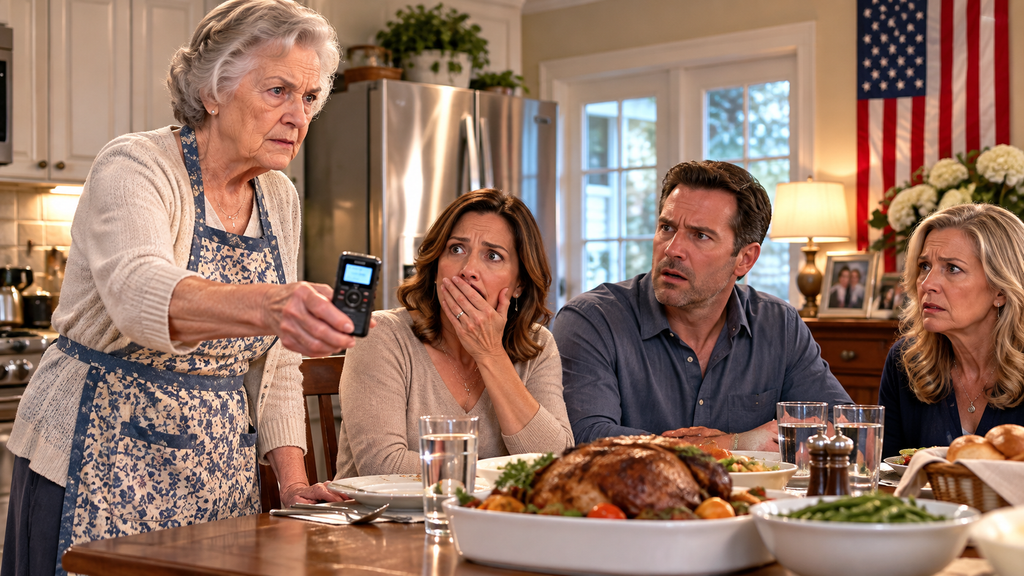
The first voice that came out of the recorder was mine. “I don’t know how much longer I can pretend I don’t notice.” For three seconds, nobody moved.
Not Paula. Not Dale. Not Colleen. Even the old refrigerator seemed to choose that moment to stop humming. My own recorded voice sounded strange coming from that little plastic speaker.
Older than I imagined.
Smaller.
Tired.
Then came the scrape of a chair.
The clink of a spoon against a coffee cup.
And Dale’s voice.
“She has to go, Paula.”
Paula’s hand flew to her mouth.
Dale stared at me.
“What the hell is this?”
I lifted one finger.
“Listen.”
“Marguerite—”
“Listen.”
Maybe it was the way I said it.
Maybe it was because, for the first time in four years, I did not sound like a woman asking permission to occupy a chair in her own daughter’s house.
Dale stopped talking.
The recording continued.
“Dale, do not start.”
“I am not starting. I am finishing. It has been four years. She was supposed to be temporary.”
“She is my mother.”
“She is a line item. Do you know what her room would rent for?”
Paula looked at her husband as though she had never seen his face before.
I watched her carefully.
That mattered to me.
I needed to know what surprised her.
And what did not.
On the recording, Paula said, “Where would she even go?”
Not no.
Where.
I had replayed those words so many times that I knew every breath around them.
Now Paula heard them too.
Her eyes filled immediately.
“Mom…”
I did not look at her.
Not yet.
The recording continued.
“There are places. She has the settlement money.”
“What settlement money?”
“From the house. The Ridgeway house.”
“Mom put that into the down payment. All of it.”
“Sure she did.”
I stopped the recording.
The silence afterward was worse than the voices.
Paula stared at Dale.
Dale stared at the recorder.
Colleen stared at the floor.
And I looked at all three of them.
“Well,” I said.
Nobody answered.
I folded my hands in my lap.
“Would anyone like potatoes?”
Paula made a sound that was half laugh, half sob.
“Mom, please.”
“What?”
“How can you ask about potatoes right now?”
“Because they are getting cold.”
Dale shoved his chair backward.
The legs scraped sharply against the floor.
“This is insane.”
“Sit down.”
“No.”
“Then stand.”
His face darkened.
“You planted a recording device in our kitchen?”
There it was.
Not an explanation.
Not an apology.
Not even surprise at what he had said.
His first concern was how I knew.
I had lived long enough to recognize that particular kind of fear.
It was the fear of a person who was not sorry he had done something.
Only sorry the door had opened while he was doing it.
“You secretly recorded private conversations in my house,” Dale said.
I looked around the kitchen.
His house.
Interesting choice of words.
I nodded toward the walls.
“Which part?”
“What?”
“Which part of the house is yours, Dale?”
He blinked.
“All of it.”
“No.”
“Excuse me?”
“I asked which part you paid for.”
His mouth tightened.
Paula whispered, “Mom.”
“No, sweetheart. We are going to talk plainly today.”
I pointed toward the window above the sink.
“That window was replaced with money from my Ridgeway house.”
I pointed toward the refrigerator.
“That refrigerator came from my savings.”
I pointed toward the hallway.
“The furnace that keeps those bedrooms warm was replaced two winters ago. I wrote the check.”
Dale laughed.
It was too loud.
Too quick.
“That does not make this your house.”
“No.”
I smiled.
“But neither does calling me a lodger make it yours.”
That hit him.
I saw it.
Just a twitch near his mouth.
Paula looked between us.
“What does she mean, ‘lodger’?”
I reached for the recorder again.
Dale moved toward me.
Colleen spoke for the first time.
“Don’t.”
One word.
But Dale froze.
I looked at my sister.
She was still standing by the window with her purse strap clutched in both hands.
Her knuckles were white.
Dale stared at her.
“Why are you even here?”
Colleen swallowed.
I answered for her.
“Because Thursday night, a woman came into this kitchen.”
Paula went still.
I pressed play.
Static.
The back door opening.
Footsteps.
Then the woman’s voice.
“Is she asleep?”
Colleen closed her eyes.
Paula turned toward her aunt.
Slowly.
Like someone in a nightmare.
The recording continued.
“She goes down at nine. Out cold. Deaf as a post anyway.”
“And Paula?”
“Second shift until eleven thirty.”
The woman laughed.
That laugh.
Even coming through a cheap speaker, I knew it.
Paula knew it too.
Her head turned sharply toward Colleen.
“Aunt Colleen?”
Colleen began crying.
Not loudly.
That somehow made it worse.
Tears simply rolled down her face while her body remained perfectly still.
I let the recording continue.
“Did you bring it?” Dale asked.
“It is in the car. Dale, if she signs it, that is it. She cannot undo it after.”
“She will sign it. She signs whatever Paula puts in front of her.”
“And your wife?”
“Paula does not need to be in the middle of this.”
I stopped the tape.
Nobody spoke.
Outside, somewhere down the block, a dog barked twice.
A car passed.
Ordinary sounds.
That was what struck me.
Your life can split directly down the middle while somebody three houses away is trimming a hedge.
Paula stood.
Her chair fell backward.
She did not notice.
“What did you bring?”
Colleen covered her mouth.
“Aunt Colleen.”
Nothing.
“What did you bring?”
Dale said, “Paula, calm down.”
She spun toward him.
“Do not tell me to calm down.”
I had never heard my daughter use that voice with her husband.
Neither had he.
His expression changed.
Only slightly.
But I saw the calculation.
He was trying to decide which version of himself would work best.
Angry Dale?
Hurt Dale?
Reasonable Dale?
He chose reasonable.
“Okay,” he said softly. “Obviously this sounds bad.”
I almost laughed.
Paula did.
But there was no humor in it.
“Sounds bad?”
“It is being presented without context.”
I reached for the carving knife.
Dale flinched.
I used it to cut the roast.
“Context is coming.”
“Marguerite, put the knife down.”
“I am carving lunch.”
“Mom,” Paula whispered.
I placed a slice of roast on my plate.
Then another.
My hands were steady.
I was proud of that.
At seventy-six, pride comes from strange places.
Sometimes it is your grandchildren graduating.
Sometimes it is a tomato plant surviving August.
And sometimes it is discovering that your hands do not shake while the people who underestimated you begin to understand their mistake.
I set down the knife.
“Colleen,” I said.
My sister looked at me.
“What was in the car?”
She shook her head.
“Please.”
“No.”
“Marguerite…”
“You came because Paula told you I said the words you have been waiting to hear.”
Her face crumpled.
Paula looked between us.
“What words?”
I kept my eyes on Colleen.
“I told Paula to tell you that I was sorry.”
Colleen whispered, “You were.”
“Yes.”
“For twenty-three years.”
“I know.”
Dale interrupted.
“What does any of this have to do with me?”
Colleen finally looked directly at him.
“Everything.”
That shut him up.
She walked toward the table.
Slowly.
Then she pulled out the chair across from me and sat.
Her purse remained on her shoulder.
“Take it off,” I said.
“I’m not staying.”
“Yes, you are.”
“Marguerite—”
“You stayed away for twenty-three years because of something you believed I did. You can stay another twenty minutes to tell my daughter what you did.”
Paula lowered herself into her chair.
Her hands were trembling.
“Aunt Colleen?”
Colleen took off her purse.
She put it on the table.
Then she unzipped it.
Dale stepped forward.
“Don’t.”
We all looked at him.
That one word told me more than an hour of conversation could have.
Colleen reached inside.
And pulled out a large white envelope.
My name was written across the front.
MARGUERITE ELLIS.
In black ink.
Block letters.
Paula whispered, “What is that?”
I already knew.
Or I thought I did.
Colleen slid the envelope toward me.
My fingers touched the paper.
For one terrible second, I was afraid to open it.
That surprised me.
I had spent three days preparing for this lunch.
I had rehearsed questions.
I had copied bank statements.
I had called an attorney.
I had even written down the phone number of a motel in case I needed to leave before sunset.
But holding that envelope made me feel seventy-six.
Not brave.
Not clever.
Just old.
Old enough to know that sometimes the truth does not rescue you.
Sometimes it only tells you exactly how badly you were hurt.
I opened it.
Inside were six pages.
The first page had a title in large letters.
DURABLE POWER OF ATTORNEY.
My name was underneath.
So was Paula’s.
I looked up.
Paula shook her head.
“I have never seen that.”
Dale spoke immediately.
“It was just estate planning.”
I turned to the signature page.
There was a line waiting for my signature.
Another for witnesses.
Another for a notary.
I read the first paragraph twice.
Then I looked at Colleen.
“This gives Paula authority over my finances.”
Colleen nodded.
“Not just Paula.”
I looked again.
There it was.
A successor agent.
DALE MERCER.
My son-in-law.
My stomach tightened.
“What else?”
Colleen removed another document.
This one was worse.
A deed.
I recognized the legal description.
The house.
This house.
The house I had helped them buy.
The house where I slept in a converted den.
The house where I was called a lodger.
I read the page.
Then read it again.
Paula stood beside me.
“What is it?”
I handed it to her.
Her face drained of color.
“It transfers Mom’s interest.”
Dale said, “She does not have an interest.”
I looked at him.
“Then why do you need my signature?”
He did not answer.
That was the first moment I knew for certain.
Not suspected.
Knew.
There was something about this house Dale had not told Paula.
Something about the down payment.
Something about my money.
And apparently, something about my name.
I turned to Colleen.
“Tell us.”
She stared at the table.
“Colleen.”
She whispered, “I notarized the original closing documents.”
Paula frowned.
“What?”
“I was still working at Grant County Title then.”
My daughter looked at me.
I remembered.
Four years earlier.
Everything had happened quickly.
My husband had been dead eleven months.
The Ridgeway house was too large.
The stairs hurt my knees.
Paula worried about me being alone.
Dale had found this place.
Five bedrooms, he said.
Plenty of room.
A yard.
A quiet neighborhood.
I could sell Ridgeway, help with the down payment, and live with them.
Family.
That word had been used approximately one thousand times.
Family.
We are family.
This keeps the money in the family.
You will never have to worry because you are with family.
I had sold the house my husband and I spent thirty-eight years paying for.
After the mortgage balance and fees, I had $214,000.
I put $190,000 into this house.
Dale and Paula financed the rest.
That was what I remembered.
But grief makes paperwork look like weather.
You know it is happening.
You just want to get indoors.
“Your name was on the purchase agreement,” Colleen said.
Paula sat back down.
Dale muttered something under his breath.
“What?” I asked.
He said nothing.
Colleen continued.
“Originally, the ownership percentages were supposed to reflect the contributions. Your mother was putting up most of the equity.”
Paula looked at Dale.
“Originally?”
Colleen nodded.
“Dale changed the instructions.”
“I did not change anything,” he snapped.
“You called the office.”
“You cannot prove that.”
Colleen reached into her purse again.
This time she pulled out a folded sheet of paper.
“I kept the file note.”
Dale’s face changed.
There.
That was the moment.
Not when I played the recording.
Not when the deed appeared.
That.
The little collapse behind his eyes when he realized that something from four years ago had survived.
Colleen unfolded the paper.
“I wrote it because I thought the request was strange.”
Paula took it.
“What does it say?”
“Read it.”
Her voice trembled.
“Client’s son-in-law called regarding vesting. Requests mother-in-law’s interest be structured as life estate only, remainder to married couple. Says MIL understands arrangement and wishes to avoid probate.”
I stared at Dale.
“I never said that.”
“I know,” Colleen said.
Paula continued reading.
“Asked that revised paperwork be sent directly to him.”
She stopped.
Then looked at her husband.
“Did you do this?”
“No.”
“Did you call them?”
“No.”
Colleen said, “Yes.”
“You hated me from day one.”
“I barely knew you.”
“You were jealous of Marguerite.”
That almost made me smile.
There are lies so foolish they collapse under their own weight.
Colleen and I had not spoken for twenty-three years.
Jealousy was not our problem.
Our problem had a name.
Robert.
My late husband.
But that was another grave we had both been walking around for decades.
Paula looked at me.
“Mom, did you know you had a life estate?”
“No.”
“What does that mean?”
“It means,” Colleen said quietly, “your mother has the legal right to occupy the property for her lifetime, depending on the exact deed language.”
Dale slammed his hand against the table.
“This is ridiculous.”
The plates jumped.
I did not.
That surprised him.
“You cannot throw me out,” I said.
He stared at me.
I had not meant to say it triumphantly.
It came out almost as a whisper.
But I saw the words reach him.
Four years.
Four years of making myself smaller.
Four years of asking before changing the thermostat.
Four years of keeping my groceries on one refrigerator shelf.
Four years of apologizing when my television was too loud.
Four years of calling it their house.
And the whole time…
I had a legal right to be there.
Maybe not ownership in the way I once believed.
Maybe not security without complications.
But not nothing.
Not a lodger.
Not a charity case.
Not a line item.
Dale pointed at Colleen.
“She is lying.”
“Then you will enjoy explaining that to my attorney.”
He turned to me.
“Your what?”
“My attorney.”
Paula looked at me.
“You have an attorney?”
“Since Friday.”
Dale actually laughed.
“You called an attorney because you overheard a conversation?”
“No.”
I reached beneath my placemat.
There was another envelope.
I slid it across the table.
“I called an attorney because I checked my credit.”
Dale did not touch the envelope.
Paula did.
Inside were copies of three statements.
She read the first.
Then the second.
By the third, her hands were shaking so badly the paper rattled.
“What is HomeBridge Financial?”
Dale said nothing.
Paula looked at me.
“Mom?”
“A home equity application.”
Her eyes moved across the page.
“For seventy-five thousand dollars?”
“Yes.”
She looked at Dale.
“You applied for a loan?”
“It was an inquiry.”
“It says application.”
“Preliminary.”
“Against the house?”
“I was exploring options.”
“Why is Mom listed?”
He opened his mouth.
Nothing came out.
I answered.
“Because of the life estate.”
Paula stared at him.
The room became very quiet again.
Then I saw something in my daughter’s face.
Not shock.
Recognition.
That frightened me more.
“What?” I asked.
She shook her head.
“Paula.”
She closed her eyes.
“There was another letter.”
Dale said sharply, “Don’t.”
She looked at him.
“I thought it was junk.”
“What letter?”
“About refinancing. Maybe two months ago. I asked Dale about it.”
“And?”
“He said it was an advertisement.”
Dale pushed away from the table.
“I am done with this.”
He walked toward the kitchen door.
I said, “There is one more recording.”
He stopped.
His back remained toward me.
I took the receiver from my apron.
“This one is from Friday.”
He turned slowly.
I had not told anyone about Friday.
Not even my lawyer.
Because Friday night, after the conversation with Colleen, Dale made his usual trip to the garage.
Only this time he took a call.
And the monitor did not reach the garage.
But he came back inside before hanging up.
I pressed play.
His voice came through.
“…Sunday. She is doing lunch Sunday.”
Pause.
“No, Colleen will not say anything.”
Colleen closed her eyes.
Dale’s recorded voice continued.
“She is too ashamed.”
Another pause.
Then:
“Once I have Marguerite’s signature, I can get the loan done.”
Paula stopped breathing.
I could see it.
Then another voice came faintly through the phone.
Male.
Too distorted to understand.
Dale answered.
“No. Paula thinks we are still paying off the credit cards.”
My daughter made a small sound.
The recording continued.
“I told you, once the seventy-five clears, I can give you your twenty back.”
Paula stood.
“What twenty?”
Dale grabbed the receiver.
Or tried to.
I pulled it away.
Colleen shouted.
Paula stepped between us.
“WHAT TWENTY?”
I had never heard my daughter scream like that.
Dale froze.
Paula’s whole body shook.
“What twenty thousand dollars?”
He looked at her.
Then me.
Then Colleen.
He was searching for the weakest person in the room.
For years, that had been me.
He looked at me longest.
I stared back.
Not today.
Finally he said, “It is complicated.”
Paula laughed once.
A broken little sound.
“Then simplify it.”
“I borrowed money.”
“From who?”
“A friend.”
“Who?”
“Boyd.”
The coworker.
The man Dale complained about every night.
Boyd was lazy.
Boyd was stupid.
Boyd was getting divorced.
Boyd was trying to steal Dale’s clients.
Boyd, apparently, had loaned him twenty thousand dollars.
“For what?” Paula asked.
Dale rubbed his face.
“Investments.”
“What investments?”
No answer.
“Dale.”
“Crypto.”
Paula stared.
“You told me you stopped.”
“I did.”
“When?”
“Last year.”
“And this?”
“Was before that.”
“Twenty thousand?”
“It was supposed to turn around.”
I watched my daughter.
Twenty-seven years earlier, when she was thirteen, I watched a doctor tell her that the fracture in her wrist meant she would miss the rest of softball season.
She had held her face completely still.
Exactly like this.
She had always done that when something hurt too much.
Become still.
I hated seeing it again.
“How much?” she asked.
Dale shook his head.
“How much have you lost?”
“Paula—”
“How much?”
“I do not know.”
“Yes, you do.”
Silence.
“How much?”
“Forty-eight.”
“Hundred?”
Nobody spoke.
Paula whispered, “Thousand?”
Dale sat down.
And suddenly he looked smaller.
That is the strange thing about people who control rooms.
Once control leaves them, you wonder how they ever seemed so large.
“Some of it came back.”
“How much?”
“Maybe eleven.”
“So thirty-seven thousand.”
“It is not that simple.”
“It is exactly that simple.”
He looked at me.
“Your mother being here costs us money.”
I almost admired the nerve.
Almost.
Paula turned toward him very slowly.
“What did you just say?”
“I am saying we would not be in this position if—”
“If my mother had not given us one hundred and ninety thousand dollars?”
He stopped.
Colleen stared at him.
I felt something inside me release.
Not anger.
Something older.
A knot I had been carrying so long I had mistaken it for part of my body.
Because there it was.
Said aloud.
My daughter knew.
She knew what I had given.
And for once she said it before I did.
Dale pointed toward me.
“She has lived here rent-free for four years.”
I laughed.
I could not help it.
The sound came out of me before I could stop it.
All three of them looked at me.
“What?” Dale demanded.
I wiped my eyes.
“I am sorry.”
“This is funny to you?”
“No.”
I looked around the kitchen.
“It is just expensive rent.”
“What?”
“One hundred and ninety thousand dollars for a den.”
Nobody answered.
“So let us calculate it.”
I reached for a napkin.
“Forty-eight months.”
I wrote.
190,000 ÷ 48.
“Three thousand nine hundred fifty-eight dollars a month.”
I slid the napkin toward him.
“For a room without a closet.”
Colleen laughed.
She tried not to.
But she did.
Paula covered her face.
Even I smiled.
Dale did not.
“Cute.”
“No,” I said. “What is cute is calling me a lodger while trying to borrow against money I put into the house.”
“I am not discussing finances with you.”
“You were discussing mine Thursday.”
He stood again.
“I want you out.”
Paula looked up.
“Dale.”
“No. This has gone far enough. She planted a surveillance device in our home. She invited your aunt here to ambush me. She contacted an attorney behind our backs.”
“Behind your back,” I corrected.
“What?”
“I did it behind your back. Paula did not know.”
He looked at his wife.
“Tell her to leave.”
Paula stared at him.
I will remember the next ten seconds until I die.
Because my daughter had spent most of her marriage avoiding conflict.
She had learned it partly from me.
Her father and I had believed that keeping peace was the same as making a home peaceful.
It is not.
Sometimes peace is only silence with good curtains.
Paula stood.
She picked up the fallen chair.
She set it upright.
Then she looked at her husband.
“No.”
Dale blinked.
“What?”
“No.”
“This is my house too.”
“Yes.”
“She cannot stay here after this.”
“Yes, she can.”
“You are choosing her over me?”
Paula’s face changed.
There was pain in it.
But also something else.
Clarity.
“No,” she said. “You chose this.”
Dale stared at her.
“I am your husband.”
“And she is my mother.”
“She invaded our privacy.”
“You tried to trick her into signing away her rights.”
“That is not what happened.”
“Then tell me what happened.”
He said nothing.
Paula pointed toward the documents.
“Tell me why Aunt Colleen brought a power of attorney here Thursday night.”
Silence.
“Tell me why Mom’s name is on a seventy-five-thousand-dollar loan application.”
Silence.
“Tell me why you owe Boyd twenty thousand dollars.”
Silence.
“Tell me why you told someone I thought we were paying off credit cards.”
Silence.
Every silence was an answer.
Paula began to cry.
Not dramatically.
Her shoulders simply dropped.
“I defended you.”
That was all she said.
Dale’s face softened.
He stepped toward her.
“Paula.”
She stepped backward.
“I defended you to her.”
I looked down.
That hurt.
Maybe because it was true.
“You said she was difficult,” Paula continued. “You said living with her was affecting our marriage. You said she criticized you.”
“I never—” I started.
Paula held up her hand.
“Please, Mom.”
I stopped.
She looked at Dale.
“And I believed you.”
He reached for her.
She moved away again.
“I told my own mother to give us space in a house she paid most of the cash for.”
“Paula, I was under pressure.”
“You called her a line item.”
“I was angry.”
“You called her a lodger.”
“I was joking.”
“You planned to have her sign legal papers she had not read.”
“They were for everybody’s protection.”
“Whose?”
He had no answer.
Colleen suddenly said, “Mine.”
We turned.
“What?” I asked.
She was crying again.
“I need to tell you the rest.”
Dale said, “There is no rest.”
Colleen ignored him.
She looked at me.
“Thursday was not the first time Dale contacted me.”
My stomach sank.
“When?”
“Three months ago.”
Paula sat down again.
“What did he want?”
“He asked about the original closing.”
Dale muttered, “Jesus Christ.”
Colleen continued.
“He wanted to know what would happen if Marguerite moved into assisted living.”
I felt cold.
“What did you tell him?”
“That the life estate language mattered. I told him to talk to an attorney.”
“He did,” Dale snapped. “That is normal.”
Colleen looked at him.
“You asked me whether a diagnosis of dementia would make it easier.”
The room disappeared for a second.
Not literally.
But that is how it felt.
I heard Paula gasp.
I heard the refrigerator.
I heard the clock.
But they sounded far away.
I looked at Dale.
He did not deny it.
And because he did not deny it, I knew.
Something inside my chest hurt.
Not my heart.
Deeper.
The place where dignity lives.
I was seventy-six.
I forgot names sometimes.
I put my glasses down and spent ten minutes looking for them.
Once I left the milk in the cupboard.
I had joked about it.
We all had.
And Dale had been watching.
Collecting.
Turning ordinary aging into ammunition.
“Mom,” Paula whispered.
I could not answer.
Colleen reached across the table.
I pulled my hand away.
She deserved that.
Not forever.
But for that moment.
She folded her hands.
“He asked if a doctor could declare you incompetent.”
“Why would you even keep talking to him?” Paula demanded.
Colleen looked at me.
“Because I thought I could find out what he was doing.”
I shook my head.
“No.”
“Marguerite—”
“No. Do not make yourself the hero yet.”
She looked down.
Good.
Some truths deserve a chair before forgiveness enters the room.
“Why did you help him Thursday?”
She swallowed.
“Because he threatened me.”
Dale laughed.
“Oh, come on.”
“With what?”
Colleen looked at me.
And suddenly I knew.
Robert.
My husband.
Her face told me before her mouth did.
“He found the letters.”
I could not breathe.
Paula frowned.
“What letters?”
I stared at my sister.
“You burned them.”
“I lied.”
Twenty-three years fell away.
I was fifty-three again.
Standing in my mother’s driveway after Robert’s funeral.
Colleen shouting.
Me shouting back.
A cardboard box between us.
Letters.
My husband’s handwriting.
Her name.
I had believed they proved an affair.
She swore they did not.
I told her never to speak to me again.
And she did not.
Until today.
“What letters?” Paula asked again.
Colleen looked at her.
“Your father wrote to me.”
Paula went pale.
I closed my eyes.
This was not how I wanted her to learn.
Not here.
Not with roast cooling on the table.
Not with Dale watching.
But secrets do not care about table settings.
Colleen continued.
“Years ago.”
“Were you having an affair with Dad?”
“No.”
Dale snorted.
I looked at him.
“Leave the room.”
He laughed.
“No.”
“Then shut your mouth.”
For once, he did.
Colleen looked at Paula.
“Your father was sick.”
Paula frowned.
“Dad died of a heart attack.”
“Yes.”
“That was sudden.”
“The heart attack was.”
Colleen wiped her cheeks.
“But for about two years before that, Robert was having problems.”
“What kind?”
“Memory problems.”
I opened my eyes.
I had not known.
Or perhaps I had known pieces.
Robert forgetting why he entered rooms.
Robert accusing me of moving his tools.
Robert driving to the hardware store and coming home three hours later because he had taken a wrong turn.
He laughed about it.
I laughed too.
We were getting older.
That was what I thought.
“He was scared,” Colleen said.
“Why did he write to you?”
“Because I worked at the county health office then. He asked me about doctors. He did not want you to know.”
I stared at her.
“You told me the letters were about money.”
“Because he asked me to.”
“You let me believe you were sleeping with my husband.”
“I thought you would eventually calm down.”
“Twenty-three years, Colleen.”
“I know.”
“Twenty-three.”
“I know.”
“You missed Paula’s wedding.”
“I know.”
“You missed my sixtieth birthday.”
“I know.”
“You missed his funeral reception.”
Her voice broke.
“I was at the funeral.”
I stared at her.
“In the back.”
I remembered.
A woman in a gray coat near the cemetery gate.
I had thought—
No.
I stopped.
Some memories are doors you should open slowly.
Paula whispered, “Why did Dad hide it?”
Colleen looked at her.
“He was terrified of losing control of his life.”
I looked at Dale.
So did she.
And suddenly the cruelty of what Dale had threatened became clear.
He had found letters describing my husband’s fear of cognitive decline.
And he had threatened to use them against Colleen.
How?
I asked.
“What did he say he would do?”
Colleen answered quietly.
“He said he would tell you I had hidden your husband’s medical problems from you. He said he would tell Paula I helped Robert lie.”
“You did.”
“Yes.”
“Then that is not much of a threat.”
“There is more.”
Of course there was.
There is always more when somebody says there is more.
Colleen opened her purse again.
She removed a small envelope.
Yellowed.
Old.
My name was on it.
Robert’s handwriting.
My hands began to shake then.
Finally.
After everything.
My hands shook.
“Where did you get that?”
“Robert gave it to me.”
“When?”
“Three weeks before he died.”
I did not touch it.
“What does it say?”
“I never opened it.”
“Twenty-three years?”
“He told me to give it to you if he died before he could tell you himself.”
“Then why didn’t you?”
Her eyes filled.
“Because after the funeral, when you found the other letters, you called me a whore.”
I flinched.
Paula looked at me.
I remembered every word.
I had said worse than that.
“You told me if I ever came near you or Paula again, you would call the police.”
“I was grieving.”
“So was I.”
That silenced me.
Because grief does not excuse every cruelty committed in its name.
Colleen pushed the envelope toward me.
“I should have given it to you anyway.”
“Yes.”
“I am sorry.”
I stared at the envelope.
Twenty-three years late.
Sometimes apologies arrive after the house they were meant to save has already burned down.
But that does not mean you refuse the water.
I picked it up.
The paper cracked faintly.
Robert had written my name the way he always did.
Marguerite.
The final E slightly higher than the other letters.
I ran my thumb over it.
Paula whispered, “Mom, you do not have to read it now.”
“Yes,” I said.
“I do.”
I opened it.
The letter was three pages.
I read the first line.
My darling Maggie,
And that was enough to make me cry.
Nobody had called me Maggie since he died.
I kept reading.
He wrote that he had been forgetting things.
That he was frightened.
That he had seen a neurologist without telling me.
That the doctor had not diagnosed dementia but wanted more tests.
That Robert had been ashamed.
Ashamed.
That word appeared four times.
He was ashamed that he might become someone I had to care for.
Ashamed that he had hidden it.
Ashamed that he had asked Colleen for help.
And ashamed that he had been too afraid to tell me himself.
Near the end, he wrote something that stopped me.
I read it again.
Then aloud.
“If I have learned anything from loving you, Maggie, it is that being cared for does not make a person a burden. I hope I am brave enough to believe that before it is too late.”
Nobody spoke.
I folded the letter.
Very carefully.
Then I looked at Dale.
He looked away.
That was when I understood what I wanted.
Until that moment, I thought I wanted revenge.
I wanted Dale humiliated.
I wanted Paula to know.
I wanted Colleen exposed.
I wanted everybody to feel as small as I had felt.
But sitting there with Robert’s letter in my hands, I realized revenge was too small.
I wanted my life back.
Whatever remained of it.
Five years.
Ten.
Maybe one.
Nobody knows.
But I was finished spending it in a converted den listening through walls to learn whether I was wanted.
I stood.
“Lunch is over.”
Paula looked up.
“Mom?”
“I said lunch is over.”
Dale immediately moved toward the hallway.
“Good.”
I looked at him.
“You are not going anywhere yet.”
He laughed.
“You do not get to tell me—”
The doorbell rang.
Nobody moved.
It rang again.
Dale looked at me.
“Who is that?”
“My attorney.”
His face went white.
That was worth thirty-one dollars all by itself.
I walked to the front door.
Behind me, Paula whispered, “You invited a lawyer?”
“Yes.”
“You planned all of this?”
“No.”
I opened the door.
“Planning would imply I knew what everybody was going to confess.”
Mr. Bennett stood on the porch holding a leather folder.
He was seventy if he was a day, with white eyebrows that looked permanently surprised.
Beside him stood a younger woman.
“This is my associate, Ms. Chen,” he said.
I stepped aside.
“Come in.”
Dale appeared behind me.
“This is a family matter.”
Mr. Bennett nodded pleasantly.
“Most property disputes are.”
Dale looked as though he had swallowed a tack.
We returned to the kitchen.
Nobody ate the roast.
That bothered me more than it should have.
It was a good roast.
Mr. Bennett sat at the table.
Ms. Chen remained standing.
I handed them the documents Colleen had brought.
Mr. Bennett read silently.
Then he looked at Colleen.
“Where did these come from?”
She explained.
He asked questions.
Dates.
Names.
Whether she had made copies.
Whether Dale had instructed her to prepare anything.
Whether anyone had witnessed their conversations.
Then he turned to me.
“Mrs. Ellis, do not sign anything.”
“I gathered that.”
He almost smiled.
Then he looked at Paula.
“Are you represented by counsel?”
“No.”
“You may want independent advice.”
Dale said, “We do not need lawyers.”
Paula looked at him.
“You do.”
That landed.
Mr. Bennett examined the deed.
Then the closing papers I had found Friday.
His finger stopped halfway down the page.
“Mrs. Ellis.”
“Yes?”
“Did you know there was a separate contribution agreement?”
“No.”
Dale went completely still.
Mr. Bennett looked at him.
“You did.”
It was not a question.
“What agreement?” Paula asked.
Mr. Bennett removed a document from my folder.
“This.”
I had brought everything from my old filing cabinet.
Receipts.
Closing papers.
Bank statements.
Even documents I did not understand.
One of them was a two-page agreement signed four years ago.
My signature was there.
Paula’s.
Dale’s.
I remembered signing it.
I had thought it was another closing disclosure.
Mr. Bennett read.
“Marguerite Ellis contributes one hundred ninety thousand dollars toward acquisition of the property. In consideration of said contribution, Marguerite Ellis retains a life estate and—”
He stopped.
His eyebrows lifted.
“What?” I asked.
He looked at me.
“—and a secured repayment interest of one hundred forty thousand dollars upon sale, transfer, or refinance of the property.”
Paula stared at him.
I stared at him.
Colleen stared at him.
Dale stared at the wall.
“What does that mean?” I asked.
Mr. Bennett turned the page.
“It means, subject to verification of the recorded documents and any later amendments, your contribution was not simply a gift.”
I looked at Dale.
He said nothing.
“You told me it was a gift,” Paula whispered.
Dale rubbed his forehead.
“I thought it was.”
“No,” Mr. Bennett said calmly. “You signed this.”
“I sign a lot of papers.”
I almost laughed again.
That had been his plan for me.
She signs whatever Paula puts in front of her.
Funny how foolish that excuse sounded coming from his mouth.
Paula noticed too.
I saw it.
“You signed whatever they put in front of you?” she asked.
He glared at her.
“This is not the time.”
“No. I think this is exactly the time.”
Mr. Bennett continued.
“If the document is valid and enforceable, a refinance may require addressing Mrs. Ellis’s interest.”
The room became silent.
And suddenly the entire Thursday plan made sense.
The power of attorney.
The deed.
My signature.
The seventy-five-thousand-dollar loan.
They did not simply want permission.
They needed me out of the way.
I looked at Colleen.
“You knew about the repayment interest?”
She nodded.
“Thursday?”
“Yes.”
“Why didn’t you tell me?”
“I was going to.”
“When?”
“Today.”
“You had twenty-three years to learn not to wait.”
She lowered her eyes.
Fair enough.
Mr. Bennett closed his folder.
“Mrs. Ellis, I recommend that you make no decisions today regarding the property.”
I nodded.
“What can I decide?”
“Where you sleep tonight.”
I looked at Paula.
She began crying again.
“Mom, please don’t leave because of me.”
That sentence almost broke me.
Because four years earlier, she had said the opposite.
Come live with us because of me.
Both sentences were love.
And both contained fear.
I walked to her.
I took her face in my hands.
“My leaving is not the same as abandoning you.”
She closed her eyes.
“I should have listened.”
“Yes.”
She opened them.
I think she expected me to soften it.
I did not.
“You should have.”
A tear slipped down her cheek.
“I am sorry.”
“I know.”
“I thought I was keeping my marriage together.”
“I know.”
“I did not know what he was doing.”
“I know.”
“Do you believe me?”
That was harder.
I looked at her.
My daughter.
My only child.
Fifty-one years old, and suddenly she looked seven.
“I believe you did not know all of it.”
Her face crumpled.
That was the truth.
And truth was what this table had lacked for too long.
She nodded.
“Okay.”
Dale muttered, “Unbelievable.”
Paula turned.
“What?”
“You are just accepting this?”
“What am I supposed to accept, Dale?”
“That she has been spying on us.”
Paula stared at him.
Then she said something I will never forget.
“If a thirty-one-dollar baby monitor can destroy our marriage, the monitor is not the problem.”
Colleen made a small sound.
Mr. Bennett looked down, perhaps to hide a reaction.
Dale’s face reddened.
“You are all insane.”
He walked toward the stairs.
Paula said, “Where are you going?”
“To pack.”
She nodded.
“Okay.”
He stopped.
That was not what he expected.
“What?”
“Pack.”
“This is my house.”
“It is mine too.”
“You cannot kick me out.”
“I am not kicking you out. You said you were packing.”
His mouth opened.
Closed.
I almost felt sorry for him.
Almost.
Then I remembered Thursday.
She signs whatever Paula puts in front of her.
No.
Pity could wait.
Dale went upstairs.
We heard drawers opening.
A closet door slammed.
Paula sat at the table.
Mr. Bennett quietly gathered the papers.
Ms. Chen photographed several pages with permission.
Colleen looked at the roast.
“Can I have some?”
I stared at her.
She shrugged.
“I skipped breakfast.”
And for some reason, that did it.
I laughed.
Paula laughed too.
Then Colleen.
Not because anything was funny.
Because human beings are strange animals and sometimes laughter is the only door the body can find when every other exit is blocked.
I cut my sister a slice.
“Potatoes?”
“Yes.”
“Carrots?”
“Not too many.”
“You still hate carrots?”
“I am seventy-two, Marguerite. I think I have given them a fair trial.”
Paula laughed harder.
Then she cried.
Then all three of us were crying.
Mr. Bennett stood.
“I think this is a good time for us to leave.”
I walked him to the door.
Before he stepped outside, he lowered his voice.
“Are you safe here tonight?”
I thought about it.
A real question deserves a real answer.
“I do not know.”
“Then do not stay.”
I nodded.
“I have a bag packed.”
“Good.”
“Mr. Bennett?”
“Yes?”
“Can he take the house?”
“Not tonight.”
That was enough.
For one night, sometimes enough is enough.
Dale came downstairs twenty minutes later with a suitcase.
He had changed his shirt.
I do not know why I remember that.
Maybe because people do ordinary things while their lives are collapsing.
He stopped in the doorway.
Paula was sitting beside me.
Colleen was washing dishes.
That might have been the strangest sight of all.
My sister had not washed a dish in my presence since 2001.
Dale looked at Paula.
“You are really doing this?”
She stood.
“No.”
He frowned.
“You are.”
“No. You did it.”
“After seventeen years?”
“After seventeen years, I deserve to know who I married.”
“You know me.”
“I thought I did.”
He pointed at me.
“She poisoned you against me.”
Paula shook her head.
“She played your voice.”
That silenced him.
He looked at me.
For a moment, I saw pure hatred.
It did not frighten me.
Hatred from someone who no longer controls you is mostly noise.
Then his expression softened.
“Marguerite.”
I almost admired the attempt.
“You know I care about you.”
“No.”
“I was stressed.”
“No.”
“I said things I did not mean.”
“You prepared things you meant me to sign.”
He swallowed.
“That was about simplifying the estate.”
“Whose estate?”
No answer.
“You called me a line item.”
“I apologized.”
“No, you did not.”
“I am apologizing now.”
“No. You are losing now.”
His face hardened.
There it was.
The mask did not fall.
He simply got tired of holding it.
“You think you won?”
I looked at him.
“No.”
And I meant it.
“My daughter is crying. My sister and I lost twenty-three years. I just learned my dead husband spent his final months frightened and hiding something from me. I discovered a man I treated like a son was trying to use my age against me.”
I took a breath.
“Nobody won.”
He looked away.
“But you lost something,” I said.
He looked back.
“What?”
“My silence.”
He left.
The front door closed.
Nobody spoke for a while.
Then Colleen turned off the faucet.
Paula asked, “Where will he go?”
I said, “Not my department.”
She almost smiled.
Almost.
That night I did not sleep in the den.
Not because Dale told me to leave.
Because I chose to.
I packed two suitcases.
My medicine.
Robert’s letter.
Three blouses.
Two pairs of slacks.
My blue cardigan.
The framed photograph of Paula at eight years old missing both front teeth.
And the baby monitor.
I almost left that behind.
Then I decided I had paid thirty-one dollars for it.
No sense wasting money.
Colleen drove me to a hotel.
We sat in her car outside for ten minutes.
Neither of us moved.
Finally she said, “I am sorry.”
“I know.”
“I should have told you.”
“Yes.”
“I was angry.”
“So was I.”
“I hated you for a while.”
“I hated you too.”
She nodded.
“That seems fair.”
I looked at her.
Twenty-three years.
Her hair had gone almost completely white.
There were lines around her mouth I had never watched arrive.
I had missed the death of her second husband.
She had missed my knee surgery.
I had never met two of her grandchildren.
She had never seen the quilt I finished after Robert died.
All because two stubborn women thought the first one to call would lose.
“What a waste,” I whispered.
She knew what I meant.
“Yes.”
I reached across the console.
She took my hand.
We sat like that.
No grand speech.
No miracle.
Just two old women holding hands in a hotel parking lot, discovering that forgiveness is sometimes embarrassingly small at first.
A hand.
A phone call.
A roast.
A chair finally pulled out at the table.
Three weeks later, Dale filed for divorce.
Or rather, his attorney sent Paula a proposed separation agreement.
He wanted the house sold.
He wanted half the equity.
He wanted reimbursement for improvements.
And, astonishingly, he wanted compensation for the years I had lived there.
When Mr. Bennett read that part, he removed his glasses.
“Creative.”
“Is that lawyer language for stupid?” I asked.
He smiled.
“I did not say that.”
“You thought it.”
“I bill by the hour, Mrs. Ellis. Thinking is included.”
The legal mess took months.
There was no dramatic courtroom scene.
Real life rarely gives you one.
Mostly there were letters.
Forms.
Phone calls.
Bank statements.
Meetings in rooms with bad coffee.
But truth has patience.
The records showed my money.
The closing agreement showed my interest.
The loan application showed what Dale had attempted.
And Colleen’s notes helped establish the sequence of events.
Boyd eventually confirmed the loan.
That was another surprise.
Dale had borrowed twenty thousand from him after claiming he needed it for emergency repairs on the house.
There had been no emergency repairs.
Some of the money went into speculative investments.
Some paid credit cards Paula did not know existed.
And several thousand dollars had simply disappeared into cash withdrawals.
We never learned exactly where every dollar went.
That bothered me at first.
Then one morning I realized I did not need every answer.
That is another thing age teaches you.
Closure is not the same as knowing everything.
Sometimes closure is deciding that the unanswered questions no longer get a room in your house.
The seventy-five-thousand-dollar refinance never happened.
The documents Colleen brought were never signed.
My life estate remained.
My repayment interest remained.
And when the house was eventually sold as part of Paula and Dale’s settlement, my secured amount was addressed first according to the agreement.
I received one hundred forty thousand dollars.
Not the full one hundred ninety I had originally contributed.
But enough.
More importantly, it was mine.
Nobody called it settlement money.
Nobody explained to me what I should do with it.
Nobody put a pen in my hand.
I bought a condominium.
One bedroom.
One bathroom.
A small balcony.
Third floor.
Elevator.
The kitchen is tiny.
I love it.
The first night there, Paula came over carrying Chinese food.
Colleen brought wine.
We sat on folding chairs because my furniture had not arrived.
At nine o’clock, I looked toward the refrigerator.
Paula noticed.
“What?”
“Nothing.”
She smiled.
“Thinking about putting a baby monitor up there?”
“No.”
“Good.”
“I already checked. There is no room above that refrigerator.”
She laughed.
Colleen nearly choked on her wine.
We laughed for five minutes.
That was six months ago.
Paula and Dale’s divorce is not final yet.
These things take time.
I do not ask her every detail.
She tells me what she wants.
She is seeing a counselor.
She also changed jobs.
Day shift.
She says she got tired of coming home at midnight to a life everyone else had been living without her.
I understand that.
Colleen and I have lunch every Thursday.
We are not pretending the twenty-three missing years did not happen.
That would be another lie.
We talk about them.
Slowly.
Sometimes painfully.
She tells me stories about her grandchildren.
I tell her things about Paula.
We argue.
Last Thursday she told me my curtains look like something from a dentist’s office.
I told her her haircut makes her look like a retired game-show host.
Then we ordered cheesecake.
Sisters.
Apparently we remembered how.
And Robert’s letter?
I keep it in my nightstand.
I have read it fourteen times.
There is one sentence I think about most.
Being cared for does not make a person a burden.
For years, I thought independence meant needing nobody.
I was wrong.
Independence means nobody gets to use what you need as proof that you are worth less.
There is a difference.
A very large one.
I am seventy-six.
I use reading glasses.
My knees complain about rain before the weather report does.
Sometimes I forget why I opened the refrigerator.
Sometimes I need help carrying groceries.
None of those things make me a line item.
None make me a lodger in somebody else’s life.
And none give another person permission to decide that my voice no longer counts.
The baby monitor is still in a drawer.
Paula told me to throw it away.
I said no.
Not because I plan to use it again.
I keep it because it reminds me of something.
For thirty-one dollars, I learned exactly what silence had been costing me.
But there is one last part I have not told you.
The final twist came two months after I moved into the condominium.
I was watering the basil on my balcony when someone knocked.
Three soft knocks.
I opened the door.
Dale stood there.
He looked different.
Thinner.
Older.
For the first time since I had known him, he looked uncertain about whether he was welcome somewhere.
He was not.
“What do you want?”
“To talk.”
“Talk.”
“Can I come in?”
“No.”
His jaw tightened.
Some habits survive consequences.
“Marguerite, please.”
I waited.
He held an envelope.
For one ridiculous second, I thought the man had brought me another document to sign.
I nearly closed the door.
Then he said, “Boyd found something.”
I stopped.
“What?”
“After everything happened, he went through the records from our investment account.”
“Our?”
“Mine and his.”
“I thought you borrowed from him.”
“I did. But before that, we invested together.”
I folded my arms.
“What does this have to do with me?”
He handed me the envelope.
I did not take it.
“What is it?”
“A check.”
That got my attention.
“For?”
“Twenty-seven thousand, four hundred and twelve dollars.”
I stared at him.
“Why?”
“Because some of the money I invested was yours.”
My stomach turned cold.
“What did you say?”
He looked at the floor.
“Years ago. After the closing.”
I could hear my pulse.
“How much?”
“Twenty-five.”
“Twenty-five what?”
“Thousand.”
I stepped into the hallway and pulled the door closed behind me.
Not because I wanted privacy.
Because suddenly I did not want him standing where he could see my home.
My home.
“Explain.”
He swallowed.
“The closing funds were transferred through the joint household account before everything settled.”
I remembered that.
For two days, the proceeds from Ridgeway had passed through an account because of a timing issue with the purchase.
“I moved twenty-five thousand.”
“You stole it.”
“I intended to replace it.”
“You stole it.”
“Yes.”
The word surprised both of us.
Maybe it was the first fully honest thing he had said to me.
“What happened?”
“I invested it.”
“And?”
“Lost most of it.”
“Then why is there twenty-seven thousand?”
“One of the assets recovered.”
I stared at the envelope.
He extended it again.
This time I took it.
The check was from an attorney’s trust account.
Not Dale personally.
Smart.
He knew I would never accept his check.
“Why are you giving this back?”
He looked at me.
“Because Paula found out.”
I laughed.
There he was.
At least he was consistent.
“So this is not conscience.”
“I am trying.”
“No. You are complying.”
He looked hurt.
Once, that expression would have made me soften.
Not anymore.
“Do you hate me?” he asked.
I thought about it.
“No.”
That surprised him.
“I did for a while.”
“And now?”
“Now I have furniture to buy.”
He almost smiled.
I did not.
“Marguerite…”
“Yes?”
“I really did care about you.”
I looked at him.
And perhaps the saddest part was that I believed him.
In his way.
At certain times.
People are not always monsters or saints.
Sometimes they are weak.
Greedy.
Afraid.
Selfish.
Capable of making you coffee in the morning and betraying you by afternoon.
Human beings are inconvenient that way.
“I believe you,” I said.
His eyes lifted.
“But caring about someone is not permission to exploit them.”
“I know.”
“Do you?”
He nodded.
“I am learning.”
“Good.”
He turned to leave.
“Dale.”
He looked back.
I held up the envelope.
“If this check does not clear, I am calling Mr. Bennett before you reach the parking lot.”
For the first time in months, he genuinely laughed.
“It will clear.”
“It better.”
He walked toward the elevator.
Then stopped.
“Marguerite?”
“What?”
“I am sorry.”
There was no audience.
No Paula.
No lawyer.
No Colleen.
No recorder.
Just him and me.
Maybe that made it real.
Maybe it did not.
But I nodded.
“I heard you.”
I did not say I forgave him.
Not everything needs to be rushed.
The elevator doors closed.
I went inside.
The check cleared.
I put most of it into savings.
I spent six hundred dollars on a ridiculous green armchair that Paula said was too large for my living room.
She was right.
I bought it anyway.
That is another pleasure of having your own home.
You can buy an ugly chair and nobody gets a vote.
Last Sunday, Paula came over for pot roast.
Colleen arrived at twelve fifty-five.
Paula at twelve fifty-eight.
At exactly one, we sat down.
Three plates.
Three women.
No recorders.
No envelopes.
No hidden documents.
Just lunch.
Halfway through, Paula looked at me.
“Mom?”
“Yes?”
“Can I ask you something?”
“Depends.”
“When did you know?”
“Know what?”
“That something was wrong with Dale?”
I thought about it.
The lodger comment?
The finances?
The baby monitor?
Thursday night?
The paperwork?
No.
The truth had started much earlier.
“I think,” I said, “I knew when I started becoming grateful for being tolerated.”
Paula’s eyes filled.
I reached across the table.
“Do not make that face.”
“I am sorry.”
“I know.”
“I should have—”
“No.”
She stopped.
“We have apologized enough for one lifetime.”
Colleen raised her glass.
“Speak for yourself. I have at least fifteen more years of apologies scheduled.”
I laughed.
Paula did too.
Then I looked at my daughter.
“You want to know what matters?”
She nodded.
“I heard something terrible through that monitor.”
Her face tightened.
“But the worst thing was not what Dale called me.”
“What was it?”
I looked at her.
“The worst thing was hearing myself believe I had nowhere else to go.”
Nobody spoke.
I smiled.
“And I was wrong.”
Outside my balcony doors, the evening sun spilled across the little living room.
My oversized green chair sat in the corner.
Robert’s photograph was on the shelf.
Colleen was stealing carrots off Paula’s plate and pretending she was not.
My daughter was laughing.
And I understood something I wish I had known at fifty.
Or forty.
Or twenty.
Home is not the place where people allow you to stay.
Home is the place where you do not have to disappear in order to remain.
I spent four years making myself smaller so I would fit inside somebody else’s idea of family.
I whispered.
I waited.
I apologized.
I listened through walls.
Then one Sunday afternoon, I put a recorder on the table and let everybody hear what silence sounded like.
It sounded like Dale.
It sounded like Colleen.
It sounded like Paula.
And, at first, it sounded like me.
But not anymore.
Now my voice fills my little condominium whenever I please.
I play music too loudly.
I talk to the television.
I call Colleen and argue about curtains.
I tell Paula when I am angry instead of saying I am tired.
I ask questions when paperwork is put in front of me.
And I read every page.
Every single page.
Last week, Paula brought over a form from the condominium association.
“Mom, they need your signature.”
I looked at her.
She froze.
Then both of us burst out laughing.
“Read it first,” she said.
“Oh, I intend to.”
I put on my glasses.
I read all four pages.
Twice.
Then I signed.
Because trust is not signing without reading.
Trust is knowing the person beside you wants you to understand before you sign.
There is a difference.
There is always a difference.
So if you want to know what happened to the seventy-six-year-old lodger in the converted den, here it is.
She moved out.
She got her money back.
She got her sister back.
She got her daughter back.
But most importantly—
she got herself back.
And somewhere in a drawer beside my kitchen is a thirty-one-dollar baby monitor that has not been switched on in months.
I hope I never need it again.
Because these days, when something needs to be said in my family, we say it at the table.
Out loud.
While everyone is still in the room.
And nobody—
not my daughter,
not my sister,
not a husband,
not a lawyer,
not a man who once thought my age made me easy to erase—
will ever mistake my silence for permission again.
Not while I still have a voice.
And believe me.
I do.
💬THE END! THANK YOU FOR READING! ❤️🙏