
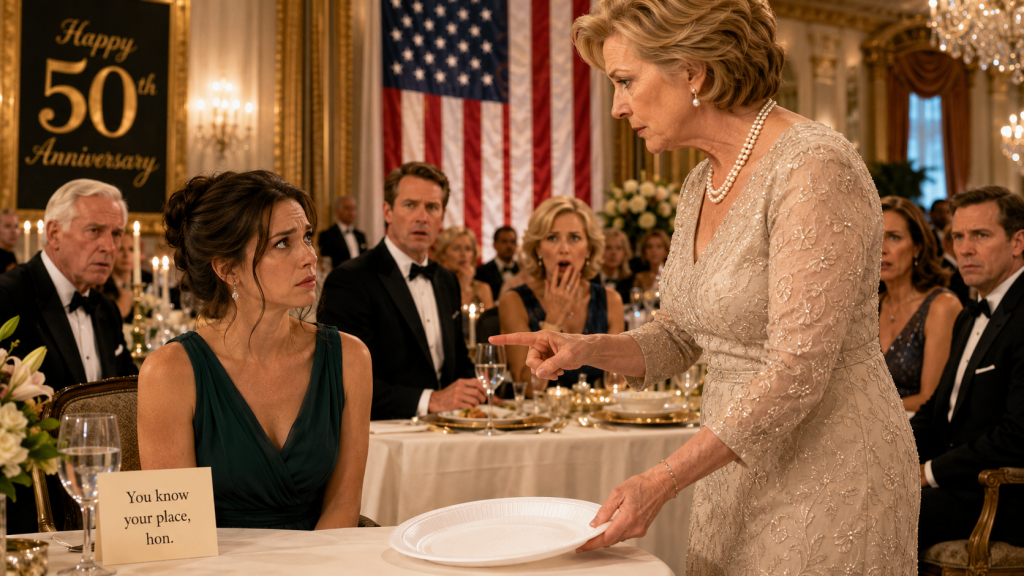
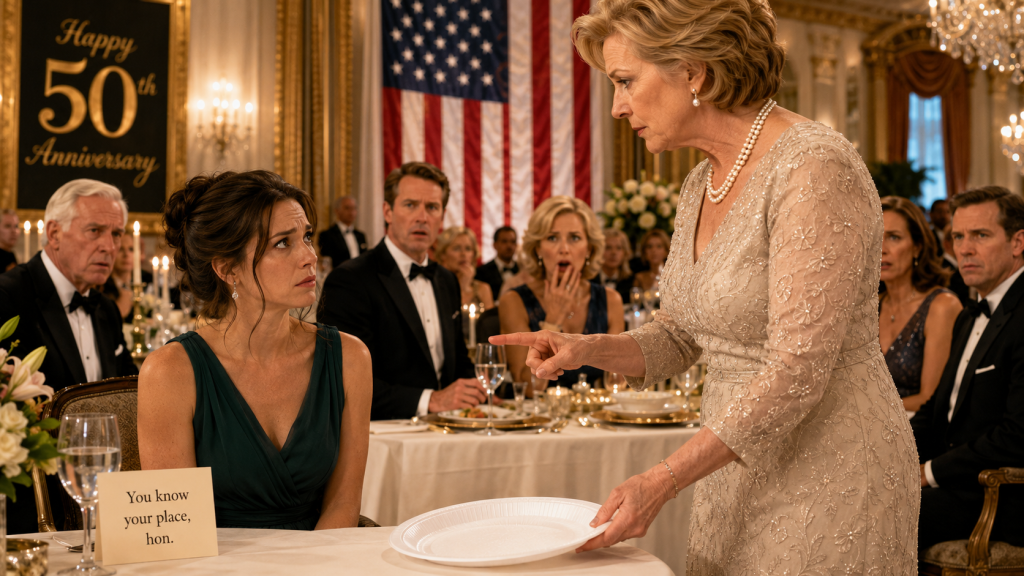
At my parents’ fiftieth anniversary dinner, everyone at the main table ate from fine china. Then my mother handed me a white plastic plate, pointed toward a chair beside the service doors, and said, “You know your place, hon.”
I didn’t argue. I didn’t cry. I set the plate down, picked up the cream-colored envelope I had carried all evening, and quietly walked to my car.
What nobody in that ballroom knew was that inside the envelope was the deed to the house my parents had been pretending was theirs for eleven years.
My name is Natalie Carter. I was forty-six years old when my parents celebrated fifty years of marriage at the Fairmont in San Francisco.
My mother had planned the evening for nearly a year. She talked about it constantly. The ballroom. The flowers. The photographer. The string quartet during cocktails.
The three-tier anniversary cake decorated to resemble the one from their wedding in 1976.
She wanted everything perfect.
And because my parents could not afford anything close to what she imagined, I quietly paid for most of it.
That was something I had become very good at doing.
Quietly paying.
Quietly fixing.
Quietly helping.
And then quietly stepping aside while someone else accepted the applause.
My older brother, Derek, was fifty-one.
He had been the golden child since the day he was born.
According to Mom, Derek was “a natural leader.”
In reality, he had changed careers seven times, borrowed money from our parents more times than anyone could count, and once went almost two years without speaking to Dad because Dad refused to invest in a restaurant Derek wanted to open with a man he met at a golf tournament.
My younger sister, Claire, was forty-two.
Claire was charming, beautiful, and very good at allowing other people to rescue her.
If her car broke down, Dad paid.
If her rent increased, Mom called Derek or me.
If she wanted to take her children to Disneyland and couldn’t afford it, somehow I received a text about how sad the children were going to be.
I was the middle child.
The dependable one.
The unmarried one.
The one without children.
The one who, according to my mother, had “chosen career over family.”
That wasn’t exactly true.
I had been engaged at thirty-one, but my fiancé died in a car accident six weeks before our wedding.
After that, I buried myself in work because numbers made sense in a way grief didn’t.
Eventually, I started my own commercial property management company.
By forty, I employed thirty-eight people and managed buildings across Northern California.
My parents rarely talked about that.
Whenever someone asked what I did, Mom usually said, “Natalie works with buildings.”
But Derek’s short-lived career selling luxury homes had been described as “real estate entrepreneurship.”
That was my family.
I knew the rules.
And for years, I accepted them.
The anniversary dinner should have been one of the happiest nights of my parents’ lives.
I arrived early wearing a dark green dress and carrying the envelope in my purse.
Inside was the greatest gift I had ever planned to give them.
Their house.
Eleven years earlier, my parents had nearly lost everything.
Dad had retired from his job with a regional shipping company and invested most of his savings in a business opportunity Derek brought him.
The business collapsed within eighteen months.
Then came missed mortgage payments.
Credit card debt.
A second mortgage.
By the time Dad finally called me, their home was weeks away from foreclosure.
I still remember sitting across from him at their kitchen table.
He looked smaller than I had ever seen him.
“Natalie,” he whispered, “don’t tell your mother how bad it is.”
“How bad?”
He slid the foreclosure notice across the table.
I stared at the number.
They owed more than they could possibly pay.
Mom walked into the kitchen carrying groceries and immediately started talking about Claire’s daughter’s school recital.
She had no idea her house was disappearing beneath her feet.
I spent three days trying to find another solution.
There wasn’t one.
So my company bought the house.
The transaction stopped the foreclosure.
My parents stayed.
They paid me a small monthly amount, which Mom proudly called “our mortgage,” although it barely covered utilities and landscaping.
I paid the property taxes.
I paid the insurance.
I replaced the roof.
I replaced the furnace.
When a pipe burst beneath the kitchen, I paid $14,700 for repairs.
When Mom decided she needed new hardwood floors, I covered those too.
I never corrected anyone when my parents told friends they had “refinanced and recovered.”
Dad knew the truth.
Mom knew enough of it.
Derek and Claire knew practically nothing because my parents were embarrassed.
That arrangement continued for eleven years.
Then, as their fiftieth anniversary approached, I decided it was time to give them the house outright.
My accountant objected.
My attorney objected.
Even my assistant, Melissa, who had been with me for fourteen years, asked whether I was absolutely certain.
“They’re getting older,” I told her. “I don’t want them worrying about housing.”
“They don’t seem very worried now.”
I smiled.
“They’re my parents.”
The deed was prepared.
The remaining balance they technically owed my company was forgiven.
I wrote a letter explaining that the house was theirs free and clear.
I intended to hand them the envelope during dinner.
I imagined Mom crying.
I imagined Dad hugging me.
I imagined, for once, feeling like I belonged at the center of my own family.
Three days before the party, the event coordinator called me.
Her name was Olivia.
“Natalie,” she said carefully, “I’m not sure whether I should mention this.”
“What happened?”
“Your mother changed the seating arrangement.”
I was driving between properties and barely paid attention.
“She changes everything. Last week she changed the flowers twice.”
“This is about your seat.”
I slowed down.
“What about it?”
There was a pause.
“She moved you from the family table.”
I thought she was joking.
“Where?”
“Near the service entrance.”
“Why?”
Olivia sounded uncomfortable.
“She said she wanted the main table to look balanced for photographs.”
I laughed once.
That sounded exactly like Mom.
Then Olivia added, “She also said that since you’re unmarried and don’t have children, people ask awkward questions when you sit with the immediate family.”
I stopped laughing.
Traffic crawled ahead of me.
For a few seconds, I heard nothing except the clicking of my turn signal.
“She said that?”
“I’m sorry.”
“Thank you for telling me.”
“Would you like me to change it back?”
I thought about it.
“Yes.”
Then I changed my mind.
“No. Leave it.”
“Natalie?”
“Leave everything exactly as she requested.”
That should have been my warning.
But I still convinced myself Mom didn’t really mean it.
Maybe she was stressed.
Maybe she was thinking about photographs.
Maybe once I arrived, she would realize how hurtful it looked.
I had spent half my life finding explanations for my mother.
The evening of the dinner, I entered the ballroom at six-thirty.
The room was beautiful.
Tall arrangements of white roses stood on every table.
Candles reflected in the chandeliers.
My parents’ wedding photograph was projected onto a wall beside a gold “50.”
Dad looked handsome in a black tuxedo.
Mom wore a champagne-colored gown and a pearl necklace I had bought her for her sixtieth birthday.
She hugged Derek when he arrived.
“Oh, my handsome boy.”
She kissed Claire.
“You look stunning.”
When she saw me, her eyes moved over my dress.
“That color is a little dark for photographs, isn’t it?”
“Hello to you too, Mom.”
She sighed.
“Don’t start tonight.”
I hadn’t started anything.
That was another family rule.
If Mom said something cruel and I reacted, my reaction became the problem.
I handed her a bouquet.
“Happy anniversary.”
She kissed my cheek.
“Thank you, honey.”
For the next hour, everything remained civil.
I greeted relatives.
I talked with Dad’s former coworkers.
I smiled for photographs.
I watched Derek tell three people that he had “helped Dad navigate some complicated financial years.”
I nearly laughed.
Then dinner began.
Guests moved toward their assigned seats.
The main table stretched across the front of the ballroom.
Every place setting had ivory Lenox china.
Gold-rimmed crystal.
Polished silverware.
Folded linen napkins.
Derek sat beside his wife.
Claire sat beside her boyfriend.
Two cousins sat nearby.
Even my parents’ neighbors, the Wallaces, had seats at the main table.
There was no place card for me.
Mom approached carrying something.
A white plastic plate.
At first, I didn’t understand.
She placed it in my hands.
“There you are.”
I looked toward the back of the room.
A small table had been set beside the service doors.
It was where two photographers had left their camera bags.
There was one empty chair.
“Mom?”
She lowered her voice.
“Please don’t make this difficult.”
“What is this?”
“You know your place, hon.”
The words came softly.
That almost made them worse.
Derek heard.
He smirked.
Claire looked into her wineglass.
Nobody said, “Mom, that’s cruel.”
Nobody moved.
I looked at the plastic plate in my hands.
Then at the beautiful ballroom.
Then at my father.
Dad’s eyes met mine.
For one second, I waited for him to speak.
He didn’t.
That hurt more than anything Mom had said.
I slowly placed the plate on the table.
Then I reached into my purse and removed the envelope.
Mom’s eyes brightened.
“Oh, is that our present?”
“It was.”
Her expression changed.
I slipped the envelope under my arm.
“Natalie,” Dad said.
I looked at him.
“Happy anniversary.”
Then I walked away.
Behind me, Derek laughed.
“Here we go. Natalie’s making another statement.”
I kept walking.
The elevator ride to the lobby felt strangely peaceful.
No tears came.
Outside, rain had started falling lightly over San Francisco.
Valets moved beneath the hotel canopy.
I sat in my car without starting the engine.
For fifteen years, I had been the person everyone called when something went wrong.
I had paid Claire’s hospital deductible when her son broke his arm.
I had covered Derek’s mortgage for four months when his business failed.
I had sent my parents money without telling either sibling.
I had paid for that ballroom.
The flowers.
The cake.
The photographs.
And I had nearly given my parents a house worth more than $1.8 million.
Yet my place was beside the service doors with a plastic plate.
I opened the envelope.
There was the deed.
Below it sat my handwritten letter.
Mom and Dad,
You gave us a home for so many years. Tonight I want to make sure you never have to worry about losing one again.
The house is now yours, free and clear.
There is no debt.
No rent.
No obligation.
Consider it my thank-you for everything you gave us growing up.
Love always,
Natalie.
I read it twice.
Then I tore the letter in half.
I called Melissa.
She answered on the second ring.
“Natalie? Aren’t you at the dinner?”
“I am.”
“What happened?”
“Do not file the transfer deed.”
Silence.
“Are you sure?”
“Yes.”
“What do you want me to do?”
I stared through the rain at the ballroom windows.
“I want a formal lease prepared at market rate.”
Melissa hesitated.
“For your parents?”
“Yes.”
“And if they won’t sign?”
“Begin preparing the property for sale.”
“Natalie—”
“My mind is made up.”
She knew me well enough not to argue.
“All right.”
I hung up.
A message appeared from Derek.
Stop being dramatic. Mom says the plate was a joke. Come back before you embarrass everyone.
Then another.
You always have to make everything about yourself.
I turned the phone facedown and drove home.
The next morning, Melissa had the documents ready.
Current market rent for the property was $6,850 per month.
My parents had been paying $900.
I did not expect them to suddenly pay the full amount.
That wasn’t really the point.
The lease offered another option: they could move within ninety days, and I would cover relocation costs plus six months of rent somewhere affordable.
I wasn’t throwing elderly parents into the street.
I was simply ending the fantasy that my generosity was their entitlement.
At 10:06 a.m., the email went out.
At 10:19, Dad called.
I didn’t answer.
At 10:23, Mom called.
At 10:31, Derek called.
Then Claire.
Then Dad again.
At noon, the voicemails began.
Dad sounded confused.
“Natalie, sweetheart, I received something from your office. I’m sure there’s been some mistake. Call me.”
Mom was less gentle.
“Whatever point you’re trying to make, you’ve made it. Call us immediately.”
Derek was furious.
“You’re threatening Mom and Dad over a dinner plate? Are you serious?”
Claire cried.
“You’re going to destroy this family.”
I listened to every message.
Then I returned to work.
That evening, Dad came to my house alone.
He stood on my porch holding the lease.
“You weren’t really going to give us the house, were you?”
I looked at him.
“Yes.”
His shoulders fell.
I handed him the torn letter.
He read both halves.
When he finished, he sat on my porch bench and covered his face.
“Oh, Natalie.”
I remained standing.
“Why didn’t you say anything?”
“At dinner?”
He nodded.
“You looked at me.”
“I know.”
“You knew it was wrong.”
“Yes.”
“Then why didn’t you say anything?”
He rubbed his forehead.
“Your mother had been planning that night for months. I didn’t want a scene.”
I almost laughed.
“So you let her humiliate me to prevent a scene.”
“I should have stopped her.”
“Yes.”
He looked toward the street.
“I’ve spent fifty years avoiding conflict with your mother.”
“And I’ve spent forty-six years paying for that choice.”
That landed hard.
Dad nodded slowly.
“I’m sorry.”
I believed him.
But apologies and consequences can exist at the same time.
“I’m not changing my decision tonight.”
He folded the torn letter and handed it back.
“I understand.”
Before he left, he stopped at the door.
“Your mother thinks the house is ours.”
“She knows my company bought it.”
“She convinced herself that because we lived there so long…”
“That doesn’t make it hers.”
“I know.”
“Does Derek know?”
Dad looked embarrassed.
“He thinks we own it.”
Of course he did.
The next day, Derek arrived at my office without an appointment.
He walked past reception and into my office.
“You need to stop this.”
“Good morning to you too.”
“You’re charging Mom and Dad almost seven thousand dollars a month?”
“That is the market rate.”
“They can’t afford that.”
“I know.”
“Then what are they supposed to do?”
I handed him the second page.
“They can relocate. I’m offering to pay six months of rent.”
He stared at me.
“You’re selling their house?”
“My house.”
His face changed.
“What?”
“The property belongs to my company.”
“No, it doesn’t.”
I opened a file on my computer and turned the screen toward him.
Purchase agreement.
Tax records.
Insurance.
Eleven years of expenses.
Derek’s mouth slowly closed.
“You bought it?”
“When your investment wiped out Dad’s retirement.”
He went pale.
“That business failure wasn’t my fault.”
“I didn’t say it was.”
“You’re blaming me.”
“I’m explaining history.”
He sat down.
For perhaps the first time in his life, Derek had nothing clever to say.
Then he whispered, “Mom told everyone they saved the house.”
“I allowed her to.”
“Why?”
“Because she was embarrassed.”
He stared at the paperwork.
“How much have they paid you?”
“In eleven years? Less than two years of market rent.”
“And you covered everything else?”
“Yes.”
“Why didn’t you tell us?”
“Because I wasn’t helping them for applause.”
He leaned back.
His anger seemed to drain away.
“What was in the envelope?”
“The deed transferring the house to them.”
He closed his eyes.
“You were giving it to them?”
“Until Mom reminded me of my place.”
Derek left quietly.
Claire came the following afternoon.
Unlike Derek, she cried before she sat down.
“I’m sorry.”
“For what?”
“For not saying anything.”
I waited.
She wiped her eyes.
“When Mom gave you that plate, I knew it was awful. I wanted to say something.”
“But you didn’t.”
“No.”
“Why?”
“Because I was afraid she’d turn on me too.”
There it was.
The truth nobody in our family ever admitted.
Mom controlled us by ranking us.
Derek stayed favored by agreeing with her.
Claire stayed safe by staying quiet.
And I stayed useful by fixing everything.
“Do you remember my thirty-fifth birthday?” I asked.
Claire nodded uncertainly.
“Mom invited everyone to dinner and spent half the night talking about your pregnancy.”
“I remember.”
“Do you remember when I won the regional business award?”
“She said awards weren’t important compared to family.”
“Yes.”
Claire looked down.
“I thought you didn’t care.”
“I trained myself not to show that I cared.”
She reached across the desk.
“I’m sorry, Nat.”
This apology felt different.
I squeezed her hand.
“Thank you.”
The family meeting happened the following Sunday.
Mom demanded it.
She sat in the living room of the house I owned as if presiding over court.
Dad sat quietly.
Derek and Claire were there.
I brought Melissa, partly because she was my employee and partly because I wanted one person in the room who would not rewrite history.
Mom began immediately.
“This has gone far enough.”
I said nothing.
“A mother makes one joke and suddenly her daughter threatens to sell her home.”
“It wasn’t a joke.”
“It was a plate.”
“It was a message.”
“Oh, Natalie, everything is always some deep emotional message with you.”
Derek surprised everyone.
“Mom, stop.”
She turned.
“What?”
“It wasn’t funny.”
Mom stared at her favorite child as if he had betrayed her.
Claire spoke next.
“You embarrassed her.”
Mom’s face reddened.
“I cannot believe this. After everything I’ve done for all of you—”
I placed a folder on the coffee table.
“Would you like to talk about everything?”
She went silent.
Inside were eleven years of property expenses.
Taxes.
Repairs.
Insurance.
Emergency plumbing.
Roof replacement.
HVAC.
Landscaping.
Then I placed the anniversary invoice beside them.
Mom glanced at the total.
Her face changed.
“You paid for the dinner?”
“Yes.”
“All of it?”
“Most of it.”
Dad whispered, “Natalie.”
I continued.
“Mom, I did not leave because of plastic. I left because that plate represented forty-six years of being treated as if my value depended entirely on what I could do for this family.”
“That is ridiculous.”
“Is it?”
“Yes.”
“Tell me one thing about my company.”
She opened her mouth.
Nothing came.
“How many employees do I have?”
Silence.
“What year did I start it?”
She looked toward Dad.
“Do you know the name of the award I received last year?”
“Natalie, I don’t keep track of every little—”
“Yet you know what neighborhood Derek sold his first house in twenty years ago.”
Derek looked down.
“You know Claire’s boyfriend’s golf handicap.”
Claire blinked.
“You know the name of every teacher your grandchildren ever had.”
I paused.
“But when people ask about me, you say I ‘work with buildings.’”
Mom’s eyes filled with tears.
I did not enjoy seeing them.
But I did not rescue her from them either.
“You told the coordinator I did not belong at the family table because I am unmarried and childless.”
“I was thinking about photographs.”
“You were thinking about appearances.”
She looked away.
“And you have been thinking about appearances my entire life.”
Dad finally spoke.
“Margaret, she’s right.”
Mom turned sharply.
“Don’t you start.”
“No. I should have started years ago.”
The room went still.
Dad looked at me.
“I let your mother make you feel lesser because you were strong enough not to complain. That was cowardly.”
Mom stared at him.
“We loved her.”
“I know,” Dad said. “But we didn’t always treat her like we did.”
For the first time, Mom had no answer.
She stood and walked into the kitchen.
A few minutes later, we heard her crying.
Nobody followed her.
That mattered.
Usually, whenever Mom became upset, someone immediately comforted her and the original problem disappeared.
This time, we allowed her to sit with what had happened.
My parents eventually chose to sign a modified lease.
I lowered the rent considerably from market rate, but it was still enough that they had to treat the arrangement seriously.
Derek volunteered to contribute monthly.
Claire did too.
For once, responsibility was shared among all three children.
Six weeks passed before Mom called me.
“Would you come to Sunday dinner?”
I hesitated.
“Who will be there?”
“Just family.”
Those words meant something different now.
I arrived at six.
Mom opened the door.
She looked older.
Not physically, exactly.
Just less certain.
The dining room table was set.
Dad sat at one end.
Derek and Claire were already there.
There was an empty chair beside Dad.
At that place sat the finest china Mom owned.
Ivory Lenox.
Gold rim.
Crystal glass.
Linen napkin.
Mom walked into the kitchen and returned holding something behind her back.
The plastic plate.
The same kind she had handed me at the anniversary dinner.
“I asked the hotel whether they still had it,” she said.
I stared at her.
“They did.”
She looked down at it.
“I have been thinking about what I said.”
Nobody interrupted.
“When you were little, you were the easiest child.”
I smiled sadly.
“That isn’t always a compliment.”
“I know that now.”
She sat across from me.
“Derek demanded attention. Claire cried when she needed something. You handled everything yourself. And instead of realizing that you needed love just as much, I kept expecting you to handle more.”
My throat tightened.
Mom continued.
“When your fiancé died, I told everyone how strong you were.”
I remembered.
“You never asked whether I wanted to be strong.”
“No.”
She swallowed.
“I should have.”
Tears formed in her eyes.
“I treated your independence as permission to neglect you.”
That was the most honest sentence my mother had ever spoken to me.
She looked at the plastic plate.
“And at our anniversary dinner, I reduced my own daughter to a seating arrangement because I cared more about what photographs would look like than what my child would feel.”
She stood.
Then she walked to the kitchen trash can.
She dropped the plate inside.
“I should have known your place all along.”
Her voice broke.
“Right here.”
She pointed toward the empty chair.
“With your family.”
I cried then.
Not because a plate had been thrown away.
Not because my mother apologized.
I cried because for the first time in decades, I didn’t have to pretend nothing hurt.
Mom hugged me.
This time I hugged her back.
Things did not magically become perfect.
Real families do not change that way.
Mom still occasionally said something thoughtless.
Derek still loved being the center of attention.
Claire still called me when her car made strange noises.
And I still had to remind myself that saying no did not make me selfish.
But the balance changed.
Dad began calling me once a week just to ask how I was.
Not what I could fix.
Not whether I could lend anyone money.
How I was.
Derek repaid a loan I had given him four years earlier.
I hadn’t asked.
Claire started taking Mom to medical appointments instead of assuming I would rearrange my schedule.
And my parents paid their rent on the first of every month.
Six months after the anniversary dinner, Dad asked me to meet him on the porch.
He handed me a small envelope.
Inside was a check.
It was not a large amount.
“What’s this?”
“Toward the roof you replaced.”
“Dad, that was years ago.”
“I know.”
“You don’t owe me.”
He smiled.
“Maybe not. But for years, we acted like your help cost you nothing because you could afford it.”
He tapped the check.
“I want us to remember that generosity is still generosity, even when the person giving it is successful.”
I hugged him.
A year later, Mom invited the entire family to another dinner.
Nothing elaborate.
No ballroom.
No string quartet.
No photographer.
Just our dining room.
At some point, Derek raised his glass.
“To Mom and Dad.”
Claire smiled.
“To fifty-one years.”
Mom looked at me.
Then she raised her glass higher.
“And to Natalie.”
I laughed.
“For what?”
“For teaching an old woman that a beautiful table means nothing if you make someone you love feel unwelcome at it.”
Nobody joked.
Nobody changed the subject.
We drank to that.
Sometimes people ask whether I ever gave my parents the house.
I didn’t.
That surprises them.
They expect forgiveness to end with some enormous gesture.
But I learned something important after that anniversary dinner.
Forgiveness does not require returning to the exact arrangement that allowed someone to hurt you.
My parents remained tenants.
When they eventually became too old to manage the property, we sold it and helped them move into a comfortable retirement community close to Claire.
The sale proceeds belonged to my company.
I used part of them to create a housing assistance program for older adults facing foreclosure.
Dad loved that.
Mom did too.
On the day they moved, I stood in the empty dining room where so many family meals had taken place.
Mom came beside me.
“Do you regret not giving us this house?”
I thought about the envelope.
The torn letter.
The plastic plate.
The years before and after.
“No.”
She nodded.
“Neither do I.”
That surprised me.
She took my hand.
“If you had given it to us that night, I would have thanked you and probably learned nothing.”
I smiled.
“You’ve changed.”
“So have you.”
She was right.
I had spent years believing love meant being endlessly useful.
Paying.
Fixing.
Forgiving before anyone apologized.
Showing up even when I was made to feel small.
I know better now.
Love without respect becomes obligation.
Generosity without boundaries becomes expectation.
And sometimes the kindest thing you can do for a family is stop protecting everyone from the consequences of how they treat you.
I still have the original transfer deed.
It was never recorded.
It sits in a folder in my office beside the two torn halves of the letter I intended to give my parents.
I kept them not because I am bitter.
I kept them because they remind me of the woman who walked into that ballroom believing she needed to give away a $1.8 million house to prove she loved her family.
And the woman who walked out finally understanding something far more valuable.
I already belonged.
I had always belonged.
The plastic plate never determined my place.
My mother’s approval never determined it.
My marital status never determined it.
My bank account certainly didn’t determine it.
And the moment I stopped begging silently for a seat at someone else’s table, I finally learned how to build one of my own.
A table where nobody has to earn the good china.
A table where strength doesn’t make you invisible.
A table where generosity is appreciated instead of expected.
And whenever my family gathers around it now, there is always an extra chair.
Because nobody who walks into my home will ever hear the words that changed me that night:
“You know your place.”
In my house, if you are loved, your place is with us.
THE END. THANK YOU FOR READING.