
I buried my husband, and nobody knew that that very same week, I purchased a ticket for a year-long cruise.
When my son dumped three cages in my living room as though I were his personal maid, I knew my grieving period was over.
My daughter-in-law didn’t even bother to say hello.
She just shoved the cages onto my carpet and said, “Here are your instructions.”
I smiled.
By dawn, when the ship sailed from San Diego, my absence was going to completely shatter the comfortable little life they had built around using me.
My husband, Arthur, passed away on a dreary Tuesday.
I buried him in his favorite white linen shirt, his rosary beads pressed between his hands, and the photograph from our anniversary trip to Lake Tahoe tucked into his breast pocket.
I wept for seven straight days.
On the eighth day, I bought the ticket.
It wasn’t an impulse.
It was survival.
For four decades, I had functioned as a wife, mother, nurse, personal chef, chauffeur, nanny, ATM, and crying towel.
When Arthur fell ill, I pawned my diamond wedding earrings to cover the cost of medications insurance wouldn’t cover.
When my son, Derek, was laid off, I drained nearly thirty thousand dollars from our emergency savings to keep his family afloat.
When his wife, Megan, had their first baby, I slept on a lumpy sofa in their apartment for three months because they said they needed help.
I cooked.
Cleaned.
Did laundry.
Changed diapers.
Made midnight bottles.
And every morning, Megan complained that I had folded something incorrectly.
Still, I stayed.
Because that’s what mothers do.
Or at least, that’s what I had been taught mothers were supposed to do.
Give until giving hurts.
Then keep giving until you stop noticing the pain.
But on the day of Arthur’s funeral, Derek didn’t even hug me.
He stood beside me outside the cemetery while people were still placing flowers on his father’s grave and asked:
“Mom, have you figured out what you’re going to do with the house?”
I literally still had cemetery dirt on my black pumps.
I looked at my son.
I didn’t answer.
Because if I had opened my mouth, forty years of accumulated disappointment might have come pouring out.
Exactly one week later, Derek dropped by unannounced.
He wore a brand-new button-down shirt, designer sunglasses, and that bossy expression he had adopted ever since Megan convinced him that being “the man of the family” meant telling everybody else what to do.
“Mom, we’re taking a trip to Hawaii for a few days.”
“That sounds lovely.”
“You’re going to watch the pets.”
Not:
Would you mind?
Not:
Are you feeling up to it?
Not even:
How are you?
It was an instruction.
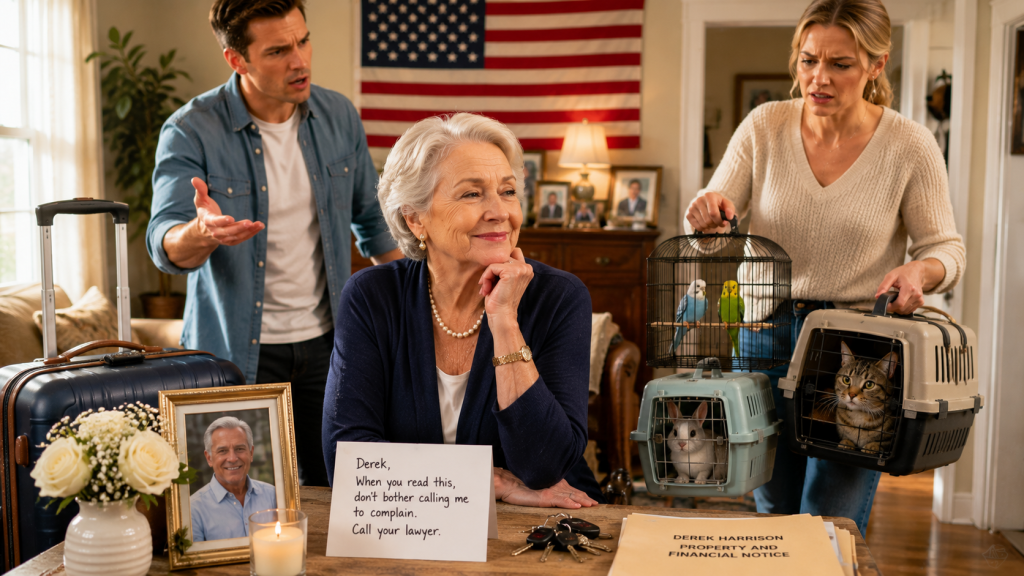
Megan came through the doorway behind him carrying three cages.
Two screeching parakeets.
A shivering white rabbit.
And a cat trapped inside a battered carrier, looking about as thrilled with the arrangement as I was.
She placed everything in the middle of my living room.
Right beside Arthur’s memorial portrait.
No flowers.
No sympathy.
No hug.
Just animals and a massive bag of kibble.
“Swap out the parakeets’ water twice a day,” Megan said without looking up from her phone. “No iceberg lettuce for the rabbit. The cat has severe anxiety, so don’t let him outside. And scoop the litter properly because it reeks if you don’t.”
I stared at her.
“Megan, I literally just buried my husband.”
She sighed.
Not sympathetically.
Annoyedly.
“Oh, Evelyn, everyone goes through hard times.”
Derek didn’t even flinch.
“Besides, it gives you a purpose, Mom. You’d just sit around getting bored by yourself anyway.”
Something changed inside me.
It wasn’t rage.
It was clarity.
Beautiful, quiet clarity.
I looked at the cages.
Then at my son.
And I smiled.
“Of course, sweetheart. Leave them here.”
Megan raised an eyebrow.
She had expected resistance.
“We left our spare apartment key on the counter in case you need more food.”
Derek kissed my forehead.
“Thanks, Mom. We know we can always count on you.”
There it was.
The sentence that had defined my entire adult life.
We can always count on you.
Not:
We love you.
Not:
We appreciate you.
Count on you.
Like a checking account.
Like a backup generator.
Like an appliance that was expected to keep working until someone unplugged it.
That evening, after their car disappeared down the street, I did not cry.
I pulled my navy suitcase from the hall closet.
I packed three sundresses.
Comfortable sandals.
Two bathing suits.
My reading glasses.
Arthur’s old Panama hat.
And the expensive perfume he had bought me shortly before his diagnosis.
Then I packed the thick manila folder my attorney had prepared.
At nine o’clock, I called Mrs. Higgins next door.
“Is your nephew still willing to collect these animals?”
“Absolutely.”
Her nephew, Daniel, operated a licensed animal rescue and boarding facility.
I had already called him before Derek arrived.
I hadn’t known what Derek would want.
But after forty-one years of motherhood, I had learned to anticipate requests disguised as obligations.
Daniel arrived with his van before midnight.
I paid the boarding fees for two weeks.
After that, Derek and Megan could make their own arrangements.
The animals would be safe.
That mattered to me.
Punishing innocent creatures for my son’s behavior would have made me no better than him.
By four in the morning, my living room was spotless.
The cages were gone.
Arthur’s memorial candles were extinguished.
My suitcase waited by the door.
On the coffee table, I placed my house keys.
Beside them, I left a note.
It didn’t say:
I’m sorry.
It didn’t say:
Please understand.
And it certainly didn’t say:
I love you.
It said:
Derek,
When you read this, don’t bother calling me to complain.
Call your lawyer.
—Mom
At five-thirty, I climbed into a rideshare headed for the Port of San Diego.
The morning was still dark.
For the first time in decades, my hands weren’t weighed down by groceries, prescriptions, laundry baskets, or somebody else’s emergency.
I carried one suitcase.
One handbag.
And my passport.
My phone began buzzing as the lights of the cruise terminal came into view.
Megan.
Derek.
Megan.
Derek.
I ignored them.
Then the text messages started.
MOM CALL ME NOW.
WHERE ARE THE ANIMALS?
WHY IS DANIEL SAYING WE OWE BOARDING FEES?
WHAT DID YOU DO?
I switched my phone to silent.
The ship waiting at the terminal looked impossibly large.
A floating city.
White decks rose above me, lined with balconies and lights.
People around me dragged suitcases, laughed, hugged, checked documents.
For once, nobody needed anything from me.
At the boarding ramp, I checked my phone one last time.
A message from Derek.
Mom, what the hell did you do? There’s a court official at the front door telling us the house doesn’t belong to us anymore.
I smiled.
Then another message appeared.
A photograph.
Derek stood inside my living room, ghost-white, holding my note.
Behind him sat the second legal folder.
His name was written across the front.
DEREK HARRISON — PROPERTY AND FINANCIAL NOTICE.
I turned off my phone.
Then I boarded the ship.
What Derek didn’t understand was that my escape had not begun after Arthur died.
It had begun six months earlier.
Arthur had known he was dying.
We both knew.
Toward the end, he stopped pretending otherwise.
One afternoon, I found him sitting at the kitchen table with a yellow legal pad.
“What’s that?”
He covered it with his hand.
“My list.”
“Of what?”
“Things I need to fix before I go.”
My throat tightened.
“Arthur.”
“Sit down, Evie.”
Only Arthur called me Evie.
I sat.
He looked toward the window.
“What’s going to happen to you after I’m gone?”
“I’ll manage.”
“That isn’t what I asked.”
I didn’t answer.
Arthur knew.
He had watched Derek treat our home like an eventual inheritance.
He had watched Megan discuss renovations to rooms she did not own.
Once, during Thanksgiving, Megan stood in my kitchen and said:
“When this becomes ours, I’m knocking down that wall.”
Arthur had been sitting ten feet away.
He never forgot it.
Neither did I.
Arthur reached across the table.
“I spent years telling myself Derek would grow out of it.”
“So did I.”
“He didn’t.”
“No.”
Arthur looked at me.
“And you keep rescuing him.”
“He’s our son.”
“He’s fifty-two.”
That silenced me.
Arthur continued.
“We helped him with college.”
I nodded.
“His first car.”
“Yes.”
“His first house deposit.”
“Yes.”
“His credit cards.”
I looked away.
“Twice.”
“Three times.”
I stared at him.
Arthur smiled sadly.
“You forgot 2018.”
I had.
That’s how often we had rescued Derek.
It had all blended together.
Arthur squeezed my hand.
“Evie, helping a child stand is love. Carrying him so long that he forgets how to walk isn’t.”
I began crying.
“I don’t know how to stop.”
“Then let me help.”
Three days later, we met with attorney Samuel Brooks.
Samuel was seventy, sharp-minded, patient, and completely unimpressed by family drama.
He reviewed our property.
The house.
Investment accounts.
Arthur’s pension.
Insurance.
Savings.
Then he asked us what we wanted.
Arthur answered before I could.
“I want my wife protected from our son.”
Those words hurt.
Because they were true.
The house had been purchased thirty-two years earlier.
Derek had never paid a cent toward it.
But three years earlier, during Arthur’s illness, we had made a mistake.
A terrible one.
We allowed Derek to move into the detached guesthouse behind our property.
He claimed it would be temporary.
Six months.
Maybe nine.
He and Megan were supposedly saving for another home.
Nine months became three years.
They paid no rent.
Then Megan started receiving mail at our address.
Then Derek started telling people he was “helping manage the property.”
Then they began talking about the house as though inheriting it were simply a matter of waiting.
Arthur saw where it was going.
So we changed everything.
The property was placed into a trust.
Not Derek’s trust.
Mine.
The arrangement guaranteed my right to live there, sell it, rent it, or dispose of it however I chose.
After my death, whatever remained would not automatically pass to Derek.
Instead, most of it would fund scholarships for nursing students and hospice-care workers.
Derek would receive a smaller inheritance through a separate trust.
Enough to help.
Not enough to reward a lifetime of dependence.
But there was another problem.
The guesthouse.
Derek and Megan had begun acting as though they owned it.
So before Arthur died, Samuel started the formal process necessary to end their occupancy.
They received written notices.
Derek ignored them.
Megan called them “paperwork nonsense.”
They assumed I would never follow through.
They were wrong.
The court official at my front door that morning wasn’t taking my house away.
He was delivering the next stage of the process that required Derek and Megan to leave the guesthouse.
The house still belonged to me.
What no longer belonged to them was the privilege of treating my property as theirs.
The legal folder explained everything.
It also contained a letter from Arthur.
Not to me.
To Derek.
Arthur had dictated it two weeks before he died.
Samuel witnessed it.
The letter began:
Son,
If you’re reading this, your mother has finally done something for herself.
Do not punish her for it.
I later learned that Derek read the letter standing in my living room.
Megan stood beside him.
Arthur continued:
For years, your mother and I helped you because we loved you.
Somewhere along the way, you stopped receiving help with gratitude and started expecting it as your right.
That was partly our fault.
We taught you that every bad decision would be cushioned.
Every debt would be rescued.
Every inconvenience could become your mother’s responsibility.
We should have stopped sooner.
But we’re stopping now.
The guesthouse is not yours.
The main house is not yours.
Your mother’s savings are not yours.
And your mother’s remaining years are certainly not yours.
Derek later told me that was the sentence that broke him.
Not the property.
Not the inheritance.
Her remaining years are not yours.
But I didn’t know that yet.
I was at sea.
The first morning of my cruise, I woke before sunrise.
For a few confused seconds, I forgot where I was.
Then I heard the ocean.
I stepped onto my balcony wearing Arthur’s robe.
The Pacific stretched beyond the railing.
No dishes waited in the sink.
No medication alarm sounded.
No son needed money.
No daughter-in-law had instructions.
I made coffee.
Then I cried.
Not because I regretted leaving.
Because Arthur should have been there.
That was something I had not prepared for.
Freedom and grief can occupy the same room.
You can be relieved and heartbroken at once.
For the first month, I barely participated in anything.
I ate breakfast alone.
Read novels.
Watched the ocean.
Sometimes I sat beside the pool and listened to other people laugh.
Then I met Grace.
She was sixty-nine.
Widowed six years.
From Wisconsin.
She sat beside me at breakfast one morning and asked:
“Are you hiding from someone or recovering from someone?”
I nearly choked on my coffee.
“Is it that obvious?”
“To another widow? Yes.”
We became friends.
Grace dragged me to trivia.
Then ballroom dancing.
Then a watercolor class.
My first painting looked like somebody had spilled soup on a postcard.
I framed it anyway.
In Hawaii, I stood barefoot on a beach while the sunset turned the sky orange.
In Tahiti, I bought a ridiculous flowered dress.
In New Zealand, I took a scenic train ride and spent most of it wishing Arthur could see the mountains.
In Australia, I held a koala and sent the photograph to Mrs. Higgins.
She replied:
Arthur would be laughing his head off.
I laughed too.
Then I cried for twenty minutes.
Meanwhile, Derek’s life was unraveling.
Not because I had destroyed it.
Because I had stopped holding it together.
They had to leave the guesthouse.
Their Hawaii trip ended early.
The pets came home.
The boarding fees were theirs.
Their credit cards were theirs.
Their rent was theirs.
Their childcare was theirs.
Their groceries were theirs.
Their emergencies were theirs.
For the first time in decades, I did not fix anything.
Derek called seventy-three times during my first month.
I answered none.
Then the calls became less frequent.
By month three, he sent an email.
Mom,
I’m angry.
I’m trying not to be.
Dad’s letter hurt.
I keep reading it.
Megan says you abandoned us.
I don’t know what I think.
I didn’t answer.
A month later, another email arrived.
Mom,
I got a second job on Saturdays.
I hate it.
I think that’s probably something you would find funny.
I smiled.
Still, I didn’t respond.
Then came another.
Mom,
I found the old bank statements while packing.
I didn’t realize how much money you and Dad gave us.
I added it up.
I stopped when I got past $180,000.
I’m ashamed.
That email I answered.
Four words.
Keep doing the math.
Derek didn’t reply for two weeks.
Then:
I deserved that.
Something shifted after that.
He stopped asking when I was coming home.
He started telling me about his life.
Real things.
He had sold the expensive SUV.
Megan returned to full-time work.
They rented a smaller townhouse.
They created a budget.
For the first time in their marriage, they were paying all their own bills.
It wasn’t smooth.
They fought.
A lot.
Megan blamed me.
Then she blamed Derek.
Then, apparently, she started blaming herself.
Six months into my cruise, I received an email from her.
Evelyn,
I owe you an apology.
I stared at that line for a long time.
She continued:
When I brought those animals to your house, I knew you were grieving.
I didn’t care enough to stop and think about what I was doing.
I treated your kindness like a service I had already paid for.
I am embarrassed by that.
I don’t expect forgiveness.
I just needed to say it.
I waited three days.
Then I replied.
Thank you for saying it.
That was all.
Forgiveness does not require immediate intimacy.
Some bridges should be rebuilt slowly enough to test whether they’ll hold.
By month nine, something else happened.
I realized I had stopped counting the days until the cruise ended.
I had become Evelyn again.
Not Arthur’s caregiver.
Not Derek’s mother.
Not Megan’s emergency babysitter.
Evelyn.
I liked jazz.
I hated bingo.
I discovered I loved snorkeling.
I could drink exactly one martini before becoming embarrassingly friendly with strangers.
I loved waking early.
I loved reading on deck.
I loved wearing red.
Arthur always told me I looked beautiful in red.
I had stopped wearing it because Megan once said it was “a little loud for someone your age.”
I bought four red dresses.
On what would have been Arthur’s seventy-sixth birthday, I stood alone at the ship’s railing.
I wore his Panama hat.
In my hand was a glass of his favorite whiskey.
“Happy birthday, old man.”
The wind took the words.
I imagined him beside me.
Then I whispered:
“I finally stopped.”
Stopped what?
I knew exactly what.
Apologizing for living.
When the cruise returned to San Diego almost a year after I left, I expected Derek to be waiting.
He wasn’t.
That surprised me.
Then I checked my phone.
There was one message.
Mom, I wanted to come to the port, but I realized that would be me deciding what your first hour home should look like. Call when you’re ready. Welcome back.
I read it twice.
Then I smiled.
Maybe my son had finally learned something.
I spent my first night home alone.
The house smelled closed-up, even though Mrs. Higgins had cared for it beautifully.
Arthur’s photograph was still on the mantel.
I touched the frame.
“I’m home.”
The next afternoon, I called Derek.
He answered immediately.
“Mom?”
“Hello, sweetheart.”
Silence.
Then I heard him crying.
“I missed you.”
“I missed you too.”
“Can we come over?”
“Tomorrow.”
“Okay.”
No argument.
No guilt.
Just:
“Okay.”
They arrived at noon.
No cages.
No suitcases.
No requests.
Megan carried flowers.
Derek carried a small cardboard box.
He hugged me.
A real hug.
Long.
Awkward.
Human.
Megan stood near the doorway.
“I don’t know whether I’m allowed to hug you.”
I appreciated that more than she knew.
“You can.”
She did.
Then we sat in the living room.
The same room where the cages had once been dumped.
For a while, nobody knew what to say.
Finally, Derek opened the cardboard box.
Inside were my diamond wedding earrings.
I stared at them.
My breath caught.
“How?”
“I found the pawn receipt among Dad’s papers.”
I looked at him.
“I bought them back.”
“Derek—”
“With my own money.”
He smiled slightly.
“I worked overtime.”
My eyes filled.
“I know they aren’t just earrings.”
No.
They weren’t.
They were the last beautiful thing I had sacrificed when Arthur became ill.
Derek placed the box in my hand.
“Dad wrote that you gave away pieces of yourself every time we needed something.”
His voice cracked.
“I can’t give all of them back.”
He looked at me.
“But I could give you these.”
I cried then.
So did he.
Megan reached across the table.
She did not grab my hand.
She waited.
I placed mine over hers.
We talked for almost four hours.
Not everything was repaired.
Some things never return to exactly what they were.
And perhaps they shouldn’t.
Derek asked whether he was still in my will.
I appreciated that he asked directly.
“Yes.”
He looked surprised.
“But not the way you expected before.”
He nodded.
“That’s fair.”
“The house may eventually be sold.”
“Okay.”
“Most of the estate will support nursing and hospice scholarships.”
“Dad told me.”
“And I’m keeping enough to live exactly as I choose.”
Derek smiled.
“You should.”
I studied his face.
A year earlier, he would have argued.
That afternoon, he didn’t ask me for anything.
When they left, Megan carried her own purse.
Derek carried the empty cardboard box.
And I stood at the doorway realizing something extraordinary.
They had come to my house and left without taking anything.
That shouldn’t have felt revolutionary.
But it did.
I didn’t remain home for long.
Three months later, Grace called.
“Norway.”
“What?”
“Cruise. Twenty-one days. Norway. Are you coming?”
I looked at Arthur’s photograph.
Then at my red suitcase.
“Yes.”
This time, I told Derek before I left.
Not because I needed permission.
Because healthy families tell each other things.
He laughed.
“Do you need a ride to the airport?”
“I’ve already booked one.”
“Of course you have.”
Then he said:
“Have fun, Mom.”
No guilt.
No instructions.
No cages.
Just love.
I am seventy-one now.
People sometimes ask whether I regret leaving so soon after Arthur died.
I don’t.
Grief does not have a dress code.
It does not have a timetable.
And it certainly does not require a widow to spend the rest of her life sitting beside a photograph proving how much she loved the man who is gone.
Arthur knew I loved him.
I know he loved me.
The final gift he gave me wasn’t the house.
It wasn’t his pension.
It wasn’t even that brutal letter to our son.
It was permission.
Permission to stop living entirely for other people.
The day Derek dumped those cages into my living room, I thought my family was about to fall apart.
In a way, it did.
But some things need to fall apart before they can be rebuilt correctly.
Derek had to learn that his mother was not an unlimited resource.
Megan had to learn that kindness is not employment.
And I had to learn the hardest lesson of all.
Being needed is not the same as being loved.
For forty years, I confused the two.
Now I know the difference.
These days, Arthur’s photograph sits beside one of my cruise pictures.
In his photograph, he’s standing beside Lake Tahoe in that white linen shirt, smiling at me from another lifetime.
In mine, I’m standing on the deck of a ship somewhere in the South Pacific.
I’m wearing a bright red dress.
Arthur’s Panama hat is tilted on my head.
The ocean is behind me.
And I am laughing.
Not smiling politely.
Not posing.
Laughing.
Sometimes I look at those two photographs together.
And I imagine Arthur saying:
“Took you long enough, Evie.”
Maybe it did.
But I got there.
My son once believed my remaining years belonged to him.
For a while, I think I believed that too.
They didn’t.
They belonged to me.
So I packed a suitcase.
I closed the door.
I boarded a ship.
And for the first time in forty years, when somebody asked what Evelyn wanted, I finally knew the answer.
I wanted my life back.
And I took it.
THE END.
THANK YOU FOR READING!