
“No.”
Leo thought for a while.
“Can I write to him first?”
That was how their relationship began.
Julian told Leo he was terrible at baseball, loved building model bridges, and hated black olives.
Leo replied:
I like baseball.
I hate olives too.
I’m still mad at you.
Julian wrote back:
You have every right to be.
Two months later, they met.
There was no dramatic embrace.
They sat awkwardly in Dr. Vance’s office until Leo finally stared at Julian and said, “You have my eyebrows.”
Julian laughed.
Then he cried.
Their relationship grew slowly.
Julian showed up on time.
He kept promises.
He accepted Leo’s anger without demanding forgiveness.
When Leo refused to speak during one visit, Julian quietly built a model bridge until Leo eventually joined him.
Trust came through ordinary moments.
After months of supervised meetings, they moved to daytime visits, then occasional weekends.
Sarah helped us obtain a court-approved arrangement formally recognizing Julian’s paternity, establishing child support and gradual visitation while I remained Leo’s legal guardian and primary home.
Money never bought Julian a place in Leo’s life.
Showing up did.
Eleanor’s path was even harder.
When Leo was 11, he confronted her.
“You knew Grandma’s name.”
“Yes.”
“You could have mailed the letter.”
“Yes.”
“Why didn’t you?”
She looked at him.
“Because I was afraid of my husband for many years. And after I became safer, I was afraid to admit how badly I had failed all of you.”
“Do I have to forgive you?”
“No.”
That answer mattered.
Eleanor stopped asking for forgiveness and started earning trust.
Eventually, Leo began calling her Grandma Eleanor.
Years passed.
At 18, Leo changed his surname.
He didn’t become Leo Sterling.
He became Leo Hayes-Sterling.
When one relative accused him of dishonoring Clara, Leo simply said, “Both names are part of my story.”
At 24, Eleanor died.
At her funeral, Leo said, “She taught me that saying you’re sorry matters most when it changes what you do afterward.”
During her later years, Eleanor had volunteered with organizations helping families affected by coercive control.
She never claimed her work erased her mistakes.
She simply stopped allowing fear to direct her life.
Leo became a structural engineer.
At 30, he married an urban planner named Maya.
At 33, they had a daughter.
They named her Sophie Clara Hayes-Sterling.
The first time I held her, I cried.
Julian stood beside me, gray beginning to show in his hair.
Leo carefully placed the baby in his arms.
“Your turn, Grandpa.”
Julian froze.
Then he kissed his granddaughter’s forehead and broke down.
By then, there was no competition between Julian and me.
No argument over who had earned Leo more.
We were simply family.
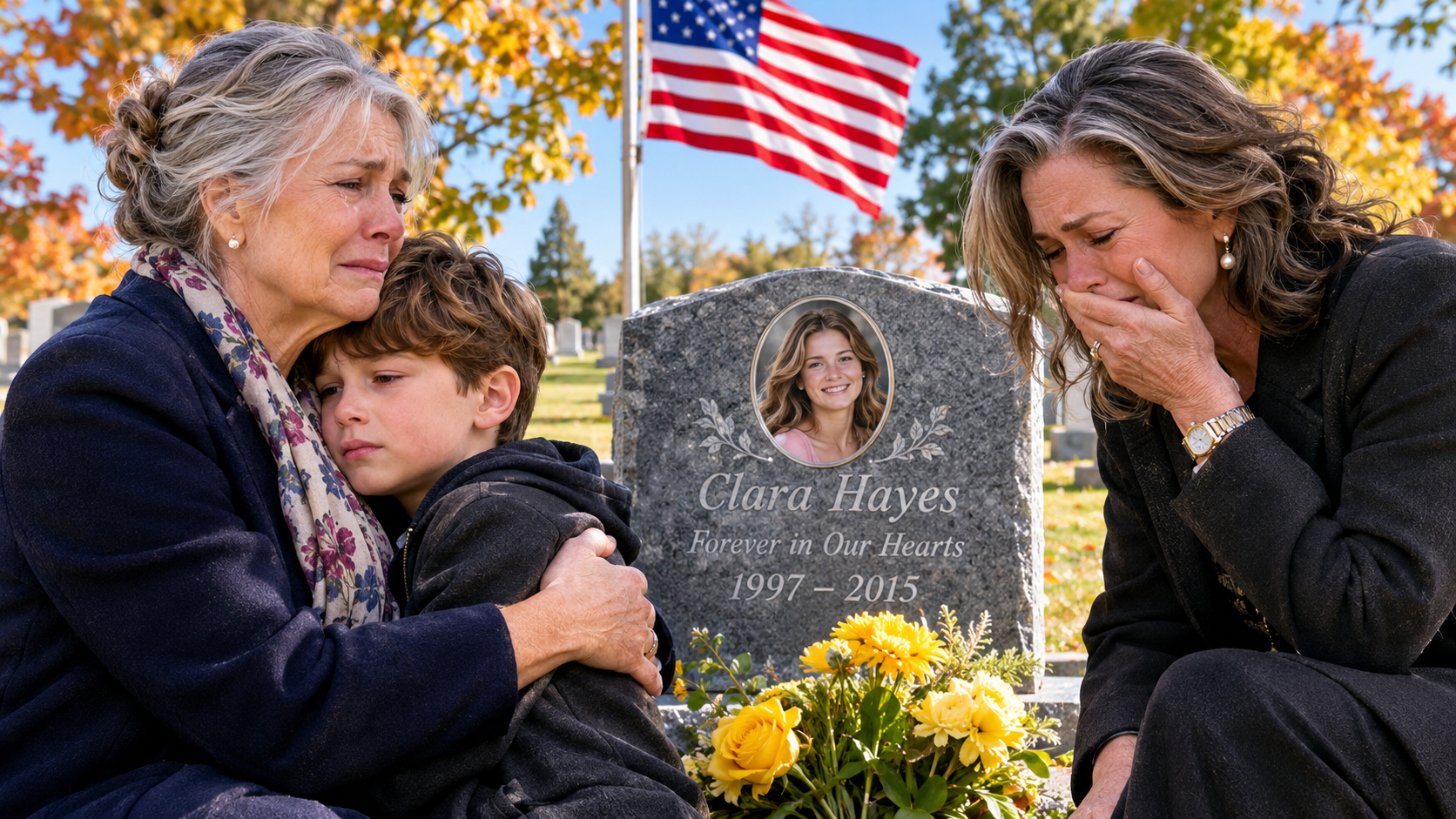
On the 35th anniversary of Clara’s death, Leo was 35, and Sophie was 2.
All of us returned to the same Washington cemetery.
Sophie carried a few yellow wildflowers up the hill.
Leo crouched beside Clara’s headstone and pointed to her photograph.
“That’s your Grandma Clara.”
Sophie studied it.
“She looks like Daddy.”
I smiled.
“She does.”
Eventually, everyone began walking back toward the cars.
Julian and I remained behind.
“Martha?”
“Yes?”
“Thank you for opening the door.”
“I almost didn’t.”
“I wouldn’t have blamed you.”
I looked toward Leo, walking beside Maya with Sophie between them.
“Opening the door wasn’t enough,” I said. “You had to do something after you walked through it.”
Julian nodded.
“I know.”
For years, I wished Eleanor had brought me Clara’s letter immediately.
I imagined how different everything might have been if the truth had arrived sooner.
But eventually I understood that imagining a corrected past can become another form of grief.
The truth would not have brought Clara back.
It would not have instantly healed Julian.
It would not have made Eleanor brave overnight.
We lost years.
That mattered.
But we did not lose the future.
And the truth finally gave Leo something I could never give him when he was small.
He knew where he came from.
He knew who loved him.
Who failed him.
Who lied.
Who stayed silent.
Who arrived late.
Who apologized.
And who changed.
Most importantly, he understood that none of those adult choices had ever meant he was unwanted.
For 10 years, I thought the missing piece of our family was the identity of Leo’s father.
I was wrong.
The missing piece was the truth.
And when it finally arrived, it didn’t erase the pain.
It simply gave us the chance to decide what happened next.
That became our real inheritance:
not money,
not a surname,
not even Clara’s letter,
but the decision that fear would no longer write the next chapter of our family.
💬THE END! THANK YOU FOR READING! ❤️🙏