
My mom spent 90 days hooked up to tubes and recovering from surgeries, and my husband didn’t even bother to step through the hospital doors.
A year later, when his own mother took a spill down the stairs, he texted me: “Get to the ER right now. You need to take care of my mom.”
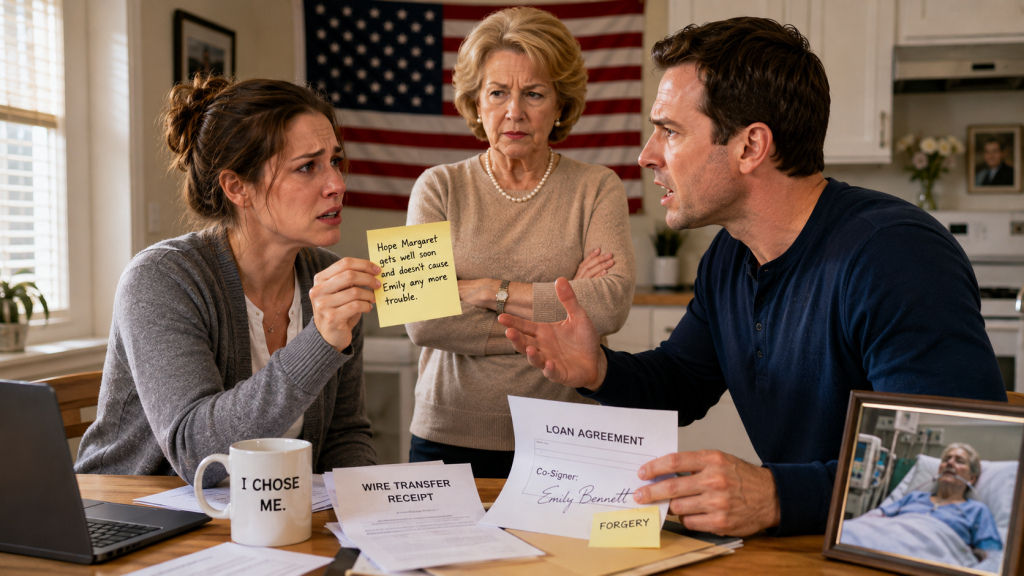
What he didn’t realize was that I was holding onto a Post-it note, a wire transfer receipt, and a forged signature that could completely destroy the perfect facade his family put up.
My mother had just gotten out of oncology surgery, and I had spent three sleepless nights curled up in an uncomfortable vinyl hospital chair.
My husband told me, “Just hire a home health aide,” and hung up the phone.
He didn’t show up once in 90 days.
My name is Emily. I’m thirty-five years old, and for the longest time, I thought suffering in silence was the same thing as being strong.
I worked in corporate finance in downtown Chicago, living my life in a frantic blur between the office and the hospital, trying to convince myself that everything would be fine if I just powered through it a little longer.
But there is a specific kind of coldness a woman never forgets.
Mine started the day I called David to tell him that my mother, Margaret, had stomach cancer and needed emergency surgery.
The call lasted forty-seven seconds.
Forty-seven.
That was all the time he had for news that completely shattered my world.
Then came the grueling days.
The sterile white corridors.
Stale vending-machine sandwiches scarfed down in a hurry.
The early mornings filled with the steady beep of monitors and a heavy, sinking fear in my chest.
I spent nights with Mom, commuted to the office in the morning, rushed back to the hospital on my lunch break, returned to work, and then headed back to the ward.
David always had an excuse.
An urgent board meeting.
A client dinner.
Swamped with work.
Year-end crunch.
Too much pressure at the firm.
My mom was incredibly frail, hooked up to an IV pole and learning how to survive after losing most of her stomach.
And my husband, the man I had been married to for seven years, couldn’t bring himself to cross the threshold of her recovery room once.
The worst part wasn’t just his absence.
It was the callousness with which he abandoned me.
It was the dismissive tone when he said hiring a nurse would “fix everything,” as though I were making a big deal out of nothing.
As if taking care of my mother fresh out of surgery was some inconvenience I had created.
As if the exhaustion, fear, and mounting medical bills were mine alone.
Then there was his family.
On Christmas Eve, while I was feeding Mom awful hospital Jell-O, my mother-in-law, Patricia, called me furious that I wasn’t coming to her house in the suburbs to cook the holiday roast.
When I explained that Margaret couldn’t be left alone, Patricia said something that still burns in my memory.
“If a woman comes from a blue-collar family, she should at least have the brains to make up for it.”
David was standing near her.
I heard his voice in the background.
He heard every word.
And said absolutely nothing.
My mother was finally discharged eighty-seven days after her surgery.
It was a brutally cold Chicago morning.
David pulled up to the hospital loading zone, but he didn’t even put the car in park to help a frail woman who had spent almost three months in a hospital bed.
I wrestled with the bags myself.
I helped Mom into the back seat.
That was when I noticed a gift box sitting on the floorboard.
A yellow Post-it note was stuck to the top.
Patricia had written it.
Hope Margaret gets well soon and doesn’t cause Emily any more trouble.
No more trouble.
I can still remember the weight of those words.
When we reached Mom’s apartment building, David kept the engine running.
He said he was late.
I helped Mom onto the icy sidewalk and turned around to retrieve her luggage.
David drove away.
With her suitcases still locked in his trunk.
He just left.
That was the moment something inside me stopped begging.
And started observing.
That night, I opened my laptop.
I created an Excel spreadsheet.
I gave it the dullest name imaginable.
Q4 Vendor Reconciliation.
Then I started logging everything.
Dates.
Messages.
Screenshots.
Bank activity.
The forty-seven-second phone call.
The hospital dates.
David’s absence.
Patricia’s Christmas call.
The yellow Post-it.
Everything.
At first, I wasn’t planning a divorce.
I think some part of me simply needed proof that I wasn’t imagining what my marriage had become.
Then I found the first wire transfer.
Four thousand dollars.
David had transferred it from our joint checking account to Patricia.
The date?
Three days after he told me we couldn’t afford to contribute another dollar toward Mom’s home-health aide.
I stared at the transaction.
Then I took a screenshot.
I added it to my spreadsheet.
A few months later, while reviewing older statements, I found something worse.
Forty thousand dollars.
Memo:
FAMILY ASSISTANCE.
Recipient:
SARAH BENNETT.
David’s younger sister.
I knew Sarah had purchased a townhouse recently.
What I hadn’t known was that we had apparently helped finance it.
I called the bank.
The representative explained that the transaction was connected to a private family loan.
“Was I listed on it?”
There was a pause.
“Yes, Mrs. Bennett. You’re listed as co-signer.”
My skin went cold.
“I’d like a copy.”
The secure email arrived twenty minutes later.
I opened the PDF.
I read every page.
Then I reached the signature section.
David Bennett.
Sarah Bennett.
Emily Bennett.
My name.
My signature.
Except I had never signed it.
I sat at the kitchen table staring at the screen.
David was upstairs taking a shower.
The house was completely ordinary around me.
Dishwasher running.
Clock ticking.
His shoes beside the back door.
Yet I knew with absolute certainty that my marriage had just ended.
I didn’t confront him.
That may have been the smartest decision I made.
Instead, I downloaded the file.
I printed two copies.
I saved another copy to secure storage.
Then I called someone from work.
Her name was Rebecca Stein.
She was an attorney specializing in financial disputes and white-collar investigations.
We weren’t close friends.
But I trusted her.
“Rebecca, can I ask you something hypothetical?”
She listened.
Then she said:
“Emily, stop calling this hypothetical.”
My throat tightened.
“I don’t know who signed it.”
“Good. Don’t accuse anyone yet.”
“What should I do?”
“Preserve everything exactly as you received it. Don’t alter the documents. Don’t access accounts you’re not authorized to access. And get your own family-law attorney.”
I stared toward the staircase.
“Do you think David did this?”
“I think your signature appears on a financial document you say you didn’t sign. That’s enough to take seriously.”
That distinction mattered.
Rebecca didn’t give me a dramatic speech.
She gave me instructions.
Document.
Preserve.
Protect.
Verify.
So I did.
Over the next several months, I quietly separated the truth from my emotions.
The loan had helped Sarah purchase her townhouse.
The forty thousand dollars came from a home-equity line attached to the house David and I owned together.
My alleged signature had helped authorize it.
I requested every document I was legally entitled to receive.
One afternoon, I found the detail that changed everything.
The electronic signature record listed the IP address used to submit my authorization.
It matched our home network.
The submission time was 9:42 p.m. on December 18.
I checked my hospital records.
At 9:42 p.m. on December 18, I was sitting beside my mother after an emergency procedure.
I had used my badge to enter the oncology ward at 8:51.
I didn’t leave until after midnight.
David had been home.
I added that to the spreadsheet.
Then I waited.
Why?
Because my mother was still recovering.
Because I needed to make sure I could support myself.
Because I wanted facts, not fury.
And because I was beginning to understand something about David.
He had spent years assuming my patience meant I had no limit.
He was wrong.
Eleven months after Mom came home from the hospital, I was sitting in my office when my phone vibrated.
David.
GET TO NORTHWESTERN ER RIGHT NOW.
I stared at the screen.
A second message arrived.
MOM FELL DOWN THE STAIRS.
Then:
YOU NEED TO TAKE CARE OF HER.
Not:
Please come.
Not:
I’m scared.
Not:
Can you help?
You need to take care of her.
I called him.
He answered immediately.
“Where are you?”
“At work.”
“Then leave.”
“Is Patricia conscious?”
“Yes. They think her hip is fractured.”
“Are you with her?”
“Obviously.”
“Is Sarah coming?”
A pause.
“Sarah has the kids.”
“Then you’re there.”
“Emily, don’t start.”
“Start what?”
“This isn’t the time for your issues with my mother.”
I looked through my office window at the Chicago skyline.
“I didn’t say anything about my issues with your mother.”
“Good. Then get here. Mom is going to need somebody after surgery, and I can’t take weeks off.”
There it was.
I almost admired the symmetry.
A year earlier:
Just hire a home health aide.
Now:
You need to take care of my mom.
“David?”
“What?”
“Hire a home health aide.”
Silence.
Complete silence.
Then:
“Excuse me?”
“You heard me.”
“My mother is hurt.”
“So was mine.”
“Don’t compare this.”
“Why?”
“Because this is different.”
“How?”
“Emily.”
His voice became low.
Warning.
The voice that had worked on me for years.
I opened my desk drawer.
Inside were three things.
The yellow Post-it.
The wire-transfer receipt.
A copy of the document carrying my forged signature.
I touched the folder.
Then I said:
“I’ll come to the hospital.”
His tone changed instantly.
“Thank you.”
“But not to take care of Patricia.”
“What does that mean?”
“You’ll find out.”
I ended the call.
Before leaving my office, I made one more call.
To my attorney.
Her name was Claire Morrison.
She had spent the previous two months preparing everything.
“Is today the day?” she asked.
“Yes.”
“Are you sure?”
I looked at Patricia’s Post-it.
“Yes.”
When I reached the hospital, David was pacing outside the emergency department.
He rushed toward me.
“Finally.”
I looked past him.
“How is she?”
“Broken hip. They’re admitting her.”
“I’m sorry she’s hurt.”
He grabbed my elbow.
“We need to talk logistics.”
I looked at his hand.
He released me.
“She’ll probably need surgery,” he continued. “Then rehabilitation. After that, she can stay with us.”
“No.”
He blinked.
“What?”
“She isn’t staying with me.”
“With us.”
“No.”
His face hardened.
“Emily, she’s my mother.”
“Yes.”
“What kind of wife refuses to help her husband’s mother after an accident?”
I almost laughed.
Instead, I reached into my handbag.
I removed the yellow Post-it.
I handed it to him.
He stared at it.
His face changed.
“Where did you get this?”
“It was attached to the gift your mother sent mine after cancer surgery.”
He read it.
His jaw tightened.
“That was a joke.”
“My mother didn’t laugh.”
“Mom has a sharp sense of humor.”
“Then perhaps she can joke with her home-health aide.”
He crushed the note slightly.
“You’ve been carrying this around for a year?”
“No.”
I took it back.
“I’ve been carrying evidence.”
His expression shifted.
“What evidence?”
I removed the wire-transfer receipt.
Four thousand dollars.
His eyes moved across the page.
“This is none of your business.”
“It came from our joint account.”
“It was my money too.”
“Three days earlier, you told me we couldn’t afford help for my mother.”
“She isn’t my responsibility.”
I nodded.
“Exactly.”
He frowned.
“Exactly what?”
“Your mother isn’t mine.”
David stared at me.
“You’re unbelievable.”
“No, David.”
I reached into my bag again.
“This is unbelievable.”
I handed him the forty-thousand-dollar loan document.
For the first time that day, David stopped performing anger.
He became afraid.
It lasted less than a second.
But I saw it.
“Where did you get this?”
“The bank.”
His eyes moved toward the signature page.
“Emily—”
“Don’t.”
“You don’t understand.”
“My name is on it.”
“It was just paperwork.”
“My signature is on it.”
“You agreed we should help Sarah.”
“No, I didn’t.”
“We talked about it.”
“You mentioned that Sarah was having trouble with her down payment. I said we couldn’t afford to help because of Mom’s medical expenses.”
David lowered his voice.
“Not here.”
“Why?”
“Because we’re in a hospital.”
“That didn’t bother you when you ordered me to become your mother’s caregiver.”
His face reddened.
“I did not forge anything.”
Interesting.
I hadn’t accused him directly.
Not yet.
“I didn’t say you did.”
He went quiet.
That was when Sarah appeared.
She walked around the corner carrying a coffee.
“Emily.”
Then she noticed the papers.
Her face changed.
David immediately said:
“Go back to Mom.”
Sarah didn’t move.
I looked at her.
“Did you know my signature was on your loan?”
She looked at David.
Not me.
That was answer enough.
“Sarah.”
“I thought you agreed.”
“Did you see me sign it?”
“No.”
“Did David tell you I signed it?”
“Emily, stop,” David snapped.
Sarah looked frightened.
“He said you were at the hospital and that you’d already approved everything.”
My heart was pounding.
“Did you ever speak to me about the loan?”
“No.”
David stepped between us.
“This is ridiculous.”
Sarah’s voice became smaller.
“David, you told me she knew.”
“She did know.”
“No.”
I held up the document.
“I didn’t.”
He looked around.
People were beginning to notice.
“Lower your voice.”
I did.
That somehow made him more nervous.
“The authorization was submitted from our house at 9:42 p.m. on December 18,” I said. “I was inside the oncology ward with my mother.”
David stared at me.
“I have the entry records.”
Nothing.
“The bank has the electronic audit trail.”
Still nothing.
“And my attorney has everything.”
That was when the color left his face.
“Attorney?”
I reached into my handbag one final time.
Not for another piece of evidence.
For an envelope.
I handed it to him.
He didn’t take it.
“What is that?”
“You know.”
“No.”
“Yes.”
Sarah backed away.
David finally accepted the envelope.
He opened it.
His eyes moved over the first page.
Then stopped.
“Divorce?”
“Yes.”
His voice became almost a whisper.
“You’re divorcing me while my mother is in the hospital?”
“No.”
I looked him straight in the eye.
“I’m divorcing you because of what happened while my mother was in the hospital.”
He stared at me.
“This is insane.”
“No.”
“You’ve planned this.”
“Yes.”
“For how long?”
“Long enough to do it correctly.”
“You’re destroying our marriage over money?”
I shook my head.
“No. The money helped me understand the marriage.”
He looked toward Sarah.
She looked away.
“Emily, let’s go home and talk.”
“I won’t be going home with you.”
“What?”
“I moved my essential things yesterday.”
His eyes widened.
“Where?”
“Somewhere else.”
“You can’t just leave.”
“I already did.”
He laughed once.
It sounded hollow.
“You think some documents make you powerful?”
“No.”
I folded my hands.
“They make things documented.”
He stared at me.
Then came the sentence I had been waiting years to hear.
“I need you.”
It should have broken my heart.
Instead, it clarified everything.
David didn’t say:
I love you.
He didn’t say:
I’m sorry.
He said:
I need you.
Of course he did.
His mother was injured.
His sister had children.
His work was demanding.
Someone needed to organize rehabilitation, medication, appointments, meals, insurance forms, transportation, and everything else invisible women are expected to absorb.
He needed the same labor he had dismissed when it was my mother.
I looked at him.
“No, David.”
His face tightened.
“You need help.”
I paused.
“And as you told me last year, you can hire it.”
I left.
The next few weeks were ugly.
But they were also illuminating.
Patricia underwent surgery and eventually moved to a rehabilitation center.
Sarah handled most of her appointments.
David complained constantly about the expense.
Apparently professional caregiving became terribly expensive when he was the one paying for it.
Meanwhile, the financial investigation continued.
The bank reviewed the disputed authorization.
David initially claimed I had verbally approved the loan.
That didn’t explain the signature.
Then he claimed he thought he had permission to sign on my behalf.
He didn’t.
My attorney handled the legal side.
I stopped arguing.
That was one of the greatest freedoms of my life.
For years, David had trained me to believe every accusation required a defense.
It didn’t.
Documents don’t get tired.
Dates don’t become emotional.
Bank records don’t question whether they remembered correctly.
The evidence simply sat there.
The forty-thousand-dollar transaction became a major issue during the divorce.
The money had benefited Sarah, but the debt had been attached to marital property without my valid authorization.
Sarah eventually cooperated fully.
One evening she called me.
“I owe you an apology.”
I almost hung up.
Instead, I listened.
“I knew something wasn’t right.”
“What do you mean?”
“When David said you approved the loan, I asked why you weren’t signing it yourself.”
“What did he say?”
“That you were overwhelmed with your mother and told him to handle it.”
I closed my eyes.
“Why didn’t you call me?”
“I wanted the money.”
At least she was honest.
“I told myself it wasn’t my marriage.”
“It became your business when you accepted forty thousand dollars from it.”
“I know.”
We never became friends.
But Sarah provided the information my attorney needed.
And something unexpected happened afterward.
She began questioning her brother.
Then her mother.
Then the entire family mythology in which David was the successful golden son, Patricia was the self-sacrificing matriarch, and everybody else existed to keep them comfortable.
Perfect families can survive almost anything except accurate records.
My spreadsheet became particularly useful.
The wire transfers.
The unexplained withdrawals.
The credit-card charges.
The dates.
The messages.
The yellow Post-it.
Not every cruel thing mattered legally.
But together they mattered to me.
They showed a pattern I had spent years trying not to see.
The divorce took nine months.
David fought over everything.
Furniture.
Accounts.
The house.
Even the espresso machine he had never used.
But the biggest fight concerned money.
He wanted the forty-thousand-dollar loan treated as a normal marital decision.
It wasn’t.
The documentation mattered.
The disputed signature mattered.
The audit trail mattered.
Eventually, the financial settlement accounted for what had happened.
I won’t pretend it felt like a movie.
Nobody stood in a courtroom and gasped.
No judge slammed a gavel and delivered a speech about karma.
Real consequences are quieter.
Numbers moved.
Responsibilities were assigned.
Documents were signed.
And one Tuesday afternoon, my marriage ended with a clerk stamping paperwork.
David stood outside the courthouse.
He looked older.
So did I.
“Was it worth it?” he asked.
“What?”
“Destroying everything.”
I looked at him.
“You still think I did that?”
He didn’t answer.
I thought about Mom.
Eighty-seven days.
The hospital chair.
Christmas Eve.
The yellow Post-it.
Her suitcases driving away in David’s trunk.
Then I thought about Patricia’s accident.
His command.
Get to the ER.
You need to take care of my mom.
“Yes,” I said.
“It was worth finally seeing everything clearly.”
Then I walked away.
Mom survived.
That is the part I care about most.
Her cancer treatment continued, but slowly, stubbornly, she got stronger.
A year after my divorce, we went to lunch together.
Just the two of us.
She ordered soup.
Half a sandwich.
And cheesecake she couldn’t finish.
At one point she looked across the table.
“You seem different.”
“I am.”
“Good different?”
I thought about it.
“Quieter.”
She smiled.
“You were always quiet.”
“No.”
I shook my head.
“I used to be silent.”
There is a difference.
Mom reached across the table and squeezed my hand.
I never told her every ugly detail about David.
She knew enough.
She knew the marriage ended.
She knew there had been financial dishonesty.
She knew I had finally chosen myself.
That was sufficient.
Before we left the restaurant, she opened her purse.
“I found something.”
She handed me a yellow square of paper.
For one horrible second, I thought it was Patricia’s note.
Then I read it.
Mom had written:
Emily—
Thank you for showing up.
Every single day.
Love, Mom.
I couldn’t speak.
Mom smiled.
“You always were the dependable one.”
I folded the note carefully.
I still have both Post-its.
Patricia’s is inside the old evidence folder.
Mom’s is framed beside my desk.
One reminds me of the life I left.
The other reminds me why.
As for Patricia, she eventually recovered enough to return home.
David hired caregivers.
Real ones.
Professionals.
People whose labor had schedules, boundaries, and invoices.
I hope he learned something from that.
But whether he did is no longer my responsibility.
Sarah refinanced her townhouse and eventually repaid part of the money involved in the disputed loan.
She sent me a brief message afterward.
I hope you’re doing well.
I answered:
I am.
And I meant it.
My life is smaller now.
Some people might even call it ordinary.
I have my own apartment.
My own accounts.
My own passwords.
Friday dinner with Mom.
A job I enjoy more because I no longer spend every workday wondering what crisis waits at home.
I sleep through the night.
I had forgotten people could do that.
And the spreadsheet?
I kept it.
Not because I need revenge.
Not because I enjoy remembering.
I kept it because there is something important about seeing the moment your own life became visible to you.
The first line is:
47-second call — Mom’s diagnosis.
The last line is:
Divorce finalized.
Between those two cells are hundreds of facts.
But if I had to reduce the entire marriage to one lesson, it wouldn’t be about forged signatures.
It wouldn’t be about money.
It wouldn’t even be about my mother-in-law.
It would be this:
Watch how someone treats your pain when it inconveniences them.
David expected unlimited compassion for his family while treating mine as a burden.
He expected my time when his mother needed care.
My money when his sister needed help.
My signature when the truth became inconvenient.
My silence when questions became dangerous.
And for years, I gave him almost all of those things.
Until I didn’t.
The day Patricia fell, David thought he was sending me an order.
Get to the ER.
Instead, he accidentally gave me the perfect reminder of everything I had learned.
So I went.
I stood in that hospital hallway.
I looked at the man who had ignored my mother’s suffering for ninety days.
And I finally returned something he had given me a year earlier.
His own advice.
Hire help.
The difference was that when he said it to me, I was exhausted, frightened, and alone.
When I said it to him, I was prepared.
I had a Post-it note.
A wire-transfer receipt.
A disputed signature.
An attorney.
And, for the first time in seven years, absolutely no intention of apologizing.
THE END.
THANK YOU FOR READING!