
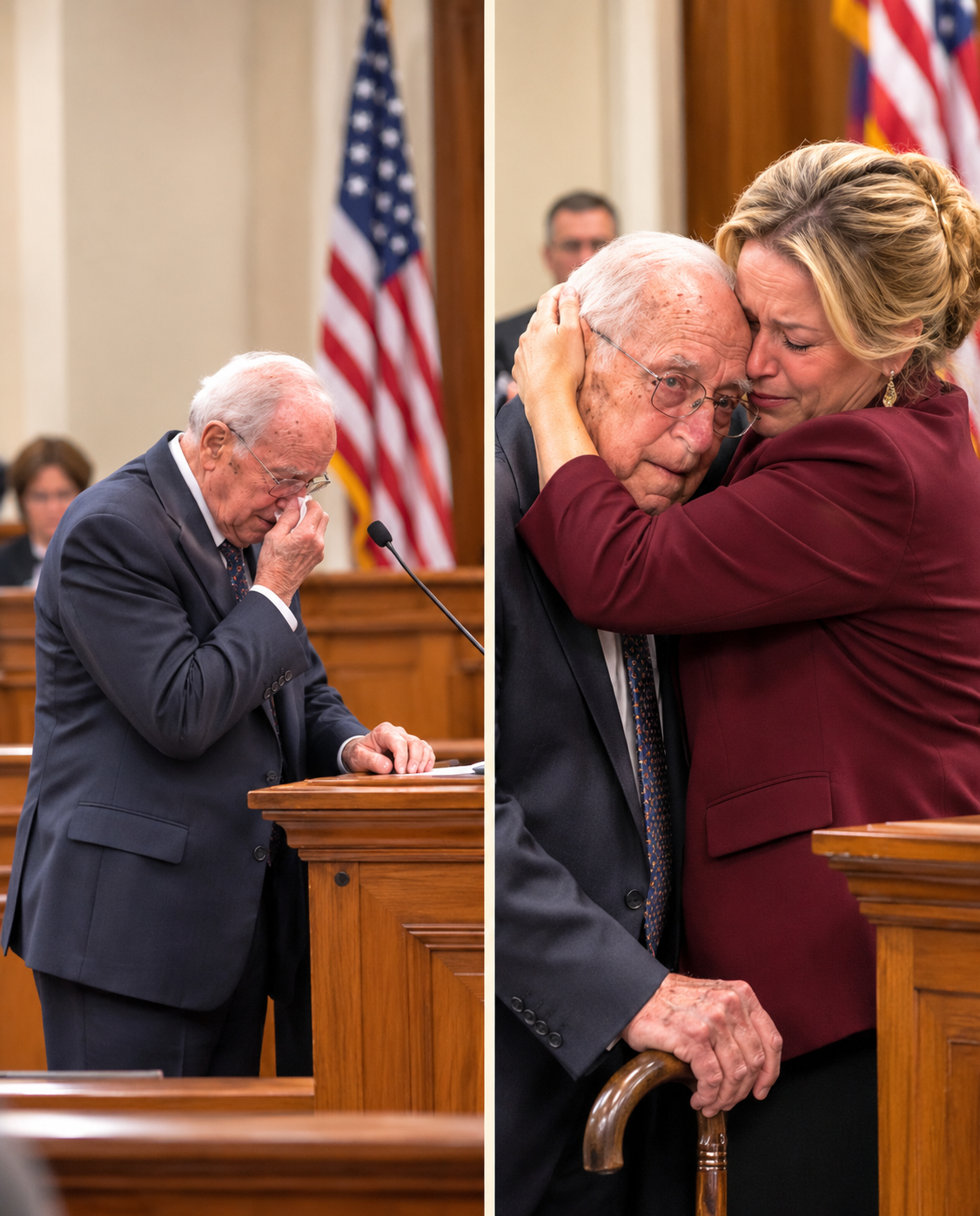
“I know I made a terrible decision,” Walter continued. “I should have asked for help. I should have spoken to the store manager. But I was afraid they would say no. And I was ashamed to admit that at my age, I couldn’t even afford to help a hungry child.”
He wiped his cheek with his sleeve.
“I never wanted to be a criminal, Your Honor. I just didn’t want those children to feel forgotten.”
The judge looked at the photograph for a long time.
Then he turned toward the prosecutor.
“Have the store representatives been informed of this information?”
The prosecutor nodded.
“They are present, Your Honor.”
The judge looked toward the back of the courtroom.
“Would someone from the store please come forward?”
A middle-aged woman wearing a store uniform slowly stood up.
She had been sitting quietly throughout the hearing.
She approached the front, holding a folder.
“Your Honor,” she said, “I manage the store where Mr. Miller was caught.”
The judge nodded.
“Did you know about these circumstances?”
“No, sir. We only knew that he kept taking items. We reviewed the footage, and we couldn’t understand why someone his age would risk so much over things that didn’t seem particularly valuable to him.”
She looked at Walter.
“One of my employees even asked him once why he was doing it. He just apologized and said he was sorry for making trouble.”
She paused.
“After the charges were filed, I went back through the footage myself. There was something I noticed that bothered me.”
The judge leaned forward.
“What was that?”
The woman opened her folder.
“Every single time Mr. Miller entered the store, he passed several expensive items without even looking at them. He never took anything for himself. He only selected the same kinds of basic necessities.”
She looked down at her papers.
“And there’s something else.”
Walter slowly raised his head.
The store manager took out a small envelope.
“We received this in the mail yesterday.”
The judge looked at it.
“What’s inside?”
The woman opened the envelope and removed a handwritten note.
“It was addressed to the store manager. It came from one of the families Walter had been helping.”
She unfolded it.
And before she could read the first sentence, she began to cry.
“Your Honor… I think you should hear this.”
She looked at Walter.
Then she looked at the judge.
And she began reading.
But the first words on that letter would reveal something about Walter that even Margaret had never known.
Something that would change the entire courtroom.
PART 3: The Letter That Changed Everything — A Judge’s Unforgettable Decision
The store manager unfolded the letter with trembling hands.
Nobody in the courtroom spoke.
Walter sat motionless, his old photograph resting between his fingers. Margaret stood beside him, quietly wiping her tears.
The store manager took a deep breath and began reading.
“To the manager of the store,
You probably don’t know who I am.
I’m the mother of three children. Until a few months ago, we were living in a small house near the old railway station. My husband left us last year, and after losing my job, I found myself struggling to keep food on the table.
There were nights when I told my children I wasn’t hungry because there wasn’t enough food for everyone.
My youngest daughter, Emma, once asked me why other children had warm coats while she had to wear her brother’s old jacket.
I didn’t know what to say.
I felt like I had failed as a mother.
Then, one morning, I found a bag outside our door.
Inside were groceries, warm clothes, shoes, and a small box of school supplies.
There was no name.
Just a little note that said:
‘Every child deserves to feel loved. Please don’t give up.’
For months, those bags appeared whenever we needed them most.
I never knew who was leaving them.
Until last week.
My son saw an old man walking away from our house. He recognized him as the gentleman who sometimes sat outside the grocery store.
We followed him the next morning and discovered that he was buying the things himself.
When I finally approached him, he became embarrassed.
He told me not to thank him.
He said he was only passing along kindness that someone had once shown him.
I asked him why he didn’t keep the things for himself.
He smiled and said:
‘My children are grown now. But somewhere, somebody’s children still need help.’
Sir, I don’t know what happened at your store. I don’t know why this elderly gentleman was arrested.
But if he took those things because he was trying to feed my children, please know that my family will never forget him.
I am working again now. My situation is slowly improving.
And yesterday, my daughter Emma asked me something.
She asked whether the old man who brought us the shoes was an angel.
I told her I didn’t know.
But I think she might be right.
Sincerely,
A grateful mother.”
The store manager stopped reading.
She couldn’t continue.
Across the courtroom, Margaret covered her mouth.
The judge looked down at the letter.
Walter’s shoulders began to shake.
He was crying.
Not loudly.
Not dramatically.
Just the quiet tears of a man who had spent so long hiding his own pain that he had forgotten what it felt like to be understood.
“Mr. Miller,” the judge said softly.
Walter slowly looked up.
“Did you know this family wrote this letter?”
“No, Your Honor.”
“Did you know the mother had found work?”
Walter shook his head.
“No, sir. I hadn’t seen them in weeks. I didn’t want to interfere in their lives.”
The judge took off his glasses.
“Then I suppose there’s something else you don’t know.”
Walter looked confused.
The judge turned toward the store manager.
“Please tell the court what your company has decided.”
The woman nodded.
“After receiving the letter, I spoke with our regional director. We reviewed the circumstances and discussed the matter with our legal department.”
She looked at Walter.
“We understand that what happened was wrong. But we also understand that this man was trying to help people in desperate circumstances.”
She paused.
“Our company has decided not to pursue financial compensation beyond the amount already recovered. We would also like to offer to reimburse the affected families for the necessities they received.”
Then she looked directly at Walter.
“And we would like to offer Mr. Miller a position helping us organize our community food and clothing donations. Of course, only if he wants it.”
Walter stared at her.
For several seconds, he couldn’t find the words.
“Me?”
The woman smiled through her tears.
“Yes, Mr. Miller. You.”
“But I’m 101 years old.”
“Then you have more life experience than anyone in our entire store.”
A few people in the courtroom smiled.
But the judge raised his hand gently.
“Please. We haven’t finished.”
He turned toward Walter.
“Mr. Miller, I want you to understand something. Your intentions may have been generous, but taking property without permission is still wrong. There were other ways to seek assistance, and you should have asked for help before allowing this situation to continue.”
Walter nodded.
“Yes, Your Honor. I understand.”
“But this court must also consider the circumstances, your age, your health, your lack of previous criminal history, and the information presented today.”