
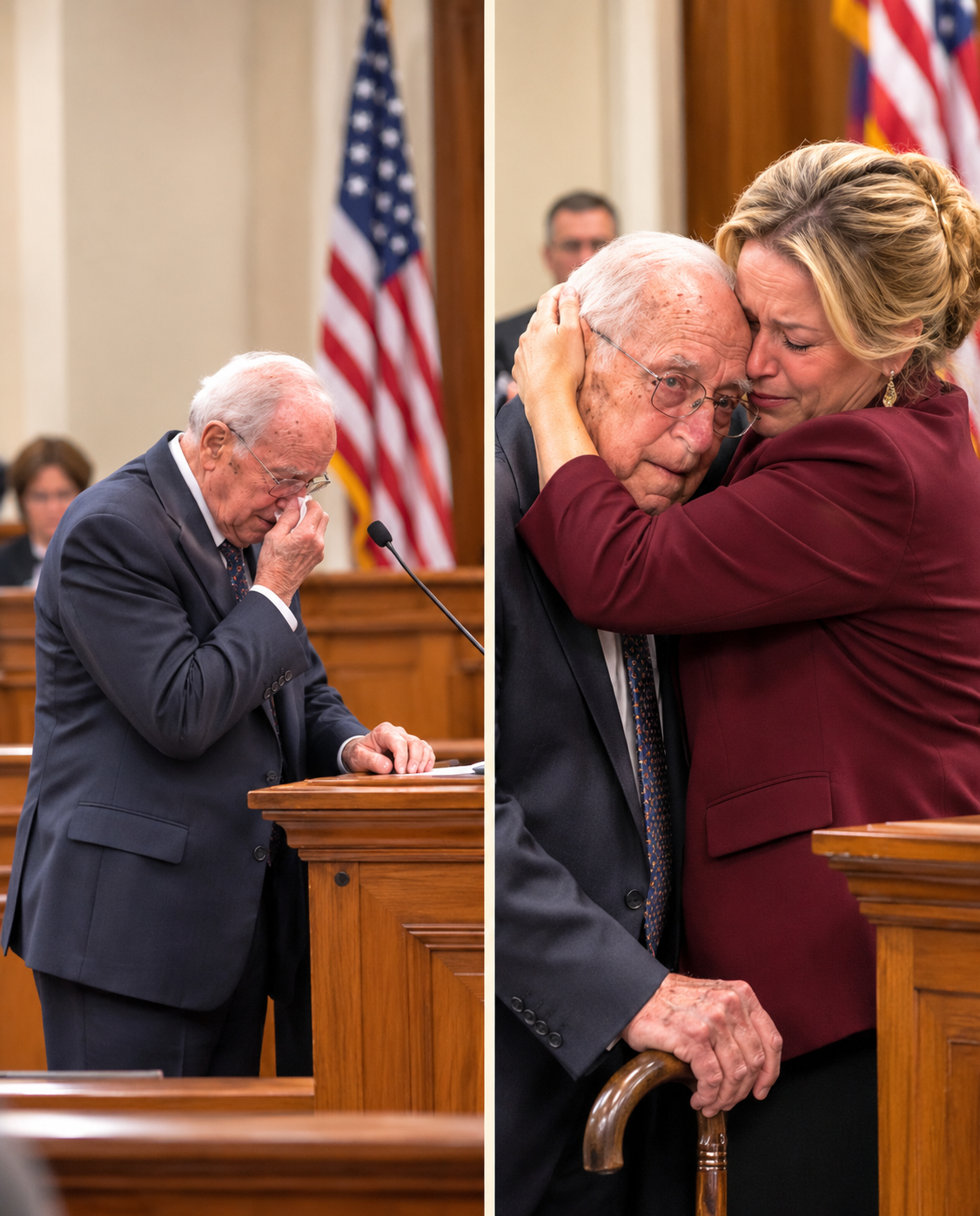
The judge looked at the list of stolen items.
Then at the photograph of Walter’s daughter.
Then at Margaret, who was still standing beside him.
Finally, he picked up his pen.
“I am dismissing the request for imprisonment and imposing no jail sentence. I will also refer you to community support services. The matter of restitution will be addressed in a way that does not leave you without the necessities of daily living.”
Walter’s mouth fell open.
“Your Honor…”
The judge raised his hand.
“There’s one more thing, Mr. Miller.”
Walter waited.
“I would like to ask you a personal question.”
“Of course, sir.”
“Your daughter. What was her name?”
Walter looked at the photograph.
A small smile appeared on his face.
“Elizabeth.”
The judge nodded.
“Elizabeth would probably be very proud of you.”
At those words, Walter broke down completely.
He covered his face with both hands and cried like a child.
Margaret reached over and gently held his arm.
For the first time that morning, Walter wasn’t trying to hide his tears.
Six Months Later
Life slowly began to change for Walter.
The store kept its promise.
Every Saturday morning, a small group of volunteers gathered to organize food packages, winter clothing, school supplies, and household necessities for families who needed assistance.
Walter was there whenever his health allowed.
He no longer carried bags secretly through the streets.
He no longer worried about being caught.
Instead, he sat at a small table near the entrance, carefully checking each package to make sure nothing was missing.
He had a new notebook.
On its first page, he had written:
No child should ever have to pretend they’re not hungry.
The store employees grew fond of him.
Some brought him coffee.
Others stopped to ask for advice.
The younger volunteers called him Grandpa Walter.
And every Saturday, Margaret sat beside him for an hour, even when she had nothing particular to do.
One afternoon, a little girl entered the store holding her mother’s hand.
She was wearing a blue coat and carrying a schoolbag that looked almost as big as she was.
She approached Walter’s table.
“Are you Mr. Walter?”
He smiled.
“That’s what they tell me.”
The girl reached into her schoolbag and pulled out a folded piece of paper.
“My mommy told me to give you this.”
Walter opened it carefully.
Inside was a child’s drawing.
It showed a little house, three smiling children, and an old man holding a shopping bag.
Above the drawing, in colorful letters, were the words:
THANK YOU FOR NOT FORGETTING US.
Walter stared at it for a long time.
Then he asked the little girl:
“Did you draw this?”
She nodded.
“Yes. Mommy said you helped us when we didn’t have anything.”
Walter smiled.
“Well, sweetheart, you know what?”
“What?”
“You helped me, too.”
The girl tilted her head.
“How?”
Walter gently touched the drawing.
“Before I met your family, I thought my life was nearly over. I thought I had nothing left to give anyone. But you reminded me that even an old man can still make a difference.”
The little girl smiled and hugged him.
Walter closed his eyes.
For a moment, he remembered Elizabeth.
He remembered her laughter, her kindness, and the promise he had made to himself after she died.
To keep caring.
To keep helping.
To never let the world make him indifferent to someone else’s suffering.
That evening, Margaret accompanied Walter home.
As they walked slowly along the sidewalk, she asked him something she had wanted to ask for months.
“Walter, are you angry with me for telling the judge?”
He stopped.
He looked at her for a moment.
Then he smiled.
“Angry? Margaret, you saved me from making the same mistake again.”
She laughed softly.
“I broke my promise.”
“No,” Walter replied. “You kept a much more important one.”
“Which one?”
He looked toward the setting sun.
“The promise to make sure I didn’t disappear into the world without anyone knowing why I was here.”
Margaret squeezed his arm.
They continued walking.
And for the first time in many years, Walter didn’t feel alone.
One Year Later
On the anniversary of the court hearing, the store organized a small gathering to honor the volunteers who had helped struggling families.
Walter was invited to sit in the front row.
He wore his best jacket, polished his old shoes, and carried his daughter’s photograph in his pocket.
When the store manager introduced him, everyone stood and applauded.
Walter slowly rose from his chair.
He looked uncomfortable with the attention.
“I don’t know what to say,” he began.
“I wasn’t trying to become anyone special. I just remembered what it felt like to need help and have nobody notice.”
He paused.
“People sometimes think kindness requires money. It doesn’t. Sometimes it’s a warm meal. Sometimes it’s listening. Sometimes it’s simply noticing that someone is struggling when everyone else walks past.”
He looked around the room.
“And if there’s one thing I’ve learned, it’s that nobody should have to reach 101 years old before discovering that their life still matters.”
There wasn’t a dry eye in the room.
Margaret sat in the front row, smiling through her tears.
The judge had also received an invitation.
He stood at the back, listening quietly.
After the gathering, he approached Walter and shook his hand.
“Mr. Miller, I remember your case.”
Walter smiled.
“I imagine it wasn’t the easiest case to forget, Your Honor.”
The judge laughed.
“No. It wasn’t.”
He looked at the old man and added:
“You know, when you first stood in my courtroom, I thought I was looking at a man who had run out of choices.”
Walter waited.
“But I was wrong. I was looking at a man who had spent so much time giving to others that he had forgotten he was allowed to ask for help himself.”
Walter’s eyes filled with tears again.
He reached into his pocket and touched his daughter’s photograph.
“Maybe that’s something we all need to remember, sir.”
The judge nodded.
And the two men shook hands.
The Final Lesson
Walter lived for another two years.
He never became wealthy.
He never owned a large house or traveled around the world.
But he spent his final years surrounded by people who cared about him.
The little girl who had once received shoes from an anonymous stranger visited him regularly.
Margaret remained his closest friend.
And the store continued the Saturday donation program, naming it the Elizabeth Miller Community Project, in honor of Walter’s daughter.
When Walter eventually passed away peacefully, his neighbors found one final note inside his notebook.
It read:
“I spent most of my life believing that growing old meant slowly becoming unnecessary.
As long as you can make someone smile, comfort someone who is hurting, or help someone stand again, your life still has a purpose.
Don’t wait until you have everything to give something.
And don’t wait until someone is gone to tell them they mattered.”
Sometimes, the greatest tragedy isn’t that someone has nothing. It’s that they believe nobody would care if they asked for help.
And sometimes, the person who appears to need the most kindness is quietly giving it away to everyone else.
Remember: Never judge a person’s entire story by the one chapter you happen to witness. ❤️