
Then asked:
“How did you manage all this?”
I looked across the water.
“By budgeting.”
Silence.
I continued.
“Your father-in-law and I saved for emergencies. We avoided unnecessary debt. And after Warren died, I continued setting aside money for maintenance.”
Sloan sighed.
“We didn’t know it cost this much.”
I nearly said something sharp.
But I stopped myself.
Because the truth was beginning to reach her without my help.
Instead, I asked:
“Did you ever look at the household accounts?”
She hesitated.
“No.”
I smiled sadly.
“Then perhaps now would be a good time.”
That evening, Gavin called.
“Mom, I’ve been going through the paperwork you left.”
I waited.
He continued.
“I didn’t realize you paid the property taxes.”
I stared.
“Gavin, I’ve been paying them for years.”
“I thought those came out of the mortgage.”
“There hasn’t been a mortgage on that house since your father paid it off.”
He went silent.
Then whispered:
“Oh.”
I closed my eyes.
He sounded like a man discovering that the ground beneath him wasn’t nearly as solid as he’d believed.
“Mom,” he said, “how much have you actually been paying?”
I took a breath.
“Gavin, look at the annual summary I left in the Household Accounts folder.”
He hesitated.
“I haven’t gotten that far.”
I smiled faintly.
“Then keep reading.”
The following morning, he called again.
His voice was different.
Quiet.
Almost embarrassed.
“Mom?”
“Yes?”
“I added everything up.”
I waited.
He swallowed.
“It’s more than thirty thousand dollars a year.”
I nodded.
“Some years more, depending on repairs.”
He was silent.
Then said:
“I didn’t know.”
I looked toward the lake.
“Gavin, you didn’t ask.”
He exhaled.
“Sloan thought the house didn’t cost much because it was paid off.”
I shook my head.
“A house without a mortgage still has expenses.”
He was quiet.
Then whispered:
“I think we made a mistake.”
My throat tightened.
“Yes, sweetheart.”
I looked toward Warren’s photograph on the bookshelf.
“You did.”
But the biggest surprise arrived the following Monday.
It came in the form of a phone call from a man named Richard Ellis.
He was the attorney who had handled the transfer of the Brooklyn property into Gavin’s name.
“Mrs. Baxter?”
“Yes?”
“I hope you’re settling in well.”
I smiled.
“Thank you.”
He hesitated.
“I’ve received a call from your son.”
My stomach tightened.
“What about?”
“He asked whether the property could be transferred back into your name.”
I nearly dropped my coffee cup.
“What?”
Richard paused.
“He said there had been a misunderstanding concerning your living arrangement.”
I stared at the wall.
Then asked:
“What exactly did he say?”
Richard took a breath.
“He said he and his wife hadn’t realized how much financial responsibility came with ownership.”
I closed my eyes.
For years, Gavin had enjoyed introducing himself as the owner of the Brooklyn house.
He’d accepted the deed.
Accepted the benefits.
Accepted the sense of security.
But when the costs finally became his responsibility, he wanted to hand the property back.
Richard continued.
“I told him any transfer would require your agreement, proper documentation, and consideration of legal and tax consequences.”
I nodded.
“Good.”
He hesitated.
“Do you want to discuss it?”
I looked around my little condo.
The morning sun was moving across the wooden floor.
Warren’s photograph stood beside the window.
And the lake stretched quietly beyond the balcony.
“No,” I said.
“Not right now.”
That afternoon, Sloan sent me a long email.
It began with an apology.
At least, something resembling one.
Elaine, I never meant to make you feel unwelcome.
I stared at the screen.
She continued:
I was under enormous pressure because my mother needs additional care, and I thought everyone in the household should contribute.
I read slowly.
There were explanations.
Financial concerns.
References to rising costs.
And several paragraphs about how difficult it was to raise children while supporting an aging parent.
Then I reached the final sentence.
We really need you to come back so we can work this out as a family.
I closed the laptop.
Not because I was angry.
Because I finally understood the difference between an apology and a request.
Sloan was sorry that the consequences were difficult.
I wasn’t yet convinced she understood why her behavior had hurt me.
Two weeks later, Gavin drove to New Hampshire.
He called from the parking lot.
“Mom, I’m here.”
I looked through the window.
His car was parked beneath a maple tree.
He’d come alone.
No Sloan.
No children.
No folder of bills.
Just my son.
I took a breath.
“Come upstairs.”
When I opened the door, he stood awkwardly in the hallway.
He looked tired.
Older than I remembered.
For a moment, I saw Warren in the shape of his shoulders.
“Hi, Mom.”
I smiled.
“Hello, sweetheart.”
He stepped inside.
Then looked around.
“This is nice.”
“Thank you.”
He walked toward the balcony.
The lake glittered in the sunlight.
He stood there for a long time.
Then whispered:
“Dad would’ve loved this.”
My throat tightened.
“Yes.”
I nodded.
“He would have.”
We sat at the small kitchen table.
I made coffee in my old drip machine.
Gavin watched me fill the pot.
Then laughed softly.
“You brought that thing?”
I smiled.
“Of course.”
He shook his head.
“Sloan hated it.”
“I know.”
For a moment, we both laughed.
Then the silence returned.
Gavin looked at his hands.
“Mom, I owe you an apology.”
I waited.
He swallowed.
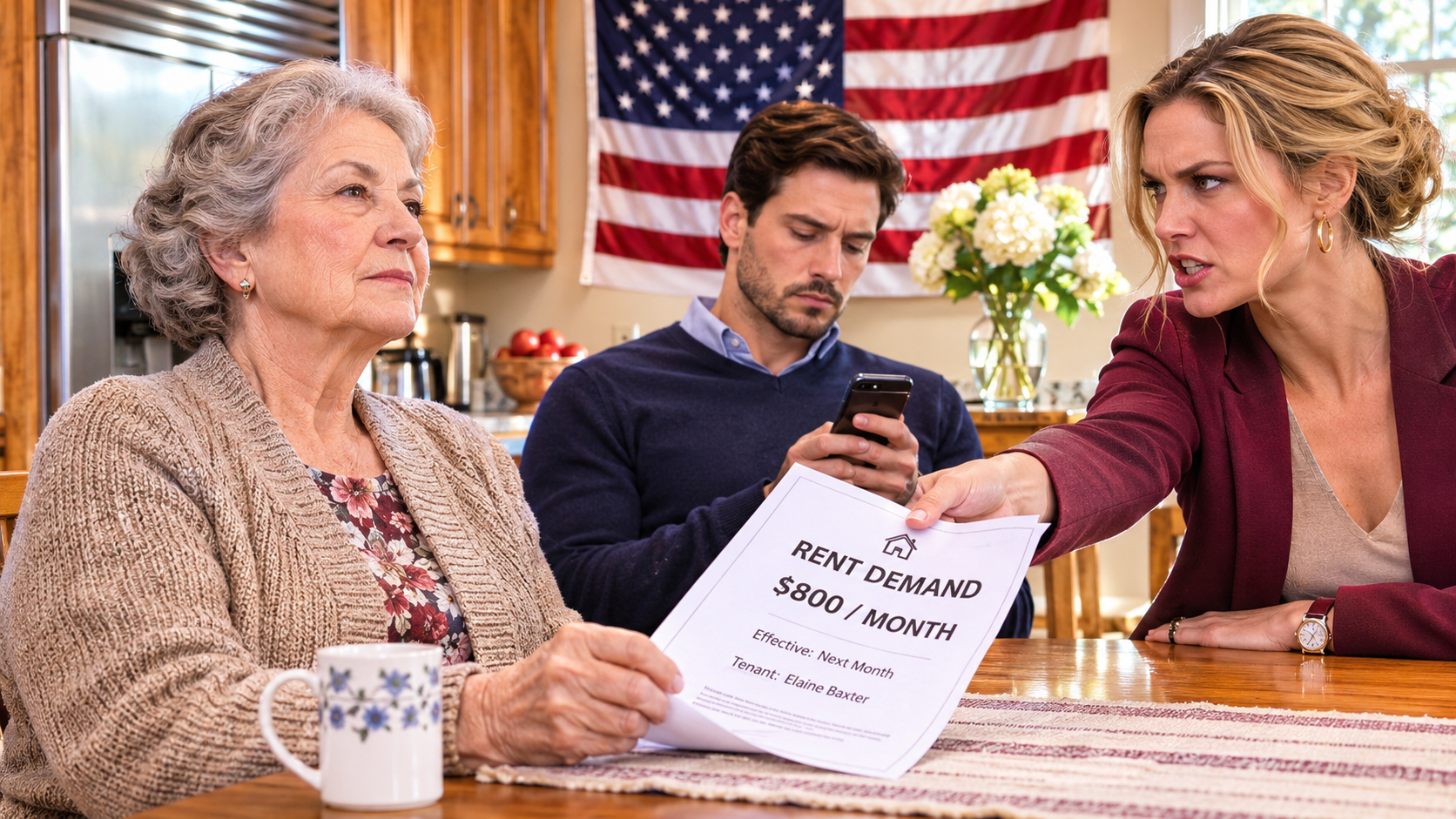
“When Sloan handed you that rent notice, I knew it was wrong.”
My throat tightened.
“Then why didn’t you say anything?”
He looked away.
“Because I didn’t want another argument with her.”
I stared.
He continued.
“I told myself you’d understand. That you’d forgive us because you’re Mom.”
I closed my eyes.
There it was.
The truth.
He’d expected me to absorb another insult because I’d spent my life doing exactly that.
“Gavin,” I said quietly, “I didn’t need you to fight with your wife.”
He looked up.
“I needed you to tell her we should discuss something like that together.”
He nodded.
“I know.”
I continued.
“I gave you the house because I trusted you. I wanted you and the children to have security.”
His eyes filled.
“I know.”
“And when she demanded rent from me, you sat there looking at your phone.”
He covered his face.
“I was ashamed.”
I swallowed.
“So was I.”
He looked up sharply.
“Why would you be ashamed?”
I stared at him.
“Because I realized I’d raised a son who could watch his mother be treated like an unwanted guest in the home she had given him.”
He began crying.
And for the first time, I didn’t rush to comfort him before he’d finished hearing the truth.
We talked for nearly three hours.
About money.
About boundaries.
About Warren.
About the way I’d continued paying for everything because I was afraid that if I stopped being useful, I’d become unnecessary.
Gavin admitted that he and Sloan had grown accustomed to my help.
They’d built their budget around it without ever discussing whether that was fair.
He said he hadn’t realized how much I’d been sacrificing.
I believed him.
But I also told him something important.
“Not realizing doesn’t erase the responsibility.”
He nodded.
“I know.”
Then he asked:
“Would you ever come back?”
I looked toward the balcony.
The lake shimmered in the afternoon light.
I smiled sadly.
“No, Gavin.”
His face fell.
I reached for his hand.
“I love you.”
His eyes filled.
“But I’m happy here.”
Before leaving, Gavin stood in the doorway.
“Mom?”
“Yes?”
“What should we do about the house?”
I took a breath.
“Decide whether you can afford to own it.”
He nodded slowly.
“And if we can’t?”
“Then speak with a financial adviser and consider your options.”
He looked down.
“Selling?”
“Possibly.”
His eyes widened.
“But Dad built so much of that place.”
I smiled sadly.
“Yes.”
I thought of the kitchen table.
The initials carved beneath it.