
The summer evenings on the porch.
The years of laughter.
Then I continued:
“Your father built a home, Gavin. He didn’t build a prison we all have to stay inside forever.”
My son began crying again.
Then hugged me.
And for the first time in years, the embrace didn’t feel like a request.
It felt like love.
The following months weren’t easy for Gavin and Sloan.
They created a household budget.
Canceled several subscriptions.
Sold one of their cars.
And started making regular contributions to the property expenses.
They also met with a financial counselor.
Eventually, they decided they could keep the house if they changed their spending habits.
It required sacrifices.
Not dramatic ones.
Ordinary ones.
Fewer impulse purchases.
Less eating out.
More planning.
And learning to say no to expenses they couldn’t afford.
The house remained in Gavin’s name.
And for the first time since I’d transferred it, he began acting like its owner.
Sloan took longer to understand.
She sent occasional messages.
Photographs of the grandchildren.
Updates about school.
And eventually, a handwritten letter.
I opened it one evening while sitting on the balcony.
Elaine,
I have been thinking about the day I handed you the rent notice.
I told myself I was being practical.
But I was asking you to pay for a home you had already provided while continuing to expect you to handle the bills, groceries, and chores.
I didn’t understand how unfair that was until I had to do those things myself.
I am sorry.
I also realize I never thanked you properly for letting us live in the house.
I hope someday you’ll visit again.
Sloan.
I read the letter twice.
Then placed it beside Warren’s photograph.
It wasn’t perfect.
But it was honest.
And that mattered.
Christmas arrived with snow falling across the lake.
I decorated my condo with a small tree.
Hung stockings beside the fireplace.
And made Warren’s favorite cinnamon cookies.
On Christmas Eve, Gavin called.
“Mom, can we come up tomorrow?”
I smiled.
“Of course.”
He hesitated.
“Are you sure?”
I laughed softly.
“Gavin, I said I moved. I never said I stopped loving my family.”
He laughed.
Then whispered:
“Thanks, Mom.”
They arrived the following afternoon.
Gavin carried gifts.
Sloan brought a casserole she’d made herself.
The children rushed into my arms.
“Grandma!”
I hugged them tightly.
My granddaughter, Lily, ran toward the balcony.
“Grandma, you can see the lake!”
I laughed.
“Yes, sweetheart.”
My grandson, Ethan, immediately asked whether he could build a snowman outside.
I smiled.
“After lunch.”
We ate around my small table.
The casserole was a little salty.
The cookies were slightly overbaked.
And there wasn’t enough room for everyone to sit comfortably.
But nobody complained.
Nobody handed me a grocery list.
Nobody asked me to pay for anything.
And when Sloan stood to clear the dishes, she gently touched my shoulder.
“Elaine, sit. I’ve got this.”
I looked at her.
Then smiled.
“Thank you.”
That evening, after everyone left, I stood beside the window.
Snow covered the balcony railing.
The lake was quiet.
Warren’s photograph sat on the bookshelf.
I picked it up.
“You would’ve laughed at all this,” I whispered.
I could almost hear him.
Ellie, you always did make things harder on yourself than they needed to be.
I smiled through tears.
Then looked around.
The little condo.
The old coffee maker.
The reading chair.
The peace.
And I understood something.
I hadn’t left Brooklyn because I hated my family.
I left because I wanted to stop disappearing inside their needs.
I’m seventy-one now.
My health is good.
I walk by the lake most mornings.
I volunteer at the local library twice a week.
And I’ve made friends who know me as Elaine, not simply someone’s mother or grandmother.
Gavin calls every Sunday.
Sloan sends photographs of the children.
And I visit Brooklyn when I want to.
Not because I’m expected to cook or clean.
Not because someone needs a babysitter.
But because I want to see the people I love.
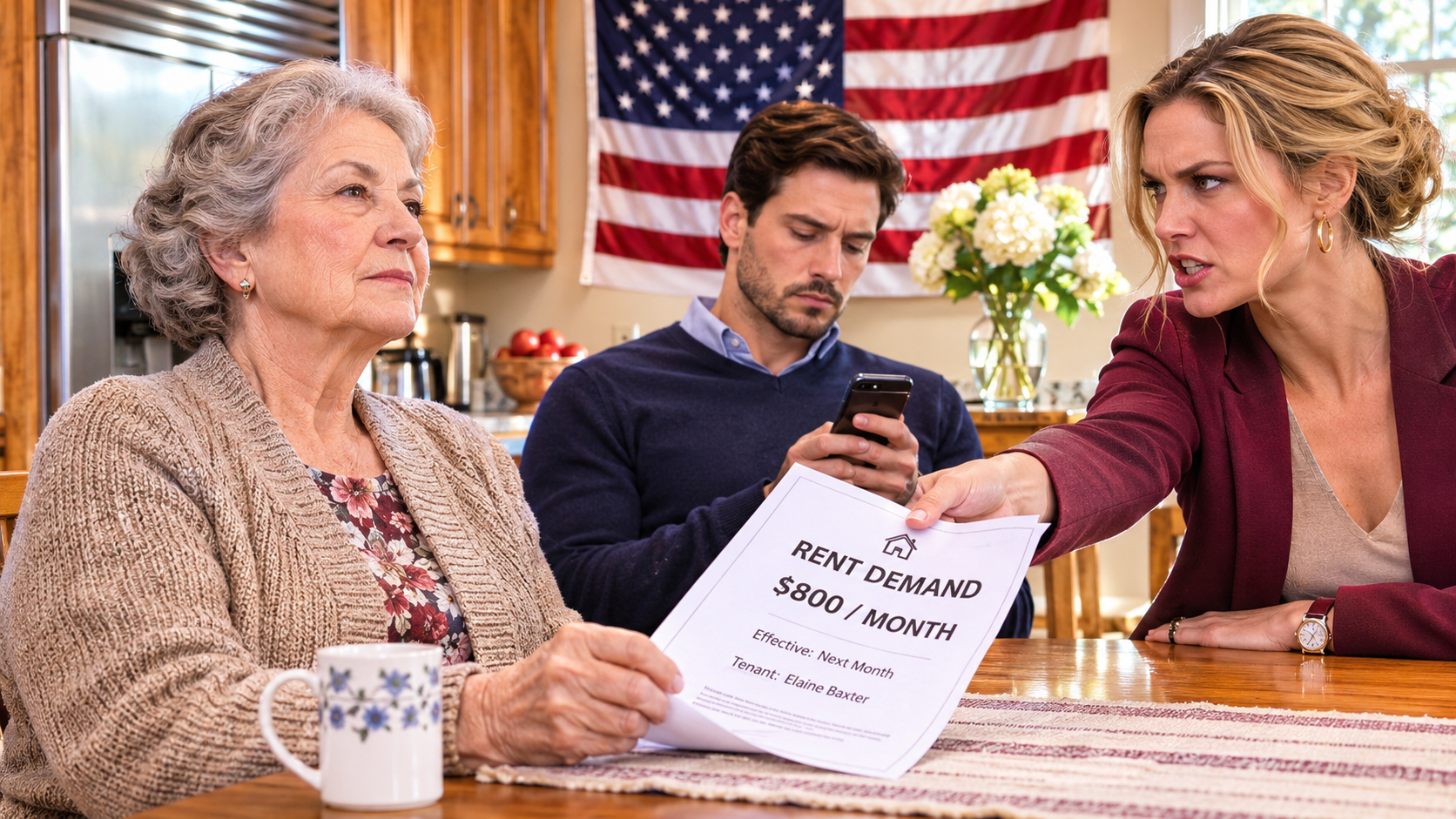
Sometimes I think about the morning Sloan placed that eight-hundred-dollar rent demand beside my coffee.
I remember the way Gavin stared at his phone.
The sharp smell of lemon cleaner.
The espresso machine sitting where my old coffee maker used to be.
And the unbelievable feeling of being told I owed rent in a home I’d spent thirty years caring for.
I could have argued.
I could have shouted.
I could have listed every expense I’d paid.
But I’d done enough explaining in my lifetime.
So instead, I made a decision.
I moved.
MY DAUGHTER-IN-LAW DEMANDED $800 A MONTH FOR A BEDROOM IN THE HOUSE MY HUSBAND BUILT.
MY SON SAT ACROSS FROM ME AND SAID NOTHING.
THEY CALLED THEMSELVES HOMEOWNERS WHILE I QUIETLY PAID THE TAXES, INSURANCE, HEATING, INTERNET, AND REPAIRS.
They thought the rent demand would finally make me contribute more.
Instead, it made me understand how much I was already contributing.
By Monday morning, I was gone.
And when the first bill arrived, they finally understood what they’d been taking for granted.
I didn’t take the house back.
I didn’t threaten Gavin.
And I didn’t demand repayment for years of financial support.
I simply stopped paying bills that were no longer mine to carry and gave my son the information he needed to take responsibility.
That was enough.
Because sometimes the most powerful lesson isn’t delivered through an argument.
It’s delivered through an ordinary invoice.
A heating bill.
An insurance renewal.
A furnace repair.
The quiet, unavoidable costs of ownership.
My husband Warren used to say something whenever Gavin complained about chores as a teenager.
“Son, if you want the keys, you’ve got to be willing to carry the responsibility.”
I hadn’t thought about those words in years.
Now, sitting beside the lake, I understand them better than ever.
I gave Gavin the keys to the house.
I gave him the deed.
I gave him security.
But I couldn’t give him maturity.
That was something he had to learn himself.
And when I finally stopped protecting him from the consequences of ownership, he began learning.
Last week, Gavin called to tell me he’d repaired a leaking faucet.
All by himself.
He sounded ridiculously proud.
I laughed.
“Your father would be pleased.”
He chuckled.
“Yeah. Took me three hours.”
I smiled.
“Warren would’ve done it in twenty minutes.”
Gavin laughed.
Then said something that brought tears to my eyes.
“Mom, I finally understand how much you and Dad did for us.”
I looked toward the lake.
“I’m glad, sweetheart.”
He paused.
Then added:
“And I’m sorry it took you moving away for me to see it.”
I ended the call and sat quietly for a while.
The afternoon sun turned the lake gold.
Somewhere across the water, a boat moved slowly toward the marina.
I thought about the woman I’d been the day Sloan handed me that envelope.
Seventy years old.
A widow.
Sitting at the kitchen table her husband built.
Trying to understand how she’d become a tenant in the home she’d once owned.
Then I thought about the woman I was now.
Still seventy-one.
Still a mother.
Still a grandmother.
But no longer responsible for everyone else’s comfort.
And no longer afraid to put her own needs first.
THEY THOUGHT CHARGING ME RENT WOULD TEACH ME MY PLACE.
INSTEAD, LEAVING TAUGHT THEM WHAT MY PLACE HAD REALLY BEEN.
I wasn’t simply the elderly woman occupying their downstairs bedroom.
I was the person who had kept their home running.
The one who paid the bills nobody wanted to see.
The one who made sure the lights stayed on and the house stayed warm.
And when I left, I didn’t take revenge.
I JUST TOOK MYSELF OUT OF THE EQUATION.
For the first time, they had to solve the problems I’d been quietly solving for years.
And for the first time, I had a home where my presence wasn’t measured in dollars.
THE END.