
For four years, my family believed I was paying eighty-nine dollars a month to store junk.
Last month my son-in-law found the receipt in my checkbook, made some phone calls, and on Tuesday he sat me down at my own kitchen table, with my daughter beside him and a folder in front of him, to talk about “managing my finances going forward.”
I let him give his whole speech.
Then I stood up and said, “Get your coats. We’re going to the unit.”
My name is June. I am seventy-five. My Bud has been gone four years, and this story is really his, so listen close.
Bud kept a 1967 Mustang fastback in our garage for fifty years.
Candy-apple red.
He and that car went steady before I ever came along, and I made my peace with being the second-prettiest thing he owned.
When Bud had his stroke, the family got very helpful, very fast.
And nobody was more helpful than my son-in-law Greg.
Greg sells boats, knows what things are worth, and wants you to know he knows.
Greg stood in our garage that spring, while my husband was upstairs learning to hold a spoon again, and said, “We should really talk about the car. Sitting money, June. I know a guy.”
Bud heard about it.
Bud could not say many words yet that year, but he said two to me that night, very clearly, holding my wrist.
“Not. Greg.”
There was history there.
A twenty-two-thousand-dollar “bridge loan” for Greg’s boat business back in 2011 that built no bridge and came back in no boats.
We were not allowed to mention it at dinners.
Bud wrote it down in his little ledger, though.
Bud wrote everything down.
My husband passed on a Thursday in October.
Greg waited until the Saturday after the funeral to say, in my kitchen, with a casserole still warm on the stove, “I can have the garage cleared by Monday. The car too. I know a guy.”
By Monday, the car was gone.
Everyone assumed I sold it.
I let them assume.
Greg told people he had “helped me get a fair number for it,” which was interesting, since he had done no such thing, but a man who lies that easily does half your work for you.
What actually happened is that Whitey Dunn from Bud’s old bowling team drove that Mustang, slow as a funeral, seven miles to a storage place on Route 9.
I have paid eighty-nine dollars a month ever since.
Every February, I go sit in it with a thermos and talk to my husband for a while.
Because before he died, Bud asked me for one thing.
Eli gets the car at twenty-one.
Whole.
Running.
No family discount.
No helpful guys who know guys.
Eli is my grandson.
He turns twenty-one in June.
You see the problem with the timing.
Two months short of the finish line, Greg finds my receipt, and suddenly there is a folder on my kitchen table with the words “financial oversight” in it, and my own daughter Kathy is saying gently, “Mom, eighty-nine dollars every month for years, and you can’t even tell us what’s in there? You see how that looks.”
“It looks like my money paying my bill,” I said.
But I stood up anyway.
“Get your coats.”
Greg drove us all to Route 9 doing sixty in a forty, ready to catalog my decline.
I could see him building the story in the rearview mirror.
Poor June.
Confused June.
June, wasting money on boxes of old magazines and broken lamps.
I called Eli on the way and told him to meet us there.
Then I made one more call, short and quiet, to a number Bud made me memorize.
Unit 44.
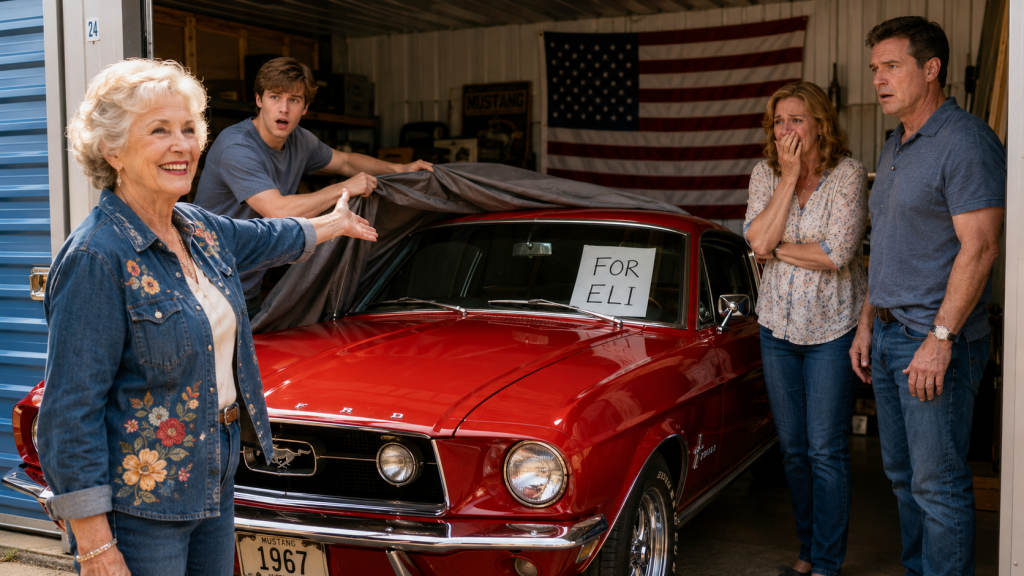
I turned my key, and Eli helped me lift the roll-up door.
The afternoon light walked in ahead of us and landed on a shape under a gray cover that every man who has ever loved anything recognized instantly.
Greg went very still.
“June,” he said. “Is that—”
“Pull it off, Eli.”
My grandson pulled the cover.
There she was.
Candy-apple red.
Chrome shining.
Black interior.
Whitey had waxed her every spring exactly the way he promised Bud he would.
My daughter made a sound like a hiccup.
Greg took one step forward with his boat-salesman eyes doing arithmetic.
And that is when everyone noticed the envelope taped to the windshield.
Bud’s handwriting.
Big block letters.
FOR ELI. DO NOT OPEN UNTIL SOMEBODY TRIES TO TAKE HER.
Four years that envelope had waited.
I never knew what he put in it because some things between a man and his grandson are not a wife’s business.
Eli peeled it off with two fingers, opened it, and started reading out loud.
He got through, “Dear Eli, if you are reading this, then it finally happened, and I would bet my good wrench I know exactly who is standing in that unit with you.”
Then my grandson stopped.
He looked up at Greg.
And read the next line slowly.
“Before anybody leaves, son, ask your Uncle Greg what happened to the original title to this car.”
Nobody spoke.
You could hear a delivery truck changing gears out on Route 9.
Greg laughed first.
It was the laugh he used when he wanted everyone else to feel foolish for taking something seriously.
“What is this supposed to be?”
Eli looked at him.
“Grandpa says to ask you about the title.”
“I don’t know anything about any title.”
I folded my arms.
“That’s funny.”
Greg looked at me.
“What?”
“Bud thought you might say that.”
Kathy turned toward me.
“Mom, what are you talking about?”
I nodded at Eli.
“Keep reading.”
Eli swallowed and looked back down.
“When Greg borrowed twenty-two thousand dollars from Grandma and me in 2011, he signed a promissory note. He also asked me for the Mustang title because he said a lender wanted to see assets connected to the family loan. I was stupid enough to let him make a copy.”
Greg’s face changed.
Not much.
Just enough.
Kathy noticed too.
“Greg?”
He shook his head.
“Bud was on medication when he wrote this.”
My daughter stared at him.
“That was years before Dad got sick.”
Greg’s mouth closed.
Eli kept reading.
“Six months later I learned Greg had not made a copy. He had taken the original. By the time I got it back, I had already discovered he had tried to use the Mustang as collateral for money he owed somebody else.”
Kathy whispered, “What?”
Greg stepped toward Eli.
“That’s enough.”
Eli stepped back.
It was such a small movement, but it did something to me.
Eli was twenty years old, six feet tall, broad across the shoulders like Bud had been at that age, and yet Greg still expected him to move when ordered.
For once, the boy didn’t.
He kept reading.
“The attempt failed because the car was registered in my name and the paperwork did not match. I recovered the title with the help of my attorney, Samuel Price. I chose not to press the matter because Kathy was pregnant with Eli, and June begged me not to blow up our daughter’s marriage before the baby was born.”
Kathy’s head snapped toward me.
“You knew?”
“I knew some.”
“Some?”
“I knew your father got the title back. I knew Greg had done something foolish.”
“Criminal,” Eli said quietly.
Greg pointed at him.
“Watch yourself.”
And there it was.
The tone.
That little slice of ownership in his voice.
The same tone he had used at my kitchen table while telling me he needed to manage my money.
Eli’s jaw tightened.
“Don’t point at me.”
Kathy whispered, “Greg, did you do this?”
“No.”
“Dad wrote it down.”
“Your father hated me.”
That was when I laughed.
I couldn’t help it.
Bud did not hate Greg.
Bud distrusted Greg, which is a different thing entirely.
Hatred takes energy.
Bud preferred bookkeeping.
“Bud didn’t hate you,” I said. “He kept receipts.”
Then headlights appeared outside the storage building.
A dark blue sedan pulled into the lane and stopped beside Greg’s SUV.
A man in a gray suit stepped out carrying a leather briefcase.
He was seventy if he was a day.
Silver hair.
Bent shoulders.
Still wearing the same tortoiseshell glasses I remembered.
Samuel Price.
Bud’s lawyer.
Greg stared at me.
“You called a lawyer?”
“I called Bud’s lawyer.”
Samuel walked toward us.
“June.”
“Sam.”
He looked at Eli, then the open envelope.
“So,” he said, “we finally got here.”
Greg threw both hands up.
“This is ridiculous.”
Samuel glanced at him.
“Good afternoon, Gregory.”
Greg went quiet.
There are men who become bigger when they enter a room.
Samuel Price was the opposite.
He never raised his voice.
He made everyone else lower theirs.
Samuel opened his briefcase.
“June asked me to come because Bud left instructions concerning the transfer of the Mustang.”
Kathy looked as if she couldn’t decide who to stare at first.
“Transfer?”
“To Eli,” I said.
Greg spun around.
“Absolutely not.”
We all looked at him.
Even Greg seemed surprised by how quickly that came out.
Then he corrected himself.
“I mean, wait. Eli’s twenty. That car could be worth a fortune. You don’t just hand something like that to a kid.”
“It’s Grandpa’s car,” Eli said.
“It’s an asset.”
“It’s mine.”
“It isn’t yours yet.”
Samuel cleared his throat.
“Actually, that is why I’m here.”
He removed several papers from his briefcase.
“Bud executed a transfer-on-death arrangement for the vehicle approximately five months before his death. Because Eli was a minor at the time, June was designated custodian until Eli reached twenty-one. The transfer becomes complete on his twenty-first birthday.”
Greg stared at the Mustang.
Then at Eli.
Then at me.
I watched the calculations behind his eyes change.
He had come there believing he had discovered an old woman wasting money.
Now he was looking at a car that collectors would cross state lines to see.
A car Bud had maintained obsessively.
Original engine.
Original panels.
Original interior except for one repaired seam on the driver’s seat where Bud carried a screwdriver in his back pocket in 1974 and learned an expensive lesson.
Greg stepped closer.
“What’s it worth?”
Nobody answered.
“Sam, what’s the car worth?”
Samuel looked at me.
“That is not relevant to the transfer.”
“It’s relevant if June’s throwing away an asset.”
“I’m not throwing it away,” I said. “I’m keeping a promise.”
Greg rubbed a hand across his mouth.
“Kathy, say something.”
My daughter still hadn’t moved.
Her eyes were on the letter in Eli’s hands.
“Keep reading,” she said.
Greg looked at her.
“Kathy.”
“Keep reading, Eli.”
And my grandson did.
“Eli, if your father is there, he will probably be angry by now. He may tell you the car should be sold because a car is just a thing.”
Greg muttered something.
Eli almost smiled.
“Your grandmother will know this already, but I want you to understand why I’m giving it to you.”
Eli’s voice changed then.
Got softer.
“When you were six, I caught you sitting in the driver’s seat making engine noises. When you were eight, you handed me every tool I needed when I changed the water pump, including six I did not need. When you were twelve, you spent three Saturdays helping me clean fifty years of dirt off the underside even though your friends were at the lake.”
Eli stopped.
His eyes filled.
I looked away.
There are some griefs you think have dried up.
They haven’t.
They are wells with lids.
Certain voices lift the lid.
Eli continued.
“When I got sick, you came into my room one afternoon and asked me whether the Mustang would be lonely if I died.”
Kathy covered her mouth.
I remembered that.
Bud couldn’t answer Eli that day.
He had cried instead.
“I told you no then because I didn’t know how to tell a twelve-year-old that machines don’t get lonely, but people do. So I decided the car should belong to somebody who understood that keeping something is not the same as owning it.”
Eli wiped his cheek.
“Take care of her. Drive her. Don’t turn her into a museum piece. Let your kids drop ice cream in the back seat someday. Your grandmother will pretend to be mad about it.”
I laughed through my tears.
Bud knew me.
Eli read the last lines.
“And if Greg tries to sell her, ask Samuel to show everyone Ledger Number Two.”
The entire unit went silent.
Greg whispered, “What ledger?”
Samuel Price looked at me.
I nodded.
He reached into his briefcase.
This time he removed a thin black notebook.
Not Bud’s usual brown ledger.
A black one.
I had seen it only twice in my life.
The first time was when Bud told me he had made a mistake trusting Greg.
The second was a week before Bud died.
“June,” Kathy whispered. “What is that?”
“Your father’s insurance policy against forgetting.”
Samuel opened the notebook.
“Bud began documenting certain financial matters after the 2011 loan.”
Greg snorted.
“A dead man’s notebook proves nothing.”
Samuel nodded.
“Correct.”
That seemed to surprise him.
Then Samuel added, “Which is why Bud attached copies of bank statements, canceled checks, signed promissory notes, emails, and correspondence from your former business partner.”
Greg’s face emptied.
Not paled.
Emptied.
Like somebody had opened a drain.
Kathy looked at her husband.
“What emails?”
Greg didn’t answer.
Samuel did.
“The twenty-two-thousand-dollar loan was not used to support Greg’s boat dealership.”
Kathy’s forehead tightened.
“What was it used for?”
Samuel looked at Greg.
“I think your husband should answer that.”
Greg shoved his hands into his coat pockets.
“This happened fifteen years ago.”
“That is not an answer.”
“Kathy—”
“What did you use my parents’ money for?”
Greg stared at the floor.
Samuel closed the ledger.
“I can summarize.”
Greg snapped, “Stay out of this.”
Samuel didn’t even blink.
Kathy stepped between them.
“No. He can talk.”
That may have been the moment my daughter’s marriage ended.
Not officially.
Not legally.
Those endings come later.
But marriages often die quietly before anybody signs anything.
They die when one person finally asks a question the other person has spent years making them afraid to ask.
Samuel told her.
The twenty-two thousand dollars had covered gambling debts and a failed private investment Greg had hidden from Kathy.
He had borrowed money elsewhere too.
Bud and I had not been the only ones.
Greg had told us his dealership needed temporary cash while a commercial loan closed.
There had never been a commercial loan.
When Bud began asking questions, Greg panicked.
The Mustang was worth enough even then that Greg thought he could use it to secure emergency money, clear the worst debt, then quietly return the title before Bud noticed.
Except Bud noticed everything.
Especially paperwork.
Kathy sank onto an upside-down plastic bucket near the unit wall.
“You told me Dad refused to invest in your business.”
Greg stared at her.
“What?”
“After the loan.”
She looked up.
“You told me you asked Dad for help and he refused because he never believed in you.”
Greg said nothing.
My heart hurt then.
Because I remembered years of dinners where Kathy came in stiff and angry at her father.
Birthdays when she stayed an hour and left.
Christmases when Greg made jokes about Bud loving his car more than his family.
I remembered telling myself not to interfere.
You raise children for eighteen years and spend the rest of your life trying to figure out when helping becomes meddling.
Sometimes you get it wrong.
I had gotten it wrong.
“Your father did help him,” I said.
Kathy looked at me.
“He helped more than once.”
Greg’s head jerked up.
I walked to the Mustang and rested my palm on the roof.
“After the twenty-two thousand, there was another seven thousand when Greg said payroll was short.”
“June.”
“No.”
I looked straight at him.
“You got to talk for fifteen years. I’m taking my turn.”
Kathy stood.
“Seven thousand?”
“And your father paid the property tax on your house one year when Greg told us you were behind.”
Her face crumpled.
“We weren’t behind.”
“I know that now.”
Greg raised his voice.
“Everybody makes mistakes!”
Eli stepped beside his mother.
Greg looked around at the four of us and seemed to understand yelling wasn’t going to help.
So he changed tactics.
He softened.
He always had gears.
“Kathy, listen to me. Your dad never liked how I handled money. He kept records because he wanted leverage. This is ancient history.”
“You stole my father’s car title.”
“I borrowed it.”
“To cover gambling debt?”
“I was desperate.”
“And then you told me he refused to help us.”
Greg looked at me.
“This is what you wanted, isn’t it?”
“No.”
I surprised myself with how calm I sounded.
“I wanted to give Eli his grandfather’s car.”
“You brought a lawyer.”
“Because you brought financial oversight papers into my kitchen.”
That shut him up.
Samuel took another document from his briefcase.
“On that subject.”
Greg looked at him.
“What now?”
Samuel handed me the paper.
I handed it directly to Kathy.
It was a copy of the document Greg had placed in front of me two days earlier.
FINANCIAL MANAGEMENT AUTHORIZATION.
When Greg brought it to my kitchen, he called it a harmless form.
Something to let him “help with bills.”
I had read it after he left.
Every word.
People mistake slow reading for poor understanding when you get old.
I read slowly because I have time.
The document would have allowed Greg to communicate with my bank, handle certain payments, and obtain information about accounts listed on an attached schedule.
There had been blank spaces on that schedule.
Kathy read the page.
Then she looked up.
“You told me this just let you make sure Mom wasn’t being scammed.”
“That’s what it does.”
Samuel shook his head.
“No. It does considerably more than that.”
“I downloaded a standard form.”
“You modified a standard form.”
Greg’s eyes flicked toward him.
Samuel continued.
“And you included language broad enough to seek control over financial accounts June did not intend you to access.”
Kathy stared at her husband.
“Why?”
“Because your mother is seventy-five!”
I laughed.
There it was.
As if seventy-five were a diagnosis.
As if birthdays slowly transfer ownership of your brain to your children.
“I balance my checkbook to the penny,” I said.
“You’re paying a thousand dollars a year for a storage locker!”
“One thousand sixty-eight.”
Greg blinked.
“What?”
“Eighty-nine times twelve. One thousand sixty-eight. If you’re taking over my finances, Greg, try multiplication first.”
Eli laughed.
He tried to stop.
He failed.
Even Samuel’s mouth twitched.
Greg turned red.
“This is insane. We’re fighting over an old car.”
“No,” Kathy said.
We all looked at her.
She folded the financial authorization document carefully.
“We’re not.”
Her voice had changed.
I recognized it.
It was Bud’s voice when he finally decided a conversation was over.
“We’re fighting because you found one bill you didn’t understand and decided my mother couldn’t manage her own life.”
Greg rubbed his forehead.
“Kathy.”
“You searched her checkbook.”
“I was helping.”
“You called the storage company.”
“I wanted to know what she was wasting money on.”
“You sat her down with paperwork.”
“Because somebody has to think ahead.”
“And when that door opened, the first thing you asked was what the car was worth.”
Greg said nothing.
My daughter stared at him for a long time.
Then she looked at me.
“Mom, I’m sorry.”
There are apologies that feel like doors opening.
And there are apologies that hurt because you know how long the person had to travel before they could say them.
I walked over and touched her cheek.
“You believed your husband.”
“I should have believed you.”
“You should have asked me.”
She nodded.
“That too.”
Then Eli walked to the driver’s side of the Mustang.
“Grandma?”
“Yes?”
“Can I sit in it?”
I smiled.
“That depends.”
“On what?”
“Are your pants clean?”
He looked down.
Samuel coughed to hide a laugh.
Bud would have loved that.
“Get in.”
Eli opened the door carefully.
The hinges made the tiniest creak.
He lowered himself behind the wheel like he was entering a church.
His hands settled on the steering wheel.
For one second I saw the six-year-old Bud had written about.
Then I saw something else.
My husband.
Not his face.
His happiness.
That particular quiet happiness men get when they sit behind the wheel of a machine they understand.
“Keys?” Eli asked.
I took them from my purse.
Greg spoke immediately.
“You’re not starting a car that’s been sitting four years.”
Whitey Dunn’s voice came from behind us.
“Good thing it hasn’t.”
We all turned.
Whitey stood at the entrance to the unit carrying two coffees.
I had forgotten about the second call I made.
He wore his old Veterans of Foreign Wars cap and a tan jacket with grease on one sleeve.
Greg stared at him.
Whitey grinned.
“Been starting her every month. Changed fluids. New battery last year. Tires are three years old. June paid for all of it.”
Greg looked at me.
“How much have you spent on this thing?”
I put the key in Eli’s palm.
“Less than you borrowed.”
Whitey laughed so hard he had to set the coffees down.
Eli turned the key.
The engine turned once.
Twice.
Then the Mustang came alive.
The sound filled Unit 44.
Deep.
Steady.
Warm.
It bounced off the metal doors and concrete floor, and for a moment I was twenty-two again, standing outside a Dairy Queen while a skinny boy named Bud leaned against a red Mustang pretending he had not been waiting forty minutes for me.
I closed my eyes.
I could smell gasoline and vinyl and coffee.
I could hear Bud saying, “June, don’t slam the door.”
I could hear fifty years.
When I opened my eyes, Eli was crying.
So was Kathy.
Even Whitey wiped his nose and blamed the cold.
Greg stood apart from us.
I thought I would feel victorious.
I didn’t.
That surprised me.
Mostly, I felt tired.
Because there is nothing satisfying about discovering somebody has been dishonest for years.
There is only relief when everybody finally stops pretending not to see it.
We drove home separately.
Kathy rode with me.
Greg took his SUV.
Eli stayed behind with Whitey because there were things to learn about an old Mustang, and Whitey had been waiting four years to teach him.
For most of the drive, Kathy said nothing.
Then, about halfway home, she asked, “Why didn’t Dad tell me?”
I watched the road.
“Because you were pregnant.”
“That was fifteen years ago.”
“He kept meaning to.”
“And you?”
“I kept thinking it wasn’t my marriage.”
She turned toward the window.
“That’s a convenient answer.”
“Yes.”
She looked at me, surprised.
I nodded.
“Sometimes the truth is convenient and still true.”
She wiped her eyes.
“I treated Dad like he was hard on Greg.”
“He was hard on Greg.”
“Because Greg stole from him.”
“Because your father thought a man should pay his debts.”
“Did Greg ever pay the twenty-two thousand back?”
I was quiet.
“No.”
“The seven?”
“No.”
“The property taxes?”
“No.”
She nodded.
Then she asked, “Why didn’t you ever ask?”
“We did.”
“And?”
“Greg said family doesn’t keep score.”
Kathy laughed once.
It wasn’t a happy sound.
“Dad literally kept score.”
“In three ledgers.”
That got a real laugh.
Small.
But real.
At my house, Greg was waiting.
The folder was still on the kitchen table.
He stood beside it with his coat on.
“I’m going to the dealership,” he told Kathy.
She put her purse down.
“No.”
“What?”
“Sit.”
For perhaps the first time in his married life, Greg sat when my daughter told him to.
I made coffee.
Nobody drank it.
Kathy placed Bud’s copied ledger pages on the table.
Then she placed the financial authorization next to them.
“I want access to every account,” she said.
Greg looked at her.
“What?”
“Business. Personal. Credit cards. Loans. Everything.”
“That’s ridiculous.”
“Then we’re done talking.”
“Kathy, your mother has poisoned you against me in one afternoon.”
My daughter stared at him.
“My mother didn’t say one bad thing about you on the drive home.”
That was true.
I had wanted to.
But I didn’t.
Kathy continued.
“My dead father did most of the talking.”
Greg stood.
“I’m not doing this.”
Kathy nodded.
“Then pack a bag.”
He looked at me.
I hate to admit it, but for one second I enjoyed his expression.
Only one.
Then I remembered Bud.
He never celebrated when somebody proved him right.
He would sigh and say, “I’d rather have been wrong.”
That evening, Greg left.
The next three weeks were unpleasant.
There were lawyers.
There were bank statements.
There were explanations.
There were more explanations about the explanations.
Kathy learned that Greg’s boat business was not collapsing, but it was carrying far more debt than she knew.
She learned about two personal credit cards.
She learned about a loan against equipment that had already been financed.
She learned that Greg had been telling people for years that Bud and I were wealthy but selfish.
We were neither.
We saved.
There is a difference.
And she learned one thing that hurt worse than the money.
Greg had told Eli that Grandpa Bud never wanted him to have the Mustang because he was “too irresponsible.”
That happened when Eli was sixteen.
I never knew.
Eli had stopped asking about the car after that.
I had assumed he was getting older and losing interest.
He hadn’t.
He thought his grandfather had changed his mind.
When he told me that, I sat at my kitchen table and cried harder than I had cried since Bud’s funeral.
Because money can be repaid.
A sixteen-year-old boy believing his dead grandfather stopped trusting him is harder to fix.
Bud fixed it anyway.
With a letter taped to a windshield.
In June, Eli turned twenty-one.
We did the transfer in Samuel Price’s office at ten in the morning.
At eleven, we drove to Route 9.
This time there was no gray cover.
The Mustang sat in the sunlight.
Whitey had polished it until the red looked deep enough to swim in.
I handed Eli the keys.
He didn’t take them immediately.
“You sure?”
“No.”
He smiled.
“Grandma.”
“I’m seventy-five. I’m allowed to be honest. I’m not sure of anything.”
He laughed.
Then I closed his fingers around the keys.
“But your grandfather was.”
Eli hugged me.
Not the polite hug young men give old women.
A real one.
The kind that makes your ribs complain.
“Thank you.”
“Don’t thank me. I just paid storage.”
He pulled back.
“For four years.”
“Your grandfather once spent nine hundred dollars rebuilding a carburetor when the whole car was worth maybe five thousand. Marriage teaches perspective.”
Whitey handed Eli a small toolbox.
Bud’s.
Inside, each wrench was laid in its proper place.
There was one more note.
Only three words this time.
DRIVE HER, KID.
So he did.
I rode passenger.
Whitey followed us.
Kathy sat in the back.
We took Route 9 north, then turned onto the old state highway where Bud used to test the engine after every repair.
Eli drove carefully.
Too carefully.
“Give it a little gas,” I told him.
“Grandma, this thing’s worth—”
I pointed at him.
“Finish that sentence and I’m taking the keys back.”
Kathy laughed from the back seat.
Eli smiled.
Then he pressed the accelerator.
The Mustang surged forward.
Not recklessly.
Just enough.
The engine opened up.
The road rolled beneath us.
Trees blurred at the edges.
And I swear, for about three seconds, I could feel Bud beside me.
Not as a ghost.
I don’t mean that.
I mean the part of him that remained because he had spent fifty years putting care into something.
A car.
A marriage.
A grandson.
Even a ledger.
People talk about inheritance like it means money.
Sometimes inheritance is knowing someone expected you to be worthy of something.
That matters too.
Kathy separated from Greg that summer.
I will not pretend I celebrated.
She had thirty years of memories to sort through, and not all of them were bad.
Life is rarely kind enough to make villains entirely villainous.
Greg loved his children.
He worked hard when he wanted to.
He could be funny.
He could be generous.
He could also lie when the truth cost him something.
In the end, that was the part Kathy could no longer live with.
Samuel helped me formally document the old debts.
I did not sue Greg.
People argued with me about that.
Even Eli.
But Bud never asked me to destroy Greg.
He asked me to protect the car.
I did.
Kathy protected herself.
Eli learned the truth.
That was enough for me.
As for my finances, I still manage them.
Every month.
By myself.
I balance the checkbook on the third Sunday after church.
Kathy sometimes sits with me now, but she asks before opening anything.
That matters.
And the eighty-nine-dollar storage payment?
It stopped in June.
Greg had been right about one thing.
Paying for an empty storage unit would be foolish.
Unit 44 is empty now.
The Mustang lives in Eli’s garage.
He sends me pictures constantly.
The first time he changed the oil, he sent seven.
When he replaced a cracked hose, twelve.
Last month he called me sounding guilty.
“Grandma?”
“Yes?”
“Something happened.”
My stomach dropped.
“What?”
“There’s ice cream in the back seat.”
I sat straight up.
“What?”
“My girlfriend’s little brother dropped a cone.”
I closed my eyes.
Strawberry.
Bud would have picked strawberry.
“Grandma?”
“I’m thinking.”
“I can get it detailed.”
“No.”
“No?”
“Clean it yourself.”
He laughed.
“All right.”
“And Eli?”
“Yeah?”
“Your grandfather said that was allowed.”
There was silence.
Then my grandson said quietly, “I know.”
After we hung up, I made coffee.
I took it to the garage.
My garage has been empty since the Monday after Bud’s funeral.
For years I hated walking into it.
Too much space.
Too much silence.
That afternoon, though, I opened the old cabinet where Bud kept spare parts.
On the top shelf was one of his brown ledgers.
I pulled it down.
Most of the pages were ordinary.
Oil changes.
Mortgage payments.
Roof repairs.
Money lent.
Money repaid.
Names.
Dates.
Figures.
Bud believed forgetting was how trouble got invited back inside.
Near the last page, though, I found something I had never seen.
It wasn’t an account.
Just a note.
June will know what to do.
That was all.
Five words.
I sat on Bud’s old work stool for a long time.
Then I laughed.
“You could have been a little more specific.”
The garage did not answer.
But I knew what he meant.
He didn’t leave me instructions because he trusted me.
That may have been the best thing my husband ever left me.
Not the house.
Not the savings.
Not the Mustang.
Trust.
Greg looked at a seventy-five-year-old woman and saw somebody whose decisions needed supervision.
Bud looked at the same woman and left her the keys.
There is a difference.
So if you ever see an old woman at a kitchen table with a checkbook, don’t assume she has forgotten what she is doing.
Maybe she is paying eighty-nine dollars a month to keep a promise.
Maybe the junk in that storage unit isn’t junk.
Maybe the thing everybody is eager to sell has already been promised to a grandson who once sat behind the wheel making engine noises.
And maybe there is an envelope on the windshield that has been waiting four years for exactly the right person to get greedy enough to open it.
Bud always said people eventually tell you who they are.
You just have to give them enough rope and keep good records.
He was right.
About Greg.
About Eli.
About me.
And, as much as I hate giving my late husband the satisfaction—
he was right about the Mustang too.
She was still the second-prettiest thing he ever had.
But after fifty-three years of marriage, I finally figured out what the prettiest one was.
It wasn’t me.
It was the life we built around her.
And that, unlike a car, was never for sale.
THE END! THANKS FOR READING!