
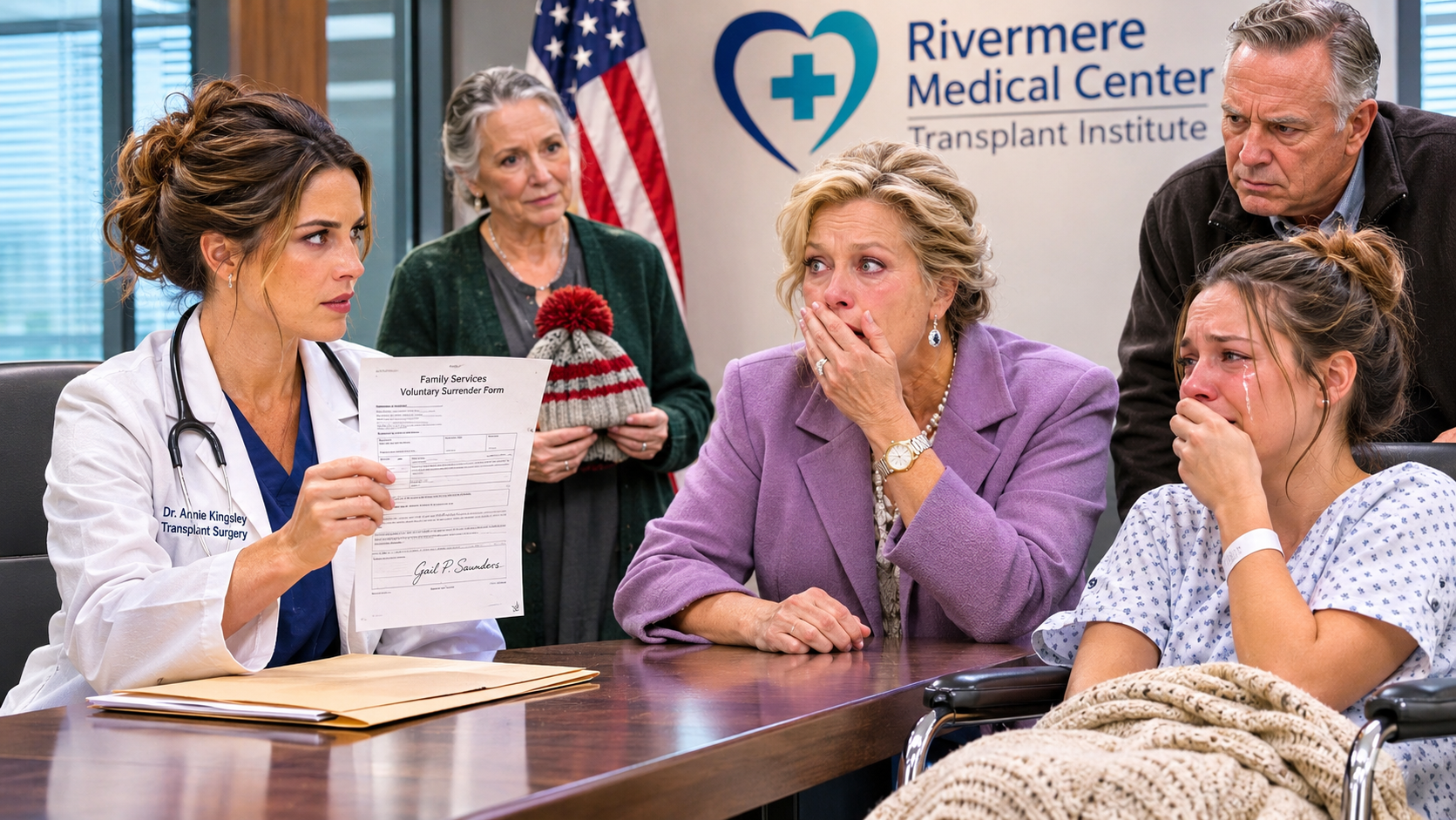
Annie, Your sister is too young to understand what’s happening. Please don’t let her forget that she had a big sister. I hope someday you will understand that we had no choice. Take care of her if you ever see her again.
Mom.
I read it once.
Then again.
My fingers trembled.
Lorraine spoke softly.
“I never understood why she wrote that. She had just signed the surrender form. But she seemed to believe you would somehow remain responsible for your sister.”
I placed the note on the desk.
For years, I had imagined that my mother might have cried after leaving me.
I had imagined her looking in the rearview mirror.
I had imagined her returning to the group home.
But now I understood something more painful.
Even in the moment she left me, she had thought about what I could do for the child she kept.
Not what I needed.
Not whether I was frightened.
Not whether I would have enough to eat.
She had written instructions for a five-year-old to take care of someone else.
I wiped my eyes.
“Did she ever come back?”
Lorraine shook her head.
“Not once.”
“Did she ever call?”
“No.”
I nodded slowly.
Then Lorraine reached into her handbag and removed another small item.
The gray-and-red knitted hat.
The one I had worn the day my mother left me.
I picked it up carefully.
It was smaller than I remembered.
The gray wool had faded, and one red thread had come loose near the edge.
I pressed it against my chest.
“I thought this was gone.”
Lorraine smiled sadly.
“You left it on a chair that afternoon. I picked it up because I thought you might want it someday.”
I looked at her.
“Thank you.”
She squeezed my hand.
“You were a very brave little girl, Annie. But you shouldn’t have had to be.”
That sentence broke something open inside me.
I cried.
Not because I wanted my mother back.
Not because I regretted the life I had built.
I cried because, for the first time, someone had acknowledged what had happened without explaining it away.
Two days later, Tori’s condition worsened.
Her blood pressure dropped during dialysis, and she developed a serious infection.
The medical team stabilized her, but her doctors warned that her condition was becoming increasingly fragile.
I visited her that evening.
She was awake, staring at the ceiling.
When she saw me, she smiled weakly.
“Hey, Nia.”
“Hey, Tory Bear.”
She shifted slightly.
“Mom came to see me.”
I pulled a chair closer.
“What did she say?”
Tori looked toward the window.
“She said you were punishing her.”
I sighed.
“I’m sorry.”
“She also said she never meant to abandon you.”
I didn’t answer.
Tori continued.
“She said she thought the group home would take care of you until she could come back.”
I looked at my sister.
“Did she tell you why she never came back?”
Tori shook her head.
“Not really.”
I sat quietly for a moment.
Then I told her about the note.
I showed her the photograph and the old knitted hat.
When she saw the note, her eyes filled with tears.
“She wrote that?”
“Yes.”
Tori read it slowly.
Then she handed it back.
“I think she wanted me to believe you were responsible for leaving.”
I nodded.
“She told you I ran away.”
“Yes.”
“She told the television audience she didn’t know where I was.”
“Yes.”
Tori closed her eyes.
“I don’t know what to believe anymore.”
I reached for her hand.
“You don’t have to figure everything out tonight.”
She squeezed my fingers.
Then she asked quietly:
“Did you hate me?”
I stared at her.
“What?”
“When we were little. When Mom kept me and left you. Did you ever hate me for being the one they chose?”
I felt my throat tighten.
“Tori, you were five.”
“But I was the one who stayed.”
“You were a child. Just like me.”
She started crying.
“I wish I could remember more.”
I brushed a tear from her cheek.
“You don’t have to remember everything for it to be real.”
She looked at me.
Then she smiled faintly.
“Will you sing the bear song again?”
I laughed softly.
“Of course.”
I began humming the little melody.
The same one I had sung in the back of that red Ford Escort.
The same one I had hummed while waiting for her blood pressure to stabilize.
The same one she remembered from a childhood she had almost forgotten.
Her eyes slowly closed.
And as I continued humming, I realized that the little girl in the red car had never really disappeared from either of our lives.
We had simply been separated by thirty years of silence.
The next morning, I made my decision.
I called the independent transplant coordinator and requested a formal donor evaluation.
I wanted every medical test completed.
I wanted an independent physician to explain every risk.
I wanted psychological counseling.
And I wanted the decision documented as mine alone.
The coordinator agreed.
A few weeks later, after extensive testing and review, the independent transplant team confirmed that I was medically suitable to donate.
They also confirmed that I understood the risks and had made the decision without coercion.
When the coordinator asked me one final time whether I wanted to proceed, I looked at the photograph of two little girls sitting together on the floor.
One holding a stuffed bear.
The other wrapped in a white blanket.
Then I answered.
“Yes.”
Not because my mother demanded it.
Not because she had given birth to me.
Not because I owed anyone a kidney.
I said yes because Tori was my sister.
And because I wanted her to have the chance to live a long life.
But there was one more thing I needed to do before the surgery.
I needed to speak to my mother.
Not as the chief of transplant surgery.
Not as the donor.
Not as the daughter she suddenly remembered.
As the little girl she had left behind.
And this time, I would not let her change the story.
PART 4
The day before surgery, I asked my mother to meet me.
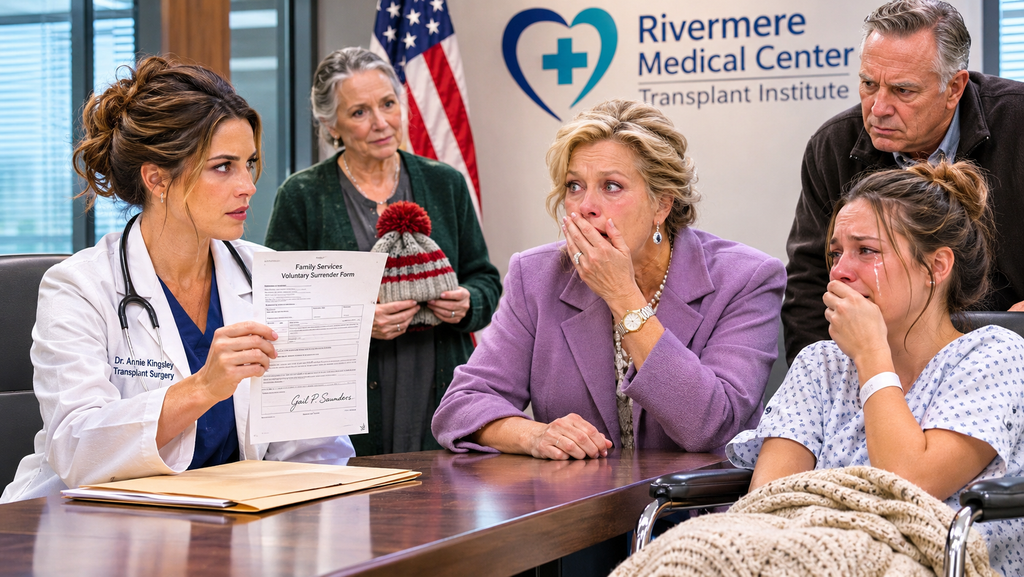
Not at my office.
Not in the hospital conference room.
I asked her to come to the small family waiting room on the fourth floor, where Tori had spent so many afternoons waiting for dialysis appointments.
She arrived twenty minutes late.
She was wearing the same lilac coat she had worn the first day she walked into my office.
Vince followed her, carrying a paper cup of coffee.
Mom looked around.
“Where is Victoria?”
“She knows we’re meeting. She wanted some time alone.”
Mom frowned.
“Why are we doing this now? The surgery is tomorrow. We should be celebrating.”
I gestured toward the chair opposite me.
“Please sit down.”
She sat.
I placed three things on the table.
The old photograph of Tori and me.
The knitted gray-and-red hat.
And the handwritten note she had left at Saint Jude’s thirty years earlier.
Mom stared at the items.
Her expression changed.
“Where did you get those?”
“Lorraine kept them.”
She picked up the photograph.
For a moment, she looked almost human in her sadness.
Then she put it down.
“I remember that day.”
I waited.
She rubbed her forehead.
“You were always attached to your sister. You followed her everywhere. You wouldn’t even let me carry her without asking where you were going.”
I smiled sadly.
“I was five. She was my little sister.”
Mom looked at the photograph again.
“You don’t understand what happened back then.”
“Then explain it to me.”
She sighed.
“Your father had lost his job. We were behind on rent. Tori was sick all the time, and we couldn’t afford everything. Someone at the social services office told us there were families who could take care of children temporarily.”
I looked at her.
“Temporarily?”
“Yes.”
“Then why did you sign a voluntary surrender form?”
She shifted in her chair.
“I didn’t know what else to do.”
“Why didn’t you come back?”
She didn’t answer.
“Why didn’t you call?”
Silence.
“Why did you tell Tori I ran away?”
Her eyes lifted.
“I didn’t want her to grow up thinking her parents abandoned her.”
I stared at her.
“So you gave her a different story and made me the person who abandoned everyone.”
“That wasn’t what I intended.”
“But that’s what happened.”
Vince finally spoke.
“Annie, people make mistakes. Your mother was under enormous pressure. We shouldn’t spend the rest of our lives punishing her for something that happened thirty years ago.”
I turned toward him.
“Were you there?”
He looked confused.
“What?”
“When I was left at Saint Jude’s. Were you there?”
He shook his head.
“No. I met your mother later.”
“Then you weren’t part of that day. But you’ve spent years helping her maintain the lie.”
He looked down.
I turned back to Mom.
“I need you to understand something. I had a good life. Michael and Olivia loved me. They gave me everything I needed. I’m grateful for that every day.”
Mom nodded quickly.
“Of course. That’s wonderful.”
“But having a good life doesn’t erase what happened when I was five.”
Her expression hardened.
“I said I was sorry.”
“No. You said you had no choice. Those are different things.”
She stared at me.
I continued.
“You came into my office because Tori needed a kidney. You didn’t recognize me. You didn’t ask whether I was happy. You didn’t ask what happened to me. You didn’t even wonder whether I had survived.”
Mom looked away.
“I didn’t know it was you.”
“That is exactly the point.”
For several seconds, the only sound was the air conditioning.
Then I pushed the handwritten note toward her.
“Read it.”
She hesitated.
Then she picked it up.
Her eyes moved across the words.
Please don’t let her forget that she had a big sister.
Take care of her if you ever see her again.
Mom.
When she finished, she put the paper down.
“I was hoping you would always love your sister.”
I swallowed.
“I did.”
She looked at me.
“I never stopped.”
Mom’s eyes filled.
Then she said something I wasn’t expecting.
“I was afraid.”
I waited.
“I thought you would hate us. I thought if you ever found out what happened, you would never want anything to do with us.”
I nodded slowly.
“Maybe you were right.”
She started crying.
“But now you have come back,” she said. “And you’re saving your sister. Maybe we can finally be a family again.”
I looked at her for a long moment.
Then I shook my head.
“Tomorrow, I’m donating a kidney to Tori. I’m not donating my life back to this family.”
Her face fell.
“Annie…” “I can love my sister without pretending you didn’t hurt me.” She reached across the table. I didn’t move. “I don’t know whether I’ll ever be able to have a relationship with you,” I said. “Maybe someday. Maybe never. But if we ever try, it has to begin with the truth.”
She wiped her cheeks.
“What truth?”
“The truth that you left me. That you didn’t come back. That you told Tori I ran away. And that you went on television and lied about not knowing what happened.”
Mom lowered her head.
I stood.
“I don’t need you to give me anything. I don’t need an apology for the cameras. I don’t need money. I don’t need you to call me your daughter in front of strangers.”
I paused.
“I needed a mother when I was five. I needed one when I was ten. I needed one when I was sixteen and wondering why nobody had ever come looking for me.”
My voice trembled.
“But I don’t need to keep waiting.”
I picked up the photograph.
“Tomorrow, I’m going into surgery because I choose to. Please don’t turn that into proof that you were right to abandon me.”
Then I walked out.
Behind me, my mother began crying.
I heard her say my name.
But I didn’t turn around.
For once, I didn’t feel guilty about walking away.
The morning of the transplant arrived.
I woke up at 4:30 a.m.
My apartment was quiet.
I made coffee, but I barely drank it.
I stood in front of the bathroom mirror and looked at myself.
Thirty-four years old.
Chief of transplant surgery.
A woman who had spent most of her adult life helping other people receive second chances.
And now I was about to give one to the little girl who had once fallen asleep against my shoulder in the back of a red Ford Escort.
My phone rang.
It was Dad.
“Good morning, sweetheart.”
“Good morning.”
“Are you ready?”
I laughed nervously.
“As ready as I’ll ever be.”
He paused.
“I want you to remember something. You don’t have to be brave every minute today.”
“I know.”
“And you don’t have to take care of everybody.”
I smiled.
“I know that, too.”
“Good. Then come home to us afterward.”
I closed my eyes.
“I will.”
When I arrived at the hospital, the transplant coordinator greeted me.
Tori was already in her room.
She looked pale but smiled when she saw me.
“Hey, big sister.”
I walked over and hugged her.
“Hey, little sister.”
She held my hand.
“I have something for you.”
She reached into the drawer beside her bed and pulled out a small stuffed bear.
It was old, with one button eye missing.
I recognized it immediately.
It was the same bear from the photograph.
I stared at it.
“Where did you find this?”
“Mom had it in an old storage box. I asked her for it.”
Tori smiled.
“I thought maybe you should have it after everything.”
I shook my head.
“You keep it.”
“But—”
“Keep it. We can share it when you get home.”
She laughed softly.
“Deal.”
Then her expression became serious.
“Annie?”
“Yes?”
“If anything goes wrong…”
I squeezed her hand.
“Don’t.”
“Please let me finish.”
I nodded.
“I just want you to know that meeting you has already changed my life. Even if we hadn’t become a donor match, I would still be grateful that I found you.”
I felt tears gather in my eyes.
“I’m grateful, too.”
She smiled.
“Now go get that kidney out of there.”
I laughed.
For the first time that morning, the fear loosened its grip on me.