
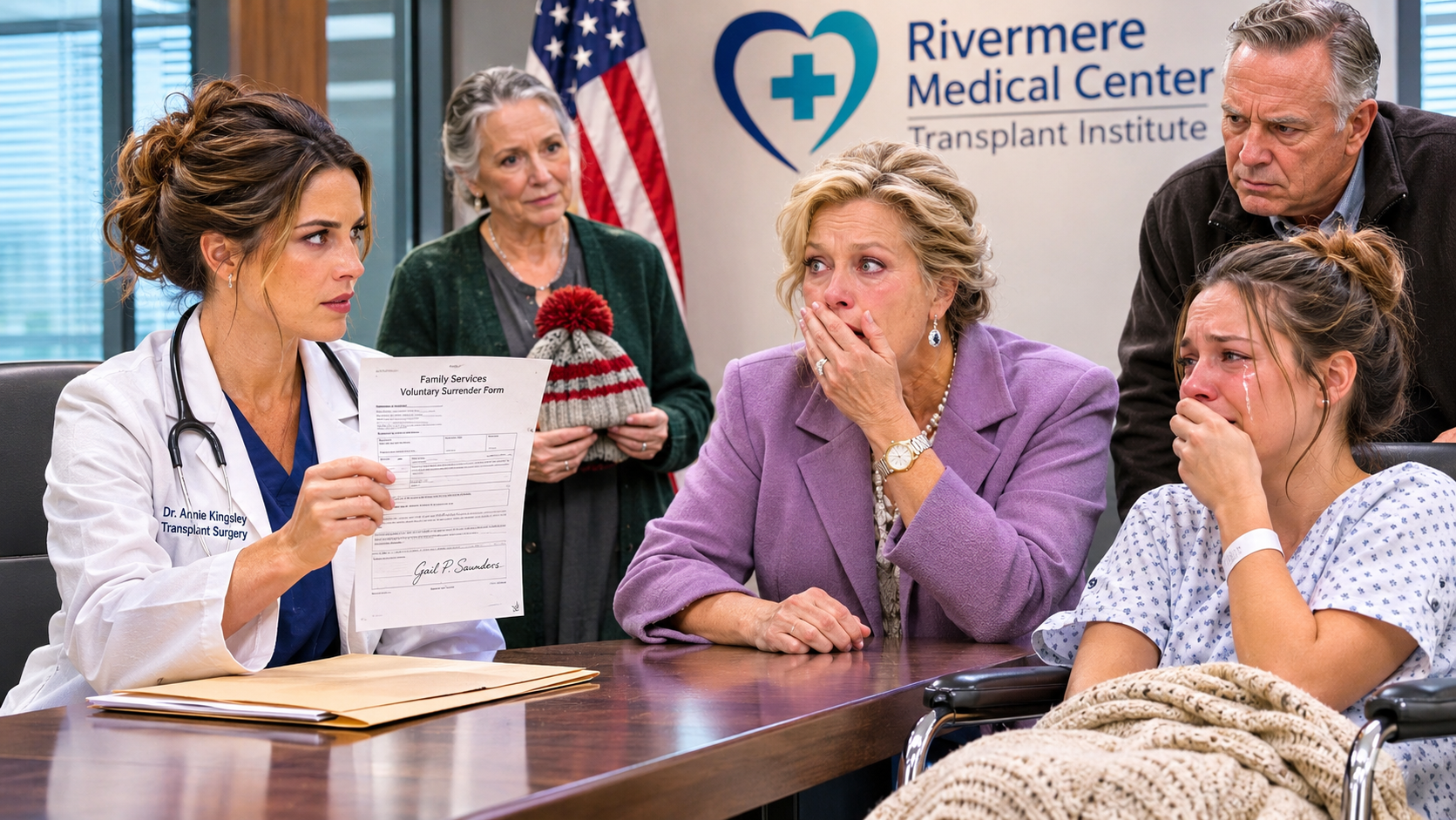
The surgery lasted several hours. Because I was the donor and also a member of the hospital’s leadership team, the operations were handled by separate surgical teams. I had already reviewed the procedures with the independent physicians.
There were no shortcuts.
No special treatment.
No exceptions.
Before I was taken into the operating room, I saw Dad standing beside my bed.
He held my hand.
“I’m proud of you.”
I smiled.
“I love you.”
“I love you more.”
Then the anesthesiologist asked me to count backward.
I remember reaching three.
After that, everything disappeared.
When I opened my eyes, the first thing I noticed was the pain.
It was manageable, but enough to remind me that something significant had happened.
A nurse leaned over.
“Welcome back, Dr. Kingsley.”
I tried to speak.
My throat was dry.
She smiled.
“Everything went well. Your kidney was successfully transplanted.”
I closed my eyes.
A tear rolled down my cheek.
“Victoria?”
“She’s in recovery. Her surgical team will update you as soon as possible.”
I nodded.
I wanted to sleep.
But I wanted to know about Tori more.
A few minutes later, Dad appeared.
He looked exhausted.
His eyes were red.
I reached for his hand.
“How is she?”
He smiled.
“She made it, sweetheart.”
I began crying.
“Her new kidney is functioning. The transplant team is pleased with her initial results.”
I covered my face.
Dad leaned closer.
“You did it.”
I shook my head.
“We did.”
He kissed my forehead.
Then he sat beside me until I fell asleep again.
Three days later, I was sitting in a wheelchair when the nurse helped me into Tori’s room.
She was awake.
Her cheeks had a little more color.
There was a smile on her face that I hadn’t seen since the day she first came to my office.
When she noticed me, she lifted her hand.
“Look who finally decided to visit.”
I laughed.
“You’re the one who had the longer recovery room stay.”
She shook her head.
Then she looked down at her abdomen.
“They said it’s working.”
“Yes.”
“Really working?”
“The doctors are happy with your progress.”
She looked at me.
“It’s inside me?”
I nodded.
She started crying.
“I don’t know what to say.”
“You don’t have to say anything.”
She reached for my hand.
“I promise I’ll take care of it.”
I smiled.
“Then take care of yourself, too.”
She nodded.
We sat quietly for a while.
Then she asked:
“Do you think we can make up for the thirty years?”
I considered the question.
“No. We can’t get those years back.”
She lowered her eyes.
“But we can make new ones.”
She smiled.
“Can we start with Thanksgiving?”
I laughed.
“Only if you’re cooking.”
“Absolutely not. I have a new kidney. I’m not risking it on my cooking.”
We laughed until the nurse came in and reminded us both to rest.
It was the first time in thirty years that we had laughed together.
And I knew it wouldn’t be the last.
The next few months were not easy.
Recovery took time.
I had follow-up appointments, medication adjustments, and restrictions on physical activity.
Tori also had a long recovery ahead of her.
Her transplant team monitored her kidney function closely, and she needed regular medication and laboratory testing.
But every week, she improved.
Her energy slowly returned.
She began eating better.
She started taking short walks around the hospital garden.
And one afternoon, she told me she wanted to teach piano again.
“I miss it,” she said.
“Then you should.”
“I’m not sure anyone will want lessons from someone who hasn’t played properly in years.”
I smiled.
“You’d be surprised what people will pay to have a patient teacher.”
She laughed.
A few weeks later, she began teaching two children from her neighborhood.
It wasn’t much, but she was happy.
That mattered more than anything.
Meanwhile, my mother continued trying to contact me.
At first, she sent messages.
Then flowers.
Then long letters.
Some were apologies.
Some were explanations.
Some were requests to meet.
I didn’t answer immediately.
I needed time.
And for the first time in my life, I allowed myself to take it.
One afternoon, a letter arrived without a return address.
I recognized the handwriting.
Inside was a single page.
Annie,
I have read the surrender document many times since you showed it to me.
I remember the day I left you. I remember how you held that grocery bag. I remember you asking whether Tori could come with you.
I told myself I was making the best decision for everyone.
But I never came back.
When Tori asked about you, I told her you ran away because I couldn’t bear to tell her what I had done.
I was wrong.
I am sorry.
I know saying that cannot give you back your childhood.
I don’t expect you to forgive me because I am your mother.
I only hope that one day you will allow me to know the woman you became.
Gail.
I read it twice.
Then I folded it carefully and placed it in the drawer beside my old photograph.
I didn’t call her.
I didn’t write back.
But I didn’t throw the letter away, either.
Sometimes forgiveness begins with a conversation.
Sometimes it begins with distance.
And sometimes it begins with accepting that an apology cannot undo the past.
I wasn’t ready to forgive her.
But I no longer wanted to spend every day being angry.
That was enough for now.
Six months after the transplant, Tori came to my apartment for dinner.
She arrived carrying a small box.
“What’s that?” I asked.
“Something for you.”
She placed it on the kitchen counter.
Inside was a framed photograph.
It was the old black-and-white picture of us as children.
But Tori had added another photograph beside it.
A recent picture of the two of us sitting together in the hospital garden.
Underneath, she had written:
Thirty years apart. Sisters forever.
I stared at it.
“Where did you get this made?”
“Don’t change the subject. Do you like it?”
I laughed.
“I love it.”
She hugged me.
Then she handed me a second item.
A small knitted bear.
“I made this.”
I examined it.
It was gray with a red scarf.
The stitching was uneven, and one ear was slightly larger than the other.
“It’s beautiful,” I said.
“It’s terrible. I know.”
“It’s perfect.”
She smiled.
“I thought we should have something new. Something that belongs to us now.”
I placed the bear beside the photograph.
Then we prepared dinner.
We burned the first batch of vegetables.
The chicken took twice as long as expected.
And Tori nearly dropped a bowl of salad because she was laughing too hard.
But when we finally sat down at the kitchen island, I looked at her and realized something.
This was the family I had wanted.
Not a perfect family.
Not one without pain.
Just a family where people showed up.
Where nobody had to earn a place at the table.
Where love wasn’t measured by what someone could give.
A year later, Tori celebrated her thirty-fourth birthday.
She invited me, Dad, and Lorraine.
She also invited Mom.
I was surprised when I received the invitation.
I called her.
“Are you sure?”
“Yes.”
“Are you ready for that?”
“I think so.”
I paused.
“What if she makes things difficult?”
“Then we’ll deal with it. But I don’t want to spend my entire life waiting for the perfect family.”
I understood.
So I agreed.
The birthday dinner was held at a small restaurant near the hospital.
Dad arrived early.
Lorraine brought flowers.
Tori wore a beautiful blue dress and looked healthier than I had seen her in years.
Mom arrived last.
She stood near the entrance for several seconds before approaching us.
Her eyes moved from Tori to me.
“Happy birthday, Victoria.”
Tori hugged her.
Then Mom turned toward me.
“Annie.”
“Gail.”
She nodded.
She didn’t try to hug me.
And I appreciated that.
Dinner was awkward at first.
Mom spoke mostly to Tori.
Vince barely spoke at all.
But after dessert, Mom reached into her handbag.
She removed a small envelope.
“I brought something.”
She placed it in front of me.
Inside was a photograph.
It showed me standing outside Saint Jude’s Group Home.
I was wearing the gray-and-red knitted hat.
My face was turned toward the camera.
I was holding the plastic grocery bag.
On the back, Mom had written:
The day I should have turned around.
I stared at the photograph.
“Where did you get this?”
“Lorraine sent me a copy.”
I looked at her.
She lowered her eyes.
“I’ve spent a lot of time thinking about that day.”
I didn’t say anything.
She continued.
“I cannot change what I did. I know that.”
Her voice trembled.
“I also know that you may never forgive me.”
I placed the photograph on the table.
“Thank you for acknowledging it.”
She nodded.
Then she turned to Tori.
“I’m glad you’re doing better.”
Tori smiled.
“Thank you, Mom.”
It wasn’t a perfect reconciliation.
There were no dramatic embraces.
No promises that everything would suddenly become normal.
But for the first time, Mom didn’t ask me for anything.
She didn’t mention the kidney.
She didn’t ask me to come home.
She didn’t tell me I owed her.
She simply sat at the table and ate dinner.
And sometimes, that is where a difficult relationship has to begin.
Later that evening, Tori and I stepped outside.
The air was cool.
The streetlights reflected against the restaurant windows.
She slipped her arm through mine.
“Are you happy?”
I smiled.
“Yes.”
“Really?”
“Really.”
She looked toward the sky.
“Do you ever think about that day?”
“Which day?”
“The day Mom left you.”
I nodded.
“Sometimes.”
“Does it still hurt?”
I thought about it.
“Yes. But it doesn’t control my life anymore.”
She leaned against my shoulder.
“I wish I could have gone with you.”
I kissed the top of her head.
“I know.”
We stood there quietly.
Then she began humming.
The little bear song.
I joined her.
And for a moment, I could almost see two little girls sitting together on the floor, sharing a blanket and laughing.
One of them had been left behind.
The other had been carried away.
But somehow, after thirty years, they had found each other again.
Two years later, I established a small hospital-supported program for children entering foster care.
We called it the Second Home Project.
It provided medical examinations, counseling referrals, educational support, and assistance for children who entered care without adequate belongings.
I also worked with local agencies to help siblings maintain contact whenever it was safe and possible.
At the opening ceremony, Dad stood beside me.
Tori was there, too.
She had returned to teaching piano full-time and volunteered to give free lessons to children in the program.
Lorraine sat in the front row.
When I stepped to the microphone, I looked at the children sitting in the audience.
Some were nervous.
Some were smiling.
Some were holding the hands of social workers.
I took a breath.
“When I was five years old, someone left me in a building and told me I was extra.”
The room became quiet.
“I spent a long time wondering what was wrong with me. I wondered why I wasn’t worth keeping.”
I paused.
“But eventually, I learned something important.”
I looked toward Dad.
“Being abandoned does not mean you are unwanted. It does not mean you are unworthy. And it certainly does not mean your future has already been decided.”
My voice trembled slightly.
“Sometimes the family that raises you is the family that chooses you. Sometimes the people who save your life are people you haven’t even met yet.”
I looked at Tori.
“And sometimes, people you thought you had lost forever find their way back.”
The audience applauded.
But I wasn’t thinking about the applause.
I was thinking about a little girl with a knitted hat and a plastic grocery bag.
I wished I could go back and tell her something.
I wished I could kneel beside her and say:
You’re not extra, Annie.
You’re not a burden.
One day, someone will choose you.
And one day, you’ll learn to choose yourself.
That evening, Tori came home with me.
We sat in the kitchen, drinking tea.
She looked at the framed photograph on the wall.
The old picture of us as children.
“Do you remember what you used to call me?” she asked.
“Tory Bear.”
She smiled.
“And do you remember what I called you?”
“Nia.”
She nodded.
“I used to think that was the most beautiful name in the world.”
I laughed.
“You couldn’t pronounce Annie.”
“Still beautiful.”
We sat quietly.
Then she reached across the counter and held my hand.
“Thank you for giving me another chance.”
I shook my head.
“Thank you for finding me.”
She smiled.
And I understood that the kidney had never been the most important gift between us.
The most important gift was that we had found our way back to each other.
Not because our mother demanded it.
Not because blood made us obligated.
But because we wanted to.
Before she left that night, Tori hugged me.
“Goodnight, big sister.”
“Goodnight, little sister.”
After the door closed, I walked over to the framed photograph.
Two little girls.
One stuffed bear.
One forgotten childhood.
I touched the glass gently.
For thirty years, I had thought the story of my family began with a goodbye.
But it didn’t.
It began with two sisters who loved each other before they even understood what love meant.
And it continued with two adults who finally got the chance to choose each other.
My mother had once looked at me and decided she could only afford two children.
She had believed I was the extra one.
But she had been wrong about the most important thing.
I was never extra.
I was never disposable.
I was never the mistake.
I was Annie Kingsley.
A daughter who had been loved.
A surgeon who had found her purpose.
A sister who had found her way home.
And for the first time in my life, I no longer needed anyone from my past to tell me that I belonged.
I already knew.
THE END!