

The attorney answered. “Because he loved you.” Kevin looked away. Then came the final part. “The house belongs to David. The investment accounts belong to David. The remaining funds have been divided according to my wishes.
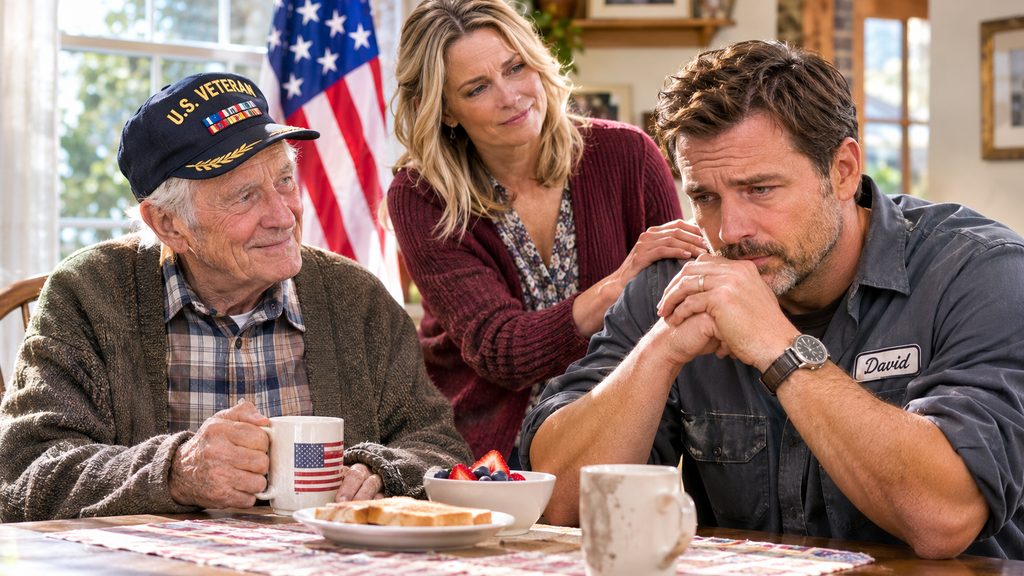
But I want David to understand something more important than money.
David, you once told me that I was a burden.
You didn’t say it directly.
You didn’t have to.
I saw it in your face.
I forgive you.
I never wanted you to feel guilty.
I only wanted you to learn what I learned when I was young.
Sometimes the people who appear to take the most are the people quietly giving you the most.
You were the son who stayed.
You were the man who drove me to appointments.
You were the one who fixed my television.
You were the one who sold his truck.
You were the one who came running when I fell.
You gave me twenty years of family.
No money could ever repay that.
So I am not leaving you an inheritance because I owe you.
I am leaving it because you earned it without knowing you were earning anything.
Take care of Sarah.
Take care of the boys.
And please, David…
sit in my chair sometimes.
It was never really your chair.
It was mine.
But I always thought it looked better when you were sitting in it.”
The room disappeared.
I could no longer see Kevin.
I couldn’t see the attorney.
I couldn’t see the walls.
All I could see was Arthur sitting in that chair, holding his coffee.
All those mornings.
All those evenings.
All those times he had said:
Thank you, son.
I had thought he was thanking me for feeding him.
Now I understood.
He had been thanking me for loving him.
Even when I didn’t know how.
I stood suddenly.
I walked toward the back bedroom.
The room looked exactly as he had left it.
His faded baseball cap was still on the dresser.
His slippers were beneath the bed.
His old radio was beside the window.
I sat on the edge of his bed.
And for the first time, I opened the drawer of his nightstand.
Inside was a stack of photographs.
My sons as children.
Sarah at twenty.
Our family Christmas.
My old Silverado.
And one photograph of me standing in the driveway with grease on my hands.
On the back, Arthur had written:
“My son, David.”
I broke.
I cried like a child.
Sarah came into the room and sat beside me.
“I’m sorry,” I whispered.
“For what?”
“For all the times I was angry.”
She leaned against my shoulder.
“He knew.”
“I should have known.”
She took my hand.
“Maybe you weren’t supposed to know until now.”
A month later, I made the first change.
I moved the dining table closer to the window.
Then I put Arthur’s chair at the head.
Not mine.
His.
My sons thought it was strange.
“Why is Grandpa’s chair there?”
I smiled.
“Because that’s where he belongs.”
The second change was harder.
I opened the financial account Arthur had left me.
There was enough money to change our lives permanently.
But I didn’t spend it on a bigger house.
I didn’t buy another truck.
I didn’t buy anything extravagant.
Instead, I paid off the mortgage.
Then I paid for my sons’ college funds.
Then I repaired the roof.
And finally, I went back to the transmission shop where I had worked for twenty years.
I gave my notice.
Not because I hated the work.
Because for the first time, I had the freedom to choose what came next.
That summer, I bought a small workshop.
I hired two young mechanics.
One of them reminded me of myself at twenty.
Hardworking.
Proud.
Too stubborn to ask for help.
I made sure he knew he didn’t have to do everything alone.
Every Sunday, Sarah and I visited Arthur’s grave.
We brought flowers.
Sometimes coffee.
Sometimes nothing.
We just sat.
One Sunday, she asked me:
“Do you still think about him?”
I smiled.
“Every day.”
“Do you miss him?”
“Every day.”
She took my hand.
“I think he knew you loved him.”
I looked at the grave.
“I hope so.”
Then I laughed softly.
“He’d probably tell me I was being dramatic.”
Sarah laughed too.
The years passed.
My sons grew up.
They got married.
They had children.
And eventually, my grandchildren began sitting at the same dining table where Arthur had once eaten oatmeal.
One afternoon, my youngest grandson asked me why an old baseball cap was sitting on a shelf.
“That’s your great-grandpa’s.”
“Was he nice?”
I thought about the question.
Then I smiled.
“He was.”
“Did you like him?”
That question hit harder.
I looked at Sarah.
She smiled gently.
I looked at the cap.
Then I answered.
“I didn’t understand him at first.”
My grandson frowned.
“What happened?”
I pulled him onto my lap.
“I thought he was taking something from our family.”
“What was he taking?”
“Food. Space. Money. Time.”
“Was he?”
I shook my head.
“No.”
“What was he doing?”
I looked toward the dining room.
“He was giving us something we couldn’t see.”
“What?”
“Security.”
My grandson thought about that.
Then he asked:
“Did he have a lot of money?”
I laughed.
“Yes.”
“Why didn’t he tell you?”
I looked at the old chair.
“Because he wanted to know whether we’d love him without it.”
My grandson wrapped his arms around my neck.
I held him tightly.
Years later, when I was cleaning out the attic, I found another box.
It contained Arthur’s old receipts.
Bank statements.
Photographs.
And one final note I had never seen.
It was written on a small piece of lined paper.
David,
If you ever find this, it means I’m already gone.
I hope you’re sitting in my chair.
Don’t feel guilty.
You gave me more than money ever could.
You gave me a home.
I sat on the attic floor for a long time.
Then I folded the note carefully.
I carried it downstairs.
I placed it beside his photograph.
And I sat in his chair.
For twenty years, I had believed Arthur Henderson was the man taking from my family.
I had counted every meal.
Every prescription.
Every gallon of gasoline.
Every bill.
I had measured what he cost.
But I had never measured what he gave.
He gave my children a grandfather.
He gave my wife peace.
He gave me the chance to become a better man.
And when he died, he gave me one final lesson.
Love doesn’t always arrive carrying flowers.
Sometimes it sits quietly at your dining table.
Sometimes it drinks black coffee.
Sometimes it says, “Thank you, son.”
Sometimes it lets you believe you’re the one doing all the giving.
And sometimes, only after it’s gone, do you finally understand that the person you called a burden was the one quietly carrying you.
I still keep Arthur’s chair by the window.
Nobody sits in it without asking.
Not because it’s expensive.
Not because it’s special.
Because every morning when the sunlight reaches that corner of the room, I can almost imagine him there.
His baseball cap on his knees.
His coffee in his hands.
His radio playing softly.
And if I close my eyes long enough, I can hear him say the words I misunderstood for twenty years.
“Thank you, son.”
This time, I always answer.
“Thank you, Dad.”
THE END! THANKS FOR READING!❤️🙏