
I went to my second home to prepare it for renters and discovered my daughter-in-law’s parents staying there with three relatives. They were drinking my wine, eating at my family’s cherrywood table, and behaving as if they had already inherited the place.
Then Brenda, my daughter-in-law’s mother, looked directly at me and smiled. “Sarah gave us permission. This house will belong to her someday anyway.” That sentence changed everything.
Not because it was the first time my daughter-in-law, Sarah, had acted as though something I owned would eventually become hers.
It wasn’t.
But it was the first time one of her relatives had said the truth aloud while sitting inside my home, using my things, and treating my retirement property like a free vacation rental.
My name is Diane.
I was sixty-eight years old when this happened, and the cabin in the mountain lake region was not some forgotten little property collecting dust.
It was part of my retirement plan.
My late husband, Robert, and I had bought it nearly thirty years earlier.
Back then, it was barely more than a weathered two-bedroom cabin with an uneven deck, a leaking roof, and a view of the lake that made every problem seem worth fixing.
Robert rebuilt the porch himself.
I painted the kitchen cabinets.
We replaced the old wood-burning stove one winter after smoke filled the living room and scared us half to death.
Our son, Jason, learned to fish from that dock.
He broke his wrist falling off a bicycle on the gravel driveway when he was eleven.
We celebrated birthdays there, spent Christmas weekends there, and once sat awake through an entire thunderstorm because eight-year-old Jason was convinced lightning could come through the chimney.
After Robert died, I could barely visit the place for nearly two years.
Every corner held a memory.
His old fishing hat still hung from a peg in the mudroom.
The small dent he had made in the pantry door while carrying a new refrigerator was still there.
I never repaired it.
Some marks on a home are damage.
Others are history.
Eventually, though, I had to begin thinking practically.
The cabin had increased considerably in value, but keeping a second property was expensive.
Taxes.
Insurance.
Maintenance.
Utilities.
Repairs.
I had no intention of becoming dependent on my son as I grew older, so I decided to rent the cabin long-term.
The income would strengthen my retirement savings and help cover future medical or housing expenses if I ever needed them.
It was not an emotional decision.
It was responsible planning.
That Saturday morning, I drove up with a folder of documents, fresh linens, cleaning supplies, and a list of small repairs the realtor had recommended before showing the house to prospective tenants.
I expected quiet.
Instead, when I unlocked the front door, I heard music.
Then laughter.
Then the unmistakable sound of glassware clinking.
I actually stepped backward and checked the house number.
For several seconds, I wondered whether I had somehow entered the wrong place.
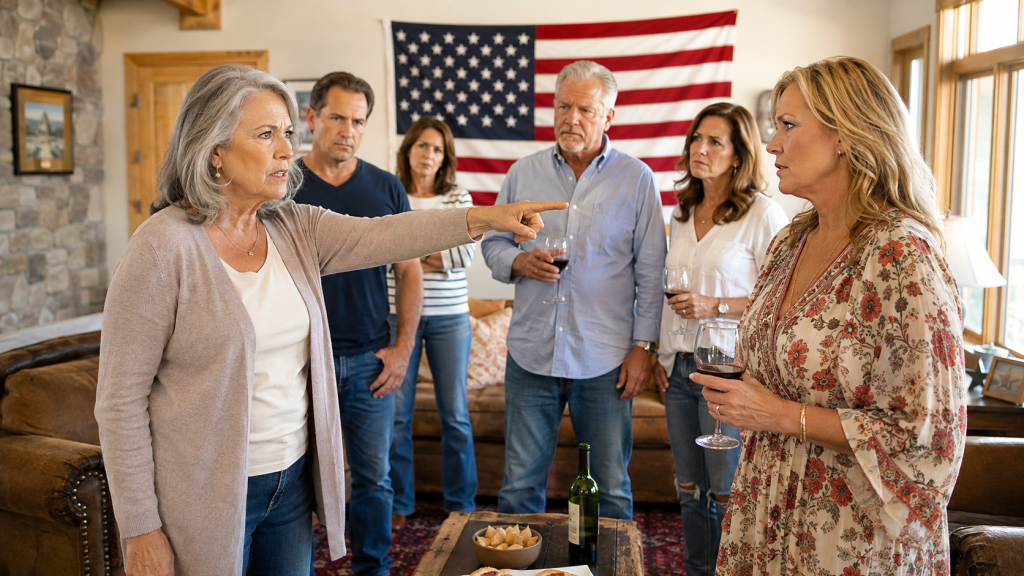
Then I saw Brenda.
She was sitting on my sofa with her shoes tucked beneath her, holding one of Robert’s crystal wine glasses.
Her husband, Larry, was stretched out in Robert’s recliner.
Three people I recognized vaguely as relatives from Sarah’s side of the family were crowded around the coffee table.
Pizza boxes covered the surface.
Someone had placed a sweating soda can directly on the wood without a coaster.
The kitchen counter was covered with food containers.
A stack of dirty dishes filled the sink.
A suitcase lay open in the hallway.
Another suitcase was sitting halfway up the stairs.
They had not just stopped by.
They were staying there.
Brenda looked at me with a surprised expression.
Not guilty.
Surprised.
“Diane,” she said. “What are you doing here?”
For a moment, I couldn’t speak.
There are insults that arrive loudly.
And then there are insults so casual that they take a second to register.
She was asking what I was doing in my own house.
“I came to prepare the property for the realtor,” I said.
Larry glanced toward Brenda.
One of the cousins lowered his slice of pizza.
But Brenda simply smiled.
“Oh. Sarah said the place was sitting empty.”
“That does not explain why you are here.”
Her smile tightened.
“Well, she told us we could use it for a few weeks. We needed a little family getaway.”
I looked around again.
“My son gave you permission?”
“Sarah did.”
“That is not the same thing.”
Brenda laughed softly.
“Diane, don’t become upset. Honestly, I thought you’d be happy someone was enjoying the place.”
I felt my pulse quicken.
“How did you get inside?”
She hesitated.
Then she said, “Sarah gave us a key.”
That answer hurt more than I expected.
Jason had once kept an emergency key for the cabin.
I had given it to him years earlier when I traveled often.
He knew the purpose of that key.
Emergency access.
Nothing more.
I looked toward the open wine bottle on the counter.
It was a 1998 Cabernet Robert and I had bought on our twenty-fifth wedding anniversary.
I had saved it all those years.
Brenda followed my eyes.
“Oh, that wine was wonderful,” she said. “I hope you don’t mind.”
Something inside me became very quiet.
“I do mind.”
Her face changed slightly.
“Diane—”
“This property is being prepared for long-term tenants. You cannot stay here.”
She blinked.
Then she looked almost amused.
“Sarah told us there was no rush.”
“It isn’t Sarah’s decision.”
“Of course not technically,” she said. “But we’re family.”
I said nothing.
Brenda stood and carried the wineglass into the kitchen.
“Look, don’t make this awkward. Sarah explained that eventually the house will belong to her and Jason anyway. We’re only here for a couple of weeks.”
There it was.
Eventually the house will belong to her.
Not them.
Her.
I stared at Brenda.
“Sarah told you that?”
She shrugged.
“Well, obviously. Jason is your only child.”
I felt something cold settle in my stomach.
My son was indeed my only child.
But I had two grandchildren.
Ethan was twelve.
Sophie was nine.
I loved them beyond words.
But inheritance had never been discussed in detail with Jason or Sarah.
I had occasionally said that I wanted to leave something meaningful for the family.
Apparently, in Sarah’s mind, that had become a promise.
Then a guarantee.
Then ownership.
While I was still alive.
“I need everyone to leave,” I said.
Brenda’s eyebrows lifted.
“Today?”
“Yes.”
Larry finally stood.
“Come on, Diane. Let’s not get dramatic.”
I turned toward him.
“Five adults entered my property without my permission. You used my key, opened my wine, slept in my rooms, and apparently planned to stay for weeks. I am not being dramatic.”
One of the relatives quietly began folding a blanket.
Brenda did not move.
“Sarah said it was fine.”
“Sarah does not own this house.”
“She will someday.”
“No,” I said. “She might not.”
That finally erased the smile from Brenda’s face.
The room became very still.
Then she crossed her arms.
“What is that supposed to mean?”
“It means exactly what I said.”
I gathered the folder I had brought and placed it back into my bag.
I suddenly knew I did not want to argue.
Not there.
Not while standing inside a room where people who barely knew me had already begun calculating what would happen after I died.
“I am leaving now,” I said. “I expect you to be gone by tomorrow.”
Brenda looked offended.
“You’re seriously throwing family out?”
“I did not invite family in.”
I walked toward the door.
Behind me, she actually called, “Well, if you’re driving back to the city anyway, could you take the garbage bags near the kitchen?”
I stopped.
For one second, I almost laughed.
Instead, I opened the door and left.
Jason called before I reached the highway.
I ignored it.
He called again twenty minutes later.
Then again.
I drove home without answering.
By the time I reached my townhome, anger had burned away and left clarity behind.
That was when I began reviewing every form of help I had been quietly providing to my son’s family.
Not because I wanted revenge.
Because generosity without boundaries had created expectations.
And expectations, left unchecked, had become entitlement.
The first thing I opened was the savings account I had created five years earlier.
There was slightly more than sixty thousand dollars inside.
I had been saving it toward a down payment for Jason and Sarah.
They wanted to move from their townhouse into a larger suburban home before Ethan entered high school.
Jason knew about the account.
Sarah knew approximately how much was there.
They had apparently started treating the money as part of their financial plan.
But the account was still mine.
No documents promised it to them.
No contract required me to give it.
It was a future gift.
A gift based on trust.
I transferred the money back into my private retirement account.
Then I called the cleaning company that serviced the cabin between my visits.
I suspended service.
After that, I removed my automatic payments for several nonessential utilities and subscription services connected to the property.
I kept necessary services active to protect the home, but everything related to their comfort was canceled.
Cable television.
Streaming packages.
The premium internet upgrade.
The grocery delivery account Sarah had apparently been using.
I also called the realtor.
I explained that the showing would need to be delayed for several days.
Then I called a locksmith.
By eight the next morning, Sarah was standing at my door.
She did not knock gently.
She knocked like someone collecting a debt.
When I opened the door, she stepped inside before I invited her.
“Diane, what are you doing?”
“Good morning to you too.”
“My parents called me last night. My mother was crying.”
“That sounds unpleasant.”
“She said you humiliated them.”
“I asked adults who entered my house without permission to leave.”
“They had permission.”
“Not from me.”
“Jason said we could use the cabin.”
I looked at her carefully.
“Jason told you that?”
Her confidence weakened for half a second.
Then she folded her arms.
“We discussed it.”
“That was not my question.”
She sighed sharply.
“Why are you making this into some legal technicality? We are family.”
“Ownership is not a technicality.”
“Your house was empty.”
“It was being prepared for renters.”
“My parents needed somewhere to stay.”
“Then they should have rented somewhere.”
“That would cost thousands.”
“Yes,” I said. “Housing often costs money.”
She stared at me.
The response clearly offended her.
Sarah had always been good at turning inconvenience into injustice.
She was not cruel in obvious ways.
That would have been easier.
Instead, she had a talent for speaking as though whatever benefited her was simply the reasonable outcome everyone else should accept.
When Jason and I disagreed, she often said things like, “I just think family should support each other.”
What she usually meant was that I should support them.
Financially.
Logistically.
Emotionally.
Conveniently.
But never inconveniently.
She followed me into the kitchen while I watered the herbs on my windowsill.
“My parents feel completely unwelcome now.”
“They are unwelcome at the cabin.”
“You cannot mean that.”
“I do.”
“Why?”
I set down the watering can.
“Because they entered my home without my permission.”
“Because I allowed them!”
I looked at her.
“That sentence is the entire problem.”
She stared at me.
Then she gave a short, nervous laugh.
“Diane, honestly, what does it matter? That house will eventually belong to Jason and me.”
I felt a strange sadness when she said it.
Not anger.
Sadness.
Because she believed it.
She had mentally moved me out of my own life.
My belongings were future possessions.
My savings were future assistance.
My property was future inheritance.
My death was apparently only an administrative delay.
“Someday is not today,” I said. “And whether that property ever belongs to you remains entirely my decision.”
Sarah became silent.
For perhaps the first time since I had known her, she seemed genuinely uncertain.
Then her face changed.
“The savings account.”
I waited.
“Jason checked it this morning. The money is gone.”
“It is not gone.”
“Where is it?”
“In my account.”
“You transferred it?”
“Yes.”
She looked stunned.
“We are closing on the house next week.”
“That is unfortunate.”
“Unfortunate? Diane, we need that money.”
“You planned to use money you did not own.”
“You promised it!”
“I said I hoped to help.”
“Jason said it was ours.”
“Then Jason misunderstood.”
Her voice rose.
“Do you understand what this does to us?”
“I understand perfectly.”
“We could lose the house!”
“Then perhaps you should not have signed a purchase agreement that depended on a gift you had not yet received.”
She stood completely still.
I pulled out a chair.
“Sit down.”
She remained standing.
I continued anyway.
“That money was meant to help you because I trusted you both. Trust must work in both directions. You do not get to plan my property, distribute my keys, promise my home to relatives, and then expect financial support to continue as though none of it matters.”
“My parents made a mistake.”
“No. A mistake would have been misunderstanding a weekend invitation. They planned to stay for weeks. Your mother told me the house would belong to you someday. That idea came from somewhere.”
Sarah looked away.
That was answer enough.
“What exactly have you told people about my property?” I asked.
“Nothing inappropriate.”
“That is not an answer.”
She finally sat down.
“I may have said that Jason would inherit it eventually.”
“And the townhome?”
She looked uncomfortable.
I felt another chill.
“What did you say about my townhome?”
“Diane—”
“What did you say?”
She exhaled.
“That we would probably sell it eventually.”
I sat back.
There are moments when betrayal does not arrive like a blow.
It arrives like a door slowly opening.
Behind it, you discover that conversations have happened without you.
Plans have been made.
Assumptions have hardened into expectations.
People have assigned themselves parts of your future because they assume you will not be there to object.
I asked one final question.
“Have you discussed my assets with your parents before?”
Sarah said nothing.
I already knew.
That afternoon, I called my attorney.
Her name was Margaret Ellis.
She had handled Robert’s estate and helped me update my will after his death.
I told her everything.
When I finished, she was silent for several seconds.
Then she said, “Diane, you should review your estate plan.”
“I was thinking the same thing.”
“What do you want the cabin to accomplish?”
That question stayed with me.
What did I want it to accomplish?
Not punish Sarah.
Not embarrass Jason.
Not become a weapon.
Robert and I had bought that cabin to create security and memories.
I wanted it to continue doing that.
For the people who had not yet learned to measure family by ownership.
My grandchildren.
“I want Ethan and Sophie protected,” I said.
Margaret understood immediately.
Over the next several weeks, we restructured my estate plan.
The cabin would eventually be placed into a trust for Ethan and Sophie.
Neither Jason nor Sarah would own it outright.
When the grandchildren reached adulthood, they would have options.
They could maintain it as a family property.
They could rent it.
They could sell it under the terms of the trust.
But neither parent could take control of it beforehand.
I also appointed an independent trustee.
Margaret asked whether I wanted Jason informed immediately.
“No,” I said.
Not yet.
First, I wanted to see how he responded when he finally had to choose between peace and responsibility.
That Sunday, I returned to the cabin.
The locksmith met me in the driveway.
Brenda’s SUV was still parked outside.
So was another vehicle.
I felt disappointed, but not surprised.
She opened the door wearing one of my bathrobes.
My bathrobe.
I almost admired the confidence.
“Diane,” she said with a tired smile. “You’re back.”
“Yes.”
“We already explained that we’re staying through the end of the month.”
I stepped aside.
The locksmith walked forward carrying a new deadbolt.
Brenda’s expression changed instantly.
“What is he doing here?”
“Changing the locks.”
“You cannot lock us out while we’re staying here.”
“You are not staying here.”
Larry appeared behind her.
“What’s going on?”
“The locks are being changed today.”
His face reddened.
“You can’t just throw people out with no notice.”
“You were told to leave yesterday.”
“We have luggage upstairs.”
“You have thirty minutes to pack it.”
Brenda laughed in disbelief.
“Sarah is going to hear about this.”
“I expect she will.”
Then something happened that surprised all of us.
A truck pulled into the driveway.
Jason stepped out.
He looked exhausted.
He walked toward the porch, saw the locksmith, and closed his eyes briefly.
“Mom.”
“Jason.”
Brenda immediately moved toward him.
“Thank goodness. Tell her this is ridiculous.”
Jason looked at me.
Then at Brenda.
Then at the open cabin behind her.
“What are you still doing here?”
Brenda froze.
“What?”
“My mother told you to leave.”
“Sarah said—”
“I don’t care what Sarah said.”
That was the first time I had ever heard my son speak to his mother-in-law that way.
Larry stepped forward.
“Watch your tone.”
Jason looked at him.
“No. You watch yours. This is my mother’s house.”
Brenda’s mouth fell open.
Jason turned toward me.
“I’m sorry.”
I said nothing.
He continued.
“I should have dealt with this before it became this.”
“Did you give Sarah permission to use the key?”
He looked ashamed.
“She asked where it was.”
“That is not what I asked.”
“No,” he said. “I didn’t give permission.”
Brenda interrupted.
“Sarah said you agreed.”
Jason shook his head.
“She said your hotel reservation fell through and asked whether I thought Mom would mind if you stayed one weekend. I told her to ask Mom.”
I looked at Brenda.
Her face had gone pale.
“One weekend?” I asked.
Jason nodded.
“I had no idea there were five people here.”
Brenda began speaking quickly.
“Well, plans changed.”
“Then you should have called me,” I said.
She crossed her arms.
“We assumed Sarah handled it.”
“No,” Jason said quietly. “You assumed nobody would stop you.”
The sentence seemed to affect him as much as it affected everyone else.
Perhaps he heard his own life inside it.
Brenda packed.
So did Larry.
The relatives moved quickly and said very little.
Before leaving, Brenda turned toward me.
“You are destroying this family over a house.”
I looked at her.
“No. I am protecting a relationship that had no boundaries.”
She shook her head.
“You will regret this when you are old and need people.”
“I am already old enough to know that help purchased by surrendering dignity is not help.”
She left.
The locksmith changed every exterior lock.
I installed a security system the following week.
The realtor found a long-term tenant within a month.
A retired couple rented the cabin and cared for it beautifully.
The income went directly into my retirement account.
But the family conflict did not disappear immediately.
Sarah was furious about the down payment money.
She and Jason lost the house they had planned to buy.
Their financing depended too heavily on my contribution.
For weeks, she blamed me.
She told relatives I had become controlling.
Petty.
Vindictive.
I heard all of it through other family members.
I did not defend myself.
Something changes when you finally stop managing other people’s opinions.
You discover how exhausting the job had been.
Jason began visiting me alone.
At first, our conversations were awkward.
Then one afternoon, he said something I never expected.
“I think I’ve been hiding behind you.”
I looked at him.
“What do you mean?”
“Whenever Sarah pushed too hard, I let you absorb the conflict.”
He stared into his coffee.
“I told myself I was keeping peace. I wasn’t. I was making you handle problems I should have addressed.”
I did not rescue him from the discomfort.
He needed to feel it.
“I love Sarah,” he said. “But she has gotten used to deciding things for everyone.”
“Yes.”
“And I let her.”
“Yes.”
He gave a sad smile.
“You don’t soften things anymore.”
“I am sixty-eight. I am conserving energy.”
He laughed.
So did I.
That was the beginning of our repair.
Not a dramatic reconciliation.
Just honesty.
Jason and Sarah entered marriage counseling several months later.
I did not ask for details.
They remained married.
But something shifted.
Sarah stopped using the cabin.
She stopped discussing my property.
She stopped volunteering me for expenses.
For nearly six months, she and I spoke only politely.
Then one Sunday, she asked if she could visit.
Alone.
I agreed.
She sat at my kitchen table where that first argument had happened.
She looked different.
Not physically.
Less certain.
“I owe you an apology,” she said.
I waited.
“I treated your generosity like a commitment.”
“Yes.”
“I also talked about your property like it already belonged to us.”
“Yes.”
Her eyes filled slightly.
“That was ugly.”
I felt my anger loosen for the first time.
“I don’t think you were trying to be cruel,” I said. “But entitlement can become cruel even when it begins as assumption.”
She nodded.
“I was embarrassed when we lost the house.”
“I understand.”
“I blamed you because it was easier than admitting we had built plans around money that wasn’t ours.”
That sentence mattered.
People rarely change because someone defeats them in an argument.
They change when they finally describe their own behavior truthfully.
“I’m sorry,” she said.
“I accept your apology.”
She looked relieved.
Then uncertain.
“Does that mean things go back to normal?”
“No.”
Her expression fell.
I reached across the table.
“It means we build something healthier.”
That was the boundary she had not understood before.
Forgiveness is not the restoration of unlimited access.
Trust does not return because someone says the right words once.
It returns slowly.
Through behavior.
Over time.
I never restored the sixty-thousand-dollar gift.
Jason and Sarah eventually purchased another home using their own savings.
It was smaller than the one they had originally wanted.
They seemed prouder of it.
My relationship with Sarah improved gradually.
She began asking rather than assuming.
Sometimes the answer was yes.
Sometimes it was no.
And to her credit, she learned to accept both.
Three years later, Ethan turned fifteen.
Sophie was twelve.
One summer, I took them to the cabin after the renters moved out.
We spent a week there before a new lease began.
Ethan found Robert’s old fishing hat.
“Grandpa wore this?”
“Every summer.”
He put it on.
It swallowed half his head.
Sophie laughed so hard she nearly dropped the tackle box.
That evening, we sat on the dock watching the sunset turn the lake orange.
Sophie leaned against me.
“Grandma?”
“Yes?”
“Are you ever going to sell this place?”
I looked at the cabin behind us.
The deck Robert built had been reinforced twice.
The kitchen had new counters.
The old coffee table had been refinished after Brenda’s visit.
But the heart of the place was unchanged.
“No,” I said. “I don’t think I will.”
Ethan looked surprised.
“Then who gets it someday?”
Children ask directly what adults whisper about.
I smiled.
“You two.”
Both of them stared at me.
“What?”
“The cabin is being protected for you through a trust.”
Ethan pulled off the fishing hat.
“Seriously?”
“Yes.”
Sophie immediately asked, “Does Dad know?”
I smiled.
“He does now.”
Jason stood several feet behind us near the porch.
He had arrived that afternoon.
I had asked him to come because I wanted him to hear it from me.
He walked down the dock.
Sarah followed.
For one second, the old tension returned.
Then Jason sat beside me.
“That sounds right,” he said.
Sarah looked toward the cabin.
Years earlier, I might have studied her expression for disappointment.
Now I didn’t need to.
She had already learned the difference between expectation and ownership.
She smiled at the children.
“You’d better take care of it.”
Sophie grinned.
“I’m getting the bedroom with the lake window.”
Ethan objected immediately.
“That’s mine.”
Their argument lasted twenty minutes.
I sat beside Jason and watched them.
“Are you upset?” I asked quietly.
He shook his head.
“No.”
Then he looked at me.
“I think Dad would like it.”
That nearly broke me.
Because he was right.
Robert had never cared much about possessions.
But he cared deeply about purpose.
He believed money should create security.
Homes should create memories.
And family should never be measured by what someone expected to inherit.
Years passed.
I continued renting the cabin most of the year.
The income strengthened my retirement.
I paid my own expenses.
I traveled.
I repaired my townhome.
I created a medical reserve.
I never again allowed anyone to treat my independence as selfishness.
And something unexpected happened.
Once my family understood that my support was voluntary rather than automatic, our relationships improved.
Jason visited because he wanted to.
Sarah called without asking for favors.
My grandchildren spent weekends with me without conversations about money.
The cabin stopped being something people competed to possess.
It became what Robert and I had always intended it to be.
A place where family could gather.
Respectfully.
One evening, years after that first confrontation, Sarah and I sat on the porch while Ethan and Sophie roasted marshmallows by the firepit.
She looked toward the lake.
“I still think about what my mother said that day.”
“So do I.”
“She really believed the house already belonged to us.”
I smiled slightly.
“You did too.”
Sarah laughed.
“Yes. I did.”
Then she became serious.
“I’m glad you stopped us.”
I turned toward her.
“That is not something I expected you to say.”
“Neither did I.”
She watched Sophie chase Ethan across the yard.
“If you hadn’t, I don’t think I would have learned where the line was.”
I understood what she meant.
Boundaries are often described as walls.
Mine were not.
They became doors.
Doors with locks.
Doors I could open when I chose.
Doors others could no longer walk through simply because they assumed they were entitled to enter.
At sixty-eight, I had spent most of my life believing that being a good mother meant helping whenever I could.
I still believe in helping.
But I learned something equally important.
Generosity should come from love.
Not fear.
Not pressure.
Not guilt.
And certainly not entitlement.
The cabin remains in the family trust today.
When I am gone, Ethan and Sophie will decide what comes next.
Perhaps they will keep it.
Perhaps they will rent it.
Perhaps one day they will decide the memories matter more than the building and sell it.
That choice will belong to them.
Not because they demanded it.
Not because their parents assumed it.
And not because anyone treated my death as an inheritance deadline.
It will belong to them because I chose it.
That difference changed my family.
And it changed me.
The day I discovered five people living inside my home without permission, I thought the conflict was about a cabin.
It wasn’t.
It was about something much larger.
It was about whether love required me to surrender control over my own life.
It was about whether being a mother meant saying yes forever.
It was about whether keeping the peace was worth slowly disappearing inside my own family.
The answer was no.
I did not cut my son out of my life.
I did not destroy his marriage.
I did not spend years seeking revenge against my daughter-in-law.
I simply stopped rewarding behavior that disrespected me.
The consequences did the rest.
Jason learned to speak.
Sarah learned to ask.
Her parents learned that my property was not theirs to occupy.
And I learned that a boundary does not end a healthy relationship.
Sometimes it is the very thing that finally makes a healthy relationship possible.
People often imagine strength as shouting.
Mine looked different.
It looked like driving home quietly.
Opening my laptop.
Moving my own money.
Changing my own locks.
Updating my own will.
And calmly reminding everyone around me of one simple truth:
Someday is not today.
And while I am still here, my life is still mine.
THE END! THANKS FOR READING!