
The judge listened to the reports from the child-protection worker, psychologist, and financial investigators.
The evidence showed that Noah had been confined in an unsuitable room for an extended period.
He had been isolated from normal family life.
He had been prevented from receiving letters from his grandfather.
And the adults responsible for his care had failed to protect his well-being.
Diane’s attorney argued that she had been under pressure and that she wanted another chance.
The judge acknowledged that possibility but emphasized that Noah’s safety had to come first.
The court approved a temporary placement with me after a full assessment of my home.
There would be continued supervision and a gradual transition.
Diane’s contact would remain supervised until further review.
Ryan was not permitted contact under the conditions established by the court.
I didn’t celebrate.
There was nothing to celebrate about a child losing his relationship with his mother.
But I was grateful that Noah would finally have a stable home.
After the hearing, Diane approached me in the hallway.
“Dad.”
I stopped.
She looked exhausted.
“I know you think I’m a terrible person.”
I didn’t answer.
“I didn’t plan for this to happen.”
I looked at her.
“Diane, you don’t have to plan every terrible thing for it to become your responsibility.”
She began crying.
“I was scared Ryan would leave.”
“And Noah was scared every day.”
She nodded.
“I know.”
I wanted to tell her that everything would eventually be okay.
But I couldn’t promise that.
Instead, I said:
“You still have a chance to become someone Noah can trust. But that will take time, and it won’t happen because you ask him to forgive you.”
She wiped her face.
“Do you think he will ever want me again?”
“I think you need to show him that your love doesn’t disappear when things become difficult.”
She looked at me.
Then she whispered:
“I understand.”
Ryan’s legal situation continued separately.
He eventually faced serious consequences arising from the investigation, including financial and legal accountability.
Diane also had to account for her role in the arrangements and the misuse of funds.
The court required financial restitution where supported by the findings and continued oversight of Noah’s trust.
The house on Harlow Street remained mine.
I had no intention of allowing it to become a hiding place again.
But I also knew that a new bedroom would not erase what Noah had experienced.
So I began preparing a different kind of home for him.
Not a perfect house.
A safe one.
PART 7 — A BEDROOM WITH AN UNLOCKED DOOR
The first day Noah moved into my house, he stood in the doorway of his new bedroom.
He didn’t enter.
He just looked.
The room had light-blue walls.
A wooden bed.
A bookshelf.
A small desk.
A night-light shaped like a dinosaur.
There were curtains on the windows, but no black paper.
Sunlight came through them.
I had placed a soft rug on the floor.
On the bed was a new dinosaur blanket.
Noah stared at it.
“Is this mine?”
“Yes.”
“Forever?”
I smiled.
“As long as you want it.”
He walked toward the bed.
Touched the blanket.
Then looked at the door.
“Does it lock?”
“No.”
“Can I close it?”
“Of course.”
“Can I open it again?”
“Anytime.”
He walked inside.
Then he turned around and looked at me.
“Can you leave it open tonight?”
“Absolutely.”
That evening, we ate dinner together.
I made chicken, rice, and vegetables.
Noah ate slowly at first.
Then he looked at his plate.
“Can I have more?”
I smiled.
“You can have as much as you’re hungry for.”
He took another serving.
After dinner, we sat in the living room.
I read him a story.
He fell asleep before I finished.
I carried him carefully to bed.
For a moment, I stood beside him.
His little hand was holding the dinosaur toy he had brought from the utility room.
I pulled the blanket up to his shoulders.
Then I left the door open.
The next morning, I found something on the kitchen table.
It was a piece of paper.
Noah had drawn a house.
It had two windows, a red roof, and a small figure standing outside.
Above the house, he had written:
MY HOME.
Underneath, in uneven letters:
GRANDPA DOES NOT LOCK THE DOOR.
I placed the drawing on the refrigerator.
I kept it there for years.
Life did not become perfect immediately.
Noah still had difficult days.
Sometimes he woke up crying.
Sometimes he hid food.
Sometimes he asked the same questions repeatedly.
But he was beginning to learn that the refrigerator would remain open.
That the lights could stay on.
That he could ask for another sandwich.
That nobody would punish him for laughing.
And that someone would always come when he called.
I began taking him to school.
His teacher said he was intelligent but quiet.
He loved dinosaurs, drawing, and building things.
He was especially interested in electricity.
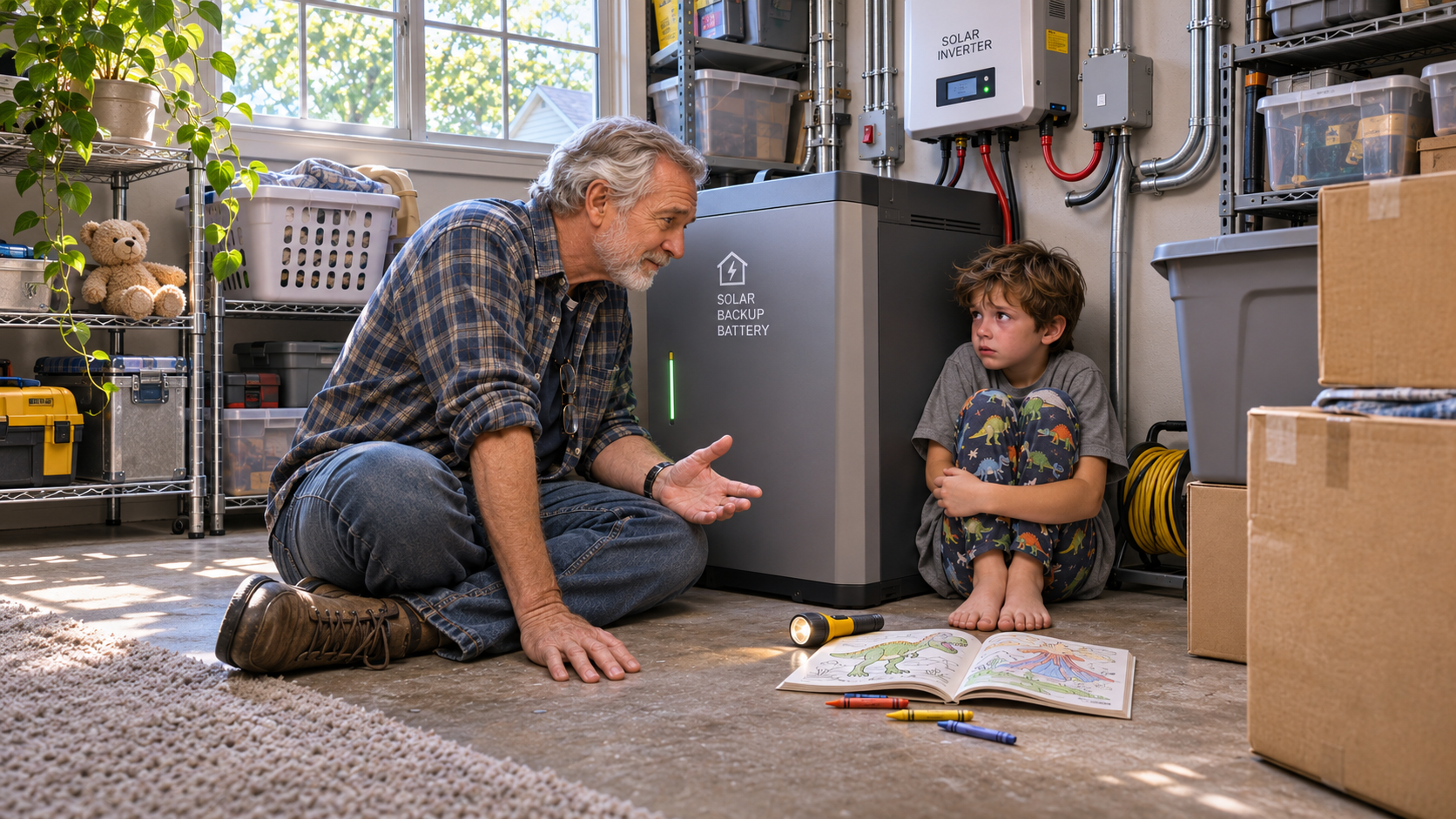
One afternoon, I found him sitting beside the solar backup unit in the garage.
I stopped immediately.
He looked at me.
“I was just looking.”
I sat down a few feet away.
“That’s okay.”
“Is this the same kind of battery?”
“Yes.”
“Can it hurt people?”
“Electrical equipment can be dangerous if handled incorrectly. That’s why trained technicians work on it.”
He nodded.
Then he asked:
“Did Hector find me because it stopped working?”
“Yes.”
He looked at the floor.
“I’m glad it stopped.”
I placed my hand on his shoulder.
“So am I, buddy.”
That afternoon, I called Hector and thanked him again.
He said he had been thinking about Noah.
“I almost didn’t open that door,” he admitted.
“Why?”
“I thought the room was just storage. I was going to leave the repair until the owner returned.”
I looked toward Noah.
“I’m glad you didn’t.”
Hector was quiet.
Then he said:
“Sometimes fixing something means finding what everyone else ignored.”
I never forgot those words.
Months later, Noah began asking about his mother.
The psychologist advised that we answer honestly without pressuring him.
Diane had been attending counseling.
She had complied with the court’s requirements and was participating in supervised visits.
She had also begun making payments toward the financial obligations established through the legal process.
But rebuilding trust was much slower than paying money.
During one visit, she brought Noah a book about dinosaurs.
He accepted it.
Then he showed her a drawing from school.
For the first time, they laughed together.
It was a small moment.
But it mattered.
Afterward, Diane approached me.
“Thank you for bringing him.”
“He wanted to come.”
She nodded.
“I know I don’t deserve another chance.”
I looked at her.
“That’s not my decision to make.”
She wiped her eyes.
“I just want him to know I love him.”
“Then keep showing him.”
She nodded.
And for once, she did not ask me to make the situation easier for her.
PART 8 — THE LETTER THAT CHANGED EVERYTHING
Almost a year after I found Noah, Linda came to visit.
She brought a small wooden box.
“I found this while cleaning Daniel’s old things,” she said.
Inside was a photograph album and several documents.
There was also a second letter.
This one had been written by Daniel shortly before his accident.
Linda explained that she had found it after his funeral but had never known how to deliver it.
The envelope was addressed:
For Noah, when he is old enough to understand.
I opened it carefully.
Daniel had written about his childhood.
He described fishing with his father, building a treehouse, and making mistakes.
He wrote about how he hoped Noah would grow up to be kind.
But near the end, there was a paragraph that made me stop.
If anyone ever tells you that you are difficult to love because you need too much attention, don’t believe them. Children are supposed to need attention. They are supposed to ask questions. They are supposed to make noise, get dirty, cry, laugh, and take up space.
Never make yourself smaller to fit into someone else’s life.
I read it twice.
Then I looked at Noah.
He was sitting on the carpet, arranging dinosaur figures.
I called him over.
“Buddy, there’s something from your dad.”
He came to sit beside me.
I read the letter aloud.
He listened carefully.
When I finished, he asked:
“Did Daddy know I would like dinosaurs?”
I laughed softly.
“I think he would have loved learning all about them with you.”
Noah smiled.
Then he asked:
“Can I write him a letter?”
I felt my eyes fill.
“Of course.”
He took a piece of paper and a pencil.
He sat at the kitchen table for nearly twenty minutes.
When he finished, he handed it to me.
The writing was uneven.
But I could read every word.
Dear Daddy,
I live with Grandpa now. I have a blue room. My door doesn’t lock. I like dinosaurs. I have a lot of food.
I miss you even though I don’t remember you. Grandma Linda says you were nice.
I hope you can see me.
Love, Noah.
I folded the letter carefully.
Then I placed it inside Daniel’s wooden box.
That evening, after Noah went to bed, I sat alone in the living room.
I thought about all the things I had learned.
I had believed that money could provide security.
I had believed that owning the house meant I knew what happened inside it.
I had believed my daughter when she said everything was fine.
I had believed that distance meant Daniel’s parents were raising Noah.
But the truth had been hiding behind a locked door.
And I had almost walked past it.
I looked at Margaret’s photograph on the shelf.
“I’m sorry,” I whispered.
“I should have listened.”
For a moment, I imagined her sitting beside me.
I imagined her smiling at the sight of Noah sleeping peacefully in his new room.
And I knew that, despite everything, our grandson finally had what she had wanted for him.
A safe home.
PART 9 — SIX YEARS OF SILENCE, ONE NEW BEGINNING
Two years passed.
Noah grew taller.
His handwriting improved.
He learned to ride a bicycle.
He made friends at school.
He began speaking more confidently.
He still had difficult memories, but he was no longer defined by them.
He loved helping me in the garden.
He liked pancakes on Sunday mornings.
He had a habit of leaving dinosaur toys in places where I would accidentally find them.
Sometimes I discovered one inside my shoes.
Sometimes in the refrigerator.
Once, I found a tiny plastic dinosaur sitting on my pillow.
He laughed when I pretended to be surprised.
His favorite activity was helping Hector when he visited to inspect the solar system.
Hector taught him about batteries, wiring, and safety.
Noah listened carefully.
One day, he said:
“When I grow up, I want to fix things.”
Hector smiled.
“That’s a good job.”
Noah looked at him.
“Especially things people think are broken forever.”
Hector glanced at me.
Neither of us spoke for a moment.
Diane continued supervised visits.
Over time, the court allowed more contact as she demonstrated progress.
She attended counseling.
She completed parenting education.
She cooperated with the financial investigation.
She never received automatic forgiveness.
But she began accepting that trust had to be earned.
Noah eventually started calling her on some weekends.
Sometimes they talked for five minutes.
Sometimes twenty.
He was allowed to decide when he was comfortable ending the conversation.
One afternoon, he asked whether he could spend a Saturday with her.
The professionals involved agreed to a carefully planned visit.
When he returned, he was carrying a small package.
“What did you get?” I asked.
He opened it.
Inside was a framed photograph.
It showed him, Diane, and me standing in a garden.
It had been taken during a supervised family event.
Noah placed it on the shelf.
“It’s okay if I have pictures with Mama, right?”
I looked at him.
“Of course.”
He smiled.
Then he added:
“But I still like living here.”
I kissed the top of his head.
“I’m glad you do.”
That night, he asked me to tell him the story of how Hector found him.
I had told it before, but he liked hearing it.
I explained how the solar system stopped working.
How Hector went upstairs.
How he heard something behind the battery.
How he called me.
Noah listened.
Then he asked:
“Grandpa, what would have happened if you didn’t come?”
I looked at him.
I wanted to give him an answer that would make him feel safe.
But I couldn’t lie.
“I don’t know, buddy.”
He thought about that.
Then he said:
“But you came.”
“Yes.”
“And you stayed.”
I smiled.
“I’m still here.”
He leaned against me.
Then he whispered:
“That’s my favorite part.”
PART 10 — THE FINAL ENDING: THE DOOR THAT STAYED OPEN
On Noah’s tenth birthday, I organized a small party.
Nothing extravagant.
Just a cake, balloons, a few friends from school, Linda, Hector, and the people who had become part of his safe circle.
Diane attended.
She brought a present and stayed for the celebration.
Ryan was no longer part of our lives.
His legal and financial matters had been handled through the appropriate proceedings, and he had no role in Noah’s upbringing.
The money that could be recovered was returned to Noah’s protected accounts.
The remaining trust assets were placed under independent management.
Noah’s education was secured.
His medical and emotional needs were covered.
But the most important thing we gave him could not be measured in dollars.
It was consistency.
It was safety.
It was the knowledge that he did not have to earn his place in a family.
After everyone left, Noah sat beside me on the porch.
He was holding a small birthday card.
“Grandpa?”
“Yes?”
“Can I ask you something?”
“Anything.”
“Were you mad when you found me?”
I thought about it.
“I was angry about what had happened. But I wasn’t angry with you.”
“Were you scared?”
“Yes.”
“Why?”
“Because I realized you had been alone for a long time.”
He looked down at his card.
“I’m not alone now.”
“No, you’re not.”
He was quiet for a moment.
Then he asked:
“Do you think Daddy would be proud of me?”
I felt my throat tighten.
“I think your dad would be incredibly proud of the person you’re becoming.”
“Even though I was scared?”
“Especially because you were scared and still found the courage to trust people again.”
He smiled.
Then he stood and ran inside.
A few minutes later, he returned carrying something.
It was the old notebook I had found behind the battery.
The one filled with rules.
Don’t cry loud.
Don’t knock.
Don’t call downstairs.
Eat slow.
Don’t make Mama mad.
He had kept it.
I had once asked whether he wanted me to throw it away.
He said no.
He wanted to remember how far he had come.
Now he opened it to the last page.
There was a new sentence written in his handwriting.
I don’t have to hide anymore.
He showed it to me.
I nodded.
“That’s right.”
Then he turned to the next page.
It was blank.
He picked up a pencil.
“What should I write here?”
I thought for a moment.
“Write whatever you want. It’s your notebook.”
He smiled and began writing.
When he finished, he handed it to me.
The sentence was simple.
I am loved.
I read it twice.
Then I pulled him into a hug.
That night, after he went to bed, I walked through the house turning off the lights.
When I reached his bedroom, the door was open.
He was asleep with his dinosaur blanket pulled up to his chin.
His night-light cast a soft glow across the room.
I stood there for a moment.
I remembered the first time I had seen him.
Barefoot.
Hiding behind a battery system.
Surrounded by boxes.
Afraid to speak.
Afraid to eat.
Afraid to make a sound.
I remembered the notebook.
The refrigerator schedule.
The six sealed birthday cards.
And the question that had broken my heart.
Am I in trouble?
I looked at the open doorway.
No locks.
No black paper over the window.
No moving blanket on a cold floor.
Just a little boy sleeping peacefully in his own room.
I went downstairs and opened the shoebox containing the birthday cards.
I had added one more envelope.
It was addressed:
To Noah, on the day you turn eighteen.
Inside, I had written:
Dear Noah,
When you read this, I hope you understand something that took me too long to learn.
Family is not simply the people who share your last name. It is not the people who appear in photographs or sit around a holiday table.
Family is made of the people who protect you when you are vulnerable, tell you the truth when lying would be easier, and stay when life becomes difficult.
For six years, I believed you were somewhere safe because someone I loved told me so.
I was wrong.
But the day I discovered the truth, I made a promise that I would never again allow your voice to be ignored.
You were never a burden.
You were never a mistake.
You never needed to be quiet to deserve love.
And you never needed to hide to belong.
If you remember only one thing from your childhood, remember this:
There will always be a place for you at my table.
There will always be food in the refrigerator.
There will always be someone who answers when you call.
And in this house, your door will never be locked against you.
Love,
Grandpa Frank.
I placed the envelope back in the box.
Then I walked upstairs one last time.
Noah shifted in his sleep.
I gently adjusted his blanket.
He opened his eyes for a second.
“Grandpa?”
“I’m here.”
“Can you leave the door open?”
I smiled.
“Always.”
He closed his eyes again.
And I left it open.
THE END.