
My seven-year-old son was burning with a fever of 103.8°F when I realized my husband was not coming home.
Noah’s entire body trembled against me as I carried him out of the bathroom, his damp hair plastered to his forehead and his teeth clicking against my shoulder.
“Mommy,” he whispered weakly. “I’m cold.”
“I know, baby. I know.”
I wrapped another blanket around him even though his skin felt like fire.
Outside, thunder rolled over Raleigh so hard that the windows rattled.
Rain struck the house in silver sheets.
My phone was pressed between my cheek and shoulder as I called Evan for the ninth time.
Nine times.
I had counted because every unanswered call felt like another tiny betrayal.
Finally, he picked up.
Music blasted behind him.
There were people laughing.
Glasses clinked.
And somewhere close to the phone, I heard a woman’s voice.
“Evan?”
“What?” he snapped.
His irritation stunned me.
“Noah’s fever is 103.8. He can barely stand. I’m taking him to WakeMed.”
There was a pause.
Not concern.
Not fear.
Just annoyance.
“Claire, stop making such a big deal out of this.”
I stared down at our son.
Noah’s eyes were half closed.
“Your son can barely stand.”
“He probably has the flu.”
“He has purple spots starting on his chest.”
“Give him medicine.”
“Evan—”
“I told you, Sabrina needs me tonight.”
My grip tightened around the phone.
Sabrina Cole.
His director of partnerships.
The woman whose name had slowly become part of our marriage without my permission.
Sabrina needed help with the Richardson account.
Sabrina needed him at a networking dinner.
Sabrina needed him to review a proposal.
Sabrina needed him to accompany her to Charlotte.
Sabrina needed him to stay late.
Apparently, Sabrina needed my husband more than his own child did.
“What kind of work crisis has music playing in the background?” I asked.
He lowered his voice.
“Don’t start.”
“I’m not starting anything. Noah is sick.”
“And I’m handling something important.”
“So am I.”
“Claire, for once, can you solve a problem without turning it into a catastrophe?”
I stopped breathing for a second.
Then Noah whimpered against my shoulder.
That sound brought me back.
“Come to the hospital.”
“I’ll check on you later.”
“Evan—”
He hung up.
I stood in the hallway staring at the dark screen.
Then I put my phone into my pocket, carried Noah outside, strapped him into his booster seat, and drove into the storm.
I remember almost everything about that drive.
I remember the windshield wipers struggling to keep up.
I remember Noah whispering that the streetlights looked blurry.
I remember reaching backward whenever he cried.
I remember promising him that doctors would make him better.
What I do not remember is how I managed not to drive off the road.
By the time we reached WakeMed, Noah could barely answer when I said his name.
I carried him through the emergency entrance.
A triage nurse took one look at him.
Then she pulled down the collar of his pajama shirt.
Purple flecks had spread across his chest.
Her expression changed instantly.
She called another nurse.
Someone brought a wheelchair.
Within seconds, we were moving through double doors.
“What’s happening?” I asked.
“We’re going to get the doctor.”
“Is it serious?”
“We’re going to move quickly, Mom.”
That sentence terrified me more than if she had shouted.
Doctors appeared.
They asked about his fever.
Vomiting?
A headache?
Sensitivity to light?
A stiff neck?
When had the rash appeared?
Had anyone else been sick?
Had he traveled recently?
I answered everything I could.
A nurse started an IV while another took blood.
Noah cried when the needle went in.
I held his hand.
“I’m here.”
“Mommy, I want Daddy.”
Those four words nearly destroyed me.
“I know.”
“Is Daddy coming?”
I looked toward the door as if Evan might somehow appear.
“He knows where we are.”
It was not an answer.
Noah was too sick to notice.
They gave him fluids.
Then antibiotics.
Then oxygen.
Everything happened too quickly.
One doctor spoke urgently to another near the monitors.
I heard words I did not understand.
Pressure.
Lactate.
Platelets.
Sepsis.
Then Dr. Maya Patel came to me.
She was a pediatric critical-care specialist, perhaps in her forties, with calm eyes and a voice that seemed deliberately steady.
“Mrs. Bennett?”
“Yes.”
“We’re concerned that Noah has meningococcal disease.”
I stared at her.
“What does that mean?”
“It’s a severe bacterial infection. In Noah’s case, it appears to have entered his bloodstream.”
“But he was fine yesterday.”
“I understand.”
“He went to school.”
“This kind of infection can progress extremely quickly.”
“How quickly?”
She hesitated just long enough that I understood the answer before she gave it.
“Sometimes within hours.”
My knees weakened.
“What do you need me to do?”
“We’re transferring him to pediatric intensive care.”
“Okay.”
“We’re treating aggressively.”
“Okay.”
“We need to talk about anyone who has had close contact with him because they may need preventive antibiotics.”
“Okay.”
I kept saying okay because the alternative was screaming.
My phone buzzed.
For one irrational second, I thought it was Evan.
It was a social-media notification.
Sabrina Cole had posted a photograph.
I almost ignored it.
Then I saw the thumbnail.
A hotel suite.
Champagne.
I opened it.
Two glasses stood on a table beside room-service dishes.
A man’s jacket hung over a chair.
On the nightstand were two objects I recognized instantly.
Evan’s silver watch.
And his wedding ring.
The same ring I had slid onto his finger eleven years earlier.
The location tag showed a luxury hotel twenty minutes from our house.
The post had been uploaded less than ten minutes earlier.
Sabrina’s caption contained one red heart.
Nothing else.
I stared at the photograph until my fingers went numb.
Then instinct took over.
I took screenshots.
One of the post.
One of the location.
One of the timestamp.
One enlarged enough to show Evan’s engraved watch.
Another showing his wedding ring.
Two minutes later, the post disappeared.
But I still had it.
Dr. Patel returned.
“We’ve confirmed fulminant meningococcal sepsis.”
I forced myself to look away from my phone.
“What happens now?”
“We are doing everything we can.”
“But he’s going to be okay?”
Her eyes softened.
“We’re doing everything.”
It was the second time she had avoided promising me anything.
That was when terror became something physical.
I called Evan again.
Voicemail.
Again.
Voicemail.
I sent him a text.
NOAH HAS MENINGOCOCCAL SEPSIS. THEY ARE TAKING HIM TO ICU. PLEASE COME NOW.
A few minutes later, the message showed as read.
11:47 p.m.
No reply.
I sent another.
THIS IS LIFE THREATENING.
Read.
Nothing.
Then another.
EVAN PLEASE. YOUR SON NEEDS YOU.
Read.
Nothing.
That was the moment I understood.
He knew.
Whatever happened next, Evan could never claim ignorance.
He had chosen.
I spent the next several hours beside Noah while machines became responsible for things his little body could no longer manage alone.
His blood pressure fell.
Doctors gave medications.
Nurses moved constantly around him.
The rash spread.
I sat in a plastic chair holding his hand, whispering every memory I could think of.
His first day of kindergarten.
The time he insisted pancakes tasted better when shaped like dinosaurs.
The summer he learned to swim.
His obsession with planets.
The cardboard spaceship he built in our living room.
His missing front tooth.
The way he called spaghetti “pasghetti” until he was five.
At 3:16 in the morning, Noah opened his eyes.
For one beautiful, impossible moment, he seemed almost like himself.
“Mommy?”
I leaned so close my hair brushed his pillow.
“I’m right here, baby.”
“Am I going home?”
My throat closed.
I pressed my forehead against his.
“I’m right here.”
He looked at me.
“Tell Daddy I was brave.”
I broke.
“You are brave.”
His eyelids fluttered.
“The bravest boy in the whole world.”
He never opened them again.
Before sunrise, alarms began sounding.
Doctors rushed in.
Someone guided me away from the bed.
I watched strangers press on my son’s chest.
I watched medications enter his IV.
I watched the monitor.
I watched Dr. Patel’s face.
Eventually, the room became quiet.
She looked at the clock.
Then at me.
I do not remember exactly what she said.
I remember only the time.
5:42 a.m.
My seven-year-old son was gone.
There are moments when grief is not crying.
It is silence.
It is sitting beside a bed and wondering why the world outside the window is getting brighter.
It is noticing that someone in the hallway is drinking coffee.
It is hearing an elevator bell.
It is realizing thousands of people are waking up, making breakfast, getting dressed, and complaining about traffic while your entire universe has just stopped.
I held Noah for nearly an hour.
No one rushed me.
A nurse removed some of the tubes so I could see his face more clearly.
Someone brought me a box containing a lock of his hair.
Someone made prints of his hand.
I stared at those tiny fingerprints and wondered how anything so small could leave such an enormous absence.
At 8:03 a.m., I checked my phone.
No call from Evan.
At 9:15, nothing.
At 10:30, nothing.
At noon, nothing.
My mother, Diane, arrived after I finally managed to call her.
She found me sitting in a hospital family room holding Noah’s backpack.
She did not ask where Evan was.
She simply held me.
Later, she helped me call a funeral home.
There should not be caskets small enough for children.
That thought stayed with me while a soft-spoken director showed us options.
White.
Oak.
Blue.
I chose white because Noah loved clouds.
My mother squeezed my hand while I signed the forms.
Then, sitting in that funeral home, something inside me changed.
I stopped waiting for Evan.
I stopped checking my phone.
I stopped wondering when he would remember that he had a family.
By the time I returned home that afternoon, grief had hardened around one clear fact.
Noah deserved better than the father who abandoned him.
And I would never again protect that father from the consequences of his choices.
I showered.
Changed clothes.
Then walked into my study.
For years, Evan had referred to Bennett Meridian Logistics as “his company.”
Technically, he was CEO.
He had the office.
The salary.
The press interviews.
The authority over daily operations.
But the company had been founded by my grandfather.
My father expanded it.
And when my father died, his shares passed primarily to me.
I owned sixty-two percent of the voting stock.
Evan owned six percent.
The rest belonged to family trusts and minority investors.
Evan knew I was the controlling shareholder.
But because I had stepped away from daily operations after Noah was born, he had slowly convinced himself that my silence meant weakness.
He thought the title on his office door mattered more than the certificates in my locked drawer.
I opened that drawer.
There they were.
Voting certificates.
Shareholder agreements.
Board bylaws.
I placed Sabrina’s screenshots beside them.
Then I logged into the corporate finance system.
Because I chaired the company’s ownership trust, I still received automated alerts for unusual executive expenses.
There were three charges from the hotel.
The suite.
Dinner.
Champagne.
All on a Bennett Meridian corporate card.
I stared at the screen.
My son had been dying while Evan entertained his mistress on company money.
I printed everything.
Then I called our general counsel, Margaret Shaw.
“Claire?”
Her voice immediately changed.
She knew about Noah.
My mother had called her.
“I’m so sorry.”
“Thank you.”
“What do you need?”
“I need an emergency board meeting tomorrow at noon.”
Silence.
Then her professional voice returned.
“Regarding?”
“Removal of the CEO for cause.”
Another pause.
“Evan?”
“Yes.”
“Claire, are you certain you want to do this tomorrow?”
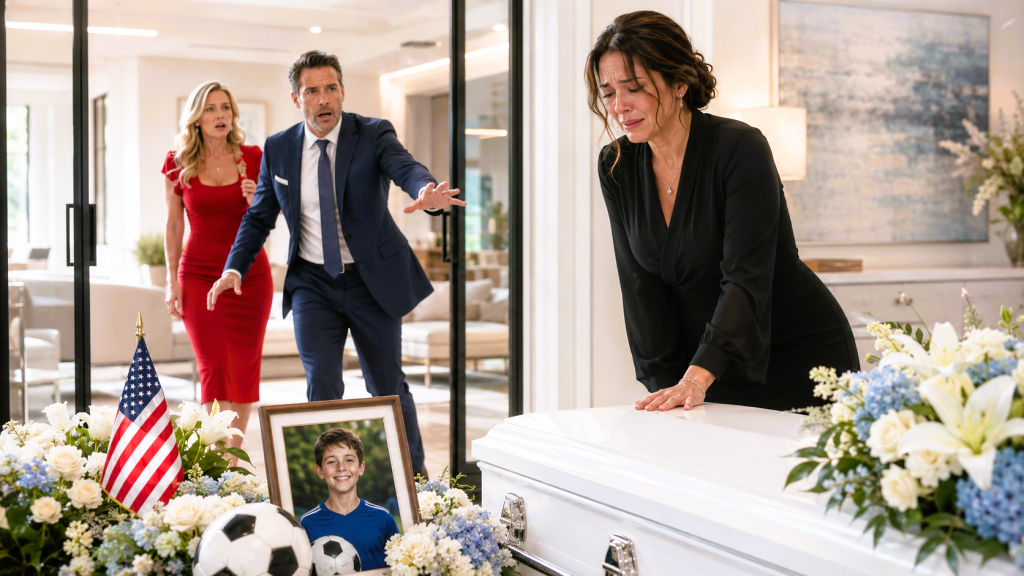
I looked at Noah’s school photograph sitting on my desk.
“Yes.”
“Then I’ll prepare everything.”
Evan came home at ten the next morning.
I was sitting at the kitchen table.
He walked in wearing the same shirt he had worn the previous evening.
His hair was messy.
His face carried the irritated expression of a man who expected an argument.
He dropped his keys.
“Where’s Noah?”
I said nothing.
“Claire?”
I slid the funeral-home receipt toward him.
His eyes moved across the page.
Then stopped.
He looked at me.
“No.”
I heard the keys fall from his hand.
“He died at 5:42 yesterday morning.”
Evan staggered backward.
“No.”
“He died asking if he was going home.”
“No, no, no.”
He grabbed the chair.
“You’re lying.”
I looked at him.
Something in my face must have convinced him.
His knees buckled.
He sat down heavily.
“Why didn’t you call me?”
The question was so unbelievable that for several seconds I thought I had imagined it.
Then I unlocked my phone.
Nine calls.
Five texts.
Read receipts.
I placed it in front of him.
“You knew.”
His lips moved.
“I—”
“You knew.”
“I didn’t understand how serious—”
“I wrote life threatening.”
“Claire—”
“I told you he was being transferred to intensive care.”
“I thought—”
“You didn’t think.”
He covered his face.
“I was working.”
I pushed Sabrina’s photograph across the table.
His hands dropped.
The color drained from his face.
“I can explain.”
That sentence ended whatever remained of our marriage.
I almost laughed.
Not because anything was funny.
Because the absurdity was too enormous for tears.
“You can explain?”
“It wasn’t what it looks like.”
“Your wedding ring is on her nightstand.”
“We had drinks.”
“In a hotel suite?”
“She was upset.”
“Our son was dying.”
“I didn’t know he was dying!”
“You knew enough to read my messages.”
He looked away.
I opened the folder.
“There’s a board meeting at noon.”
His eyes returned to me.
“What?”
“I’m removing you as CEO.”
He stared.
“You’re what?”
“I’m suspending your corporate access immediately. The board will vote on your termination, and an outside forensic team will audit every transaction associated with you and Sabrina.”
His grief suddenly had competition.
Fear.
“You can’t do that.”
I pushed the voting certificates toward him.
“I own sixty-two percent.”
His mouth opened.
Then closed.
“You wouldn’t.”
“Noah spent his last night asking for you.”
His face crumpled.
“You chose her.”
“Claire, please.”
“And now I choose my son.”
His phone began ringing.
Sabrina.
Her name illuminated the screen between us.
Evan reached for it.
I got there first.
“Hello?”
Silence.
Then Sabrina said, “Claire?”
“Yes.”
“I need to speak to Evan.”
“No.”
“Claire, I know this looks—”
“My son died yesterday.”
Another silence.
“I heard.”
“You heard?”
“Evan told me this morning.”
I looked across the table at him.
So he had known before walking through the door.
Yet his first question had been where Noah was.
He had been preparing a performance.
Something colder than anger settled over me.
Sabrina continued.
“I’m very sorry.”
“Were you with my husband when he received my ICU messages?”
“Claire—”
“Yes or no?”
She did not answer.
That was answer enough.
“Boardroom. Noon.”
“What?”
“You’re expected there.”
I disconnected.
At 11:55, I walked into Bennett Meridian headquarters wearing black.
Not because of the meeting.
Because I was mourning my child.
Every employee who saw me became quiet.
Word had spread.
Margaret met me outside the executive conference room.
“There are things you should know.”
She handed me a folder.
Our finance team had already discovered additional expenses.
Hotel stays.
Resort charges.
Luxury dinners.
Flights.
Thousands of dollars billed as client development.
Several coincided with trips Sabrina had taken with Evan.
“How much?”
“So far, eighty-seven thousand dollars requiring explanation.”
My hands tightened around the folder.
“There’s more.”
She opened another page.
“Evan recently attempted to restructure voting authority through a proposed executive-share issuance.”
I looked up.
“What?”
“He couldn’t complete it without your approval. But documents were drafted.”
“To dilute my shares?”
“That appears to have been the objective.”
My grief briefly disappeared beneath disbelief.
“He was trying to take my company.”
Margaret nodded.
“And there’s an email chain involving Sabrina.”
The boardroom doors opened.
Evan sat at one end of the table.
Sabrina sat two seats away.
She looked flawless.
Cream blazer.
Perfect hair.
Diamond earrings.
But her face was pale.
Seven board members were present.
I took my father’s old seat.
For years, I had allowed Evan to sit there.
Not anymore.
Margaret began.
“This emergency meeting has been called by controlling shareholder Claire Bennett concerning alleged misconduct by Chief Executive Officer Evan Bennett and Director of Partnerships Sabrina Cole.”
Evan interrupted.
“This is inappropriate.”
I looked at him.
“Our son’s funeral is Friday.”
The entire room went still.
“This meeting will proceed.”
Nobody argued.
Margaret displayed the hotel charges.
Then Sabrina’s photograph.
Then the corporate-card records.
Evan tried to speak.
I stopped him.
“You will have an opportunity.”
Additional documents appeared.
Trips labeled as business development where no client meetings had occurred.
A resort weekend.
Luxury gifts.
A jewelry purchase disguised as “executive relationship development.”
Then Margaret presented the share-dilution proposal.
Board member Thomas Reeves removed his glasses.
“Evan, were you attempting to issue executive shares without notifying the controlling shareholder?”
“It was exploratory.”
“Exploratory?”
“We were considering retention incentives.”
“For yourself?”
“For leadership.”
I turned toward Sabrina.
“Were you part of those discussions?”
She swallowed.
“I attended meetings.”
“Did you expect to receive shares?”
She looked at Evan.
That tiny movement told everyone everything.
Margaret produced an email.
Subject: Post-Transaction Control Structure.
Sabrina had written:
Once Claire’s percentage falls below majority control, we’ll have room to operate without family interference.
The room went silent.
I looked at her.
“Family interference?”
Sabrina stared down at the table.
Evan stood.
“This is being deliberately misrepresented.”
“Sit down,” I said.
“Claire, you’re grieving.”
“Yes.”
“You’re not thinking rationally.”
There it was.
The same contempt he had shown over the phone.
Stop making such a big deal.
I realized he had been saying versions of that sentence to me for years.
Whenever my concerns interfered with what he wanted, I was emotional.
Dramatic.
Sensitive.
Unreasonable.
He had mistaken patience for stupidity.
I folded my hands.
“I move for immediate removal of Evan Bennett as chief executive officer for misuse of corporate assets, breach of fiduciary duty, undisclosed conflict of interest, attempted dilution of controlling ownership, and conduct damaging to the company.”
Thomas seconded the motion.
The vote was not close.
Six in favor.
One abstention.
Evan stood motionless.
Margaret turned to Sabrina.
A second motion placed her on administrative suspension pending investigation.
Unanimous.
Security arrived minutes later.
Evan stared at me as though I had betrayed him.
“You’re destroying everything.”
“No.”
I stood.
“You did that.”
He leaned closer.
“Our son just died.”
“I know exactly when he died.”
His face collapsed.
“Don’t.”
“At 5:42 a.m.”
“Claire.”
“You read my message at 11:47 p.m.”
His eyes filled.
“You had almost six hours.”
“I made a mistake.”
“A mistake is forgetting an appointment.”
My voice shook for the first time.
“A mistake is missing a school recital.”
I looked directly into his eyes.
“You abandoned your dying child because you wanted to spend the night with another woman.”
He began crying.
I felt nothing.
Not satisfaction.
Not revenge.
Nothing.
“Security will escort you out.”
The funeral was two days later.
The church overflowed.
Noah’s teachers came.
His classmates came with drawings.
Neighbors came.
Employees from Bennett Meridian stood along the back wall.
Someone arranged sunflowers because Noah loved yellow.
His little white casket sat beneath photographs of his seven years.
Noah holding a fish.
Noah wearing his first soccer uniform.
Noah dressed as an astronaut for Halloween.
Noah asleep beside our old golden retriever.
I placed his cardboard spaceship beside the casket.
Evan arrived alone.
He looked twenty years older.
For a moment, I considered telling him to leave.
Then I remembered Noah loved him.
Whatever Evan had failed to be at the end, my son had loved his father.
So I allowed him to stay.
During the service, Noah’s teacher read a letter he had written during a class assignment.
The question had been:
Who is your hero?
Noah had written about Evan.
“My dad works very hard and knows how to fix things. He says when I’m older he will teach me how to be responsible. I want to be like him but also I want to be an astronaut.”
I heard Evan make a sound behind me.
Not a sob.
Something deeper.
He left the sanctuary before the reading ended.
After the burial, he stood alone beside the grave.
I waited until everyone else had gone.
Then I approached.
“He thought you were his hero.”
Evan covered his mouth.
“I know.”
“No, you didn’t.”
He looked at me.
“I would give anything to change that night.”
“So would I.”
“I keep seeing the messages.”
“I keep hearing him ask for you.”
He closed his eyes.
“Please stop.”
“I can’t stop.”
My voice cracked.
“I will hear that question for the rest of my life.”
Evan began sobbing.
For eleven years, I had loved that man.
Seeing him cry once would have broken me.
Now I simply stood there.
Eventually, he whispered, “Is there any chance for us?”
I looked at Noah’s grave.
“No.”
He nodded as if he had expected it.
“I’ll sign whatever you want.”
“You’ll hear from my attorney.”
I walked away.
The forensic audit took six weeks.
What it uncovered turned an ugly betrayal into something much larger.
Evan and Sabrina had charged more than $143,000 in personal expenses to Bennett Meridian over two years.
Hotel suites.
Vacations.
Jewelry.
Meals.
Private transportation.
Sabrina had also approved consulting payments to a company owned by her brother.
The services provided were questionable at best.
The board referred the findings to outside counsel.
Insurance investigators became involved.
Auditors began asking questions.
Evan’s reputation, once carefully built around competence and integrity, collapsed.
But I discovered something unexpected.
Destroying him did not make me feel better.
There was no triumphant moment.
No sense of victory.
Because Noah was still gone.
Every morning, I woke for half a second believing I needed to make his breakfast.
Then I remembered.
I kept buying his favorite cereal accidentally.
Once, I put dinosaur-shaped chicken nuggets into my grocery cart before realizing there was no child waiting at home to eat them.
I abandoned the cart in the aisle and cried in my car for forty minutes.
Grief was not dramatic most days.
It was ordinary.
A toothbrush.
A backpack.
A pair of sneakers beside the door.
A drawing taped to the refrigerator.
Silence at 3:15 when the school bus passed our street.
My mother stayed with me for nearly two months.
Eventually, Dr. Patel contacted me.
She asked whether I would consider meeting with a foundation promoting awareness of meningococcal disease.
At first, I refused.
I could not even say Noah’s diagnosis without feeling sick.
Then she told me something.
“You got him here quickly, Claire.”
I looked at her across the hospital café.
“It wasn’t quickly enough.”
“That isn’t what I said.”
“He died.”
“Yes.”
“So I failed.”
“No.”
Her voice was gentle but firm.
“This disease can be devastating even with immediate treatment. You recognized something was wrong. You brought him here. You stayed with him. He was never alone.”
Those final four words broke through something inside me.
He was never alone.
I had spent months obsessing over the father who was absent.
Dr. Patel reminded me that Noah had also had a mother who never left.
Eventually, I agreed to help the foundation.
We created the Noah Bennett Initiative through Bennett Meridian.
It funded educational materials for schools and parents about symptoms of invasive meningococcal disease and supported families dealing with pediatric critical illness.
I refused to let Noah become only the worst thing that had ever happened to me.
He had existed before that hospital room.
He had laughed.
Built spaceships.
Hated broccoli.
Loved Saturn.
Collected smooth rocks.
Sang terribly.
Asked a million questions.
He deserved to be remembered for living, not only dying.
Three months after the funeral, Sabrina asked to meet me.
My attorney advised against it.
I agreed anyway.
We met in a quiet coffee shop.
She looked different.
No designer blazer.
No polished confidence.
She wore jeans and a plain sweater.
“I’m not asking you to forgive me,” she said.
“Good.”
Her eyes lowered.
“I loved him.”
“I know.”
“He told me your marriage was over.”
“It wasn’t.”
“I know that now.”
“He told you what you wanted to hear.”
“Yes.”
I studied her.
“Why did you post the hotel photograph?”
Her face tightened.
“I wanted you to see it.”
That surprised me.
She continued.
“I was tired of being hidden.”
“So you deliberately posted his ring.”
“Yes.”
“And deleted it afterward?”
“He panicked.”
I almost admired the honesty.
Almost.
“Did you see my messages that night?”
She went pale.
“I saw some.”
“All of them?”
“No.”
“Did you know Noah was in ICU?”
She swallowed.
“Yes.”
The café sounds faded.
“When?”
“Shortly after midnight.”
“What did you say?”
She started crying.
“I told Evan he should go.”
For the first time, my certainty shifted.
“What?”
“I told him to leave.”
She wiped her eyes.
“He said you always exaggerated when Noah was sick. He said if it were truly serious, the doctors would call him directly.”
I felt physically ill.
“He said that?”
“Yes.”
“Why didn’t you make him go?”
Her eyes met mine.
“Because I was selfish.”
At least she did not pretend otherwise.
“I had spent two years hearing that he was leaving you. That night he finally took off his ring. I didn’t want the night to end.”
I looked out the window.
For months, I had imagined Sabrina preventing Evan from leaving.
Manipulating him.
Distracting him.
But the truth was worse.
She had told him to go.
And he had stayed.
The responsibility belonged exactly where it always had.
With Evan.
Before leaving, Sabrina pushed an envelope toward me.
“What’s this?”
“Emails.”
“About what?”
“The share plan.”
My eyes narrowed.
“I kept copies.”
“Why?”
“Because eventually I realized Evan was planning to blame the entire thing on me.”
That sounded like him.
She continued.
“The documents show he initiated the dilution strategy before I became involved.”
I took the envelope.
“Why give these to me?”
“Because whatever happens to me, you should know the truth.”
She stood.
Then hesitated.
“I am sorry about Noah.”
I said nothing.
Some apologies do not deserve acceptance or rejection.
They simply exist.
The additional emails proved devastating for Evan.
He had begun exploring ways to reduce my voting control nearly eighteen months before Noah died.
In one message to a financial adviser, he referred to me as a “passive inherited shareholder.”
Another said:
Claire has no appetite for corporate conflict. If structured carefully, she won’t challenge it.
He had been wrong.
Very wrong.
The final divorce hearing took place almost a year after Noah’s death.
By then, Evan no longer worked in logistics.
No major company would hire him for an executive role.
The financial investigation had resulted in a civil settlement requiring substantial repayment to Bennett Meridian.
Sabrina had cooperated with investigators and accepted responsibility for her role.
Our divorce itself was surprisingly simple.
There were no custody arguments.
That was the cruelest part.
There was no little boy to divide holidays around.
No discussion of weekends.
No child support.
No schedule.
Only assets.
A house.
Retirement accounts.
Shares.
Furniture.
Things.
After the hearing, Evan approached me outside the courthouse.
“Claire.”
I stopped.
He looked thinner.
“I heard about the foundation.”
I nodded.
“It’s doing good work.”
“Thank you.”
He stared at the steps.
“I volunteer now.”
I waited.
“At a pediatric bereavement center.”
That surprised me.
“I’m not telling you because I think it changes anything.”
“It doesn’t.”
“I know.”
He looked at me.
“I spent most of my life thinking responsibility meant providing money.”
I said nothing.
“I thought being important at work made me important everywhere.”
A sad smile touched his mouth.
“Noah knew better than I did.”
At that, my eyes burned.
Evan reached into his coat pocket.
He held out a small object.
Noah’s blue toy rocket.
I recognized it immediately.
“He left this in my car a few days before he got sick.”
I took it.
The plastic was scratched.
One fin was bent.
Noah had carried that rocket everywhere during his space phase.
“I’ve been keeping it.”
Evan’s voice broke.
“But I think it should be with you.”
I closed my fingers around it.
“Thank you.”
He nodded.
Then turned away.
“Evan.”
He stopped.
I had spent a year imagining everything I might someday say to him.
Angry speeches.
Accusations.
Questions.
But standing there, none of them mattered.
“I hope you become the man Noah thought you were.”
His face crumpled.
Then he nodded once.
“So do I.”
We walked in opposite directions.
Two years after Noah died, Bennett Meridian opened a new pediatric-family support center in Raleigh.
The building was not enormous.
I did not want something grand.
I wanted something useful.
A place where parents could shower during long hospital stays.
Sleep for a few hours.
Eat without paying.
Speak with grief counselors.
Receive emergency financial help.
Sit somewhere quiet.
The entrance contained no corporate logo.
Only a small bronze plaque.
THE NOAH BENNETT FAMILY HOUSE
Beneath it were words taken from one of Noah’s school notebooks:
Being brave does not mean you aren’t scared. It means you still do the thing.
On opening day, Dr. Patel stood beside me.
My mother held my hand.
Several of Noah’s former classmates attended.
They were nine now.
It shocked me how much they had grown.
For a long time, I had unconsciously expected Noah to grow with them in my imagination.
But he never did.
He remained seven.
Always seven.
After the ceremony, a little boy approached me.
He looked about Noah’s age.
His mother stood nearby.
“Are you Noah’s mom?” he asked.
“Yes.”
He held out a folded drawing.
It showed a rocket flying above yellow stars.
“My mom said this place exists because of him.”
I swallowed.
“That’s right.”
“Was he an astronaut?”
I smiled through tears.
“He wanted to be.”
The boy considered that.
“Maybe he is one now.”
Children sometimes say things adults would never dare say.
I crouched.
“Maybe.”
He handed me the picture.
I still have it.
People sometimes ask me whether I regret what I did to Evan immediately after Noah died.
They expect me to say yes.
They imagine grief made me vindictive.
That I destroyed my husband in anger.
But I did not destroy him.
I stopped protecting him.
There is a difference.
Evan lost his position because he misused company money and attempted to undermine the ownership structure.
He lost his marriage because he betrayed it.
And he lost the version of himself he believed in because, when his child needed him most, he made a choice he could never undo.
I did not create those consequences.
I simply refused to stand between him and them.
For a long time, I hated him.
Then eventually, something stranger happened.
The hatred faded.
Not into forgiveness.
Not exactly.
Into distance.
Evan became someone I had once known.
Someone tied forever to the happiest and worst moments of my life.
We occasionally saw each other on Noah’s birthday.
Never by arrangement.
We both went to the cemetery.
At first, one of us would leave when the other arrived.
Eventually, we stopped doing that.
On what would have been Noah’s tenth birthday, I found Evan sitting on the grass beside the grave.
A model of Saturn rested beside the headstone.
I stood several feet away.
“He would have liked that.”
Evan looked up.
“I remember.”
I sat on the grass.
For several minutes, neither of us spoke.
Then he said, “I still think about 11:47.”
The time he read my first ICU message.
“I know.”
“I’ve replayed it thousands of times.”
“So have I.”
“In some versions, I leave immediately.”
My chest tightened.
“In some versions, I’m there before three.”
I looked at Noah’s name carved in stone.
“And then?”
“He opens his eyes.”
Evan swallowed.
“And I get to tell him I’m there.”
For the first time in years, I reached across the grass and touched Evan’s hand.
Only for a moment.
Not as his wife.
Not as someone offering absolution.
As the only other person in the world who understood exactly what it meant to miss Noah.
“You can’t change that night,” I said.
“I know.”
“But you can decide what every night after it means.”
He nodded.
We sat there until sunset.
Then we went our separate ways.
Five years after Noah’s death, the family house had supported more than four thousand families.
The company expanded the program.
Other businesses contributed.
Hospitals partnered with us.
One of the rooms inside the center became known as Noah’s Room.
It contained shelves of children’s books, puzzles, toys, and a ceiling painted like the night sky.
Saturn was directly above the bed.
Every year on his birthday, I visited before sunrise.
I brought pancakes.
Dinosaur-shaped whenever possible.
I would sit beneath the painted stars and remember the boy who believed breakfast tasted better when it looked ridiculous.
Grief never disappeared.
People lied when they said time healed everything.
Time did not heal the hole Noah left.
It taught me how to build a life around it.
There were still mornings when I missed him so fiercely that breathing hurt.
There were still moments when I saw a boy with brown curls in a grocery store and my heart forgot reality for half a second.
There were still birthdays I counted.
Eight.
Nine.
Ten.
Eleven.
Twelve.
I wondered what his voice would have sounded like.
Whether he would still love space.
Whether he would become embarrassed when I kissed him in front of friends.
Whether he would grow taller than me.
Those questions had no answers.
But I learned to live with questions.
One rainy evening, years after the night everything changed, I returned home and opened the same study drawer where I had once stored my voting certificates.
The corporate documents had long since moved to a secure office.
The drawer held something else now.
Noah’s handprint.
His hospital bracelet.
His blue rocket.
His school photograph.
And the screenshots from Sabrina’s hotel post.
I stared at those screenshots for a long time.
For years, I had kept them because they were evidence.
Then because they were part of the story.
That evening, I understood I no longer needed them.
I printed one final copy of Evan’s text history.
11:47 p.m.
Read.
Then I fed the hotel photographs into the shredder.
The blades pulled Sabrina’s champagne glasses apart.
Then Evan’s watch.
Then his wedding ring.
Thin strips of paper fell into the bin.
I expected to feel something dramatic.
I didn’t.
I simply closed the drawer.
The next morning was clear.
I drove to the cemetery carrying yellow flowers.
Someone had already been there.
A small astronaut figurine rested beside Noah’s headstone.
No note.
I knew who had left it.
I sat in the grass.
“Hi, baby.”
Birds moved through the trees.
“I brought your favorites.”
I placed the flowers down.
For a while, I told him about the family house.
About a mother from Durham whose daughter had recovered after months in intensive care.
About a father who had slept there every night while his son waited for a transplant.
About a little girl who had drawn planets all over the counseling-room whiteboard.
“She says Jupiter is better than Saturn.”
I smiled.
“You would have argued with her.”
The breeze moved through the grass.
I reached into my bag.
Inside was the last thing I had brought.
A framed copy of Noah’s hero essay.
I had spent years unable to read it without anger.
Now I could see it differently.
Noah had not been foolish for believing in his father.
Children do not love people according to what they deserve.
They love completely.
Maybe the tragedy was not that Noah had believed Evan was a good man.
Maybe the tragedy was that Evan had forgotten he needed to keep becoming one.
I placed the essay beside the flowers.
“You were right about something,” I whispered.
“People can learn to be responsible.”
My eyes filled.
“Sometimes they just learn too late.”
I pressed my fingers to Noah’s name.
“And you were brave.”
The bravest boy in the whole world.
I no longer think of the night Noah died as the night Evan chose Sabrina.
For years, that was how I remembered it.
The affair.
The hotel.
The ignored messages.
The board meeting.
The betrayal.
But those things belonged to Evan.
They were his decisions.
His failures.
His consequences.
Noah’s final night belonged to something else.
It belonged to the little boy who fought as hard as he could.
To the nurses who never stopped moving.
To Dr. Patel, who treated him with tenderness until the final second.
To my mother, who came when I could finally make the call.
And to me.
The mother who held him when he was frightened.
The mother who drove through the storm.
The mother who stayed.
For years, I had carried one question like a wound.
Why wasn’t Evan there?
Eventually, another truth became more important.
I was.
When Noah opened his eyes at 3:16 in the morning, he did not wake up alone.
He saw me.
When he asked whether he was going home, he heard my voice.
When he was afraid, my hand was around his.
When his little heart finally stopped, someone who loved him more than life itself was beside him.
That truth did not erase the loss.
Nothing could.
But it changed how I carried it.
I had once thought my life ended in that hospital room.
Instead, part of me ended there.
The part that begged people to choose me.
The part that confused endurance with loyalty.
The part that believed keeping a family together mattered more than asking whether the people inside it were treating one another with love.
What grew afterward was different.
Quieter.
Stronger.
I never remarried quickly.
I never felt pressured to replace what I lost.
Years later, I eventually allowed myself to love again.
His name was Daniel.
He was a widowed architect who volunteered on the expansion of Noah’s family center.
He never tried to compete with a child he had never met.
He asked about Noah.
Remembered his birthday.
Learned why Saturn mattered.
On our first Christmas together, he placed a tiny blue rocket ornament on the tree without saying anything.
I cried for ten minutes.
He simply held my hand.
That was how I finally understood the difference between someone who wanted to occupy space in my life and someone willing to honor what already lived there.
Evan rebuilt his life too.
Not the life he had before.
That one was gone.
He eventually became operations director for a small nonprofit serving families after sudden childhood loss.
He never returned to corporate leadership.
He once told my mother that perhaps this was better.
He had spent too long wanting to be important.
Now he wanted to be useful.
I never told him whether I forgave him.
He never asked again.
Some relationships do not need a final verdict.
They need boundaries.
Truth.
And enough distance for everyone to become whatever they are capable of becoming.
On the tenth anniversary of Noah’s death, I woke at 3:16 a.m.
I always did.
No alarm necessary.
My body remembered.
I went downstairs and made tea.
Rain tapped softly against the kitchen windows.
Not a thunderstorm.
Just rain.
Daniel came downstairs a few minutes later.
“You okay?”
I nodded.
He sat beside me.
Neither of us spoke.
At 5:42, I closed my eyes.
For years, I had dreaded that minute.
That year, I pictured something different.
Not the monitor.
Not doctors.
Not the hospital bed.
I pictured Noah running through our backyard wearing his cardboard astronaut helmet.
Seven years old.
Laughing.
His arms stretched outward.
He was shouting that he had discovered a new planet.
I could hear his voice perfectly.
“Mommy! Come see!”
And in my memory, I followed him.
Not because he was dying.
Because he was alive.
That is how I choose to remember my son now.
Not as the small body in a white casket.
Not as the reason my marriage ended.
Not as the child whose father failed him.
Noah Bennett was here for seven years.
Seven astonishing, noisy, messy, beautiful years.
He loved pancakes shaped like dinosaurs.
He believed Saturn was the greatest planet.
He thought Band-Aids cured almost anything.
He slept with one foot outside the blanket.
He once tried to rescue a worm from the sidewalk and carried it home in his pocket.
He asked strangers what their favorite dinosaur was.
He believed his father was a hero.
And he believed his mother could make almost anything better.
I could not make that final night better.
For a long time, I hated myself for that.
Then I understood that motherhood was never about having enough power to prevent every terrible thing.
Sometimes love is simply refusing to leave.
Sometimes it is carrying a feverish child through the rain.
Sometimes it is holding a tiny hand when doctors run out of miracles.
Sometimes it is building something good from the ruins.
And sometimes it is waking years later and finally remembering the laughter before the silence.
My husband made his choice that night.
So did I.
Evan chose the hotel room.
I chose Noah.
I would make the same choice in every lifetime.
And although I could not save my son, I could make sure the world remembered that he had been here.
Every family that sleeps safely inside Noah’s House carries a small piece of him forward.
Every frightened parent who finds someone waiting with coffee at three in the morning carries him forward.
Every child who looks up at the painted Saturn above the bed carries him forward.
That became Noah’s legacy.
Not betrayal.
Not revenge.
Not the downfall of the father who failed to show up.
Love.
A seven-year-old boy’s life was too important to be remembered only by the worst night of it.
So when people hear our story and ask me what happened to Evan, I tell them the truth.
He lost almost everything.
His job.
His reputation.
His marriage.
Years of financial security.
The woman he believed he wanted.
But the greatest consequence was something no board, court, or investigator imposed.
He lost the chance to answer his son when Noah called for him.
There is no appeal from that.
No repayment.
No second meeting.
No clever explanation.
Some doors close once.
And forever.
But when people ask what happened to me, my answer is different.
I survived.
At first, survival meant waking up.
Then showering.
Then eating.
Then returning a phone call.
Then walking into Noah’s empty bedroom.
Eventually, survival became living.
Then helping.
Then laughing without immediately feeling guilty.
Then loving again.
Then understanding that carrying grief did not mean putting down joy.
I still miss him.
I always will.
But I no longer measure my life only by what was taken from me.
I measure it by what Noah gave me.
Seven years of being his mother.
Seven years of bedtime stories.
Seven years of sticky fingers and missing socks.
Seven years of hearing “Mommy.”
Seven years I would choose again even knowing how they ended.
And every August, on the anniversary of the family center’s opening, children gather beneath the painted stars in Noah’s Room.
We give them paper rockets.
They write wishes on the wings.
Some wish to go home.
Some wish for their siblings to get better.
Some wish to become doctors.
Some simply write that they want pizza.
Then we hang the rockets from the ceiling.
Hundreds of them now float beneath Saturn.
Whenever I stand there, I imagine one more rocket among them.
Blue plastic.
Bent fin.
Scratched nose.
A seven-year-old boy holding it above his head.
“Mommy,” he says.
“Look how high it can fly.”
And this time, in my heart, I do not answer with tears.
I smile.
“I see it, baby.”
I see it.
I see you.
And I always will.
💬THE END! THANK YOU FOR READING!