
I brought my 70-year-old father to live with us after he fell twice trying to navigate the stairs alone. My husband called him a burden, hid his medication, and announced, “By this afternoon, a nursing home will take him off our hands.” The next morning, I found Dad barefoot and shivering in the freezing backyard while my husband watched from the upstairs bedroom window. I reached for my cell phone, but Dad touched my hand and whispered, “Not yet. Let him keep thinking I’m helpless.”
“Did you sign them?”
“No.”
“Why not?”
He reached beneath his pillow and pulled out a heavy, old-fashioned black pen.
“Because this records every word spoken near it.”
I stared at him in disbelief. “You recorded him?”
“For three days.”
“Why didn’t you tell me?”
“I needed to know exactly how far he was willing to go.”
The doorbell rang before I could respond.
Three firm, authoritative knocks.
Two men in dark suits stood on the porch beside a woman holding up a federal badge. Behind them stood Mark. His face was ghostly pale.
The woman introduced herself as Agent Jessica Miller.
“We received a report involving financial fraud, elder abuse, and an attempt to forcibly remove a senior from his home without legal permission.”
I turned toward Dad. He stood in the hallway, resting one hand against the wall.
Mark shook his head frantically. “Don’t listen to him. He’s confused with dementia.”
Dad looked straight at him.
“Not confused. Retired.”
Then he removed a worn identification card from his shirt pocket. The photograph showed a much younger version of my father. Beneath it were the words:
Federal Bureau of Investigation. Financial Crimes Division. Special Agent Arthur Hayes.
My hands went ice cold.
Mark took one step backward.
Agent Miller carefully placed the recording pen inside a clear plastic evidence bag.
“Your father contacted us an hour ago. This device contains audio of conversations regarding forged documents, property transfers, and coercion to enter a care facility.”
I looked at Dad, stunned. “You worked for the FBI?”
“Many years ago.”
Mark suddenly let out a desperate laugh. “Ask him why he really retired.”
Dad’s expression hardened. “Enough.”
“No,” Mark spat. “She deserves to know what actually happened to her mother.”
The room seemed to tilt beneath my feet. My mother had passed away when I was eight. Dad had always told me it was a tragic car accident.
I turned toward him. “What is he talking about?”
Before he could answer, a dark tactical van screeched to a halt outside.
Agent Miller glanced through the front window.
“Everyone step away from the door.”
The men beside her drew their weapons and moved quickly. A loud crash echoed from the front of the house as the living room window shattered inward.
Dad yanked me behind the sofa as the agents called for backup.
Mark did not look surprised.
That frightened me more than the shattering glass. He had known someone else was coming.
Within minutes, more federal vehicles swarmed the property. The men from the van were intercepted and subdued on the lawn before they could enter, and Mark tried to slip toward the kitchen back door.
Dad saw him. “Don’t.”
There was such booming authority in his voice that Mark froze in his tracks. The tired old man with weak knees looked at my husband with cold, unblinking eyes.
“You made the exact same mistake your father did,” Dad said. “You believed age meant weakness.”
Agent Miller cuffed Mark and led him away.
As he passed me, he whispered my name. For years, hearing pain in his voice had made me soften and cave. This time, I took a step back.
The hours that followed were a blur of questions, photographs, and endless paperwork. Agents collected the forged forms, the snapped cane, Dad’s discarded medicine, and the files from the bedroom drawer.
The Denver nursing home was already under a massive federal investigation. It was part of a larger syndicate that targeted older people with paid-off properties, solid pensions, or large insurance policies. Families were manipulated or pressured into signing power of attorney. Signatures were expertly forged. Once the senior citizen was locked in a facility, their assets and property were quietly liquidated.
“Why did Mark choose my father?” I asked, wrapping my arms around myself.
Agent Miller looked over at Dad.
“Because he discovered who your father used to be.”
Dad lowered himself heavily into an armchair.
Twenty-two years earlier, he had investigated a similar fraud network spearheaded by a man named Thomas Vance.
Thomas was Mark’s father.
Except Mark was not the name my husband had been born with. His real name was Marcus Vance. After his mother remarried, he took her new surname and built a squeaky-clean life under it. By the time I met him in college, there was almost nothing connecting him to the old criminal case.
Dad had been the lead agent who put Thomas in federal prison.
And that was not the only truth he had hidden from me.
“When your mother passed away,” Dad said, his voice thick with emotion, “I told you it was a terrible accident.”
My chest tightened. “It wasn’t?”
“It was staged to look like one.”
He explained that the federal case against Thomas had nearly been airtight. Then, key witnesses began mysteriously changing their stories. Victims’ families received anonymous threats. My mother begged Dad to drop the case.
He refused because he knew walking away would leave thousands of vulnerable older people in danger.
Then, one rainy evening, she just didn’t come home.
Dad always suspected Thomas’s syndicate but could never find the forensic evidence to prove it.
“I thought keeping the ugly truth from you would protect you,” he said, wiping his eyes. “I let you believe I cared more about my career than our family.”
“I was eight years old.”
“I know.”
“I blamed you for her death.”
“I know.”
His eyes brimmed with tears.
“Your childish anger felt much safer to me than allowing you to live in terror, knowing there were dangerous people who might still be hunting us.”
After my mother was buried, Dad left the field operations side of the Bureau and moved us under a carefully altered identity trail. Thomas went to maximum-security prison, but fragments of his network survived in the shadows.
Years later, I unknowingly married his son.
“Did Mark marry me just to get to you?” I asked, feeling sick to my stomach.
“We don’t know for sure,” Agent Miller said gently.
Dad shook his head.
“I don’t think so. I think he specifically wanted a partner he could manipulate and control. Discovering my true identity probably came later.”
Somehow, that answer felt even worse.
There had been no grand mastermind plan when Mark first asked me out. He had simply been a cruel person because cruelty suited him. Then, he found a lucrative way to profit from it.
Dad and I spent the next month in a secure FBI safehouse while the investigation exploded.
Mark’s stolen documents led the feds to three separate facilities, several bribed medical evaluators, and dozens of illegal property transfers.
He denied everything at first. Then he blamed his incarcerated father. Then he told investigators I had completely misunderstood him because I was suffering from caregiver burnout.
My divorce attorney listened to his recorded excuses and sighed.
“Toxic people who force you to carry their baggage always call you unreasonable the very moment you finally put it down.”
She helped me file the divorce papers, freeze all our joint accounts, and legally lock down the house until the criminal case concluded.
The biggest bombshell came from Mark himself.
During an interrogation, he panicked when prosecutors mentioned his mother. Everyone had assumed Evelyn Vance had passed away years ago from cancer.
She hadn’t.
She had been quietly helping operate the shadow network from across state lines in Nevada.
Federal agents raided her property and found her sitting outside a luxury private care facility. Inside her rented storage unit were meticulous financial records dating back almost thirty years.
One cardboard box had my mother’s name written in thick black marker across the top. Inside were surveillance photographs, old schedules, and concrete proof that she had been targeted because Dad refused to drop the federal case.
There was also a chilling handwritten note tucked inside a ledger.
Arthur won’t stop for his own sake. Use the wife.
Dad could not bring himself to read it.
I did.
For the first time in my life, I understood why he had become such a quiet, guarded man after my mother was gone. He had not stopped loving her. He had simply buried the part of his soul that believed he deserved to speak about that love out loud.
The federal trial lasted nearly six months.
The silent courtroom listened to Mark’s cruel voice playing from the recording pen.
“Sign the papers, Arthur. Your daughter is exhausted. No one wants to spend the best years of their life changing an old man’s diapers.”
Then came Dad’s quiet, steady reply:
“You sound exactly like your father.”
Mark laughed arrogantly on the recording.
Dad continued.
“And you are making his greatest mistake. You think old means helpless.”
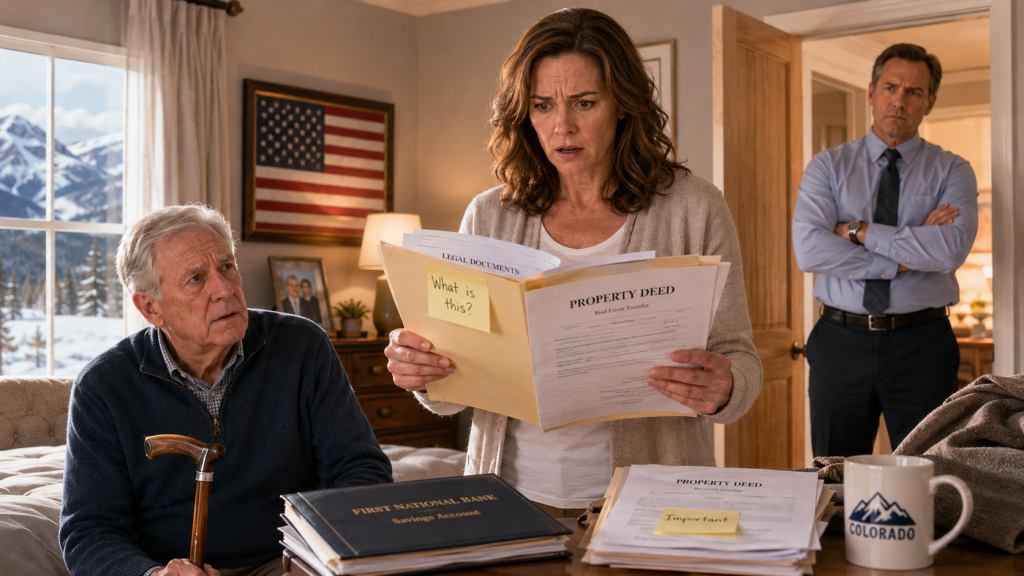
That audio recording shattered every pathetic excuse Mark tried to spin for the jury. The forged signatures, the fraudulent care directives, and the stolen property deeds completed the puzzle.
He and his mother were both found guilty on multiple federal charges, along with several administrators connected to the nursing facilities.
When Mark was led out of the courtroom in handcuffs, he stopped and looked back at me.
“You should have just let me leave,” he sneered.
I held his gaze without flinching.
“You should have left before you tried to steal my father’s life away from him.”
Afterward, I sold the house. Too many of the rooms carried dark memories I no longer wanted to keep.
Dad and I pooled our money and moved into a cozy, single-story ranch home in the suburbs with wide doorways, a large vegetable garden, and zero stairs.
On our very first morning there, he intentionally dragged the rubber tip of his brand-new cane across the pristine hardwood floor while watching my face for a reaction.
“Did I scratch it?” he asked innocently.
“No.”
“What a shame.”
We both laughed so hard I had tears streaming down my face.
Agent Miller stayed in our lives long after the criminal case officially closed. At first, she just came by with legal updates. Then she started stopping by for morning coffee.
She never patronized Dad or treated him like a helpless senior citizen, and she never treated me like a fragile victim waiting to be rescued. She listened, always asked before offering a hand, and never confused real love with control.
Over time, she became someone I deeply trusted.
Two years later, when she asked me to marry her under the oak tree in our garden, Dad sat nearby in his favorite lawn chair, pretending to be fast asleep.
When I tearfully said yes, he cracked one eye open and whispered, “Finally.”
I threw a paper napkin at his head. He caught it effortlessly without fully opening his eyes.
At our small, intimate wedding, Dad walked proudly beside me until we reached the front row of seats. Then he kissed my cheek and stepped back.
“I carried you when you needed it,” he smiled. “Now you can walk for yourself.”
People in our town still tell the crazy story of the old man whose son-in-law thought he was a helpless target.
They gossip about the hidden medicine. The forged nursing home papers. The secret recording pen. The shiny federal badge.
But all of that was never the most important part of the story.
Dad didn’t create the dangerous, greedy monster inside my ex-husband. He only forced him to step into the light.
Mark looked at an older man who walked with a limp and needed a little help organizing his pills, and he truly believed he had found an easy victim to control and discard.
He was dead wrong.
My father had spent his entire career noticing the tiny details that other people ignored. He immediately recognized the predatory legal language in Mark’s paperwork. He recorded every veiled threat. And before anyone could drag him away against his will, he called the people who still respected his name.
My father was never the burden in my house.
He was the blaring warning siren I had spent years refusing to hear.
Now, every morning, he sits comfortably beside the bay window in our new home, sipping green tea while I get ready for work.
His cane rests proudly against his armchair.
Sometimes, he taps it rhythmically against the floorboards just to annoy me.
Sometimes, I make a pot of chicken soup, and he tells me it needs a pinch more salt.
Sometimes, I remember the terrible night I actually apologized for bringing him into my own home.
I never apologize for that anymore.
My ex-husband thought an old man with bad knees would be easy to throw away. He didn’t know that the quietest person in the room had been profiling him from the very beginning.
And he learned way too late that growing old does not mean becoming helpless.
Sometimes, it simply means you have survived in this world long enough to recognize the danger before the danger even recognizes you.
THE END! THANKS FOR READING!