
The School Nurse Looked Annoyed When My Daughter Wouldn’t Eat Because “It Hurt To Swallow”—Then She Noticed The Darkened Line Under Her Chin. The call came at 12:15 PM on Tuesday, after Chloe refused lunch for the third time that week…
The doctor glanced at me, stepped outside, and returned with a hospital social worker. Chloe stared at the woman’s badge before finally whispering one name.
A name I knew. But not from her classroom. “Mr. Dale.” For a second, I thought I had misunderstood her. “Mr. Dale?” I repeated. Chloe nodded without lifting her eyes from the hospital blanket.
My fingers tightened around the metal rail beside her bed.
Mr. Dale was not a teacher. He was not a classroom aide. He was the assistant director of the after-school program.
He was the man who stood beside the elementary school’s side entrance every afternoon wearing a green staff polo and waving parents toward the correct pickup lane.
He knew every child by name.
He knew which parents were usually late.
He knew which children rode the activity bus.
And he had known Chloe since kindergarten.
The social worker, whose badge identified her as Rebecca Moreno, pulled a chair close enough to Chloe that their knees were almost level.
She spoke softly.
“Chloe, you’re doing a very good job telling us what you remember. You aren’t in trouble.”
Chloe looked at me.
I nodded.
Rebecca continued.
“Can you tell me what kind of game Mr. Dale said everyone had to play?”
Chloe swallowed and immediately winced.
The movement pulled at the bruised skin beneath her chin.
I wanted to stop every question right there.
I wanted to pick her up, carry her home, lock every door, and somehow reverse the previous three days.
But the doctor had already warned me that we needed to understand exactly what had happened because the pressure to Chloe’s neck could have caused injuries we couldn’t see.
So I stayed where I was.
Chloe pulled the blanket toward her chest.
“He called it the Quiet Challenge.”
The room seemed to become smaller.
“What happens in the Quiet Challenge?” Rebecca asked.
“You have to be quiet.”
“How?”
Chloe hesitated.
Then she lifted her hands and made a loose circle in front of her neck.
My stomach turned.
Rebecca did not react visibly.
“Did Mr. Dale put something around your neck?”
Chloe nodded.
“What did he use?”
“The blue cord.”
“What blue cord?”
“The one from the equipment closet.”
I closed my eyes.
The after-school gym had jump ropes in several colors.
I had seen them myself.
Rebecca asked whether any other children had been there.
Chloe whispered, “Three.”
“Do you know their names?”
Another nod.
She named two children from second grade and one from third.
I recognized all three.
One of them, Tyler Morgan, lived three streets away from us.
I had watched him ride his bicycle past our house dozens of times.
Another, Emma Ruiz, had been at Chloe’s birthday party the previous spring.
The third was a boy named Gabriel whose mother I had spoken to at pickup.
My pulse hammered.
“When did this happen?” Rebecca asked.
“Friday.”
Friday.
Four days earlier.
I remembered Friday.
I remembered asking Chloe why she had barely eaten her macaroni at dinner.
She had told me she wasn’t hungry.
I remembered telling her she needed at least three more bites before dessert.
She had forced down one spoonful and then started crying.
I had assumed she was tired.
The guilt came so fast and violently that I had to grip the side of the bed.
Chloe noticed.
“Mommy?”
“I’m okay.”
I wasn’t.
But she did not need to carry that.
“Did the Quiet Challenge happen once?” Rebecca asked.
Chloe shook her head.
“More than once?”
Another nod.
“How many times?”
“I don’t know.”
The doctor stepped slightly closer.
“When was the last time?”
“Yesterday.”
Monday.
The first day recorded in the school nurse’s log.
Lunch refusal.
Throat examined.
No visible irritation.
My anger rose so quickly it became almost calming.
Every detail became sharp.
The fluorescent lights.
The dry air.
The thin hospital blanket beneath my daughter’s hands.
The plastic clock above the door.
The water stain near one ceiling tile.
I remembered Mrs. Henderson telling me children sometimes learned which complaints got them sent home.
I remembered the tiny exhale before she suggested Chloe might be exaggerating.
I remembered Chloe begging not to return to lunch.
And I wondered whether lunch had never been the thing she feared.
Rebecca leaned forward.
“Chloe, after the game yesterday, did Mr. Dale tell you anything?”
Chloe’s eyes filled.
“He said I cheated.”
“How?”
“I made noise.”
“What happened because you made noise?”
Her lower lip trembled.
“He said I had to do it longer.”
I stopped breathing for a moment.
Rebecca gave Chloe time.
Then she asked, “Did anyone tell you not to tell your mom?”
Chloe nodded.
“What did they say?”
“He said grown-ups don’t understand games.”
My skin went cold.
“He said if I told, they would close the after-school club and everybody would know it was because of me.”
That sentence told me more about Mr. Dale than anything else could have.
This was not a misunderstanding.
This was not rough play between children.
This was an adult using guilt to silence a seven-year-old.
Rebecca looked at the doctor.
Something passed between them.
A decision.
The doctor stepped outside again.
When he returned, he told me that based on Chloe’s imaging, she had soft-tissue swelling around the front and sides of her neck but no fracture and no obvious major airway injury.
However, because swelling could change over time, they wanted to keep her under observation.
Then he told me the hospital was legally required to report suspected abuse.
“I want you to report it,” I said.
My voice came out harder than I expected.
“I want everything reported.”
Rebecca nodded.
“It already has been.”
I looked toward the curtain.
“To the police?”
“And child protective services.”
“What about the school?”
“They’ll be contacted through the appropriate channels.”
I immediately reached for my phone.
Rebecca stopped me gently.
“I understand the instinct to call the school right now.”
“I’m not calling the school.”
“Who are you calling?”
“My husband.”
I had already pressed Daniel’s number.
He answered on the second ring.
“Hey, how’s Chloe?”
His voice sounded distracted.
He thought we were probably at the pediatrician.
I had texted him from the school parking lot saying I was taking her to be checked.
I hadn’t updated him since.
“Daniel, we’re at St. Matthew’s emergency department.”
Silence.
“What?”
“She has an injury to her neck.”
“What kind of injury?”
I looked at Chloe.
“Come here.”
His voice changed immediately.
“Sarah, tell me what happened.”
“Come to the hospital.”
“I’m leaving now.”
The call ended.
Daniel worked twenty-eight minutes away.
He arrived in nineteen.
I heard him before I saw him because he was arguing with the front desk.
“My daughter is seven. Chloe Bennett. She came in with my wife.”
A nurse guided him through the curtain.
He stopped when he saw Chloe.
Daniel was a large man, six feet two, broad shoulders, the kind of father who had spent years letting Chloe paint his fingernails and stick glitter stars to his forehead.
He crossed the room in three steps.
“Hey, bug.”
Chloe reached for him.
He hugged her carefully.
Then his eyes found the mark beneath her chin.
I watched his face change.
“What happened?”
I explained.
Not everything.
Not in front of Chloe.
Just enough.
Daniel stood perfectly still while I said Mr. Dale’s name.
Then he walked toward the curtain.
I grabbed his arm.
“No.”
He looked at me.
“Sarah.”
“No.”
“I’m going to that school.”
“And do what?”
His jaw tightened.
“Ask him.”
“No, you’re not.”
“He put something around our daughter’s neck.”
“I know.”
“He—”
“I know.”
My voice cracked.
Daniel stopped.
Rebecca stepped closer.
“Mr. Bennett, law enforcement has already been contacted.”
Daniel stared at her.
“How long ago?”
“Approximately twenty minutes.”
“That’s twenty minutes he could be around other kids.”
Rebecca nodded.
“That concern has been communicated.”
Daniel looked at me again.
I could see the war happening behind his eyes.
Every instinct he had was telling him to run toward the danger.
But Chloe was watching.
And she had already spent four days being told adults might blame her for what happened.
So Daniel returned to the bed.
He crouched beside her.
“Bug, look at me.”
Chloe did.
“You didn’t do anything wrong.”
She began crying.
“You’re not mad?”
Daniel’s expression collapsed.
“At you?”
She nodded.
He shook his head.
“Never.”
“But the club might close.”
“I don’t care if the building falls into the ocean. That isn’t your job to worry about.”
That earned the smallest smile.
“There’s no ocean here.”
Daniel swallowed.
“Then we’ll find one.”
Chloe leaned into him.
Forty minutes later, two detectives arrived.
One was Detective Andrea Cole.
The other was Detective Marcus Reid.
They spoke to Rebecca first.
Then they spoke to us.
They did not question Chloe in detail.
Detective Cole explained that children were often interviewed by specially trained forensic interviewers to avoid asking the same questions repeatedly or unintentionally influencing their answers.
I appreciated that.
For the first time all afternoon, I felt as though someone understood how fragile the situation was.
Detective Cole asked whether we had photographs.
I handed her my phone.
She examined all six.
“When were these taken?”
“12:31.”
“At the school?”
“Yes.”
“Anyone else present?”
“The school nurse.”
“Name?”
“Patricia Henderson.”
She wrote it down.
“Did the nurse document the mark?”
“Yes. After I told her to.”
Detective Cole’s eyes lifted.
“After?”
I explained everything.
The three visits.
The lunch complaints.
The repeated throat examinations.
The assumption that Chloe might be trying to go home early.
The failure to check beneath her hair or examine the outside of her neck.
Detective Cole did not criticize the nurse.
She simply wrote.
But the way she wrote told me she understood why I was furious.
At 3:48 PM, my phone started buzzing.
School number.
I ignored it.
It rang again.
Then another number.
Then another.
Daniel looked at the screen.
“Principal?”
“Probably.”
The phone rang a fourth time.
I silenced it.
Detective Cole said, “You don’t have to speak with anyone right now.”
“I know.”
That might have been the most comforting thing anyone said to me that day.
You don’t have to speak with anyone right now.
Not the school.
Not administrators.
Not parents.
Not anyone.
My daughter was injured.
And for once, I did not have to make everyone else comfortable about it.
At 4:10 PM, Daniel’s phone began buzzing.
He looked at the message.
His face hardened.
“What?”
He showed me.
It was from another parent.
TYLER’S MOM SAYS POLICE ARE AT SCHOOL. DO YOU KNOW WHAT’S GOING ON?
Daniel started typing.
I stopped him.
“No names.”
He deleted the message.
At 4:23, another parent texted.
Then another.
By five o’clock, everyone knew something was happening at the elementary school.
No one knew what.
At 5:17, Detective Cole received a call.
She stepped into the hallway.
When she returned, she asked Daniel and me to speak privately.
A nurse stayed with Chloe.
We moved ten feet away.
That was as far as I was willing to go.
Detective Cole kept her voice low.
“Mr. Dale is no longer at the school.”
I stared at her.
“What does that mean?”
“He left approximately thirty minutes before officers arrived.”
Daniel’s jaw clenched.
“Did somebody warn him?”
“We don’t know.”
“Was he scheduled to leave?”
“We’re looking into that.”
My stomach tightened.
“Where is he?”
“We’re locating him.”
“Locating him?”
Detective Cole held my gaze.
“I don’t want to speculate.”
That sentence frightened me more than any speculation could have.
“Did he run?”
“We don’t know.”
Daniel paced toward the wall and back.
“He knew.”
“We don’t know that.”
“He leaves thirty minutes before police show up?”
Detective Cole did not argue.
Instead, she asked whether Mr. Dale had ever contacted us outside school.
“No.”
I paused.
“Wait.”
I opened my phone.
The after-school program used an app.
Staff could send general announcements.
There were dozens.
Snack reminders.
Weather closures.
Pickup instructions.
One message stood out.
Three weeks earlier.
Mr. Dale had sent me a direct message.
Chloe left her purple water bottle. I’ll keep it safe in my office.
At the time, I thought nothing of it.
I showed Detective Cole.
She photographed the screen.
“Any others?”
We searched.
One from September.
Chloe was very helpful cleaning up today! She’s becoming one of my little leaders.
Daniel read it twice.
“That sounds normal.”
“It probably is,” Detective Cole said.
But she recorded it anyway.
At 5:42, a nurse brought Chloe a frozen fruit ice pop.
She tried one tiny lick.
Then another.
It hurt, but she could swallow.
Daniel nearly cried watching her eat.
I understood.
The most ordinary things had become victories.
At 6:15, my mother arrived.
We had not called her.
Daniel had texted his sister, who had apparently called Mom.
She rushed through the curtain carrying Chloe’s pink stuffed rabbit.
The second Chloe saw it, she smiled.
“Bunny!”
My mother hugged her carefully.
Then she looked at us.
“What happened?”
“Later,” I said.
Mom nodded.
No questions.
No drama.
She simply sat beside Chloe and began telling her an absurd story about the hospital vending machine stealing her dollar.
For twenty minutes, Chloe laughed.
I stood in the hallway and cried silently against Daniel’s shoulder.
At 7:03 PM, Detective Cole returned.
They had found Mr. Dale.
He had not fled town.
He was at his apartment.
Officers had made contact.
She did not tell us whether he had been arrested.
Not yet.
There were procedures.
Interviews.
Evidence.
But she did tell us something else.
Police had spoken with the parents of the three children Chloe named.
Two of those children had also complained of neck pain during the previous month.
One parent had taken her son to urgent care and been told he likely had a pulled muscle.
Another child had suddenly refused to attend the after-school program.
My knees weakened.
“So there are others.”
Detective Cole carefully chose her words.
“There are other concerns being investigated.”
Daniel sat down.
He covered his mouth with one hand.
I thought about Tyler riding his bike down our street.
Emma eating strawberry frosting at Chloe’s birthday party.
Gabriel’s mother waving from the pickup lane.
How many parents had gone home thinking their children were tired?
How many had told them to eat dinner?
How many had believed adults who said everything looked normal?
I wanted to blame myself.
Then Rebecca said something I would remember for years.
“The responsibility belongs to the person who caused the harm.”
That did not erase my guilt.
But it kept the guilt from swallowing me.
Chloe was admitted overnight for observation.
Daniel slept in a chair that was too small for him.
I slept badly beside Chloe.
At 2:11 AM, she woke and whispered, “Mommy?”
“I’m here.”
“Is Mr. Dale mad at me?”
My heart broke all over again.
“No.”
“But I told.”
“You were supposed to tell.”
“He said everybody would hate me.”
I leaned close.
“Listen to me. Anybody who tells you that keeping a secret protects everybody else is trying to make you carry something that belongs to them.”
She stared at me.
I simplified.
“You did the right thing.”
“What if he says I’m lying?”
“Then he can say it.”
“What if people believe him?”
“I believe you.”
“Daddy too?”
“Daddy too.”
“Nana?”
“Nana too.”
She considered that.
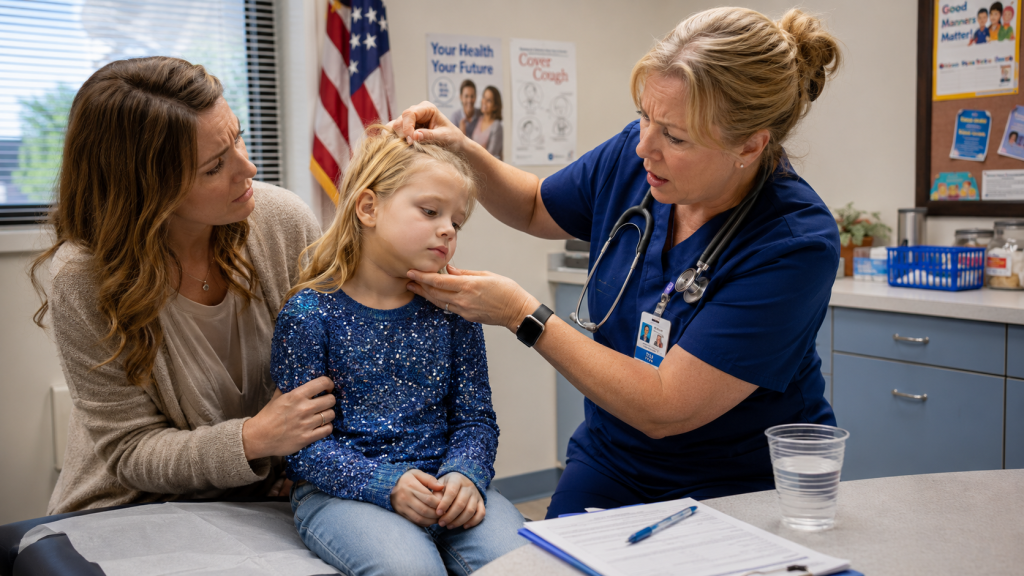
Then she whispered, “Mrs. Henderson didn’t.”
I had no answer ready.
Children notice everything.
Even what adults try to hide behind professional language.
“She didn’t understand what was happening.”
Chloe looked away.
“I told her three times.”
There it was.
The sentence that would later appear in reports, meetings, and legal documents.
I told her three times.
Not once.
Three times.
The next morning, the pediatric specialist examined Chloe again.
Her swelling had not worsened.
Her breathing remained normal.
She was discharged with instructions for soft foods, pain control, limited activity, and immediate return if breathing or swallowing changed.
Before we left, a forensic interviewer met us at the hospital.
The interview itself happened without Daniel or me in the room.
That was one of the hardest things I have ever done.
Chloe walked through a door holding Bunny.
I stood outside for forty-three minutes.
When she returned, she looked exhausted.
But lighter.
As though telling the complete story had removed some invisible weight.
Detective Cole spoke with us afterward.
She could not share every detail.
But she told us enough.
The so-called Quiet Challenge was not something the children had invented.
Mr. Dale had introduced it during periods when the program moved between the cafeteria and gym.
He would select children who were “too noisy” or “not listening.”
He presented it as discipline disguised as play.
The blue cord Chloe described had been located in an equipment area.
Police had taken it as evidence.
Security cameras covered hallways and exterior doors.
Not the equipment room.
But footage showed Mr. Dale entering the area with individual children on several dates.
My hands began shaking.
“How many dates?”
Detective Cole paused.
“More than the ones Chloe remembered.”
Daniel turned away.
I knew he was trying not to lose control.
“Why was he alone with them?”
“That’s part of what investigators are examining.”
The school called again while we were leaving.
This time, I answered.
“Mrs. Bennett?”
The voice belonged to Principal Linda Graham.
“Sarah speaking.”
“First, I want to say how deeply concerned we are about Chloe.”
I said nothing.
“We understand there may have been an incident involving an employee.”
“An incident?”
She paused.
“We are cooperating fully with law enforcement.”
“Good.”
“I also want you to know Mr. Dale has been placed on administrative leave.”
I stopped walking.
“Placed on leave?”
“Yes.”
“Police removed evidence from your building.”
Another pause.
“I can’t discuss details of an active investigation.”
“Then don’t call me to minimize it.”
“I’m not minimizing anything.”
“You called it an incident.”
“Mrs. Bennett—”
“My daughter reported pain three times.”
Silence.
“The nurse documented those visits.”
“I’m aware.”
“Was anyone else informed?”
“I’m reviewing that.”
“Was Mr. Dale informed that Chloe was visiting the nurse?”
A longer silence.
That silence answered before she did.
“I don’t have confirmed information about that yet.”
I felt sick.
“You need to find out.”
“We will.”
“No. You needed to find out before calling me.”
Daniel touched my arm.
Not to stop me.
Just to remind me we were standing beside Chloe.
I lowered my voice.
“Do not contact Chloe directly. Any communication comes through me or Daniel.”
“I understand.”
“And preserve everything.”
“Excuse me?”
“Emails. Messages. Logs. Cameras. Staff schedules. Nurse records. Every document involving Chloe or Mr. Dale.”
Principal Graham became very formal.
“Of course.”
I hung up.
Daniel looked at me.
“Preserve everything?”
“My sister told me to say it.”
His mouth almost smiled.
His sister was a paralegal.
That afternoon, we contacted an attorney.
Not because money mattered.
Not because we wanted headlines.
Because we had learned very quickly that institutions start protecting themselves the moment something goes wrong.
Within forty-eight hours, the school district sent a carefully worded email to parents.
It said an after-school employee had been placed on leave during an investigation into “inappropriate disciplinary practices.”
I read the sentence five times.
Inappropriate disciplinary practices.
Daniel threw his phone onto the couch.
“That’s what they call it?”
Chloe was upstairs with my mother.
I lowered my voice.
“They’re terrified.”
“They should be.”
Within an hour, screenshots of the email were everywhere.
Parents began comparing stories.
A mother posted that her son had complained of headaches after after-school care.
Another said her daughter had begged to quit but would never explain why.
Then Tyler Morgan’s mother called me.
Her name was Jasmine.
She was crying before I answered.
“Sarah?”
“Yeah.”
“Tyler said Chloe told the truth.”
I closed my eyes.
Jasmine continued.
“He said Mr. Dale did it to him too.”
I sat down.
“I’m so sorry.”
“I took him to urgent care three weeks ago.”
“I know.”
“They said muscle strain.”
“You didn’t know.”
“I should’ve asked more.”
“You didn’t know.”
The words felt strange coming out of my mouth.
Because I had been telling myself the opposite for two days.
We talked for almost an hour.
By the end, we both understood something important.
Mr. Dale had counted on isolation.
Each child thought they were the only one.
Each parent had only one fragment.
A sore neck.
A skipped meal.
A sudden reluctance to attend after-school care.
A complaint that sounded too small to connect to something serious.
Once the parents started talking, the fragments formed a picture.
Emma’s mother remembered a bruise near her daughter’s collar.
Gabriel’s father remembered his son suddenly cutting the drawstrings out of his hoodies.
Another child had started having nightmares about being unable to breathe.
A fifth child, one Chloe had not named, told his parents that Mr. Dale punished children for “making noise after warning.”
Five children became seven.
Seven became nine.
Not every report involved the same thing.
Some were uncertain.
Some might have had innocent explanations.
Investigators had to examine each one carefully.
But the pattern was impossible to ignore.
Three days after Chloe left the hospital, Mr. Dale was arrested.
The news broke before police contacted us.
Daniel saw the article first.
He came into the kitchen holding his phone.
“They got him.”
I looked at the screen.
I did not feel relief.
Not immediately.
I felt empty.
An arrest did not undo Friday.
It did not erase Monday.
It did not remove the dark line beneath Chloe’s chin.
But that night, Chloe slept for six uninterrupted hours.
It was the longest she had slept all week.
The investigation expanded beyond Mr. Dale.
The district hired an outside firm.
Police interviewed staff.
Parents demanded records.
Then one afternoon, our attorney called.
“You need to see something.”
She sent us a copy of an internal email obtained through the investigation.
The email had been sent Monday afternoon.
The day before I arrived at the school.
The subject line was simple.
RE: CHLOE BENNETT – REPEATED THROAT COMPLAINT
It was from Mrs. Henderson.
To Mr. Dale.
Daniel and I read it together.
The message said Chloe had visited the nurse again complaining of throat discomfort and refusing lunch.
Mrs. Henderson asked whether Chloe had eaten during the after-school program and whether staff had noticed “attention-seeking behavior or reluctance around mealtimes.”
Mr. Dale replied seventeen minutes later.
Nothing unusual. She’s been testing boundaries lately. Probably looking for an excuse to go home early.
I read it again.
And again.
My hands went numb.
Daniel pushed away from the table.
“He knew she was reporting pain.”
Our attorney nodded through the video call.
“According to the timestamp, yes.”
“He told the nurse she was testing boundaries.”
“Yes.”
“And then Monday afternoon—”
I couldn’t finish.
Monday was the day Chloe said the Quiet Challenge happened again.
If the timeline was accurate, Mr. Dale had received the nurse’s email before the after-school session.
He knew Chloe had complained.
He knew an adult had noticed something.
And instead of stopping, he had apparently convinced the nurse that Chloe’s behavior was manipulation.
That changed everything.
Mrs. Henderson had not simply missed a bruise.
She had unintentionally gone to the very person who needed Chloe to be disbelieved.
I wanted to hate her.
For several hours, I did.
Then I imagined being in her position.
A child says swallowing hurts.
You check the throat.
Nothing.
You ask the after-school supervisor whether anything happened.
He says no.
He says the child has been testing boundaries.
You believe a colleague.
It was a terrible mistake.
But it was not the same as deliberately causing harm.
Still, one fact would not leave me alone.
She had not looked at the outside of Chloe’s neck.
Not once.
The district placed Mrs. Henderson on leave pending review.
Parents immediately chose sides.
Some called her negligent.
Others said she had been deceived.
A few attacked me online for “destroying a nurse’s career.”
I stopped reading comments.
Daniel did too.
We learned quickly that strangers love simple stories.
Villain.
Victim.
Hero.
Failure.
Real life was messier.
Mr. Dale had caused the harm.
Mrs. Henderson had missed warning signs.
The school had weak safeguards.
Parents had incomplete information.
Children had been manipulated into silence.
Multiple things could be true at once.
Chloe returned to school two weeks later.
Not full days.
Just mornings.
Daniel and I walked her inside.
The first day, she froze when we reached the hallway leading toward the cafeteria.
Her hand tightened around mine.
“I don’t want to go that way.”
“We won’t.”
“We have to for class.”
I looked at the principal.
Principal Graham nodded immediately.
“We can use the library hallway.”
So we did.
It took three extra minutes.
No one complained.
For the next month, Chloe used the library hallway every day.
She also started therapy with a child psychologist named Dr. Patel.
At first, Chloe barely spoke.
She drew.
Houses.
Cats.
Rainbows.
One picture showed a child standing beneath a huge blue circle.
Dr. Patel never forced explanations.
She simply stayed curious.
Over time, Chloe began talking.
Not only about Mr. Dale.
About the nurse.
About the lunchroom.
About the fear of being called a liar.
That surprised me.
The physical pain faded before the fear of disbelief did.
One evening, she asked me something while brushing her teeth.
“If a grown-up says something and a kid says something different, who do people believe?”
I turned off the faucet.
“It depends.”
“That means the grown-up.”
“No.”
She looked at me in the mirror.
“It means people should listen carefully to both. Being older doesn’t automatically make someone right.”
She considered that.
“Even teachers?”
“Even teachers.”
“Even nurses?”
“Even nurses.”
“Even moms?”
I smiled slightly.
“Especially moms.”
That made her laugh.
It was one of the first normal laughs I had heard in weeks.
The criminal case moved slowly.
Months, not days.
There were hearings.
Evidence reviews.
Interviews.
Attorneys.
Words Chloe did not need to understand yet.
Meanwhile, the school district changed several policies.
Children could no longer be taken alone into equipment rooms by after-school staff.
Disciplinary activities had to occur in visible spaces.
Staff were prohibited from using physical restraint except under specific emergency circumstances and with reporting requirements.
Nurse visits involving repeated pain complaints required parent notification after a defined number of visits.
Outside injuries had to be documented if a child indicated pain beyond the mouth or throat.
Parents received direct access to same-day health-office entries.
Daniel read the policy announcement at the kitchen table.
“They needed Chloe to tell them how to do their jobs?”
I understood the bitterness.
But I also understood something else.
Policies are often written in the shadow of what somebody survived.
I wished Chloe had never been part of that shadow.
But if another child was safer because adults finally changed the rules, I would take that small piece of good.
Four months after the hospital visit, Mrs. Henderson asked through our attorney whether she could send Chloe a letter.
I said no at first.
Then I reconsidered.
“Can I read it before Chloe sees it?”
“Yes.”
The letter arrived in a plain envelope.
It was handwritten.
Mrs. Henderson did not defend herself.
She did not explain how busy the health office had been.
She did not blame Mr. Dale.
She did not ask Chloe to forgive her.
She wrote that Chloe had told her something hurt and she had focused too narrowly on finding a sore throat.
She wrote that adults sometimes make the dangerous mistake of trying to fit a child’s words into the answer they expect.
Then she wrote one sentence that made me put the letter down.
You deserved to be believed enough for me to keep looking.
I cried.
Daniel read it afterward.
He cried too.
We let Chloe decide whether she wanted to read it.
She did.
When she finished, she asked, “Is she sorry?”
“Yes.”
“Does sorry fix it?”
“No.”
She nodded.
“Okay.”
Then she folded the letter and placed it in the drawer beside her bed.
That was all.
Children sometimes understand accountability more clearly than adults.
Sorry does not fix everything.
But it still matters.
Spring arrived.
The bruise disappeared completely.
For weeks, I kept checking Chloe’s neck anyway.
Whenever she wore her hair down, I caught myself looking beneath it.
She noticed once.
“Mom.”
“What?”
“My neck is okay.”
“I know.”
“You’re checking.”
“I know.”
She rolled her eyes.
“I’m seven, not invisible.”
I laughed.
“Fair.”
The school year ended in June.
At the final assembly, Chloe received an award for reading.
When her name was called, she walked onto the stage wearing a yellow dress and white sneakers.
Daniel clapped so loudly she covered her face.
Afterward, we took pictures beneath a paper banner.
For one photograph, Chloe tilted her chin upward.
The skin beneath it was clear.
No charcoal line.
No swelling.
No shadow.
I almost cried again.
Instead, I smiled.
The criminal case concluded the following autumn.
Mr. Dale entered a guilty plea to multiple charges involving several children.
The court hearing was closed in certain portions to protect minors.
Daniel and I attended only what our attorney and Chloe’s therapist believed was appropriate.
Chloe did not have to stand in front of him.
She did not have to prove herself to a courtroom full of adults.
Her recorded forensic interview and other evidence had already done what needed to be done.
At sentencing, several parents gave statements.
I gave one.
I spent weeks writing it.
Then I threw almost all of it away.
When I stood at the podium, I did not talk about revenge.
I talked about trust.
I said parents send children to school carrying lunchboxes and unfinished homework and missing front teeth.
We assume the adults assigned to them understand that children are not small employees.
They cannot resign.
They cannot file complaints in the way adults can.
They often lack the language to explain what frightens them.
So when a seven-year-old says, “It hurts when I swallow,” the job is not only to look for redness.
The job is to remain curious.
When she says it again, remain more curious.
When she says it a third time, stop assuming the simplest explanation is the correct one.
I said Chloe had survived because eventually somebody looked where she pointed.
Not inside her throat.
Outside.
Beneath her hair.
Where the evidence had been waiting.
Afterward, Jasmine hugged me in the courthouse hallway.
Tyler stood beside her holding a toy airplane.
Emma’s parents were there too.
So were families I had never known before all of this.
None of us wanted to belong to that group.
But we did.
And somehow, belonging to it made the burden lighter.
Mrs. Henderson never returned to the elementary school.
She resigned from the district after the review.
Months later, I heard she had taken a position at a pediatric clinic after completing additional training.
I did not contact her.
She did not contact us again.
But every year on Chloe’s birthday, a card arrived.
No long message.
No request for forgiveness.
Just Happy Birthday, Chloe.
Chloe kept them.
By the time she turned nine, the whole story had changed shape inside our family.
It was no longer something we talked about every day.
It became one chapter among many.
Chloe joined soccer.
She lost two teeth.
She learned to make scrambled eggs badly.
She became obsessed with astronomy.
She stopped sleeping with Bunny every night, though she denied ever having done so.
One Saturday, almost two years after that Tuesday at school, we were cleaning her room when I found the blue sequin sweater folded at the bottom of a storage box.
The same sweater she had been wearing in the nurse’s office.
I froze.
Chloe looked over my shoulder.
“Oh.”
I held it up.
“Do you want to keep this?”
She thought about it.
Then she took the sweater.
For a moment, I expected sadness.
Instead, she examined the sequins.
“They’re kind of itchy.”
I laughed.
“They always were.”
She dropped the sweater into the donation bag.
“That kid can have it.”
“That kid?”
“Whoever gets it.”
“You’re sure?”
“Mom.”
“What?”
“It’s just a sweater.”
I looked at her.
She was right.
For Chloe, it had become just a sweater.
That realization felt enormous.
I had spent two years believing healing would look dramatic.
A courtroom.
An apology.
A policy change.
A conviction.
But healing also looked like a nine-year-old deciding an old sweater was taking up too much drawer space.
A few weeks later, Chloe’s school invited me to speak at a parent safety meeting.
I almost refused.
Then I remembered that first health log.
Monday.
Lunch refusal.
Throat examined.
No visible irritation.
Tuesday.
Repeat complaint.
Refused food and water.
Two neat lines that had almost hidden everything.
So I went.
I stood in the same cafeteria where Chloe had once begged not to return to lunch.
Parents filled folding chairs.
Staff stood along the walls.
The new nurse sat in the front row.
I told them one thing.
“Listen to patterns, not just individual complaints.”
A stomachache one morning might be a stomachache.
Five stomachaches before the same class might be something else.
A child refusing lunch once might be picky.
Repeated refusal combined with pain deserves another look.
A sudden change in behavior is information.
Fear is information.
Silence is information.
And if a child points to the outside of her neck, look at the outside of her neck.
Nobody applauded immediately.
I was glad.
It was not a speech that needed applause.
Then the new nurse stood.
She said every examination room in the district now displayed a small sign for staff.
The sign read:
LISTEN.
LOOK WHERE THE CHILD POINTS.
DOCUMENT.
ASK AGAIN.
CALL HOME.
I stared at it.
Five ordinary instructions.
They would have changed everything for us.
After the meeting, Principal Graham approached.
She looked older than I remembered.
“I’m sorry,” she said.
Not the institutional apology from two years earlier.
Just those two words.
I nodded.
“So am I.”
We stood awkwardly for a moment.
Then she said, “Chloe is doing well.”
“She is.”
“She’s remarkable.”
I smiled.
“She’s a kid.”
Principal Graham seemed surprised.
I continued.
“She likes soccer and hates mushrooms and forgets her library books. I don’t want this to become the most important thing about her.”
Principal Graham nodded slowly.
“You’re right.”
That became the final lesson I had to learn.
Trauma can become greedy.
It tries to claim the whole story.
It turns a child into “the child something happened to.”
A parent into “the mother who discovered it.”
A family into “the family from that case.”
We refused.
Chloe was not what Mr. Dale did.
She was not the darkened line.
She was not the hospital scan.
She was not the police report.
She was the girl who counted ceiling tiles to nineteen.
The girl who insisted warm air made breathing harder.
The girl who laughed when Daniel said the after-school building could fall into the ocean even though we lived hundreds of miles from one.
She was the girl who told the truth even after an adult taught her to fear what truth might cost.
Years later, when people asked me when I knew something was seriously wrong, they expected me to say it was when the doctor showed me the scan.
It wasn’t.
It was earlier.
It was in the nurse’s office.
Not when I first saw the line.
Before that.
It was when I reached for Chloe’s hair and she jerked away.
“Mommy, don’t.”
That was the moment.
Because children sometimes tell us things before they have words for them.
They tell us by refusing food.
By avoiding rooms.
By protecting a part of their body.
By suddenly hating an activity they once enjoyed.
By becoming quiet.
By becoming loud.
By asking questions that seem unrelated.
By saying, “It hurts.”
Our job is not to panic at every change.
But it is to notice.
To remain curious.
To remember that children do not always present pain in ways adults find convenient.
And sometimes the difference between “nothing looks wrong” and the truth is simply moving a little hair aside.
Chloe is twelve now.
Last Tuesday, almost exactly five years after that hospital visit, I packed her lunch while she searched the kitchen for a missing science worksheet.
She was late.
Daniel was complaining about traffic.
The dog had stolen half a piece of toast.
Everything was wonderfully ordinary.
Before leaving, Chloe grabbed an apple from the counter.
I looked at her.
“You’re actually eating fruit voluntarily?”
She groaned.
“Mom.”
“I need documentation.”
“You’re so weird.”
She opened the front door.
Then she stopped.
For just a second, she looked back.
Her hair was pulled into a high ponytail.
Her chin lifted.
Her neck was completely bare.
“Love you,” she said.
“Love you too.”
Then she ran toward the car.
I stood in the doorway watching her go.
Five years earlier, I had carried her out of that same school wrapped in a coat because moving her arms hurt too much.
I had driven through winter traffic believing the worst thing in the world was not knowing what had happened.
I know differently now.
Not knowing is frightening.
But refusing to look is worse.
I can never change what happened to Chloe.
I cannot erase the days when she tried to tell adults her throat hurt.
I cannot undo the moment a trusted adult taught her that silence protected everyone else.
But I can remember what finally changed everything.
One child pointed.
One mother asked a different question.
One nurse moved aside a curtain of blonde hair.
And underneath it, the truth was already there.
Waiting for someone to look.
💬THE END! THANK YOU FOR READING!