
I got pregnant by a married man, and my baby was born with Down syndrome. When I finally messaged his wife, I fully expected her to show up and rip my face off. Instead, she arrived holding a folder and a truth that knocked the wind right out of me.
David called me “babe” for six straight months. He swore he lived alone. He told me he disappeared on Sundays because he took care of his sick mother. And I, like an absolute fool, believed every word.
I met him at a corporate office in downtown Chicago. He smelled like expensive cologne, wore perfectly pressed shirts, and carried himself with the effortless confidence of a man who had never been forced to explain himself twice.
He opened doors.
He remembered how I took my coffee.
He texted me every morning.
“Good morning, beautiful.”
He kissed my forehead when I was stressed.
He sent flowers to my office after difficult meetings.
And somehow, I ignored the fact that he never answered FaceTime calls after 9:00 PM.
I ignored the Sundays when he vanished.
I ignored the way his apartment always looked suspiciously temporary, as though nobody actually lived there.
When you’re falling in love, red flags can look a lot like Christmas lights.
Around the six-month mark, I took five pregnancy tests in the cramped bathroom of my Logan Square apartment.
All five were positive.
I sat on the cold tile with one hand pressed against my stomach and the other gripping my phone.
For twenty minutes, I stared at David’s name.
Then I typed:
David, I need to see you. It’s an emergency.
He came over that night.
He walked through my door pale and tense.
Before I even spoke, he seemed to know.
I placed the tests on the coffee table.
David stared at them.
Then he slowly removed his watch and set it beside them.
“That baby cannot be born.”
For a second, I thought I had misunderstood him.
“What?”
“We aren’t ready for this, Sarah.”
“We?”
“You aren’t ready. I’m definitely not.”
“You told me you wanted children someday.”
His jaw tightened.
“Someday isn’t now.”
“You told me you loved me.”
He closed his eyes.
Not guilty.
Annoyed.
“Don’t be dramatic.”
That sentence broke something inside me.
The charming man disappeared.
What remained was a coward wearing expensive shoes.
For the next several weeks, David moved between affection and cruelty.
One day, he blocked my number.
The next, a massive bouquet arrived at my office.
He told me he was confused.
He said he needed time.
He said he loved me.
He said I was ruining everything.
He said everything except the truth.
Then one Saturday afternoon, I saw him inside a CVS in the Loop.
He was holding shopping bags.
A beautiful woman walked beside him.
A toddler held her hand.
David leaned toward the woman and called her “babe.”
Same tone.
Same smile.
Same effortless affection he had used on me.
I ducked behind the diaper aisle.
The little boy looked up at David.
“Daddy.”
My entire body went cold.
Daddy.
The sick mother.
The unavailable Sundays.
The late-night silence.
The refusal to FaceTime.
Everything connected at once.
David wasn’t single.
David had a wife.
And I was pregnant with his child.
I confronted him that evening.
He didn’t deny it.
He simply rubbed his face and said, “You weren’t supposed to find out like this.”
I laughed.
“How exactly was I supposed to find out? At my baby shower?”
“Sarah, lower your voice.”
“You’re married.”
“Yes.”
“You have a child.”
“Yes.”
“And you’ve been sleeping in my bed for six months.”
He looked toward the window.
“My family cannot know about this.”
“Your family?”
“My wife doesn’t deserve this kind of pain.”
That sentence nearly made me choke.
“What do I deserve?”
He didn’t answer.
Instead, he pulled a thick envelope from his jacket and placed it on my kitchen counter.
Cash.
Thousands.
“You can take care of the situation with this.”
I stared at the envelope.
Then at him.
“Get out.”
“Sarah—”
“Get out.”
“Stop being ridiculous.”
“GET OUT.”
He left.
I cried until sunrise.
But I never went to a clinic.
I went to my prenatal appointment.
I heard my baby’s heartbeat.
Fast.
Strong.
Stubborn.
The sound filled the little examination room.
And something inside me became clear.
Whatever David did next, my baby and I were moving forward without his permission.
The pregnancy was difficult.
I was sick constantly.
Bills piled up.
I worked later than I should have because unpaid leave terrified me.
David appeared twice.
The first time, he begged me to stay quiet.
The second time, he stood inside my apartment and said:
“If you contact my wife, you’ll regret it.”
There was no love left in his voice.
Only warning.
That scared me more than everything else.
My son was born during a rainstorm at Northwestern Memorial Hospital.
I named him Leo.
He was tiny.
Beautiful.
Furious about being cold.
When the pediatrician explained that preliminary findings strongly suggested Down syndrome, I cried.
Not because I was ashamed of him.
Because I was terrified.
I didn’t know what support he would need.
I didn’t know whether I could afford it.
I didn’t know whether the world would be gentle with him.
Then Leo wrapped his tiny hand around my finger.
Every machine in the room seemed to fade.
He was my son.
Nothing about that diagnosis changed the fact that I loved him.
I sent David one photo.
He’s here. His name is Leo.
Four hours passed.
Then his reply appeared.
Delete my number.
Another message followed.
And never contact me again. That kid is not my problem.
Whatever love I had left for him died right there.
For three months, I raised Leo alone.
There were pediatric appointments.
Cardiology appointments.
Therapy referrals.
Insurance calls.
Sleepless nights.
And moments when I sat on the kitchen floor holding him because I was too exhausted to make it to the couch.
Then, one night, while Leo slept against my chest, I searched Facebook.
Emily Hayes.
David’s wife.
Her profile picture showed her beside David and the little boy I had seen at CVS.
They looked perfect.
I stared at that photograph for almost an hour.
Then I wrote:
I’m incredibly sorry. I know this is going to destroy your world, but you deserve to know who your husband really is. I just had a baby with David.
I attached a photograph of Leo.
And pressed send.
Two days passed.
Nothing.
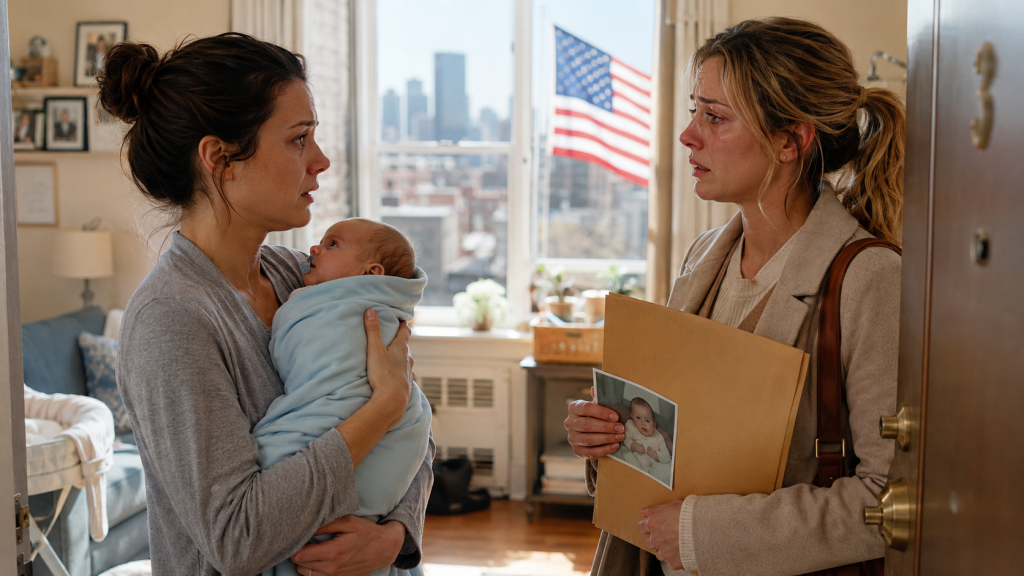
On the third morning, someone knocked on my door shortly before 7:00.
Leo was bundled in his blue swaddle.
I opened the door cautiously.
Emily stood there.
No makeup.
Her eyes were swollen from crying.
Her hands trembled around a thick manila folder.
She looked at me.
Then at Leo.
She covered her mouth.
A sound escaped her that I will never forget.
Not anger.
Grief.
“Can I please come in?” she whispered.
I tightened my hold on Leo.
“If you came here to fight about David, I don’t have the energy.”
She shook her head.
“I didn’t come about David.”
Then she opened the folder.
She removed a faded photograph.
A newborn baby.
Tiny.
Wrapped in a hospital blanket.
A NICU bracelet circled his wrist.
Emily looked at me.
“Sarah… before you decide to hate me, you need to know what David did to my first son.”
I stared at the picture.
“I thought the boy I saw with you was your only child.”
“He is my second.”
Emily sat on my couch.
Her hands shook so badly that the photograph fluttered.
“The baby in that picture was named Nathan.”
I sat opposite her.
Leo stirred against my chest.
Emily looked at him again.
“Nathan was born nine years ago.”
Her voice cracked.
“He had Down syndrome.”
My stomach dropped.
I looked down at Leo.
Then back at the photograph.
“Nathan?”
Emily nodded.
“David and I had been married two years.”
She wiped her cheek.
“When the doctors told us Nathan had Down syndrome, David changed almost overnight.”
“What do you mean?”
“At first, he cried with me. He told everyone we would handle it together.”
She gave a bitter laugh.
“That lasted about forty-eight hours.”
Nathan had been born with a heart defect that required surgery.
Emily remained beside him in the hospital.
David stopped visiting regularly.
He told colleagues he was overwhelmed.
He told friends Emily had become “obsessed” with the baby.
Then he started asking doctors questions Emily initially misunderstood.
Could the adoption process begin from the hospital?
Could parents voluntarily relinquish custody?
Could a child with medical needs be placed with another family?
“I thought he was terrified,” Emily said. “I kept telling myself fear made people say strange things.”
“What happened?”
“One night, he told me we should give Nathan up.”
I held Leo tighter.
Emily continued.
“He said raising a child with Down syndrome would destroy our future.”
My eyes filled with tears.
“He said that?”
“He said we could start again.”
The room went silent.
I remembered David’s message.
That kid is not my problem.
Emily’s voice dropped.
“I told him no.”
David became angry.
He accused her of choosing Nathan over their marriage.
Then Nathan’s condition worsened.
He needed another procedure.
For nearly three months, Emily practically lived inside the hospital.
David visited less and less.
Then one morning, Nathan suffered complications.
The doctors tried everything.
He died when he was four months old.
Emily pressed both hands over her face.
I didn’t know what to say.
“I’m so sorry.”
She nodded without looking at me.
“After Nathan died, David erased him.”
“What?”
“He removed every photograph from our house.”
My skin prickled.
“He told friends we had suffered a miscarriage.”
I stared at her.
“He pretended Nathan never existed?”
“Yes.”
Emily pulled more papers from the folder.
Hospital records.
Photographs.
A tiny footprint card.
A death certificate.
There was no denying any of it.
“Why stay with him?” I asked gently.
She looked ashamed.
“Because grief made me weak.”
“You weren’t weak.”
“I felt like I was.”
Her voice trembled.
“David convinced me Nathan’s death was my fault because I refused to ‘let him go’ sooner.”
I felt sick.
“He said that?”
“Many times.”
Then Emily told me what happened next.
She spent more than a year in therapy.
David became charming again.
Apologetic.
Patient.
He promised he had changed.
Three years later, Emily became pregnant again.
Their second son, Noah, was born without major health complications.
David became the proud father everyone expected.
Soccer pictures.
Birthday parties.
Family vacations.
Perfect Christmas cards.
Nobody talked about Nathan.
“Not even his parents?” I asked.
Emily’s expression changed.
“They knew.”
That hit harder than I expected.
“They knew about Nathan?”
“They visited him twice.”
“And then?”
“When he died, they followed David’s lead.”
Emily stared at the floor.
“His mother said sometimes families need to focus on the children who have a future.”
My mouth fell open.
I looked at Leo.
Suddenly, the message I had received from David felt even uglier.
Not my problem.
He had done this before.
Maybe not exactly the same circumstances.
But the pattern was there.
When fatherhood became difficult, David disappeared.
Emily reached into the folder again.
“This is why I came.”
She handed me another document.
It was a screenshot.
An email.
From David.
To a lawyer.
Sent two weeks earlier.
The subject line read:
Paternity exposure and liability.
My stomach turned.
“He already knew you might contact me,” Emily said.
I read the email.
David asked whether he could deny paternity until legally compelled to test.
He asked whether Sarah’s “financial instability” could affect custody.
He asked whether a mother raising a child with special medical needs could be portrayed as overwhelmed.
Then I reached the final paragraph.
If necessary, would it be possible to argue that Sarah knowingly continued a high-risk pregnancy against my wishes and therefore assumed sole responsibility?
I stopped breathing.
“He wants to make this my fault.”
Emily nodded.
“He wanted Nathan to be my fault too.”
For several moments, neither of us spoke.
Then Emily looked directly at me.
“I came here because I will not let him erase another child.”
I felt tears spill down my cheeks.
“You don’t owe me anything.”
“I know.”
“I slept with your husband.”
“You slept with a man who told you he wasn’t married.”
“I should have known.”
“So should I.”
Her answer surprised me.
Emily leaned back.
“Sarah, David lied to both of us in different ways.”
“That doesn’t make what happened to you less awful.”
“No.”
She swallowed.
“But blaming you would be easier than admitting I spent years sharing a bed with the same man who told me our dying son was an inconvenience.”
I didn’t know what to say.
Emily looked at Leo.
“Can I see him?”
I hesitated.
Then I moved closer.
Leo’s eyes fluttered open.
Emily stared at him.
For a second, her face crumpled.
“He has Nathan’s nose.”
The words hit both of us.
She touched one finger gently to Leo’s tiny hand.
He grabbed it.
Emily cried.
Not quietly.
She bent forward, shoulders shaking.
I sat beside her.
Two women connected by the worst man either of us had ever trusted.
And between us was a baby who had done absolutely nothing wrong.
That morning changed everything.
Emily didn’t return home.
She took Noah and moved into her sister’s house.
By the end of the week, she had filed for divorce.
I hired an attorney too.
Her name was Rachel Kim, and she had very little patience for David.
When I showed her the texts, the cash envelope photograph I had taken, and Emily’s copies of his lawyer emails, Rachel removed her glasses and said:
“He is about to discover that ignoring a child does not erase legal responsibility.”
A paternity test was ordered.
David resisted.
He delayed.
He claimed scheduling conflicts.
Eventually, the court compelled him.
The result came back at 99.99%.
Leo was his son.
David’s attorney attempted to negotiate privately.
A monthly payment.
No public court fight.
No acknowledgment beyond the minimum required.
I refused.
“I don’t want revenge,” I told Rachel. “I want Leo protected.”
“That means establishing everything properly.”
So we did.
Support.
Medical expenses.
Insurance obligations.
Future educational needs.
And legal recognition.
David hated every second of it.
But what truly broke his control wasn’t me.
It was Emily.
During her divorce proceedings, she produced years of financial records.
She discovered David had hidden money.
He had maintained a separate account for years.
He had paid for hotels, gifts, and travel during our relationship from that account.
And I wasn’t the first woman.
There had been others.
At least three.
One reached out after Emily’s attorney contacted her.
Another refused to get involved.
The perfect family image collapsed.
David blamed everyone.
Me.
Emily.
His attorney.
His parents.
Even Nathan.
At one hearing, he said, “My first child’s medical problems destroyed my marriage emotionally long before Sarah came along.”
Emily stood up.
Her attorney touched her arm.
She sat back down.
Later, outside the courtroom, David approached us.
He looked tired.
Older.
Not charming anymore.
Just angry.
He pointed at Emily.
“You’re enjoying this.”
“No,” she said.
“I’m finally ending it.”
Then he looked at me.
“And you.”
I instinctively moved my stroller backward.
“You should’ve left my family alone.”
Emily stepped between us.
“No.”
Her voice was calm.
“You should have left women alone until you learned how to tell the truth.”
David stared at her.
She continued.
“And you should never have treated our son like something shameful.”
For once, he had no answer.
The divorce was finalized nine months later.
Mine wasn’t a divorce, of course.
David and I had never been married.
But legally disentangling myself from the consequences of trusting him sometimes felt just as exhausting.
Life with Leo continued.
And it wasn’t the tragedy David imagined.
It was difficult sometimes.
Absolutely.
There were appointments.
Therapies.
Insurance fights.
Specialists.
Milestones that arrived according to Leo’s own schedule rather than anyone else’s.
But there was also laughter.
So much laughter.
Leo loved music.
He hated peas.
He adored ceiling fans.
By the time he was one, he could recognize Emily’s voice from across a room.
She became Aunt Emily.
Not because genetics required it.
Because love did.
Noah adored Leo too.
The first time Noah asked why Leo looked different from other babies, Emily gave him a simple answer.
“Everyone’s body is built from instructions called chromosomes. Leo has an extra copy of one. It means some things may take him longer, and he may need extra help sometimes.”
Noah thought for a moment.
Then asked, “Does he still like dinosaurs?”
When I told him Leo was too young to have an opinion about dinosaurs, Noah looked offended.
“We can fix that.”
By Leo’s second birthday, his room contained more plastic dinosaurs than a museum gift shop.
Emily and I never became best friends in the effortless movie sense.
Our friendship was stranger than that.
More honest.
Sometimes painful.
There were boundaries.
There were days when she needed distance from me because my existence reminded her of David’s betrayal.
There were days when I looked at her and felt crushing guilt despite knowing I had been lied to.
We talked about it.
That mattered.
One evening, after the children were asleep, I finally asked the question I had avoided for almost two years.
“Do you ever hate me?”
Emily looked at her wine glass.
“Sometimes I hate what you represent.”
I nodded.
“That’s fair.”
“But I don’t hate you.”
She looked at me.
“I hate that he made two women think we were enemies before we even met.”
That stayed with me.
David had relied on silence.
He needed Emily not to know about me.
He needed me not to know about Emily.
He needed both of us not to know about Nathan.
He needed shame to keep every room separated.
Once we started talking, his entire structure collapsed.
Years passed.
Leo grew into a joyful, stubborn little boy who had opinions about everything.
Especially socks.
He had favorite songs.
Favorite teachers.
A laugh that made strangers smile.
He also had health challenges.
There were frightening nights.
One hospitalization for pneumonia nearly broke me.
Emily stayed beside me until sunrise.
At four in the morning, when I told her she could go home, she said:
“I know what it feels like to sit beside a hospital bed and be afraid nobody else understands. I’m staying.”
That was the moment I stopped thinking of her only as David’s former wife.
She was family.
Not conventional family.
But real family.
When Leo turned five, we visited Nathan’s grave together for the first time.
Emily brought white flowers.
Noah carried a little toy truck.
Leo held my hand.
The cemetery was quiet.
Emily knelt and brushed leaves from the headstone.
Nathan James Hayes.
Beloved son.
Four months old.
I stood several feet away.
Then Leo walked toward Emily.
He didn’t understand the full meaning of the place.
He simply saw someone he loved crying.
He hugged her.
Emily closed her eyes and held him.
Noah sat beside them.
I cried behind my sunglasses.
Later, Emily said something I never forgot.
“David spent years acting like Nathan’s life mattered less because it was short and complicated.”
She looked at Leo chasing leaves across the grass.
“But Nathan changed everything.”
“He changed you.”
“He changed you too.”
“How?”
“Because if Nathan hadn’t existed, I might not have recognized what David was doing to Leo.”
She was right.
A child I had never met had helped protect my son.
That thought stayed with me.
David eventually moved to another state.
His contact with Leo remained limited.
At first, that hurt.
Then I realized something.
A child doesn’t benefit from someone’s presence simply because biology gives that person a title.
Presence without kindness can wound more deeply than absence.
I never told Leo his father didn’t want him.
I told him the truth in age-appropriate pieces.
That adults sometimes make selfish choices.
That none of those choices were his fault.
That he was never a burden.
That he was loved before I even knew exactly who he would become.
When Leo was seven, he asked me:
“Mom, did Dad leave because I have Down syndrome?”
I had known the question might come.
It still broke my heart.
I knelt in front of him.
“No.”
He studied my face.
“Really?”
“Really.”
I touched his cheek.
“Your dad had trouble being responsible long before you were born.”
Leo thought about that.
Then he asked, “Is that why Aunt Emily divorced him?”
I nearly laughed.
“Yes.”
“Good.”
“Leo.”
“What?”
He shrugged.
“He was mean to her.”
Fair enough.
That Christmas, Emily gave me a framed photograph.
It was the first picture she had shown me the morning she came to my apartment.
Nathan.
Tiny.
Wrapped in a hospital blanket.
But beside it, she placed a second photograph.
Leo on his fifth birthday, laughing with frosting across his nose.
Underneath the two photographs was a small engraved plate.
Two boys who deserved to be seen.
I couldn’t speak.
Emily hugged me.
“I kept Nathan hidden because David taught me to be ashamed of talking about him.”
She looked at both pictures.
“I’m done with that.”
“So am I.”
Today, Leo is eight.
Emily and I joke sometimes that the worst morning of our lives became the beginning of one of the strangest families anyone could design.
Noah is twelve now.
He still considers it his personal responsibility to educate Leo about dinosaurs.
David is mostly a name attached to legal paperwork and occasional phone calls.
I used to think that meant Leo was missing something.
Now I understand he has far more family than David ever knew how to appreciate.
He has me.
He has Emily.
He has Noah.
He has grandparents and teachers and therapists and friends.
And somewhere in our family story, he has Nathan too.
I still think about that morning when Emily stood outside my apartment holding a manila folder.
I had expected rage.
I expected accusations.
I expected two betrayed women to tear each other apart over the man who deceived us both.
Instead, she handed me the truth.
And once I knew what David had done to Nathan, I understood something important.
Leo’s diagnosis was never the tragedy.
Nathan’s diagnosis had never been the tragedy either.
The tragedy was a father who looked at children through the lens of inconvenience.
A husband who treated women as separate rooms in which he could tell different versions of himself.
A family culture that confused silence with dignity.
But silence ended at my apartment door.
Emily walked in.
She told the truth.
I told mine.
And David lost the one thing he had relied on for years:
our isolation from each other.
People sometimes ask whether I regret sending Emily that message.
I regret believing David.
I regret ignoring the warning signs.
I regret every moment Emily had to learn that her husband betrayed her.
But I do not regret telling her.
Because the truth didn’t destroy her family.
David’s choices had already done that.
The truth simply gave all of us the chance to build something better from what remained.
And every night, when Leo wraps his arms around my neck and says, “Love you, Mom,” I remember the terrified woman I was when the doctor first explained his diagnosis.
I wish I could go back to that hospital room and sit beside her.
I would tell her:
You are going to be tired.
You are going to be scared.
You are going to learn medical terms you never wanted to know.
Some people will underestimate your son.
Some will underestimate you.
But your life is not ending.
It is changing.
And one day, a woman you thought would hate you will stand beside you in a cemetery, holding your child’s hand, and you will realize that family can emerge from the most unexpected wreckage.
David once called Leo “not my problem.”
He was right about only one thing.
Leo was never a problem.
He was a person.
A son.
A brother in every way that mattered.
A little boy whose life deserved to be celebrated rather than hidden.
And thanks to a grieving mother who showed up at my door with a folder, Leo will grow up knowing something Nathan should have been told every day of his short life:
You are wanted.
You are worthy.
And nobody gets to erase you.
THE END! THANKS FOR READING!