
My name is Mara Bennett, and betrayal often sounds most controlled when it comes from family. The first lie my mother told stole twelve years of my life.
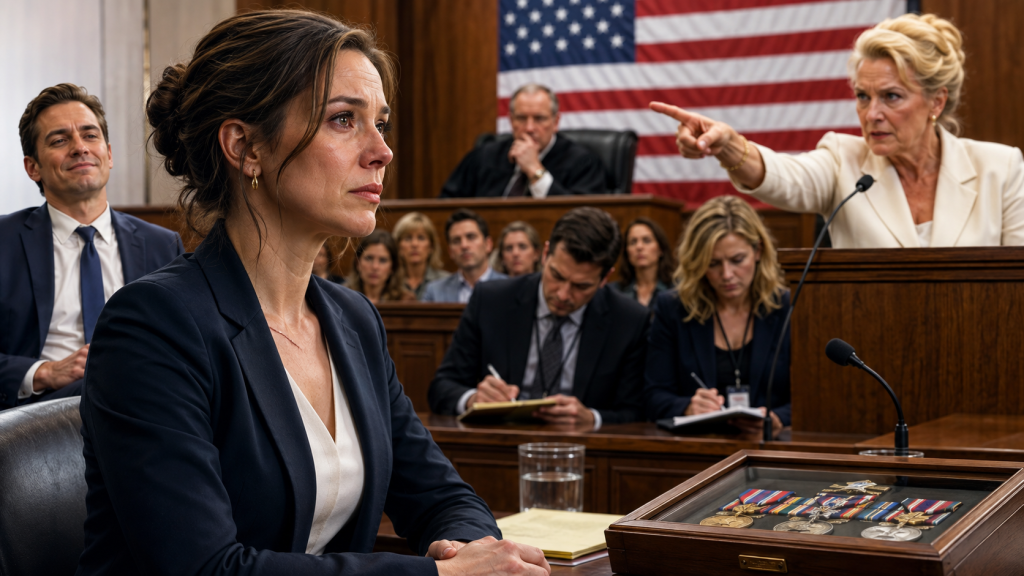
The second was designed to put me behind bars. “She was never in the Army,” my mother, Victoria Bennett, said with total confidence. “The scars, the medals, the entire story—she made it all up.”
Whispers spread across the courtroom. I did not move.
My attorney, Aaron Price, leaned toward me. “Mara… don’t react.” “I won’t,” I whispered.
He studied my face. “That worries me more.” Across the aisle, my younger brother, Caleb, lowered his head to hide a satisfied smile.
He had been waiting for this moment for months.
Maybe years.
The case had begun as a fight over my father’s defense technology company, Bennett Meridian Systems.
My father, Thomas Bennett, built the company from a rented warehouse outside Baltimore into one of the most respected specialized defense contractors in the country.
He designed guidance systems.
Secure communications equipment.
Protective navigation technology.
Nothing glamorous.
Nothing that appeared on billboards.
But some of his work quietly saved lives.
Before Dad died, he left me controlling shares in the company and named me executor of his estate.
Three days after the funeral, Caleb suddenly produced a new will.
According to that document, Dad had changed his mind shortly before his death.
Everything was supposed to belong to Caleb.
The company.
The family estate.
The intellectual property trusts.
Even the lake house where Dad had taught us to fish as children.
I knew immediately that something was wrong.
Dad and I had discussed his estate less than two weeks before he died.
He had been weak.
His voice had barely risen above a whisper.
But his mind was completely clear.
He told me exactly what he had done.
Control of Bennett Meridian was coming to me because Caleb had been making reckless financial decisions and associating with investors Dad did not trust.
Caleb would still receive money.
More than enough money.
Dad loved him.
But Dad did not trust him with the company.
When I challenged the new will, Caleb did not defend himself with evidence.
He attacked me.
First he claimed I had manipulated our father.
Then he claimed I had lied about my military service to earn Dad’s trust.
Then anonymous documents began appearing online supposedly proving that I had never served at all.
People started asking questions.
Reporters called.
Former employees whispered.
A veterans’ organization issued a statement demanding an investigation.
And eventually prosecutors became involved because copies of what appeared to be military records had supposedly been submitted during several business and estate proceedings.
Fraud.
Forgery.
Falsified federal documents.
Stolen valor.
By the time we reached trial, Caleb had successfully transformed a suspicious inheritance dispute into something much uglier.
He had turned my entire life into evidence against me.
The prosecutor lifted a wooden shadow box for the jury.
Inside were my Silver Star, my Purple Heart, and the burned unit patch I had carried home from a mission that nearly ended my life.
My mother sneered.
“She bought those online.”
Several jurors looked at me with disgust.
I knew what they were thinking.
Fraud.
Liar.
Imposter.
Beneath my blouse, the scar along my ribs throbbed as if it remembered the blast before I did.
For one moment, I was back overseas.
Helicopter blades.
Smoke.
The sharp metallic taste of blood.
A vehicle burning twenty yards away.
Major Daniel Hayes dragging me through wreckage while gunfire tore through the air.
The weight of a radio pressed against my chest.
Someone shouting that the extraction point was compromised.
Those memories were real.
The people who died that night were real.
But I could not explain any of it.
The operation had remained classified.
My unit assignment had been sealed under special authorities because the work involved intelligence-linked missions and military systems that were still considered sensitive.
Most of my publicly accessible service record had been deliberately sparse.
That had never mattered before.
I had never built a career around medals.
I did not give speeches.
I did not wear veteran status like a title.
After leaving the Army, I returned quietly to civilian life and eventually began working with Dad at Bennett Meridian.
Caleb knew my record was difficult to verify.
That was why he built his entire case around it.
The truth could not defend me.
Not publicly.
Not yet.
My father had known everything.
Before cancer took the last of his strength, he had gripped my hand in his hospital room.
“They’re moving money through shell companies,” he whispered.
I leaned closer.
“Who?”
His eyes shifted toward the hallway.
“Caleb. Maybe your mother too. I don’t know how deep it goes.”
My chest tightened.
“Dad, what are you talking about?”
“Meridian contracts. Consulting invoices. Equipment purchases that never happened.”
He coughed hard enough that the monitor beside him chirped.
I reached for the nurse button.
He caught my wrist.
“Listen to me.”
“I’m listening.”
“Protect the company.”
“I will.”
“But don’t expose your unit.”
I stared at him.
He knew better than anyone what my classified obligations meant.
He had signed enough federal contracts to understand that some truths could not simply be revealed because they were convenient.
“I promise.”
He closed his eyes.
“And don’t underestimate your brother.”
Those were among the last clear words my father ever said to me.
Now, months later, my father’s warning sat in the courtroom with me like a ghost.
Aaron rose.
“Mrs. Bennett, did your daughter ever deploy overseas?”
My mother looked directly at him.
“No.”
“Did she ever serve in the United States Army?”
“Never.”
“Not even briefly?”
“No.”
“Did she ever leave this country for military duty?”
My mother’s expression hardened.
“She disappeared for years and told everyone whatever story made her look important.”
Aaron glanced toward me.
“What did you believe she was doing during those years?”
Victoria shrugged.
“Drifting. Running away from responsibility.”
My jaw tightened.
I remembered every letter I had written home.
Every holiday call made from miserable satellite connections.
Every time my mother had told me she was proud.
Every time she had cried when I returned from deployment.
Aaron walked closer to the witness stand.
“Mrs. Bennett, are you telling this jury that you never attended a military ceremony involving your daughter?”
“No.”
My mother lied effortlessly.
“You never received communication from Army personnel regarding her?”
“No.”
“You never visited a military hospital?”
“No.”
The prosecutor watched without expression.
Caleb looked almost amused.
Aaron paused.
Then he asked, “What about her scars?”
My mother looked at me.
A small victorious smile touched her mouth.
“Mara was always dramatic.”
A murmur passed through the courtroom.
Aaron’s voice sharpened.
“Are you suggesting she injured herself?”
“I’m saying I have no idea where those scars came from.”
“And the medal citations?”
“Fake.”
“The photographs?”
“Staged.”
“The people who have publicly said they served with her?”
“Friends helping her maintain the lie.”
Aaron stopped.
For one second, I thought he might lose his temper.
Instead, he returned to our table.
My mother glanced toward Caleb.
He gave her the smallest nod.
They thought I had nowhere left to hide.
I calmly folded my hands and looked at the clock above the judge.
11:47 a.m.
My pulse stayed steady.
Aaron noticed.
“What are you waiting for?” he whispered.
I did not look away from the clock.
“Authorization.”
He frowned.
“For what?”
I smiled for the first time that day.
“In thirteen minutes, classified becomes declassified.”
His eyes widened.
“What?”
Before I could answer, the courtroom doors rattled.
Everyone turned.
The doors opened.
A uniformed Army colonel stepped inside.
Behind him were two federal officials carrying sealed document cases.
The entire room fell silent.
Even the judge seemed startled.
The colonel walked down the center aisle with the measured calm of a man who had spent his career entering rooms where everyone else had already lost control.
One of the federal officials handed paperwork to the bailiff.
The bailiff brought it to the judge.
The judge read the first page.
Then the second.
Her expression changed.
“Counsel,” she said. “Approach.”
The prosecutor and Aaron moved toward the bench.
Caleb’s attorney stood too.
After several minutes of quiet discussion, the judge returned her attention to the courtroom.
“I have received an emergency authorization from the Department of Defense permitting limited disclosure of previously restricted service records relevant to this proceeding.”
The courtroom exploded into whispers.
My mother went pale.
Caleb sat completely still.
The judge struck her gavel.
“Order.”
The colonel took the witness stand.
He gave his name.
Colonel Adrian Mercer.
Twenty-eight years of service.
Current assignment with a Pentagon records and operations review office.
The prosecutor looked shaken.
Aaron looked like he had just been handed oxygen after drowning.
Colonel Mercer opened the first case.
“These records establish that Captain Mara Bennett served twelve years in the United States Army.”
My mother stared at him.
The colonel continued.
“Her assignments included conventional service followed by work supporting a compartmented special operations command. Portions of that record were restricted from ordinary public databases.”
A juror covered her mouth.
Another looked directly at me.
The disgust was gone.
Colonel Mercer placed several documents on the evidence table.
“These records also confirm multiple overseas deployments and the lawful award of decorations including the Purple Heart and Silver Star currently in evidence.”
The prosecutor rose.
“Your Honor…”
The judge lifted one hand.
“You will have your opportunity.”
Colonel Mercer’s expression remained unreadable.
“The Silver Star citation was sealed because the action described involved personnel and locations that were classified at the time.”
My mother’s attorney whispered urgently to her.
She did not answer.
Then Colonel Mercer opened the second document case.
“And there is another matter.”
Caleb’s smile vanished.
The colonel removed a folder.
“Three months ago, an unauthorized individual accessed a restricted archival system containing references to Captain Bennett’s service.”
Caleb shifted in his chair.
“The access did not reveal operational details,” Mercer continued. “However, it provided enough metadata to identify record numbers and service gaps visible in public-facing systems.”
Aaron looked at me.
I nodded slightly.
This was the part Dad had predicted.
Someone had used the secrecy surrounding my life as a weapon.
Colonel Mercer went on.
“Following the unauthorized access, several civilian record databases were altered using fabricated documents designed to suggest Captain Bennett had created a false military history.”
The prosecutor’s face drained of color.
“Do you know who made those alterations?”
“We know the access originated from an account connected to Meridian Strategic Consulting.”
My stomach tightened.
That was one of Caleb’s shell companies.
Aaron stood.
“Your Honor, Meridian Strategic Consulting is controlled by the plaintiff, Caleb Bennett.”
The courtroom erupted.
Caleb shot to his feet.
“That’s a lie!”
His attorney grabbed his arm.
“Sit down.”
“I didn’t do anything!”
The judge slammed her gavel.
“Mr. Bennett, you will remain silent unless addressed.”
Caleb sat.
But now everybody was staring at him.
Reporters who had spent all morning writing down accusations against me were suddenly flipping pages, rewriting the entire story.
My mother looked toward my brother.
He would not meet her eyes.
Colonel Mercer was excused after his limited testimony, but the courtroom doors opened again before the judge could call the next witness.
This time two men entered.
One walked with a slight limp.
The other carried himself with the unmistakable posture of someone who had never completely stopped being a soldier.
I recognized them immediately.
Major Daniel Hayes.
And Sergeant First Class Marcus Cole.
Daniel had dragged me out of a burning compound eleven years earlier.
Marcus had held pressure against the wound in my side while yelling at me to stay awake.
For a second, I forgot the courtroom.
I saw dust.
Smoke.
Daniel’s face covered in blood that was not his own.
Marcus kneeling beside me.
“You die and I’m going to be furious, Bennett.”
I had tried to laugh.
It had hurt too much.
Now they stood twenty feet away.
Daniel looked at me.
He did not smile.
Neither did I.
But the smallest nod passed between us.
That was enough.
After clearance paperwork was verified, Daniel testified.
He described my service in careful language.
He confirmed my rank.
My deployments.
My decorations.
The fact that I had been wounded during an operation overseas.
He did not reveal anything still protected.
He did not need to.
Then Aaron asked the question that changed everything.
“Major Hayes, did you ever meet Victoria Bennett?”
Daniel’s eyes shifted toward my mother.
“Yes.”
My mother froze.
“When?”
“Walter Reed. Approximately eleven years ago.”
The courtroom became completely still.
Aaron turned toward my mother.
“Under what circumstances?”
Daniel looked at me briefly.
Then back at the jury.
“Captain Bennett had been medically evacuated following injuries sustained during an operation. Mrs. Bennett was listed as family contact.”
My mother’s lawyer stood.
“Objection.”
“Overruled,” the judge said.
Aaron continued.
“Did Victoria Bennett visit her daughter?”
“Yes.”
“How long?”
“Several days.”
My mother closed her eyes.
There it was.
Not just proof that I had served.
Proof that she had known.
Aaron produced a photograph.
It had been recovered from Daniel’s old personal files after authorization.
My mother stood beside my hospital bed.
Her hand rested on my shoulder.
I looked barely conscious.
Army medical personnel stood in the background.
The date was visible.
Aaron approached the witness stand.
“Is this Victoria Bennett?”
“Yes.”
“Is that Mara Bennett?”
“Yes.”
“Was this photograph taken at a military hospital?”
“Yes.”
Someone in the gallery gasped.
My mother stared at the image projected on the courtroom screen.
All of her confidence disappeared.
Aaron let the silence sit for several seconds.
Then he asked the question everyone was waiting for.
“So when Victoria Bennett testified under oath that she never visited a military hospital involving her daughter…”
Daniel answered quietly.
“That statement was false.”
My mother’s face collapsed.
Caleb leaned toward his attorney.
The attorney ignored him.
The judge called a recess.
The moment we entered the hallway, reporters surged toward us.
“Mara!”
“Captain Bennett!”
“Did your family know?”
“Why were your records sealed?”
“Do you believe your brother fabricated evidence?”
Aaron pushed us through the crowd.
“Do not answer anything.”
I didn’t.
I was looking for someone else.
Daniel found me near the courthouse conference rooms.
For several seconds, we simply stood there.
Then he pulled me into a careful hug.
“Still impossible to kill,” he muttered.
I laughed once.
“Apparently.”
Marcus joined us.
“You look better than the last time I saw you.”
“That is an extremely low standard.”
He smiled.
Then his expression became serious.
“We’re sorry it took this long.”
“You came.”
Daniel studied me.
“How much did they do to you?”
I looked toward the courtroom doors.
“Enough.”
He nodded slowly.
“Then finish it.”
When court resumed, the estate case no longer looked like an argument over inheritance.
It looked like a conspiracy unraveling in public.
Aaron called Bennett Meridian’s forensic accountant.
For weeks, his team had been tracking transactions Dad identified before his death.
Payments had moved from Bennett Meridian into consulting vendors.
Those vendors transferred money into holding companies.
Several of those companies were connected to Caleb.
Others connected indirectly to my mother.
The amounts were staggering.
Four hundred thousand.
Nine hundred thousand.
One point three million.
Over several years, nearly twelve million dollars had been diverted through contracts for services that appeared never to have been performed.
Caleb claimed they were legitimate.
Then the accountant displayed an invoice.
It was for cybersecurity consulting supposedly performed by Meridian Strategic Consulting.
The date was seven months before that company legally existed.
The jury stared.
Caleb’s lawyer stopped taking notes.
Then came the forged will.
Dad’s longtime attorney testified that Dad had never signed it.
A handwriting expert explained that the signature appeared to have been digitally reconstructed from several genuine signatures.
The notary seal was authentic.
But the notary herself testified next.
She had never witnessed the document.
Her seal had gone missing from her office months earlier.
When asked whether she recognized anyone in the courtroom, she pointed toward Caleb’s former assistant.
The assistant had been subpoenaed.
Her name was Emily Raines.
She looked terrified when she took the stand.
At first she said almost nothing.
Yes.
She worked for Caleb.
Yes.
She handled administrative tasks.
No.
She did not know anything about a forged will.
Then Aaron showed her text messages recovered from a company phone.
CALEB: I need Dad’s signature samples.
EMILY: For what?
CALEB: Estate planning.
EMILY: Shouldn’t the lawyer handle that?
CALEB: Just send them.
Emily began crying.
Caleb stared at the table.
Aaron continued.
Another message.
CALEB: Mom says we have one chance before Mara takes control.
Another.
CALEB: Once everyone thinks she lied about the Army, no one will believe anything she says about Dad.
The courtroom went silent.
My mother whispered something under her breath.
Caleb turned toward her.
Their alliance was breaking in real time.
Emily covered her face.
“I didn’t know what he was planning at first.”
Aaron softened his voice.
“When did you realize?”
“When he asked me to find vendors who could modify database entries.”
Caleb’s attorney closed his eyes.
Emily continued.
“He said it was for a background-check problem.”
“Did you believe him?”
“At first.”
“And later?”
“No.”
“What changed?”
“He told me his sister’s military story needed to disappear.”
My brother finally looked at me.
Not with triumph.
Not even hatred.
Fear.
Pure fear.
I had spent months wondering whether he felt any guilt.
Now I understood.
Guilt required a conscience.
He was simply afraid of consequences.
Emily testified that my mother had attended multiple meetings.
Victoria objected loudly.
“That girl is lying!”
The judge ordered her attorney to control her.
Aaron displayed another message.
VICTORIA: Mara has always been Dad’s favorite. Once she controls Meridian, Caleb gets nothing.
CALEB: Then we make sure she never controls it.
VICTORIA: And the military issue?
CALEB: Already handled.
My mother stopped speaking.
The prosecutor requested an immediate conference with the judge.
Thirty minutes later, the criminal case against me was suspended pending review of newly discovered evidence.
The jury was dismissed.
But nobody left.
Everyone seemed to understand they were watching something larger happen.
The federal officials who had entered with Colonel Mercer returned.
This time they were accompanied by investigators.
One approached Caleb.
“Caleb Bennett?”
His attorney stood.
“My client will not answer questions.”
The investigator nodded.
“That’s fine.”
He produced a document.
“We have a warrant for devices and records associated with Meridian Strategic Consulting.”
Caleb’s face changed.
“You can’t do this.”
The investigator looked almost bored.
“We can.”
Another investigator approached my mother.
Her attorney immediately stepped between them.
She looked at me over his shoulder.
For the first time in my life, my mother seemed small.
“Mara.”
I said nothing.
“Mara, tell them this is a family misunderstanding.”
I almost laughed.
A family misunderstanding.
She had called me a fraud under oath.
She had told strangers my scars were fake.
She had tried to destroy my reputation so completely that a jury might send me to prison.
And now it was a misunderstanding.
She took a step toward me.
“I was protecting your brother.”
There it was.
The sentence that explained our entire childhood.
I was twelve when Caleb broke Dad’s antique radio.
I was punished because I had supposedly distracted him.
I was seventeen when Caleb crashed Mom’s car.
I was told not to mention he had been drinking.
I was twenty-one when he stole money from Dad’s office.
Mom called it a bookkeeping mistake.
Every consequence in Caleb’s life had been redirected toward someone else.
Usually me.
“You were always stronger,” Mom had once told me.
At the time, I thought it was a compliment.
Now I understood what she meant.
You can survive what I allow him to do to you.
Caleb stood across the courtroom shouting at his attorney.
“This is her fault!”
The room went quiet again.
He pointed at me.
“She left! She disappeared for twelve years! Dad worshipped her because she wore a uniform!”
Daniel stepped forward instinctively.
I lifted my hand.
“No.”
He stopped.
I walked toward my brother.
Aaron said my name.
I ignored him.
Caleb looked wild now.
“You think you’re better than me.”
“No.”
“You always did.”
“No, Caleb.”
“Dad gave you everything.”
“Dad gave you chance after chance.”
His mouth twisted.
“He never trusted me.”
“You gave him reasons not to.”
“He loved you more.”
The words came out like they had been trapped inside him since childhood.
For one second, I saw the little boy who used to wait outside my bedroom when thunderstorms scared him.
The brother who once climbed into my bed after nightmares.
The boy I used to defend even when he did not deserve it.
Then he said something that erased the memory.
“You should have died overseas.”
The courtroom seemed to disappear.
My mother gasped.
Even Caleb looked surprised by his own words.
I stared at him.
Maybe he expected anger.
Maybe tears.
Instead, I felt something much quieter.
Finality.
“You’re right about one thing,” I said.
“What?”
“I almost did.”
He blinked.
“I had people carry me through fire because they refused to leave me behind. Men and women who owed me nothing risked their lives for me.”
I looked toward my mother.
“Meanwhile, my own family was waiting for me to become useful enough to exploit.”
Victoria shook her head.
“Mara—”
“No.”
My voice was calm.
“That word belongs to me now.”
She stopped.
I turned back to Caleb.
“You wanted the company.”
His eyes narrowed.
“You wanted Dad’s money.”
Silence.
“You wanted my reputation destroyed.”
I stepped closer.
“And you nearly succeeded.”
He swallowed.
“But you made one mistake.”
“What?”
“You thought secrecy meant there was no truth.”
I walked back toward Aaron.
Behind me, federal agents began collecting Caleb’s phone and laptop.
The estate proceedings continued over the next several weeks.
By then, everything had changed.
The criminal allegations against me were formally dropped.
The prosecutor issued a statement acknowledging that key evidence supporting the charges had been fabricated or altered.
That statement did not magically restore my reputation.
Nothing works that quickly.
But the same newspapers that had printed headlines questioning my service now ran photographs of Colonel Mercer entering court.
Military experts confirmed what could legally be confirmed.
Veterans who had served near my command spoke publicly about my character.
Daniel gave one interview.
He said only twelve words.
“Mara Bennett never needed fake medals. She already earned the real ones.”
I called him immediately.
“You enjoy causing trouble.”
“After retirement, I need hobbies.”
Marcus was worse.
He sent me a screenshot every time a publication corrected a story.
Under each one he wrote:
ANOTHER ONE.
For the first time in months, I occasionally laughed when my phone rang.
But the investigation into Caleb and my mother grew darker.
Federal agents discovered the estate fraud was only part of it.
Caleb had been transferring company funds into shell entities with help from an outside executive named Richard Vale.
Vale ran a private investment group that had been attempting to acquire Bennett Meridian for years.
Dad always refused.
Caleb’s plan had been simple.
Take control of Dad’s shares.
Push me out.
Then sell the company to Vale.
The stolen money had financed the scheme.
But there was an even more dangerous element.
One of Bennett Meridian’s current projects involved specialized navigation hardware used in defense applications.
Caleb had secretly promised Vale access to design information after the sale.
That changed the entire investigation.
Corporate fraud became potential theft of protected technical data.
My father had discovered pieces of the scheme shortly before his cancer worsened.
That was why he changed internal access controls.
That was why he made me executor.
And that was why Caleb became desperate.
Dad had not chosen me because he loved Caleb less.
He chose me because he believed I would stop something dangerous.
One evening, nearly two months after the courtroom collapse, Aaron called me.
“They found something in your father’s private office.”
“What?”
“A recording.”
I sat upright.
“What kind?”
“He made it himself.”
The next morning, we gathered in Dad’s old office at Bennett Meridian.
I had avoided that room since his death.
His books were still there.
His reading glasses still rested beside an old photograph of Caleb and me as children.
Dad stood between us.
One hand on each shoulder.
We all looked happy.
Aaron placed a small encrypted drive on the desk.
“The company’s cybersecurity team recovered it from a hidden partition.”
He connected it.
Dad appeared on the screen.
He looked tired.
Thin.
But completely lucid.
“If Mara is watching this,” he began, “then I was probably right to be worried.”
My throat tightened.
Dad looked directly into the camera.
“Caleb, if you are watching this too, I want you to understand something.”
A pause.
“I never wanted to disinherit you.”
I closed my eyes.
“I wanted you to grow up.”
Dad explained everything he had found.
Suspicious payments.
Caleb’s contacts with Richard Vale.
Attempts to access restricted company files.
He said he had confronted my mother.
She begged him not to report Caleb.
Victoria promised she would convince him to stop.
Dad agreed to wait forty-eight hours.
Caleb did not stop.
Instead, more money disappeared.
Dad looked older as the video continued.
“There comes a point when protecting someone from consequences becomes helping them cause harm.”
I thought of Mom.
Dad must have understood her better than I realized.
Then he spoke about me.
“Mara spent twelve years serving a country that will never know most of what she did.”
My vision blurred.
“She never asked me for the company. She never asked me for money. When I offered her an executive position years ago, she told me to give it to someone more qualified.”
Aaron glanced at me.
I looked away.
Dad smiled faintly on the screen.
“That irritated me.”
Despite everything, I laughed.
“So I made her qualify.”
That was true.
Dad had required me to work through nearly every major department at Meridian.
Procurement.
Compliance.
Manufacturing.
Field support.
Security.
He never let me use the family name as a shortcut.
At the time, I resented him.
Now I understood.
He had been preparing me.
“If Mara has control of Bennett Meridian,” Dad continued, “it is because she earned my trust.”
Then his expression changed.
“And if Caleb produced a document claiming otherwise, investigate it.”
Aaron froze the video.
“That’s enough to destroy the forged will even without everything else.”
“No.”
He looked at me.
“Keep playing.”
Dad returned.
“Mara.”
I leaned toward the screen.
“I know what you promised me.”
My heart stopped.
“Protect the company. Protect your unit.”
He took a slow breath.
“But do not confuse protecting secrets with protecting people who hurt you.”
Tears filled my eyes.
Dad seemed to look directly through the screen.
“You have spent your entire life carrying things because you were strong enough.”
His voice softened.
“That does not mean you were meant to carry them forever.”
The video ended.
Nobody spoke.
I remained seated long after Aaron left.
For years I believed strength meant endurance.
You stayed quiet.
You completed the mission.
You protected the person beside you.
You carried pain without making it anyone else’s burden.
Those instincts had saved lives in the Army.
Inside my family, they had nearly destroyed mine.
Caleb eventually accepted a plea agreement on multiple fraud-related charges after investigators produced overwhelming financial evidence.
Additional federal charges connected to protected technical information remained separate.
My mother faced charges related to perjury, obstruction, and participation in the estate fraud.
Her attorneys argued that Caleb manipulated her.
Caleb’s attorneys argued that Victoria manipulated him.
Watching them turn on each other should have felt satisfying.
It didn’t.
It mostly felt sad.
Not because I wanted them absolved.
Because I finally understood how much of our family had been built around pretending.
Pretending Caleb’s actions were mistakes.
Pretending my mother’s favoritism was love.
Pretending silence kept us together.
Truth did not destroy our family.
Truth revealed how damaged it already was.
Three weeks before my mother’s sentencing hearing, she asked to see me.
I almost refused.
Then I remembered Dad’s words.
Do not confuse protecting secrets with protecting people who hurt you.
Seeing her did not mean forgiving her.
So I went.
The meeting room at her attorney’s office was small.
Victoria looked twenty years older.
No jewelry.
No perfect makeup.
No courtroom confidence.
Just my mother.
She looked at the scar visible near my collar.
For once, she did not call it fake.
“I remember the hospital,” she said.
“I know.”
“You were unconscious when I arrived.”
“Yes.”
“I thought you were going to die.”
“So did the doctors.”
She looked down.
“I sat beside you all night.”
“I remember waking up once.”
Her eyes filled.
“You squeezed my hand.”
I nodded.
“Then why?” I asked.
Her lips trembled.
“Why what?”
“Why stand in court and say none of it happened?”
She cried silently.
I waited.
Finally she said, “Because Caleb told me if you took control of the company, he would go to prison.”
I stared at her.
“He had already stolen the money.”
“Yes.”
“So you knew.”
“Some of it.”
“And you thought destroying me would save him.”
She covered her mouth.
“I kept thinking I could fix it.”
“You always thought that.”
“What?”
“That if Caleb did something terrible, someone else should pay the price until he learned.”
She closed her eyes.
“I failed him.”
“Yes.”
She looked at me, startled.
“You failed him every time you protected him from reality.”
My voice stayed steady.
“And you failed me every time you decided I could survive another injury because I was stronger.”
“Mara…”
“I spent years wondering why being dependable earned me less compassion.”
She began crying harder.
“I’m sorry.”
I believed she meant it.
That surprised me.
But regret was not restoration.
“I forgive you for being my mother,” I said quietly.
She stared at me.
“I don’t forgive what you did yet.”
Her face crumpled.
“And forgiveness will not mean access to my life.”
I stood.
“I hope one day you become someone who understands the difference.”
As I reached the door, she spoke.
“Did your father hate me?”
I turned.
“No.”
Her eyes filled with hope.
“That may have been the hardest part for him.”
Then I left.
Taking control of Bennett Meridian was more difficult than winning the court case.
The company had been shaken.
Employees feared losing government contracts.
Partners questioned our stability.
Several executives resigned.
The board asked whether I wanted to sell.
I refused.
Dad had not built the company for me to preserve it like a museum.
He had built something useful.
My job was to make it trustworthy again.
We brought in independent auditors.
Strengthened security.
Terminated questionable vendors.
Reported every irregularity voluntarily.
Some contracts were delayed.
We lost money.
A lot of money.
But slowly, trust returned.
Six months later, I stood inside the company’s main engineering facility watching a demonstration of a new emergency navigation system designed for aircraft operating in disrupted environments.
One of the engineers handed me the prototype.
“This started from one of your father’s old concepts.”
I turned it over in my hands.
“He would have complained about the casing.”
The engineer laughed.
“He did. There’s a note in the archive saying, ‘Why does everything engineers design look like expensive luggage?’”
That sounded exactly like Dad.
I looked through the glass wall into the testing area.
For the first time since his death, being inside Meridian did not feel like walking through a graveyard.
It felt alive.
That evening, Daniel and Marcus met me at a small restaurant outside Washington.
No uniforms.
No reporters.
No courtroom.
Just three people who had once spent years communicating in acronyms and emergencies.
Marcus lifted his glass.
“To Mara Bennett.”
I groaned.
“No speeches.”
He ignored me.
“Captain, executive, family scandal survivor—”
“Marcus.”
“—and still terrible at accepting compliments.”
Daniel laughed.
I looked around the table.
“Do you ever think about them?”
They both knew who I meant.
The people who never came home.
Marcus’s smile faded.
“Every day.”
Daniel nodded.
“For a long time I thought remembering meant staying angry.”
“What changed?”
He looked at me.
“I got older.”
Marcus snorted.
“That’s his answer to everything.”
Daniel ignored him.
“Then I realized memory isn’t supposed to trap you in the worst day of your life.”
I looked down at my hands.
The scars were faint there.
Most people would never notice.
“Sometimes I feel guilty that I got all this.”
“All what?” Marcus asked.
“A company. A future. Another chance.”
Marcus leaned back.
“You think they wanted you to crawl into a hole after surviving?”
“No.”
“Then stop making survival sound like theft.”
I looked at him.
He shrugged.
“I’ve had therapy.”
Daniel nearly choked on his drink.
The three of us laughed until people at the next table stared.
A year after the trial, the courthouse asked whether I wanted the medal shadow box returned.
I almost said no.
For months, I could barely look at it.
Those medals had been held up in court like counterfeit jewelry.
My mother had mocked them.
Jurors had stared at them with suspicion.
Reporters had photographed them from every angle.
Then I realized something.
The medals had done nothing wrong.
So I brought the box home.
I did not put it in the living room.
I did not display it at Meridian.
I hung it in my study beside Dad’s photograph.
Not because I needed visitors to see what I had earned.
Because I needed to remember that truth does not become less true when someone lies about it convincingly.
That lesson mattered more than the medals.
Caleb wrote me once from prison.
The envelope sat unopened on my desk for three days.
Eventually, I read it.
He did not apologize at first.
The first page blamed Dad.
The second blamed Mom.
The third blamed Richard Vale.
Then, halfway through the fourth page, the handwriting changed.
Smaller.
Less angry.
He wrote:
I keep replaying the courtroom.
I thought when those doors opened someone was coming to arrest you.
When I saw the uniform, I knew.
I knew before he said anything.
I asked myself why I hated you so much.
I think the answer is because every time I looked at you, I saw what Dad expected me to become.
I almost stopped reading.
Then came the final paragraph.
You didn’t steal anything from me.
I threw it away.
I’m sorry.
I folded the letter.
I did not write back.
Maybe one day I would.
Maybe I wouldn’t.
Healing was not a contract requiring reconciliation.
Sometimes peace was simply refusing to continue the war.
Two years after Dad’s death, Bennett Meridian held a memorial dedication in his name.
We converted an unused section of the headquarters into a training center for veterans transitioning into engineering, cybersecurity, and manufacturing careers.
Dad believed competence mattered more than pedigree.
It felt right.
Hundreds of employees gathered for the dedication.
I stood behind a podium.
Public speaking still made me more nervous than armed operations ever had.
Daniel stood near the back.
Marcus beside him.
Aaron attended too.
Even Emily Raines came.
After cooperating with investigators, she had rebuilt her life in another state.
I was glad she came.
Behind me was a large photograph of Dad wearing his usual rumpled shirt.
He hated suits.
I looked at the audience.
“My father believed technology mattered only if it helped someone come home.”
The room became quiet.
“He also believed people deserve the opportunity to become more than their worst mistake.”
I paused.
“That belief was tested in our family.”
Several people lowered their eyes.
“I spent a long time thinking strength meant never letting anyone see you hurt.”
Daniel smiled slightly.
“I was wrong.”
The words surprised me as I said them.
“Strength is knowing what deserves protection.”
I looked toward the veterans seated in the front row.
“Sometimes that is a mission.”
Then toward my employees.
“Sometimes a company.”
Then at Dad’s photograph.
“Sometimes a legacy.”
I took a breath.
“And sometimes the thing you finally have to protect is yourself.”
The applause began slowly.
Then rose.
Afterward, people stayed for hours.
Veterans spoke with engineers.
Young employees asked Daniel impossible questions about military life.
Marcus ate enough catered food for four people.
Near sunset, I slipped outside.
The headquarters lawn overlooked a narrow stretch of water.
Dad used to stand there when he needed to think.
I heard footsteps behind me.
Daniel.
“You disappeared.”
“Old habit.”
He stood beside me.
“You did good.”
“I almost threw up before the speech.”
“That would have made it memorable.”
I smiled.
We watched the water.
After a while, he said, “Do you miss the Army?”
“Sometimes.”
“What part?”
I thought about it.
“The certainty.”
He nodded.
“In the Army, somebody tells you the mission.”
“Yes.”
“And now?”
“Now I have to choose it.”
He glanced at me.
“So choose.”
I looked back through the windows at the training center.
People were still talking.
Laughing.
Building connections.
For years, my life had been defined by what I defended against.
Enemy fire.
Secrets.
My brother.
My mother.
A courtroom.
A lie.
Maybe the next part of my life could be defined by what I built instead.
The following spring, I visited Dad’s grave.
I went alone.
The cemetery was quiet.
I placed a small Meridian lapel pin near the headstone.
“We kept it,” I said.
The wind moved through the trees.
“Barely.”
I smiled.
“You would have hated what legal fees cost.”
I sat on the grass.
For a few minutes, I told him everything.
The training program.
The new contracts.
Daniel and Marcus.
Mom.
Caleb’s letter.
I told him I was angry that he had left me with such a mess.
Then I told him I understood why.
Before leaving, I touched the headstone.
“You said protect the company.”
My throat tightened.
“I did.”
A tear slid down my face.
“And I finally learned to protect myself too.”
I stood.
That should have been the end of the story.
But there was one thing I still needed to do.
The courthouse had scheduled the final hearing closing the original estate litigation.
It was mostly procedural.
The forged will had been invalidated.
Dad’s legitimate estate plan restored.
My ownership confirmed.
There was no jury.
No packed press section.
Just lawyers, court staff, and a few reporters who still followed the case.
As I entered the courtroom, I looked at the clock.
11:47 a.m.
The same time I had once sat accused while my mother called me a fraud.
For a moment, I could almost see that earlier version of myself at the defense table.
Hands folded.
Waiting.
Counting down.
Terrified beneath the calm.
I wanted to tell her something.
You do not have to prove everything today.
Just survive long enough for the truth to arrive.
The judge signed the final order.
Aaron shook my hand.
“It’s officially finished.”
I looked around the courtroom.
“No.”
He raised an eyebrow.
“It isn’t?”
I smiled.
“The case is finished.”
Outside, sunlight covered the courthouse steps.
Reporters waited, but there were fewer now.
One called my name.
“Captain Bennett, do you have anything you’d like to say now that the estate case is officially closed?”
I stopped.
For two years, other people had told my story.
My mother.
My brother.
Prosecutors.
Reporters.
Lawyers.
Even people defending me.
Maybe it was finally my turn.
I faced the cameras.
“My family believed that if they could erase the evidence of my past, they could erase the truth.”
Pens moved.
Cameras lifted.
“They were wrong.”
I looked directly into the nearest lens.
“Truth is not always loud.”
The courthouse doors stood behind me.
“Sometimes it is sealed.”
I thought of Colonel Mercer.
Daniel.
Marcus.
Dad.
“Sometimes it is delayed.”
I touched the scar beneath my collar without thinking.
“Sometimes the people who know it are not allowed to speak yet.”
The reporters were silent.
“But a lie does not become truth simply because it reaches the courtroom first.”
Aaron smiled behind me.
I continued.
“I lost family through this.”
My voice softened.
“But I found something too.”
“What?” a reporter asked.
I looked toward the street.
Daniel was leaning against his car.
Marcus stood beside him holding two coffees and looking impatient.
I smiled.
“I learned the difference between people who share your blood and people who refuse to leave you behind.”
Then I walked down the courthouse steps.
No countdown.
No sealed files.
No fear about what came next.
Behind me stood the courtroom where my mother had sworn I never served.
Ahead of me stood two men who had carried me from a battlefield and crossed the country years later to carry the truth into another fight.
Marcus held out a coffee.
“Took you long enough.”
I accepted it.
“You could have left.”
Daniel opened the passenger door.
“We tried that once.”
I understood immediately.
My throat tightened.
Marcus grinned.
“Didn’t work then either.”
I climbed into the car.
As we pulled away, I looked back once at the courthouse.
For years, I thought the most important moment of my story was when those courtroom doors opened.
It wasn’t.
The important moment came afterward.
When the truth was finally free.
When my brother could no longer rewrite me.
When my mother could no longer define me.
When my father’s company no longer felt like a burden I had inherited, but a future I had chosen.
The scars remained.
They always would.
Some beneath my clothes.
Some nobody could see.
But I no longer needed anyone to believe in them for them to be real.
I knew where they came from.
I knew what I survived.
And for the first time in my life, that was enough.
💬THE END! THANK YOU FOR READING!