
Every year, my family claimed I “ruined” Christmas, so this time I simply stayed home—and I didn’t pay for any of it either. But when the phone calls started coming at four in the afternoon, I knew something had gone very wrong.
It began nine days before Christmas with a white bank envelope sitting on my kitchen island. I was sixty-nine, retired after thirty years at an auto plant outside Cleveland, and living alone in the four-bedroom colonial where my wife, Eleanor, and I had raised our son, Preston.
Eleanor had been gone for three years, but every morning I still drank coffee from her blue ceramic mug, and every December I arranged her little Christmas village across the mantel.
She had collected those ceramic houses one at a time.
A bakery.
A post office.
A church with a crooked plastic steeple.
A tiny train station that had stopped lighting up sometime around 2008.
Preston used to complain that the village looked old-fashioned.
Eleanor always smiled and said, “That’s the point.”
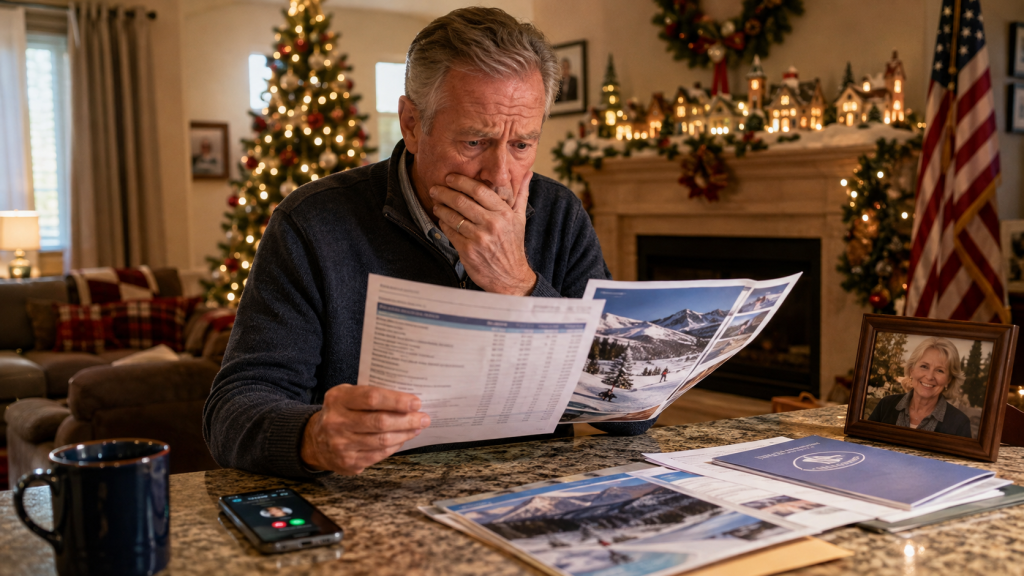
The morning everything changed, I had just switched on the miniature streetlamps when I opened my bank statement.
I expected nothing unusual.
Then I saw the charge.
$30,000.
A luxury ski resort in Telluride, Colorado.
I checked the account number twice.
Preston was still listed as an authorized user on one of my cards. Years earlier, I had added him for emergencies and occasional work travel. Somewhere along the way, “emergency” had come to mean anything he assumed his father would eventually pay for.
I called him.
He answered on the fourth ring.
“Hey, Dad.”
“Why is there a thirty-thousand-dollar resort charge on my account?”
There was a pause.
Not surprise.
Annoyance.
Then he sighed.
“Dad, it’s Christmas.”
“That doesn’t answer my question.”
“You do this every year.”
“Do what?”
“Turn everything into money.”
I stared at the statement.
“I’m asking why thirty thousand dollars was charged to my card without my permission.”
“It’s a family vacation.”
“That you didn’t ask me about.”
“You would’ve said no.”
“Then perhaps that should have told you something.”
His voice sharpened.
“This is exactly what I mean. Everyone wants to enjoy the holiday, and you always turn it into some conversation about money.”
I looked across the kitchen toward Eleanor’s empty chair.
Then Preston used the one argument he knew could still make me hesitate.
“Mom always wanted us to enjoy life. This trip is exactly the kind of thing she would’ve wanted.”
Something inside me hardened.
“Don’t use your mother to justify a charge I never approved.”
“You’ll understand once you see the itinerary.”
Fifteen minutes later, his email arrived.
That was his mistake.
Instead of sending only the flight information, Preston forwarded the entire email chain between himself and his wife, Marissa.
I scrolled through airline confirmations, private transportation details, ski rentals, restaurant reservations, spa appointments, and the booking for a six-bedroom lodge with heated floors, mountain views, a private hot tub, and a chef available for Christmas dinner.
Then I found my name.
Not inside the lodge.
At a roadside motel three miles away.
At first, I assumed there had been an error.
I searched my name again.
There it was.
Raymond Carter.
One king room.
Three nights.
No mountain view.
No breakfast package.
Then I reached Marissa’s message.
Raymond cannot stay in the main house.
Preston had responded:
Already handled.
I kept reading.
Marissa wrote that I was “depressing during the holidays.”
She complained that I told the same stories about Eleanor.
That I wore old flannel shirts.
That I refused to buy “presentable clothes.”
That my “gloomy look” would ruin the family photographs she intended to post online.
She wanted me brought over for dinner and sent back to the motel afterward.
But my credit card?
That was welcome to stay.
Another message read:
Make sure he brings the card. Raymond can cover dinners and incidentals.
I sat staring at the glowing screen while the Christmas lights blinked behind me.
Eleven people would be staying in the luxury lodge I had paid for.
Marissa’s parents.
Her two sisters.
Their husbands.
Three children.
Preston.
Marissa.
Everyone except the father whose account had funded the reservation.
For thirty years, I had stood on concrete factory floors through Ohio winters so Preston could graduate without student debt.
I wore work boots until the soles were nearly gone.
I packed sandwiches instead of buying lunch.
Eleanor cut coupons at the dining table.
We drove the same cars for years.
We skipped vacations whenever tuition was due.
When Preston needed braces, we paid cash.
When he wanted to attend an out-of-state university, we found a way.
When he married Marissa, Eleanor and I paid for half the wedding.
When they bought their first house, I helped with the down payment.
Those choices had once been called sacrifice.
Now my family seemed to consider them proof that I did not belong in their polished holiday photographs.
I almost closed the email.
Then I noticed older messages beneath the vacation planning.
One was dated three weeks earlier.
Marissa had written:
We need him out of that house before spring. The property value is being wasted on one person.
Preston replied:
January is better. After the trip he’ll be tired and easier to talk into simplifying.
I leaned closer to the screen.
Another message.
If he sells before summer, we can probably convince him to put part of the equity into something for Emma’s future. Then we can borrow against it if necessary.
Marissa replied:
Exactly. Call it estate planning.
My stomach turned.
They already had a plan.
Convince me the house was too large.
Make selling it sound like something that would make my life “safer” and “easier.”
Use the equity to cover debts they had never mentioned to me.
The same Cleveland home Eleanor and I had spent thirty years paying off had somehow become part of their financial strategy without anyone asking whether I wanted to leave.
I printed every page.
The printer continued feeding sheets into the tray while I sat there listening to the mechanical hum.
Then my banking app flashed another alert.
A new transaction.
$5,000 had been withdrawn that morning from a joint savings account I had opened for Preston decades earlier as an emergency fund.
I called the bank.
The representative confirmed the withdrawal.
“Would you like to discuss restricting future access?” she asked.
I looked at the pages spread across my desk.
“Yes.”
Before doing anything else, I went upstairs.
Behind a landscape painting in my bedroom was a wall safe.
Inside were the deed to the house, old insurance papers, our marriage certificate, and a dark blue velvet box containing Eleanor’s anniversary jewelry.
At least, that was where the box should have been.
The deed was there.
The documents were there.
The velvet box was gone.
I stood staring into the empty space.
The jewelry had never mattered because of its monetary value.
It was a diamond necklace and matching earrings I had bought for Eleanor on our twentieth anniversary after selling the old pickup truck I had restored myself.
I remembered giving her the box.
She had cried before she even opened it.
After she died, I saved the jewelry for our granddaughter, Emma.
I intended to give it to her when she turned eighteen.
Only two people had ever known where the spare key to the safe was once hidden.
Eleanor.
And Preston.
That was the moment I stopped describing what was happening as “family tension.”
I photographed the safe.
I gathered the bank statements.
I printed the email chain.
I located my old power-of-attorney documents.
Then I placed everything inside a manila folder.
The following morning, I carried that folder into the downtown Cleveland office of my attorney, Julian Vance.
Julian was in his early sixties and had handled our wills for nearly twenty years.
He had attended Eleanor’s funeral.
He had watched Preston grow up.
He read for almost fifteen minutes without speaking.
Then he removed his glasses.
“Raymond, what do you want?”
No one had asked me that in years.
Not what Preston needed.
Not what would keep Christmas peaceful.
Not what would make life easier for everyone else.
What did I want?
“I want my decisions to belong to me again.”
Julian nodded.
“Then we start there.”
By noon, Preston’s financial authority had been revoked.
My accounts were being separated from his access.
My estate documents were being revised.
The house was transferred into a trust that required my explicit approval for any sale, loan, or transfer.
I closed the old joint savings account.
I removed Preston from every card connected to mine.
I froze my credit.
I changed the locks.
And because Julian believed the missing jewelry moved the situation beyond family disagreement, he advised me to make a police report.
That part hurt.
I sat inside a Cleveland police station two days before Christmas and told a young officer that I suspected my only son had taken his dead mother’s jewelry.
I hated every word.
But I said them.
The strangest part was how little drama reclaiming my life required.
Sign here.
Initial there.
Confirm your identity.
Transfer the balance.
Cancel access.
For years, I had imagined that boundaries required screaming.
Instead, sometimes they sounded like sheets of paper sliding across a desk.
That evening, I went home, switched on the Christmas tree, and looked at the Telluride itinerary again.
Eleven people in a luxury lodge.
Me in a motel.
My card paying for everything.
I picked up a pen and wrote two short sentences across the top.
Not attending.
Not paying.
I contacted the credit card company and disputed the charge as unauthorized.
Because Preston had been an authorized user, the process was not as simple as pressing a button, but I had emails proving I had not approved the purchase.
The bank froze additional charges while they investigated.
Then Julian contacted the resort directly and informed its accounting department that the cardholder disputed the reservation.
What happened after that was no longer my problem.
Or so I thought.
On the morning of December twenty-third, Preston started sending instructions.
Don’t miss the airport shuttle.
Pack warm clothes.
The motel shuttle runs every hour.
Marissa wants everyone ready for pictures by five.
Call me when you land.
I responded once.
Have a wonderful Christmas.
His reply came immediately.
Dad, what does that mean?
I did not answer.
The next morning, while they boarded flights for Colorado, Julian confirmed that the resort had suspended the payment method attached to the reservation.
Preston still had no idea.
I spent Christmas Eve at home.
I made Eleanor’s cinnamon rolls.
Mine came out crooked.
Hers had always risen perfectly.
I laughed when I saw them.
Actually laughed.
It surprised me.
I invited my neighbor Frank over for coffee.
Frank had lost his wife five years earlier and usually spent Christmas Eve watching football with his dog.
We sat at my kitchen table, ate misshapen cinnamon rolls, and talked about everything except our children.
For the first time in years, the house felt peaceful.
There was no Marissa criticizing the decorations.
No Preston asking why I bought the wrong wine.
No one rolling their eyes when I told a story about Eleanor.
That night, I placed one wrapped gift beneath the tree.
It was for Emma.
Not the jewelry.
A book.
Inside the cover, I had written:
For Emma. Never let anyone convince you that kindness requires surrendering your dignity.
Christmas morning came quietly.
I made coffee.
I listened to an old Nat King Cole record.
I walked through the neighborhood while snow gathered along the sidewalks.
At noon, Frank returned with a plate of ham.
At one, we watched the Browns lose part of a game we both pretended not to care about.
At three-thirty, I reheated soup.
At four o’clock, my phone began vibrating across the dining table.
Preston called first.
Then Marissa.
Then her father.
Then Marissa again.
Then a number I did not recognize.
I ignored them.
At 4:12, Preston left a voicemail.
His voice was different.
The confidence was gone.
“Dad, call me. Right now. The resort says the balance wasn’t paid. They’ve locked us out of the lodge, and Marissa’s card keeps declining.”
Five minutes later, another voicemail arrived.
Marissa.
“Raymond, whatever point you’re trying to make, you’ve made it. There are children standing outside in the snow.”
I looked at the weather app.
Telluride was twenty-seven degrees.
Cold, certainly.
But according to the itinerary, they had rental SUVs.
Restaurants.
Phones.
Four other adults with credit cards.
They were not abandoned.
They were inconvenienced.
There was a difference.
Then Julian texted.
Don’t respond emotionally. Call me first.
I did.
He answered on Christmas Day.
“I thought lawyers were supposed to have holidays.”
“Good lawyers do. Apparently I made poor career choices.”
Despite everything, I smiled.
“What happened?”
“The resort attempted to finalize payment after your dispute. It failed. They offered your son the option of providing another card. Apparently none of the cards they provided had sufficient available credit.”
I rubbed my forehead.
“So they’re stranded?”
“No. They have transportation. The resort has offered to help locate alternative accommodations. Your son wants you to restore the card.”
“I’m not doing that.”
“I know.”
There was a pause.
Then Julian said, “Raymond, the detective assigned to the jewelry report called me this morning.”
I straightened.
“What did he say?”
“They may have found it.”
The room seemed to shrink.
“Where?”
“A jewelry reseller in Beachwood.”
I closed my eyes.
“Who sold it?”
“Preston.”
For several seconds, I heard only the soft ticking of Eleanor’s kitchen clock.
Julian continued carefully.
“The store keeps identification records and surveillance. The necklace and earrings were sold three weeks ago.”
Three weeks.
Right around the time Marissa had written that they needed me out of the house.
“How much?”
“Eleven thousand four hundred dollars.”
The original appraisal had been nearly twice that.
But the amount did not matter.
“What did he do with the money?”
“We don’t know yet.”
I did.
Or at least I suspected.
The five-thousand-dollar withdrawal.
The unpaid cards.
The desperate plan to sell my home.
The luxury vacation purchased with my account.
Preston was in financial trouble.
And instead of telling me, he had decided my life was a collection of assets available for liquidation.
Another call came in.
Emma.
My granddaughter was sixteen.
She was not in Telluride.
She was spending Christmas with her mother, Preston’s first wife, in Cincinnati.
Preston and Marissa had married when Emma was nine.
I answered immediately.
“Merry Christmas, sweetheart.”
“Grandpa?”
Her voice sounded worried.
“Are you okay?”
“I’m fine.”
“Dad called Mom. He’s freaking out.”
I closed my eyes.
“What did he tell you?”
“That you canceled Christmas because you’re mad at everyone.”
I almost laughed.
Instead, I said, “Emma, I stayed home. Christmas seems to have continued without me.”
She was quiet.
Then she said, “He said you refused to pay for the hotel.”
“I did.”
Another pause.
“Was it your hotel?”
“No.”
I could hear the moment she understood something.
“He used your card?”
“Yes.”
“Did you know?”
“No.”
She whispered something I barely heard.
“Oh.”
I did not tell her about the jewelry.
Not then.
She was sixteen, and whatever Preston had done, he was still her father.
“Don’t worry about any of this today,” I told her. “Enjoy Christmas with your mom.”
“Grandpa?”
“Yes?”
“I like your flannel shirts.”
That nearly broke me.
After we hung up, I sat beneath the Christmas tree longer than I intended.
At five-thirty, Preston called again.
This time I answered.
He exploded before I finished saying hello.
“What the hell did you do?”
“I removed my payment method.”
“You humiliated us.”
“You charged thirty thousand dollars to my account without asking.”
“We’re family!”
“Then why was I sleeping in a motel?”
Silence.
Only for a second.
Then he recovered.
“That was Marissa’s idea.”
“You agreed to it.”
“It wasn’t personal.”
“You wrote, ‘Already handled.’”
Another silence.
Longer this time.
“You read our private emails?”
“You sent them to me.”
“That doesn’t give you the right—”
“Stop.”
I did not raise my voice.
Maybe that was why he stopped talking.
“You used my dead wife’s memory to manipulate me into paying for a trip where I wasn’t welcome. You withdrew five thousand dollars from an emergency account. You discussed selling my home before asking me. And now I know you sold your mother’s jewelry.”
Nothing.
Not even breathing.
Then Preston said softly, “Dad…”
“Did you sell it?”
His voice changed.
“Let me explain.”
That answer was enough.
I stood.
My hand shook around the phone.
Not from anger.
From grief.
“Did you take the jewelry from my safe?”
“We needed temporary cash.”
“Did you take it?”
“Yes.”
The word was barely audible.
I closed my eyes.
“Your mother wore that necklace on our anniversary.”
“I know.”
“It was going to Emma.”
“I was going to replace it.”
“With what?”
“I don’t know.”
His voice cracked.
Then the truth began spilling out.
Preston’s consulting business had been failing for nearly a year.
He had hidden it from Marissa at first.
Then Marissa discovered the debts.
They had refinanced their house.
Maxed out credit cards.
Borrowed from her parents.
Used the emergency savings.
The Telluride trip had been Marissa’s idea because she wanted everyone to believe they were doing well.
Apparently, appearances had become their last functioning asset.
“Why thirty thousand dollars?” I asked.
“Marissa said we needed one good Christmas.”
“One good Christmas?”
I looked around my quiet house.
At Eleanor’s village.
At the book beneath the tree.
At Frank’s half-eaten plate of ham.
“You stole from me so people could think you were wealthy.”
“We were going to pay you back after you sold the house.”
There it was.
Not if.
After.
My own son had already spent money he expected to receive from a decision I had never agreed to make.
“You thought my house belonged to you.”
“No.”
“Yes, you did.”
“Dad, you don’t need four bedrooms.”
“That isn’t your decision.”
“You’re almost seventy!”
“And still competent enough to know when I’m being robbed.”
He began crying then.
I wish I could tell you it softened me.
It didn’t.
Not yet.
Because I had spent years confusing remorse with consequences.
Preston was not crying when he took the jewelry.
He was not crying when he booked my motel.
He was not crying while discussing how to move me from my home.
He was crying now because the machinery had stopped working.
“Are you pressing charges?” he asked.
“The police will decide what happens with the jewelry.”
“Dad, please.”
“I am not lying for you.”
“Emma will find out.”
“You should have considered Emma before stealing what was meant for her.”
He began pleading.
I let him speak.
Then I said something Eleanor once told me when Preston was a teenager.
“Loving someone does not require protecting them from every consequence.”
He went silent.
“I love you,” I said. “But I am finished financing the version of you that thinks love means access.”
Then I ended the call.
I expected guilt.
Instead, I felt tired.
Deeply tired.
But underneath the exhaustion was something I had not felt for a long time.
Clarity.
The Telluride group eventually found accommodations.
Not at the luxury resort.
A collection of smaller hotel rooms nearly forty minutes away.
Marissa’s father paid for two rooms.
Her sister paid for another.
Preston and Marissa stayed in a budget room with a pullout sofa.
They canceled the chef.
They canceled the spa.
They canceled the private ski instructor.
They ate Christmas dinner at a crowded family restaurant.
No one froze.
No one starved.
The children survived the catastrophe of ordinary accommodations.
The photographs Marissa had wanted so badly never appeared online.
The day after Christmas, I received twelve text messages from her.
I read only the first three.
You’ve destroyed our relationship.
You embarrassed Preston in front of my family.
Eleanor would be ashamed of you.
That last one made me angry enough to type a response.
Then I deleted it.
Instead, I blocked her number.
Two days later, Preston came to my house.
He discovered the locks had been changed.
He rang the bell.
I watched him through the front window.
He looked older than he had a week earlier.
For a moment, I saw the six-year-old boy who used to run through that same front door with muddy shoes.
Then I remembered the emails.
I opened the door but did not invite him inside.
“Can we talk?”
“Yes.”
“Inside?”
“No.”
His face tightened.
“Dad.”
“What do you need to say?”
He looked toward the driveway as if embarrassed that a neighbor might see him standing outside his childhood home.
“I’m sorry.”
“For what?”
He stared at me.
“Everything.”
“That isn’t an answer.”
He swallowed.
“For taking the jewelry.”
I waited.
“For using the card.”
I kept waiting.
“For the savings.”
Still I said nothing.
“And for the house.”
“What about the house?”
His eyes filled.
“For talking like it was mine.”
That mattered more than he probably understood.
I nodded.
“And the motel?”
He looked ashamed.
“I should’ve stopped it.”
“You should never have participated.”
“I know.”
A car passed behind him.
Neither of us spoke.
Finally he said, “I need help.”
For most of his life, those four words would have opened my wallet.
This time I asked, “What kind?”
He looked surprised.
“Financial.”
“No.”
His mouth opened.
I continued.
“I will pay for a consultation with a bankruptcy attorney directly. I will not give you cash. I will not pay your credit cards. I will not refinance your house. I will not co-sign anything.”
He stared at me.
“That’s it?”
“That is help.”
“It doesn’t feel like help.”
“That may be part of the problem.”
He looked away.
Then he asked about the police.
I told him I had given them the truth and would continue doing so.
Because he had voluntarily admitted taking the jewelry and the reseller still possessed most of the pieces, the situation eventually moved more slowly than I expected.
The necklace was recovered.
One earring had already been transferred to another location, but police retrieved it several weeks later.
I had to purchase the jewelry back through an insurance and restitution process that Julian helped untangle.
Preston entered a repayment agreement as part of resolving the matter.
There were legal consequences.
There were attorney fees.
There was humiliation.
But there was no dramatic handcuff scene on my lawn.
Real life is rarely as theatrical as people expect.
The bigger consequence was simpler.
I stopped rescuing him.
In January, Preston and Marissa listed their own house.
Not mine.
They downsized to a townhouse.
Marissa sold her luxury SUV.
Preston sold his fishing boat.
They canceled memberships.
They met with a financial counselor.
For several months, Marissa refused to speak to me.
That suited me perfectly.
Then something unexpected happened.
Emma started visiting more often.
Her mother would drive her up from Cincinnati on weekends.
Sometimes we baked Eleanor’s cinnamon rolls.
Sometimes we watched old movies.
Sometimes Emma sat at the dining table doing homework while I worked on a model train set in the basement.
One Saturday in March, she noticed the blue velvet box on the table.
I had finally retrieved the jewelry.
She touched the lid.
“Was this Grandma’s?”
“Yes.”
I told her the truth.
Not every ugly detail.
But enough.
I told her I had intended the necklace for her.
I told her Preston had taken it during financial trouble.
She stared at the box for a long time.
“Do you hate Dad?”
“No.”
“Are you mad at him?”
“Yes.”
“Can you be both?”
The question surprised me.
“Love someone and be mad?”
She nodded.
“Yes,” I said. “In fact, that’s usually when boundaries matter most.”
She opened the box.
The diamonds caught the afternoon light.
Then she closed it again.
“I don’t want it yet.”
“You don’t?”
She shook her head.
“Give it to me when I turn eighteen. Like you planned.”
My throat tightened.
“All right.”
“And Grandpa?”
“Yes?”
“Don’t sell this house because people tell you to.”
I smiled.
“I won’t.”
Spring arrived.
For the first time since Eleanor died, I planted flowers in the backyard again.
I had let her garden become overgrown.
Preston used to say that was evidence the house was too much for me.
Maybe he had been partly right about the garden.
But he had been wrong about the solution.
I hired a teenager from three streets over to help with mowing.
I paid someone to repair the gutters.
I converted Preston’s old bedroom into a woodworking room.
I turned the smallest bedroom into a reading room.
The house stopped feeling like a museum built around my grief.
It became mine again.
In June, I received a letter from Marissa.
A real letter.
Not a text.
Not an email.
Four pages.
The first page was defensive.
The second was less so.
By the third, she admitted she had become obsessed with appearances.
She wrote that she had spent years comparing their lives to people online.
Bigger houses.
Better vacations.
Designer clothes.
Perfect holiday photographs.
She said she had convinced herself that looking successful was the same as being successful.
Then she wrote:
I treated you like a resource instead of Preston’s father. I am ashamed of that.
I read the sentence three times.
I did not immediately forgive her.
Forgiveness is not a coupon someone receives for saying the correct words.
But I appreciated the apology.
I wrote back.
Thank you for saying it.
That was all.
By August, Preston was working full-time for an engineering supplier.
Not glamorous.
Not the business owner he had wanted to be.
But stable.
He began making restitution payments every month.
Sometimes they were small.
He never missed one.
In October, he asked whether I would have coffee with him.
We met at a diner halfway between our houses.
For the first twenty minutes, we talked about baseball.
Then he said, “I blamed you.”
“For what?”
“For making everything look easy.”
I nearly laughed.
“Easy?”
“You and Mom always had money when something went wrong.”
“That’s because we saved it.”
“I know that now.”
He rubbed his hands together.
“When my business started failing, I kept thinking I should be able to fix it without anyone knowing. Then Marissa found out. We panicked. Every decision after that was about buying time.”
“You could have asked me for advice.”
“I didn’t want advice.”
“What did you want?”
“Money.”
At least he was honest.
He looked down at his coffee.
“And I knew if I told you the truth, you’d make me show you the numbers.”
“I would have.”
“That’s why I didn’t.”
We both smiled slightly.
Then his expression changed.
“I’m sorry about Mom’s necklace.”
“I know.”
“I think about that more than anything.”
“Good.”
He winced.
I continued.
“Not because I want you miserable. Because some things should stay uncomfortable. That’s how we remember not to repeat them.”
He nodded.
We finished our coffee.
When we stood to leave, he hugged me.
I hugged him back.
It was not reconciliation wrapped neatly with a bow.
It was a beginning.
Christmas approached again faster than I expected.
By the first week of December, stores were already blasting holiday music.
One afternoon, Preston called.
“I wanted to ask about Christmas.”
I waited.
“We’re doing dinner at our townhouse.”
“All right.”
“We’d like you to come.”
“That sounds nice.”
He hesitated.
“We’re keeping it small. Just us, Emma, Marissa’s parents, and you.”
“No ski resort?”
He laughed.
“Definitely no ski resort.”
“Where am I sleeping?”
There was a long silence.
Then we both started laughing.
It was the first time either of us had joked about Telluride.
“You get the guest room,” he said.
“I’ll bring flannel.”
“Emma already told Marissa she likes the flannel.”
“Smart girl.”
Then Preston said something that mattered.
“And Dad?”
“Yes?”
“You’re not paying for dinner.”
I smiled.
“I can bring pie.”
“You can bring pie.”
Christmas Day, I drove to their townhouse carrying an apple pie and Eleanor’s old Christmas village church.
Preston had asked if he could have one piece of the village.
Years ago, I would have given him the entire set.
Now I understood that giving something meant more when it was chosen freely.
Marissa opened the door.
For a moment, we stood awkwardly.
Then she stepped aside.
“Merry Christmas, Raymond.”
“Merry Christmas.”
She did not mention my shirt.
She did not ask me to stand anywhere special for photographs.
She did not tell me what Eleanor would have wanted.
Dinner was simple.
Ham.
Potatoes.
Green beans.
Dinner rolls that came from a grocery store bag.
No private chef.
No rented lodge.
No champagne.
No matching designer pajamas.
And somehow, no one suffered.
Halfway through dinner, Emma told a joke that made Preston laugh so hard he nearly spilled his drink.
Marissa’s father argued with me about football.
Someone burned the rolls.
The dog stole a piece of ham.
It was imperfect.
Which meant it felt real.
After dinner, Emma handed me a small wrapped box.
Inside was a new blue ceramic mug.
Painted on the side were the words:
Grandpa’s Christmas Coffee.
I turned it in my hands.
“It’s so you can stop using Grandma’s every morning,” Emma said.
My smile faded slightly.
She noticed.
“You don’t have to stop because you miss her,” she added quickly. “I just thought maybe you could have one that’s yours too.”
That girl understood something the rest of us had taken years to learn.
Moving forward did not mean throwing away what came before.
I kissed the top of her head.
“Thank you.”
Later, while everyone cleaned the kitchen, I stepped into the living room.
Preston had placed Eleanor’s little ceramic church on a bookshelf.
The tiny bulb inside cast warm light through the plastic windows.
He came to stand beside me.
“Looks good there,” I said.
“Yeah.”
We watched it silently.
Then he said, “I’m glad you stayed home last year.”
I looked at him.
“That’s an unusual thing to say.”
“If you’d come to Telluride, nothing would’ve changed.”
He was right.
I would have slept in the motel.
Paid for meals.
Smiled through the photographs.
Ignored the missing jewelry a little longer.
Listened while they explained why selling my home was best for me.
I would have gone home angry.
Then convinced myself that keeping the family together mattered more than respecting myself.
Instead, I had stayed home.
Christmas fell apart.
And somehow, that was what allowed something healthier to take its place.
A year later, my house still belonged to me.
The trust was still in place.
Preston had no access to my accounts.
My financial documents remained locked.
The jewelry remained in the safe, waiting for Emma’s eighteenth birthday.
Those boundaries never changed.
Neither did my love for my son.
That was the lesson I wish Eleanor had been there to see.
For years, I believed there were only two choices.
Give endlessly and keep the peace.
Or refuse and lose your family.
I had been wrong.
Sometimes saying no is not the end of a family.
Sometimes it is the first honest thing that family has heard in years.
And sometimes the Christmas everyone says you ruined becomes the one that finally saves you from spending the rest of your life being useful to people who have forgotten how to value you.
When I returned home that evening, snow had begun falling over Cleveland.
I carried my new blue mug into the kitchen.
Eleanor’s old mug still sat beside the coffee maker.
I picked it up.
For a second, I could almost hear her voice.
Not telling me what Preston wanted.
Not telling me what Christmas should look like.
Just laughing the way she used to when I overfilled the coffee filter.
I placed her mug carefully inside the cabinet.
Not hidden.
Not discarded.
Just safe.
Then I set Emma’s gift on the counter.
My mug.
My house.
My Christmas.
My decisions.
The tree lights reflected against the kitchen window.
Outside, the neighborhood was quiet.
I thought about that first bank statement.
Thirty thousand dollars.
At the time, it had felt like proof that I had failed somehow.
Failed as a father.
Failed to teach Preston gratitude.
Failed to notice how far our family had drifted.
Now I understood that the charge had actually purchased something none of them intended to give me.
The truth.
It showed me what they expected.
What I had allowed.
And exactly where generosity had crossed into exploitation.
I cannot change the years when I said yes because I was afraid of conflict.
I cannot recover every dollar I spent trying to keep people happy.
I cannot erase what Preston did.
But I can decide what happens next.
That is the part people rarely tell you about getting older.
Everyone assumes age makes you weaker.
Easier to manage.
More willing to surrender.
Sometimes the opposite happens.
Sometimes after enough birthdays, funerals, disappointments, and quiet mornings, you finally understand that the time you have left is too valuable to spend auditioning for a place in your own family.
I was sixty-nine when I learned that.
All because I stayed home for Christmas.
And refused to pay for the room where I was never truly welcome.
💬THE END! THANK YOU FOR READING!