
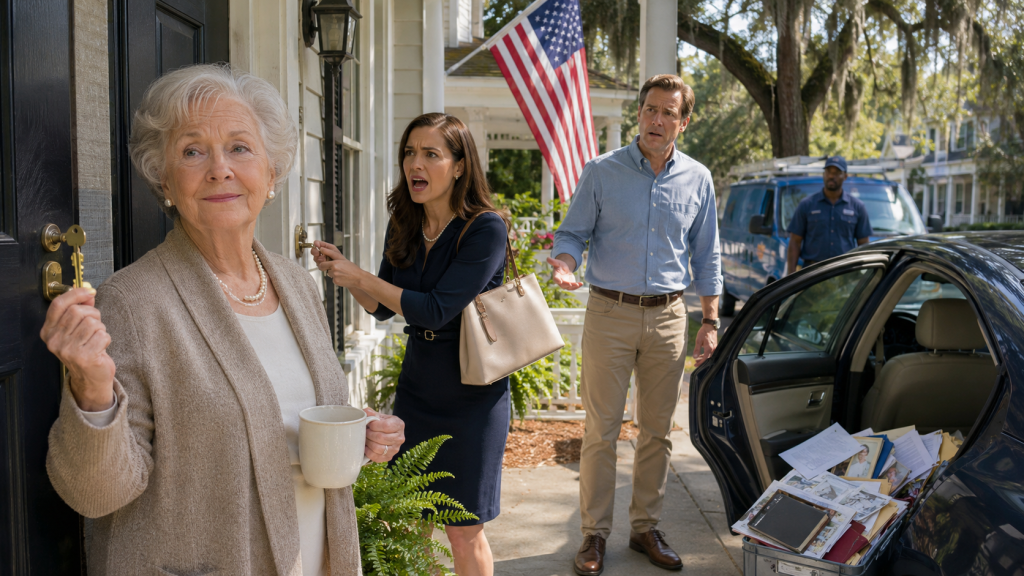
I changed the locks on my own house at 9:15 on a Sunday morning while my daughter-in-law was at church. Then I carried my coffee onto the porch and waited.
I thought the worst moment would be seeing her face when her key refused to turn. I was wrong. The worst moment came when I looked inside her car.
My name is Evelyn. I am 81 years old, and I have lived in this house in Savannah, Georgia, since 1974, when my late husband, Arthur, and I bought it with nearly every dollar we had.
We painted the walls ourselves.
Arthur built the dining room china cabinet by hand.
Our only son, Julian, took his first steps across the living room floor.
After Arthur passed away, the house became painfully quiet.
So when Julian and his wife, Candice, asked to stay with me while they saved for a larger home, I agreed.
They said it would be for six months.
They stayed for four years.
Julian traveled frequently for work, leaving Candice and me alone together. At first, she appeared helpful. She drove me to appointments, collected my prescriptions, and offered to organize my bills.
Gradually, helping became control.
She opened my mail without permission.
She answered questions doctors directed at me.
She moved my financial papers into a locked drawer and told me I no longer needed to worry about them.
Whenever I objected, she smiled patiently.
“You should let someone younger handle these things, Evelyn.”
Julian always defended her.
“She’s just trying to make life easier for you, Mom.”
Eventually, I stopped arguing.
Candice mistook my silence for weakness.
About eight months before I changed the locks, my eyesight began to deteriorate. I could still recognize faces, photographs, and large lettering, but small print blurred together.
My mind, however, was clear.
I did not tell Candice how much trouble I was having.
Instead, I called my oldest friend, Martha Jenkins.
Every Wednesday, I brought my mail to Martha’s kitchen, and she read it aloud to me. When Candice began placing documents beside my breakfast plate, I took those to Martha too.
The first document Candice called an insurance update was actually a durable power of attorney giving her control over my finances.
The second was an affidavit claiming I had become confused and could no longer manage my affairs.
The third was a quitclaim deed transferring ownership of my house to Julian immediately.
I signed none of them.
Martha introduced me to an elder-law attorney named Rebecca Sterling.
Rebecca arranged for a complete medical evaluation. The doctor confirmed that although my eyesight was declining, I was mentally capable of making my own decisions.
Rebecca placed fraud alerts on my accounts and warned the Chatham County recorder not to accept any property transfer without confirming it with me personally.
She also told me to document everything.
So I wrote down every time Candice opened my mail, moved my belongings, or told someone I was becoming forgetful.
I still wanted to believe there was an innocent explanation.
Then, one Sunday afternoon, I heard Candice speaking to her sister, Heather, on speakerphone.
I was moving through the hallway with my walker when I heard them in the kitchen.
“The paperwork is almost finished,” Candice said. “Julian signed the affidavit on Tuesday.”
“And Evelyn has no idea?” Heather asked.
“She thinks it’s routine medical paperwork.”
Candice laughed.
“She can’t read the small print anymore, and she’s too proud to admit it.”
I stopped behind the wall.
“What about the house?”
“Once the deed is recorded, it belongs to Julian. Then we can put it on the market.”
“And Evelyn?”
“I put a deposit on a room at Magnolia Gardens. We’ll tell her she’s going for temporary physical therapy. Once she’s settled in, we’ll make the arrangement permanent.”
My hands tightened around the walker.
“Does Julian know?”
“He thinks Evelyn wants to downsize somewhere safer. He signs whatever I put in front of him.”
I returned quietly to my bedroom and called Rebecca.
By the next morning, Rebecca had located copies of the documents Candice had attempted to submit.
Julian’s signature appeared on an affidavit supporting a potential guardianship petition. It stated that he had witnessed me becoming confused and unable to manage my finances.
He had never discussed any of that with me.
Rebecca filed an emergency petition using the fraudulent paperwork, my medical evaluation, and my sworn account of the conversation I had overheard.
Before the end of the week, the court granted me temporary exclusive possession of my home. Julian and Candice would be allowed to collect their belongings later under supervision, but they could not enter without permission.
On Sunday morning, a locksmith named Thomas Bradley replaced both exterior locks.
When he finished, he placed the new keys in my hand.
“I’ll stay nearby for a while,” he said.
“You don’t need to.”
“I know.”
Candice returned from church at 10:40.
She stepped out of her car wearing a pale dress and carrying a folded bulletin. She walked past me as though I were part of the porch furniture.
“Good morning,” I said.
She barely looked at me.
Candice inserted her key into the front door.
It did not turn.
She tried again, harder.
“Evelyn, the lock is jammed.”
“The lock is fine.”
She turned around.
“What did you do?”
“I changed it.”
Her mouth fell open.
“You can’t lock me out. I live here.”
“You stayed here,” I said. “There is a difference.”
Her expression shifted from anger to false concern.
“You’re confused again. Let me call Julian.”
“Call him. His key won’t work either.”
“You’re having an episode.”
“I’m having a Sunday.”
She walked back toward the driveway and called my son.
That was when I noticed her rear car door standing open.
At first, I saw only a gray garment bag and two reusable grocery sacks.
Then a gust of wind lifted a manila folder lying across the back seat.
Several photographs slid partly out.
One landed facedown near the door.
Another turned toward me.
It was my bedroom.
Not just a casual photograph.
A close, carefully framed picture of the wall safe behind Arthur’s landscape painting.
My stomach tightened.
I stood slowly.
Candice was still at the end of the driveway arguing into her phone.
“He changed the locks? No, she did. I don’t know how. She’s clearly having some kind of breakdown.”
I took my walker down the porch ramp.
Thomas, who had been sitting in his truck two houses away, opened his door.
“Mrs. Whitmore?”
“I’m all right.”
I reached Candice’s car.
The folder had opened farther.
Inside were photographs of my bank statements.
My jewelry box.
The filing cabinet in Arthur’s old study.
The back of my Social Security card.
Copies of my insurance documents.
And a photograph of my signature enlarged on white paper.
My breathing stopped.
There was more.
A spiral notebook lay beneath the folder.
The cover had my name on it.
EVELYN.
Underneath, in smaller handwriting:
Confusion log.
I reached for it.
Candice suddenly shouted.
“Get away from my car!”
She ran toward me.
Thomas stepped between us before she reached the driveway.
“Ma’am, take it easy.”
“That old woman is going through my property!”
I looked at her.
“Your property contains photographs of my bedroom.”
Her face drained of color.
For the first time since I had known her, Candice had no quick answer.
She held out her hand.
“Give me the notebook.”
“No.”
“Evelyn, you don’t understand what you’re looking at.”
“That sentence has worked very hard for you these last four years.”
She reached for the notebook.
Thomas moved closer.
“I wouldn’t do that.”
Candice stopped.
Then a black SUV turned onto the street.
Julian.
My son got out before the vehicle had fully settled.
“Mom!”
His face looked panicked.
He glanced from me to Candice to Thomas.
“What is going on?”
I held up the notebook.
“You tell me.”
Candice moved toward him.
“Julian, she went into my car. She’s acting paranoid.”
I opened the notebook.
The first entry was dated seven months earlier.
Evelyn forgot whether she took medication.
False.
I had asked Candice whether she had moved my pill organizer.
The next:
Evelyn became agitated when reminded about finances.
False.
I had objected when she opened a bank statement addressed to me.
Another:
Evelyn wandered into kitchen at 2:00 a.m., confused.
False.
I had gone downstairs for water after leg cramps woke me.
Page after page transformed ordinary moments into evidence of mental decline.
My son stared at the handwriting.
“Candice…”
She folded her arms.
“I was documenting concerns.”
“For who?”
She hesitated.
“For the guardianship attorney.”
Julian looked at me.
“What guardianship attorney?”
That answer told me something I hadn’t expected.
He truly didn’t know the full plan.
I reached into the folder and pulled out the photograph of my signature.
“What is this?”
Candice said nothing.
Julian took it.
His eyes moved across the image.
“Why do you have Mom’s signature enlarged?”
“It was for paperwork.”
“What paperwork?”
She became defensive.
“The paperwork you signed.”
“I signed a statement saying Mom was considering assisted living.”
I stared at him.
“No, Julian. You signed an affidavit saying I was mentally incompetent.”
His face went blank.
“No.”
“Yes.”
“That isn’t what she told me.”
Candice snapped, “Don’t do this here.”
Julian turned toward her.
“What did I sign?”
“It was preliminary.”
“What did I sign?”
She looked toward the house.
“This is ridiculous. We should go inside and talk.”
“You cannot go inside,” I said.
Julian looked at me.
“Mom, please.”
“No.”
His face crumpled slightly.
It was the first time I had seen fear replace frustration.
“Did you really get a court order?”
“Yes.”
Candice laughed.
“She manipulated some lawyer because she’s angry about the paperwork.”
I looked at Julian.
“She tried to transfer my house into your name.”
His mouth opened.
“She what?”
Candice spun toward me.
“You were going to give it to him eventually.”
I felt something inside me become very still.
“Eventually is not today.”
“You’re eighty-one.”
“And?”
She stared at me as though the answer should have been obvious.
Julian whispered, “Candice, did you try to transfer the house?”
She looked at him.
“We needed security.”
“For what?”
“Our future.”
“My mother is still alive.”
“I know that.”
“Then why were you planning to sell her house?”
Candice’s mask broke.
For years, she had used the same soft, patient voice whenever she wanted to make me feel foolish.
Now it vanished.
“Because we are drowning, Julian!”
The street went silent.
Even the birds seemed to stop.
Julian stared at her.
“What?”
She pressed both hands against her forehead.
“The cards. The loans. The business.”
“What business?”
She looked at him as if he were stupid.
“My design business.”
“You told me it was profitable.”
“It was supposed to be.”
“How much?”
She didn’t answer.
“How much debt?”
Candice looked away.
“About one hundred and sixty thousand.”
Julian actually staggered backward.
“That’s impossible.”
“No, it isn’t.”
“You said your parents helped you.”
“My parents don’t have that kind of money.”
“So you were going to sell Mom’s house?”
“We would have paid her care expenses.”
My stomach turned.
Care expenses.
The polite phrase for putting me somewhere I had never chosen so they could liquidate my home.
Julian ran both hands over his face.
“Why didn’t you tell me?”
“Because you never solve anything!”
The words came out sharp and furious.
“You travel. You work. You say you’re tired. I had to fix this.”
“By stealing my mother’s house?”
“I wasn’t stealing it. It would have been ours one day anyway.”
I looked at my son.
He looked sick.
Candice pointed at me.
“She doesn’t need this whole place. She can barely see! She uses a walker! Magnolia Gardens is beautiful.”
“You put down a deposit there without asking her.”
“She would have adjusted.”
I spoke quietly.
“And if I didn’t?”
Candice looked at me.
For one second, there was no sympathy in her face.
Only irritation.
Then she said, “You would have.”
That was the moment I finally understood her.
She had never thought of me as someone whose agreement mattered.
Only as an obstacle whose resistance could eventually be managed.
A police cruiser turned onto the street.
Rebecca had arranged for an officer to be present if Candice attempted to enter the house.
Candice looked startled.
“You called the police?”
“I called my attorney.”
The officer stepped out.
Rebecca arrived five minutes later.
She was still wearing a navy church dress under a light jacket.
“Evelyn?”
I handed her the folder.
She looked through the photographs.
Then she opened the notebook.
Her expression changed immediately.
“Where did this come from?”
“Her car.”
Candice stepped forward.
“She took that without permission.”
Rebecca looked at the officer.
“I think we need to preserve this.”
Candice laughed nervously.
“For what?”
Rebecca held up the signature photograph.
“For starters, possible evidence of attempted fraud.”
Candice stopped laughing.
The next two hours were humiliating for everyone except me.
The police documented the contents of the car.
Not everything was illegal.
But enough was troubling.
There were copies of financial records Candice had no authorization to possess.
Drafts of documents relating to guardianship.
A partially completed deed.
Photographs of my signature.
Notes describing supposed symptoms of dementia.
A printed brochure for Magnolia Gardens.
And, in the glove compartment, a receipt showing a $4,000 deposit for what was described as “memory care transition services.”
Memory care.
I had never been diagnosed with dementia.
I had never even been evaluated for it because no doctor believed I needed to be.
Julian sat on the curb with his head in his hands.
Candice stood beside her car, pale and furious.
At one point, she looked at me and said, “I was trying to protect this family.”
I answered, “From me?”
She didn’t reply.
The officer eventually told Candice she could leave, but she was warned not to enter my property.
Julian remained.
He watched her drive away.
Then he walked slowly toward the porch.
“Mom.”
I did not invite him inside.
He understood.
He sat on the porch step.
I sat in Arthur’s old wicker chair.
For a long time, neither of us spoke.
Then Julian said, “I’m sorry.”
I stared across the yard.
“Which part?”
His face tightened.
“All of it.”
“That is too large an apology.”
He nodded.
“I should have asked questions.”
“Yes.”
“I should have read what I signed.”
“Yes.”
“I thought…”
He stopped.
“What?”
“I thought you were struggling more than you admitted.”
“I was.”
He looked at me.
“My eyesight is failing. My knees hurt. Some mornings I forget why I walked into a room.”
He almost smiled.
I didn’t.
“That does not make me incompetent.”
“I know.”
“You know now.”
He lowered his head.
I continued.
“When you were a little boy, I tied your shoes because you couldn’t. I didn’t take your shoes away.”
His eyes filled.
“Mom.”
“When your father got sick, I helped him bathe. I didn’t decide he no longer had opinions.”
Julian wiped his face.
“I failed you.”
“Yes.”
I let the word sit between us.
He needed to hear it.
So did I.
Then I said, “But failure is not the same as being beyond repair.”
He looked up.
“Can you forgive me?”
“Not today.”
He nodded.
“I understand.”
“I hope you do.”
The investigation took months.
Candice hired an attorney and insisted she had never intended to harm me.
But electronic records told a different story.
Rebecca obtained emails between Candice and a private guardianship service.
In one, Candice wrote:
Once Evelyn is placed, we can prepare the house immediately.
In another:
My husband does not understand the urgency. Please communicate through me.
There were messages to a real estate agent discussing an estimated sale price.
There were even photographs of my furniture with notes about what might be sold separately.
Arthur’s handmade china cabinet had the word ANTIQUE? written beside it.
That one hurt more than I expected.
Candice eventually faced charges related to attempted financial exploitation, document fraud, and unauthorized use of personal information.
The exact legal process moved slowly.
Rebecca warned me not to expect television-style justice.
There were hearings.
Continuances.
Negotiations.
Eventually, Candice entered a plea agreement.
She received probation, restitution requirements, mandatory financial counseling, and a court order prohibiting her from managing my affairs or entering my property.
The guardianship attempt collapsed completely.
My competency evaluation became part of the record.
So did the notebook.
Ironically, the book Candice had created to prove I was confused became one of the strongest pieces of evidence showing how carefully she had distorted reality.
Julian filed for divorce six months later.
I did not celebrate.
Their marriage was their business.
But I refused to rescue him from the consequences.
He moved into a small apartment near his office.
For the first time in his adult life, he paid attention to every bill.
He also started therapy.
At first, he called me almost daily.
I answered maybe twice a week.
Trust returns more slowly than love.
One afternoon, about nine months after the lock change, Julian came to visit.
He knocked.
He waited.
That mattered.
When I opened the door, he held up a paper grocery bag.
“I brought peach cobbler.”
“From where?”
“Mrs. Wilkes.”
I stepped aside.
“You may come in.”
He smiled.
Not because of the cobbler.
Because I had invited him.
We sat at the kitchen table.
The same table where Candice had once placed papers she expected me to sign blindly.
Julian looked around.
“The house feels different.”
“It is.”
“What did you change?”
“I moved your father’s chair back by the window.”
He smiled.
“He always liked it there.”
“I know.”
I had also installed brighter lights, large-print labels, voice-controlled devices, and handrails in the bathroom.
Rebecca helped me set up a revocable trust that protected the property while leaving control entirely in my hands.
Martha came over twice a week.
I hired a driver for appointments.
I also hired a college student named Naomi to help me read mail and manage online accounts.
She worked three hours every Friday.
The first day she came, she asked, “Would you like me to open these envelopes?”
I almost cried.
Not because the question was emotional.
Because she asked.
Permission.
Such a small thing.
Such an enormous thing.
A year after Candice left, I decided not to sell the house.
Everyone assumed I would.
The place was too large, they said.
Too much upkeep.
Too many stairs.
Maybe one day they will be right.
But if I leave, it will be because I choose to.
That distinction has become sacred to me.
On the anniversary of Arthur’s death, I sat on the porch with Julian.
He had changed too.
Not perfectly.
But noticeably.
He listened more.
He no longer answered questions directed at me.
When a waiter once asked him whether I needed help reading a menu, Julian said, “You should ask my mother.”
That tiny sentence almost made me laugh.
As the sun went down over Savannah, he said, “Do you hate Candice?”
I thought about it.
“No.”
He seemed surprised.
“You don’t?”
“No. Hate requires too much maintenance.”
He laughed softly.
“So what do you feel?”
“Grateful.”
He stared at me.
“For what?”
“She showed me something.”
“What?”
“That I had started disappearing before anyone put me anywhere.”
He frowned.
I continued.
“I was letting people speak for me because it was easier. Letting people open my mail. Letting people make decisions because I didn’t want conflict.”
“That doesn’t excuse what she did.”
“No.”
I looked at him.
“But I am responsible for what I do next.”
The following spring, I had cataract surgery.
My vision improved more than anyone expected.
The first thing I did when I could read smaller print again was sit at my dining room table with every important document Rebecca had prepared.
I read every page myself.
Slowly.
Deliberately.
Then I signed where I chose.
Julian sat across from me.
He didn’t touch the papers.
He didn’t explain them unless I asked.
When I finished, I looked at him.
“Do you know why I changed the locks before anyone was formally removed from the house?”
He shook his head.
“Because I needed to hear the sound.”
“What sound?”
I held up the new key.
“This.”
I turned it once in my fingers.
“The sound of something belonging to me again.”
He looked down.
“I understand.”
Maybe he did.
Maybe he was still learning.
So was I.
I am eighty-two now.
My house still stands beneath two old live oaks.
Arthur’s china cabinet still occupies the dining room.
My coffee still tastes better on the porch.
And beside the front door hangs a small brass hook holding my keys.
Only two people have access now.
Me.
And Rebecca’s office, under written emergency instructions.
Not Julian.
Not Martha.
Not anyone who loves me.
Because love is not the same as authority.
That is the lesson I learned too late, but not too late to use.
Candice believed declining eyesight made me helpless.
She believed age made me easier to manage.
She believed the people around me would accept her version of my life if she repeated it often enough.
For a while, she was right.
Then I stopped trying to convince everyone I was still capable.
I documented it.
I protected it.
And one Sunday morning, I changed the locks.
I thought the most satisfying moment would be watching her old key fail.
It wasn’t.
The real victory came months later, when I stood alone in my hallway, put my own key into my own door, and turned it without asking permission from anyone.
THE END! THANKS FOR READING!