
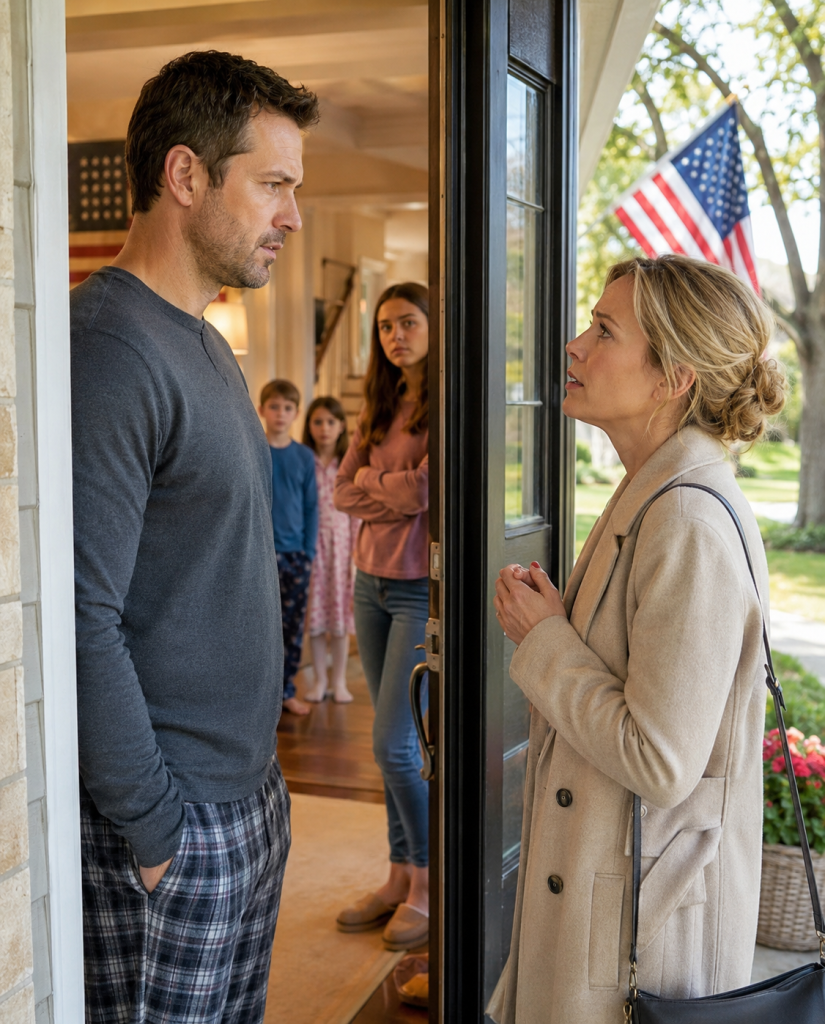
“You’ve got two minutes,” I said. Meredith looked older. Not dramatically. Just enough that I noticed. There were fine lines around her eyes that had not been there five years earlier, and the expensive coat she wore looked too large around her shoulders.
She glanced toward the house. Through the front window, I could see Lily helping one of the twins with homework.Rosa was clearing plates from the dining table.
My youngest daughter, Sophie, was sitting cross-legged on the floor with markers scattered around her. Meredith stared at them for several seconds.Then she whispered, “Calvin is coming after you.”
I laughed.
Not because it was funny.
Because after five years, that was somehow what she had brought to my doorstep.
“Your boyfriend is coming after me?”
“He’s not my boyfriend anymore.”
“Congratulations.”
“Ben, please.”
“You have ninety seconds.”
Her hands tightened.
“Calvin is under federal investigation.”
That made me stop.
“For what?”
“Fraud. Embezzlement. Tax evasion. I don’t know everything.”
I stared at her.
“And this concerns me how?”
“He used me.”
I almost smiled.
“That seems to be a recurring theme.”
She flinched.
I did not apologize.
“He put accounts in my name,” she continued. “Companies. Credit cards. Transfers. I signed things I didn’t understand because I trusted him.”
“And now?”
“Now he’s trying to make it look like some of the money came through you.”
My expression changed.
“What?”
“He still had copies of old financial documents from our divorce. Tax returns. Your Social Security number. Business records from when we were married.”
Cold moved through my chest.
“I never gave him permission to have any of that.”
“I know.”
“You did?”
She looked at the ground.
“At the beginning.”
Of course she had.
I folded my arms.
“What exactly did he do?”
“I found an account with your name connected to it.”
“What kind of account?”
“A consulting company.”
“I don’t own a consulting company.”
“I know.”
“What’s it called?”
“Bennett Family Management.”
My jaw tightened.
Our last name.
Our children’s last name.
“What did he use it for?”
“Money moved through it for almost three years.”
“How much?”
She looked sick.
“Almost six hundred thousand dollars.”
For one second, I forgot how to breathe.
Then I said, “You’re telling me your boss used my identity to move six hundred thousand dollars?”
“I’m telling you I think he did.”
“You think?”
“I found the records yesterday.”
“Where?”
“In his office.”
“You still work with him?”
“No. I left two weeks ago.”
“Why?”
She laughed bitterly.
“Because apparently leaving my family for him did not make me special enough to survive becoming inconvenient.”
That sentence might once have given me satisfaction.
It didn’t.
I was too busy thinking about my children.
My house.
My job.
My bank accounts.
“Why come here?”
“Because if the investigators trace it to you before you know, it could look terrible.”
“Why not go to the police?”
“I did.”
That surprised me.
She reached inside her handbag.
I immediately stepped back.
“What are you doing?”
“Getting a card.”
She pulled out a business card and held it toward me.
A federal investigator’s name.
Department of Justice.
I did not take it.
“Call that number yourself,” she said. “Don’t trust me. Verify everything.”
That was the first sensible thing she had said.
I took the card.
Behind us, the front door opened.
“Dad?”
I turned.
Lily stood in the doorway.
Fourteen now.
Almost as tall as Meredith.
She looked from me to her mother.
And froze.
Meredith’s face collapsed.
“Lily.”
My daughter took one step backward.
“No.”
Meredith’s eyes filled.
“Honey—”
“No.”
Lily turned and went inside.
The door slammed.
Meredith covered her mouth.
I felt something inside me harden all over again.
“That’s what you left,” I said quietly.
“I know.”
“No, you don’t.”
“I think about them every day.”
“You chose five years of not seeing them.”
“I know.”
“Birthdays.”
She closed her eyes.
“I know.”
“Broken arms. School plays. Sophie learning to read. Noah’s first home run. Ethan’s asthma attack. Lily’s middle-school graduation.”
She was crying now.
I continued anyway.
“You don’t get to stand on this porch and act like you lost them. You left them.”
“I know.”
For once, she did not defend herself.
That stopped me more than an excuse would have.
She wiped her face.
“I didn’t come here asking you to forgive me.”
“Good.”
“I came because Calvin is dangerous in a way I didn’t understand.”
I looked at the card.
“Dangerous how?”
“Not physically.”
She saw my expression.
“He destroys people financially. Professionally. He makes them look responsible for things he did.”
“Like you?”
She nodded.
“Like me.”
“And now me.”
“Yes.”
I looked toward the house.
Five children were inside.
Five lives I had spent five years protecting from instability.
I was not about to let Meredith bring another disaster through the door.
“You need to leave.”
“Ben—”
“I’ll call the number. I’ll get a lawyer. If what you’re saying is true, they can contact me.”
She nodded slowly.
“Okay.”
I started toward the door.
“Ben?”
I stopped but didn’t turn.
“Calvin knows where you live.”
I looked back.
“So do you.”
She flinched again.
“I deserved that.”
“Yes.”
Then she walked down the driveway.
I watched until her car disappeared.
Only then did I go inside.
Lily was waiting in the hallway.
She had her arms crossed.
The other children were gathered behind her.
Of course they had heard enough to know something was wrong.
Noah, twelve now, looked angry.
Ethan, ten, looked confused.
Grace and Sophie, both eight, looked frightened.
Rosa stood near the dining room.
She gave me the look that meant, You cannot pretend everything is normal.
So I didn’t.
“Sit down,” I said.
We went into the living room.
Lily did not sit.
“What did she want?”
“She came to warn me about something involving her old boss.”
“Calvin?”
I was surprised she remembered his name.
Then I remembered children remember the names attached to their worst days.
“Yes.”
“Is she coming back?”
“No.”
The answer came too fast.
Lily noticed.
“Ever?”
“I don’t know.”
“I don’t want her here.”
“That’s okay.”
Noah looked at me.
“Did she ask about us?”
I hesitated.
“Yes.”
“What did you say?”
“I told her she had missed a lot.”
He nodded.
Then he looked down.
That broke my heart more than anger would have.
The younger girls asked fewer questions.
They barely remembered Meredith.
Sophie’s strongest memory of her mother was a yellow scarf and the smell of vanilla perfume.
Grace remembered a bedtime song but couldn’t remember the words.
For them, Meredith was almost a story other people told.
Lily remembered everything.
That night, after the younger kids went to bed, she found me in the kitchen.
“You’re not letting her back, right?”
“No.”
“Promise.”
“Lily.”
“Promise me.”
I looked at her.
“You don’t have to be afraid that your life is going to change overnight because she showed up.”
“That’s not what I asked.”
“I know.”
She stared at me.
“I hate her.”
I leaned against the counter.
“You’re allowed to be angry.”
“I said I hate her.”
“I heard you.”
“She left us.”
“Yes.”
“She left you.”
“Yes.”
“And now she comes back because she needs something.”
“She came back with information that might protect us.”
“That doesn’t make her good.”
“No.”
Lily’s eyes filled.
“Then why did you listen?”
“Because protecting you sometimes means listening even to people I don’t trust.”
She looked away.
“That sounds like something a dad says when he’s going to make a terrible decision.”
Despite everything, I laughed.
She almost smiled.
Almost.
Then she whispered, “I don’t want another mom.”
“You don’t need another mom.”
“I have Rosa.”
From the laundry room, Rosa shouted, “I heard that.”
Lily smiled for real.
Rosa had been with us nearly four years.
She had started as a nanny.
By then, she was closer to family than most relatives.
I did not make her replace Meredith.
Neither did the kids.
She simply showed up long enough that love found its own name.
The next morning, I called the number on the card from my office.
Special Agent Daniel Brooks answered.
When I gave him my name, his tone changed.
“Mr. Bennett, we were planning to contact you.”
That was enough to make my stomach drop.
“Why?”
“We’d prefer to discuss that in person.”
“Am I under investigation?”
A pause.
“You are connected to financial activity we’re reviewing.”
“That isn’t an answer.”
“It’s the best answer I can give over the phone.”
I called an attorney immediately afterward.
Not a family lawyer.
A criminal-defense attorney recommended by a colleague.
Her name was Rebecca Shaw.
By noon, I was sitting in her office.
She read the information I had written down.
“Do not speak to federal investigators without me.”
“I haven’t done anything.”
“That’s excellent. Innocent people still need lawyers.”
She said it without drama.
That calmed me.
Two days later, Rebecca and I met with Agent Brooks and another investigator.
They showed me copies of company filings.
My name was there.
My old signature was there.
An address I hadn’t used in five years was there.
There were transfers.
Wire payments.
Loan documents.
Invoices bearing my name.
I stared at the pages.
“I’ve never seen any of this.”
Agent Brooks nodded.
“That is consistent with what Ms. Bennett told us.”
“Don’t call her that.”
He looked confused.
“My ex-wife is Meredith Cole now.”
“Understood.”
Rebecca asked, “What evidence connects my client beyond these documents?”
Agent Brooks explained that several forms had been submitted electronically from accounts controlled by Calvin Mercer’s company.
One IP address connected to his office.
Another to a remote server.
Not mine.
That helped.
But not enough.
“What was the company supposedly doing?” I asked.
“Consulting.”
“For what?”
“Procurement.”
“I work in municipal facilities.”
“We know.”
“Was that the reason he used me?”
“Possibly. Your background made the entity look legitimate.”
I felt sick.
Calvin had not merely stolen my identity.
He had selected it.
My career.
My credibility.
The stable man raising five children while he enjoyed the woman who abandoned us.
He had turned even that into something useful.
Rebecca asked about Meredith.
Agent Brooks was careful.
“She is cooperating.”
“Is she charged?”
“We can’t discuss charging decisions.”
I understood what that meant.
Maybe.
Maybe not.
When I returned home, there was a letter in the mailbox.
No return address.
Inside was a single page.
BEN,
I know Meredith came to see you.
She’s scared and making mistakes.
Don’t let her panic become your problem.
You have a good life now.
Five children.
A stable job.
A home.
Stay out of something that doesn’t concern you.
Calvin
I read it twice.
Then I called Rebecca.
“Do not touch it more than necessary,” she said.
“It’s paper.”
“It’s evidence.”
“What is he threatening?”
“He’s telling you he knows your life.”
“That feels like a threat.”
“It may be.”
“Should I be scared?”
“You should be careful.”
That evening, I installed new cameras.
Changed alarm codes.
Called the school and reminded them no one outside the approved pickup list could take the children.
I hated doing it.
Five years of rebuilding normal life.
And suddenly I was checking windows again.
Meredith called three days later.
I almost ignored it.
Then I answered.
“What?”
“Did Calvin contact you?”
“Yes.”
“How?”
“Letter.”
“Oh God.”
“I turned it over.”
“Good.”
“What does he want?”
“To scare you.”
“Why?”
“Because I gave them everything.”
Her voice shook.
“What is everything?”
“Bank records. Email archives. Files. Recordings.”
“You recorded him?”
“After I realized what was happening.”
“Why didn’t you leave earlier?”
Silence.
Then she said, “Because I was ashamed.”
I laughed bitterly.
“That stopped you?”
“I deserved that.”
“You keep saying that.”
“Because I keep deserving it.”
I sat on the edge of my desk.
“Why did you leave us, Meredith?”
The question escaped before I decided to ask it.
She went silent.
For five years, I had assumed I knew.
Calvin.
Excitement.
Money.
Freedom.
But I had never actually heard her explain.
“I was selfish.”
“That’s not an explanation.”
“I was drowning.”
“So was I.”
“I know.”
“No. Back then.”
“I know that now.”
I almost hung up.
Then she spoke quickly.
“Calvin made me feel like I was still a person.”
I said nothing.
“I had five kids before I was thirty. I was tired all the time. You were always working. Every conversation was schedules, bills, diapers, school.”
“That was our life.”
“I know.”
“He told me I was brilliant. Beautiful. That I had wasted myself.”
“And you believed him.”
“Yes.”
“Enough to leave your children?”
She started crying.
“Yes.”
I closed my eyes.
At least it was true.
Ugly.
But true.
“I thought they’d be better with you.”
“That was convenient.”
“Yes.”
“You could have visited.”
“I was ashamed.”
“You could have called.”
“I was ashamed.”
“Birthdays?”
“I was ashamed.”
“Christmas?”
“I was ashamed.”
“You keep using shame like it was a locked door.”
She breathed shakily.
“It became one.”
I said nothing.
Then she whispered, “I know that doesn’t excuse anything.”
“No.”
“I’m not asking it to.”
For the first time in five years, I heard something in her voice that was not manipulation.
Regret.
Not enough to repair anything.
But real.
The case against Calvin moved quickly after that.
His company had been shifting money through dozens of shell businesses.
Fake consulting invoices.
Inflated contracts.
Employees listed as vendors.
Former clients used as fronts without their knowledge.
Meredith was one of several people whose names appeared on accounts.
She had signed some documents knowingly.
Others had been altered.
Rebecca told me I was unlikely to face charges.
The forensic evidence supported identity misuse.
That should have been the ending.
It wasn’t.
Two weeks later, I came home and found Lily sitting on the porch.
She looked furious.
“What happened?”
She held up her phone.
“Mom messaged me.”
My stomach tightened.
“What did she say?”
“Hi, sweetheart. I know you probably don’t want to hear from me, but I hope someday we can talk.”
I clenched my jaw.
“She should not have contacted you directly.”
“I answered.”
My anger shifted instantly.
“What did you say?”
“I told her she ruined everything.”
I sat beside her.
“And?”
“She said I was right.”
That surprised both of us.
Lily stared across the yard.
“I wanted her to argue.”
“Why?”
“So I could hate her.”
I understood.
She wiped at her face angrily.
“She said she remembers my ninth birthday.”
“That was before she left.”
“I know.”
“She said I wore a purple dress.”
“You did.”
“She remembered.”
I looked at her.
“That doesn’t erase leaving.”
“I know.”
“She can have memories and still have made terrible choices.”
Lily’s voice cracked.
“What if I want to see her?”
There it was.
The question I had feared.
Not because I wanted to keep Meredith away.
Because I knew pain might walk back into my daughter’s life wearing her mother’s face.
“You’re allowed to want that.”
“You’re not mad?”
“No.”
“I thought you would be.”
“I’m not going to make you choose between loving me and being curious about her.”
“She hurt you.”
“Yes.”
“She hurt all of us.”
“Yes.”
“Then why aren’t you mad?”
“I am.”
She looked at me.
“Then?”
“Your relationship with your mother is not a reward I get to give or take away based on what she did to me.”
Lily cried then.
I pulled her against my shoulder.
For all her anger, she was still fourteen.
Still a daughter.
A week later, with a therapist’s recommendation, Lily met Meredith at a counselor’s office.
I did not attend.
Rosa drove her because Lily asked me not to.
When she returned, she went straight upstairs.
I waited.
Twenty minutes later, she came down.
“How was it?”
“Weird.”
“Good weird?”
“Bad weird.”
“Okay.”
Then she smiled faintly.
“Both.”
That became the pattern.
Slow.
Careful.
Supervised at first.
Meredith did not ask to see the younger kids immediately.
For once, she listened.
Noah refused completely.
“I don’t need her.”
I respected it.
Ethan asked questions but did not want contact.
Grace wanted to see photographs.
Sophie barely understood why everyone was upset.
We let each child move at their own pace.
Meredith did something I never expected.
She did not push.
Maybe five years had finally taught her that wanting access did not create entitlement.
The federal case ended the following year.
Calvin pleaded guilty to multiple financial crimes.
His company collapsed.
Assets were seized.
Several victims received restitution.
My name was formally cleared.
The fraudulent company connected to me was dissolved.
Meredith avoided prison, largely because she cooperated early and provided evidence that helped expose the larger scheme.
She did receive probation and financial penalties.
I had mixed feelings.
Part of me wanted consequences bigger than paperwork.
Then I remembered I already had what mattered.
My children.
My home.
My name.
Calvin had taken none of them.
Meredith’s reckoning was different.
She had to rebuild a relationship with children who remembered being abandoned.
No court could make that easy.
No plea agreement could shorten it.
Three years after she returned to my porch, Lily invited her to a school awards night.
Meredith sat three rows behind me.
She didn’t try to sit beside us.
When Lily’s name was called, both of us stood.
For half a second, our eyes met.
Then we looked at our daughter.
Afterward, Meredith approached me outside.
“Thank you.”
“For what?”
“For not turning them against me.”
I looked at her.
“I didn’t have to.”
She winced.
I softened.
“Life did enough explaining.”
She nodded.
“You’re right.”
Then she surprised me.
“I used to think you were the reason I disappeared.”
I frowned.
“What?”
“I told myself you were boring. Controlling. Married to work.”
“Nice.”
“I know.”
She looked ashamed.
“Calvin helped me build that story. But I wanted it too. Because if you were the problem, then leaving made me brave.”
“And now?”
“Now I think leaving made me selfish.”
I studied her.
“That sounds closer.”
She almost smiled.
“I’m not asking forgiveness.”
“That’s good.”
“I’m asking whether someday you might stop hating me.”
I thought about it.
“I don’t hate you.”
Her eyes filled.
“You don’t?”
“No.”
“What do you feel?”
I looked through the school doors where our children were laughing.
“Distance.”
She nodded slowly.
“I can live with that.”
“You don’t get to choose.”
That made her smile sadly.
“No. I guess I don’t.”
Today, five years after Meredith came back, our lives look nothing like they did when she left.
Lily is nineteen and in college.
She sees her mother occasionally.
Their relationship is complicated but real.
Noah is seventeen and still keeps his distance.
Ethan is fifteen and recently agreed to have lunch with Meredith for the first time.
Grace and Sophie know her better now, but Rosa remains the woman they call when they are sick, scared, or need advice.
I never asked them to define any of it.
Families are messy enough without forcing labels.
Rosa still works with us, though the children joke that she is now “management.”
She tells them she deserves stock options.
I tell her she probably does.
As for me, I learned something I wish I had understood the night Meredith left.
Someone abandoning you does not mean you were not enough.
Sometimes people run from good lives because good lives require responsibility.
Sometimes they mistake excitement for freedom.
Attention for love.
Escape for courage.
I spent years believing Meredith chose Calvin because he was better than me.
He wasn’t.
He was simply offering a door out when she wanted one.
And five years later, she came back to warn me because the man she once believed represented freedom had become another prison.
I did listen.
Not because she deserved my trust.
Because my children deserved my judgment.
That distinction saved us.
The night she returned, she told me:
“You must listen to what I’m about to say, or you’ll regret it.”
She was right.
But not in the way she thought.
If I had refused to listen simply because I hated the messenger, Calvin might have succeeded in dragging my name into his crimes.
Listening did not mean forgiving.
Protecting my children did not mean welcoming Meredith home.
And allowing my daughter to know her mother did not mean pretending five lost years had never happened.
We did not become a family again.
We became something more honest.
People connected by history.
Some by love.
Some by regret.
Some by choices that could never be undone.
And I stopped waiting for life to put everything back where it had been.
Because the truth is, after someone walks away, you do not rebuild the old house.
You build differently.
Stronger walls.
Better doors.
And you become much more careful about who gets a key.
THE END