
“I’m sending a private ambulance,” Cassandra said. “Not one connected to that hospital.” I stared at the locked door. “How?” “I have contacts. But Stella, listen carefully. If there is any immediate threat to your life, call emergency services yourself. Do not try to be brave.”
“I can barely sit up.” “Then don’t. Preserve evidence. Stay awake if you can. Keep that phone hidden.”
I looked at Ivy.
She was pale.
“Can you help me?”
For a moment, she said nothing.
Then she nodded.
“Yes.”
Cassandra heard her.
“Nurse Monroe?”
Ivy moved closer to the phone.
“Yes.”
“Do you understand the seriousness of what Mrs. Taylor is alleging?”
“Yes.”
“Then I need you to document exactly what you personally observed. Nothing you heard secondhand. Nothing you guessed. Only what you saw.”
Ivy swallowed.
“I saw her stable before the second procedure. I saw a consent form appear afterward that had not been in the chart before.”
My skin went cold.
“Afterward?”
“Yes.”
Cassandra’s voice sharpened.
“Can you access the timestamp?”
Ivy looked toward the door.
“I think so.”
“Do it only if you’re authorized to access that record. Do not break policy or alter anything.”
Ivy nodded even though Cassandra couldn’t see her.
“I understand.”
There was a sound in the hallway.
Footsteps.
Ivy immediately slipped my hidden phone beneath the blanket.
“Someone’s coming.”
The lock clicked.
Blake entered.
Behind him was Dr. Lancaster.
And a third man carrying a leather briefcase.
The notary.
Blake smiled.
“There she is.”
I looked at the clock.
11:42 a.m.
Barely four hours after they had taken something from me I could never get back.
The notary arranged papers on the rolling table.
“I understand Mrs. Taylor is capable of signing?”
Dr. Lancaster answered before I could.
“She is recovering normally.”
I stared at him.
“You told Blake my uterus could be preserved.”
The doctor did not meet my eyes.
“Mrs. Taylor, emergency conditions change surgical decisions.”
“You said there was no emergency before they took me back.”
Blake stepped between us.
“Stella, this isn’t the time.”
“What am I signing?”
He smiled patiently.
“Nothing complicated.”
The notary slid the first document toward me.
I read the title.
AMENDMENT TO MANAGEMENT AUTHORITY.
My head began to pound.
“Management of what?”
“Our family assets.”
“My assets.”
“Our marriage is a partnership.”
“Then why does the document give you sole authority?”
Blake’s expression hardened.
“You’re in no condition to handle business matters.”
The notary looked uncomfortable.
“Perhaps we should postpone.”
“No,” Blake said immediately.
I looked at the notary.
“What is your name?”
“Mr. Caldwell.”
“Mr. Caldwell, are you willing to notarize my signature while I am hospitalized after anesthesia?”
He hesitated.
Blake answered for him.
“My wife is lucid.”
I looked directly at Caldwell.
“I am telling you I do not consent to signing anything.”
That changed the room.
Caldwell slowly closed his pen.
“In that case, I cannot proceed.”
Blake’s jaw clenched.
“You were told this had been agreed upon.”
“I was told Mrs. Taylor requested document execution.”
“I did not.”
Caldwell packed his papers.
Blake grabbed his arm.
“Wait.”
Caldwell looked down at the hand.
“Mr. Taylor.”
Blake released him.
The notary left without another word.
The moment the door closed, Blake turned toward me.
“What did you do?”
“I said no.”
“You don’t understand what you’re jeopardizing.”
“I understand exactly.”
He looked at Ivy.
“Leave us.”
She hesitated.
“I need to check Mrs. Taylor’s vitals.”
“Now.”
Ivy looked at me.
Then left.
Dr. Lancaster started to follow.
Blake stopped him.
“You stay.”
I realized then that the doctor was afraid of my husband too.
Not innocent.
But afraid.
Blake pulled a chair beside my bed.
His voice became soft.
“You’re making this harder than it needs to be.”
“You removed an organ from my body without permission.”
“You keep saying that as though I personally operated.”
“You ordered it.”
“You heard fragments while sedated.”
“I heard enough.”
He leaned closer.
“No court is going to believe a drugged patient over a surgeon, anesthesiologist, and hospital record.”
I looked at Dr. Lancaster.
“Is that what you think too?”
The doctor stared at the floor.
Blake answered.
“He knows what happened medically.”
“Then let him say it.”
Dr. Lancaster finally looked at me.
“There was bleeding.”
“How much?”
He didn’t answer.
“What were my vitals?”
Silence.
“What was my hemoglobin?”
Blake stood.
“This is absurd.”
“No. It’s specific.”
I kept my eyes on Lancaster.
“If I was hemorrhaging badly enough to require an emergency hysterectomy, what was the estimated blood loss?”
The doctor’s face tightened.
Blake said, “You don’t get to interrogate him.”
I smiled faintly.
“You already wrote the answers, didn’t you?”
That was when I knew.
They had altered the chart.
And they were afraid I knew enough medical language to expose the inconsistencies.
Blake stared at me for several seconds.
Then his expression changed.
Not anger.
Decision.
He looked at Lancaster.
“Give her something for pain.”
“I don’t want anything.”
“You’re clearly distressed.”
“I said no.”
Lancaster hesitated.
Blake’s voice dropped.
“Doctor.”
The doctor moved toward the medication cart.
I reached under the blanket and pressed the emergency call icon on my hidden phone.
Cassandra had told me to do one thing if I felt unsafe.
Call.
I did.
Ivy entered before Lancaster reached my IV.
Behind her were two hospital security officers.
And another woman wearing a visitor badge.
Cassandra.
I almost cried when I saw her.
She didn’t rush toward me dramatically.
She walked in like a person who expected to be obeyed.
“My client has expressly declined further medication,” she said.
Blake went rigid.
“How did you get in here?”
Cassandra held up a visitor authorization.
“The better question is why your wife’s room was locked from the outside.”
Security looked at Blake.
He pointed toward the door.
“That was for privacy.”
One guard frowned.
“Patient rooms aren’t supposed to be locked externally.”
Blake looked at Ivy.
She said nothing.
Cassandra came to my bedside.
“Stella, do you want me here?”
“Yes.”
“Do you want your husband here?”
“No.”
Blake laughed.
“This is my wife.”
Cassandra turned to security.
“My client has asked him to leave.”
The older guard stepped forward.
“Sir.”
Blake stared at me.
“You’re making a very serious mistake.”
Cassandra answered.
“No. She’s documenting one.”
He looked at Lancaster.
Then at Ivy.
Then at me.
Finally, he walked out.
Dr. Lancaster followed.
Cassandra waited until the hallway was clear.
Then she took my hand.
“You did well.”
My composure broke.
“I heard him.”
“I know.”
“They did it anyway.”
“I know.”
“I can’t have children.”
Cassandra’s eyes filled, but her voice remained controlled.
“I’m so sorry.”
For several minutes I could not speak.
I had been holding everything inside because Blake was waiting for me to become hysterical.
He wanted tears.
He wanted panic.
He wanted a woman who could be described as unstable.
So I had swallowed grief until Cassandra walked into the room.
Then it came out.
Not dramatically.
Just quiet sobs that hurt my incision every time my abdomen tightened.
Ivy stood near the wall crying too.
Eventually, Cassandra said, “We’re moving you.”
“Where?”
“Another hospital.”
“Can they stop us?”
“Not if you are medically stable for transfer and you request it.”
“They’ll say I’m not.”
“I already arranged an independent physician consultation.”
I looked at her.
“When?”
“On the way here.”
That was Cassandra.
She never entered a fire without checking where the exits were.
A physician from another facility arrived within an hour.
Dr. Samuel Green.
He reviewed the available records, examined me, and asked questions directly to me.
Not Blake.
Not Lancaster.
Me.
“Mrs. Taylor, do you wish to transfer?”
“Yes.”
“Do you understand that transfer has risks following surgery?”
“Yes.”
“Do you still want to go?”
“Yes.”
He nodded.
“Then we’ll proceed if your vital signs remain stable.”
The first hospital resisted.
Administrators appeared.
A risk-management attorney appeared.
Dr. Lancaster suddenly insisted I was too medically fragile to move.
Cassandra asked him to put that opinion in writing with supporting clinical data.
He stopped arguing.
By three in the afternoon, I was in a private ambulance heading across town.
I kept expecting Blake to stop us.
He didn’t.
He had already realized he had a bigger problem.
My medical record had been copied.
Not all of it.
Enough.
Ivy had printed the original pre-op note showing I was stable with no active hemorrhage.
She had also preserved a screenshot of the electronic audit log showing when the “emergency hemorrhage” note had been entered.
Forty-seven minutes after my surgery ended.
The consent form authorizing hysterectomy showed an even later timestamp.
An hour and twelve minutes after the procedure.
My forged permission had been created after they had already removed my uterus.
At the second hospital, a new gynecologic surgeon examined me.
Dr. Lena Park.
She was careful not to make accusations.
Doctors rarely criticize another physician before reviewing every record.
But when she read the operative summary, her forehead tightened.
“Mrs. Taylor, do you remember signing consent for hysterectomy?”
“No.”
“Do you remember anyone explaining that possibility before surgery?”
“Only as an emergency risk. Dr. Lancaster specifically told me there was no planned hysterectomy.”
She nodded.
“Do you have that in writing?”
“My consultation notes should say fertility preservation was the goal.”
“They do.”
I closed my eyes.
For the first time all day, someone had said something that made the room feel solid again.
The next morning, Cassandra brought a second attorney.
Her name was Elena Ruiz.
Medical malpractice.
Patient-rights litigation.
She sat beside my bed with three binders.
“I’m going to say this clearly,” Elena told me. “What happened to you may involve multiple areas of law. Medical negligence. Lack of informed consent. Potential falsification of records. Possibly criminal conduct. We will not assume facts before the evidence is complete.”
I nodded.
“What do you need from me?”
“The truth. Repeated the same way every time.”
“I can do that.”
“And patience.”
That was harder.
“What about Blake?”
Cassandra opened her laptop.
“That brings us to the financial side.”
She turned the screen toward me.
For six months before surgery, I had suspected Blake was moving money through Taylor Enterprises.
My father founded the company before I was born.
Industrial equipment distribution.
Three warehouses.
Nearly two hundred employees.
When Dad died, he left controlling shares to me.
But I had been grieving.
Trying to become pregnant.
Running charitable projects.
Blake gradually took over management.
He liked saying business stressed me.
I liked believing marriage meant I could trust him.
Cassandra had quietly hired forensic accountants two months earlier at my request.
They had found irregular payments.
Consulting contracts.
Loans to shell companies.
Large transfers labeled “strategic development.”
One of those companies was called BRS Holdings.
“What does BRS stand for?” I asked.
Cassandra looked at me.
“Blake Raymond Shaw.”
My husband’s full name.
I almost laughed.
“He named the shell company after himself?”
“Arrogance sometimes helps investigators.”
“How much?”
“So far?”
She hesitated.
“Just over $3.8 million.”
The room went quiet.
I stared at the screen.
“He stole almost four million dollars?”
“We believe funds were improperly diverted. We are still tracing them.”
“Where did they go?”
“Real estate. Investment accounts. Luxury purchases.”
“And the mistress?”
Cassandra looked toward Elena.
Then back at me.
“Her name is Camille Ross.”
I knew her.
Of course I did.
She worked in corporate communications for one of Blake’s partner firms.
Thirty-four.
Polished.
Always warm to me at charity dinners.
Once she had touched my arm and told me how inspiring my fertility journey was.
My stomach turned.
“How long?”
“Based on messages we recovered through lawful discovery from company devices, at least eighteen months.”
I looked toward the hospital window.
Eighteen months.
During my second miscarriage.
During IVF.
During the anniversary trip where Blake toasted “the family we’re still building.”
Elena spoke softly.
“Stella?”
“I’m fine.”
Cassandra gave me a look.
“No, you’re not.”
I swallowed.
“No. I’m not.”
That afternoon, Blake arrived at the second hospital.
He was not allowed upstairs.
Cassandra met him in the lobby.
He demanded to see me.
I refused.
Then Camille arrived.
That part I did not expect.
I was sitting up in bed trying to eat soup when Ivy—who had come to visit after her shift—looked through the hallway window and froze.
“She’s here.”
“Who?”
“The pregnant woman.”
My spoon stopped.
“What pregnant woman?”
Ivy looked horrified.
“I thought you knew.”
“Knew what?”
Before she could answer, a nurse entered.
“Mrs. Taylor, there’s a woman downstairs asking to see you. Camille Ross.”
My hand began shaking.
“Is she pregnant?”
The nurse hesitated.
“I don’t know.”
Ivy whispered, “She is.”
I stared at her.
“How do you know?”
“She came to the first hospital yesterday. I saw her in the board office.”
“Before my surgery?”
“After. Around noon.”
I looked at Cassandra, who had just returned.
“Bring her up.”
“No,” Cassandra said.
“I need to see her.”
“Why?”
“Because Blake thinks I’m still weak enough to be controlled by surprises.”
Cassandra studied me.
“Do not discuss legal strategy.”
“I won’t.”
“And I’m staying.”
“Fine.”
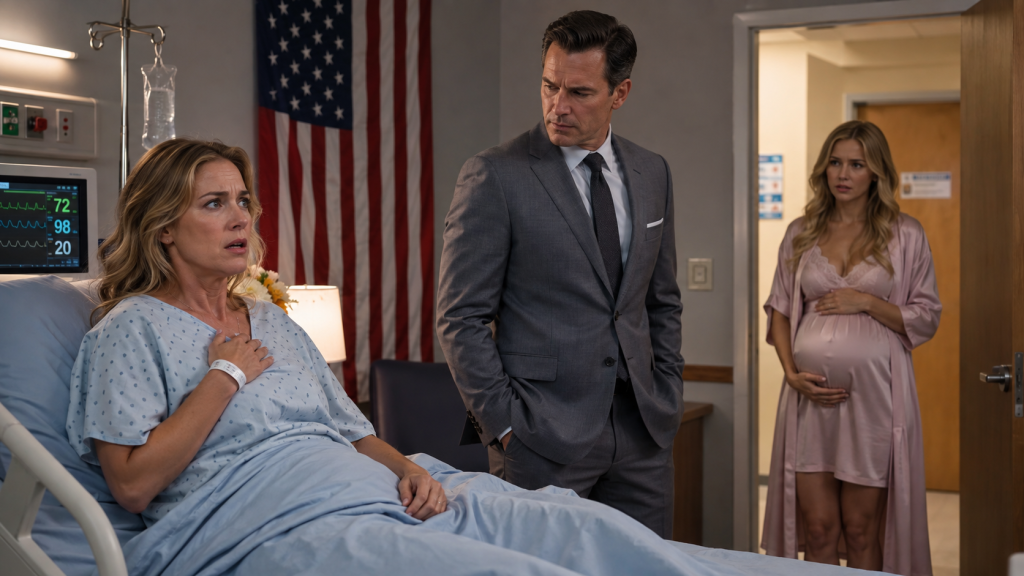
Camille entered ten minutes later.
She wore a pale green dress under a beige coat.
Her belly was unmistakable.
Five months, maybe six.
She stopped near the door.
I looked at her stomach.
Then at her face.
“Congratulations.”
She looked ashamed.
“I’m sorry.”
“No, you aren’t.”
She flinched.
Cassandra remained silent near the window.
Camille placed one hand protectively over her belly.
“Blake said you knew.”
I laughed.
“He told you I knew about you?”
“He said your marriage had been over emotionally for years.”
“Interesting.”
“He said you stayed together for the company.”
“Did he also tell you we were undergoing fertility treatment?”
She looked down.
“He said that was for appearances.”
For appearances.
Two miscarriages.
Hormone injections.
Surgeries.
Hope.
Apparently all public relations.
I felt anger rise.
Then something else replaced it.
Clarity.
“Why are you here?”
Camille swallowed.
“Blake told me what happened.”
“What version?”
“That you had emergency surgery.”
“Try again.”
She looked at Cassandra.
“I don’t want lawyers involved.”
Cassandra almost smiled.
“That ship left port before breakfast.”
Camille looked back at me.
“Blake said the doctors found something worse than the fibroid.”
“Did he?”
“He said you can’t have children now.”
I said nothing.
She touched her belly.
“Then he said this baby would be his only heir.”
There it was.
The sentence that told me exactly how Blake saw people.
Not as family.
Assets.
Functions.
Inheritance.
Control.
“My father’s company,” I said slowly.
Camille frowned.
“What?”
“Blake wants your child to inherit Taylor Enterprises.”
Her face changed.
“He said the company would be ours someday.”
“Ours?”
“He said once the divorce was final—”
I laughed.
“You thought he was divorcing me?”
“Yes.”
“Did he file?”
She hesitated.
“I assumed.”
“He didn’t.”
Her face went pale.
“What?”
“He was trying to make me financially incompetent.”
Camille stared.
I continued.
“He had medical notes altered before this surgery describing me as confused and psychiatrically unstable.”
“That’s not true.”
“I know.”
“No, I mean—he told me you were already under psychiatric treatment.”
“He lied.”
Her hand moved away from her belly.
Cassandra watched her carefully.
Camille whispered, “He told me the doctors recommended guardianship.”
I looked at Cassandra.
That word changed everything.
“Guardianship?”
Camille nodded.
“He said after surgery you would need someone to manage your estate.”
My skin went cold.
Cassandra stepped forward.
“What exactly did Blake say?”
Camille shook her head.
“I shouldn’t be here.”
“Yes,” Cassandra said. “You should.”
Camille backed toward the door.
“I need to go.”
I spoke before she could leave.
“Was he planning to have me declared incompetent?”
She stopped.
Her shoulders began to shake.
Then she whispered, “Yes.”
That was when the surgery stopped being the worst thing he had planned.
He had not only wanted to end my ability to have a child.
He wanted to turn the aftermath into proof that I could no longer control my company.
The false psychiatric notes.
The hysterectomy.
The medication.
The notary.
The management authority document.
It all fit.
Cassandra asked Camille to sit.
She refused.
“I can’t.”
“You may need your own lawyer,” Cassandra said.
Camille started crying.
“I thought he loved me.”
I stared at her.
There are moments when life becomes too absurd for jealousy.
I almost felt sorry for her.
Almost.
“What did he promise you?”
“A house.”
“Where?”
“Westlake.”
“Bought through BRS Holdings?”
Her head snapped up.
“How do you know that name?”
Cassandra answered.
“We know quite a lot.”
Camille sat down.
Over the next twenty minutes, she told us enough to reshape the entire case.
Blake had been preparing a petition for temporary guardianship.
He planned to use my “mental deterioration,” alleged depression after infertility, and supposed postoperative confusion as evidence.
Once appointed guardian or financial conservator, he could exercise control over trust voting rights and company decisions.
He also intended to argue that my inability to have children made the existing succession plan “obsolete.”
My father’s trust specified that if I died without descendants, certain voting shares transferred to a charitable foundation rather than automatically to my spouse.
Blake hated that clause.
But if I had a child, the shares could ultimately pass to that child.
Camille’s baby was not legally mine.
Obviously.
But Blake had apparently been researching adoption structures, marital presumptions, and trust amendments.
He thought if I became legally incapacitated, he could reshape everything.
Not easily.
Maybe not successfully.
But he was trying.
The baby was part of a succession strategy.
Camille realized it at the same time I did.
“He doesn’t love either of us,” she whispered.
I looked at her.
“No.”
That night, she hired her own attorney.
The secret recording surfaced three days later.
Ivy called Cassandra.
“There’s something you need.”
She sounded terrified.
During my original pre-op period, Ivy had left her phone recording inside the medication room because she had been documenting repeated staffing complaints for her union representative.
She had forgotten to stop it.
The audio captured voices from the adjoining physician workroom.
Blake.
Lancaster.
The anesthesiologist.
And later, the hospital administrator.
It was not a dramatic movie-quality confession.
Mostly muffled conversation.
But enough was clear.
Blake saying:
“Once she’s medically dependent, we move on the competency filing.”
Lancaster asking:
“And if pathology shows nothing?”
Blake replying:
“Then the hemorrhage is the justification.”
The administrator asking:
“Are you absolutely sure the board won’t get dragged into this?”
Blake answering:
“I am the board.”
And then the sentence that changed the investigation from a malpractice dispute into something far darker:
“After the guardianship goes through, she won’t control anything—not the company, not the trust, not even which doctors she sees.”
Cassandra played it twice.
I sat in silence.
Finally, I said, “He wanted to own me.”
Elena shook her head.
“No.”
I looked at her.
“He wanted to legally erase your ability to say no.”
That was worse.
We turned everything over to investigators.
From that point forward, the story stopped belonging only to me.
Hospital regulators became involved.
Law enforcement.
The medical board.
The company’s independent directors.
Blake’s world began collapsing quietly.
First, Taylor Enterprises suspended his management authority.
Then a judge issued temporary orders preventing him from accessing my personal trusts and certain accounts.
The hospital placed Lancaster on administrative leave.
The anesthesiologist resigned before he could be suspended.
The administrator hired a criminal lawyer.
Blake continued insisting it was all a misunderstanding.
He sent me flowers.
I refused them.
He sent letters.
Cassandra kept them.
Then he sent an email.
Stella, everything I did was because I knew you were destroying yourself chasing a pregnancy that was never going to happen. I saved you from more pain.
I read it once.
Then forwarded it.
People who believe they are entitled to control you often document the entitlement themselves.
My recovery took months.
Physically, I healed.
Emotionally, I did not know what healing meant anymore.
I had lost my uterus.
My marriage.
The future I had imagined.
But I had not lost myself.
That became important.
I moved into my father’s old guesthouse on the family property while the divorce proceeded.
For the first time in years, Blake did not know where I slept.
Cassandra helped restructure company authority.
A professional management team took over.
I joined board meetings by video until I was strong enough to return in person.
The first day I walked back into Taylor Enterprises headquarters, the receptionist cried.
So did I.
My father’s photograph still hung in the lobby.
Underneath was a brass plaque:
A COMPANY IS ONLY AS STRONG AS THE TRUST PEOPLE PLACE IN IT.
I stood beneath those words for a long time.
I had failed to understand them in my marriage.
I understood them now.
The divorce was ugly.
Blake fought for money.
He claimed he had been instrumental in growing the company.
He minimized the affair.
He denied coercion.
He blamed physicians for the surgery.
Then the financial records surfaced.
BRS Holdings had received millions.
The Westlake property promised to Camille had been purchased partly with money diverted from Taylor Enterprises.
Luxury trips had been billed as business development.
One payment to Lancaster came through a consulting entity shortly before my surgery.
Blake’s attorney stopped using the phrase “coincidence.”
The hospital settled the civil claims without requiring me to remain silent.
That mattered.
I would not accept money in exchange for pretending nothing happened.
Lancaster lost his medical license after the professional board concluded he had violated informed-consent standards and falsified documentation.
Other consequences followed through the courts.
I will not pretend every bad person received a perfect punishment.
Real justice is slower and less poetic than people want.
But the evidence held.
Blake eventually faced multiple charges unrelated to infidelity and very much related to fraud, conspiracy, document falsification, and financial misconduct.
The secret recording became only one part of a much larger case.
Camille cooperated.
She gave birth to a healthy baby boy.
I did not meet him.
I did not need to.
He was innocent.
That was important too.
Blake had talked about him as “the heir.”
But a baby is not an inheritance strategy.
A baby is a human being.
Camille eventually moved away from Texas.
Before she left, she wrote me a letter.
I almost threw it away.
Instead, I read it.
She apologized.
Not perfectly.
She admitted she had known I existed.
She had chosen to believe Blake when he described me as cold, unstable, and obsessed.
She wrote:
I wanted the story where I was the woman he truly loved, so I ignored every piece of evidence that made that story impossible.
I understood that sentence more than I wanted to.
For years, I had wanted the story where Blake was the husband who loved me.
I had ignored things too.
Different things.
But still.
I did not forgive Camille immediately.
I did eventually stop carrying anger toward her.
Blake was harder.
The final time I saw him was during a court hearing almost two years after the surgery.
He looked smaller.
Not physically.
Power had left him.
That changes how a person occupies a room.
He looked at me while attorneys argued over restitution.
For the first time since we met, he had no authority over my money.
My medical care.
My house.
My company.
My body.
During a recess, he approached.
A deputy stood nearby.
“Stella.”
I kept walking.
“Please.”
I stopped.
Not because I owed him anything.
Because I wanted to know whether hearing his voice still frightened me.
It didn’t.
He looked at me.
“I loved you once.”
I almost laughed.
“No.”
His eyes tightened.
“You don’t know what I felt.”
“You loved what access to me gave you.”
“That’s not fair.”
“You removed my ability to have children.”
“I didn’t perform the surgery.”
“You arranged it.”
He looked away.
“I thought you would eventually understand.”
“That is the frightening part.”
“What?”
“You still believe understanding you would make what you did acceptable.”
He said nothing.
I continued.
“You didn’t want a wife.”
“I did.”
“No. You wanted authority.”
His face hardened.
“You think Cassandra didn’t manipulate you?”
There he was.
The old Blake.
The one who could not imagine a woman making decisions without someone else controlling her.
I smiled.
“She works for me.”
He flinched.
I turned away.
“Stella.”
I looked back.
“What?”
“I’m sorry.”
I studied him.
Maybe he meant it.
Maybe he was sorry for losing everything.
Maybe he was sorry I survived his plan with my legal identity intact.
It no longer mattered.
“I hope someday you understand what those words require.”
Then I walked away.
Three years have passed.
I am forty-one now.
I never became a biological mother.
That grief did not disappear simply because I won court cases.
There are mornings when I still wake from dreams where I am pregnant.
Sometimes I walk past children’s clothing in stores and feel something inside me ache.
Healing does not demand dishonesty.
I can be grateful to be alive and still mourn what was taken.
Both can be true.
I eventually created a foundation through Taylor Enterprises focused on patient advocacy and medical informed consent.
Not because every bad outcome is wrongdoing.
Medicine is complicated.
Emergencies happen.
Doctors sometimes have to make impossible decisions.
But patients deserve to know their rights.
And hospitals should never become private kingdoms for powerful people.
Ivy became the foundation’s first patient-safety liaison.
She almost refused.
“I’m just a nurse,” she said.
I looked at her.
“You were the only person in that hospital who treated my voice like it mattered.”
She cried.
So did I.
Cassandra still represents me.
She claims I am her most exhausting client.
I tell her she charges enough to recover.
My company is stronger now.
Smaller executive perks.
More independent oversight.
Every trust document has been reviewed.
Every password is mine.
Every signature is mine.
No one places yellow arrows where I should sign without first explaining every page.
My father would approve.
There is one thing I kept from the hospital.
My original wristband.
STELLA TAYLOR.
Date of birth.
Patient number.
At first, I kept it because Cassandra said it was evidence.
Later, when the case ended, I almost threw it away.
Instead, I placed it in a small frame inside my home office.
People sometimes think that is strange.
To me, it means something simple.
On the day Blake tried to reduce me to a diagnosis, a forged signature, a body he could alter, and an estate he could control, that little plastic band still carried my name.
Mine.
Not his.
Mine.
The surgery changed my body.
The betrayal changed my marriage.
The investigation changed my company.
But none of them got to change the most important fact.
My life still belonged to me.
And when Blake told me I had no proof, he made the same mistake controlling people always make.
He assumed silence meant helplessness.
He assumed sedation meant ignorance.
He assumed money meant loyalty.
He assumed power meant permanence.
He was wrong on every count.
Because while he was planning how to erase my choices, a nurse remembered what she saw.
A computer remembered its timestamps.
A recording remembered his voice.
Bank records remembered where the money went.
And I remembered the sentence he whispered while I was helpless beneath hospital lights:
“This is what’s best for everyone.”
Years later, I finally understood what “everyone” meant.
Blake.
His mistress.
His money.
His future.
Everyone except me.
So I built a new future around the person he had forgotten to include.
Myself.
And for the first time in my life, that was enough.
THE END! THANKS FOR READING!