
My daughter-in-law announced that her parents were moving into the guest house on my nine-acre Montana property because, according to her, “At your age, you don’t need this much land anyway.”
She never asked.
She simply informed me.
Worse, my son had apparently already given her parents permission without discussing it with me.
I didn’t argue.
Instead, I bought three heavy-duty padlocks, changed a couple of financial arrangements, and made one very inconvenient adjustment to the only road leading to the pasture where they intended to park their RV.
It started one quiet morning while I was drinking coffee on the porch of my Montana cabin.
The sun was just beginning to rise over the ridge, turning the tops of the ponderosa pines gold.
Clare sat across from me with one leg crossed over the other, scrolling through her phone as though we were discussing grocery lists.
“My parents are arriving on the fifteenth,” she said casually. “They’ll use the guest house.”
I slowly lowered my mug.
“Who invited them to live here?”
She sighed as though I were the unreasonable one.
“Evelyn, please. You’re making this unnecessarily difficult.”
I looked past her toward the property I had purchased after thirty-seven years as a surgical nurse.
Nine acres of pine trees, open pasture, and mountain views.
A workshop I had built.
A guest cottage I had restored.
A vegetable garden that took me three summers to get right.
And the peaceful retirement I had worked nearly four decades to afford.
The guest cottage wasn’t large.
It had one bedroom, a small kitchen, a bathroom, and a porch overlooking the lower pasture.
I had renovated it mostly for friends who visited during summer.
Caleb and Clare had stayed there several times.
Apparently, repeated invitations had somehow convinced Clare that temporary hospitality meant permanent family access.
“My parents sold their place,” Clare continued. “They need somewhere while they figure things out.”
“You didn’t mention that before.”
“Well, now you know.”
“How long?”
“Six months, probably.”
Probably.
That word told me everything I needed to know.
“Where are they moving after six months?”
She shrugged.
“They haven’t decided yet.”
“So they sold their home without knowing where they were going.”
“They wanted flexibility.”
I almost laughed.
Instead, I picked up my coffee.
“And you decided their flexibility should happen on my property.”
Clare’s mouth tightened.
“There’s plenty of room.”
“That isn’t the point.”
“What point?”
“That it’s mine.”
She stared at me.
I had known Clare for almost eight years.
She was intelligent, organized, ambitious, and capable of being perfectly pleasant when things were going the way she wanted.
But she had a habit I had noticed early in Caleb’s marriage.
She presented decisions as completed facts.
Dinner reservations.
Holiday plans.
Vacation dates.
Which relatives would host Thanksgiving.
What everyone was expected to contribute.
If you objected after the announcement, you became the difficult one.
For years, I had avoided unnecessary conflict.
I figured married adults should manage their own lives.
But there is a considerable difference between choosing where Christmas dinner happens and deciding who gets to live on someone else’s property.
Two days later, Caleb called.
“Mom, it’s only temporary. Six months at most.”
“Did you tell Clare her parents could move onto my property before anyone asked me?”
Silence.
That told me everything.
“Caleb?”
He exhaled.
“She brought it up a couple weeks ago.”
“And?”
“I said I didn’t think you’d mind.”
“That isn’t the same as asking me.”
“I know.”
“Did you tell her yes?”
Another silence.
“Sort of.”
I closed my eyes.
My son was thirty-four years old.
He had inherited his father’s tendency to avoid confrontation until avoiding it became more painful than confronting it would have been.
When Caleb was twelve, he once spent three weeks hiding a broken bedroom window behind a poster rather than tell me a baseball had gone through it.
Apparently, some habits survive adulthood.
“We’ll come Saturday and get the guest house ready,” he finally said.
“Fine.”
But I had a different definition of ready.
The next morning, I drove into town.
I purchased three industrial padlocks, heavy steel chain, a reinforced deadbolt, and two security cameras.
Then I went home.
By noon, the guest cottage was locked.
The workshop was locked.
The small utility shed beside the pasture was locked.
Apparently, Clare had confused my kindness with permission.
That needed correcting.
On Friday afternoon, a delivery truck pulled into my driveway.
The driver climbed out carrying a clipboard.
“Queen mattress for Clare Harper. I’m supposed to put it in the guest house.”
“You can take it back.”
He looked confused.
“Wrong address?”
“No. Wrong permission.”
He glanced at the cottage.
Then back at me.
“You sure?”
“Completely.”
The mattress left on the same truck.
Clare called less than thirty minutes later.
“That mattress was for my parents!”
“Then send it to the house where they’ll actually be living.”
“They are living there!”
“No, Clare. You decided they were living there.”
“Caleb said it was fine.”
“Caleb does not own my property.”
She went quiet.
Then came the sentence that probably ended any remaining chance of me being diplomatic.
“You’re being selfish.”
I looked through the kitchen window at nine acres I had paid for with decades of overnight shifts, emergency surgeries, missed holidays, aching feet, and more weekends in an operating room than I could count.
“Then I’m comfortable being selfish.”
She hung up.
Saturday morning, Clare and Caleb arrived at ten.
Clare marched toward the guest cottage before stopping at the sight of the chain across the front door.
She tried the handle anyway.
“Where’s the key?”
“With me.”
“Give it to me.”
“No.”
Her expression hardened.
“My parents are coming next week.”
“You told me they were coming. You never asked whether they could stay.”
She turned toward my son.
“Caleb, tell your mother to unlock this.”
He looked uncomfortable.
“Mom, maybe we can just—”
“No.”
One word.
Nothing dramatic.
But it finally made something clear.
My property wasn’t a family committee decision.
Clare stared at me.
“You’re seriously going to make elderly people scramble for housing?”
Her parents were sixty-one and sixty-four.
Healthy.
Recently retired.
And apparently wealthy enough to buy a large travel trailer on short notice.
I raised an eyebrow.
“They have a week.”
“This is unbelievable.”
“No. What’s unbelievable is assuming you can move people into someone else’s home without asking.”
Caleb rubbed his forehead.
“Can everybody calm down?”
“I’m perfectly calm,” I said.
That was true.
Clare was furious.
Caleb was anxious.
I felt remarkably peaceful.
They left twenty minutes later.
But I wasn’t finished.
That evening, I sat at my desk and began reviewing some of the other ways I had been “helping” my thirty-four-year-old son.
I still paid his phone bill.
His truck remained on my insurance because adding it years earlier had been cheaper than him getting his own policy.
Whenever his landscaping business struggled during winter, I quietly transferred money.
I had covered part of their roof repair two years earlier.
I had paid a surprise veterinary bill when their dog needed surgery.
I had loaned them money for a down payment on a work trailer and never asked for repayment.
I had considered it parental support.
Clare and Caleb had apparently begun considering it an obligation.
So I stopped.
I transferred Caleb’s phone account into his name and removed his truck from my insurance policy effective at the end of the billing cycle.
I canceled an automatic monthly transfer I had forgotten I was still making into an account Caleb used for business expenses.
No angry lecture.
No threats.
I simply decided that a grown man could start paying his own bills.
Two days later, Caleb called.
“Mom, something happened to my phone account.”
“I transferred it to you.”
“And my truck insurance?”
“You’ll need your own policy.”
There was a long pause.
“Why?”
“Because you’re thirty-four.”
Before he could respond, I heard Clare in the background.
Then she grabbed the phone.
“Fine! Keep your stupid guest house. Dad bought an RV.”
I said nothing.
“They’re bringing it Friday,” she continued. “We’ll park it in the lower pasture.”
“No, you won’t.”
She laughed.
“You own nine acres, Evelyn. You’re seriously going to complain about one RV sitting on empty grass?”
“Yes.”
“It won’t affect you!”
“It already affects me because I’m telling you no.”
“Whatever.”
Then she hung up.
I walked to the window and looked toward the pasture.
Clare had forgotten one important detail.
There was only one road wide enough for a vehicle to reach the lower field.
The following morning, I called Marcus, a contractor who had worked on my property several times.
“I need a drainage trench across the pasture access road.”
“How large?”
“Three feet deep and four feet wide.”
He paused.
“Evelyn, a vehicle won’t be able to cross that.”
“Perfect.”
He knew me well enough not to ask many questions.
There actually was a drainage issue along that road.
Spring runoff regularly washed mud toward the barn.
I had considered installing a culvert for years.
Instead, I told Marcus to begin the drainage work and leave the trench open until the proper pipe arrived.
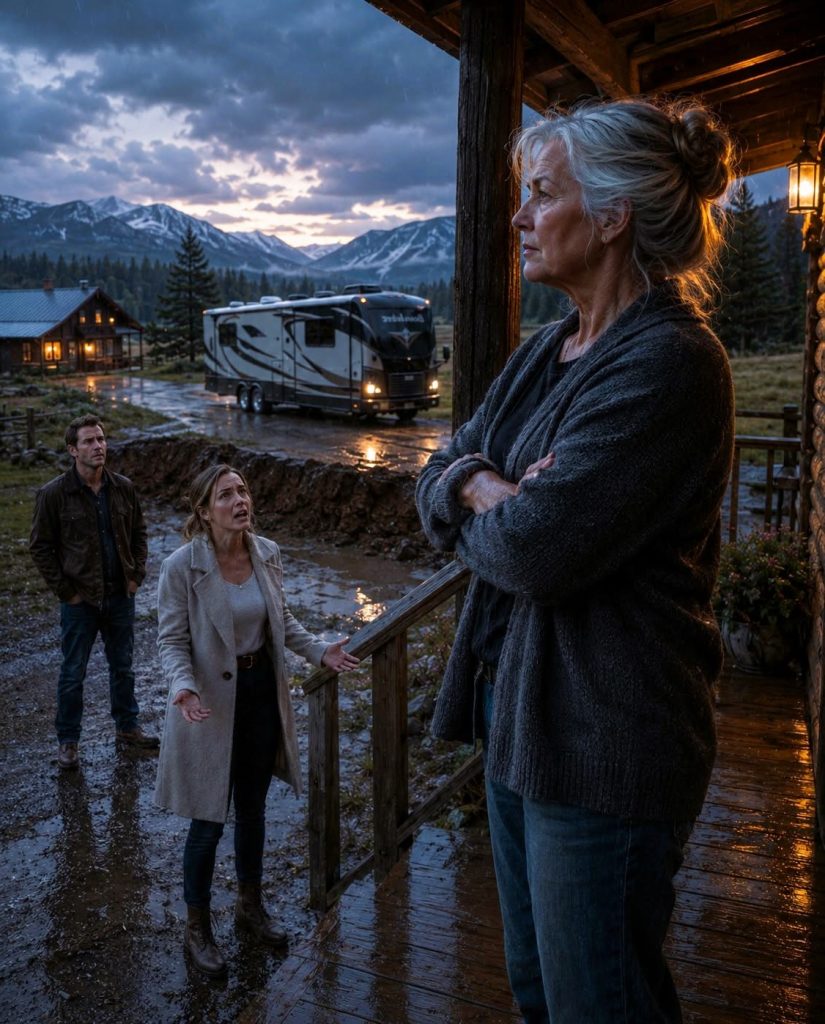
By that afternoon, the road ended at a deep trench.
Legal.
Useful.
And extremely inconvenient for thirty-foot travel trailers.
Friday arrived with cold Montana rain.
I spent most of the afternoon inside.
Just before sunset, headlights appeared at the entrance to my property.
A pickup came first.
Behind it was another truck towing a thirty-foot travel trailer.
Then Caleb and Clare’s SUV.
They had actually done it.
Clare’s father, Dennis, turned toward the pasture and guided the enormous RV down the dirt access road.
Then his brake lights came on.
The truck stopped.
He climbed out, walked several feet forward, and stared into the trench.
Then he looked at the RV.
Then at my cabin.
I remained on the porch.
Seconds later, Clare came storming through the rain.
“What did you do?”
“I improved the drainage.”
“You deliberately dug that because you knew we were bringing the trailer!”
“I told you not to bring it.”
“Fill it in.”
“No.”
Her face went red.
“You can’t do this!”
“On my property?”
She opened her mouth but couldn’t seem to find an answer.
Then Caleb approached.
For once, he wasn’t looking at me as though I were the problem.
He studied the trench.
Then the enormous RV.
Then his furious wife.
Clare pointed toward me.
“Well? Tell her!”
Caleb remained silent.
Then something unexpected happened.
He looked directly at Clare.
“Actually, Mom told us not to bring the RV.”
She froze.
“Whose side are you on?”
“This isn’t about sides.”
Clare’s parents were still standing beside their truck.
Her mother, Janice, looked uncomfortable.
Dennis folded his arms.
Then Caleb glanced toward them.
His expression changed.
“There’s something I should’ve told you before any of this started.”
Clare stared at him.
“Told me what?”
Caleb took a long breath.
“Your parents aren’t planning to stay six months.”
Clare’s face tightened.
“What are you talking about?”
He pulled out his phone.
“Your dad called me yesterday because the RV dealer wanted confirmation about the remaining balance.”
Dennis looked down.
Clare turned toward him.
“Dad?”
Caleb continued.
“Apparently, you told them Mom would cover it once they arrived.”
I stared at Clare.
The rain suddenly seemed very quiet.
“And that’s not all,” Caleb said.
Clare’s expression changed.
“You went through my messages?”
“No. Your dad called me because the dealership wanted the money.”
Caleb looked at me.
“She told them you had agreed to pay for utilities, groceries, and construction of a permanent RV hookup.”
Janice looked away.
Dennis muttered, “She said it was already arranged.”
Clare snapped, “I was going to explain!”
“After they moved in?” I asked.
She said nothing.
Caleb shook his head.
“You also told me their house was being renovated.”
“It basically is.”
“No, Clare. It isn’t. They sold it.”
I looked toward Dennis.
He gave a reluctant nod.
My stomach dropped.
Not because I felt responsible.
Because I suddenly understood the scale of what had been planned.
Her parents weren’t visiting temporarily.
They intended to move onto my property indefinitely.
With me financing the transition.
I folded my arms.
“Then everyone needs a new plan.”
Clare stared at me.
“You wouldn’t leave my parents homeless.”
“No,” I replied. “But I also won’t let you make me responsible for choices I never agreed to.”
Dennis cleared his throat.
“There’s something else.”
Clare whipped around.
“Dad, don’t.”
That was all the confirmation I needed that I absolutely wanted to hear it.
“Go ahead,” I said.
Dennis looked miserable.
“Clare told us that eventually you planned to transfer the lower five acres to Caleb.”
For several seconds, I honestly thought I had misunderstood.
“What?”
“She said you’d already discussed subdividing the property.”
I turned toward my son.
His face told me he was hearing this for the first time.
“No,” Caleb said immediately. “Mom never said that.”
Clare pressed her lips together.
Dennis continued.
“She told us the RV was just temporary until we built a small house.”
Janice finally spoke.
“She said it would be good for everyone. We’d be nearby. We could help when Evelyn got older.”
I almost admired the creativity.
Almost.
“So let me understand this,” I said.
Nobody answered.
“You sold your house because Clare told you that you could live here.”
Dennis nodded reluctantly.
“She said the family had agreed.”
“You purchased an RV because she told you I would help pay for it.”
Another nod.
“And you believed five acres of my land would eventually become Caleb’s.”
Janice looked embarrassed.
“We thought you knew.”
I turned to Clare.
She was staring at the porch boards.
“Why?”
Her head came up.
“What?”
“Why would you tell them any of that?”
Her expression hardened again.
“Because it made sense.”
I nearly laughed.
“That isn’t an answer.”
“You live alone on nine acres.”
“Yes.”
“You’re sixty-seven.”
“Yes.”
“You don’t need all this forever.”
There it was again.
Need.
As though property ownership expired when someone reached a certain birthday.
Clare continued.
“Caleb is your only child. Eventually, it’s his anyway.”
Caleb actually flinched.
I looked at him.
“Did you know she thought that?”
“No.”
His answer came immediately.
Clare scoffed.
“Oh, come on. We’ve discussed inheritance.”
“We discussed what might happen decades from now,” Caleb said. “Not moving your parents onto Mom’s land.”
She crossed her arms.
“You’re acting like I stole something.”
“You tried to give away property that doesn’t belong to you.”
“I was planning for the future!”
“No,” I said. “You were spending my future.”
That silenced her.
Rain drummed against the roof.
The RV sat awkwardly on the access road.
Finally, Dennis spoke.
“So what are we supposed to do tonight?”
It was a fair question.
And unlike Clare, he didn’t sound demanding.
He sounded exhausted.
I looked at him.
“There’s an RV park eighteen miles east of town.”
Clare groaned.
“They’re full this time of year.”
“No. I called this morning.”
Every face turned toward me.
“There are two long-term spaces available.”
Clare stared.
“You planned this?”
“I planned for the possibility that people might arrive after being told not to.”
Dennis looked relieved.
“Do you have their number?”
I handed him a piece of paper from my jacket pocket.
Clare looked as if I had personally betrayed her.
Her parents, however, seemed grateful.
Within fifteen minutes, Dennis had called the campground.
They had a space.
Temporary.
Monthly.
Paid.
Not free.
But available.
The next problem emerged when Dennis climbed back into his truck and the RV began sliding slightly on the muddy road.
Marcus had warned me the pasture access turned slick in heavy rain.
Thankfully, Caleb helped Dennis reverse the trailer slowly back toward the main driveway.
It took nearly forty minutes.
I stood under the porch roof while Clare remained soaked in the rain, furious.
When the trailer finally reached level ground, Janice approached me.
“I’m sorry.”
I studied her.
She looked genuinely embarrassed.
“We really believed you’d agreed.”
“I believe you.”
Clare turned sharply.
“Mom!”
Janice ignored her.
“She told us you wanted family closer as you got older.”
“I never said that.”
“I know that now.”
Dennis came over.
“We shouldn’t have accepted anything without speaking to you directly.”
“That would have helped.”
He nodded.
“I suppose it would.”
Then they left for the RV park.
Caleb stayed.
Clare wanted to leave immediately.
He didn’t.
“I need to talk to Mom.”
“You’ve talked enough,” Clare snapped.
“No. We haven’t.”
She gave him a long look.
Then she got into their SUV and slammed the door.
Caleb and I went inside.
I made coffee.
He sat at my kitchen table with both hands around the mug.
For a while, neither of us spoke.
Finally, he said, “I’m sorry.”
I nodded.
He looked surprised.
“That’s it?”
“What do you want me to say?”
“I don’t know.”
“You already know what you did.”
He rubbed his forehead.
“I should’ve asked you.”
“Yes.”
“I thought it would avoid an argument.”
“That worked beautifully.”
He laughed once.
Not because anything was funny.
Because sometimes the truth is too accurate not to laugh at.
“I didn’t know about the land,” he said.
“I believe you.”
“Or the RV money.”
“I believe that too.”
He looked at me.
“But you’re still angry.”
“Yes.”
“Because I told her they could stay.”
“Because you behaved as though you had authority over something that belongs to me.”
He lowered his eyes.
“That’s fair.”
I sat across from him.
“Caleb, you’re my son. I love you. But somewhere along the way, helping you became so normal that you stopped noticing it was help.”
He stayed quiet.
“I paid your phone bill because you were twenty-one and broke.”
“I know.”
“You’re thirty-four now.”
“I know.”
“I kept your truck on my insurance because your first business barely survived its first winter.”
He nodded.
“I sent money when you needed it.”
“I know.”
“No. I don’t think you did.”
That made him look up.
“Because if you understood those things were gifts, you wouldn’t have treated my property like another resource available to you.”
His face changed.
Not defensiveness.
Shame.
“I’m sorry.”
This time, it sounded different.
“I know.”
We talked for nearly two hours.
He told me things about his marriage I hadn’t known.
Nothing dramatic.
No secret affair.
No hidden catastrophe.
Just years of small compromises.
Clare had always been decisive.
Caleb had always been conflict-avoidant.
At first, that combination worked.
She chose.
He agreed.
But over time, decisions became assumptions.
She handled finances.
She made family plans.
She decided what they could afford.
Caleb avoided arguments by saying yes until he forgot he was allowed to say no.
The situation with her parents had been the inevitable result.
“She told me they’d already sold the house,” he said. “I panicked.”
“So you offered mine.”
He winced.
“When you say it like that, it sounds terrible.”
“It is terrible.”
“Yeah.”
I reached across the table and touched his hand.
“I didn’t raise you to become someone who avoids discomfort by handing the consequences to somebody else.”
“I know.”
“Then stop.”
He nodded.
When he left, Clare wouldn’t look at me.
Their SUV disappeared down the driveway.
The next morning, I called my attorney.
Not because I expected litigation.
Because Clare had taught me something valuable.
Unspoken expectations are dangerous.
My attorney, Margaret, had handled the purchase of my property years earlier.
When I explained everything, she was quiet for several seconds.
“Evelyn, I’m going to say something you probably already know.”
“Go ahead.”
“Do not promise anyone any part of that property.”
“I haven’t.”
“Good.”
We reviewed my will.
Caleb was still my primary beneficiary.
That didn’t bother me.
But I made several changes.
Instead of the property automatically passing directly to him, I added instructions giving my executor flexibility to sell it if necessary.
I also placed restrictions on certain financial assets.
Not because I wanted to punish my son.
Because I had learned that inheritance could be mentally spent long before someone actually died.
My retirement was not an advance payment on someone else’s future.
A few days later, Clare’s mother called.
I almost didn’t answer.
But I did.
“Evelyn?”
“Yes?”
“It’s Janice.”
“I know.”
She paused.
“Could we meet?”
“For what?”
“To talk.”
I considered saying no.
Then I remembered that Dennis and Janice had made foolish assumptions, but they had made them based on their daughter’s lies.
“Tomorrow morning.”
We met at a diner in town.
Janice arrived alone.
She looked exhausted.
“I’m embarrassed,” she said immediately.
“That makes two of us.”
She gave a sad smile.
“I should have called you.”
“Yes.”
“We trusted Clare.”
“She’s your daughter.”
“That doesn’t excuse us.”
No, it didn’t.
But I appreciated the admission.
Janice explained that they had sold their home because Dennis had recently retired and they wanted to downsize.
The house had become expensive.
Taxes were increasing.
Maintenance was difficult.
Clare convinced them not to purchase another home immediately.
“She said Caleb wanted us nearby.”
“Did Caleb ever tell you that?”
“No.”
“Did I?”
“No.”
Janice looked down at her coffee.
“When you say it out loud, I realize how foolish we were.”
I softened slightly.
“People hear what they want to hear.”
She nodded.
“There’s another reason.”
I waited.
“Dennis lost money.”
“How?”
“A retirement investment.”
I didn’t ask for details.
“He didn’t lose everything,” she continued. “But enough that buying another house immediately became difficult.”
“And Clare knew?”
“Yes.”
That explained part of her urgency.
Not her entitlement.
But the urgency.
“She wanted to help you,” I said.
“I think so.”
“She just wanted to use my money to do it.”
Janice sighed.
“Yes.”
We sat quietly.
Then she said something I didn’t expect.
“I don’t want the land.”
I looked at her.
“Dennis doesn’t either.”
“Good.”
“We never would have accepted it if we knew you hadn’t offered.”
“I believe you.”
“And we’re paying for the RV ourselves.”
“That’s between you and the dealership.”
She smiled slightly.
“You really don’t bend, do you?”
“I bent for thirty-seven years in operating rooms. My back is tired.”
She laughed.
It was the first pleasant moment between us in weeks.
Before leaving, Janice apologized again.
I accepted.
But acceptance is not the same as restoring trust.
That takes longer.
The real explosion happened three days later.
Caleb called me at nine in the evening.
“Mom, can I come over?”
“Now?”
“Yes.”
Something in his voice worried me.
“Come.”
He arrived alone.
The moment he walked through the door, I knew something had changed.
He looked tired.
Not physically.
Emotionally.
He sat at my table.
“What happened?”
“Clare and I had a fight.”
I waited.
“She thinks I embarrassed her.”
“You disagreed with her in front of her parents.”
“She says I chose you over her.”
“Did you?”
“No.”
He looked frustrated.
“That’s the whole problem. She keeps turning everything into choosing sides.”
I poured him water.
“What did you tell her?”
“That she lied.”
“And?”
“That she manipulated her parents.”
“And?”
“That she used my name to promise things I never agreed to.”
“And?”
He looked at me.
“That we need counseling.”
I nodded.
“What did she say?”
“She said I’m overreacting.”
“Are you?”
“No.”
That answer mattered.
A year earlier, Caleb would have asked me what I thought.
Now he already knew.
“She left,” he said.
“Where?”
“Her parents’ RV.”
I almost smiled at the irony.
I didn’t.
“She said she needs space.”
“Then give her space.”
“What if she doesn’t come back?”
“That isn’t something you can control.”
He stared at the table.
“I love her.”
“I know.”
“But I don’t like who I am around her lately.”
That was harder to hear.
My son wasn’t perfect.
Neither was Clare.
Marriage rarely breaks because one person wears a black hat and the other wears white.
Sometimes two people create a pattern that becomes unhealthy because each person’s weakness reinforces the other’s.
Clare controlled.
Caleb surrendered.
Clare pushed harder because surrender worked.
Caleb surrendered faster because pushing became exhausting.
Eventually both became resentful.
I said, “Then counseling is a good idea.”
“What if she refuses?”
“Then you still go.”
He looked surprised.
“By myself?”
“Yes.”
“Why?”
“Because you need to understand why saying no feels harder than accepting consequences you don’t want.”
He considered that.
Then nodded.
He stayed the night in the guest cottage.
Yes.
I unlocked it.
For him.
Because that was my choice.
The next morning, I saw him sitting on the little porch drinking coffee.
For a moment, I remembered him at ten years old.
Same dark hair.
Same thoughtful expression.
Children grow.
Mothers sometimes forget.
That week, Caleb found a therapist.
Clare eventually agreed to attend.
I stayed out of it.
That was difficult.
Mothers want updates.
We want outcomes.
We want reassurance.
But their marriage was theirs.
The property situation, however, was mine.
So I finished making changes.
Marcus returned with the culvert.
We installed proper drainage beneath the pasture road.
Then I added a locked metal gate at the entrance.
Not a spiteful gate.
A practical one.
The lower pasture had always been too accessible from the county road.
I should have done it years earlier.
The gate had a keypad.
Only I had the code.
For now.
I also contacted an estate planner.
We created a trust.
My land would remain mine for my lifetime.
If I became unable to manage my affairs, a neutral trustee—not Caleb and not Clare—would handle major property decisions.
That was not punishment.
It was clarity.
I discovered clarity is extremely peaceful.
Two months passed.
Dennis and Janice remained at the RV campground.
Eventually, they purchased a small manufactured home on two acres about twenty-five minutes away.
Affordable.
Simple.
Their own.
The first time Janice invited me for coffee, I went.
Their place was charming.
Dennis had built a small deck.
Janice planted flowers along the front.
As we sat outside, she said, “This is better.”
I looked around.
“I think so too.”
She laughed.
“Dennis keeps saying we dodged a bullet.”
“I wasn’t planning to shoot anyone.”
“You know what I mean.”
I did.
Living beside relatives can work beautifully.
But only when everyone chooses it.
Their relationship with Clare had changed too.
Janice admitted they were angry about being lied to.
“She said she was trying to save us.”
“Maybe she was.”
“That’s what Dennis said.”
She looked toward the yard.
“But helping someone by taking from someone else isn’t really helping.”
Exactly.
Caleb and Clare separated for almost three months.
Not divorced.
Separated.
Caleb rented a small apartment near his business.
He paid his own phone bill.
His own insurance.
Every bill.
I didn’t rescue him.
The first month was difficult.
His truck needed repairs.
He called.
I listened.
I did not transfer money.
He figured it out.
He took on two extra landscaping jobs.
Sold an unused equipment trailer.
Negotiated a payment plan.
Then something interesting happened.
He sounded proud.
“I handled it,” he told me one evening.
“I know.”
“You didn’t even offer to help.”
“No.”
He laughed.
“I think I’m starting to understand.”
“What?”
“You weren’t punishing me.”
“No.”
“You were stopping yourself from preventing me from growing up.”
I smiled.
“That sounds dramatic.”
“It also sounds true.”
He was right.
Parents sometimes sabotage adulthood through generosity.
Not intentionally.
We remove obstacles because we can.
Then we’re surprised when our children become shocked by obstacles.
I had helped too much.
That was mine to own.
Clare changed too.
Slowly.
I didn’t see her for several weeks.
Then one Sunday afternoon, her car appeared in my driveway.
I watched from the kitchen window.
She got out alone.
No boxes.
No parents.
No demands.
She walked to the porch.
I opened the door.
“Hello, Clare.”
“Hi.”
She looked nervous.
That was new.
“Can we talk?”
I stepped aside.
We sat at the kitchen table.
The same table where Caleb and I had talked after the RV disaster.
Clare folded her hands.
“I owe you an apology.”
I waited.
Not to punish her.
Because apology means more when nobody helps you finish it.
“I lied to my parents.”
“Yes.”
“I used Caleb’s name.”
“Yes.”
“I assumed things about your property that weren’t mine to assume.”
“Yes.”
She swallowed.
“And I treated you like saying no made you selfish.”
I nodded.
“I was wrong.”
“Why did you do it?”
She looked toward the window.
“For my parents.”
“That’s the reason. Not the explanation.”
She gave me a faint smile.
“You really were a nurse for a long time.”
“Patients lie too.”
That made her laugh softly.
Then she became serious.
“My dad lost almost two hundred thousand dollars.”
I said nothing.
“It wasn’t fraud exactly. Just a terrible investment.”
“I’m sorry.”
“They were scared.”
“I understand.”
“I was scared too.”
“So you made a plan.”
“Yes.”
“Using my property.”
“Yes.”
“Why didn’t you ask?”
Her answer came slowly.
“Because I thought you might say no.”
There it was.
The simplest truth.
“And if I said no?”
“I didn’t have another plan.”
“So instead of risking disappointment, you removed my choice.”
She looked ashamed.
“Yes.”
I leaned back.
“Clare, you are allowed to ask me for help.”
She looked at me.
“You are not allowed to decide what my answer will be.”
“I know.”
“You’re allowed to think I have too much land.”
She smiled faintly.
“You are not allowed to distribute it.”
“I definitely know that now.”
I almost smiled.
Almost.
Then she said, “There’s something else.”
I waited.
“I resented you.”
That surprised me.
“Why?”
“Because you could help so easily.”
I frowned.
“My parents were scared about money. Caleb’s business struggled. We had bills. And you had land, savings, retirement income…”
She stopped.
“You thought I had more than I needed.”
“Yes.”
I nodded slowly.
“I understand the arithmetic.”
She looked confused.
“Arithmetic?”
“You looked at what I had and compared it with what other people needed.”
“Yes.”
“What you forgot was the history.”
She waited.
“I worked nights while Caleb was small.”
She lowered her eyes.
“I spent Christmas mornings in surgical suites.”
“I know.”
“I missed birthdays. Weddings. Weekends.”
“I know.”
“I saved money when coworkers bought bigger houses.”
She stayed quiet.
“I drove the same car for eleven years.”
I pointed toward the property.
“This didn’t fall into my lap.”
“I know.”
“No. I don’t think you did.”
Her eyes filled slightly.
“I think you saw the result and forgot the cost.”
She wiped beneath one eye.
“You’re right.”
“I don’t expect gratitude for what I’ve earned. But I expect respect.”
“You deserve it.”
The conversation lasted almost three hours.
Not easy.
Not magical.
But honest.
Before she left, Clare asked one question.
“Do you hate me?”
“No.”
She looked surprised.
“I was furious.”
“Were?”
“I’m less furious.”
That made her laugh through tears.
“Progress?”
“Maybe.”
She stood.
At the door, she hesitated.
“Caleb and I are trying again.”
“I know.”
“He told you?”
“No.”
She looked confused.
“Then how?”
“You arrived here apologizing voluntarily.”
She smiled.
“That obvious?”
“Very.”
They didn’t move back together immediately.
They spent another month in counseling.
Then Caleb returned home.
They made financial changes.
Separate discretionary accounts.
Shared household account.
Weekly budget meetings.
Decisions involving either family required agreement from both spouses.
No volunteering each other’s money.
No promising someone else’s property.
That last rule became a joke eventually.
Not immediately.
Eventually.
A year after the RV incident, we had Thanksgiving at my cabin.
Everyone came.
Caleb.
Clare.
Dennis.
Janice.
The afternoon was cold and clear.
Snow covered the distant mountains.
Dennis brought smoked turkey.
Janice made pie.
Clare arrived carrying flowers.
Caleb carried firewood.
At one point, Dennis looked toward the lower pasture.
The steel gate was visible from the porch.
“Still locked?” he asked.
“Absolutely.”
He laughed.
“Good.”
Clare rolled her eyes.
“I’m never going to live this down, am I?”
“No,” Caleb said.
Janice added, “Definitely not.”
Even Clare laughed.
That mattered.
Not because the conflict had become funny.
Because shame loses power when people can acknowledge mistakes without pretending they never happened.
After dinner, Caleb helped me wash dishes.
He looked through the window toward the guest cottage.
“You know, Mom…”
I immediately pointed a dish towel at him.
“No.”
He laughed.
“I didn’t even say anything.”
“You looked at the cottage.”
“I was going to say it turned out nice with the new porch.”
“Good recovery.”
He grinned.
Then his expression became serious.
“I’m glad you said no.”
I looked at him.
“To all of it?”
“Yeah.”
“Even the phone bill?”
“Especially the phone bill.”
I laughed.
He dried another plate.
“I was angry at first.”
“I know.”
“I thought you were trying to teach me a lesson.”
“I was.”
He gave me a look.
“Okay. Maybe you were.”
I smiled.
“But I needed it.”
He set the plate down.
“I think I had started seeing you as… permanent backup.”
“That’s what parents are sometimes.”
“No.”
He shook his head.
“Emotional backup, yes.”
I waited.
“Financial emergency fund? Property provider? Problem fixer? No.”
I felt strangely emotional hearing him say it.
He continued.
“You raised me. That was already enough.”
I reached over and squeezed his shoulder.
“You weren’t a terrible son.”
“I know.”
“Just occasionally ridiculous.”
He laughed.
“Thanks.”
“Anytime.”
Later that evening, everyone left except Caleb.
He stayed behind to help stack chairs.
Before leaving, he stood on the porch beside me.
The mountains were barely visible in the moonlight.
“Do you still plan to leave this place to me?”
I looked at him.
He immediately raised his hands.
“I’m asking, not assuming.”
“Good improvement.”
He smiled.
“The answer is maybe.”
“Maybe?”
“I might sell it and spend every penny traveling.”
He laughed.
“Fair enough.”
“I might donate it to a llama sanctuary.”
“That seems unlikely.”
“Don’t challenge me.”
He shook his head.
Then he said, “Whatever you do, it’s yours.”
Three words.
It’s yours.
That was all I had wanted them to understand.
Not because I was greedy.
Not because land mattered more than family.
Because boundaries matter most with the people we love.
Strangers rarely assume they can take from us.
Family sometimes does.
Not always maliciously.
Sometimes familiarity creates entitlement.
Sometimes generosity creates expectation.
Sometimes fear creates terrible judgment.
Clare was afraid for her parents.
Caleb was afraid of conflict.
Dennis and Janice were afraid of financial insecurity.
And I had been afraid that saying no would make me seem unkind.
But saying no did something saying yes never could.
It forced everyone to face reality.
Dennis and Janice found housing they could actually afford.
Clare learned that helping people requires consent from everyone involved.
Caleb learned that avoiding conflict simply moves the conflict somewhere else.
And I learned that generosity without boundaries eventually becomes resentment.
The guest cottage remained exactly what I had intended it to be.
A place for invited guests.
Sometimes Caleb stayed there after late visits.
Sometimes friends from my nursing years came for weekends.
Dennis and Janice spent two nights there during a snowstorm when roads near their house became unsafe.
Yes.
I invited them.
That distinction mattered.
One summer, nearly two years later, Clare and I sat on the porch drinking iced tea.
She stared across the pasture.
“I really did think you had too much land.”
“I remember.”
She smiled.
“I was unbearable.”
“Sometimes.”
“Only sometimes?”
“I’m being polite.”
She laughed.
Then she asked, “Why nine acres anyway?”
I looked toward the ridge.
The evening light stretched long shadows across the grass.
“Because I spent thirty-seven years inside rooms without windows.”
She turned toward me.
“Operating rooms.”
“Most of them.”
I pointed toward the mountains.
“I wanted enough space that nobody could block my view.”
She was quiet.
“I never knew that.”
“You never asked.”
She nodded.
That sentence meant more than either of us said.
There had been a lot we hadn’t asked.
She hadn’t asked whether her parents could live here.
Caleb hadn’t asked whether he had permission to offer my property.
Her parents hadn’t asked whether the arrangement was real.
And I hadn’t asked myself whether years of financial support had accidentally taught my son that my resources were simply part of his household safety net.
Assumptions had caused almost everything.
Questions might have prevented most of it.
A month later, Caleb and Clare announced they were expecting their first child.
I cried.
Clare cried.
Caleb pretended not to.
Dennis absolutely did.
When my granddaughter was born, they named her Nora Evelyn Harper.
I told them using my name wasn’t necessary.
Clare smiled.
“We asked ourselves whether we had permission.”
I laughed so hard the baby woke up.
Becoming a grandmother changed many things.
But not my boundaries.
I offered to babysit.
I did not become automatic childcare.
I bought gifts.
I did not finance their household.
I helped when I wanted to.
I said no when I needed to.
And strangely, our relationship became better.
Much better.
Because gifts feel like gifts again when they aren’t expected.
Three years after the trench incident, Marcus came back to repair fencing along the eastern boundary.
He stood beside the pasture gate and laughed.
“Remember when you had me dig that trench?”
“I remember.”
“Most expensive argument I’ve ever participated in.”
“It solved a drainage problem.”
“Sure.”
He grinned.
“And nothing else?”
“Purely agricultural.”
He shook his head.
“Whatever you say, Evelyn.”
That evening, I sat on my porch after everyone had gone.
The property was quiet.
Wind moved through the pine trees.
The guest cottage lights were off.
The workshop door was locked.
The pasture gate stood closed.
And the mountains remained exactly where they had always been.
I thought about the first morning Clare told me her parents were moving in.
At sixty-seven, I had been spoken to as though age had transformed ownership into temporary custody.
As though my life had already begun shrinking.
As though what I had built was simply waiting to be redistributed among younger people with plans.
But retirement is not surrender.
Age is not permission.
Generosity is not obligation.
And family does not mean ownership.
I loved my son.
I came to love Clare again too.
I cared about Dennis and Janice.
But loving people does not require handing them every key.
Sometimes love sounds like yes.
Sometimes love sounds like, “I’ll help.”
Sometimes love sounds like, “You can stay here tonight.”
And sometimes the healthiest, clearest form of love is one calm word.
No.
That little word saved my property.
It saved my relationship with my son from becoming permanently resentful.
It forced Clare to confront the way fear had turned her into someone she didn’t want to be.
It pushed Dennis and Janice toward a home that was truly theirs.
And it reminded me that the retirement I had earned belonged to the woman who had worked for it.
Me.
I still keep the three industrial padlocks.
One is on the workshop.
One is on the pasture storage shed.
The third hangs from a hook inside my mudroom.
Clare once asked why I kept it.
“Sentimental value,” I told her.
She groaned.
Caleb laughed.
Dennis nearly choked on his coffee.
And every time I look at that old padlock, I remember the week an unwanted RV nearly became a permanent address on my land.
More importantly, I remember the moment my family finally learned something that should never have required a trench, a steel gate, and three industrial locks to explain.
You can love someone deeply without giving them control over your life.
And when someone confuses your kindness with permission, sometimes the best thing you can do is lock the door, stand your ground, and let them discover that your boundaries are not up for negotiation.
💬THE END! THANK YOU FOR READING!