
Saturday morning arrived under a sky the color of polished steel. Colonel Alexander Hayes had faced mortar fire before sunrise, emergency briefings at two in the morning, and rooms full of generals waiting for him to say the one thing nobody else wanted to say.
None of those situations had made him change shirts three times. He stood in front of the mirror in his apartment, staring at himself with the same expression he normally reserved for questionable intelligence reports.
The first shirt had looked too formal. The second had looked like he was trying too hard not to look formal.
The third was a plain blue button-down with the sleeves rolled once at the forearms.
He decided it would have to do.
His phone sat on the dresser.
One message glowed on the screen.
Claire: Sophie says pancakes start at 9:00, but Grace says you should come at 8:45 because Sophie cheats and eats the strawberries before breakfast.
Hayes read it twice.
Then, despite himself, he smiled.
He typed:
0800 departure. Estimated arrival 0845. I have been briefed regarding the strawberry situation.
Three dots appeared almost immediately.
Claire: Did you just give me a military ETA for pancakes?
Hayes: Yes.
Claire: You may be beyond help.
He stared at that message longer than necessary.
At 8:43, he parked outside a modest two-story house on a quiet street lined with bare winter trees.
There were bicycles leaning beside the porch.
A chalk drawing covered part of the driveway, faded from rain.
Four stick figures stood beside a fifth, much taller figure wearing what appeared to be a badly drawn military hat.
Above them, someone had written:
OUR TEAM
Hayes stopped.
For several seconds, he simply looked at it.
He had spent most of his adult life being identified by rank, position, unit, or responsibility.
Commander.
Colonel.
Sir.
Operations chief.
The man who made the call.
Nobody had drawn him in sidewalk chalk before.
The front door exploded open.
“HE’S HERE!”
Sophie came sprinting down the porch steps wearing pink pajamas beneath a winter coat.
“Sophie!” Claire called from inside. “Shoes!”
Sophie ignored her.
She reached Hayes, threw both arms around his waist, and nearly knocked the coffee from his hand.
“You came.”
“I said I would.”
“Adults say things all the time.”
That stopped him.
Sophie looked up as if she had merely stated a fact.
Hayes lowered himself slightly.
“When I tell you I’m going to show up, Sophie, I will make every reasonable effort to show up.”
She frowned.
“What does reasonable mean?”
“It means unless something very important stops me.”
“Like war?”
“Possibly.”
“Or aliens?”
“Less likely.”
She considered this.
“Okay.”
Then she grabbed his hand.
“Come inside before Lily eats your pancakes.”
The Bennett household was warm, noisy, and completely unlike any place Hayes had lived in for decades.
Emma, twelve, stood at the stove with Claire, carefully flipping pancakes.
Lily, nine, was arranging blueberries into faces.
Grace, seven, had somehow gotten flour in her hair.
And Sophie, five, immediately announced that Hayes should sit in “the dad chair.”
Claire nearly dropped the spatula.
“There is no dad chair.”
“There is now.”
Sophie pointed to the chair at the end of the table.
Hayes raised an eyebrow.
Claire looked mortified.
“You absolutely do not have to—”
“It appears I’ve been assigned a position.”
Emma snorted.
“You sound like a robot.”
“I’ve been called worse.”
He sat down.
Within twenty minutes, there were pancakes stacked in front of him, three competing conversations happening simultaneously, and Sophie attempting to determine whether the Army possessed secret tunnels beneath the entire United States.
“Classified,” Hayes said.
Her mouth fell open.
Emma studied him.
“You’re messing with her.”
“Correct.”
Sophie gasped.
“You can’t lie to children.”
“I said it was classified. I never said it existed.”
“That is sneaky.”
“It is precise.”
Claire laughed.
Not politely.
Not nervously.
Actually laughed.
Hayes looked at her.
It changed her face.
At the café, fear had tightened everything about Claire Bennett—her shoulders, her mouth, the careful way she chose each word.
Here, in the kitchen, she looked younger.
Tired, certainly.
But lighter.
And Hayes realized he liked hearing her laugh.
That realization made him look down at his coffee.
After breakfast, the girls pulled him into the living room for what Sophie described as “important family business.”
A sheet of construction paper lay on the floor.
Across the top, Emma had written:
RULES FOR PRETEND DADS
Hayes crossed his arms.
“There are regulations?”
“Obviously,” Emma said.
Lily read the first one.
“Number one: Pretend dads have to come to pancake breakfast at least sometimes.”
Grace held up two fingers.
“Number two: No yelling unless there is a fire, a burglar, or somebody is about to get hit by a bus.”
“Reasonable.”
Emma continued.
“Number three: You are not allowed to marry Mom without asking us first.”
Claire, standing in the doorway, choked on her coffee.
“Emma!”
“What? Richard kept talking about marrying you.”
Hayes’ expression changed slightly.
The room quieted.
Claire noticed.
“He isn’t coming back,” she said.
It sounded less like certainty than hope.
Hayes studied her.
“Has he contacted you?”
“No.”
The answer came too quickly.
Emma looked at the floor.
Claire saw it.
“Emma?”
Nothing.
“Emma.”
The girl reached into the pocket of her sweatshirt and pulled out a phone.
Claire’s face tightened.
“What happened?”
Emma unlocked it.
“There were messages last night.”
Claire took the phone.
Her face drained of color.
Hayes stood.
“What did he say?”
Claire didn’t answer.
She handed him the phone.
The first message contained only five words.
YOU EMBARRASSED ME IN PUBLIC.
The second:
THE SOLDIER CAN’T PROTECT YOU FOREVER.
The third had arrived at 2:17 in the morning.
It was a photograph.
The Bennett house.
Taken from across the street.
Hayes felt every trace of Saturday-morning warmth leave his body.
He no longer saw pancakes or construction paper or four girls in pajamas.
He saw terrain.
Access points.
Windows.
Blind spots.
Approach routes.
Threat indicators.
“Did you call the police?”
Claire shook her head.
“I didn’t see them. Emma did.”
“I was going to tell you,” Emma said softly. “But Mom was happy.”
Claire closed her eyes.
“Sweetheart…”
“I didn’t want him ruining breakfast.”
Hayes looked through the window toward the street.
Nothing moved.
Yet.
“Girls,” he said calmly, “I need you all to stay inside for a few minutes.”
Sophie immediately looked frightened.
“Is Richard outside?”
“I don’t know.”
“That means maybe.”
Hayes crouched.
“Yes. It means maybe.”
Claire watched him.
No false reassurance.
No promises he couldn’t guarantee.
Just truth delivered without panic.
Sophie nodded.
“Okay.”
Hayes called the local police.
Then he called someone else.
“Collins.”
Major Collins answered on the second ring.
“Sir?”
“I need a favor.”
There was a pause.
“Personal or official?”
“Personal.”
That pause lasted even longer.
Hayes almost never asked for personal favors.
“Send me what you have.”
An hour later, two police officers had taken the report.
The messages were documented.
Patrols would be increased.
Mercer, they explained, had technically not entered the property or made an explicit threat of violence.
Hayes understood the limitations.
He also hated them.
When the officers left, Claire stood on the porch with her arms folded.
“I’m sorry.”
He turned.
“For what?”
“For dragging you into this.”
“You didn’t.”
“My daughters did.”
“That is technically accurate.”
She almost smiled.
Then her face changed.
“You have a life, Colonel.”
“Alexander.”
She blinked.
“What?”
“You’re hosting me for breakfast. You can call me Alexander.”
The name seemed strange between them.
More personal than either expected.
“All right,” she said softly. “Alexander.”
He waited.
“You have a life,” she repeated. “A career. Responsibilities. You don’t need four little girls adopting you because they panicked in a café.”
“I’m aware.”
“And Richard is…”
She looked down the street.
“Richard is what?”
Claire hesitated.
“Persistent.”
“That is not the word you were going to use.”
“No.”
“Then use the correct word.”
She looked at him.
“Dangerous.”
Hayes’ jaw tightened.
For the first time, Claire told him everything.
Richard Mercer had entered her life eleven months earlier.
He was a regional developer who had hired her consulting firm for a property redevelopment project.
At first, he had been charming.
Helpful.
Generous with compliments.
After learning she was divorced and raising four daughters, his interest became personal.
Claire turned him down.
Politely.
Then firmly.
Then repeatedly.
Richard began appearing where she happened to be.
A grocery store.
A school fundraiser.
A restaurant.
He sent flowers after she asked him not to.
He offered Emma a private-school recommendation.
He told Lily she needed “a strong male figure.”
He mailed Sophie a birthday gift despite never being invited to the party.
Then, three months ago, he started talking as if marrying Claire were no longer a possibility but an eventual fact.
“I thought if I ignored him long enough, he’d get bored.”
“Men like that don’t interpret silence as rejection,” Hayes said. “They interpret it as space they haven’t occupied yet.”
Claire stared at him.
“That sounds like experience.”
“It is.”
“With people like Richard?”
“With people who confuse control with authority.”
She was silent for a moment.
“Is there a difference?”
“Control is forcing someone to behave the way you want.”
“And authority?”
“Being trusted enough that they follow you when they don’t have to.”
From inside the house came a crash.
Then Sophie yelled, “NOTHING BROKE!”
Hayes and Claire both turned.
Another crash followed.
Grace shouted, “SOMETHING BROKE!”
Claire closed her eyes.
“This is my life.”
Hayes looked at her.
“It seems loud.”
“It is.”
“Disorganized.”
“Extremely.”
“Potentially hazardous.”
“Frequently.”
He glanced toward the doorway.
“I’ve managed worse.”
That afternoon, he helped Emma repair a model bridge for school.
He showed Lily how to tie three types of knots, which resulted in her securing two dining chairs together.
Grace asked whether he had ever been scared.
Hayes considered giving her a simple answer.
Instead, he told the truth.
“Many times.”
She seemed surprised.
“But you’re a colonel.”
“Rank doesn’t remove fear.”
“Then how do you make it go away?”
“You don’t.”
She frowned.
“You decide what matters more than being afraid.”
Grace thought about that for a long time.
Then she nodded as if filing it somewhere important.
Sophie remained suspiciously close to him all day.
If he moved to the kitchen, she appeared in the kitchen.
If he went outside to check something, her face appeared at the window.
When he finally put on his coat to leave, she blocked the front door.
“No.”
Claire sighed.
“Sophie.”
“No leaving.”
“I have to leave.”
“You said pretend dads come to pancakes.”
“I came to pancakes.”
“But real dads don’t leave after pancakes.”
The room became very still.
Emma looked away.
Claire’s face tightened with a sadness she was too practiced at hiding.
Hayes understood instantly that Sophie was no longer talking about him.
He knelt.
“Sophie.”
Her lip trembled.
“My dad said he was going to call.”
Hayes didn’t look at Claire.
“When?”
“My birthday.”
Her voice shrank.
“That was five months ago.”
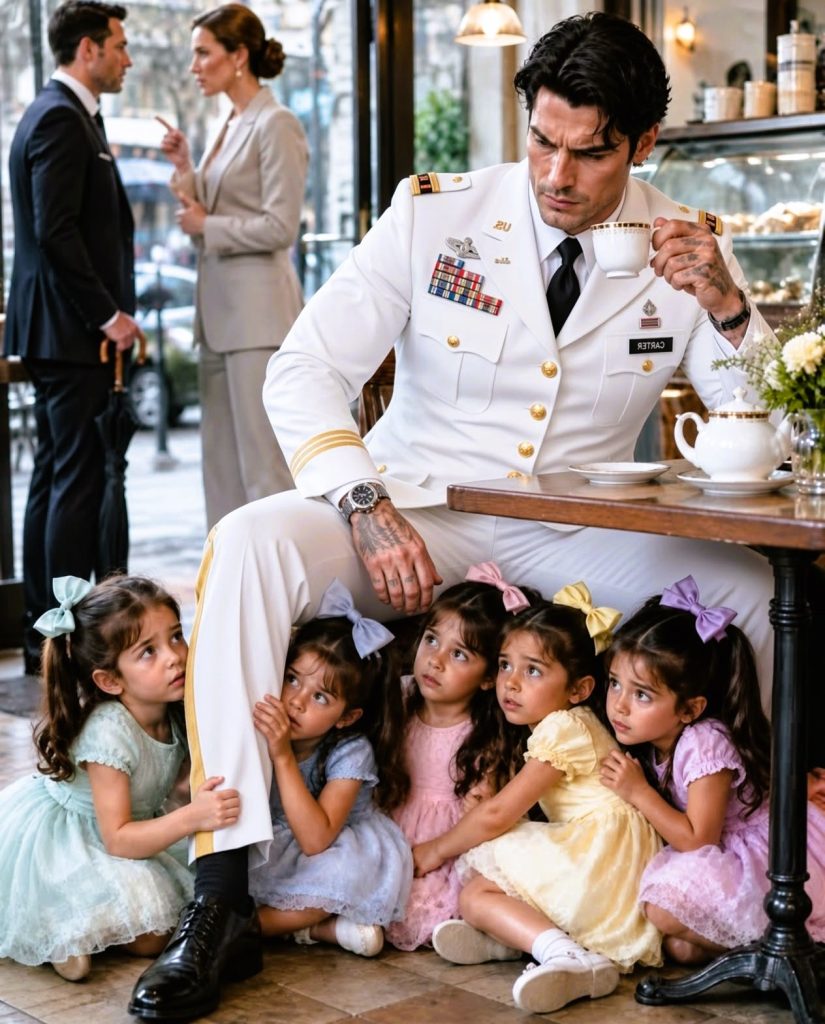
Hayes had survived conversations with grieving parents whose sons had died under his command.
This, somehow, felt harder.
He looked into Sophie’s eyes.
“I’m not your father.”
“I know.”
“I can’t promise to become your father.”
“I know.”
“But I can promise something else.”
She waited.
“If I say I’m coming to pancakes, I will come to pancakes.”
“That’s not enough.”
Claire whispered, “Sophie…”
Hayes remained still.
“What would be enough?”
Sophie suddenly hugged him.
Her voice was muffled against his shoulder.
“Come back.”
He wrapped one arm around her.
“I can do that.”
She pulled away.
“Tomorrow?”
“I have work.”
“Monday?”
“Work.”
“Tuesday?”
“Still work.”
Her expression became appalled.
“How much do they make colonels work?”
“Too much.”
“Wednesday?”
Hayes glanced at Claire.
She was trying not to smile.
“I could come for dinner Wednesday.”
Sophie nodded gravely.
“Six o’clock.”
“Eighteen hundred.”
She squinted.
“You ruin numbers.”
That evening, Hayes met Major Collins at a quiet restaurant near the installation.
Collins slid a thin folder across the table.
“You were right to ask.”
Hayes opened it.
“What am I looking at?”
“Richard Mercer. Forty-six. Developer. Multiple corporations. Political donations. Civil lawsuits.”
Hayes skimmed.
“Anything criminal?”
“Nothing that stuck.”
“That phrasing is doing a lot of work.”
Collins leaned back.
“Two complaints from former employees alleging harassment. Both withdrawn. One restraining-order application from a woman in Virginia six years ago.”
“Outcome?”
“She withdrew it before the hearing.”
“Why?”
“No idea.”
Hayes turned a page.
Then stopped.
A photograph showed Mercer shaking hands with a group of officials at a fundraising dinner.
Beside him stood a retired Army general.
Hayes knew him.
Everyone at senior command levels knew him.
Lieutenant General Warren Pike.
Retired four years earlier.
Well-connected.
Wealthy.
And now chairman of a defense-industry consulting firm with contracts worth hundreds of millions.
Hayes looked up.
“Why is Pike in this file?”
“Mercer sits on the board of one of Pike’s foundations.”
Hayes’ eyes returned to the picture.
“That may mean nothing.”
“Maybe.”
Collins reached for his coffee.
“But there’s more.”
He placed another page on the table.
Mercer’s development company had recently purchased property bordering an Army logistics expansion project.
Hayes slowly read the address.
He knew the project.
More importantly, he knew the briefing waiting on his desk Monday morning.
“That land wasn’t supposed to be public information yet.”
“No.”
“Who had access?”
“Limited list.”
Hayes looked at Collins.
“Pike?”
“Indirectly.”
A cold weight settled behind Hayes’ ribs.
“What exactly did you find?”
“Not enough.”
“Don’t protect me from speculation.”
“I’m not.”
Collins lowered his voice.
“I’m protecting you from moving too quickly.”
Hayes closed the folder.
“Richard Mercer has been stalking a woman with four children, photographed her home after being confronted, and apparently bought land beside a classified logistics project.”
“Restricted. Not classified.”
“Thank you for the distinction.”
Collins gave him a tired look.
“My point is this may be two separate problems.”
“And yours?”
“My point is that you hate coincidences.”
“I distrust convenient ones.”
Hayes returned to his apartment after ten.
He should have reviewed the Monday briefing.
Instead, he stood at his kitchen counter staring at Mercer’s photograph.
His phone buzzed.
Claire.
A picture.
Sophie was asleep on the couch holding the construction-paper list.
At the bottom, someone had added another rule.
NUMBER 4: PRETEND DADS HAVE TO COME BACK.
Hayes stared at it for a long time.
Then another message arrived.
Claire: She made me promise not to throw it away.
He typed:
Don’t.
Then deleted it.
He typed again.
Please keep it.
He set down the phone.
For the first time in years, the apartment felt too quiet.
Wednesday arrived with freezing rain.
Hayes reached the Bennett house at exactly six carrying a bakery box.
Sophie opened the door before he knocked.
“You’re late.”
He checked his watch.
“1759.”
“That’s not six.”
“It is one minute before six.”
“That means I suffered for one extra minute.”
Emma shouted from the kitchen, “She was standing at the window for twenty minutes!”
“TRAITOR!”
Hayes laughed.
Dinner became spaghetti, garlic bread, and an argument over whether a colonel outranked a principal.
Grace insisted school principals were more powerful because they could cancel recess.
Afterward, Claire sent the girls upstairs to finish homework.
Hayes was drying plates when she spoke.
“You know you don’t have to do dishes.”
“I ate here.”
“You’re a guest.”
“I’m capable of dishwashing.”
“I’m starting to suspect you’re terrible at relaxing.”
“That accusation has been made.”
Claire leaned against the counter.
“You asked someone to investigate Richard.”
Hayes stopped.
“How do you know?”
“Because two men visited my office today.”
His expression hardened.
“What men?”
“They said they worked for one of Richard’s companies.”
“What did they want?”
“To ask whether you had pressured me into making accusations against him.”
Hayes put the dish down carefully.
“Did they threaten you?”
“No.”
“Claire.”
“They never said anything threatening.”
“That wasn’t my question.”
She looked away.
“One of them said getting involved with powerful people can damage careers.”
Hayes’ face became unreadable.
Claire watched him.
“That expression is terrifying.”
“What expression?”
“The one where you look like you’re deciding whether somebody needs to disappear.”
“I do not make people disappear.”
“Good.”
“Usually.”
Her eyes widened.
He allowed two seconds of silence.
Then said, “That was a joke.”
Claire stared.
“You have a horrible sense of humor.”
“So I’ve been told.”
The humor vanished almost immediately.
“Tell me exactly what they said.”
She did.
Hayes memorized every word.
At 8:20, while helping Lily understand fractions, his phone rang.
Unknown number.
He answered.
“Hayes.”
Silence.
Then a man spoke.
“Colonel.”
Hayes stood.
Claire looked toward him.
The voice was older.
Calm.
Familiar.
“You’ve become involved in a private domestic dispute.”
Hayes walked into the hallway.
“Identify yourself.”
“You know who I am.”
Hayes did.
Warren Pike.
The retired general.
“Then say it.”
A pause.
“Warren Pike.”
Claire watched from the kitchen.
Hayes’ voice remained flat.
“General.”
“Retired.”
“Then Mr. Pike.”
Pike chuckled without humor.
“You always were rigid.”
“What do you want?”
“For you to step away from Claire Bennett and Richard Mercer.”
Hayes looked toward the four girls seated around the kitchen table.
“Why?”
“It’s personal.”
“No. It became professional when two men visited her workplace.”
“That was unfortunate.”
“Was it?”
Another pause.
Pike’s voice hardened.
“You are scheduled to brief senior leadership Monday regarding the Northern Logistics Corridor.”
Hayes said nothing.
“That briefing will affect several development contracts.”
“I’m aware.”
“Then focus on your responsibilities.”
“I am.”
“Mercer’s relationship with the Bennett woman is irrelevant.”
“Her name is Claire.”
“That is exactly the kind of emotional involvement I’m warning you about.”
Hayes’ eyes narrowed.
“You seem unusually interested in who I eat dinner with.”
“I’m interested in protecting you from a mistake.”
“Whose mistake?”
Pike did not answer.
Hayes looked at the front window.
A dark sedan was parked half a block away.
It had not been there when he arrived.
His body went still.
“Warren.”
The use of Pike’s first name changed the air between them.
“Yes?”
“If you know Mercer is harassing Claire, and you’re using your influence to shield him, then you and I are going to have a very different conversation.”
Pike’s voice became cold.
“You don’t understand what you’ve stepped into.”
“Then explain it.”
“You’ll understand Monday.”
The call ended.
Hayes lowered the phone.
Claire stood behind him.
“What happened?”
He looked again toward the sedan.
Its lights came on.
It pulled away.
“Lock the door.”
Claire’s face changed.
“Alexander?”
“Lock it.”
She did.
He called Collins.
This time, he didn’t ask for a favor.
“Find out everything connected to Mercer, Pike, and the logistics corridor.”
“Sir—”
“Everything.”
“Understood.”
Hayes remained at the Bennett house until after midnight.
The girls eventually fell asleep.
Claire sat across from him in the living room.
“You should go home.”
“Probably.”
“But you won’t.”
“No.”
“Because Richard might come back?”
“Among other reasons.”
Claire studied him.
“Why are you doing this?”
Hayes looked at the dying fire.
“I don’t know.”
“That’s not true.”
“No. It’s not.”
She waited.
His answer came quietly.
“My wife died nine years ago.”
Claire’s expression softened, but she didn’t interrupt.
“Cancer. Fast. Six months from diagnosis.”
“I’m sorry.”
Hayes nodded once.
“We never had children. We kept postponing it.”
His voice remained steady, but only because he had spent years learning how to make it so.
“Next assignment. Next promotion. Next move. There was always time.”
Claire said nothing.
“Then there wasn’t.”
The house creaked in the silence.
Hayes looked toward the staircase.
“I spent twenty-seven years telling myself the Army needed everything I had.”
“And now?”
“Now four girls have apparently decided I require supervision.”
Claire smiled faintly.
“They’re aggressive recruiters.”
“Yes.”
“You can still walk away.”
He looked at her.
“Do you want me to?”
The question changed something.
Claire lowered her eyes.
“No.”
A soft sound came from the stairs.
Sophie stood there in pajamas, holding a stuffed rabbit.
“You stayed.”
Hayes turned.
“I stayed.”
She walked down, climbed onto the sofa beside him, and rested her head against his arm.
Within minutes, she was asleep again.
Claire watched them.
Neither spoke.
At 1:13 in the morning, Hayes’ phone vibrated.
Major Collins.
Hayes carefully moved away from Sophie and stepped into the kitchen.
“What did you find?”
Collins sounded different.
Not tired.
Alert.
“Sir, we have a serious problem.”
“Go.”
“The property Mercer purchased wasn’t speculative.”
“I assumed that.”
“He acquired it through a shell company forty-eight hours before the internal route recommendation was finalized.”
Hayes’ expression hardened.
“Who had the recommendation?”
“Eleven people.”
“Names.”
“Sir, one of them is you.”
Hayes’ eyes narrowed.
“And?”
“Two are civilians. Three are on the logistics command staff.”
“And the others?”
Collins hesitated.
“Four general officers.”
“That’s ten.”
Silence.
Hayes gripped the phone.
“Who is eleven?”
Collins answered.
“Brigadier General Matthew Hayes.”
Alexander stopped breathing for half a second.
Claire, watching from across the room, saw his face change.
Matthew Hayes.
His younger brother.
They had not spoken in almost three years.
Matthew was brilliant, ambitious, and currently assigned to Pentagon procurement oversight.
He was also the one person in the Army Alexander had once trusted without question.
“Are you certain?”
“Yes.”
Hayes looked down.
“Anything else?”
“Yes.”
Collins sounded reluctant now.
“Mercer’s shell company sent three payments last year to a private consulting firm.”
“Whose firm?”
“That’s where it gets worse.”
Hayes waited.
“The firm belongs to your brother’s wife.”
The kitchen seemed to tilt.
For years, Alexander Hayes had believed the hardest battles were the ones where the enemy stood on the opposite side.
He had been wrong.
He turned toward the living room.
Claire stood beneath the warm lamp.
Sophie slept on the sofa.
Emma, Lily, and Grace were safe upstairs.
A family he had known for less than a week had somehow become connected to a chain of money, influence, restricted military information, and the brother he had spent years refusing to call.
Then his phone buzzed again.
This time, it was not Collins.
It was a text message from Matthew Hayes.
Only seven words.
Alex. Do not trust Claire Bennett. Call me.
Hayes stared at the screen.
Another message appeared before he could react.
A photograph.
Claire.
Richard Mercer.
And Warren Pike.
All three were standing together at a private reception.
The date stamped beneath the image was eighteen months earlier.
Long before Claire claimed Richard Mercer had entered her life.
Hayes slowly raised his eyes.
Claire was still watching him.
“What is it?” she asked.
For the first time since four frightened little girls had crawled beneath his table, Colonel Alexander Hayes had no idea which person in the room was telling the truth.
THE END! THANKS FOR READING!