
“Let’s not do this halfway,” I said quietly. “Not tonight.” Sarah’s lips parted, but no words came out. Reverend Thomas stopped beside the dining table. The easy smile had vanished from his face.
He looked at Sarah. Then at me. Then at the phone on the counter. That was when he finally understood. “You sent the message,” he said.
“Yes.”
His fingers tightened around the edge of the pie dish.
Sarah closed her eyes.
“Marcus, please.”
“Please what?”
“Let me explain.”
I nodded toward the living room.
“Get dressed first.”
She stared at me.
“I’m not having a twenty-five-year marriage explained to me while you’re standing in a bath towel.”
Her face crumpled.
For once, I didn’t rush to comfort her.
Sarah disappeared upstairs.
Thomas remained beside the table.
“You shouldn’t have done that,” he said.
I almost laughed.
“Sent the message?”
“Yes.”
I looked at him.
“You came.”
He had no answer.
I walked into the kitchen and poured the cold coffee into the sink.
My hands were remarkably steady.
Thomas set the pie down.
“Marcus, what you think is happening—”
“Don’t.”
He stopped.
“You came to my house after receiving a message supposedly from my wife saying her husband wasn’t home.”
I turned toward him.
“You didn’t ask why.”
Silence.
“You didn’t call.”
Nothing.
“You showed up carrying her favorite pie.”
His face tightened.
“Maybe I was concerned.”
“At eight o’clock on a Tuesday night?”
“Yes.”
“With cherry pie?”
He looked away.
I nodded.
“That’s what I thought.”
Thomas sat down without being invited.
Suddenly he looked older.
Not like Reverend Alden, the man whose sermons filled our church every Sunday.
Just Thomas.
A sixty-one-year-old man caught somewhere he had no business being.
Sarah returned ten minutes later.
She wore gray sweatpants and a blue sweater.
The sweater was mine.
For some reason, that almost hurt more than the text.
She sat at the opposite end of the dining table.
Nobody spoke.
Finally, I pulled out my chair.
“Start.”
Sarah folded her hands.
“Marcus…”
“No speeches.”
My voice remained quiet.
“How long?”
She started crying immediately.
I waited.
“Sarah.”
“Eight months.”
The answer hit differently than I expected.
Eight months meant summer.
It meant my birthday.
It meant our anniversary dinner.
It meant the weekend we visited our daughter in Pittsburgh.
It meant Sunday mornings when Thomas had shaken my hand after church while Sarah stood beside me.
Eight months was not a mistake.
It was a second life.
I looked at Thomas.
“Eight months?”
He looked at Sarah.
She nodded.
My stomach turned.
“How did it start?”
Sarah wiped her cheeks.
“After the counseling sessions.”
That one nearly broke through the cold.
“What counseling sessions?”
She stared at me.
“After your mother died.”
I remembered.
I had shut down after Mom passed.
For weeks, I barely spoke.
Sarah suggested we talk to Thomas because he had known our family for years.
Three sessions.
That was all.
Thomas had sat across from us telling me grief could make husbands distant.
He told Sarah she needed patience.
He prayed over our marriage.
Apparently he had been studying its weak points.
I looked at him.
“You used our counseling sessions?”
Thomas shook his head quickly.
“No.”
Sarah whispered, “Not like that.”
“Then tell me what it was like.”
She took a shaky breath.
“A few weeks afterward, Thomas called to check on me.”
“On you.”
“Yes.”
“Not us.”
She looked down.
“At first, it was innocent.”
Of course.
Every affair apparently begins innocent.
Coffee.
Concern.
A phone call.
One person understanding what the spouse supposedly didn’t.
“When did innocent stop?”
Sarah closed her eyes.
“June.”
I did the math.
“Three weeks after our twenty-fifth anniversary?”
She started crying harder.
Thomas finally spoke.
“We weren’t trying to hurt you.”
That was the first moment anger truly entered me.
I stood.
Thomas flinched.
I didn’t touch him.
I didn’t even move toward him.
I simply put both palms on the table and looked straight into his face.
“You don’t get to tell me what you were trying to do.”
He swallowed.
“You stood in my home.”
My voice shook now.
“You ate at my table.”
“Marcus—”
“You baptized my granddaughter.”
Sarah covered her mouth.
“You counseled my marriage.”
Thomas looked toward the floor.
“And every Sunday, you looked me in the eye.”
Nothing.
“Did you ever feel guilty?”
“Yes.”
I laughed.
A single empty sound.
“Not guilty enough to stop.”
He didn’t respond.
I turned to Sarah.
“Did you love him?”
She stared at the table.
That hesitation was worse than a yes.
“Sarah.”
“I don’t know.”
“You know.”
She whispered, “I thought I did.”
Something inside me settled.
That was the sentence.
Not the kisses.
Not the eight months.
That.
I thought I loved him.
I sat down again.
“What were you planning?”
Sarah looked confused.
“What?”
“You weren’t exchanging kisses for eight months without talking about the future.”
Thomas shifted.
I noticed.
I looked at him.
“What?”
“Nothing.”
“Thomas.”
He rubbed his jaw.
Sarah whispered, “We talked about leaving.”
The vintage clock ticked behind us.
For twenty-five years, that clock had hung in the dining room.
We bought it at an estate sale our third year of marriage.
Suddenly I could hear every single tick.
“Leaving me?”
“Yes.”
“When?”
“We never decided.”
Thomas said, “Sarah wasn’t ready.”
I looked at him.
“You were?”
He hesitated.
“My marriage ended years ago.”
Thomas’s wife, Elaine, had moved to Arizona the previous spring to care for her sister.
Everyone at church believed they were temporarily living apart.
Apparently that wasn’t the whole story either.
“Does Elaine know?”
“No.”
I nodded slowly.
“So I’m not the only husband being humiliated.”
Sarah reached across the table.
“Marcus, please understand—”
I pulled my hand away before she touched it.
Her face collapsed.
“Don’t.”
“I’m sorry.”
“I know.”
“You don’t sound like you believe me.”
“I believe you’re sorry right now.”
She stared at me.
“That isn’t the same as being sorry eight months ago.”
Nobody spoke.
My phone buzzed.
Our daughter, Emily.
I didn’t answer.
Sarah looked toward the screen.
“Are you going to tell the kids?”
“We have adult children.”
“Marcus.”
“What?”
“Please don’t tell them tonight.”
I stared at her.
There it was.
Even now.
Damage control.
“Why?”
“They’ll hate me.”
I almost smiled.
“You’re worried about consequences.”
“That’s not fair.”
“Neither was any of this.”
Thomas stood.
“I should go.”
I looked at him.
“No.”
He stopped.
“You came here because you thought I wasn’t home.”
I leaned back.
“You can stay another ten minutes while I finish asking questions.”
He slowly sat again.
“How many times were you in this house?”
Sarah shook her head.
“Marcus, don’t.”
“How many?”
Thomas answered.
“Four.”
Sarah looked at him sharply.
I felt sick.
“Four times.”
He nodded.
“When?”
“Mostly afternoons.”
“When I was working.”
No answer was necessary.
“Our bedroom?”
Sarah immediately said, “No.”
I looked at her.
“Don’t lie now.”
“We never used our bedroom.”
Thomas nodded.
It was bizarre that this brought me relief.
As if betrayal had acceptable rooms.
I hated myself for caring.
“Where?”
Sarah whispered, “The guest room.”
I looked toward the hallway.
The guest room where my mother stayed during her final Thanksgiving.
The room where our grandson slept on Christmas Eve.
I stood.
“I’m done.”
Sarah jumped up.
“What does that mean?”
“It means Thomas leaves.”
Thomas grabbed his coat.
He didn’t look at me.
At the front door, I stopped him.
“One thing.”
He turned.
“Sunday.”
His expression changed.
“What about Sunday?”
“Are you getting into that pulpit?”
He hesitated.
“Marcus, church matters are—”
“Are you?”
“I haven’t decided.”
I nodded.
“You should.”
He looked confused.
“Because if you stand there and preach about marriage while my wife sits beside me knowing what you did, I won’t protect you.”
His face went pale.
“Is that a threat?”
“No.”
I opened the door.
“It’s advance notice.”
He left.
I locked the door behind him.
When I turned around, Sarah was crying in the hallway.
“Marcus, I’ll end it.”
I stared at her.
“You think that fixes this?”
“No.”
“I’ll block him.”
“Eight months ago would’ve been impressive.”
She flinched.
“I’ll quit the church.”
“This isn’t about church.”
“I’ll do counseling.”
“The last counselor you picked slept with you.”
She covered her face.
Immediately, I regretted saying it.
Not because it wasn’t true.
Because cruelty wasn’t going to give me my dignity back.
I lowered my voice.
“I’m going to a hotel.”
Her head snapped up.
“No.”
“Yes.”
“This is your house too.”
“I know.”
“Then stay.”
“I can’t sleep beside you tonight.”
She moved closer.
“Please don’t leave.”
I looked at the woman I had loved since I was twenty-seven.
Gray had begun appearing in her hair.
Small lines surrounded her eyes.
I knew every version of her face.
The young mother.
The exhausted nurse.
The woman crying at our daughter’s wedding.
The wife who held my hand while my mother died.
And now this one.
The woman who had betrayed me.
That was the hardest part.
She wasn’t suddenly a stranger.
She was still Sarah.
And that made leaving the room almost unbearable.
“I need space.”
She whispered, “Are we over?”
“I don’t know.”
That was the truth.
I packed a small bag.
Before leaving, I photographed the messages on her phone.
Not because I wanted revenge.
Because I no longer trusted reality to remain stable once panic set in.
Sarah watched me.
“You think I’m going to lie?”
“I didn’t think you’d cheat either.”
She looked away.
I spent the night at a Hampton Inn off the interstate.
I didn’t sleep.
At 3:14 a.m., I sat on the edge of the bed staring at the floral carpet while trucks moved along the highway outside.
My mind kept replaying every Sunday.
Every dinner.
Every time Sarah said she was going to the store.
Every work shift I took because we were trying to rebuild our retirement savings.
By sunrise, betrayal had become accounting.
Dates.
Hours.
Excuses.
Then my phone rang.
Emily.
My daughter.
“Dad?”
I tried to sound normal.
“Morning, sweetheart.”
“Why is Mom calling me crying?”
I closed my eyes.
“She called you?”
“She wouldn’t tell me what happened.”
I said nothing.
Emily became quiet.
“Dad.”
“Your mother and I are having problems.”
“What kind?”
“I don’t want to involve you.”
“Is she safe?”
“Yes.”
“Are you safe?”
“Yes.”
Another pause.
“Did someone cheat?”
Children know their parents better than parents believe.
I couldn’t lie.
“Yes.”
Emily inhaled sharply.
“Mom?”
I stayed silent.
“Mom cheated on you?”
“Yes.”
She began crying.
That hurt more than anything from the previous night.
“Emily.”
“With who?”
“I don’t want to tell you over the phone.”
“Dad.”
“Please.”
She lowered her voice.
“Is it someone I know?”
I closed my eyes.
“Yes.”
“Who?”
I waited.
Then said it.
“Thomas Alden.”
Silence.
Complete silence.
Finally she whispered, “Reverend Alden?”
“Yes.”
“Oh my God.”
I heard her husband in the background asking what was wrong.
Emily started crying harder.
“He baptized Noah.”
“I know.”
“Dad, he counseled you and Mom.”
“I know.”
“Are you going back home?”
“Not yet.”
“Come here.”
I almost did.
But I needed to handle one thing first.
At nine, I called Elaine Alden.
Thomas’s wife.
She answered from Arizona.
“Marcus! What a surprise.”
Her warmth made this worse.
“Elaine, are you alone?”
Silence.
“Yes.”
“I need to tell you something difficult.”
Twenty minutes later, she knew.
I didn’t give graphic details.
I didn’t insult Thomas.
I told her what I knew.
She cried quietly.
Then said something that shocked me.
“I wondered.”
“About Sarah?”
“No.”
She exhaled.
“About someone.”
Apparently Thomas had become secretive months earlier.
New phone password.
Late-night messages.
Random trips back to Pennsylvania even when church business didn’t require them.
Elaine had asked.
Thomas accused her of mistrusting him.
The same pattern.
Different marriage.
“I’m sorry,” I said.
“So am I.”
Then she asked, “What are you going to do?”
“I don’t know.”
“Neither do I.”
Sunday came.
Thomas did not preach.
The church bulletin said he had taken an unexpected personal leave.
Rumors spread immediately.
Sarah stayed home.
I went.
Not because I was brave.
Because I refused to surrender a place that had belonged to my family for eighteen years simply because Thomas had contaminated it.
After service, one of the elders approached me.
“Marcus, can we talk?”
Thomas had confessed enough to the board Saturday night that they knew there had been an inappropriate relationship with a married member of the congregation.
He did not initially give Sarah’s name.
I did.
Quietly.
Privately.
Not for revenge.
Because there had been marriage counseling involved.
That mattered.
A spiritual leader crossing that boundary wasn’t simply an affair.
It was an abuse of trust.
Thomas resigned two weeks later.
Sarah and I separated.
For six months, I lived in a small furnished apartment near work.
We met with a licensed counselor chosen by neither of us.
The first session was brutal.
Sarah kept saying she never intended for the affair to become physical.
The counselor finally asked her, “Why does intention matter more to you than repeated choice?”
Sarah had no answer.
Over time, she stopped defending.
She began answering.
She told me she had felt invisible after twenty-five years.
She felt like we had become coworkers maintaining a household.
I listened.
Some of it was true.
I worked too much.
I stopped asking about her dreams.
After Mom died, I disappeared emotionally.
But one afternoon, the counselor looked at me and said something I desperately needed to hear.
“Understanding the weaknesses in a marriage does not assign responsibility for an affair.”
I carried that sentence home.
Our marriage had problems.
Sarah’s affair was still Sarah’s choice.
Both things could be true.
Around the seventh month, Sarah asked me whether I could ever forgive her.
“I already have,” I said.
She looked stunned.
“Then why aren’t you coming home?”
“Because forgiveness and reconciliation aren’t the same thing.”
She started crying.
I continued.
“I don’t want to spend the rest of my life punishing you.”
I swallowed.
“But I also don’t know if I can spend the rest of my life checking your phone every time you shower.”
That was the real question.
Not whether I loved her.
I did.
Not whether she regretted it.
I believed she did.
Could trust grow again where it had been deliberately poisoned for eight months?
For us, the answer eventually became no.
A year after the Tuesday-night text, Sarah and I filed for divorce together.
No screaming courtroom battle.
No attempt to destroy each other financially.
We divided what we had built.
Sold the Scranton house.
Split retirement accounts.
Kept our children out of negotiations.
It was the saddest mature thing I had ever done.
Thomas and Elaine divorced too.
I heard Thomas moved to another state and eventually took work outside ministry.
I never contacted him again.
Three years later, I bought a small ranch house outside Clarks Summit.
Nothing fancy.
Two bedrooms.
A workshop.
Enough backyard for a grill and a few tomato plants.
Emily came over one Sunday with Noah.
My grandson ran through the living room carrying a toy truck while Emily helped me unpack dishes.
She found an old photograph.
Sarah and me at twenty-nine.
Standing beside our first used car.
Laughing.
“You want me to throw this away?” she asked.
I looked at it.
“No.”
She seemed surprised.
“You sure?”
“Yes.”
I put the picture into a drawer.
“That happened too.”
Emily looked at me.
“What do you mean?”
“Your mother hurting me doesn’t mean every good year before it was fake.”
She hugged me.
I almost cried.
Sarah and I speak occasionally now.
Birthdays.
Grandchildren.
Family emergencies.
There’s kindness between us.
Sometimes even laughter.
But no marriage.
And strangely, I’m okay with that.
People ask what I learned from catching my wife because of one text.
They expect me to say never trust anyone.
That isn’t it.
Twenty-five good years are not erased by eight terrible months.
But trust should never require blindness.
And forgiveness should never require pretending betrayal didn’t change you.
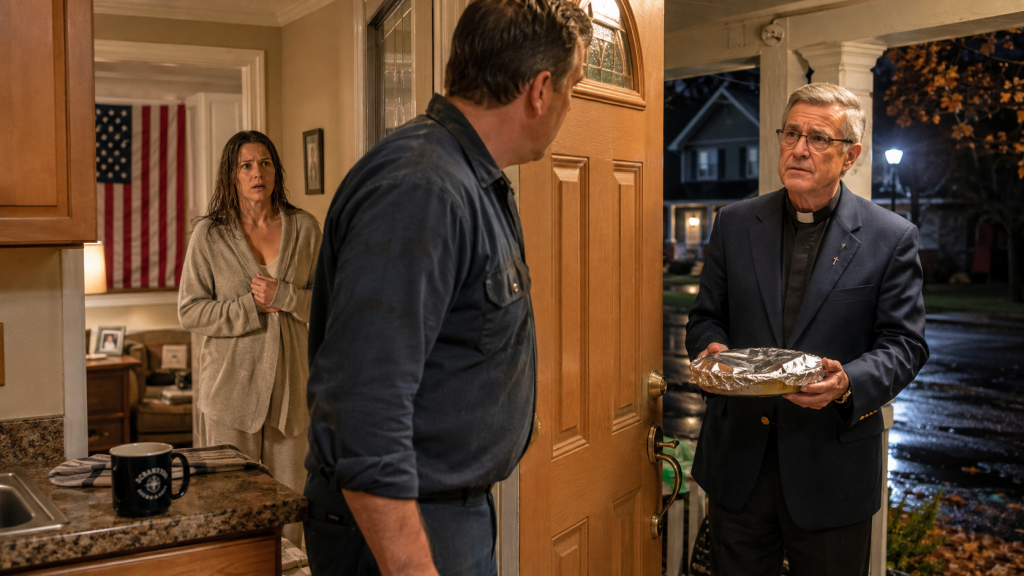
That November night, I thought opening the front door would reveal the man sleeping with my wife.
Instead, it revealed something much bigger.
It showed me who Thomas was.
Who Sarah had become.
And eventually, who I needed to become too.
A man capable of walking away without destroying everyone on the way out.
A man who could admit the marriage had failed without calling his entire life a failure.
A man who could forgive and still choose not to return.
Sometimes the person standing at the door isn’t the biggest shock.
Sometimes the real shock is realizing the life behind you has already changed.
And the only thing left to decide is whether you are brave enough to walk forward.
THE END! THANKS FOR READING!