
“I warned you the Army would chew her up and spit her out,” Dad mocked during his fiftieth birthday celebration. The guests laughed. Until the windows started trembling.
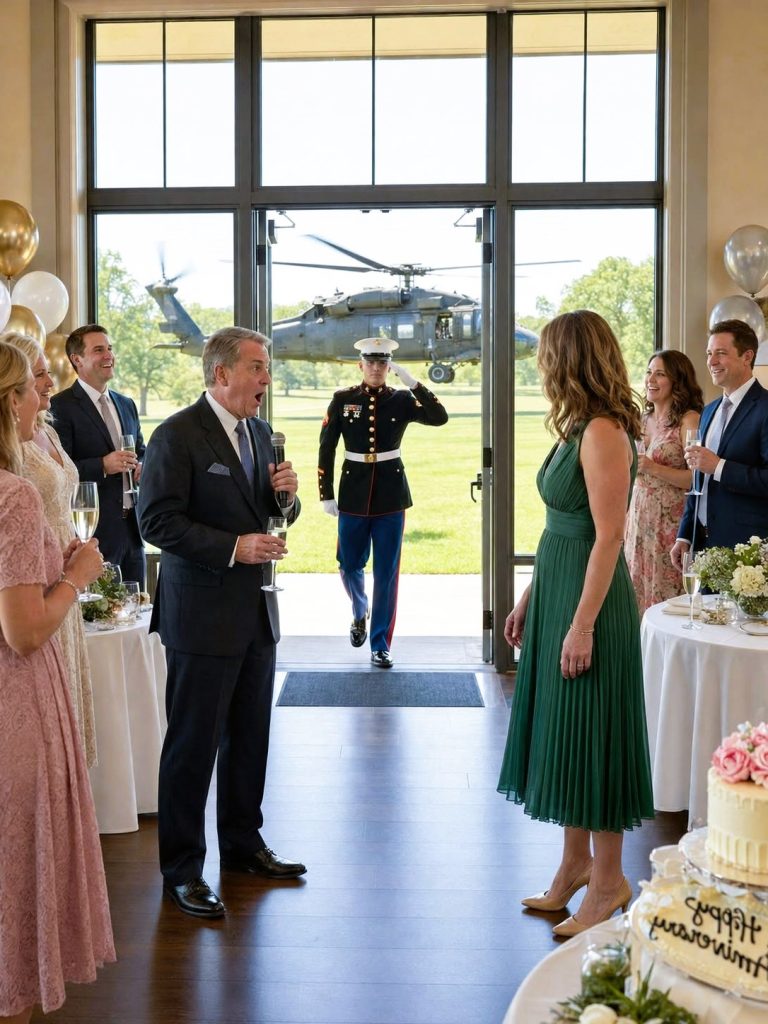
A Black Hawk dropped onto the lawn. A Marine climbed out and saluted me. “Admiral Hayes, the President is waiting.” Every trace of color disappeared from my father’s face.
My father’s company celebrated its fiftieth anniversary on a Saturday so bright that sunlight flashed from every window of the banquet hall.
I stood near the rear patio with a glass of white wine I had no desire to drink while Leonard Hayes moved from guest to guest beneath a banner that read:
HALF A CENTURY OF HAYES & SONS.
The banner had been my mother’s suggestion.
The “and Sons” part had been Dad’s.
He had exactly one son.
My brother Grant stood next to him in a navy-blue suit, one hand tucked into his pocket while the other rested casually on Dad’s shoulder, as if he had been born to stand in that photograph.
Grant had never spent a single day in uniform.
He had never delivered devastating news to the parents of a twenty-year-old sailor.
He had never stood on the bridge of a ship while violent seas crashed against reinforced windows.
He had never spent Christmas thousands of miles from home because people he would never meet were depending on him to stay where he was.
But in Dad’s eyes, Grant was the builder.
The responsible one.
The successor.
I was simply the daughter who had “joined the Navy.”
“Amelia,” Aunt Ruth called, curling two fingers toward me. “Come over here, sweetheart. We were just discussing you.”
That sentence had never ended well for me.
Still, I walked over.
Family has a way of planting habits so deeply inside you that you continue following them long after you understand exactly what they are doing.
Ruth’s pearl necklace sat perfectly against her dress, and I could smell her perfume before I even reached her.
“Are you still doing that military work?” she asked, giving me a small, sympathetic smile.
“That military work,” I echoed. “Yes.”
“Oh, bless you. And how old are you now? Forty?”
“Thirty-nine.”
“And still no husband?”
One of my cousins suddenly found his drink extremely interesting.
“My career keeps me busy,” I replied.
Dad heard that.
Naturally, he did.
His head turned at once, exactly the way it always did whenever he sensed an opportunity to reduce me in front of an audience.
“Career,” he called with a laugh. “She calls it a career. Amelia, come tell everybody about your ships.”
The people around him shifted apart to make room for me.
I stepped into the center of chilled wine, baked salmon, and cigar smoke that clung to the jackets of men who had spent the afternoon praising my father.
Dad wrapped an arm around my shoulders.
His grip was tighter than it needed to be.
“This is my daughter, Amelia,” he announced. “She’s been with the Army for, what, fifteen years now?”
“The Navy,” I corrected.
A few guests smiled awkwardly.
“Right, right. Navy. And how long?”
“Twenty-two years.”
“Twenty-two.” He let out a low whistle. “Can you imagine? Twenty-two years pretending to be a sailor.”
Several people laughed.
Not viciously.
Somehow, that made it worse.
They laughed because Dad had given them permission to laugh.
Because he was hosting the party.
Because everyone standing in that circle already knew who was supposed to be important.
“Dad,” I said softly.
He didn’t stop.
“I told her when she enlisted, didn’t I, Claire? I said, ‘Sweetheart, the military is going to chew you up and spit you out.’ But she never listened to me.”
My mother stood beside the cake table in her pale blue dress, her hands folded neatly in front of her.
She gave me the same expression she had been giving me since I was seventeen.
Please don’t turn this into a problem.
Dad raised his glass.
“I’m still waiting to find out whether I was right.”
The laughter was louder this time.
Something inside me became completely still.
I could have corrected him.
I could have told everyone in that room that I wasn’t “pretending to be a sailor.”
I could have told them about the strike groups I had commanded.
The operations I had overseen.
The Cabinet officials I had briefed.
The thousands of sailors whose safety had rested partly on decisions carrying my signature.
I could have told them that the stars on my uniform had not been handed out because someone felt sorry for me.
But I had spent most of my life trying to explain myself to a man who had already decided not to understand me.
So I smiled.
Then the glass doors behind us started to tremble.
The laughter scattered as everyone turned toward the lawn.
The vibration intensified, making glasses rattle against the tables while the noise outside swallowed every conversation in the banquet hall.
Dad’s arm fell away from my shoulders.
Through the windows, a Black Hawk descended toward the grass.
Guests rushed toward the doors.
Napkins blew from outdoor tables.
A cluster of children squealed and covered their ears.
Grant stared through the glass.
“What the hell?”
The helicopter touched down fifty yards from the patio.
The side door opened.
A Marine officer stepped out first.
Then another.
Both moved quickly toward the building.
Dad looked delighted for half a second.
He probably assumed some government official had come to congratulate him.
That was the kind of man my father was.
If a helicopter landed at his party, surely it must be there for Leonard Hayes.
The first Marine reached the patio.
He scanned the crowd.
Then his eyes found me.
His posture changed instantly.
He stopped three feet away.
Came to attention.
And saluted.
“Admiral Hayes.”
Nobody laughed.
I returned the salute.
“Colonel.”
“Ma’am, apologies for the interruption. The President is waiting for your secure briefing. We have a developing situation, and your presence has been requested immediately.”
Behind me, someone dropped a fork.
The sound was absurdly clear.
Dad whispered, “Admiral?”
The colonel glanced toward him, then back to me.
“Yes, sir.”
Dad’s face drained.
Grant looked at me as if I had suddenly become a stranger.
Aunt Ruth actually whispered, “Oh my God.”
I set my untouched wine on the table.
“Give me two minutes.”
“Yes, ma’am.”
The colonel stepped back.
I turned toward my father.
For once, Leonard Hayes had no joke ready.
No correction.
No speech.
He simply stared.
“Amelia,” he said slowly, “you’re an admiral?”
“Yes.”
“How long?”
“Three years.”
My mother covered her mouth.
“Three years?”
I looked at her.
“Yes, Mom.”
Dad’s voice became sharper.
“Why didn’t you tell us?”
That question almost made me laugh.
“I did.”
He frowned.
“No, you didn’t.”
“At Christmas three years ago.”
Silence.
“I told you I’d been selected for promotion.”
Dad blinked.
“You said something about getting another star.”
“Yes.”
“I thought you meant some commendation.”
Grant looked away.
I continued.
“Then I sent you the ceremony invitation.”
Mom’s face changed.
“What invitation?”
I looked at her.
“The one mailed to the house.”
Dad’s eyes shifted.
There it was.
Recognition.
Small.
But unmistakable.
“You saw it,” I said.
He rubbed his mouth.
“I get a lot of mail.”
“It required a response.”
“I was busy.”
“You didn’t come.”
Mom turned toward him.
“Leonard?”
He ignored her.
I looked at Grant.
“You were invited too.”
Grant swallowed.
“I had a board meeting.”
“You sent me a text that morning.”
His eyes lowered.
“What did he say?” Mom asked.
I remembered every word.
“Congrats on whatever Navy thing this is. Dad says you understand we can’t shut down the office for ceremonies.”
The silence around us became unbearable.
Dad looked at the guests.
He hated public embarrassment.
Always had.
“Maybe this isn’t the place.”
I smiled faintly.
“You made it the place.”
The colonel stepped forward.
“Ma’am, we need to move.”
I nodded.
I turned to my mother.
“I’ll call you when I can.”
She grabbed my hand.
“Amelia, wait.”
I looked at her.
Her eyes were wet.
“I didn’t know.”
“I know.”
That answer hurt both of us.
Because it was true.
She didn’t know.
But she also hadn’t tried very hard to know.
I walked toward the helicopter.
Behind me, nobody spoke.
The rotor wash pushed my hair loose from its clip.
The colonel helped me aboard.
As the Black Hawk lifted, I looked down through the open side.
My father stood in the middle of his perfect lawn surrounded by businessmen, relatives, and employees.
For the first time in my life, he looked small.
Not because I outranked him.
Not because a helicopter had come for me.
Because the story he had told about his daughter had collapsed in front of everyone who believed it.
Four hours later, I was inside a secure conference facility participating in a briefing that had nothing to do with my family.
That was one of the strangest things about responsibility at that level.
The world did not care that my father had just discovered my rank.
There were ships moving.
Aircraft repositioning.
People waiting for decisions.
So I did my job.
By midnight, the immediate crisis had stabilized.
I finally checked my personal phone.
Forty-seven messages.
Grant.
Aunt Ruth.
Three cousins.
Two people from Dad’s company I hadn’t spoken to in years.
And seventeen calls from my mother.
There was one text from Dad.
Call me.
Nothing else.
No apology.
No congratulations.
Just an order.
Some things never changed.
I called Mom first.
She answered immediately.
“Amelia?”
“Hi.”
She started crying.
“I am so sorry.”
I leaned against the hallway wall outside the briefing room.
“For what?”
“For not knowing.”
I closed my eyes.
“You knew enough.”
“No.”
Her voice cracked.
“I knew you were doing well. I didn’t know how well.”
“That’s not the point.”
She became quiet.
“The point is you never asked.”
“I asked.”
“Mom, asking whether I’m ‘still doing military work’ is not asking.”
She cried harder.
I hated hurting her.
But for once, I refused to soften the truth.
“You came to Grant’s promotion dinner when he became regional vice president.”
“Yes.”
“You flew to Dallas when Dad received his industry award.”
“Yes.”
“You hosted a party when Grant bought his first company car.”
Silence.
“When I took command of my first ship, you mailed me socks.”
Mom let out a broken laugh through her tears.
“They were good socks.”
“They were excellent socks.”
For a second, we both laughed.
Then I said, “But you didn’t ask what command meant.”
She whispered, “No.”
“When I made captain, Dad told me officers were basically administrators.”
“Oh, Amelia.”
“When I was promoted to rear admiral, nobody came.”
“I’m sorry.”
“I know.”
There was a pause.
Then Mom said, “Your father is furious.”
I almost smiled.
“At me?”
“At himself, I think. But he doesn’t know how to say that, so right now it looks like anger at everyone else.”
That sounded exactly like Dad.
“He wants you to call him.”
“I will.”
“When?”
“Tomorrow.”
“Please don’t wait too long.”
I looked through the window at the lights outside.
“I waited twenty-two years for him to take my career seriously. He can wait until morning.”
Mom did not argue.
The next day, I called at 8:15.
Dad answered on the first ring.
“Amelia.”
“Dad.”
“What happened yesterday?”
“I was called away for work.”
“I understand that.”
“No. You asked what happened.”
He exhaled sharply.
“You know what I mean.”
I waited.
Finally he said, “Why didn’t I know?”
There it was again.
Why didn’t I know?
As though information had failed to locate him.
“Because you never listened.”
“I listened.”
“No.”
“I may not understand military terminology.”
“You didn’t need to understand terminology to ask questions.”
He fell silent.
I continued.
“When I told you I commanded a destroyer, you asked whether there were men above me making the real decisions.”
His voice lowered.
“I don’t remember saying that.”
“I do.”
“People say things.”
“When I made captain, you joked that I finally had a title sailors might respect.”
“I was teasing.”
“When I received my first star, you didn’t come.”
“I told you—”
“You were busy.”
“Yes.”
“You have been busy for twenty-two years.”
He sighed.
“So what do you want from me?”
That question stopped me.
“What?”
“What do you want? An apology? Fine. I’m sorry.”
It sounded like paying a parking ticket.
I closed my eyes.
“No.”
“No?”
“I don’t want an apology you’re giving because people saw you get embarrassed.”
“That’s not fair.”
“Isn’t it?”
He became angry.
“You think yesterday was easy for me?”
I laughed.
“Dad, yesterday was not about you.”
“It happened at my anniversary celebration.”
“Because you chose your anniversary celebration to mock me.”
“I was joking!”
“And everybody laughed.”
“You could have told them to stop.”
“I spent twenty-two years telling you to stop.”
Silence.
That landed.
His voice changed slightly.
“I thought the Navy was a phase.”
“For twenty-two years?”
“I thought eventually you’d come home.”
“To do what?”
“Join the family business.”
There it was.
I had always suspected it.
But hearing him say it made the past rearrange itself.
“You thought if you ignored my career long enough, I’d abandon it.”
“I wanted you here.”
“You wanted me useful to you.”
“That is not what I said.”
“Grant stayed. I left. Grant became the good child.”
“He committed to the family.”
I stared at the wall.
“And I committed to something else.”
“Yes.”
“At seventeen.”
“You were too young to understand.”
“I was old enough to serve.”
“You were stubborn.”
“I was determined.”
“We can argue vocabulary all day.”
“No, Dad. We can’t.”
My voice softened.
“You spent my entire adulthood calling my purpose a rebellion because it wasn’t the purpose you picked for me.”
He didn’t answer.
I could hear him breathing.
Then he asked quietly, “Are you really an admiral?”
For some reason, that question almost made me cry.
“Yes.”
“How many stars?”
“Three.”
Another silence.
“What exactly do you do?”
It was the first real question he had asked about my work in decades.
I sat down.
So I told him.
Not classified information.
Not operations.
Just enough.
I explained my command responsibilities.
How many people worked under the organizations I oversaw.
The years at sea.
The positions that led there.
The promotion process.
He listened.
Actually listened.
When I finished, he said, “That sounds… significant.”
I smiled despite myself.
“It is.”
He cleared his throat.
“I looked you up last night.”
Of course he had.
“What did you find?”
“More than I expected.”
I waited.
“You have a Wikipedia page.”
That made me laugh.
Dad sounded offended that the internet had known more about his daughter than he did.
“It’s not exactly an official qualification.”
“There were articles.”
“Yes.”
“A photo of you with the Secretary of Defense.”
“Yes.”
“Another with the Prime Minister of Japan.”
“That was a delegation visit.”
“And you commanded more than ten thousand people?”
“At one point.”
He became quiet.
Then he said something so softly I almost missed it.
“I should have known.”
My throat tightened.
“Yes.”
“I should have known.”
This time, there was no defense attached.
No excuse.
Just the truth.
That mattered.
But it did not fix everything.
Family stories rarely transform because of one dramatic moment.
The helicopter did not magically make Dad a different father.
It merely made denial impossible.
A week later, Grant called.
I almost ignored him.
Then I answered.
“Hey.”
“Hey.”
He sounded uncomfortable.
“I owe you an apology.”
I waited.
“For what?”
“For letting Dad do that.”
“That’s a long list.”
He sighed.
“At the party.”
“And every other time?”
Silence.
I wasn’t making it easy for him.
I had made things easy for everyone for too long.
Grant finally said, “Yeah. Every other time too.”
That surprised me.
He continued.
“I liked being the one Dad was proud of.”
There it was.
Honesty.
“I know.”
“I think I let him dismiss you because it made me feel more important.”
My anger softened.
Not disappeared.
Softened.
“Why are you telling me this?”
“Because when that helicopter landed, everybody looked at me like I was some idiot.”
I laughed.
“Very noble motivation.”
“I’m serious.”
“So am I.”
He chuckled.
Then he said, “I realized something.”
“What?”
“I’ve spent my whole life being Dad’s successful son.”
“And?”
“And I don’t actually know what success means without him telling me.”
That was more vulnerable than I had ever heard my brother.
I leaned back.
“You run a good company.”
“His company.”
“You helped grow it.”
“He still introduces me as his boy.”
I smiled.
“Welcome to the club.”
Grant laughed.
Then went quiet.
“I’m proud of you.”
I didn’t answer immediately.
Twenty-two years late.
Still, I wanted to hear it.
“Thank you.”
Three months passed.
Dad called more often.
At first, the questions were awkward.
“What ocean are you on?”
As if admirals wandered around oceans like fishermen.
Then:
“How many people are in a fleet?”
Then:
“Do people actually call you Admiral all day?”
Sometimes the questions made me smile.
Other times they made me angry because I kept thinking:
You could have asked me these things twenty years ago.
But relationships are rarely repaired on the schedule of the injured person.
That is one of the most frustrating truths I know.
Dad was learning.
Slowly.
I was deciding whether learning late still counted.
Then he surprised me.
My mother called one Thursday.
“You’re going to want to see this.”
“What?”
“Check your email.”
There was an invitation from Hayes & Sons.
Annual leadership dinner.
I nearly deleted it.
Then I opened the attached program.
Keynote Speaker:
VICE ADMIRAL AMELIA HAYES, UNITED STATES NAVY.
I stared at it.
Then called Dad.
“What is this?”
“My dinner.”
“I can see that.”
“I want you to speak.”
“To your company?”
“Yes.”
“Why?”
He hesitated.
“Because I owe you a room where nobody is laughing.”
That shut me up.
“Dad.”
“I spent a lot of years making you feel like what you did was less because I didn’t choose it.”
My eyes burned.
He continued.
“I can’t change that.”
“No.”
“But I can stop doing it.”
That was the first apology I believed.
I accepted.
The leadership dinner was held in the same banquet hall.
Same windows.
Same lawn.
No helicopter this time.
I wore my dress uniform.
When I entered, people stood.
Dad waited beside the stage.
For once, he didn’t put an arm around me like he owned the introduction.
He simply stepped to the microphone.
“My daughter has spent most of her life doing work I was too stubborn to understand.”
The room became quiet.
He looked at me.
“I used to joke that the Navy would chew her up and spit her out.”
A few people shifted uncomfortably.
Dad continued.
“I was wrong.”
No laughter.
“I thought strength meant staying close to home, running the family business, and building something with your name on the door.”
He looked toward Grant.
“My son Grant did that, and I’m proud of him.”
Then he turned back toward me.
“But Amelia taught me there are other ways to build.”
My throat tightened.
“She built teams.”
“Commands.”
“Trust.”
“She carried our family name into rooms I will never enter and earned respect I never bothered to understand.”
His voice broke slightly.
“I’m proud of her too.”
There are sentences you imagine hearing so many times that when they finally arrive, they sound strangely small.
I’m proud of you.
Four words.
They could not return twenty-two years.
They could not put my parents in the audience at my promotion ceremony.
They could not erase every family dinner where I was treated like the rebellious daughter who refused to grow up.
But they mattered.
I stepped onto the stage.
Dad held out his hand.
I looked at it.
Then hugged him.
The room applauded.
Quietly at first.
Then louder.
Dad whispered near my ear, “I’m sorry.”
“I know.”
“No. Really.”
I pulled back.
“I know.”
Then I gave my speech.
I didn’t talk about classified missions.
I didn’t talk about medals.
I talked about leadership.
About responsibility.
About how authority means very little if the people beneath you are afraid to speak honestly.
I talked about the danger of deciding someone’s potential before they have the chance to show you who they are.
And yes, I looked at my father when I said that.
He smiled.
After dinner, one of his longtime employees approached me.
He was an older man named Walter who had laughed at the anniversary party.
“Admiral.”
“Yes?”
“I owe you an apology.”
“You don’t.”
“I laughed.”
“Dad made a joke.”
“I still laughed.”
I considered him.
Then nodded.
“Fair enough.”
He smiled awkwardly.
“My granddaughter wants to join the Coast Guard.”
“That’s a good service.”
“I told her she should get a real job first.”
I raised an eyebrow.
Walter laughed.
“I’m reconsidering.”
“Good.”
Dad overheard.
Later, as we stood near the same patio where the helicopter had landed months earlier, he asked, “Did you know that thing was coming?”
“The helicopter?”
“Yes.”
“No.”
“You didn’t arrange it?”
I laughed.
“Dad, the military does not provide dramatic entrances to settle family arguments.”
He smiled.
“I figured.”
“It was an operational pickup.”
“So it really had nothing to do with me?”
I stared at him.
Then we both started laughing.
“No, Dad.”
He shook his head.
“I suppose that was the lesson.”
“What was?”
“That not everything is about me.”
I almost told him not to push his luck.
Instead, I smiled.
“Progress.”
He looked out across the lawn.
“I still wish you had joined the company.”
“I know.”
“You would have been terrifying in negotiations.”
“Probably.”
“And Grant could use the help.”
“Definitely.”
He laughed.
Then he grew serious.
“You happy?”
The question surprised me.
“Yes.”
“Really?”
“Yes.”
He nodded.
“That’s what I should have asked years ago.”
I looked at him.
“Yes.”
We stood there quietly.
My father and me.
Not fixed.
Not magically healed.
But finally honest.
A year later, Dad attended my retirement-of-command ceremony.
Front row.
Beside Mom.
Grant was there too.
When my name was announced, Dad stood before everyone else.
He clapped so hard my mother had to pull him back into his seat.
Afterward, he asked if he could see my stars.
I handed him my uniform cap.
He ran one finger beneath the insignia.
“Three,” he murmured.
“Still three.”
He smiled.
“I know what they mean now.”
I looked at him.
“That’s enough.”
People sometimes tell this story as though the helicopter changed everything.
It didn’t.
The helicopter merely interrupted a lie.
The lie was that I had failed because my life did not resemble the one my father had planned.
The lie was that Grant’s path counted because it stayed inside the boundaries Dad understood.
The lie was that a daughter could serve for twenty-two years, lead thousands, and still be treated like a teenager who had made an impulsive career choice.
What changed everything was what happened afterward.
Dad asked questions.
Grant admitted the truth.
Mom stopped asking me to keep the peace whenever keeping peace meant accepting humiliation.
And I stopped shrinking my own life just to make my family comfortable.
That mattered most.
For years, whenever Dad mocked my career, I tried to answer gently.
I explained.
Defended.
Corrected.
Proved.
Eventually, I learned that sometimes you do not need to prove who you are.
You simply need to stop accepting someone else’s definition.
The Saturday that Black Hawk touched down on my father’s lawn, he finally saw the rank on my shoulders.
But I had earned it long before he noticed.
And that may have been the most important lesson of all.
Your worth does not begin the moment someone finally recognizes it.
Sometimes they are simply late to the ceremony.
THE END! THANKS FOR READING!