
The first thing my father did when I came home was laugh at me. Not the soft laugh people use when they are trying not to cry. Not the awkward laugh a father might make after three years of silence, missed holidays, and half-finished phone calls.
A real laugh. A backyard laugh. A laugh meant to travel from the grill to the patio table and land in front of everyone who still remembered me as the girl who used to sit alone on the porch steps.
Frank Carter lifted his greasy spatula like he was pointing traffic away from his house. Then he shouted, “The bus stop’s that way.”
For half a second, nobody moved. The burger smoke curled up behind him.
The country song coming from the patio speaker crackled through a bad connection.
The Texas heat pressed against my face, thick and wet, and the grass under my boots felt too soft after so much concrete, metal flooring, and packed dust overseas.
Then my brother Jake barked out a laugh.
That was all it took.
A cousin near the cooler chuckled into his beer can.
My aunt turned her mouth into a hard little line, pretending she was not about to smile.
A neighbor I barely recognized looked away too late, which meant he had seen the whole thing and decided it was easier to become part of the furniture than part of the moment.
I stood there with my old sand-colored duffel in one hand.
I was wearing dark jeans, worn boots, and a plain black T-shirt, the kind of clothes that could get you through an airport, a staff room, a hangar, and a family cookout without asking to be noticed.
The sun bounced off the driveway in white sheets.
Somebody had mowed that morning, and the cut-grass smell mixed with lighter fluid, cheap beer, onion, smoke, and burgers that had already crossed from done to punished.
Cicadas screamed from the live oaks behind the fence like they were trying to drown out the patio speaker.
I had imagined this homecoming on the flight back.
That was the first mistake.
The itinerary in my backpack said I had landed just after noon.
My phone still had the group text from my mother, three messages in a row, all practical: Your father starts grilling at 3, park on the street if the driveway is full, don’t make a big entrance.
I had looked at that last line for a long time in the airport bathroom.
Don’t make a big entrance.
As if my showing up at my own father’s seventieth birthday after three years away could be made small enough for him to tolerate.
I had imagined my mother stepping off the porch when she saw me.
I had imagined her hand over her mouth, maybe tears, maybe the kind of shaky smile that could make the last three years feel less empty.
I had imagined my father pretending not to care, because pretending had always been easier for him than apologizing.
Maybe he would clear his throat.
Maybe he would slap my shoulder too hard and say, “Good to see you, kid.”
Maybe he would ask if I had eaten.
When I was in high school, if I came home late from work, he sometimes left a plate for me on the kitchen counter without a note.
It was never warm.
It was never tender.
But it was there.
When you grow up in a house where love comes in disguised forms, you learn to call a paper plate under foil a peace offering.
So I had imagined too much.
My mother was not on the porch.
She was beside the picnic table, arranging paper plates that were already straight.
She wore a blue sundress and flat sandals, and her hair was pinned back the way she wore it when she wanted the world to believe everything in our family was organized.
Her smile kept slipping.
When my father humiliated me in front of the whole yard, she looked down at the plastic forks instead of at me.
That was what got through.
Not the joke.
Not Jake laughing.
Her eyes choosing the forks.
“Good to see you too, Dad,” I said.
My voice came out even.
There were skills you learned because you wanted them, and there were skills you learned because life cornered you until you had no choice.
Keeping my face still was one of mine.
I had answered questions in rooms where everyone watched your mouth more than they listened to your words.
I had sat under fluorescent lights with a lanyard around my neck and a folder in front of me, knowing that one nervous sentence could make someone doubt the whole briefing.
I had stood in evacuation corridors while alarms blared and parents clutched children so hard their little shoes lifted off the floor.
I had learned how to sound calm while everything behind my ribs was moving.
Frank Carter squinted like my calm offended him.
He was seventy that day, though he would have hated hearing the number spoken with softness.
He was still tall, still broad through the chest, still sunburned across the nose and forearms from working outside when he did not have to.
His gray hair was cut short, his jaw rough with white stubble, and his anger had settled into his face so deeply it looked less like a mood than a feature.
Age had softened his body.
It had not softened his mouth.
“Well,” he said, turning a burger so hard it broke at the edge, “if it isn’t our world traveler.”
More laughter moved across the patio.
It was not loud enough to be called cruel by anyone who wanted to deny it later.
That was the old Carter family talent.
They knew how to hurt you at a volume that let them call you sensitive afterward.
Jake leaned back in his lawn chair with his sunglasses pushed into his thinning hair.
He was thirty-eight, but he still had the look of someone waiting for a football coach to clap him on the back and tell him he was the kind of man a town could believe in.
His beer rested on his stomach.
His grin was lazy.
“Still playing soldier?” he called.
I looked at him.
“Still serving,” I said.
“Serving coffee at the airport?”
My father laughed at that one.
Jake lifted his beer like he had scored something.
A cousin said, “Come on, man,” but he was smiling when he said it, so it did not count.
I set my duffel by the fence.
I did it slowly.
For a moment, I let myself picture throwing it straight through the grill lid, watching smoke and metal and burgers scatter across the patio while everyone finally had a reason to call me difficult.
Then I released the strap and straightened my fingers.
Not giving someone the reaction they want can feel like swallowing glass.
But sometimes it is the only dignity you get to keep.
My mother walked toward me with a plastic cup of iced tea.
The cup was sweating.
Her hand was too.
“You look thin,” she whispered.
Not I missed you.
Not I am glad you are alive.
Not I thought about you every night.
Just thin.
“I’m okay, Mom.”
She nodded too quickly.
“You must be tired.”
“A little.”
Her eyes jumped toward my father the way they always did before she decided how much truth the room could survive.
“Your room isn’t really made up,” she said. “We weren’t sure if you were staying.”
Of course they weren’t.
In my old room, there was probably a treadmill now, or stacked Christmas bins, or one of those boxes people label miscellaneous because they do not want to admit what they have decided is not worth sorting.
“I’m not staying long,” I said.
Something like relief crossed her face.
Then guilt chased it away.
My father heard enough to turn from the grill.
“Not staying long? You just got here.”
“I have to be back in D.C.”
Jake sat forward as if I had handed him a gift.
“D.C.? Listen to that. She says it like she’s important.”
I took a drink of the iced tea.
It was too sweet.
My mother had always made it that way because my father liked sugar better than taste.
I did not answer Jake.
That bothered him more than any comeback would have.
My cousin Deanna tilted her head.
She had been kind to me when we were kids, or at least less unkind, which in my family had once counted as loyalty.
“What do you actually do now, Emily?” she asked.
Every person at the picnic table turned a little.
That was the part I noticed.
Not a dramatic turn.
Not a movie moment.
Just shoulders shifting, faces angling, cups pausing halfway to mouths.
They expected the answer to be something small enough to laugh at.
They needed it to be.
Some families do not want you to fail because they hate you.
They want you to fail because your success would make them answer for how they treated you when you had nothing.
“I work at the Pentagon,” I said.
Jake slapped his knee.
My father shook his head and grinned down at the grill.
“The Pentagon,” he said. “Sure.”
“I do.”
“Doing what?” Jake asked. “Changing printer toner?”
The laughter came again.
This time it was easier for everyone.
The first insult had broken the seal.
Now they could enjoy themselves.
A man near the cooler said, “Hey, those printers are complicated,” and people laughed harder because cruelty always likes a witness who thinks he is being clever.
I looked at my mother.
She had both hands around the iced tea pitcher now.
Her knuckles were pale.
She did not defend me.
She did not tell them to stop.
She looked like a woman watching a storm form over a field and hoping it would choose another house.
I had carried a Pentagon badge in my pocket that morning until I changed clothes at the hotel.
I had folded my temporary travel paperwork into the side pocket of my duffel with the same care I used for briefing notes.
I had a 14:10 pickup time marked in a secure message thread I would never show anyone in that backyard.
None of it mattered there.
In that yard, I was still the quiet daughter who left after high school with a scholarship, a duffel, and no one waving from the driveway.
In that yard, Jake was still the son who could wreck two trucks, lose three jobs, and get called unlucky.
In that yard, my father still believed respect was something he owned and loaned out when people amused him.
“So what is it?” Jake pressed. “You can’t say? Is that the big act?”
I met his eyes.
“Some of it, no.”
That set them off again.
My father made a show of lowering his voice.
“Careful, everybody. Emily might be classified.”
The neighbor laughed into his beer.
My aunt finally let her smile show.
Deanna looked down at her lap.
My mother whispered my name like a warning.
I could have left then.
I could have picked up my duffel, walked back down the driveway, and waited by the mailbox until my ride arrived.
I could have spared them what was coming.
But mercy is not the same thing as letting people keep the lie that makes them comfortable.
So I stayed.
The heat thickened.
The music changed songs.
A child from next door kicked a soccer ball against the fence and got yelled at by someone I could not see.
My father pulled another burger off the grill and dropped it onto a plate with the satisfied force of a man who believed feeding people erased whatever he had just said to them.
“You want one?” he asked me.
“No, thank you.”
“Too good for burgers now?”
“I ate on the plane.”
“Plane,” Jake repeated. “Hear that? Not bus. Not car. Plane.”
He looked around for approval.
He got it.
Then my phone buzzed once in my back pocket.
I did not take it out.
I already knew.
You learn the sound of timing when your work depends on it.
A minute early.
Maybe two.
The world did not announce itself all at once.
First, the patio speaker popped.
Then the cicadas seemed to thin.
Then a napkin slid across the picnic table, slow at first, as if an invisible hand had pulled one corner.
My aunt put her palm on it.
Another napkin lifted anyway.
Jake frowned toward the trees.
“What the hell is that?”
It started low.
Deep.
Not thunder, though a few people looked at the sky.
Not a truck, though my father turned toward the street.
The sound came through the ground as much as the air, a heavy mechanical pulse that made the iced tea tremble in its cup.
My father lifted the spatula again.
He was going to make another joke.
I could see it forming.
Something about my fancy ride.
Something about buses.
Something about me always needing attention.
Then the shadow crossed the driveway.
It moved over the parked cars first.
Then over the fence.
Then over the picnic table, the cooler, the grill, the blue dress my mother wore, the beer in Jake’s hand, and every face that had been laughing thirty seconds earlier.
The plates lifted.
Not one.
All of them.
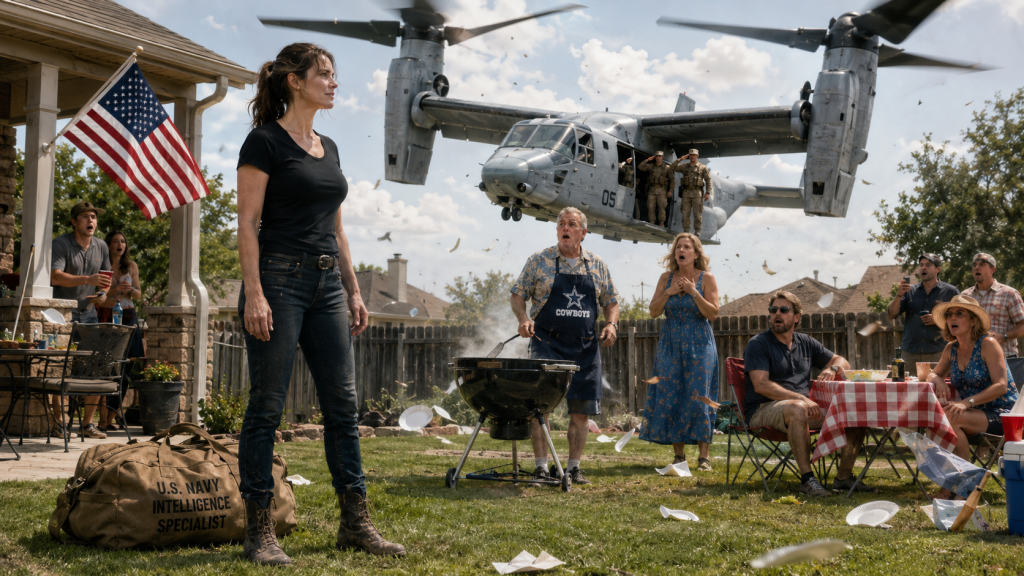
White paper plates spun off the table and slapped against the grass, the patio, a cousin’s leg.
The plastic forks scattered.
Beer cans rolled under lawn chairs.
The cooler lid banged open.
My mother’s iced tea pitcher tipped, and amber liquid poured across the tablecloth.
Nobody laughed.
The V-22 Osprey came down through the heat with its rotors beating the air into waves.
It was so loud the whole yard became one sound.
The grass flattened outward.
Dust lifted near the fence line.
Jake stumbled backward from his chair, one hand on his sunglasses, the other uselessly clutching his beer.
My aunt grabbed the table.
Deanna reached for my mother.
My father stood beside the grill with the spatula still raised, his mouth open, his face stripped of every joke he had saved for me.
I picked up my duffel.
The canvas was warm from the sun.
For a second, I remembered being seventeen on that same lawn, carrying two trash bags full of clothes to an old sedan because I did not own a suitcase yet.
My father had stood in the doorway then too.
He had not asked where I would sleep.
He had only said, “Don’t come running back when it gets hard.”
It had gotten hard.
It had gotten harder than anything he had the imagination to threaten me with.
But I had not run back.
I walked toward the aircraft.
Not because I wanted to show off.
Not because I wanted applause.
Because my ride was here, and for once my family was going to have to watch me leave in a way they could not turn into a punchline.
My mother said something, but the rotors tore it apart.
Her eyes were wide now.
Not nervous.
Not careful.
Wide.
The side door began to open.
Two uniformed officers appeared in the hard white light.
Their boots hit the grass.
They moved with the kind of control that quiets a room even when the room is an entire backyard under the roar of an aircraft.
They stepped toward me.
I stopped beside the picnic table.
The plates were everywhere.
The iced tea was dripping off the edge.
Jake had gone pale under his sunburn.
My father lowered the spatula slowly, as if his arm had just remembered it was attached to him.
The officers did not look at the grill.
They did not ask who Frank Carter was.
They did not scan the yard for a man to explain me.
They looked at me.
Both of them stopped in front of me.
Then they saluted.
The gesture cut through the noise more cleanly than any shout could have.
My mother reached for the table and missed.
Deanna caught her under the arms before her knees gave out completely.
Someone gasped.
Someone said, “Oh my God,” so softly it almost disappeared beneath the rotors.
I returned the salute.
My hand was steady.
That was the part my father saw.
Not the aircraft.
Not the uniforms.
Not the fact that every person in his backyard had gone silent.
He saw my hand go up, calm and exact, and he realized there was a version of me the world had known for years that he had never bothered to meet.
The older officer lowered his hand first.
His face did not change.
He turned just enough for my family to hear him over the storm of the blades.
Then he said my rank.
Jake’s mouth opened.
My father’s spatula slipped from his hand and hit the concrete.
I looked at my mother, who was still standing only because Deanna held her up.
Her lips moved around my name.
For once, no one laughed.
For once, no one knew how to make me smaller.
And as the officer reached for the next sentence, the one that would explain why a V-22 had landed on Frank Carter’s lawn in the middle of his birthday cookout, my father took one step toward me and whispered, “Emily, what did you do?”
THE END! THANKS FOR READING!