
 Reading Time: 17 minutes
My daughter-in-law pocket-dialed me at 7:15 this morning. She never knew I answered. For nineteen minutes I sat at my kitchen table with my tea going cold and listened to her and my son plan, in detail, what they were going to do with me by Christmas. They were in the car.
They were driving to my house. So I pulled my grocery notepad closer, clicked my pen, and started writing down every word.
My name is Dorothy Bennett.
I am seventy-three years old.
My husband Raymond has been gone four years now.
My son Mark calls me every Sunday at five, for exactly eleven minutes.
Not ten.
Not twelve.
Eleven.
He asks if I have groceries.
If the furnace is behaving.
If I remembered to take my blood pressure medication.
Then his wife, Alicia, usually calls from across the room, “Love you, Mother D,” in that sugary voice of hers, and Mark says he has to go.
That has been our relationship for the last few years.
Orderly.
Scheduled.
Polite.
Thin.
The phone rang at 7:15 that morning, and when Alicia’s name appeared on the screen, my first thought was that someone was in the hospital.
Nobody calls an old woman that early with good news.
I answered immediately.
“Alicia?”
No reply.
Road noise.
Turn signal.
A radio playing softly.
Then Alicia spoke.
Not to me.
“Did you bring the folder?”
“It’s in the back seat,” Mark said.
My son.
“And the brochure?”
“Glovebox.”
I opened my mouth.
I almost said, “Hello? You called me.”
Then Alicia laughed.
“Relax, Mark. She’ll sign. She signs whatever we put in front of her. Remember the flu shot forms? She didn’t read one line.”
I stopped breathing for a second.
Then I put my hand flat on the kitchen table.
Raymond used to say something whenever we had to deal with insurance companies, contractors, taxes, doctors, or anybody who thought age meant foolishness.
“Dot, when it matters, write it down.”
So I reached for the grocery pad beside the sugar bowl.
Clicked my pen.
And wrote:
7:19 a.m.
Mark: “What if she asks to read it first?”
Alicia: “Then you take her glasses to get ‘cleaned.’ Honestly, do I have to think of everything?”
I stared at the words.
My reading glasses were sitting three inches from my hand.
I picked them up.
Put them on.
Kept listening.
7:21.
The brochure had a name.
Silver Meadows.
I knew the place.
Everyone my age knew it.
A large assisted-living complex outside town with manicured hedges, beige hallways, scheduled bingo, and cheerful advertisements featuring elderly couples who looked suspiciously well-rested.
Alicia’s cousin worked there.
“Family discount,” she said.
Then both of them laughed.
Not cruelly.
That was almost worse.
Casually.
As though my removal from my own house was an administrative inconvenience they had solved before breakfast.
7:24.
Mark became quieter.
“It just feels fast.”
For one brief second, I heard the boy I had raised.
The child who once cried because he stepped on a beetle.
The teenager who sat beside Raymond in the garage pretending not to cry when his first girlfriend left him.
The young man who held my hand in the hospital when his father died.
“It just feels fast.”
I almost interrupted.
Almost said, “Mark, if something feels wrong, listen to it.”
Then Alicia answered.
“Fast? We have been paying for that house for four years.”
My pen stopped.
Now here is the thing you need to understand.
Nobody pays for my house.
Nobody ever has except Raymond and me.
We bought that house in 1974.
Three bedrooms.
One bath at the time.
Avocado-green refrigerator.
Ugliest carpet ever installed by human hands.
We raised Mark there.
Added a second bathroom.
Built the deck ourselves.
Replaced the roof twice.
Burned the mortgage papers in a coffee can in 1998 while drinking cheap champagne in the backyard.
I own that house to the last shingle.
What Alicia called “paying for that house” was actually something very different.
Four years earlier, after the twins were born, I handed Mark and Alicia forty thousand dollars.
They were renting a cramped townhouse then.
The twins were premature.
Alicia was not working.
Mark looked exhausted all the time.
They had found a small house near a good elementary school but did not have enough for the down payment.
Raymond had been gone only three months.
I was still walking around my own kitchen expecting to hear him cough.
Mark sat across from me and said, “Mom, I hate asking.”
So I wrote a check.
Forty thousand dollars.
No repayment agreement.
No strings.
A gift.
I told him, “Your father would want the babies to have a yard.”
He cried.
So did I.
Apparently, in Alicia’s mind, that gift had somehow become a debt I owed them.
7:26.
Alicia said, “And the minute she’s settled at Silver Meadows, we list her place. Bruce says one-eighty, easy. That’s the lake trip, that’s the boat, that’s everything.”
Bruce.
That name I knew too.
Bruce Calder.
Realtor.
Golfing friend of Mark’s.
Too-white teeth.
Too much cologne.
He had been in my living room twice.
The first time, Alicia told me he was “just admiring the crown molding.”
The second time, he stood in my dining room looking at the windows and said, “These old houses are coming back.”
I had thought he was being friendly.
Now I understood he had been appraising my life.
7:31.
Alicia said, “Let me do the talking. You just look sad. Can you manage sad?”
There was a pause.
Then Mark said, “Yeah.”
That “yeah” cost me more than everything else.
Because I knew Alicia was pushy.
I knew she liked control.
I knew Mark avoided conflict the way some people avoid dentists.
But a grown man letting his wife plan to take his mother’s house while he practiced looking sad was something else.
At 7:34, the call ended.
Probably her purse shifted.
I sat at the kitchen table for one full minute.
No crying.
No shouting.
No throwing cups.
At seventy-three, you learn something useful.
Panic wastes time.
I stood.
Rinsed my tea cup.
Then made two phone calls.
The first was to Eleanor Price.
My neighbor for forty years.
Eleanor had watched Mark learn to ride a bicycle on our street.
She knew every neighborhood scandal before the mailman.
She also owned the best phone camera in the county and understood privacy better than most lawyers.
She answered on the third ring.
“Dorothy?”
“Eleanor. I need your kitchen window and your phone camera for one hour.”
There was a pause.
Then she said, “Finally.”
I blinked.
“What does that mean?”
“I’ll tell you later.”
She hung up.
The second call went downtown.
To Theodore Halpern.
Raymond’s attorney.
Mine too.
Ted was eighty-one and refused to retire because, according to him, “retirement is how people trick you into organizing your garage.”
He had handled our mortgage paperwork, wills, Raymond’s estate, my trust, and the legal documents after Raymond died.
Ted answered himself.
“Dorothy.”
“Ted, I need you at my house at eight-forty.”
“That specific?”
“Yes.”
“Trouble?”
“My son is bringing papers for me to sign.”
Silence.
Then Ted’s voice changed.
“What kind?”
“I don’t know yet.”
“Do not sign anything.”
“I wasn’t planning to.”
“What do you need from me?”
“Bring copies of my deed, trust, power of attorney, and whatever shows who can sell my house.”
“Anything else?”
“Yes.”
“What?”
“Come through the front door like you own the place.”
He laughed.
“I can do that.”
Ten seconds.
That was all it took.
After hanging up, I put out the good cups.
The blue-and-white china my mother left me.
I sliced the banana bread Alicia always praised and never ate.
Set butter on a little glass dish.
Three places.
Then a fourth.
I placed my grocery pad under the newspaper beside my chair.
At 8:22, Eleanor texted me.
I’m ready.
At 8:40, a silver SUV turned into my driveway.
I watched from behind the living-room curtain.
Alicia checked her lipstick in the visor mirror.
Mark sat still for several seconds.
Then she touched his arm.
Said something.
He nodded.
Practiced looking sad.
I saw it.
Actually saw my son change his face.
The doorbell rang.
I counted to ten.
The way I used to when Mark was little and throwing a tantrum.
Then I opened the door.
“What a surprise!”
Alicia leaned forward and kissed the air beside my cheek.
“Mother D.”
Mark kissed my forehead.
Too quickly.
They came inside.
Alicia carried a leather folder against her chest.
Mark carried the Silver Meadows brochure.
I pretended not to notice.
“Come in. I even have banana bread.”
“Oh, you shouldn’t have,” Alicia said.
She had been planning to move me out of my home before Christmas and was still capable of criticizing my baking schedule.
People are remarkable.
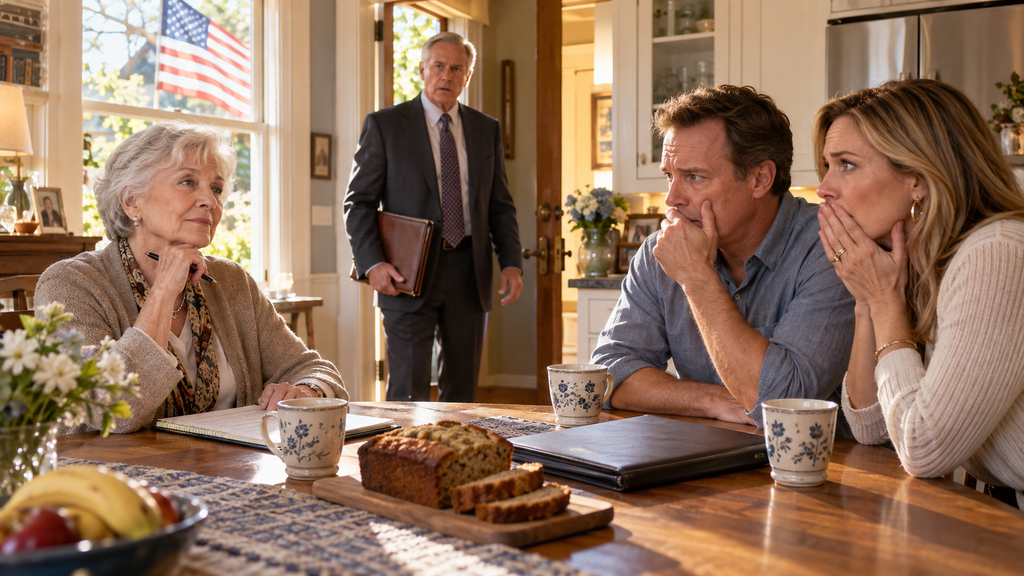
We sat at the kitchen table.
Mark would not look at me.
Alicia sat across from me and placed the folder beside the butter dish as casually as if it contained coupons.
I poured coffee.
She touched my wrist.
“Mother D, Mark and I have been thinking about what’s best for you.”
“I appreciate that.”
Her shoulders relaxed slightly.
“This house is a lot.”
“It certainly has a lot of dust.”
She laughed too hard.
“And stairs.”
“Oh, yes.”
“You shouldn’t be alone here.”
I looked around.
Sunlight through the lace curtains.
Raymond’s old clock ticking above the stove.
The little crack in the tile Mark made when he dropped a bowling ball at sixteen.
Forty-nine years of living in one room.
“I suppose not,” I said.
Mark finally looked up.
Alicia smiled.
“We found somewhere wonderful.”
She slid the brochure toward me.
SILVER MEADOWS SENIOR LIVING.
Smiling gray-haired couple on the cover.
Walking beside a pond.
“What a nice pond,” I said.
“Exactly,” Alicia replied. “They have activities, meals, transportation, nurses nearby.”
“I have a car.”
“Well, for now.”
Mark flinched.
Small.
But I saw it.
Alicia opened the folder.
“There are just a few forms.”
“What kind?”
“Nothing complicated. Preliminary placement paperwork. Some financial authorizations.”
I adjusted my glasses.
Her eyes flicked toward them.
I almost laughed.
She had actually planned to steal my glasses.
“Financial authorizations?”
“Standard.”
Mark said quietly, “Mom, it’s just so they can handle everything.”
“Who is they?”
Alicia answered.
“The facility. And us, obviously.”
I nodded.
“Obviously.”
She took out a pen.
Clicked it.
“It’s boring stuff. You don’t need to read every—”
The doorbell rang.
Alicia frowned.
“Are you expecting someone?”
“Oh,” I said, pushing my chair back. “Didn’t I mention?”
I opened the door.
Ted Halpern stood on my porch in a charcoal suit holding a leather briefcase and a thick blue folder.
Behind his glasses, his eyes were bright.
“Morning, Dorothy.”
“Come in.”
He stepped into the kitchen.
Alicia’s face changed.
Not much.
Just enough.
Mark knew him immediately.
“Mr. Halpern?”
“Mark.”
Ted sat in the fourth chair.
Placed his folder on the table.
“Morning, folks.”
Nobody answered.
I poured him coffee.
He took one sip.
“Good.”
Then looked at me.
“You want to start?”
I reached beneath the newspaper.
Pulled out my grocery pad.
Placed it between the butter and the banana bread.
Alicia stared at it.
“What’s that?”
“Nineteen minutes.”
She frowned.
“Nineteen minutes of what?”
“Your pocket call.”
The room changed.
Mark went white.
Alicia did not move.
I opened the pad.
“Seven-fifteen this morning. You called me.”
She shook her head.
“No, I didn’t.”
“You did.”
“That’s impossible.”
“Road noise. Radio. Mark asking whether you brought the folder.”
Mark closed his eyes.
Alicia turned to him.
“You said my phone was in my purse.”
“It was.”
I continued.
“Seven-nineteen. You said I would sign because I sign whatever you put in front of me.”
Alicia’s mouth opened.
Nothing came out.
“Seven-twenty-one. Silver Meadows. Your cousin works there. Family discount.”
“Dorothy—”
“Seven-twenty-four. Mark said it felt fast.”
My son looked at me.
Shame.
There it was.
Finally.
“Seven-twenty-six. You said once I was ‘settled,’ Bruce could list my house for one-eighty. Lake trip. Boat. Everything.”
Alicia stood.
“This is ridiculous.”
Ted said calmly, “Sit down.”
She stared at him.
He did not raise his voice.
He did not need to.
“Mrs. Bennett,” he said, “if you intend to discuss Dorothy’s property or any documents you brought for her signature, I recommend you remain seated.”
Alicia sat.
Mark whispered, “Mom, it wasn’t what it sounded like.”
I looked at him.
“Good. Then explain it.”
He opened his mouth.
Closed it.
Alicia stepped in.
“We’re worried about you.”
“That’s not an explanation.”
“You live alone.”
“So does Eleanor.”
“That’s different.”
“Why?”
“She’s healthier.”
From next door, through the open kitchen window, Eleanor coughed dramatically.
Alicia’s head snapped toward the sound.
I nearly smiled.
Ted opened his folder.
“Dorothy asked me to clarify her legal position.”
He placed a copy of my deed on the table.
“The property at 418 Maple Street belongs solely to Dorothy Bennett.”
Alicia rolled her eyes.
“We know that.”
Ted looked at her.
“Do you?”
Silence.
“The mortgage was satisfied in 1998. There are no liens. No co-owners. No outstanding obligations that would give either of you a claim.”
Mark stared at the deed.
I could tell he had never seen it.
Ted continued.
“Dorothy’s house is also addressed in her estate planning documents.”
Alicia’s chin lifted.
“We weren’t talking about inheritance.”
“No?”
“No.”
“You were talking about listing her house.”
She crossed her arms.
“If she moves somewhere safer, obviously the house would be sold.”
“Not obviously.”
Alicia’s eyes narrowed.
Ted turned to Mark.
“You currently hold a durable financial power of attorney granted after your father died.”
Mark looked confused.
“Yes.”
“Not anymore.”
Alicia’s face changed.
Ted placed another document on the table.
“Dorothy revoked it at 8:06 this morning.”
Mark stared at me.
“Mom.”
I said nothing.
He looked at Ted.
“She revoked it?”
“Yes.”
“Why?”
Ted raised one eyebrow.
“You’re asking me?”
Mark looked away.
Alicia leaned forward.
“This is insane. We were only trying to help.”
I said, “Then why take my glasses?”
Her lips parted.
“Excuse me?”
“You told Mark if I wanted to read the paperwork, he should take my glasses to be cleaned.”
Alicia’s face turned red.
Mark covered his mouth with one hand.
“It was a joke.”
“You both laughed.”
“It was a joke.”
“Funny jokes don’t usually need signatures.”
Ted looked at the leather folder.
“What did you bring?”
Alicia put her hand on it.
“Private family papers.”
Ted nodded.
“Then Dorothy will not sign them.”
Mark said, “Can we just stop?”
I looked at him.
That was the first time he had spoken with any force.
He looked exhausted.
“I don’t want the house.”
Alicia turned on him.
“Mark.”
“I don’t.”
“Don’t do this.”
He looked at me.
“Mom, I swear I didn’t think it would happen like this.”
“How did you think it would happen?”
He swallowed.
“We thought you’d visit Silver Meadows.”
“No.”
“Just visit.”
“Then why bring papers?”
He had no answer.
“Why did Bruce ask what my house was worth?”
Still nothing.
Alicia stood again.
“Because someone in this family has to think about the future.”
Ted said, “I recommend you lower your voice.”
“No.”
She looked at me.
“Fine. You want honesty? This house is too much for you. Mark worries constantly. We pay for groceries. We fix things. We drive you places.”
I blinked.
“You brought me groceries twice.”
“That isn’t the point.”
“Mark fixed my gutter.”
“Exactly.”
“It took forty minutes.”
Mark stared at the table.
Alicia continued.
“And what happens when you fall? What happens when you leave the stove on? What happens when something breaks?”
I said, “We address it.”
“You’re seventy-three!”
“Yes.”
“Exactly!”
I waited.
She seemed to realize age itself was not an argument.
Then she said the thing she should not have said.
“You’re sitting on a house you don’t need.”
Silence.
Mark whispered, “Alicia.”
But it was too late.
I nodded slowly.
“There it is.”
She knew it too.
She sat down.
Ted closed one folder.
Opened another.
“Before we finish, there is another matter.”
Alicia looked tired now.
“What?”
Ted removed a printed page.
“Yesterday afternoon, Bruce Calder contacted the county property records office regarding this address.”
Mark looked up.
“What?”
Ted continued.
“He requested title history, deed information, and asked whether any transfer documents had recently been filed.”
Alicia’s face went blank.
Mark turned toward her.
“You told me he was just estimating.”
“He was.”
“Why was he checking title?”
“Because that’s what realtors do.”
Ted shook his head.
“Not for a property they have not been retained to sell.”
She glared.
“Are you accusing us of something?”
“No.”
Ted’s voice stayed calm.
“I’m telling you Dorothy now knows enough to protect herself before anyone gets creative.”
Mark pushed back his chair.
He stood.
Walked to the window.
His shoulders shook once.
He was crying.
I hated seeing it.
Even then.
That is the cruelty of being a mother.
Someone can betray you and some part of your body still remembers holding them at three in the morning with a fever.
Alicia looked at him.
“Mark, sit down.”
He did not.
He turned toward her.
“You said she’d be better off.”
“She would.”
“You said this would make everything easier.”
“It would.”
“For who?”
That question silenced her.
Mark looked at me.
“Mom, I am sorry.”
I wanted to believe him immediately.
That was the problem.
Old instincts.
Old love.
I said, “What are you sorry for?”
He wiped his face.
“For going along with it.”
“Anything else?”
“For talking about your house like it was ours.”
“Anything else?”
“For letting her call you a problem.”
Alicia stared at him.
“You coward.”
He flinched.
Then something changed in him.
He looked at her calmly.
“No.”
She laughed.
“You sit there letting your mother humiliate me and now you grow a spine?”
He answered quietly.
“I should have grown one earlier.”
For the first time that morning, I saw my son.
Not the practiced sad face.
Not the husband trying to keep peace.
My son.
Late.
But there.
Alicia grabbed the folder.
“We’re leaving.”
Ted said, “Take your documents.”
“I was planning to.”
I slid the Silver Meadows brochure across the table.
“Take that too.”
She looked at me.
“Maybe they have a room with a lake view.”
Eleanor laughed next door.
Actually laughed.
Alicia’s head whipped toward the window.
“You recorded us?”
I answered.
“Eleanor recorded your arrival. Public view from her property.”
Alicia’s face went red.
“You people are unbelievable.”
Ted corrected her.
“Prepared.”
She walked toward the door.
Mark remained by the window.
“Are you coming?” she snapped.
He looked at me.
Then at her.
“I’ll meet you outside.”
“No.”
“Alicia.”
“You’re coming now.”
He did.
Of course he did.
He followed her.
But before stepping outside, he turned.
“Mom.”
I waited.
“I’ll call you.”
I said, “Call me when you miss your mother.”
His face crumpled.
“Not when you miss her property.”
Then I closed the door.
I stood with my hand against it.
Listened to their car start.
Drive away.
Only after it disappeared did my knees weaken.
Ted moved quickly.
“Sit down.”
“I’m fine.”
“You’re seventy-three. You’re allowed to sit.”
I laughed.
Then cried.
Not dramatically.
Quietly.
The kind of crying that comes when your body has been holding itself upright for too long.
Ted sat beside me.
Eleanor came through the back door without knocking.
She carried tissues.
“Finally,” I said.
She hugged me.
After a while, I asked what she had meant earlier.
When she said “finally.”
Eleanor sighed.
“Bruce came by last week.”
I froze.
“What?”
“He parked two houses down and took pictures of your exterior.”
“Why didn’t you tell me?”
“I thought he was doing one of those real estate comparison things. Then Alicia asked me casually whether you ever forgot to lock the door.”
My stomach turned.
“What did you say?”
“I told her you lock it better than Fort Knox.”
I laughed despite myself.
Eleanor squeezed my shoulder.
“I’m sorry, Dot.”
“No.”
“You didn’t know.”
Neither had I.
That afternoon, Ted changed more than my power of attorney.
We reviewed everything.
Medical proxy.
Emergency contacts.
Banking authorizations.
Trust provisions.
Beneficiaries.
I had never been careless.
But grief had made me dependent on Mark for things I did not want to think about after Raymond died.
Passwords.
Insurance.
Property taxes.
He had become my helper.
Somewhere along the way, Alicia had mistaken assistance for ownership.
And Mark had failed to correct her.
I replaced him as financial agent with Ted’s firm and my niece, Sarah, acting jointly.
For medical decisions, I chose Sarah and Eleanor.
I kept Mark as a beneficiary.
That surprised Ted.
“You’re sure?”
“He is my son.”
“That does not require it.”
“I know.”
I looked at Raymond’s picture on the shelf.
“I am not rewriting my whole life while I’m angry.”
Ted smiled faintly.
“Raymond would say the same.”
I nodded.
“But I am changing one thing.”
“What?”
“The house.”
My original will divided everything between Mark and two charities.
Now I placed the house in a trust.
Mark could not force a sale while I was alive.
After my death, the property would be sold and part of the proceeds would fund local elder legal services.
The remainder would still go to Mark’s children.
The twins.
Not Mark.
Not Alicia.
Ted looked at me.
“You realize that may create conflict.”
“Conflict already exists.”
He nodded.
“Fair.”
For three days, Mark did not call.
Then came Sunday.
Five o’clock.
My phone rang.
Exactly on schedule.
I let it ring four times.
Then answered.
“Hello.”
“Mom.”
He sounded terrible.
“Hello, Mark.”
There was a long silence.
Then:
“Can I come over?”
“Alone?”
“Yes.”
I looked out the window.
Eleanor was watering something dead.
“Tomorrow. Ten.”
He arrived at nine-fifty-five.
Alone.
No folder.
No brochure.
No practiced face.
He looked older than forty-seven.
I let him in.
We sat at the kitchen table.
Same places.
He stared at the butter dish for almost a minute.
Then said, “Alicia and I are staying apart.”
I did not react.
“That is between you.”
“I know.”
“She didn’t make you do what you did.”
He looked up.
“I know.”
Good.
That mattered.
He took a breath.
“I kept telling myself I was helping you.”
“Were you?”
“No.”
“Then what were you doing?”
He thought.
“I was scared.”
“Of what?”
“Money.”
I almost laughed.
Of course.
The universal excuse.
He continued.
“We’re in debt.”
“How much?”
“More than I told you.”
I waited.
He rubbed both hands over his face.
“Seventy-three thousand.”
I stared.
“What?”
“Credit cards. The boat deposit. A loan. The twins’ school stuff.”
“The boat you don’t own yet?”
He nodded.
“Alicia thought if we sold your place—”
I lifted one hand.
“No.”
He stopped.
“My home is not your debt solution.”
“I know.”
“You know now.”
“Yes.”
He started crying.
“I don’t know how I let it get this far.”
I did.
One compromise at a time.
One silence at a time.
One “yeah” in the car.
I said, “You did not betray me in nineteen minutes.”
He looked at me.
“You betrayed me in all the moments before that when you decided my property mattered more than asking what I wanted.”
He nodded.
“I’m sorry.”
“I believe you are.”
His face lifted slightly.
“That does not mean I trust you.”
He swallowed.
“I understand.”
“No. You understand the sentence. Trust takes longer.”
He nodded again.
Then asked the question I knew was coming.
“Did you cut me out of the will?”
I laughed.
Actually laughed.
His face went red.
“I’m sorry.”
“No. That was honest.”
He looked embarrassed.
“I shouldn’t have asked.”
“But you wanted to know.”
“Yes.”
I poured us coffee.
Then said, “You are not entitled to information about my will.”
He nodded.
“That answer tells me everything.”
“No, it doesn’t.”
He looked up.
“It tells you I am finally treating my future like mine.”
We sat in silence.
Then he said something unexpected.
“Dad would be ashamed of me.”
That hurt.
“Your father is dead.”
“I know.”
“Stop using him to punish yourself.”
He looked at me.
“He loved you.”
“So do I.”
His mouth shook.
“But love does not cancel consequences.”
He nodded.
That became the beginning.
Not forgiveness.
Not restoration.
Beginning.
Mark started calling outside the Sunday schedule.
At first, I did not answer every time.
When he offered to fix the back step, I hired a carpenter.
When he asked if I needed groceries, I said no.
When he tried to help with property taxes, I told him Ted had it handled.
It hurt him.
Good.
Not because suffering pleased me.
Because he needed to relearn the difference between being my son and being my manager.
Three months later, Alicia called.
I nearly did not answer.
Then I did.
“Mother D.”
The voice was gone.
No syrup.
Just tired.
“My name is Dorothy.”
A pause.
“Dorothy.”
Better.
“I owe you an apology.”
“Yes.”
She almost laughed.
“I deserved that.”
I waited.
“I was wrong.”
“About what?”
“Trying to push you into Silver Meadows.”
“And?”
“Planning to list your house.”
“And?”
She sighed.
“Treating your age like permission to make decisions for you.”
That was the sentence.
The right one.
Not enough.
But right.
“I’m sorry.”
I looked out my kitchen window.
The porch flag moved gently in the afternoon wind.
“Do you expect forgiveness?”
“No.”
“Good.”
Silence.
Then she said, “Mark left me.”
I closed my eyes.
“I’m sorry you are hurting.”
She began crying.
“I kept thinking if we had more money, everything would calm down.”
Money again.
Always money.
I said, “People can do terrible things while telling themselves they are solving a financial problem.”
“I know.”
“Do you?”
“I do now.”
We spoke for twelve minutes.
Longer than Mark’s old Sunday calls.
I did not forgive her that day.
I still have not, entirely.
Forgiveness is not a switch.
But I stopped hating her.
That was enough for me.
Christmas came.
I did not spend it at Silver Meadows.
I spent it in my house.
The one with the stairs.
Eleanor came over.
Sarah and her husband came.
The twins came too.
Mark arrived alone with a pie from the grocery store and a terrible expression because he had forgotten whipped cream.
I hugged him.
Not because everything was fixed.
Because he was my son.
Alicia spent Christmas with her sister.
That was probably best.
After dinner, Mark and I stood in the living room.
He looked at the fireplace.
“You and Dad burned the mortgage papers right there, didn’t you?”
“In a coffee can.”
He smiled.
“I remember.”
“You were twenty.”
“I thought you were both crazy.”
“We were.”
He put his hands in his pockets.
“Mom?”
“Yes?”
“I’m glad you didn’t sign.”
I looked at him.
“So am I.”
He swallowed.
“Would you really have gone?”
“To Silver Meadows?”
“Yes.”
“No.”
He laughed.
“I should’ve known.”
“Yes.”
Then I said, “If I ever do go somewhere like that, it will be because I choose it.”
He nodded.
“I know.”
“That sentence is more important than you think.”
“I know now.”
We stood there quietly.
The tree lights reflected in the window.
Raymond’s old chair sat beside the fireplace.
Empty.
Still his somehow.
Later that night, after everyone left, I made tea.
Sat at my kitchen table.
Pulled open the junk drawer.
The grocery notepad was still there.
I had kept the page.
7:19.
Glasses.
7:21.
Silver Meadows.
7:26.
List house.
7:31.
Look sad.
Every word.
I read it once.
Then put it in a small envelope.
On the front I wrote:
When it matters, write it down.
Raymond would have liked that.
I keep the envelope with my legal documents now.
Not because I think Mark will try again.
I do not.
Because that morning taught me something worth remembering.
People do not lose their independence all at once.
Sometimes it disappears under concern.
“We’re worried about you.”
“It’s safer.”
“You don’t need to read all this.”
“Let us handle everything.”
“You’re too old for this house.”
Not every offer of help is control.
But help that cannot tolerate your questions is not help.
Concern that requires your silence is not concern.
Love that treats your home, money, or choices as available assets is not love behaving properly.
I am seventy-three.
Maybe one day I will need more help.
Maybe I will stop driving.
Maybe I will move.
Maybe I will choose a smaller place.
Maybe I will even visit Silver Meadows and discover I like the pond.
But I will decide.
That is the part Alicia forgot.
That is the part Mark almost forgot.
And that is the part I remembered at 7:15 on a Tuesday morning when my daughter-in-law’s purse accidentally called the one person she least wanted listening.
She thought I was an old woman who signed whatever people put in front of her.
Instead, I was an old woman with a pen.
And nineteen minutes was more than enough time to change everything.
THE END