
 Reading Time: 26 minutes
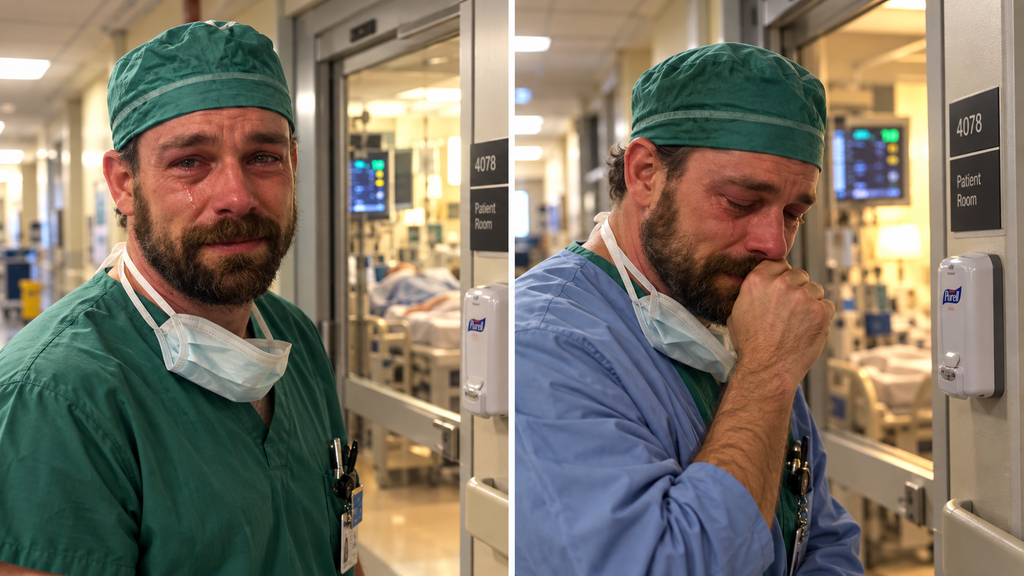
The alarm screamed again. Arnold dropped the lunch bag. My carefully packed sandwich, the apple pie, and the little handwritten note I had tucked beneath the fork hit the polished hospital floor.
I barely noticed. Arnold was already running. “Ben!” I ran after him. The ICU doors flew open. Everything beyond them happened too quickly and somehow not quickly enough.
Nurses rushed past us.
A crash cart appeared from nowhere.
Someone shouted a blood pressure.
Someone else yelled for medication.
And through the open doorway at the end of the hall, I saw a pair of bare feet beneath a hospital blanket.
I knew those feet.
I knew the scar on the left ankle from when Ben had fallen off his bicycle at fourteen.
I knew the way his second toe bent slightly inward.
I knew my husband.
“BEN!”
A nurse caught me around the shoulders.
“Ma’am, you can’t go in there.”
“That’s my husband!”
“I know.”
“No, you don’t understand. That’s my husband!”
My voice cracked so violently that I hardly recognized it.
“He left our house this morning! He kissed our daughter! He told me he was going to work!”
Arnold caught up behind me.
“Claire.”
I turned on him.
“What is happening?”
His face was wet with tears.
“Tell me!”
“Claire, please—”
“Six months?”
The words tore out of me.
“You said six months. You said he’s known for six months.”
Arnold closed his eyes.
“Yes.”
“And all of you knew?”
He didn’t answer.
That was answer enough.
I looked through the glass again.
Doctors surrounded Ben’s bed.
One of them was squeezing air into his lungs.
Another stared at the monitor.
I could hear my heartbeat louder than the alarms.
“You all knew,” I whispered.
“Claire—”
“You watched me walk into this hospital carrying his lunch like an idiot.”
“You are not an idiot.”
“You watched me ask where he was.”
“I’m sorry.”
“You watched me stand there talking about surprising my husband while my husband was lying in intensive care.”
Arnold lowered his head.
“I’m sorry.”
I shoved his chest.
It wasn’t hard.
I didn’t have enough strength left to make it hard.
“You should have told me.”
“I wanted to.”
“You should have told me!”
“Ben begged us not to.”
“He is my husband!”
“I know.”
“I am his wife!”
“I know!”
Arnold’s voice broke.
“And he was terrified.”
That stopped me.
Not because it made sense.
Because I had never heard anyone describe Ben that way.
Ben was many things.
Stubborn.
Quiet.
Protective.
Occasionally infuriating.
But terrified?
No.
Ben was the man who held other people’s lives in his hands.
The man who could walk into an operating room while an entire family prayed outside and remain steady.
The man who once stitched our daughter’s chin at the kitchen table because she was screaming too hard to let anyone at urgent care touch her.
The man who stood beside me when my father died and handled every phone call because I couldn’t speak without crying.
Ben wasn’t terrified.
At least that was what I had believed.
Then I remembered the night I had awakened and found him sitting on the edge of our bed.
His shoulders shaking.
“Rough night,” he had said.
Go back to sleep.
My knees weakened.
Arnold grabbed my arm.
“What does he have?”
He hesitated.
“Tell me.”
“A glioblastoma.”
I stared at him.
The word meant nothing for half a second.
Then it meant everything.
Because I had heard Ben mention it before.
Years ago.
At dinner.
He had been talking about one of his patients.
A young father.
Thirty-nine years old.
Ben had barely touched his food that night.
I remembered asking why.
He had said only four words.
“Some tumors don’t negotiate.”
Now that sentence came back to me.
Some tumors don’t negotiate.
“How bad?”
Arnold looked toward Ben’s room.
“Claire…”
“How bad?”
“They originally estimated twelve to eighteen months.”
Originally.
That word frightened me more than anything else he had said.
“Originally?”
“The tumor progressed faster than expected.”
“How long?”
He said nothing.
I grabbed his coat.
“HOW LONG?”
“Ben was told last week that without another intervention…”
His voice disappeared.
I waited.
“Say it.”
“Weeks.”
The corridor vanished around me.
Weeks.
Not years.
Not months.
Weeks.
My husband had been dying beside me.
Sleeping beside me.
Drinking coffee across from me.
Kissing our daughter goodbye.
Leaving his shoes beside the back door.
Complaining that I bought the wrong toothpaste.
Asking whether we had paid the electricity bill.
Doing ordinary things while carrying the knowledge that there might be almost no ordinary days left.
And he had said nothing.
I slid down the wall.
Arnold crouched beside me.
“Why?”
I whispered it.
Then louder.
“Why?”
Arnold looked at me for a long time.
“Because of Emma.”
Our daughter’s name made me look up.
“What about Emma?”
“He couldn’t figure out how to tell her.”
“That doesn’t explain lying to me.”
“No.”
“Then explain it.”
Arnold sat on the floor beside me.
Doctors and nurses continued moving around us, but neither of us cared anymore.
“He kept saying he needed time.”
“For what?”
“To fix things.”
“What things?”
“Everything he thought would fall apart after he was gone.”
I stared at him.
“He increased his life insurance.”
My mouth opened.
“He reorganized your mortgage.”
I said nothing.
“He moved money into an education account for Emma. He updated his will. He recorded messages.”
My heart stopped.
“What messages?”
Arnold looked away.
“For birthdays.”
I couldn’t breathe.
“What?”
“For Emma.”
“No.”
“Claire…”
“No.”
“He recorded one for her ninth birthday. Her tenth. Her thirteenth. Sixteenth. Eighteenth.”
“Stop.”
“Her graduation.”
“Stop.”
“Her wedding, if she ever—”
“STOP!”
The word echoed down the ICU hallway.
Everyone turned.
I covered my mouth.
A sob tore through me.
Arnold put his hand over his eyes.
“He recorded one for you too.”
I stared at him through tears.
“He did what?”
“He said he knew you’d be angry.”
“Angry?”
I laughed.
It came out broken.
“I’m going to kill him.”
Arnold almost smiled.
“That’s approximately what he predicted.”
“I’m serious.”
“I know.”
“I’m going to kill him if he doesn’t die first.”
The second the words left my mouth, I wished I could take them back.
Arnold looked down.
Neither of us spoke.
Then the alarm stopped.
The sudden silence was worse.
I stood so quickly that I nearly fell.
“What happened?”
The door opened.
A doctor stepped out.
I knew him vaguely.
Dr. Patel.
Ben had mentioned him before.
He removed his gloves.
“Mrs. Carter?”
I hated how gently he said my name.
“Yes.”
“Your husband had a seizure followed by respiratory compromise.”
“Is he alive?”
“Yes.”
My knees nearly gave way.
“He’s alive?”
“Yes.”
“Can I see him?”
“In a moment.”
“What does ‘in a moment’ mean?”
“We’ve stabilized him, but there’s significant swelling around the tumor.”
“Then operate.”
Dr. Patel’s expression changed.
“Operate.”
“We need to discuss that.”
“There’s nothing to discuss. You said there’s swelling. Ben is a surgeon. You’re surgeons. Fix it.”
“Claire…”
“Don’t say my name like that.”
Dr. Patel nodded slowly.
“There is an experimental procedure.”
Arnold stood beside me.
I saw something pass between them.
“You knew about this too.”
Arnold said nothing.
I looked at Dr. Patel.
“What procedure?”
“The tumor is positioned near areas responsible for speech and motor function. Standard resection carries substantial risk. Ben previously underwent a limited procedure, but the tumor has infiltrated tissue we couldn’t safely remove.”
“Previously?”
I felt the floor tilt again.
“What do you mean previously?”
Dr. Patel looked at Arnold.
Then back at me.
“When was my husband operated on?”
“Four months ago.”
I stared at him.
Four months.
I searched my memory.
Four months earlier, Ben had supposedly attended a three-day surgical conference in Boston.
He had called me each evening.
Short calls.
He said the hotel was terrible.
He complained about the coffee.
He told Emma he would bring her a snow globe.
He had returned home wearing a baseball cap.
He said he hadn’t slept because his flight had been delayed.
I remembered teasing him.
“You look like you had brain surgery.”
He had smiled.
I actually remembered saying those words.
You look like you had brain surgery.
And he had smiled.
My stomach turned.
“The conference.”
Arnold closed his eyes.
“There was no conference.”
I slapped him.
The sound cracked through the corridor.
For a moment, nobody moved.
My hand burned.
Arnold didn’t touch his cheek.
He simply nodded.
“I deserved that.”
“No,” I whispered. “Ben deserved it.”
Then I started crying again.
“I would have been there.”
“I know.”
“I would have sat beside him.”
“I know.”
“I would have held his hand.”
“I know.”
“He woke up from brain surgery alone?”
“No.”
I looked at Arnold.
“I was there.”
That somehow made it hurt more.
Arnold’s eyes filled again.
“I sat beside him all night.”
I couldn’t speak.
“He asked for you when he woke up.”
My anger faltered.
“What?”
“He was confused from the anesthesia. He kept saying your name.”
Arnold swallowed.
“Then he remembered.”
“Remembered what?”
“That he hadn’t told you.”
I covered my face.
Arnold continued softly.
“He cried.”
The image destroyed me.
Ben waking in a hospital bed.
Confused.
Hurting.
Calling for me.
Then remembering that he had chosen to keep me away.
“He made me promise,” Arnold said. “He said if the surgery worked, he’d tell you after Emma’s birthday.”
“Her birthday was two months ago.”
“I know.”
“He missed it.”
“Yes.”
“Why?”
Arnold looked toward Ben’s room.
“Because he was here.”
I stared at him.
“No.”
“He had another seizure that night.”
My chest tightened.
Ben had called at 7:14 p.m.
I remembered because Emma had been staring at the birthday cake, trying not to cry.
Ben’s voice had sounded strange.
Weak.
He said he had been pulled into emergency surgery.
He apologized.
He sang half of “Happy Birthday” over the phone.
Emma had forced a smile.
Afterward she had gone upstairs and cried.
And I had been furious with him.
I had sent a message.
YOUR DAUGHTER ONLY TURNS EIGHT ONCE.
He had replied:
I know. I’m sorry. Tell her Daddy loves her more than anything.
I had not answered.
I sank into the chair beside the wall.
“He wasn’t working.”
“No.”
“He was sick.”
“Yes.”
“And I was angry at him.”
“You didn’t know.”
“But he knew I was angry.”
“Yes.”
A terrible thought came to me.
“Did he see my message?”
Arnold hesitated.
“Yes.”
“What did he say?”
Arnold’s eyes filled.
“He said, ‘Good. Let her be angry.’”
I stared at him.
“What?”
“He said anger would be easier for you than fear.”
I shook my head.
“No.”
“He thought if you were angry at him…”
“No.”
“…you would begin learning to live without him before you actually had to.”
“No!”
“He was wrong.”
“He was an idiot!”
“Yes.”
“A brilliant, selfish, arrogant idiot!”
“Yes.”
“I didn’t need practice losing him!”
“I know.”
“I needed my husband!”
My voice broke.
“I needed every day he stole from me.”
Arnold lowered his head.
“I know.”
The door opened again.
Dr. Patel stepped out.
“He’s awake.”
I stopped breathing.
“Can I see him?”
“Yes.”
I walked toward the room.
Then stopped at the doorway.
For the first time in eleven years, I was afraid to look at my husband.
Ben had always seemed too large for hospital beds.
Even asleep at home, he occupied space with certainty.
Now he looked small.
There was tape against his cheek.
An IV in his arm.
Wires across his chest.
His hair had grown enough to hide most of the surgical scar, but now that I knew where to look, I could see it.
A pale line curving above his ear.
How had I missed it?
How had I slept beside this man and missed it?
His eyes opened.
They found me immediately.
For several seconds, neither of us spoke.
Then Ben whispered:
“Hi.”
I walked to the bed.
He attempted a smile.
“You brought lunch?”
I hit him.
Not hard.
Just my palm against his shoulder.
Then again.
And again.
“You liar.”
“Claire—”
“You unbelievable liar.”
“I know.”
“Six months!”
“I know.”
“Brain surgery?”
“I know.”
“You let me believe you were at a conference!”
“I’m sorry.”
“You missed Emma’s birthday!”
His eyes closed.
“I know.”
“She cried.”
A tear slipped from the corner of his eye.
“I know.”
“She thought you chose this hospital over her.”
“I know.”
“I thought you chose this hospital over us.”
“I know.”
“And you let me.”
“Yes.”
I stared at him.
“Why?”
His lips trembled.
For the first time since I had known him, Benjamin Carter looked afraid of me.
“I didn’t know how to come home and tell my eight-year-old daughter that her father was dying.”
My anger collapsed.
I sat down.
Ben stared at the ceiling.
“I’ve told families their loved ones were dying hundreds of times.”
His voice was barely audible.
“I know exactly what words to use. I know where to sit. I know not to stand over them. I know when to stop talking.”
He looked at me.
“But I couldn’t tell you.”
“Why?”
“Because then it would be real.”
“It was already real.”
“Not at home.”
I shook my head.
“Our house was the only place where I wasn’t dying.”
That sentence went straight through me.
“At home, I was still your annoying husband who left socks on the floor.”
“You do leave socks everywhere.”
“I know.”
“And coffee cups.”
“I know.”
“And wet towels.”
A faint smile.
“Those too.”
I started crying.
He reached for my hand.
His fingers were weak.
“At home, Emma still yelled, ‘Daddy!’ when I walked through the door.”
His voice cracked.
“She didn’t look at me like a patient.”
“Neither would I.”
“Yes, you would.”
“No.”
“You would have watched me.”
I couldn’t deny it.
“You would have noticed every headache. Every time I forgot a word. Every time my hand shook.”
“So?”
“And Emma would have noticed you noticing.”
I looked down.
“I wanted a few more normal days.”
“You didn’t give us normal days, Ben.”
He went still.
“You gave us confusing days.”
His face tightened.
“You gave Emma nights wondering why her father didn’t come home.”
“I know.”
“You gave me months wondering what I had done wrong.”
His eyes snapped to mine.
“Nothing.”
“I wondered if you didn’t love me anymore.”
“Claire…”
“I wondered if there was someone else.”
“There never was.”
“I know that now.”
He squeezed my hand.
“I’m sorry.”
“You should be.”
“I am.”
“I hate you.”
“I know.”
“I love you.”
His face broke.
“I know.”
I leaned forward until my forehead rested against his.
“And I am so angry with you.”
“I know.”
We cried together.
No dramatic music.
No perfect speech.
Just two people who had loved each other for eleven years discovering that love could exist alongside fury.
After a while, Ben whispered:
“There’s something else.”
I pulled back.
“No.”
He blinked.
“What?”
“No more something elses.”
Despite everything, he laughed.
It turned into a cough.
“Unfortunately, there’s one more.”
I wiped my face.
“What?”
“Open the bottom drawer.”
I looked at the cabinet beside his bed.
“Ben…”
“Please.”
Inside the drawer was a thick envelope.
My name was written across the front.
CLAIRE.
I looked at him.
“What is this?”
“My confession.”
“You’ve already confessed.”
“Not all of it.”
I felt cold.
“What else could there possibly be?”
He looked toward the door.
“Arnold should be here.”
“No.”
“Claire.”
“If you tell me there’s another secret, I swear—”
“Please.”
I called Arnold inside.
He entered slowly, one cheek still pink from where I had slapped him.
Ben noticed.
“What happened to your face?”
Arnold looked at me.
“Occupational hazard.”
Ben almost smiled.
Then his expression became serious.
“Tell her.”
Arnold froze.
“Ben.”
“Tell her.”
“Tell me what?”
Arnold pulled a chair closer.
“Claire, there’s a reason Ben kept coming to the hospital even after we suspended his surgical privileges.”
I looked at Ben.
“Suspended?”
“I haven’t operated in five months,” Ben said.
I stared at him.
“Then why did you keep coming here?”
Neither man answered.
“Why?”
Ben looked at the envelope.
“Open it.”
Inside were financial documents.
Lists of names.
Photographs.
Letters.
I pulled out the first page.
At the top was written:
THE CARTER FUND.
“What is this?”
Ben stared at his hands.
“Patients.”
“What patients?”
“Families who couldn’t afford treatment.”
I looked through the pages.
There were dozens.
A single mother with leukemia.
A twelve-year-old boy needing heart surgery.
A retired teacher requiring rehabilitation after a stroke.
A baby born with a congenital condition.
Beside each name was an amount.
Paid.
Paid.
Paid.
Paid.
My eyes widened.
“Where did this money come from?”
Ben didn’t answer.
I looked at Arnold.
“Where?”
Arnold spoke quietly.
“Ben.”
I turned back.
“What do you mean Ben?”
“I had savings.”
“Our savings?”
“No.”
“Then what?”
Ben sighed.
“My father’s inheritance.”
I stared at him.
Ben’s father had died three years earlier.
Ben had inherited considerably more than I knew.
Or apparently thought I knew.
“You told me you invested that money.”
“I did.”
“In this?”
He nodded.
I flipped through the pages.
“Why?”
Ben looked genuinely confused by the question.
“Because they needed it.”
“You were dying and secretly paying strangers’ medical bills?”
“They weren’t strangers to me.”
“Ben!”
“One of them was six years old.”
His voice sharpened.
“He had a tumor that could be removed. His parents were going to lose their house paying for treatment.”
“So you paid?”
“Yes.”
“How much?”
He looked away.
“How much?”
“Eighty-three thousand.”
I stared at him.
Arnold quietly said, “Ben has helped thirty-seven families.”
Thirty-seven.
I sat down.
“You missed our anniversary for this?”
Ben hesitated.
“Partly.”
“What does partly mean?”
“There was a fundraiser that night.”
I wanted to scream.
Instead, I started laughing.
It was the kind of laughter that arrives when the body has run out of appropriate reactions.
“You are unbelievable.”
“I’ve been told.”
“You’re dying, and you decided to become some secret hospital Robin Hood?”
Arnold coughed to hide a laugh.
I pointed at him.
“Don’t.”
He stopped immediately.
Then I looked at Ben.
“Why hide this too?”
His answer came instantly.
“Because you would have helped.”
I stared at him.
“Of course I would have helped.”
“That was the problem.”
“What?”
“You would have given everything.”
“So would you!”
“Exactly.”
Despite myself, I laughed again.
Then cried again.
That was when Dr. Patel returned.
The room changed immediately.
He looked at Ben.
“We need a decision.”
Ben’s face became still.
“What decision?” I asked.
Dr. Patel pulled up a chair.
“The swelling will continue. Medication may temporarily control it, but we’re approaching the limits of what medication can do.”
“And the experimental procedure?”
Dr. Patel nodded.
“There is a surgical option.”
“What are the chances?”
Silence.
I hated that silence.
“Tell me.”
“Survival of the procedure itself is reasonably likely.”
“That sounds good.”
“But survival isn’t the only concern.”
I looked at Ben.
He already knew.
“What could happen?”
Dr. Patel answered carefully.
“Permanent speech impairment. Paralysis. Cognitive changes. Memory loss.”
My stomach tightened.
“How much memory?”
“We can’t predict.”
I looked at Ben.
He stared at me.
“You could forget us?”
“It’s possible,” he whispered.
I felt sick.
“What happens if you don’t do it?”
Dr. Patel was quiet.
“Given today’s deterioration, probably days to a few weeks.”
The world stopped.
Days.
I had walked into the hospital carrying apple pie.
And now someone was telling me my husband might have days.
I stood.
“No.”
Ben watched me.
“No.”
“Claire.”
“You’re having the surgery.”
He closed his eyes.
“Claire—”
“You’re having it.”
“I already told them no.”
I stared at him.
“You what?”
“I signed a refusal yesterday.”
My blood went cold.
“Yesterday?”
“Yes.”
“You came home yesterday.”
“Yes.”
“You ate dinner with us.”
“Yes.”
“You helped Emma with fractions.”
“Yes.”
“And you had already decided to die?”
His eyes filled.
“That’s not fair.”
“Fair?”
I stepped closer.
“You want to discuss fair?”
“I don’t want Emma’s last memory of me to be a man who can’t recognize her.”
“And I don’t want her memory to be that her father refused a chance to stay!”
“You don’t understand.”
“No, Ben. You made sure I didn’t understand. You excluded me from every decision!”
“I was trying to protect you!”
“STOP PROTECTING ME!”
The room fell silent.
I lowered my voice.
“Stop deciding what pain I’m allowed to survive.”
Ben stared at me.
“You don’t get to choose my grief.”
He started crying.
“You don’t get to choose Emma’s grief.”
I took his hand.
“And you do not get to turn dying into one more thing you have to handle alone.”
His chin trembled.
“I’m scared.”
There it was.
The truth beneath every lie.
Not bravery.
Fear.
I sat beside him.
“So am I.”
“What if I wake up and don’t know you?”
“Then I introduce myself.”
His eyes squeezed shut.
“What if I can’t walk?”
“We get a wheelchair.”
“What if I can’t speak?”
“I’ll finally win an argument.”
A tiny laugh escaped him.
“What if I’m not me anymore?”
I held his face.
“Then we figure out who you are.”
He stared at me.
“And what if I die on the table?”
My voice nearly failed.
“Then at least you didn’t leave because you were afraid to stay.”
He cried.
I cried.
Arnold turned toward the window.
Dr. Patel waited.
Finally Ben whispered:
“I want to talk to Emma.”
I nodded.
“I’ll call my sister.”
“No.”
He shook his head.
“I want to see her.”
An hour later, my sister brought Emma to the hospital.
She entered the room carrying her purple backpack.
She looked at Ben.
Then at me.
Then at the monitors.
“Daddy?”
Ben smiled.
“Hey, peanut.”
She didn’t move.
“Why are you in bed?”
“I got sick.”
Her face changed.
“Like flu sick?”
Ben looked at me.
This time, he didn’t lie.
“No.”
Emma walked closer.
“How sick?”
He reached for her hand.
“Pretty sick.”
“Are you going to die?”
I stopped breathing.
Children sometimes walk directly into the room adults spend hours circling.
Ben’s eyes filled.
“Everybody dies someday.”
“That’s not what I asked.”
Ben looked at me.
Our eight-year-old daughter stood beside his hospital bed waiting for the truth he had spent six months avoiding.
He swallowed.
“The doctors are going to do an operation.”
“Will it fix you?”
“They’re going to try.”
“That’s not what I asked either.”
Ben laughed through his tears.
“You sound like your mother.”
“I know.”
I covered my mouth.
Ben squeezed Emma’s hand.
“There’s a chance I could die.”
Emma stared at him.
Then she climbed onto the bed.
Every adult in the room began to object at once.
She ignored us.
She curled against her father’s chest.
Ben wrapped one arm around her.
“You missed my birthday.”
His face crumpled.
“I know.”
“I was mad.”
“You had every right.”
“Mom was mad too.”
“I know.”
“She said a bad word after you called.”
“Emma!”
“What word?”
Ben asked.
“Don’t encourage her.”
For one miraculous second, our family was normal again.
Emma whispered something into his chest.
“What?” Ben asked.
“I said I forgive you.”
Ben closed his eyes.
Tears ran into his hair.
“But you can’t miss nine.”
He laughed and sobbed at the same time.
“I’ll do my best.”
“No.”
Emma sat up.
“You have to promise.”
Ben looked at her.
Then at me.
For six months, he had lied because he thought promises could protect us.
Now he finally understood they couldn’t.
“I can’t promise that.”
Emma’s face fell.
“But I can promise something else.”
“What?”
“I will fight very, very hard to be there.”
She considered that.
Then held out her little finger.
“Pinky promise?”
Ben hooked his finger around hers.
“Pinky promise.”
The surgery was scheduled for 6:00 the next morning.
That night, none of us slept.
Emma eventually curled up in the visitor chair under two hospital blankets.
I sat beside Ben.
At 2:17 a.m., he whispered:
“Claire?”
“I’m awake.”
“There’s another letter.”
I looked at him.
“You have got to stop saying things like that.”
He smiled.
“This one isn’t a secret.”
He pointed toward his bag.
Inside was a sealed envelope.
FOR CLAIRE — ONLY IF I DON’T COME BACK.
I stared at it.
“No.”
“Please take it.”
“No.”
“Claire.”
“I don’t want it.”
“You might need it.”
“I don’t want a letter. I want you.”
“I know.”
“Then come back.”
“I’m going to try.”
“No.”
I pushed the envelope against his chest.
“Bring it with you.”
He stared at me.
“What?”
“Bring your goodbye letter into surgery.”
“That’s ridiculous.”
“Good.”
I tucked it into the pocket of his hospital gown.
“You wrote it. You carry it.”
He laughed quietly.
“You’re insane.”
“You married me.”
“Best thing I ever did.”
At 5:42 a.m., they came for him.
Emma woke when the wheels moved.
“Daddy?”
“I’m right here.”
She ran to the bed.
He kissed her forehead.
Then he looked at me.
There are moments when eleven years of marriage become too large for language.
Our wedding.
Emma’s birth.
My father’s funeral.
His mother’s last Christmas.
Thousands of breakfasts.
Arguments.
Apologies.
Inside jokes.
Bills.
Laundry.
Bad vacations.
Good kisses.
Ordinary Tuesdays.
All of it stood between us.
“I love you,” he said.
I kissed him.
“Then come home.”
The operating-room doors closed at 6:03.
At 8:15, no news.
At 10:30, no news.
At noon, Arnold brought coffee.
I didn’t drink it.
At 1:17, Dr. Patel’s assistant came out.
“There’s been a complication.”
My body turned to ice.
“What complication?”
“Bleeding.”
“Is he alive?”
“Yes.”
That became my entire world.
Is he alive?
Yes.
Nothing else mattered.
At 2:40, Arnold started pacing.
At 3:12, Emma asked if Daddy was still fighting.
“Yes,” I told her.
“How do you know?”
“Because he pinky promised.”
At 4:06, Dr. Patel came through the doors.
His surgical cap was still on.
There was blood on his shoe.
I stood.
He looked exhausted.
“Dr. Patel?”
He removed his mask.
“The tumor was more invasive than imaging suggested.”
My legs weakened.
“But?”
“We removed what we safely could.”
“But?”
“There was significant bleeding.”
“But?”
“He went into cardiac arrest for forty-seven seconds.”
I made a sound I had never heard before.
Arnold caught me.
“But we got him back.”
I stared at the doctor.
“Is he alive?”
“Yes.”
“Will he wake up?”
“We don’t know.”
The next three days were worse than the previous six months combined.
Ben did not wake up.
I talked to him anyway.
I told him about the weather.
I told him Emma had refused to go home.
I told him Arnold snored in the waiting-room chair.
Arnold denied it.
I told Ben he owed me eleven anniversary dinners.
Then fourteen.
Then twenty.
I told him I was still angry.
I told him I loved him.
On the fourth morning, I was asleep with my head beside his hand when something touched my hair.
I woke instantly.
Ben’s fingers moved.
“Ben?”
Nothing.
I stood.
“Ben?”
His eyelids fluttered.
I hit the call button so many times a nurse ran in thinking something catastrophic had happened.
His eyes opened.
Slowly.
Unfocused.
Then they found me.
I stopped breathing.
“Ben?”
He stared.
No recognition.
My heart shattered.
The warning came back.
Memory loss.
Cognitive damage.
He looked at my face.
I forced myself not to cry.
“Hi.”
His lips moved.
No sound.
“It’s okay.”
I took his hand.
“You don’t have to know.”
His eyebrows tightened.
“I’m Claire.”
A tear slipped down my cheek.
“I’m your wife.”
His lips moved again.
This time a whisper emerged.
“I know.”
I collapsed against the bed.
He blinked.
Then whispered:
“You’re loud.”
I laughed so hard the nurse started crying too.
“You remember me?”
He squeezed my hand.
“Unfortunately.”
I kissed him.
Then hit his shoulder very gently.
“Idiot.”
“Still angry?”
“Forever.”
He closed his eyes.
“Good.”
But the miracle wasn’t complete.
Ben couldn’t move his right leg.
His right hand barely worked.
His speech came slowly.
Some words disappeared completely.
He knew what he wanted to say but couldn’t always find the word.
The first time he couldn’t remember the word “window,” he threw a plastic cup across the room.
The second time, he cried.
Recovery wasn’t beautiful.
It wasn’t a montage.
It was ugly.
Painful.
Humiliating.
Slow.
There were days Ben refused therapy.
Days he screamed at me.
Days I screamed back.
Days Emma sat beside him doing homework while he practiced lifting his foot one inch off the floor.
Then came another twist.
Three weeks after surgery, Dr. Patel called us into his office.
He placed the new scans on the screen.
“The pathology surprised us.”
Ben frowned.
“Bad?”
“Different.”
My stomach tightened.
“What does different mean?”
Dr. Patel pointed to the image.
“The tumor remains aggressive. I don’t want to give you false hope.”
Ben nodded.
“But?”
“But genetic testing identified a mutation that makes you potentially eligible for a clinical trial.”
I stared at him.
“What kind of trial?”
“A targeted treatment.”
Ben was silent.
“Could it cure him?”
“No.”
I appreciated that he didn’t lie.
“Could it give him more time?”
“Yes.”
“How much?”
“We don’t know.”
Weeks?
Months?
Years?
Nobody could say.
Ben looked at me.
I looked at him.
For once, he didn’t make the decision alone.
“What do you think?” he asked.
Those four words nearly made me cry.
Not because they were romantic.
Because they meant he finally understood.
We were in this together.
“I think,” I said, “you promised somebody you’d try very, very hard to make her ninth birthday.”
Ben smiled.
“Then I guess we try.”
The trial was brutal.
There were infections.
More seizures.
Physical therapy.
Speech therapy.
Days when Ben couldn’t get out of bed.
Days when I locked myself in the bathroom and cried into a towel so Emma wouldn’t hear.
But there were good days too.
Tiny victories became enormous.
Ben took six steps.
Then twelve.
Then crossed the therapy room with a cane.
The day he managed to button his own shirt, he called me into the bedroom as though he had won an Olympic medal.
“Look.”
I stared at his shirt.
“You buttoned it wrong.”
His face fell.
I burst out laughing.
“So did you before the tumor.”
He threw a pillow at me.
Emma’s ninth birthday arrived on a rainy Thursday.
I woke at 5:30 a.m.
The other side of the bed was empty.
For one terrifying second, I panicked.
Then I smelled pancakes.
I ran downstairs.
Ben stood at the stove.
He had one hand braced against the counter.
His cane leaned nearby.
The pancakes were burned.
The kitchen looked like a flour bomb had exploded.
And my husband was alive.
He looked at me.
“Don’t.”
I covered my mouth.
“Don’t what?”
“Cry.”
“I’m not crying.”
“You are.”
“I have allergies.”
“To pancakes?”
“Apparently.”
At 6:02, Emma came downstairs.
She stopped halfway.
Ben turned.
“Happy birthday, peanut.”
She stared at him.
Then screamed.
“YOU MADE IT!”
She ran so hard she nearly knocked him over.
He dropped the spatula.
I grabbed his shoulder.
He wrapped both arms around our daughter.
And I watched my husband cry into her hair.
“I made it.”
She pulled back.
“You promised.”
“I did.”
That night, after Emma fell asleep, Ben and I sat on the back porch.
He held my hand.
“I almost missed this.”
“Yes.”
“I almost chose not to have the surgery.”
“Yes.”
“I was wrong.”
I turned toward him.
“Say that again.”
He smiled.
“Absolutely not.”
“Ben.”
“I have neurological damage. I’m medically incapable of admitting fault twice.”
I laughed.
Then he became serious.
“There’s something I want to do.”
My stomach dropped.
He saw my expression.
“Not a secret.”
“Good.”
“I want to stop the recordings.”
I knew exactly what he meant.
The birthday messages.
The graduation messages.
The wedding message.
“Why?”
“Because I realized something.”
“What?”
“I was so busy preparing everyone for my death that I stopped participating in my life.”
I squeezed his hand.
“What about the recordings you already made?”
He thought about it.
“Keep them.”
“For Emma?”
“For all of us.”
“And when do we watch them?”
He smiled.
“When I’m ninety.”
“Deal.”
Ben never returned to surgery.
That loss nearly broke him.
Being a surgeon had been part of his identity for most of his adult life.
For months, he couldn’t walk through the hospital without staring at the operating-room corridor.
Then one afternoon, Arnold came to our house carrying a folder.
“I have an idea.”
Ben groaned.
“Your ideas usually involve paperwork.”
“This one involves annoying medical students.”
Ben looked interested.
Six months later, he began teaching.
At first, one lecture a month.
Then weekly.
He taught young surgeons things textbooks couldn’t.
How to speak to frightened families.
How to admit uncertainty.
How to recognize when a doctor’s identity had become too entangled with being the person who fixes everything.
And on the first day of every new class, he wrote one sentence on the board:
YOU ARE ALLOWED TO BE THE PATIENT.
The Carter Fund continued too.
Except it wasn’t secret anymore.
I joined the board.
So did Arnold.
Eventually, families Ben had once helped began donating.
One gave twenty dollars.
Another gave five thousand.
The little boy whose surgery Ben had secretly paid for sent us a photograph from his first day of middle school.
On the back, his mother wrote:
Because you gave our son time, we got to watch him grow.
Ben read that sentence for a long time.
Then handed the photograph to me.
“That’s all anyone really wants, isn’t it?”
“What?”
“More time.”
I looked at him.
“Yes.”
“But I think I misunderstood something.”
“What?”
“We don’t own it.”
I leaned against his shoulder.
“No.”
“We just get to use it.”
Three years passed.
Then four.
Every scan terrified us.
Some were good.
Some weren’t.
The tumor never disappeared.
We stopped pretending it had.
But it also didn’t take Ben as quickly as anyone had predicted.
On our fifteenth anniversary, we returned to the little restaurant where he had proposed.
Ben raised his glass.
“To the anniversary I’m actually attending.”
I laughed.
“Low bar.”
“I’ve learned humility.”
“No, you haven’t.”
“Fair.”
Emma was twelve by then.
Tall.
Funny.
Too smart for our own good.
She still made Ben pinky promise before every scan.
Not that he would survive.
We had all learned better than that.
The promise changed.
“Promise you’ll tell us the truth.”
And Ben always hooked his finger around hers.
“I promise.”
That became the rule in our house.
Not that nothing bad would happen.
Not that nobody would die.
Not that love could protect us from disease.
Only this:
No one would face the truth alone.
Five years and two months after the day I carried that lunch into the hospital, Ben’s scans changed again.
The treatment had stopped working.
There were fewer options this time.
We knew it.
The doctors knew it.
And this time, nobody hid anything.
Ben came home.
We sat at the kitchen table.
Emma was thirteen.
He told her himself.
“The medicine isn’t working anymore.”
She cried.
He cried.
I cried.
Then Emma asked:
“How long?”
Ben looked at me.
Then answered honestly.
“We don’t know exactly.”
“Months?”
“Probably.”
She nodded.
Then she climbed into his lap even though she was almost too big.
“Okay.”
There was nothing okay about it.
But somehow, we were okay inside the not-okayness.
Because we were together.
Those final months became some of the most painful and beautiful months of my life.
Ben stopped teaching.
Friends visited.
Former patients came.
Doctors came.
Nurses came.
People we had never met sent letters describing how the Carter Fund had helped them.
One afternoon, Arnold arrived carrying a familiar brown paper bag.
I recognized it immediately.
It was the same kind I had used for Ben’s lunch years earlier.
“What is that?” I asked.
Arnold smiled.
“Something I saved.”
Inside was a folded piece of paper.
My handwriting.
You don’t have to take care of everyone.
Let me have a turn.
The note I had tucked beneath Ben’s fork.
The note that had fallen onto the ICU floor.
Arnold had picked it up.
“You kept this?”
“I thought one day you might want it.”
I handed it to Ben.
He read it.
Then looked at me.
“You were right.”
“About what?”
“I should have let you have a turn.”
I sat beside him.
“You eventually did.”
One quiet Sunday morning, almost six years after doctors first told Ben he might have twelve to eighteen months, I woke beside him.
Sunlight was coming through the curtains.
His breathing was shallow.
I knew.
You know these things.
Not because anyone teaches you.
Because after loving someone long enough, you learn the language of their breathing.
“Ben?”
His eyes opened.
“Hi.”
I smiled through tears.
“Hi.”
He looked toward the door.
“Emma?”
“She’s asleep.”
“Let her sleep.”
I took his hand.
His wedding ring had become loose.
“You scared?”
I asked.
He thought about it.
“A little.”
“Me too.”
He smiled.
“Still angry?”
“Definitely.”
“Good.”
I laughed quietly.
He looked at me for a long time.
“I wasted six months.”
“No.”
“I did.”
“You were afraid.”
“I should have trusted you.”
“Yes.”
“I should have told you.”
“Yes.”
“I should have come home.”
“Yes.”
He squeezed my hand weakly.
“I’m sorry.”
“I know.”
“Did you forgive me?”
I leaned closer.
“Years ago.”
He closed his eyes.
Then opened them again.
“Claire?”
“Yes?”
“Take care of yourself too.”
That nearly broke me.
“I will.”
“Not just Emma.”
“I know.”
“Promise.”
“I promise.”
He breathed slowly.
Then whispered:
“You don’t have to take care of everyone.”
I started crying.
Those were almost the words from my note.
I pressed my forehead against his.
“Let me have a turn.”
His mouth curved into the smallest smile.
“Exactly.”
Emma came in ten minutes later.
Maybe she sensed something too.
She climbed into bed between us.
She took her father’s hand.
“Daddy?”
His eyes opened one final time.
“Peanut.”
“I love you.”
His lips moved.
We barely heard him.
“More than anything.”
At 8:17 that morning, my husband died.
No alarms.
No rushing doctors.
No crash cart.
No secrets.
Just sunlight.
Our daughter.
My hand in his.
And the truth.
For a long time afterward, I hated hospitals.
Even the smell of antiseptic could send me back to that Tuesday afternoon when Arnold had looked at me with tears in his eyes and asked:
“He hasn’t told you anything, has he?”
But grief changes shape.
Slowly.
Painfully.
It stops being the only thing you can see.
A year after Ben died, Emma and I went to the hospital together.
The Carter Fund was opening a new family assistance center.
They had put Ben’s name on a small plaque near the entrance.
I expected something grand.
Instead, the inscription was simple.
DR. BENJAMIN CARTER
HE BELIEVED EVERY FAMILY DESERVED MORE TIME.
Emma stood beside me.
She was fourteen now.
She slipped her hand into mine.
“Mom?”
“Yes?”
“Do you think Dad knew he’d get almost six years?”
“No.”
“Would he have done things differently if he knew?”
I thought about it.
The missed dinners.
The secret surgery.
The lies.
The birthday recordings.
The pancakes.
The cane.
The pinky promises.
The years we almost didn’t get.
“Yes,” I said.
“How?”
I looked at the plaque.
“He would have come home sooner.”
Emma nodded.
Then she reached into her backpack.
“I found something.”
She handed me an envelope.
My heart stopped.
The handwriting was Ben’s.
FOR CLAIRE.
I stared at her.
“Where did you get this?”
“The box in Dad’s closet.”
I recognized it immediately.
The recordings.
The letters.
The goodbyes we had never opened.
My hands trembled.
“This isn’t the surgery letter.”
“No.”
“When did he write it?”
Emma shrugged.
“There’s a date.”
I looked.
Three weeks before he died.
I opened it.
Inside was one page.
Just one.
Claire,
If you are reading this, then apparently I ignored my own rule about leaving dramatic letters behind.
Sorry.
You can yell at me when you see me.
There is something I spent years trying to understand.
When I first got sick, I thought loving you meant protecting you from pain.
I was wrong.
Love was never supposed to prevent pain.
Love was supposed to make sure we didn’t carry it alone.
I thought strength meant being the person everyone could lean on.
You taught me that sometimes strength is letting yourself lean back.
I thought dying was the worst thing that could happen to me.
It wasn’t.
The worst thing would have been dying without truly living beside you.
Thank you for making me stay.
Thank you for being angry.
Thank you for refusing my goodbye.
And thank you for every ordinary day.
Especially those.
I love you.
I love Emma.
And wherever you are when you read this, please do one thing for me.
Go home.
Someone you love is waiting.
Ben.
I read the last line twice.
Then a third time.
Emma was crying.
So was I.
“Mom?”
“Yes?”
“Can we go home?”
I folded the letter carefully.
I looked through the hospital windows at the parking lot where, years earlier, I had walked in carrying a lunch bag and believing my biggest problem was an overworked husband.
I had entered that building expecting to surprise Ben.
Instead, I discovered he was dying.
But that wasn’t the entire truth.
Because that day had also been the day Ben finally began living again.
Not as a surgeon.
Not as a hero.
Not as the man who had to save everyone.
Just as my husband.
Emma’s father.
A frightened human being who finally allowed himself to be loved.
I put the letter against my heart.
“Yeah,” I told my daughter.
“Let’s go home.”
We walked through the automatic doors together.
Outside, the afternoon sun was warm.
Emma talked about school on the way to the car.
Something about a science project.
Something about a boy named Noah who apparently was “absolutely not her boyfriend,” which meant I immediately suspected he was.
I laughed.
Really laughed.
And for a moment, I could almost hear Ben laughing too.
Life continued.
That was the strange part.
For years, I had thought continuing after Ben would somehow betray him.
But eventually I understood.
Continuing was exactly what he had fought for.
More birthdays.
More terrible pancakes.
More arguments.
More ordinary Tuesdays.
More chances to say the things we assume we’ll have time to say tomorrow.
That night, I placed Ben’s final letter in my bedside drawer.
Beside it, I put the old note Arnold had saved from the hospital floor.
Two pieces of paper.
Two versions of us.
On one, I had written:
You don’t have to take care of everyone.
Let me have a turn.
On the other, Ben had written:
Go home.
Someone you love is waiting.
I keep them together now.
Because if my husband’s illness taught me anything, it is that the greatest tragedy isn’t always losing someone.
Sometimes it is having them beside you and believing there will always be another dinner.
Another birthday.
Another apology.
Another morning.
Another chance to ask what they’re afraid of.
Another chance to say:
Tell me the truth.
Another chance to answer:
I’m here.
We spend so much of our lives waiting for the important moments that we fail to recognize them while they are happening.
The important moment might be someone standing barefoot in the kitchen.
It might be your daughter laughing upstairs.
It might be an unfinished cup of coffee.
A hand reaching for yours beneath the blankets.
A burned pancake.
A forgotten anniversary that becomes a joke years later.
A pinky promise.
Or a brown paper lunch bag containing a slice of apple pie and a note that says:
You don’t have to take care of everyone.
Let me have a turn.
I went to the hospital that Tuesday believing I was bringing my husband lunch.
I had no idea I was arriving just in time to help give him six more years of life.
And Ben?
He had spent six months trying to prepare us to live without him.
In the end, he learned something far more important.
How to live with us while he was still here.
And sometimes, when the house is quiet and the sunlight falls across his empty side of the bed, I still speak to him.
I tell him about Emma.
I tell him about the Carter Fund.
I tell him when I’m angry.
I tell him when I’m happy.
And every now and then, I tell him the same thing I should have told him years before that terrible Tuesday:
“You never had to save us from loving you, Ben.
You only had to let us stay.”
And that, finally, was the promise he kept.
💬THE END! THANK YOU FOR READING! ❤️🙏