
 Reading Time: 16 minutes
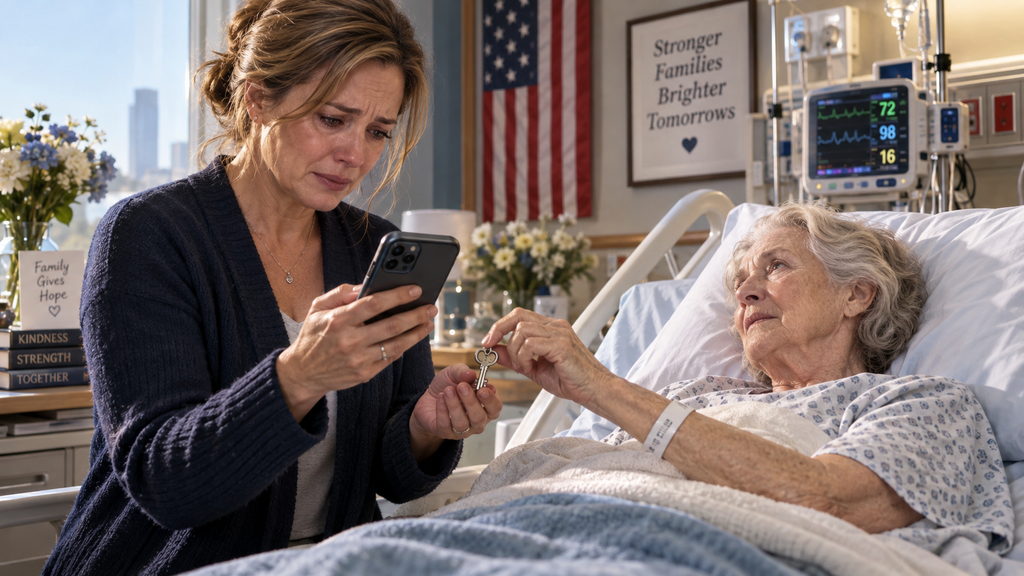
I called my husband thirty-one times from the emergency room while his mother fought for her final breath. On the thirty-first call, a woman answered instead. “He’s in the shower. We’re in Maui. Stop calling, pathetic wife,” she laughed while ocean waves crashed somewhere behind her.
My husband had invented a fake business trip so he could vacation with his mistress. What she did not know was that his dying mother heard every cruel word. Rage flashed through Eleanor’s fading eyes.
Then she reached beneath the blanket, slipped a small silver key into my hand, and silently formed two words.
Destroy him.
Seconds later, the heart monitor became one long, unbroken tone.
My name is Claire Bennett.
For twenty years, I had been more of a daughter to Eleanor Bennett than her own son had been a son.
That sounds cruel.
I wish it were untrue.
When I married Julian at twenty-nine, Eleanor was already a widow.
She lived alone in a modest brick house outside Pittsburgh and worked part-time at a church office even though she had enough money to retire.
She liked structure.
Grocery store on Tuesdays.
Hair appointment every six weeks.
Coffee in the same blue mug every morning.
Julian found her habits embarrassing.
“She’s stuck in another century,” he used to say.
I thought he was joking.
Over time, I realized he simply did not have patience for anybody whose needs interfered with his own.
When Eleanor had her first stroke, I was the one who found her.
Julian was in Chicago for work.
At least that was what he said.
I stayed beside her in the hospital for four days.
Helped with rehabilitation.
Learned her medication schedule.
Cooked her meals.
Took her to appointments.
After the second stroke, she lost some strength in her left side.
By then, Julian had become vice president of operations for a private logistics company.
He traveled constantly.
He always had an excuse.
Board meeting.
Client dinner.
Conference.
Expansion project.
I learned to stop expecting him.
Eleanor never did.
That was the saddest part.
Every time her phone rang, she looked toward it with hope.
“Maybe Julian.”
Usually it was a pharmacy.
A nurse.
Me.
But she kept hoping.
Four years before she died, her health declined badly.
There were more falls.
More hospital visits.
Early-stage heart failure.
Then kidney problems.
I reduced my own working hours to care for her.
Julian objected.
Not because he wanted to help.
Because I was earning less.
“We can hire somebody,” he said.
“She hates strangers in the house.”
“She’ll get used to it.”
“She needs family.”
He laughed.
“You act like she’s your mother.”
I stared at him.
“She is my family.”
He rolled his eyes.
That was Julian.
Everything emotional became inconvenient if it could not be turned into money, status, or admiration.
Still, I stayed.
I suppose part of me believed loyalty would eventually teach him loyalty.
That is one of the most expensive mistakes a person can make.
The night Eleanor died began with rain.
Cold October rain against the hospital windows.
I had taken her to the emergency room just before midnight after she became short of breath and confused.
By two in the morning, we were upstairs in a cardiac unit.
By four, the doctors had stopped using hopeful language.
Dr. Franklin pulled me aside.
“Claire, you should call family.”
Family.
I nodded.
“I’ll call Julian.”
The first call went to voicemail.
The second too.
Then the third.
I texted.
Your mother is in the hospital. Please call me.
Nothing.
I called again.
And again.
By ten calls, I was angry.
By fifteen, frightened.
By twenty, numb.
Eleanor lay under thin hospital blankets, oxygen mask over her face, chest rising unevenly.
Every few minutes, her eyes opened.
She looked toward the door.
“Julian?” I asked once.
Her fingers squeezed mine.
“Yes.”
“I’m trying.”
At 4:50 a.m., I called again.
Voicemail.
I texted:
This is serious. She may not have much time.
No response.
At 5:20:
Please call me.
At 5:44:
Julian, your mother is dying.
Nothing.
By the thirtieth call, I hated the sound of his voicemail greeting.
“Hey, it’s Julian. Leave a message.”
Casual.
Confident.
Alive.
While his mother struggled for every breath.
At 6:03 a.m., I called for the thirty-first time.
Someone answered.
Not Julian.
A woman.
Sleepy voice.
Then a laugh.
“Would you stop blowing up his phone?”
I froze.
“Who is this?”
She laughed again.
“He’s in the shower.”
I looked at Eleanor.
Her eyes were open.
I said, “Where is Julian?”
“Seriously?”
I heard music.
Wind.
Then waves.
Actual ocean waves.
“We’re in Maui,” the woman said.
My whole body went cold.
“Maui?”
“Yes. Hawaii. Paradise. You should try relaxing sometime.”
My hand tightened around the phone.
“Julian told me he was in Denver for a logistics conference.”
The woman snorted.
“Oh, my God. He told you Denver?”
Then she laughed so hard she had to catch her breath.
I wanted to hang up.
I should have.
But shock has a strange way of holding you still.
I asked, “Who are you?”
There was a pause.
Then:
“Someone he actually enjoys being with.”
I looked at Eleanor.
Her eyes had sharpened.
She could hear.
The speaker was on because I had placed the phone near her pillow in case Julian answered.
The woman continued.
“He said you’d probably call about his mother eventually.”
My mouth went dry.
“He knew she was sick?”
“Of course he knew. He said you overreact about everything.”
Eleanor’s eyes filled with tears.
I saw it.
One tear slipping toward her temple.
I said, “His mother is dying.”
Silence.
For the first time, the woman sounded uncertain.
“What?”
“She may have minutes. Maybe hours. I’ve been calling because his mother is dying.”
A man’s voice appeared faintly in the background.
Julian.
“What is it?”
The woman covered the phone badly.
“She says your mom is dying.”
Then Julian’s voice:
“Hang up.”
My breath stopped.
The woman returned to the phone.
“He says stop calling.”
Then, with a little drunken laugh:
“Honestly, pathetic wife. Let him have one peaceful trip.”
She disconnected.
The hospital room became silent except for the monitor.
I stared at the phone.
Then at Eleanor.
“I’m sorry.”
My voice broke.
“Eleanor, I’m so sorry.”
She looked furious.
Not sad.
Not frightened.
Furious.
Her fingers began moving beneath the blanket.
Weakly.
Searching.
I leaned closer.
“What do you need?”
She reached beneath the neckline of her hospital gown.
There was a thin chain there.
I had seen it for years.
I assumed it held a religious medal.
Instead, she pulled out a tiny silver key.
Her fingers shook.
I helped her free it from the chain.
She pushed the key into my palm.
“Eleanor?”
Her lips moved.
No sound.
I bent closer.
She tried again.
Two words.
Destroy him.
I stared at her.
“I don’t understand.”
Her eyes flicked toward my hand.
The key.
Then toward the bedside table.
Her purse.
I reached for it.
Inside was a small card.
A bank name.
A box number.
No explanation.
I looked back at her.
“Is this for me?”
She blinked once.
Yes.
Her breathing changed.
The nurse entered.
Then another nurse.
The monitor alarmed.
I stepped backward.
Everything happened quickly.
Medical staff around the bed.
Instructions.
Hands moving.
Then stillness.
The tone stretched into one continuous sound.
The nurse silenced the machine.
Dr. Franklin looked at the clock.
6:11 a.m.
Eleanor was gone.
I stood beside the wall with the silver key cutting into my palm.
I do not remember leaving the hospital.
I remember a nurse giving me Eleanor’s belongings.
I remember sitting in my car.
I remember rain running down the windshield.
And I remember Julian finally calling at 7:42 a.m.
I did not answer.
He called again.
Then again.
Then texted.
What happened?
I stared at those two words.
What happened?
As though he had been unavailable because of bad reception.
I typed:
Your mother died at 6:11.
His response came twenty seconds later.
Oh God.
Then:
I’ll call you soon.
I turned off my phone.
I drove home.
Julian and I lived in a large colonial house he loved because it photographed well.
Four bedrooms.
Three-car garage.
Stone fireplace.
Everything chosen to impress visitors.
That morning, it felt like a hotel.
I showered.
Changed clothes.
Made coffee.
Then sat at the kitchen island with Eleanor’s purse.
The card she left me belonged to a private bank downtown.
Safe-deposit box number 118.
I called the number printed beneath it.
A woman answered.
I gave Eleanor’s name.
She became careful immediately.
“Are you an authorized deputy on the box?”
“I don’t know.”
“What is your name?”
“Claire Bennett.”
Pause.
Then:
“Yes, Mrs. Bennett. Your name is listed.”
I nearly dropped the phone.
“When?”
“I cannot discuss full account details by phone, but you are an authorized co-lessee.”
“How long?”
Another pause.
“Approximately three years.”
Three years.
Eleanor had added me without telling me.
The bank representative scheduled an appointment that afternoon.
I called no one else.
Not Julian.
Not his sister, because he did not have one.
Not friends.
Only one person.
Martin Hale.
Eleanor’s attorney.
I knew Martin through years of handling her medical powers, property documents, and estate planning.
When I told him she was dead, he became quiet.
Then I mentioned the silver key.
Silence again.
“Claire.”
“Yes?”
“Do not open that box without me.”
My stomach tightened.
“Why?”
“Because Eleanor instructed me that if you ever contacted me about a silver key, I was to meet you personally.”
I sat down.
“What is in there?”
“I don’t know everything.”
That did not comfort me.
At two o’clock, Martin and I entered the bank together.
We were taken downstairs.
No dramatic underground vault.
Just quiet halls, heavy doors, polished metal.
The employee verified identification.
My name was indeed on the box.
I signed.
The silver key fit perfectly.
Inside was a long metal container.
Martin placed it on the private viewing table.
I lifted the lid.
Documents.
Thick stacks.
Envelopes.
A flash drive.
Three property deeds.
Several account statements.
A handwritten letter with my name.
And another envelope marked:
FOR JULIAN, AFTER EVERYTHING ELSE.
I looked at Martin.
“What is this?”
He did not answer.
He started reading.
His face changed.
“Sit down.”
I hated those words.
I opened Eleanor’s letter first.
Claire,
If you are reading this, I am gone, and I am sorry I did not tell you sooner.
You have cared for me with more kindness than I knew how to repay.
My son has spent years assuming everything I own belongs to him eventually.
It does not.
I stopped reading.
Martin waited.
My hands shook.
I continued.
Julian believes I am poor because I allowed him to believe it.
Your father-in-law, Thomas, left more than Julian knows.
After Thomas died, several investments grew substantially.
I kept them separate because Julian began asking for money before the funeral flowers had wilted.
I looked up.
“Did you know?”
Martin nodded reluctantly.
“Some of it.”
“How much?”
He pushed an account statement toward me.
I stared.
$4.8 million.
Then another.
$2.1 million.
Then property deeds.
A commercial building.
Two rental homes.
Land.
Eleanor had been quietly wealthy.
Not extravagantly.
But far more than Julian knew.
I continued reading.
I have changed my estate plan more than once because Julian repeatedly borrowed money from me and lied about why.
Some of the documents in this box show what he did.
I looked at Martin.
“What did he do?”
“Keep reading.”
The next folder answered.
Loan documents.
Transfers.
Signature pages.
At first, I did not understand.
Then I saw Eleanor’s name.
Signed.
Except something was wrong.
I had seen Eleanor sign hundreds of forms.
Her E curved sharply.
This one did not.
“These aren’t her signatures.”
Martin nodded.
“That appears to be one of the issues.”
My stomach turned.
There were loans secured against a rental property.
Investment withdrawals.
A line of credit.
Money moved through a business entity tied to Julian.
Hundreds of thousands.
Maybe more.
I whispered, “He stole from her?”
Martin corrected me carefully.
“We do not make that legal conclusion without investigation.”
“He forged her name.”
“It appears signatures may have been unauthorized.”
I looked at him.
“You were a lawyer for forty years and that is the best you can say?”
“Yes.”
I almost laughed.
Then I cried.
Not because of the money.
Because Eleanor had known.
She had spent her final years watching her son treat her like a financial inconvenience while he quietly reached into the life her husband left behind.
Martin handed me another document.
Her will.
Signed eighteen months earlier.
Julian was not disinherited entirely.
That surprised me.
He would receive $100,000.
Enough that no one could say Eleanor had forgotten him.
But the majority of the estate went elsewhere.
A nursing scholarship fund.
The hospital foundation.
A church food program.
And me.
I stared.
“No.”
Martin said nothing.
“No. She can’t leave this to me.”
“She can.”
“I’m her daughter-in-law.”
“You were also her caregiver.”
“I didn’t do it for money.”
“I know.”
“I don’t want Julian saying I manipulated her.”
“He will.”
I looked at him.
“Thank you for that comforting prediction.”
“Claire, Eleanor anticipated it.”
Of course she did.
Martin showed me capacity evaluations.
Two independent doctors.
Recorded meetings.
Witnesses.
Video statements.
Every major revision had been documented.
Eleanor had prepared for war.
Then I found the flash drive.
Martin opened it on the bank’s secure computer.
There were video files.
The first one was Eleanor seated in Martin’s office six months earlier.
She looked tired but alert.
“My name is Eleanor Bennett. I am making this recording voluntarily.”
My eyes filled.
She continued.
“My son Julian has repeatedly ignored my wishes regarding money, property, and medical care.”
She described transfers she never authorized.
Pressure to sign documents.
Requests for access to investment accounts.
Then:
“I am leaving the majority of my estate away from my son because I do not trust his judgment or his honesty.”
My throat tightened.
Then she smiled slightly.
“Claire will be blamed.”
I covered my mouth.
“She did not ask me for anything.”
Eleanor looked directly into the camera.
“She gave me what my son did not give me. Time.”
I cried openly.
Martin looked away.
The video continued.
“If Julian challenges this, play him the recordings in folder C.”
Folder C.
We found it.
Audio files.
Julian’s voice.
Apparently Eleanor had started recording certain conversations after suspecting financial abuse.
One file:
“Mom, just sign it.”
“What is it?”
“Tax paperwork.”
“It says loan.”
“Same thing. Just sign.”
Another:
“You don’t need that rental income.”
“It is mine.”
“It’ll all be mine eventually.”
Then Eleanor:
“That attitude is exactly why it may not be.”
Julian laughed.
“Don’t be dramatic.”
I stopped the recording.
That phrase.
Do not be dramatic.
He had used it on me for years.
Apparently, it was hereditary cruelty.
The bank box also contained a folder labeled MAUI.
My stomach tightened.
Inside were printed hotel confirmations.
Flight records.
Credit card statements.
Julian had used one of Eleanor’s linked business cards for portions of the trip.
Not just cheating.
Partly financing his affair through money connected to his mother’s assets.
The hotel suite.
One dinner.
A spa charge.
Champagne.
I whispered, “He used her money?”
Martin said, “It appears so.”
The rage came then.
Not hot.
Cold.
Focused.
Destroy him.
Eleanor’s final words.
I understood now.
She had not meant violence.
She had meant destroy the lie.
Destroy the image.
Destroy the machinery that allowed him to treat everyone around him as resources.
I closed the box.
“What happens next?”
Martin answered, “We follow the law.”
That became my mantra.
Not revenge.
Law.
Evidence.
Documentation.
I handed everything necessary to Martin.
He arranged preservation of the financial records.
He contacted the bank’s legal department.
He notified the executor named in Eleanor’s will.
Not me.
Smart woman.
She had appointed an independent fiduciary.
Within twenty-four hours, questions about unauthorized transactions were formally raised.
Accounts were flagged.
Records preserved.
Then I went home.
Julian called again.
I answered this time.
His voice sounded annoyed.
“Finally.”
I almost laughed.
“Where are you?”
“Maui.”
“Still?”
“I’m trying to get a flight.”
“Try harder.”
“Claire, don’t start.”
“Your mother is dead.”
“I know!”
His voice cracked.
For one moment, I heard grief.
Then he said, “Did she leave any instructions?”
There it was.
Not funeral.
Not final words.
Instructions.
Money.
I said, “Martin Hale is handling things.”
Silence.
“Why is Martin involved already?”
“Because he was her attorney.”
“I know who he is.”
“Then why ask?”
“Did she change the will?”
I closed my eyes.
His mother had been dead less than twelve hours.
“What do you think?”
He became defensive.
“I’m asking because she talked about changing things when she was confused.”
“She wasn’t confused.”
“You don’t know that.”
“I cared for her daily.”
“And I’m her son.”
“Biology didn’t make you available.”
Silence.
Then:
“Is this because of this morning?”
“This morning?”
“You heard Sophie.”
So.
The mistress had a name.
Sophie.
“She answered your phone while your mother was dying.”
“It looks bad.”
I actually laughed.
Looks bad.
“Julian, I heard ocean waves while your mother fought for breath.”
“I didn’t know it was that serious.”
“I texted you that she was dying.”
“My phone was on silent.”
“Thirty-one calls.”
“Claire.”
“No.”
He went quiet.
“What?”
“You have spent twenty years saying my name like it ends conversations.”
I stood in the kitchen.
“No.”
He breathed heavily.
“I’m coming home tomorrow.”
“Good.”
“We’ll talk.”
“No.”
“Claire.”
“I won’t be there.”
Silence.
I had already decided.
The marriage was over.
Not because of Sophie alone.
She was just a flashlight.
The room had been rotten for years.
That evening, I packed.
Not dramatically.
Clothes.
Documents.
Jewelry from my mother.
Photographs.
My laptop.
I left Julian’s house and moved into Eleanor’s home temporarily because the executor asked me to secure personal items there.
That felt strange.
Her slippers remained beside the chair.
Her blue mug beside the sink.
I slept in the guest room.
The next afternoon, Julian returned.
He went to our house first.
Then called.
“Where are you?”
“Your mother’s.”
“Why?”
“Estate matters.”
“I’m coming.”
“Martin will meet you tomorrow at eleven.”
“I’m coming now.”
“No.”
“It’s my mother’s house.”
“It belongs to the estate.”
That sentence stopped him.
He finally understood something had changed.
The next morning, Julian arrived at Martin’s office fifteen minutes early.
I was already there.
So was the independent executor, a woman named Carolyn Reese.
Julian entered looking terrible.
Not destroyed.
Just human.
No tan could hide exhaustion.
He looked at me.
Then at Martin.
“What is this?”
Martin said, “Sit down.”
Julian did.
Martin began with the will.
Julian listened.
When he heard his inheritance amount, he laughed.
One short sound.
“That’s wrong.”
Martin continued.
“Your mother’s will was executed eighteen months ago.”
“She changed it while medicated.”
“Capacity evaluations were completed.”
“She hated doctors.”
“She completed two.”
He looked at me.
“You did this.”
I said nothing.
He stood.
“You manipulated her.”
Martin said calmly, “Sit down, Julian.”
“I’m not sitting.”
Then Carolyn spoke.
“Mr. Bennett, there are also questions regarding financial transactions connected to your mother’s assets.”
His face changed.
Tiny.
But I saw it.
“What questions?”
Martin placed copies of loan documents on the table.
Julian stared.
Then:
“I handled some things for her.”
“With authority?”
“She gave me permission.”
“Written?”
“She was my mother.”
Not an answer.
Martin continued.
“There are signatures under review.”
Julian looked at me.
“What did you find?”
I met his eyes.
“A silver key.”
His face emptied.
He knew.
That was the moment I realized the key itself was not a surprise to him.
“You knew she had a box.”
He said nothing.
Martin pressed a button.
Eleanor’s recorded voice filled the room.
“My son Julian has repeatedly ignored my wishes regarding money, property, and medical care.”
Julian sank into the chair.
Not because of money.
Because his mother was speaking after death.
Martin played only part of the statement.
Then one audio clip.
“Mom, just sign it.”
“What is it?”
“Tax paperwork.”
“It says loan.”
“Same thing. Just sign.”
Julian closed his eyes.
“That was out of context.”
Carolyn said, “The financial review will determine context.”
Then Martin placed the Maui charges on the table.
Julian’s face changed again.
I said quietly, “Your mother paid for champagne with your mistress.”
“That wasn’t intentional.”
I stared.
“What part?”
He looked away.
I removed my wedding ring.
Placed it beside the documents.
Metal against wood.
Small sound.
Huge ending.
Julian looked at it.
“Claire.”
“Your mother’s last gift wasn’t money.”
He looked at me.
“It was the truth.”
He started crying.
For the first time in years, I almost reached for him.
Then I remembered Eleanor’s face when Sophie laughed.
I kept my hands in my lap.
He whispered, “I loved her.”
“I believe you.”
That surprised him.
“Then why are you doing this?”
“I’m not doing anything to you.”
I nodded toward the documents.
“You did this.”
He covered his face.
“What did she say at the end?”
I hesitated.
That question hurt.
“Did she ask for me?”
“Yes.”
His shoulders shook.
“Did she know where I was?”
“Yes.”
He cried harder.
I could have told him her last words.
Destroy him.
I did not.
Those words belonged to me.
Instead I said:
“She heard everything.”
That was enough.
The estate process took months.
So did the financial review.
Some transactions had paperwork supporting them.
Others did not.
Certain loans had apparently been authorized earlier.
Others became disputed.
Banks investigated.
Attorneys argued.
Records were reconstructed.
Julian was required to repay substantial amounts to the estate.
Not everything became criminal.
Real life is rarely that clean.
But his reputation inside his company suffered when unrelated financial irregularities from his business dealings surfaced during the broader review.
His employer opened its own investigation.
He resigned several months later.
Sophie disappeared almost immediately.
Apparently paradise was less romantic once lawyers began calling.
She sent me one message.
I did not answer.
Julian and I divorced.
The proceedings were ugly at first.
Then exhausting.
Eventually, transactional.
House.
Retirement.
Accounts.
Vehicles.
Years of marriage reduced to spreadsheets.
I did not use Eleanor’s inheritance as leverage.
Her estate was separate.
Her wishes were hers.
After debts and charitable gifts were resolved, I received the portion she designated.
It was more money than I had ever had in my own name.
I kept expecting guilt.
Instead I felt responsibility.
I sold one rental property and funded a caregiver respite program through the hospital that treated Eleanor.
Martin helped establish it.
Eleanor Bennett Family Care Fund.
Julian was furious when he heard the name.
Then quiet.
Maybe he understood.
Maybe not.
I kept her house.
Not because it was valuable.
Because the kitchen window looked over the lilac bushes she loved.
I moved in permanently after the divorce.
For months, grief lived everywhere.
In the empty chair.
In the medicine cabinet.
In the coat hanging by the door.
One morning, I found a note inside an old cookbook.
Claire—
Julian hates my meatloaf because I put oats in it. Don’t listen to him.
Love,
E.
I sat on the kitchen floor laughing and crying at the same time.
That is how grief works.
You can inherit millions and still be destroyed by handwriting on a recipe card.
Julian called occasionally.
At first about legal issues.
Then nothing.
Then, almost a year later, on Eleanor’s birthday.
I almost did not answer.
“Hello?”
“Claire.”
His voice sounded different.
Older.
“Hi.”
“I went to Mom’s grave.”
I said nothing.
“I should’ve been there.”
“Yes.”
No argument.
No excuse.
“I think about those calls.”
“So do I.”
“I saw your messages later.”
My chest tightened.
“The ones saying she was dying?”
“Yes.”
Silence.
“I don’t know how I became that person.”
I closed my eyes.
Neither did I.
But I had watched it happen.
Slowly.
One selfish choice at a time.
He continued.
“I blamed work. Money. You. Mom. Everybody.”
“Yes.”
“I’m sorry.”
I believed him.
That did not mean I wanted him back.
“I hope you mean that.”
“I do.”
Then he asked:
“What were her last words?”
I had carried that question for a year.
This time, I answered.
“She said, ‘Destroy him.’”
Silence.
Long silence.
Then he whispered, “She hated me.”
“No.”
He breathed shakily.
“She must have.”
“No, Julian.”
“Then why say that?”
“Because I don’t think she meant you.”
“What?”
I looked around Eleanor’s kitchen.
Sunlight.
Blue mug.
Lilacs beyond the glass.
“She meant the man you had become.”
Julian said nothing.
I continued.
“The lies. The entitlement. The idea that everyone existed to serve you. That version of you.”
He began crying.
“I think she wanted it destroyed because she still remembered the boy you used to be.”
That was the first time I understood Eleanor’s final words differently.
Not revenge.
A final demand.
Become someone else.
Julian whispered, “Do you think I can?”
“That is not my decision anymore.”
We ended the call.
Years have passed.
I am fifty-four now.
Eleanor would have been eighty-three this spring.
The silver key sits in a small frame in my study.
Not because it opened money.
Because it opened truth.
People love stories where betrayal is punished perfectly.
Mistress abandoned.
Husband ruined.
Widow becomes rich.
Real life is messier.
Sophie disappeared.
Julian lost money, status, marriage, and the illusion that consequences belonged to other people.
But he did not vanish.
He had to keep living.
So did I.
That was harder than revenge.
I rebuilt.
I returned to work part-time with a nonprofit supporting caregivers.
I traveled alone for the first time.
I took Eleanor’s blue mug with me when I moved.
I planted lilacs.
I learned how quiet a house can feel when nobody is lying inside it.
Every year on the anniversary of her death, I go to the hospital chapel.
I sit for ten minutes.
Then I leave.
No dramatic ceremony.
Just gratitude.
Because on the worst morning of my life, a dying woman gave me a key.
At first, I thought it opened a lockbox.
Later, I understood.
It opened the door I had been too afraid to walk through.
The door out of my marriage.
Out of financial dependence.
Out of excuses.
Out of waiting for Julian to become someone he had no intention of becoming.
Eleanor’s true inheritance was never the property.
Never the accounts.
Never the money.
It was permission.
Permission to believe what I saw.
Permission to stop protecting a man who did not protect us.
Permission to let consequences arrive.
That morning, I called my husband thirty-one times.
I thought I was begging him to come home for his mother.
I know better now.
The thirty-first call did bring something home.
The truth.
And once I heard it, I never let it leave again.
THE END! THANKS FOR READING!❤🙏