
 Reading Time: 16 minutes
My boyfriend’s billionaire father looked at my dress and laughed. “Street trash in a borrowed dress.” He said it in front of twenty-three guests. Twenty-three people with enough money, influence, and polished manners to understand exactly how cruel the sentence was. Nobody spoke.
My boyfriend, Julian, pushed his chair back. “Dad, that’s enough.” His father only leaned deeper into his chair, smiling as though he had finally accomplished something important. I didn’t argue. I didn’t cry.
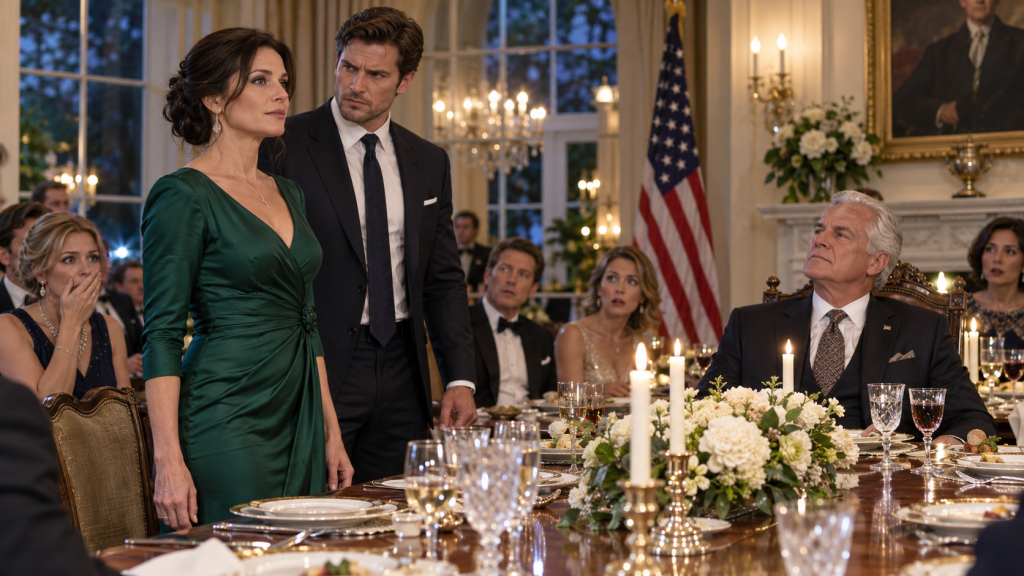
I folded my napkin, thanked him for dinner, and walked out.
Arthur Sterling thought he had humiliated a woman who wanted access to his family fortune.
He had no idea that the following morning, one phone call from me would threaten everything he had spent forty years building.
My name is Chloe Bennett.
And the strangest part of the whole thing is that I genuinely wanted Arthur Sterling to like me.
Not because he was rich.
Because Julian loved him, despite everything.
Or maybe loved the version of his father he kept hoping still existed somewhere underneath the money, control, and ego.
The first warning came before we even made it through the front door.
Julian glanced at my ten-year-old Toyota, then at the line of Mercedes, Bentleys, Range Rovers, and black SUVs parked outside his father’s Bellevue estate.
“You sure you don’t want me to park it around back?”
I looked at him.
He immediately winced.
“That came out wrong.”
“It definitely did.”
“I meant because Dad’s guests have blocked half the driveway.”
“Excellent recovery.”
He laughed nervously.
My Toyota was navy blue.
It had 189,000 miles on it and a dent beside the rear bumper from a runaway shopping cart at Target.
I blamed the wind.
The insurance company blamed physics.
Either way, it ran perfectly.
That was enough for me.
Julian had offered more than once to buy me something newer.
Every time, I gave him the same answer.
“When it stops moving, I’ll replace it.”
Eventually he learned not to ask.
Arthur Sterling apparently had stronger opinions about what a car said about a person.
The moment we entered the marble foyer, he looked past me through the open door.
“That yours?”
I followed his gaze.
“The Toyota?”
“Yes.”
“It still runs?”
“Every morning.”
Arthur laughed.
“They still manufacture those?”
Julian’s expression tightened.
“Dad.”
“What? I’m making conversation.”
Arthur turned toward me and extended his hand.
“So. Chloe.”
I shook it.
“Nice to finally meet you.”
His handshake was firm.
Measured.
Less greeting than evaluation.
Arthur Sterling was sixty-three, silver-haired, broad-shouldered, and dressed like a man who considered tailoring an expression of moral discipline.
He had built Sterling Enterprises from a regional freight company into a corporate empire spanning logistics, warehousing, software, commercial real estate, and shipping.
His name appeared on university buildings, hospital wings, charity galas, and plaques all over Seattle.
People called him visionary.
Generous.
Brilliant.
People who worked for him used more complicated language when he wasn’t around.
Julian usually skipped complicated.
“He’s a bully,” he told me once.
Then, after thinking about it:
“A very successful bully.”
Julian’s mother had died five years before we met.
According to him, Arthur became worse afterward.
More controlling.
More obsessed with legacy.
He treated the family and the company as extensions of himself.
Every decision was personal.
Every disagreement was betrayal.
Julian was thirty-four, Harvard-educated, accomplished in his own right, and already a senior executive inside Sterling Enterprises.
Yet around his father, he sometimes looked sixteen.
Arthur corrected the way he spoke.
Interrupted presentations.
Changed deals Julian had spent months negotiating.
Then told people he was “teaching the boy how business worked.”
I once asked Julian why he stayed.
He answered without hesitation.
“Fourteen thousand employees.”
“What about them?”
“They didn’t choose my father. Their mortgages and families shouldn’t depend on whether I get tired of dealing with him.”
That answer told me everything I needed to know about Julian.
He understood privilege.
More importantly, he understood responsibility.
We met at a community food pantry in downtown Seattle.
I was carrying boxes of pasta when one split at the bottom.
Packets scattered everywhere.
Julian dropped to his knees and helped me clean them up.
He wore jeans.
Old sneakers.
No watch I noticed.
No driver.
No assistant.
We spent twenty minutes organizing canned food.
Then drank terrible coffee from Styrofoam cups.
He asked for my number.
I gave it to him.
I learned his last name on our third date.
“Sterling?” I asked.
He looked uncomfortable.
“Yes.”
“As in Sterling Enterprises?”
“Unfortunately.”
I laughed so hard I nearly spilled my water.
He loved that reaction.
Most people, he told me later, changed the moment they found out.
Some became nervous.
Others became ambitious.
A few became almost comically agreeable.
I didn’t care.
That was probably because I had spent enough time around money professionally to stop finding it mystical.
Julian knew I worked in investments.
What he didn’t tell his father—and what I specifically asked him not to tell his father—was what that actually meant.
I was managing partner for infrastructure and strategic capital at Northstar Capital.
Northstar controlled or advised on tens of billions in institutional money.
Pension funds.
University endowments.
Insurance capital.
Family offices.
We invested in transportation systems, ports, freight networks, industrial technology, and large-scale real estate.
I had spent twenty-six years in finance.
I started as an analyst.
Worked eighty-hour weeks.
Built models at midnight.
Flew coach across the country for meetings where men twice my age called me sweetheart.
I learned quickly.
Then learned faster.
By forty-one, I was running deals.
By forty-seven, I became managing partner.
I was forty-nine when I met Julian.
Arthur assumed I was younger.
Maybe because he never asked my age.
Maybe because people see what confirms their assumptions.
He knew none of this when I entered his home.
That was deliberate.
Three months before the dinner, Sterling Enterprises approached Northstar regarding a massive refinancing and acquisition plan.
The company wanted approximately $1.6 billion in capital commitments.
Arthur planned to refinance existing debt, acquire two regional logistics companies, upgrade a fleet, and expand a technology platform.
It was ambitious.
Potentially very profitable.
Also risky.
My division was leading Northstar’s evaluation.
Arthur knew the Northstar name.
He had attended two meetings with our chairman and one conference call with senior staff.
I had deliberately stayed out of the early-stage meetings because my team was still gathering information.
Arthur did not know I was the decision-maker expected to sign off before investment committee approval.
Julian knew.
He hated the situation.
“You realize this could get weird.”
“Business is always weird.”
“My father will lose his mind if he realizes you’re evaluating him.”
“That’s why he doesn’t need to know yet.”
“Why?”
“Because I want to see how Sterling operates when nobody thinks I’m watching.”
That was true professionally.
Personally, I also wanted Arthur to meet Chloe Bennett.
Not Managing Partner Bennett.
Not someone who controlled access to capital he desperately wanted.
Just the woman dating his son.
I wanted to see which version of himself he would show someone he believed had no influence.
I got my answer before dessert.
The dinner itself was larger than Julian had described.
Twenty-three guests around a massive mahogany table beneath crystal chandeliers.
A state senator.
Technology executives.
A university dean.
Venture capitalists.
Real estate developers.
Two people whose faces I recognized from business publications.
I knew several by reputation.
One had pitched Northstar a project the previous year.
Another had once sat across from me in a negotiation without realizing who I was because I attended virtually under a shortened name.
None seemed to recognize me.
Perfect.
Arthur placed Julian near the center of the table.
He seated me close to the far end.
Julian frowned immediately.
“Dad. Chloe is sitting with me.”
Arthur examined the seating arrangement like it was constitutional law.
“It’s already organized.”
“Move someone.”
Arthur smiled.
“You can survive ten feet away from your girlfriend for dinner.”
I touched Julian’s arm.
“It’s okay.”
It wasn’t.
But I understood the message.
Arthur wanted everyone to see my position.
Outside the center.
Outside the family.
Outside the important people.
I sat.
Dinner began.
For twenty minutes, Arthur mostly ignored me.
Then a woman across from me asked:
“Where did you grow up?”
“Outside Tacoma.”
“Oh, nice. What did your parents do?”
“My mother worked in hotel housekeeping.”
The woman smiled politely.
“Your father?”
“Not around.”
There was a small pause.
I wasn’t embarrassed.
Other people were embarrassed for me.
That always fascinated me.
Arthur heard the exchange.
“Housekeeping?”
“Yes.”
He looked almost delighted.
“And what do you do, Chloe?”
“I work in investments.”
He raised an eyebrow.
“Investments.”
“Yes.”
“A bank?”
“No.”
“Hedge fund?”
“Not exactly.”
“Private equity?”
“Something adjacent.”
Julian looked toward me.
He knew I was being intentionally vague.
Arthur did not enjoy uncertainty.
“Where?”
“I’d rather not turn dinner into networking.”
A man two seats away laughed.
Arthur didn’t.
“I respect ambition,” Arthur said. “Particularly from people who started at the bottom.”
There was technically nothing wrong with the sentence.
The tone did the work.
I smiled.
“Most people start somewhere.”
“What school?”
“Washington State.”
“Graduate school?”
“Later.”
“Where?”
“Stanford.”
That surprised him.
A tiny flicker.
Then he recovered.
“Scholarship?”
“Yes.”
“Impressive.”
“Thank you.”
He asked about my neighborhood.
Whether I rented.
Whether I owned.
How long I had known Julian.
Whether I planned to “upgrade” my lifestyle if our relationship became permanent.
Julian interrupted twice.
Arthur ignored him.
Eventually, Arthur asked about my dress.
It was emerald green.
Simple.
Elegant.
Borrowed from my closest friend, Maya.
She had worn it once to a gala.
When I told her about dinner, she pulled it from her closet.
“Wear this.”
“I can buy something.”
“Yes, Ms. Managing Partner, we all know you can buy clothing.”
“Then why—”
“Because you hate shopping and this fits.”
She was right.
So I borrowed it.
Arthur looked at the dress.
“Designer?”
“No idea.”
He laughed.
“You don’t know who designed your own dress?”
“It’s my friend’s.”
His smile widened.
“So it’s borrowed.”
“Yes.”
I continued eating.
Arthur leaned back.
Something about the information pleased him.
As though a mystery had been solved.
Poor mother.
Old Toyota.
Borrowed dress.
State school.
Now Chloe Bennett made sense to him.
Dessert arrived.
Arthur barely touched his.
The conversation shifted toward marriage and younger generations.
One executive joked that people increasingly married for financial security.
Arthur looked directly at me.
“Sometimes people see a family like ours and think they’ve discovered the elevator, so they can skip the stairs.”
Julian’s chair moved sharply.
“Dad.”
Arthur held up one hand.
“I’m speaking generally.”
“No, you aren’t.”
Arthur turned toward him.
“Sit down.”
“I’m not twelve.”
“Then stop behaving like it.”
Silence.
Twenty-three powerful people suddenly became fascinated by their plates.
Arthur looked back at me.
His eyes moved slowly from my face to the emerald dress.
Then he laughed.
Cold.
Short.
“Street trash in a borrowed dress.”
The sentence hung over the table.
Julian stood.
“What the hell is wrong with you?”
Arthur ignored him.
He watched me.
Waiting.
I understood exactly what he wanted.
Anger.
Tears.
A scene.
He wanted proof.
Proof that I lacked manners.
Proof I was after money.
Proof his instincts about class were correct.
So I denied him everything.
I folded my napkin.
Placed it beside my plate.
Stood.
“Thank you for dinner, Arthur.”
His smirk disappeared.
I picked up my clutch.
Julian followed me into the foyer.
“Chloe.”
“I’m going home.”
“So am I.”
“No.”
He stopped.
“What?”
“Stay.”
“After that?”
“These are your father’s guests.”
“I don’t care.”
“This is his mess.”
Julian looked furious.
“I should have stopped him twenty minutes ago.”
“You tried.”
“Not hard enough.”
He ran both hands through his hair.
“He called you trash.”
“I noticed.”
“How are you this calm?”
I glanced back toward the closed dining-room doors.
“Because he answered a question I’ve been debating for three months.”
“What question?”
“Whether I could trust him.”
Julian frowned.
“With what?”
I kissed his cheek.
“Go back inside.”
“Chloe.”
“We’ll talk tomorrow.”
I left.
I drove my battered Toyota through Arthur Sterling’s iron gates and did not cry until I reached the freeway.
Not because Arthur had hurt my self-esteem.
He didn’t know enough about me to do that.
I cried because Julian had spent his life under that man.
Because fourteen thousand employees answered, ultimately, to someone who measured human worth by proximity to wealth.
And because the professional doubts I had been carrying for months suddenly looked much more serious.
At Northstar, we had concerns about Sterling Enterprises before that dinner.
Turnover among senior executives.
Aggressive accounting around acquisition targets.
Vendor complaints.
A governance structure that concentrated enormous authority in Arthur’s hands.
Several strong managers had left after disagreements with him.
The company was profitable.
But profitability is not the same as health.
The refinancing would have given Arthur another enormous pool of capital.
Our investment committee had asked me one question repeatedly:
Can Sterling’s leadership responsibly execute this expansion?
Until dinner, my answer had been:
Maybe.
At 7:12 the next morning, I was already in my office.
Seattle was gray beyond the windows.
I had slept four hours.
My assistant brought coffee.
“You okay?”
“Yes.”
“You’re wearing yesterday’s angry face.”
“I have an angry face?”
“You have several.”
She left.
At 7:40, my investment team entered the conference room.
Eight people.
Legal.
Risk.
Operating partners.
Senior analysts.
Nobody knew what happened at dinner except one colleague who had texted after hearing through Seattle’s remarkably efficient gossip network.
I opened the meeting.
“Where are we on Sterling?”
Our senior analyst summarized.
Debt manageable under base assumptions.
Acquisition synergies uncertain.
Management risk elevated.
Vendor concentration concerning.
Several legal matters unresolved.
Then our governance specialist said:
“My biggest concern remains Arthur.”
I looked at him.
“Explain.”
“Too much authority. Weak internal challenge culture. Employees describe decision-making as personality-driven.”
Another partner added:
“Three references independently used the word retaliatory.”
I sat back.
That word mattered.
Retaliatory.
Not rude.
Not difficult.
Retaliatory.
I thought about dinner.
Arthur humiliating someone because he believed she had no power.
I asked:
“If we removed Arthur from the equation?”
“Deal becomes much cleaner.”
“If he remains?”
“Governance discount should increase substantially.”
I looked around the table.
“Recommendation?”
Silence.
They were waiting for me.
I had always been careful about separating personal emotion from investment judgment.
So I did not mention the insult.
Instead I asked them to review the record.
Everything.
Executive departures.
Litigation.
Audit notes.
Vendor disputes.
Internal decision rights.
By 9:30, the conclusion was obvious.
The dinner had not created the problem.
It had revealed the pattern.
I called Northstar’s chairman.
“Richard.”
“Morning.”
“I’m withdrawing our participation from Sterling.”
Pause.
“All of it?”
“Yes.”
“You sure?”
“Yes.”
“Personal or investment?”
Good question.
“Investment.”
I meant it.
He knew me well enough to hear the rest.
“What happened?”
“I had an opportunity to observe Arthur Sterling outside a controlled business setting.”
“And?”
“It confirmed the governance concerns.”
Richard exhaled.
“That’s going to cause noise.”
“I know.”
“We’re lead capital.”
“I know.”
“Arthur will call.”
“I know.”
“You want me to handle him?”
“No.”
“I thought you might say that.”
At 9:52, our legal team notified Sterling Enterprises that Northstar was withdrawing from the proposed financing.
The letter was professional.
Short.
No mention of dinner.
Northstar had reassessed governance and execution risk and would not proceed under the current structure.
That was all.
By 10:30, Julian called.
I didn’t answer.
At 10:42, again.
Then 11:05.
At 11:20, a Sterling board member called my office.
I had my assistant say I was unavailable.
Then the reaction spread.
Northstar was expected to provide almost forty percent of the institutional capital.
Other investors noticed immediately.
One pension partner called asking why.
We gave no confidential detail.
Only that our risk assessment had changed.
That was enough.
Investors are like birds.
One takes off.
Everyone checks the sky.
By early afternoon, another institution delayed its commitment pending review.
A third requested revised governance protections.
Sterling’s acquisition timeline immediately became uncertain.
At 2:07, Julian finally reached me.
“Chloe.”
“Hi.”
“What did you do?”
“My job.”
Silence.
Then:
“Northstar?”
“Yes.”
“You’re Northstar’s lead?”
“For this transaction.”
He exhaled.
“Oh my God.”
“Did your father tell you?”
“He just found out.”
“How?”
“The board chair walked into his office with your profile.”
I closed my eyes.
I could imagine it.
“What happened?”
Julian gave a strange laugh.
“He thought there was another Chloe Bennett.”
“That would have been convenient.”
“He asked why nobody told him.”
“And what did you say?”
“That you specifically asked me not to.”
“Thank you.”
“He’s furious.”
“At me?”
“At everyone.”
Of course.
Julian lowered his voice.
“Chloe, did you pull the financing because of last night?”
“No.”
He went silent.
“I pulled it because my team had serious governance concerns that last night confirmed.”
“That distinction might be difficult for him.”
“That isn’t my problem.”
Another silence.
Then Julian said:
“I’m proud of you.”
I almost cried.
“Don’t be.”
“Why?”
“Because this isn’t revenge.”
“I know.”
“It cannot become revenge.”
“I know.”
“I’m serious.”
“So am I.”
Then he said:
“I resigned this morning.”
I stood.
“What?”
“I resigned.”
“Julian.”
“I should have done it years ago.”
“Did I cause that?”
“No.”
“Think carefully.”
“I have.”
I sat again.
“What about the employees?”
“I didn’t resign from the board. I resigned from reporting directly to him.”
“That’s different.”
“I told the independent directors I’ll stay if governance changes.”
I smiled.
“That sounds like you.”
He laughed softly.
Then:
“Dad wants your number.”
“He has it.”
“What?”
“He has called me twice.”
“You didn’t answer?”
“No.”
“Good.”
At 3:14, Arthur Sterling called again.
I answered.
“Arthur.”
Silence.
Then:
“Chloe.”
His voice had changed.
No amusement.
No superiority.
“I understand we need to talk.”
“About the transaction?”
“About several things.”
“Then let’s discuss the transaction.”
He exhaled.
“I believe we got off on the wrong foot.”
“No.”
Pause.
“I beg your pardon?”
“You met me exactly the way you intended to.”
“Last night was unfortunate.”
“It was informative.”
His tone tightened.
“I owe you an apology.”
“Yes.”
Another pause.
He was not accustomed to apologies being accepted without relieving him.
“I was rude.”
“You were.”
“I misjudged you.”
“That’s actually the part I care about least.”
“What do you mean?”
“You believed I was poor.”
Silence.
“You believed my mother’s job, my car, my dress, and my background gave you permission to humiliate me.”
“That is not—”
“It is.”
I kept my voice calm.
“If I had been exactly who you thought I was, would you still be apologizing?”
He did not answer.
There it was.
Arthur changed direction.
“Northstar’s withdrawal puts fourteen thousand jobs at risk.”
“No.”
“What?”
“Sterling’s capital structure and acquisition strategy put those jobs at risk. Northstar declined to assume that risk.”
“You’re splitting hairs.”
“I’m describing fiduciary responsibility.”
He became angry.
Finally.
“So this is punishment.”
“No.”
“You expect me to believe the timing is coincidence?”
“No. The timing is observation.”
He went quiet.
I continued.
“My team has been concerned about your leadership structure for months. Executive turnover. Vendor disputes. Concentrated decision authority. Retaliatory management practices.”
His voice cooled.
“You’re relying on disgruntled employees.”
“I watched you humiliate someone in front of twenty-three people because you believed she was socially beneath you.”
Silence.
“That did not create the concern. It validated it.”
Arthur tried another tactic.
“Come to dinner.”
“No.”
“Private. Just us.”
“No.”
“I’ll make a donation to whatever charity you choose.”
I almost laughed.
“No.”
“What do you want?”
That question said everything about him.
He assumed every conflict ended with a price.
“I want nothing from you.”
“Then what solves this?”
“Governance.”
“What does that mean?”
“Independent oversight.”
“I built that company.”
“Yes.”
“I know every employee—”
“No, Arthur. You know an organization with fourteen thousand employees. That is not the same thing.”
He breathed heavily.
“You’re enjoying this.”
“I’m not.”
And I wasn’t.
I thought about Julian.
About people whose mortgages depended on Sterling.
About employees who could lose jobs if Arthur refused to adapt.
“I hope your company succeeds.”
“Without me?”
“With leadership investors can trust.”
He hung up.
The next forty-eight hours were chaos.
Sterling’s board met twice.
Banks demanded revised projections.
One acquisition target extended its exclusivity deadline.
Another threatened to reopen negotiations with competitors.
The press learned that financing had stalled.
Arthur publicly called it “routine capital restructuring.”
Privately, according to Julian, he was furious.
Then something unexpected happened.
The board stopped being afraid of him.
Once Northstar withdrew, directors started asking questions they had avoided for years.
Why had four senior executives left in eighteen months?
Why was Arthur personally approving vendor contracts above ordinary thresholds?
Why were succession plans vague?
Why did the board’s risk committee receive incomplete reporting?
The problem expanded beyond one deal.
It became about Arthur’s entire method of control.
Three weeks later, the board proposed new conditions.
Independent executive committee.
Enhanced audit authority.
Separation of chairman and CEO responsibilities.
Julian given operational authority independent of Arthur.
Arthur rejected the package.
The board rejected Arthur.
That was the beginning of the end of his chairmanship.
Not because I destroyed him.
He had built the mechanism himself.
I simply stopped financing it.
Two months later, Sterling Enterprises announced Arthur would step down as chairman and remain a nonexecutive founder.
The company resumed financing discussions under a new governance structure.
Northstar reconsidered.
That surprised people.
Arthur called it hypocrisy.
It wasn’t.
Investing is not about revenge.
Conditions changed.
Risk changed.
We eventually participated in a smaller package with stronger protections and substantially more independent oversight.
Julian became chief operating officer.
He earned it.
Not because he was Arthur’s son.
Because the board interviewed outside candidates and still selected him.
The first time I attended a formal Sterling board meeting after the restructuring, Arthur was present.
He sat across from me.
No insult.
No smirk.
Professional.
When the meeting ended, everyone filed out.
Arthur remained seated.
So did I.
He looked tired.
Not defeated.
Older.
“I owe you a better apology.”
I waited.
He looked at the table.
“When my wife died, I started thinking control was the only thing keeping everything together.”
I said nothing.
“That isn’t an excuse.”
“No.”
He almost smiled.
“You really don’t make these easy.”
“Apologies shouldn’t be easy.”
He nodded.
“I treated you badly because I thought I understood your value before knowing anything about you.”
“Yes.”
“I also treated Julian that way.”
“Yes.”
“That one may be harder to fix.”
“It should be.”
He looked toward the door.
“Do you hate me?”
“No.”
He seemed surprised.
“I don’t know you well enough.”
That actually made him laugh.
Quietly.
Then he said:
“The dress was nice.”
I stared at him.
He raised both hands.
“I’m trying.”
“It still belongs to Maya.”
He laughed again.
We were never close.
Let me be clear.
This did not become one of those stories where the arrogant billionaire transforms overnight into a warm grandfather who bakes muffins.
Arthur remained Arthur.
Opinionated.
Difficult.
Proud.
But he changed enough to stop confusing cruelty with authority.
Sometimes enough is real progress.
Julian and I stayed together.
Slowly.
Carefully.
His resignation threat had frightened me at first.
I did not want him choosing between me and his family.
Eventually I understood he wasn’t.
He was choosing what kind of man he wanted to become.
A year later, he proposed.
Not at a restaurant.
Not in Paris.
Not with photographers hiding in bushes.
He took me back to the food pantry where we met.
Same storage room.
Same terrible coffee.
He held out a ring.
I stared at him.
“You know I’m going to ask about the expense.”
“I have a receipt.”
“I hate you.”
“No, you don’t.”
I said yes.
Arthur attended our wedding.
He behaved.
Mostly.
Before the ceremony, he found me alone near the garden.
“You look beautiful.”
“Thank you.”
He looked at my dress.
“Own this one?”
I stared.
His face went pale.
Then I laughed.
He looked relieved.
“Yes, Arthur. I bought this one.”
“Good.”
“From a clearance rack.”
He sighed.
I enjoyed that far too much.
My mother attended too.
Arthur met her properly for the first time.
I watched carefully.
He shook her hand.
“Mrs. Bennett. Chloe speaks very highly of you.”
My mother smiled.
“She usually exaggerates.”
Arthur said:
“She told me you worked in hospitality.”
Housekeeping.
He had learned something.
“Yes.”
“For thirty-two years.”
Arthur nodded.
“That sounds harder than what I do.”
My mother laughed.
“You wouldn’t last a week.”
He laughed too.
That moment mattered more to me than the financing.
Years later, people still tell a distorted version of what happened.
They say Arthur insulted the wrong woman.
That a billionaire mocked someone more powerful than he realized.
That I destroyed his empire with one phone call.
It sounds satisfying.
It is also not quite true.
Arthur’s mistake was not insulting a woman with hidden power.
His mistake was believing anyone deserved less dignity because they appeared powerless.
If I had actually been a struggling analyst wearing a borrowed dress, his words would have been equally ugly.
Maybe uglier.
That became the lesson I carried with me.
Power reveals people.
Not when they deal with someone stronger.
When they deal with someone they believe cannot hurt them.
Arthur thought my Toyota, my mother’s housekeeping job, and Maya’s borrowed dress meant I had nothing he needed.
So he showed me exactly who he was.
And I listened.
As for the Toyota, it survived another three years.
214,317 miles.
Then one morning, the transmission finally gave out.
Julian received my text.
THE TOYOTA HAS FALLEN.
He called immediately.
“This is the greatest day of my life.”
“I’m calling a tow truck.”
“I’m calling Porsche.”
“No.”
“Mercedes?”
“No.”
“Range Rover?”
“Absolutely not.”
“What are you buying?”
I smiled.
“Another Toyota.”
There was a long silence.
“You manage billions of dollars.”
“Yes.”
“You could drive anything.”
“Exactly.”
Three weeks later, a new dark-blue Toyota sat in our driveway.
Arthur came over for dinner.
He looked at it.
Then at me.
“You did that just to annoy me.”
“Mostly.”
He laughed.
And this time, when we sat down together, nobody cared what anybody’s dress cost.
Nobody asked who owned which car.
Nobody needed a seating chart to establish rank.
My mother sat beside Arthur.
Julian beside me.
And the woman Arthur had once called street trash passed him the potatoes.
He accepted them.
“Thank you, Chloe.”
I smiled.
“You’re welcome.”
It was not a dramatic ending.
No ruined empire.
No public revenge.
No man begging on his knees.
Just something better.
A table where everyone finally understood that money could buy the house, the crystal, the company, and every expensive car in the driveway.
But respect?
That still had to be earned.
THE END! THANKS FOR READING!❤️🙏