
 Reading Time: 24 minutes
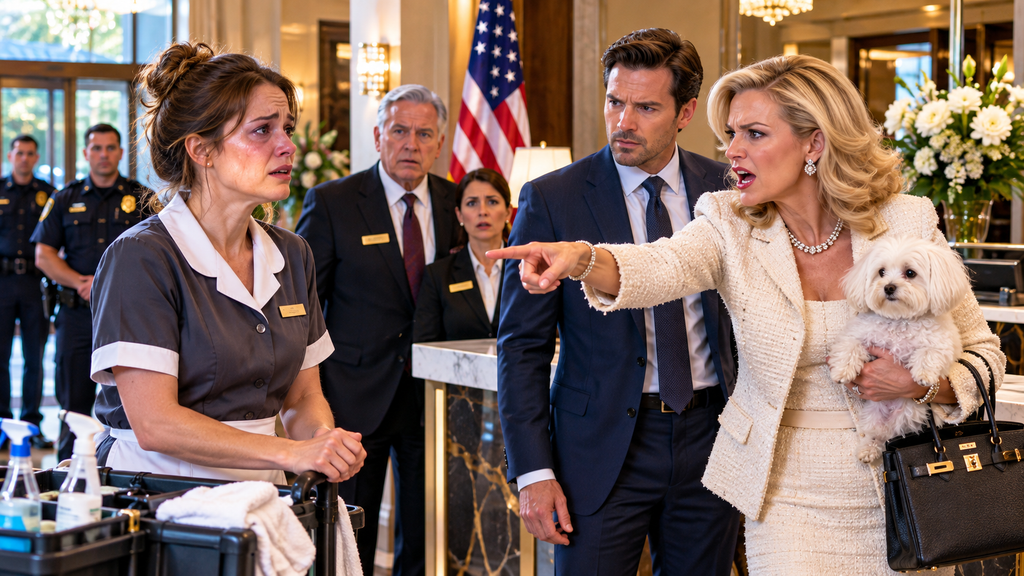
I lost my hotel job after a wealthy guest accused me of stealing her $5,000 diamond ring. The next morning, one of the security guards called and said, “Rachel, come back to the hotel. You need to see what that woman left behind for you.”
At the time, I thought I had already reached the worst moment of my life. I was wrong.
My husband, Daniel, died from cancer eighteen months earlier. He was thirty-six. I was thirty-four. Our twin daughters, Sophie and Emma, were three years old when they lost their father.
For almost a year before Daniel died, our lives revolved around hospitals, chemotherapy appointments, insurance calls, medication schedules, and waiting rooms.
Daniel fought harder than anyone I had ever known.
Even near the end, when he could barely walk from our bedroom to the kitchen without stopping to catch his breath, he worried more about me and the girls than he did about himself.
“You’re going to be okay,” he told me once.
I remember getting angry.
Not because he had said anything cruel.
Because I knew what he was really saying.
He knew he was dying.
“Don’t talk like that,” I told him.
He smiled weakly.
“I know you, Rachel. You’ll figure things out.”
I didn’t feel strong after he died.
I felt hollow.
And grief wasn’t the only thing he left behind.
There were medical bills.
Thousands and thousands of dollars.
Insurance had covered some of his treatment, but not everything.
There were scans, specialists, emergency admissions, medications, and procedures that seemed to generate new bills every week.
By the time the funeral was over, I had less than two thousand dollars in savings and more debt than I wanted to calculate.
I had no parents nearby.
My mother had died when I was twenty-seven.
My father lived across the country with health problems of his own.
Daniel’s parents were gone.
I had friends, but they had families and bills too.
There was nobody I could call and say, “Please take care of everything for six months while I fall apart.”
So I didn’t fall apart.
At least not where anyone could see me.
I cried in the shower.
I cried after the girls went to sleep.
I cried sometimes while sitting in the grocery store parking lot because I had to decide whether to buy laundry detergent or the yogurt Sophie liked.
But every morning, I got up.
I packed two tiny lunches.
I brushed two heads of tangled hair.
I found missing shoes.
I wiped tears.
I kissed cheeks.
And then I went to work.
Eventually, I found a housekeeping position at the Wexler Grand Hotel.
It was the kind of hotel where people paid more for one night than I paid in monthly rent.
Marble floors.
Crystal chandeliers.
Fresh flowers changed every morning.
Cars arriving at the entrance that cost more than my apartment building.
I earned seventeen dollars an hour.
To the guests, I was almost invisible.
But I didn’t care.
The work was steady.
The health insurance was decent.
And my supervisor usually let me pick up additional rooms whenever I needed overtime.
That job kept my daughters fed.
It kept the lights on.
It paid daycare.
It kept our lives barely balanced.
I could not afford to lose it.
Then, one Tuesday afternoon, my manager called me to the lobby.
I knew something was wrong the moment I saw his face.
His name was Mr. Pearson.
Normally, he was the kind of manager who spoke while walking because he was always in a hurry.
That afternoon, he stood completely still beside the front desk.
A couple waited near him.
I recognized them immediately.
They were staying in Suite 814.
I had cleaned their room earlier that morning.
The woman looked as if she had stepped directly out of a luxury advertisement.
Cream-colored designer coat.
Gold earrings.
Perfect blond hair.
Leather handbag.
A tiny white dog tucked beneath one arm.
Her husband stood slightly behind her.
Tall.
Gray suit.
Expensive watch.
Nervous expression.
The instant the woman saw me, she raised one finger.
“That’s her.”
I stopped.
Mr. Pearson cleared his throat.
“Rachel, Mrs. Carter says an item is missing from her room.”
Mrs. Carter folded her arms.
“My diamond ring.”
“I’m sorry?”
“My anniversary ring. Five thousand dollars.”
My stomach tightened.
“I didn’t see a ring in your room.”
She gave a short laugh.
“Of course you didn’t.”
“I’m sorry, ma’am?”
She looked at Mr. Pearson.
“Do you hear this?”
I tried to stay calm.
“Where did you leave it?”
“On the nightstand.”
I pictured the suite.
Unmade bed.
Half-empty bottle of sparkling water.
Shopping bags beside the closet.
Two used champagne glasses.
A handbag on the chair.
A dog blanket near the window.
I remembered almost everything because housekeepers train themselves to notice objects.
Anything valuable is left alone.
Anything that looks like trash but could possibly matter stays untouched.
“I never saw a ring on the nightstand,” I said.
Mrs. Carter’s expression hardened.
“I put it there before breakfast.”
“Maybe it was moved.”
“By whom?”
“I don’t know.”
“You were the person inside the room.”
“I cleaned the room. That’s all.”
“And now my ring is missing.”
My heart started pounding.
“I didn’t steal anything.”
She stepped closer.
“Then where is it?”
“I don’t know.”
Mr. Pearson raised both hands.
“Everyone, please. Let’s handle this calmly.”
Security was called.
My housekeeping cart was searched.
My uniform pockets were searched.
My locker was searched.
I agreed to everything because I thought the faster they searched, the faster this nightmare would end.
They found nothing.
Then they checked the electronic door records.
That was when everything turned against me.
Mrs. Carter and her husband left Suite 814 at 8:07 that morning.
At 8:23, my employee key opened their door.
I cleaned the room for twenty-seven minutes.
At 8:50, I left.
The Carters returned later.
According to the door log, nobody else entered during that period.
Marcus, one of the security officers, reviewed the hallway camera.
It showed exactly the same thing.
The couple leaving.
Me arriving with my cart.
Me entering.
Me leaving.
No other hotel employee entered.
No stranger slipped inside.
No mysterious person appeared.
On paper, there was only one suspect.
Me.
“I didn’t take it,” I said again.
Mrs. Carter looked at Mr. Pearson.
“I want the police called.”
My chest tightened.
“Please. I have two daughters.”
She looked directly at me.
“What does that have to do with my ring?”
“Nothing. I’m just telling you, I wouldn’t risk my job. I wouldn’t risk everything over a ring.”
She narrowed her eyes.
“People like you always say that after they get caught.”
People like you.
I felt those words more sharply than I expected.
Mr. Carter finally spoke.
“Lydia, maybe we should let security finish investigating.”
She turned on him.
“My ring is gone.”
“I know, but—”
“And she was in our room.”
He became quiet.
Then Mrs. Carter pulled out her phone.
“You should probably know that I have nine hundred and eighty thousand followers.”
Mr. Pearson visibly stiffened.
“I review luxury hotels for a living. Do you know what happens if I post a video saying this hotel allows employees to steal from guests?”
“Mrs. Carter—”
“I can upload it before dinner.”
That changed everything.
Until then, management had been investigating.
After that, management started panicking.
They took Mr. Pearson into an office.
Ten minutes later, he returned with the director of operations.
Twenty minutes after that, they called me into a conference room.
Nobody looked me in the eyes.
That was when I knew.
“Rachel,” Mr. Pearson began, “given the circumstances—”
“No.”
He stopped.
“You don’t have to say it like that.”
“Rachel—”
“You’re firing me.”
“The hotel needs to respond appropriately while this matter is unresolved.”
“Then suspend me.”
Nobody answered.
“Investigate it.”
Silence.
“Call the police if you actually think I stole something.”
The operations director shifted in his chair.
“We believe termination is the best course of action.”
“For who?”
Again, silence.
“For me?”
I looked from one person to another.
“Or for the hotel?”
Mr. Pearson whispered, “I’m sorry.”
I stood.
Almost a year of work.
Gone.
Almost a year of coming in early.
Taking extra rooms.
Working Christmas Eve.
Covering shifts when other housekeepers called out.
Cleaning bathrooms after people who sometimes left twenty-dollar tips and sometimes left nothing.
Gone because a wealthy woman pointed at me.
They gave me my final check.
After taxes and deductions, it was less than half my monthly rent.
I walked through the lobby carrying my uniform in a plastic bag.
Mrs. Carter was still there.
She watched me pass.
And I will never forget the expression on her face.
She wasn’t angry anymore.
She looked satisfied.
I noticed it.
But I didn’t understand it.
Not then.
I went home.
The moment I opened my apartment door, Sophie and Emma ran toward me.
“Mommy!”
I dropped the plastic bag and hugged them both.
Sophie had blue marker on one cheek.
Emma was wearing one sock.
For a few seconds, I held them so tightly they started laughing.
That almost broke me.
Because children trust you to keep the world stable.
They don’t know about rent.
Or employment records.
Or accusations.
Or medical debt.
They just know Mommy came home.
After dinner, I put them to bed.
Emma asked if Daddy could see her new drawing from heaven.
I said yes.
Then I sat alone at the kitchen table.
My bills were stacked in a drawer beside me.
Rent was due in nine days.
Daycare was due Friday.
My checking account had $643.
My final paycheck would barely change that.
I covered my face with both hands.
For the first time since Daniel died, I thought, I cannot do this.
Not emotionally.
Financially.
Practically.
I could survive grief.
I had already proven that.
But I could not survive without income.
What would happen when another hotel called Wexler Grand for a reference?
Would they say I had been terminated following a theft accusation?
Would anyone hire me?
I barely slept.
At 7:13 the next morning, my phone rang.
Marcus.
He worked hotel security.
He was in his late forties, former military, quiet, serious, and one of the few people at work who always treated housekeepers like actual human beings.
“Hello?”
“Rachel.”
Something in his voice made me sit up.
“What happened?”
“You need to come back to the hotel.”
I looked toward my daughters’ bedroom.
“Marcus, they fired me.”
“I know.”
“I can’t just walk back in there.”
“I know that too.”
“Then why are you calling?”
He lowered his voice.
“I reviewed the footage again.”
My heart began pounding.
“And?”
“I saw something we missed yesterday.”
“What?”
A pause.
Then he said something I still remember word for word.
“You’re not going to believe what that woman left behind for you.”
I sat completely still.
“What do you mean, for me?”
“Come to the employee entrance.”
“Marcus—”
“Trust me.”
Forty minutes later, after dropping the girls at daycare and spending money I really couldn’t afford on a rideshare, I stood outside the hotel.
Marcus met me at the employee door.
He looked exhausted.
“Does management know I’m here?”
“Not yet.”
That didn’t make me feel better.
He led me to the security office.
Three monitors covered one wall.
“Sit.”
I didn’t.
“Show me.”
He pulled up footage from the previous morning.
The hallway outside Suite 814 appeared.
8:07 a.m.
Mrs. Carter stepped out first.
Her husband followed.
The little white dog trotted between them.
“Watch her,” Marcus said.
“I did yesterday.”
“No. Yesterday we watched the door.”
He rewound the video.
“Watch her hands.”
He played it in slow motion.
Mrs. Carter stood partly inside the suite while her husband waited in the hallway.
Then she reached into her handbag.
She removed something black.
Because the hotel camera was positioned diagonally across the hall, you could see several feet into the suite whenever the door was open.
Mrs. Carter bent slightly and tucked the black object behind the decorative tray on the entry table.
Then she looked directly down the hallway.
Not casually.
Carefully.
Checking whether anyone was coming.
My skin prickled.
“What is that?”
Marcus paused the image.
“That’s what I wanted to know.”
He skipped forward.
I appeared sixteen minutes later.
I entered Suite 814.
Twenty-seven minutes passed.
Then I came back out with my cart.
“Now watch.”
At 9:18, Mrs. Carter returned alone.
She moved quickly.
She opened the room.
Thirty-nine seconds later, she came back out.
Whatever she had placed there was apparently gone.
Except it wasn’t.
Marcus opened his desk drawer.
He removed a clear evidence bag.
Inside was a black envelope.
My name was written across the front.
RACHEL MORGAN.
My knees almost gave out.
“That’s my name.”
“I know.”
“Where did you get that?”
“Maintenance found it this morning.”
“Where?”
“Behind the dresser in Suite 814.”
I stared at him.
“The Carters complained that one of the outlets wasn’t working before they checked out. Maintenance moved the dresser after they left. This was behind it.”
I looked at the envelope.
“Why would she have my name?”
“That’s the question.”
“But she didn’t know me.”
Marcus gave me a strange look.
“I think she did.”
I felt suddenly cold.
He slid the bag toward me.
“I haven’t opened it.”
I looked at the black envelope for several seconds before pulling it free.
My hands trembled.
The flap had already been torn slightly when maintenance found it.
I opened it.
Inside was a photograph.
At first, I didn’t understand what I was looking at.
Then I stopped breathing.
Daniel.
My husband.
He was standing outside an office building wearing the navy-blue jacket I bought him for our sixth anniversary.
Beside him stood Mr. Carter.
Not the woman.
Her husband.
The photograph had been taken years earlier.
Daniel looked healthy.
Alive.
I turned it over.
Three sentences were written on the back.
Daniel kept something that belongs to us.
You have until noon tomorrow to return the blue drive.
If you don’t, losing your job will be the least of your problems.
For several seconds, I couldn’t hear anything except my heartbeat.
Marcus read the message over my shoulder.
“Rachel?”
I lowered myself into the chair.
“No.”
“You recognize the man?”
“My husband.”
“I mean Carter.”
I shook my head.
“No.”
“But your husband knew him.”
“I guess.”
“What blue drive?”
“I don’t know.”
Marcus crouched slightly.
“Think.”
“I am thinking.”
My voice cracked.
“Daniel was an accountant.”
Marcus waited.
“He worked for a firm downtown. Mostly corporate audits and nonprofit accounts. I never knew all his clients. He wasn’t allowed to discuss them.”
“Did he ever mention Carter?”
“No.”
I stopped.
A memory came back.
Not clearly at first.
Just Daniel sitting at our dining table about six months before his diagnosis, laptop open, rubbing his forehead.
I had asked whether something was wrong.
He said, “I have a client who thinks money can make facts disappear.”
At the time, I laughed.
“What did that mean?”
He answered, “Exactly what it sounds like.”
I hadn’t thought about that conversation in years.
Another memory surfaced.
A blue flash drive.
Daniel had used one constantly.
It hung from his keychain.
After he got sick, I remembered seeing it in his home office.
Then everything from that period blurred together.
Doctors.
Bills.
Medication.
Hospice.
Funeral.
Boxes.
“Rachel?”
I looked at Marcus.
“I might know what she means.”
He immediately stood.
“Then don’t go home alone.”
I almost laughed.
“I have two children at daycare. Where exactly am I supposed to go?”
Before he could answer, someone knocked.
Mr. Pearson entered.
He looked from Marcus to me to the envelope.
“What is happening?”
Marcus closed the door.
Twenty minutes later, Mr. Pearson had stopped apologizing and started calling people.
Hotel legal counsel.
The general manager.
Corporate security.
Then police.
This time, nobody asked me to leave.
The general manager, a woman named Helen Ward, arrived from another property across town.
She watched the footage.
Read the note.
Then asked Marcus one question.
“Did you review the restaurant cameras?”
He stared at her.
“No.”
The Carters had claimed Mrs. Carter left her ring on the nightstand before going downstairs for breakfast.
If that was true, she should not have been wearing it outside the room.
Marcus pulled up the restaurant entrance camera.
At 8:11 a.m., Lydia Carter walked into breakfast with her husband.
Marcus zoomed in.
Her left hand was resting on her dog’s back.
Something flashed on her finger.
A diamond ring.
Nobody spoke.
He switched angles.
At 8:14, another camera showed her reaching for a coffee cup.
The ring was still on her finger.
At 8:31, she lifted her phone.
Still wearing the ring.
I felt something inside me change.
Not relief.
Not yet.
Anger.
She had been wearing the ring while I was cleaning her room.
She knew I could not possibly have stolen it.
Helen looked sick.
“Rachel…”
I stood.
“Yesterday, you fired me.”
“I understand.”
“No. You don’t.”
She became quiet.
“You searched my pockets.”
“I know.”
“You searched my locker.”
“I know.”
“You let that woman stand in your lobby and call me a thief while she was wearing the ring she said I stole.”
Helen lowered her eyes.
“I’m deeply sorry.”
“That doesn’t pay my rent.”
“No.”
“That doesn’t erase what goes in my employment record.”
“No.”
“And it doesn’t explain why she knew my husband.”
A police detective arrived shortly afterward.
His name was Detective Alvarez.
He watched everything.
He photographed the note.
He took the envelope.
Then he asked me about Daniel.
I told him what I knew.
It wasn’t much.
Daniel had worked for an accounting firm called Brooks, Keller & Finch.
He had been a forensic accountant.
He audited businesses, charities, and nonprofits.
He had started working long hours on one confidential account about four years earlier.
Then cancer entered our lives and everything else became insignificant.
Daniel left the firm shortly after his diagnosis.
He spent his final year mostly at home.
“Do you still have his work materials?” Alvarez asked.
“Maybe.”
“Do not search for the drive alone.”
That sentence scared me more than anything else.
The hotel arranged childcare for the twins and paid for me to take a car home with Detective Alvarez and another officer.
Marcus came too.
My apartment looked different when police entered it.
Smaller.
More vulnerable.
I went directly to the bedroom closet.
After Daniel died, I had put most of his personal belongings into four storage boxes.
For months, I couldn’t open them.
Even seeing his handwriting hurt too much.
One box contained clothes.
Another contained photographs.
The third held documents.
The final box had miscellaneous things from his desk.
I sat on the floor and opened it.
His old watch.
Business cards.
A calculator.
Pens.
A framed photograph of Sophie and Emma as babies.
Then I found his keychain.
My chest tightened.
Attached to it was a blue flash drive.
Nobody spoke.
I stared at it.
All this time.
Eighteen months.
It had been sitting less than ten feet from where I slept.
Detective Alvarez put on gloves.
“Rachel, before we do anything with this, I need to ask whether your husband ever told you what was on it.”
“No.”
“Did he leave instructions?”
“I don’t know.”
I searched the box again.
Beneath a stack of envelopes was one with my name.
Daniel’s handwriting.
Rachel.
I began crying before I opened it.
Inside was a single sheet.
If you ever have a reason to open the blue drive, call Martin Ellis before you open anything else.
Do not give the drive to anyone who asks for it.
Especially anyone connected to the Carter Foundation.
I read the last line twice.
Then three times.
Detective Alvarez asked, “Who is Martin Ellis?”
I knew the name.
Daniel’s former supervisor.
We called him from my kitchen.
He answered on the fourth ring.
The moment I told him who I was, he went silent.
Then I said “Carter Foundation.”
His voice changed.
“Where are you?”
Less than two hours later, Martin sat across from me.
He had aged dramatically since Daniel’s funeral.
He looked at the blue drive on the table as if it were radioactive.
“I told Daniel to destroy that.”
My stomach tightened.
“Why?”
Martin rubbed both hands over his face.
“Because he found fraud.”
The room became silent.
According to Martin, Daniel’s firm had been hired years earlier to review finances for a charitable organization controlled by Graham and Lydia Carter.
The Carter Foundation publicly raised money for children’s hospitals, cancer support programs, and emergency housing.
But Daniel discovered irregularities.
Invoices from companies that barely existed.
Consulting fees routed through shell businesses.
Large expenses categorized as outreach programs that apparently never occurred.
At first, Daniel believed it was sloppy bookkeeping.
Then he realized the same names appeared repeatedly.
Millions of dollars had moved through questionable companies.
One of them was controlled by Lydia Carter’s brother.
Another was linked indirectly to Graham Carter.
“Daniel wanted us to report everything immediately,” Martin said.
“Why didn’t you?”
He looked ashamed.
“The partners got scared.”
“The same way the hotel got scared?”
He flinched.
I didn’t apologize.
Martin continued.
“The Carters had powerful attorneys. They threatened the firm. Claimed Daniel had misunderstood records. Said they would destroy us with litigation.”
“What did Daniel do?”
“He copied the documents he believed proved the transactions.”
“Onto that drive?”
“Yes.”
I stared at it.
“Why didn’t he go to the police?”
“He intended to.”
Martin swallowed.
“Then he got sick.”
The diagnosis came fast.
Stage four pancreatic cancer.
Doctors originally gave Daniel maybe a year.
He got fourteen months.
His entire universe became treatment and his daughters.
Martin said Daniel had still intended to turn over the evidence but became afraid that doing so would drag me into a legal war while I was caring for him.
“So he kept it,” I whispered.
Martin nodded.
“He asked me to hold copies.”
“Did you?”
Martin’s expression answered before he spoke.
“No.”
I stood.
“You let him protect you.”
“Rachel—”
“You let a dying man keep the evidence because you were afraid.”
“I was.”
At least he admitted it.
Detective Alvarez asked whether the Carters knew Daniel had retained documents.
Martin nodded.
“They suspected.”
“How?”
“Someone inside the firm told them Daniel had made a backup.”
“And eighteen months after he died, they came looking for me.”
Martin looked toward the drive.
“Apparently.”
My phone rang.
Unknown number.
Everyone looked at it.
Detective Alvarez motioned for me to answer on speaker.
“Hello?”
Silence.
Then a man’s voice.
“Rachel?”
I recognized it.
Mr. Carter.
Graham.
“I think we need to talk.”
Detective Alvarez silently started recording.
I said, “About what?”
“My wife has made a terrible mistake.”
I looked at Alvarez.
“What mistake?”
“She panicked.”
“About the ring?”
A long silence.
“Yes.”
“You mean the ring she was wearing downstairs while accusing me of stealing it?”
Another silence.
“She never intended for things to go this far.”
I almost laughed.
“She got me fired.”
“I know.”
“She threatened me.”
“I know.”
“She left a letter using my dead husband’s name.”
“I know.”
His voice sounded broken.
“Rachel, Lydia believed you had documents that could destroy our family.”
“Do I?”
He didn’t answer.
“Where is the ring?”
Another pause.
Then he said quietly, “I have it.”
Everyone in the room went still.
“You have the ring.”
“Yes.”
“Did you know she accused me?”
“Not at first.”
I almost shouted.
“You were standing beside her!”
“I thought she had actually lost it.”
“So when did you find out?”
“At the restaurant. After everything started. She showed it to me inside her handbag.”
My stomach turned.
“And you said nothing.”
“I confronted her.”
“After I got fired?”
Silence.
“After they searched me?”
Silence.
“After she called me a thief?”
“I’m sorry.”
I hated that phrase.
Everyone was sorry after the damage was done.
Graham continued.
“She told me she needed pressure on you. She believed if you thought the police were involved, you’d surrender the drive.”
“She tried to frame me.”
“Yes.”
“Why are you telling me this?”
His voice became quieter.
“Because she crossed a line.”
“No, Mr. Carter. She crossed several.”
Detective Alvarez took the phone.
“Mr. Carter, this is Detective Luis Alvarez. I strongly recommend that you stop talking and arrange to meet us with your attorney.”
Graham Carter surrendered the ring that afternoon.
By evening, I had written confirmation from the Wexler Grand that the accusation against me had been false.
By the following morning, the hotel had officially reversed my termination.
Helen came to my apartment personally.
She brought no flowers.
I appreciated that.
Flowers would have felt insulting.
She sat at my kitchen table.
“Rachel, I cannot undo what happened.”
“No.”
“What management did was unacceptable.”
I waited.
“We made a decision based on fear of a guest’s online influence instead of evidence.”
“Yes.”
“Mr. Pearson has been placed on administrative leave while we conduct an internal review.”
I said nothing.
“We want to reinstate you immediately with full back pay.”
I looked at her.
“Immediately?”
“Yes.”
“As a housekeeper.”
“If that’s what you want.”
I almost laughed.
Three days earlier, I would have begged for that job.
Now something had changed.
“I need time.”
“Of course.”
“And I want a letter.”
“You already have one.”
“No. I want a letter saying I was falsely accused. That the hotel found evidence proving I did not steal anything. That my termination was reversed. And if anyone ever calls you for a reference, that is what you tell them.”
Helen nodded.
“You’ll have it today.”
“And the lost wages.”
“Yes.”
“And my daycare payment yesterday.”
She looked surprised.
“I had to pull money from rent because your hotel fired me without completing an investigation.”
She nodded again.
“We’ll reimburse it.”
I didn’t feel powerful.
I felt tired.
But for the first time in a long time, tired did not mean helpless.
The blue drive went to investigators.
What happened afterward unfolded over months.
I learned more about Daniel’s final year than I had known while living through it.
That hurt.
There were emails he never told me about.
Threatening letters.
Legal pressure.
Calls from people connected to the Carter Foundation.
Daniel had hidden those things because he knew I was already drowning in fear about his cancer.
Part of me was angry with him.
I wished he had trusted me.
Another part understood.
Daniel had spent his final months trying to leave me with fewer burdens, not more.
Investigators eventually confirmed that documents on the drive matched financial records obtained through subpoenas.
Several shell companies had received foundation money.
Some payments had legitimate explanations.
Others did not.
Graham Carter began cooperating with investigators.
According to his attorney, he claimed Lydia and her brother had controlled much of the financial scheme while he had deliberately avoided asking questions.
Investigators did not treat ignorance as a complete defense.
Lydia Carter’s online image collapsed almost overnight.
But I refused to watch.
Friends sent me links.
I deleted them.
I didn’t want to see strangers arguing about whether she was evil, misunderstood, arrogant, desperate, or framed herself.
I knew what she had done to me.
That was enough.
She had selected me deliberately.
Investigators found searches on a laptop seized from one of her assistants.
My name.
The hotel.
Daniel’s name.
My apartment building.
Even a photograph from a fundraising page my cousin had created during Daniel’s cancer treatment.
That was how Lydia found me.
She knew I had two young children.
She knew I had debts.
She knew I depended on my hotel paycheck.
She believed that made me easy to frighten.
The plan was horribly simple.
Book a room at my hotel.
Request housekeeping during my shift.
Leave the envelope where I would find it.
Then claim something valuable was missing.
If I found the envelope, I was supposed to understand the message.
Return Daniel’s drive and the accusation would disappear.
But I never saw the envelope.
When Lydia returned to the room and realized it was still there, she tried to retrieve it quickly.
She knocked it behind the dresser.
Instead of abandoning the plan, she continued with the theft accusation.
That was the part I struggled to understand.
How could someone destroy another person’s livelihood so casually?
Detective Alvarez answered that once.
“Because she didn’t think of you as a person,” he said.
“She thought of you as pressure.”
Those words stayed with me.
Lydia eventually faced charges connected to the staged theft accusation, attempted coercion, obstruction, and financial crimes tied to the foundation.
The legal case continued for a long time.
Her attorneys disputed parts of the government’s allegations.
There were hearings.
Negotiations.
Endless headlines.
I testified about what happened at the hotel.
Sitting across from her in court felt different from seeing her in the lobby.
Without the designer coat, the tiny dog, the hotel staff rushing to please her, and the phone she had threatened us with, she looked ordinary.
That surprised me.
For months, she had occupied my mind like some enormous force.
But she was just a person.
A person who had made choices.
When asked whether I had stolen her ring, I answered clearly.
“No.”
When asked whether I had ever seen the ring before she accused me, I said no.
When asked how losing my job affected me, I looked directly at Lydia.
“I went home that night wondering whether my daughters were going to lose their apartment because a stranger decided my life was disposable.”
Lydia looked down.
I didn’t need anything else from her.
The hotel settled with me separately.
My lawyer advised me not to discuss the exact amount publicly.
It wasn’t some ridiculous fortune.
I didn’t become rich overnight.
But it was enough to pay off the most urgent medical debt.
Enough to create an emergency savings account.
Enough that one bad week would no longer mean disaster.
Wexler Grand also offered me another position.
Housekeeping supervisor.
Better pay.
Better hours.
At first, I planned to reject it.
Every time I imagined walking into that lobby, I remembered Lydia pointing at me.
“That’s her.”
But Marcus changed my mind.
We met for coffee one afternoon.
“You know what happens if you don’t come back?” he asked.
“What?”
“I have to keep working with people who think checking one hallway camera counts as an investigation.”
I laughed for the first time in what felt like weeks.
Then he became serious.
“You were good at your job before this happened. You’ll still be good afterward.”
“I don’t want people looking at me like the woman who got accused of stealing.”
“They’re going to look at you like the woman management owes a huge apology.”
“That’s not better.”
“Give it time.”
I did.
I returned.
The first morning was horrible.
I stood in the employee elevator with my stomach twisting.
When the doors opened onto housekeeping, conversations stopped.
Then one of my coworkers, Maria, walked toward me.
She hugged me.
Hard.
“You scared us.”
Another housekeeper hugged me.
Then another.
Within five minutes, I was crying.
Not because I was sad.
Because I realized something I had forgotten while sitting alone in my kitchen that terrible night.
I wasn’t completely alone.
People had believed me.
Marcus had believed me enough to keep looking.
My coworkers had questioned management’s decision.
A maintenance worker had found the envelope and immediately turned it over instead of throwing it away.
A detective had listened.
A lawyer had helped.
Strength wasn’t always doing everything alone.
Sometimes strength was surviving long enough to discover who would stand beside you.
Three months after I returned to work, Martin Ellis called.
Daniel’s former supervisor.
“There’s something else,” he said.
My first instinct was panic.
“What?”
“When investigators copied the drive, they found a folder that wasn’t connected to the Carter records.”
My chest tightened.
“What folder?”
“It has your name.”
I sat down.
Inside was a video.
Daniel had recorded it during one of his last months.
Martin sent me an authorized copy.
I waited until Sophie and Emma were asleep before playing it.
Daniel appeared on my laptop screen.
Thin.
Pale.
Wearing the gray sweatshirt he practically lived in near the end.
For several seconds, he just looked at the camera.
Then he smiled.
“Hi, Rach.”
I started crying immediately.
I had forgotten the exact rhythm of his voice.
Not the sound.
The rhythm.
The tiny pause before he said my name.
“I’m recording this because there are some things I haven’t told you.”
He took a slow breath.
“I found something at work that became bigger than I expected.”
He explained the audit.
The Carter Foundation.
The documents.
The threats.
Then he said something I never expected.
“I know you’re going to be angry that I didn’t tell you everything.”
I laughed through my tears.
“You know me,” he continued.
“I also know you’re probably going to think I didn’t trust you.”
I covered my mouth.
“That isn’t true. I trust you more than anyone I have ever known.”
He looked away from the camera for a moment.
“When I got sick, everything changed. There were suddenly only so many hours left, and I didn’t want to spend them talking about lawyers and criminals and accounting files.”
His eyes became wet.
“I wanted to watch Sophie throw peas on the floor.”
I laughed again.
“I wanted to hear Emma mispronounce spaghetti.”
I was crying so hard I could barely see.
“I wanted to sit beside you on the couch and pretend some terrible television show was interesting because you liked it.”
“That show was good,” I whispered at the screen.
Daniel smiled as if he could hear me.
“If anyone ever comes looking for the drive, give it to law enforcement. Not the company. Not the foundation. Not their lawyers.”
Then his expression changed.
“Most importantly, don’t be afraid of people just because they have more money than you.”
I became completely still.
“Money can buy expensive rooms, good lawyers, beautiful clothes, and people who say yes.”
He paused.
“It cannot turn a lie into the truth unless everyone else agrees to stop looking.”
I thought of Marcus rewinding that hotel footage.
Again.
And again.
Looking one more time.
Daniel continued.
“Rachel, you’ve always been stronger than you know.”
I closed my eyes.
“I hate saying that because I know you hate when people tell you to be strong.”
I laughed through my tears.
“But you are.”
He leaned closer to the camera.
“If I’m not there someday when things become difficult, I need you to remember something.”
His voice cracked.
“You do not have to win every day.”
I pressed both hands over my mouth.
“You only have to keep going long enough to reach the next good one.”
The video ended a few minutes later.
I sat in the darkness for a long time.
Then I walked into the twins’ bedroom.
Sophie was sprawled sideways across her bed.
Emma had kicked her blanket onto the floor.
I tucked them both in.
For the first time since Daniel died, remembering him didn’t feel only like losing him.
It felt like having something returned.
A year passed.
Our life became ordinary again.
Beautifully ordinary.
I worked.
The girls started preschool.
We argued over vegetables.
We watched cartoons on Saturday mornings.
I learned how to fix a leaking faucet through online videos.
I finally replaced the cracked lamp in our living room.
I paid off one medical bill.
Then another.
Then the final one.
The day I made that last payment, I stared at the confirmation screen for almost a minute.
Then I cried.
Of course I cried.
I seemed to cry about everything in those years.
But those tears were different.
They weren’t grief.
They weren’t fear.
They were relief.
Marcus eventually became head of hotel security.
Whenever I teased him about it, he claimed solving my case had nothing to do with his promotion.
I never believed him.
Mr. Pearson returned after his administrative leave.
He asked to speak with me privately.
“I failed you,” he said.
I appreciated that he didn’t hide behind corporate language.
“Yes.”
“I was afraid of what she could do to the hotel.”
“I know.”
“I chose protecting the business over protecting an employee from an accusation we hadn’t proved.”
“Yes.”
He nodded.
“I’m sorry.”
This time, I accepted the apology.
Not because what happened was suddenly okay.
But because forgiveness and pretending something never happened are not the same thing.
I could forgive him.
I would never forget the lesson.
Months later, I saw Lydia Carter one final time.
Not in person.
On television.
Her attorney stood beside her outside a courthouse.
She looked tired.
Older.
No glamorous coat.
No little dog.
No crowd of hotel employees trying to keep her happy.
A reporter shouted a question about the ring.
Lydia stopped.
For one second, she looked directly toward the cameras.
Then she said, “I made decisions I regret.”
I turned off the television.
That was enough.
I didn’t need to hear whether she regretted hurting me or regretted getting caught.
There are questions you can spend your entire life trying to answer even though the answers change nothing.
The answer that mattered was sitting beside me on the couch.
Two answers, actually.
Sophie was coloring.
Emma was eating crackers and dropping crumbs everywhere.
“Mommy,” Sophie said.
“Yeah?”
“Are we rich?”
I laughed.
I have no idea where she got the question.
“Why?”
“Because Emma said we’re rich because we have strawberry ice cream.”
Emma nodded seriously.
“It’s expensive.”
I smiled.
“No, sweetheart. We’re not rich.”
Sophie thought about it.
“Are we poor?”
That question hit harder.
I looked around our apartment.
The furniture didn’t match.
My car was eleven years old.
There were still weeks when I checked my bank balance before buying anything unnecessary.
But rent was paid.
There was food in the refrigerator.
We had savings.
We were safe.
And no stranger could destroy our life with one accusation anymore.
“We have enough,” I said.
Sophie smiled.
“Enough strawberry ice cream?”
“Definitely.”
That night, after putting the girls to bed, I opened the small box where I kept Daniel’s watch and wedding ring.
Beside them was the blue flash drive.
Investigators had eventually returned it after preserving everything they needed.
For a long time, I considered throwing it away.
Instead, I kept it.
Not because of the financial records.
Not because of Lydia Carter.
Not because it had helped expose anything.
I kept it because Daniel’s video was still there.
Sometimes, on the hardest nights, I played one sentence.
You do not have to win every day.
You only have to keep going long enough to reach the next good one.
The morning Lydia Carter accused me of stealing her diamond ring, I thought my life was collapsing because someone wealthy and powerful had decided her word mattered more than mine.
For twenty-four hours, it did.
Then one security guard looked at the footage again.
One maintenance worker noticed an envelope.
One camera showed a diamond flashing on a woman’s finger when it should have been sitting on a nightstand upstairs.
One old blue drive revealed a secret my husband had carried almost to his grave.
And one lie began unraveling.
That experience taught me something I hope my daughters understand long before they ever need to.
People can accuse you.
They can underestimate you.
They can use money, status, fear, or influence to make other people doubt you.
Sometimes they may even succeed for a while.
You may lose something.
A job.
A friendship.
A reputation.
A night of sleep.
Maybe many nights.
But a lie has one weakness.
It needs the truth to remain hidden.
And sometimes the truth survives in places nobody expects.
On a forgotten security camera.
Behind a hotel dresser.
Inside an old cardboard box.
On a blue flash drive belonging to a man who knew he might not live long enough to explain everything himself.
I once believed that terrible Tuesday was the day I lost my job.
Now I think of it differently.
It was the day someone tried to destroy my life with a lie.
And the day that lie began leading me toward the truth.
A truth about Lydia Carter.
A truth about Daniel.
And, strangely, a truth about myself.
Daniel had been right about one thing.
I did figure it out.
Not all at once.
Not gracefully.
Not without crying at kitchen tables, counting dollars, making mistakes, and needing help.
But I figured it out.
And years later, whenever I walk through the lobby of the Wexler Grand and see a nervous new housekeeper pushing her cart past guests wearing clothes worth more than we earn in a month, I make sure to look at her.
Really look at her.
I say good morning.
I learn her name.
Because I know what it feels like to become invisible.
And I know what it feels like when someone decides your life matters less because of the uniform you wear.
Mine didn’t.
Neither does theirs.
No one’s does.
And somewhere in my apartment, tucked safely beside Daniel’s watch, that old blue flash drive remains.
Not as evidence anymore.
As a reminder.
Money can make a lie loud.
Power can make it frightening.
But neither makes it true.
And sometimes all it takes to change everything…
is one person willing to look again.
💬THE END! THANK YOU FOR READING!