
 Reading Time: 16 minutes
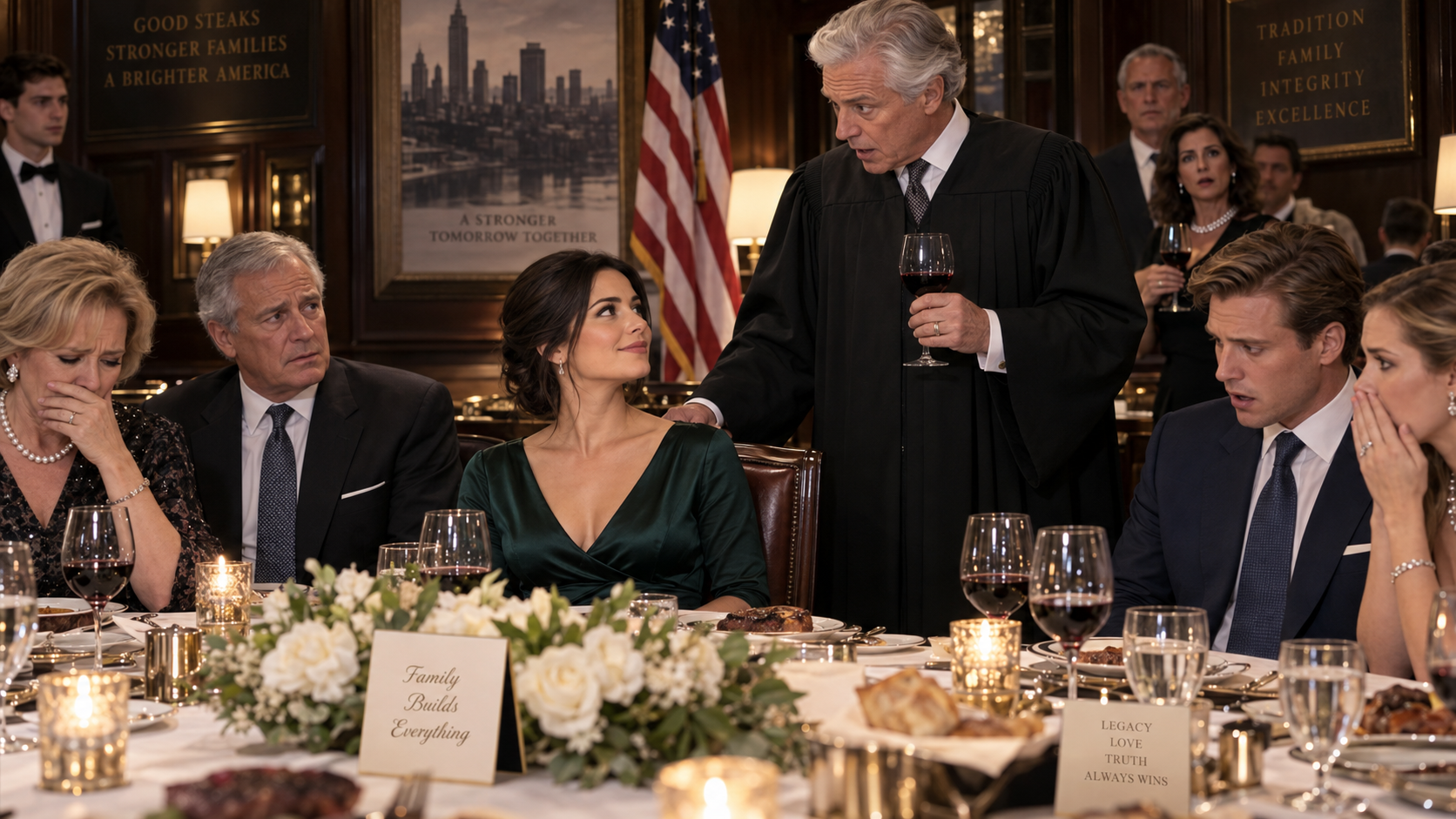
My dad called me at 1:30 a.m. “Tomorrow, you can join your brother’s fiancée’s family for dinner, but keep your mouth shut.” I asked why. Mom snapped in the background, “Her dad’s a judge. Don’t embarrass us, you always do.” I smiled. “Got it.” The next evening, during the toast, the judge suddenly stopped right in front of me. “Hello,” he said. “I’m surprised to see you here. Who are you to them?” The room fell dead silent.
My name is Julia Mercer. At the time, I was thirty-five years old, living alone in Richmond, Virginia, and working as an assistant district attorney. That was the simple version. The version my parents liked to tell people was that I “worked at the courthouse.”
They said it the same way someone might say their daughter worked the front desk at a dentist’s office.
Not because there was anything wrong with either job.
Because minimizing me made my older brother, Grant, look bigger.
And Grant had spent his entire life being made bigger.
The night my father called, I was sitting at my kitchen table with three open case files, a cold cup of coffee, and notes for a hearing scheduled the next morning.
The clock on my microwave read 1:32 a.m.
No decent parent calls after midnight unless there is an emergency.
My first thought was that Dad had fallen.
My second was that Mom was in the hospital.
I answered immediately.
“Dad?”
His voice came low and irritated.
“Tomorrow night, you can come to dinner.”
I blinked.
“What?”
“Dinner with Elise’s family.”
My brother’s fiancée.
They had been engaged for four months.
I had met Elise twice.
She seemed kind, educated, and much more thoughtful than Grant usually preferred.
“What dinner?”
“The formal one,” Dad said. “At Harrington’s. Her parents are coming in. Her father arranged a private room.”
I checked the clock again.
“You called me at one-thirty in the morning to invite me to dinner?”
“You can come,” he repeated, “but keep your mouth shut.”
I leaned back.
“Why?”
Before he answered, my mother’s voice came through the phone.
She must have been standing beside him.
“Because her father is a judge,” she snapped. “Do not embarrass us, Julia. You always do.”
That made me smile.
Not because it was funny.
Because it was familiar.
In my family, “embarrassing” had a very specific meaning.
It meant correcting my mother when she exaggerated.
It meant refusing to pretend one of Grant’s failed business ventures was “temporarily restructuring.”
It meant not laughing when Dad told stories that made Grant sound like a self-made businessman instead of a man whose parents had refinanced their house twice to rescue him.
It meant telling the truth when a lie would have been more convenient.
My father lowered his voice.
“Just be pleasant.”
“I’m always pleasant.”
My mother laughed.
“No, you’re not. You think because you’re a lawyer everyone wants your opinion.”
“I’m a prosecutor.”
“That’s worse.”
There it was.
My family never knew whether to be proud of my career or annoyed by it.
They liked telling strangers that I had gone to law school.
They did not like what law school had apparently done to my personality.
According to Mom, I had become “too analytical.”
According to Dad, I “cross-examined people in normal conversations.”
According to Grant, I thought I was better than everyone.
The truth was simpler.
I had stopped accepting nonsense just because it came from people who shared my last name.
“What exactly am I supposed to stay quiet about?” I asked.
Silence.
Dad cleared his throat.
“Just don’t bring up work.”
“Why?”
“Because nobody wants dinner to become some courtroom conversation.”
“Fine.”
“Don’t bring up politics.”
“I wasn’t planning to.”
“Don’t bring up Grant’s old businesses.”
“I wasn’t planning to do that either.”
“And don’t bring up the past.”
That made me sit straighter.
“What past?”
Mom interrupted.
“Oh, for heaven’s sake, Julia. This is exactly what I mean. Everything has to become an interrogation.”
“No. I just want to know what I’m forbidden from saying before I accidentally say it.”
Dad sighed.
“If Judge Parker asks what you do, keep it simple.”
There it was.
Judge Parker.
I recognized the surname immediately.
Not enough to be certain.
But enough to make me curious.
“What is Elise’s father’s first name?”
Another pause.
Dad said, “Nathaniel.”
I stared at the case file in front of me.
Judge Nathaniel Parker.
Virginia Circuit Court.
I had been in his courtroom three weeks earlier.
Interesting.
Very interesting.
“Julia?”
“I’m here.”
“So you understand?”
“Yes.”
“Good.”
Mom called from the background, “And wear something feminine.”
That actually made me laugh.
Dad hung up.
I sat alone in my apartment for another minute.
Then I closed my case file.
My parents were terrified.
Not nervous.
Terrified.
Which meant they had told Elise’s family something.
I just did not know what.
The next morning, I handled my hearing, spent six hours at the office, and went home early enough to change.
I wore a dark green dress, simple heels, and pearl earrings my grandmother had left me.
Very feminine.
Just to be safe.
Harrington’s was one of those old Richmond restaurants where the lighting made everybody look richer.
Dark wood.
Brass lamps.
White tablecloths.
Servers who spoke softly.
The private dining room was upstairs.
When I entered, I immediately spotted my mother.
She was wearing navy silk and pearls and smiling like her face hurt.
Dad stood beside her holding a glass of bourbon.
Grant was near the fireplace.
My older brother had always been handsome.
That had been both a gift and a curse.
People forgave him too quickly.
Teachers.
Girlfriends.
Employers.
Our parents.
Grant had learned early that charm could delay consequences.
Sometimes indefinitely.
He saw me and walked over.
“You actually came.”
“You sound disappointed.”
“No.”
He looked me over.
“You look good.”
“Thank you.”
Then his voice dropped.
“Please don’t do your thing tonight.”
I smiled.
“What thing?”
“You know.”
“Existing?”
He rolled his eyes.
“This is important to me.”
“I understand.”
“Elise’s father is kind of old-school.”
“I’ve noticed.”
Grant froze.
“What does that mean?”
“Nothing.”
Before he could ask more, Elise approached.
She looked beautiful in a cream dress.
“Julia, I’m so glad you came.”
She hugged me.
Unlike my brother, her warmth seemed real.
“Congratulations again,” I said.
“Thank you. Dad has been excited to meet everybody.”
I glanced toward the far end of the room.
And there he was.
Judge Nathaniel Parker.
Sixty-three.
Silver hair.
Tall.
Calm.
A man whose courtroom voice never needed volume because people listened anyway.
He was speaking with another couple near the wine table.
Three weeks earlier, I had spent two full days arguing a fraud case before him.
Not a dramatic murder trial.
Not anything that would make television.
It involved a contractor who had stolen from elderly homeowners through fake renovation deposits.
Judge Parker had ruled on several evidentiary issues.
At one point, after I finished questioning a witness, he had said, “Counsel, that was unusually efficient.”
For Judge Parker, that was practically a standing ovation.
He had seen me.
He remembered attorneys.
I knew that much.
My mother followed my eyes.
“Don’t stare.”
“I’m not.”
“You look intense.”
“I’m looking at a person.”
“Please, Julia.”
I turned toward her.
“What have you told them about me?”
Her face changed slightly.
“Nothing.”
“Nothing?”
“They haven’t asked.”
I looked at Grant.
He had suddenly become very interested in rearranging forks.
Interesting.
Dinner began at seven.
Judge Parker sat at the head of the table.
His wife, Celeste, sat beside him.
My parents sat across from them.
Grant and Elise were together.
I was placed near the far end beside Elise’s aunt.
That made sense.
It also made me laugh internally.
My family had seated me as far away from the important people as possible.
The first course went smoothly.
My mother talked about Grant’s real estate “portfolio.”
Portfolio was generous.
Grant owned one rental townhouse with Dad.
Another property had gone into foreclosure two years earlier.
Dad described Grant as an entrepreneur.
Judge Parker nodded politely.
“What kind of work do you do now, Grant?”
Grant straightened.
“Strategic development.”
I nearly choked on my water.
He was a regional sales manager for a building supply company.
Nothing wrong with that.
Good job.
Stable income.
But apparently “sales manager” was not impressive enough.
Judge Parker asked, “Development in what sector?”
Grant smiled.
“Commercial assets. Some consulting.”
Elise looked at him.
Not suspiciously.
Not yet.
Just surprised.
I focused on my salad.
My mother continued.
“Grant has always been business-minded.”
That part was true.
Even at sixteen, he sold Dad’s tools without permission.
I said nothing.
I had promised.
Then Celeste asked my father how many children they had.
“Two,” Dad said proudly.
“Grant and Julia.”
Celeste smiled at me.
“What do you do, Julia?”
Before I could answer, Mom jumped in.
“She works in law.”
Works in law.
I looked at her.
She gave me a warning smile.
Judge Parker was speaking to someone else and did not hear.
Celeste asked, “What kind?”
“Public service,” Mom said.
I almost admired the technique.
True enough to avoid lying.
Vague enough to make me disappear.
I said nothing.
Dinner continued.
Then came the toast.
Grant stood first.
He thanked Elise’s parents for welcoming him.
He talked about family.
Commitment.
Respect.
Listening to him speak about honesty nearly qualified as performance art.
Then Judge Parker stood.
He lifted his glass.
He said a few kind words about his daughter.
About marriage.
About building a life with someone whose character mattered more than status.
That sentence seemed to make my father sit straighter.
Judge Parker moved around the table as he spoke.
Then he reached my side.
His eyes landed on me.
He stopped.
Actually stopped.
His expression changed from polite host to recognition.
“Hello.”
Every muscle in my mother’s face tightened.
I smiled.
“Good evening, Judge Parker.”
He looked surprised.
“I’m surprised to see you here.”
Then he glanced around the table.
“Who are you to them?”
Nobody spoke.
Not Dad.
Not Mom.
Not Grant.
So I answered.
“I’m Julia Mercer. Grant’s younger sister.”
Judge Parker blinked.
Then smiled broadly.
“Julia Mercer?”
“Yes, sir.”
“The prosecutor?”
The silence became physical.
I heard somebody set down a fork.
Judge Parker turned toward my parents.
“Your daughter is the prosecutor from Commonwealth v. Dalton?”
Mom looked like someone had pulled a chair out from under her.
“She… works at the courthouse.”
I looked down at my plate.
Judge Parker laughed.
“Works at the courthouse?”
His wife smiled.
“Nathaniel?”
He gestured toward me.
“Julia argued before me less than a month ago. Extremely capable attorney.”
My father stared at me.
As if he had never heard the phrase before.
Judge Parker continued.
“You handled the evidentiary hearing in the Dalton contractor case, correct?”
“Yes.”
“You were excellent.”
“Thank you.”
Mom’s face had turned pink.
Grant looked pale.
Elise looked confused.
Very confused.
She turned toward him.
“You told me Julia worked part-time for a legal office.”
There it was.
The first crack.
Grant gave a nervous laugh.
“I said she worked in law.”
“No.”
Elise’s voice remained calm.
“You said she had bounced around and was doing part-time legal work.”
I stared at Grant.
He avoided my eyes.
Judge Parker slowly sat down.
Nobody raised a voice.
Nobody needed to.
Elise looked at my mother.
“You also said Julia had never really settled into a career.”
Mom immediately reached for her water.
“That’s not exactly what I said.”
“It is.”
My father leaned forward.
“Let’s not turn this into something.”
Judge Parker said quietly, “It already appears to be something.”
Grant looked at me.
“This is exactly what I was afraid of.”
That actually made me laugh.
Everyone turned toward me.
I put down my napkin.
“I have said almost nothing.”
Grant lowered his voice.
“You knew he knew you.”
“I recognized him when I arrived.”
“And you didn’t tell me?”
“You didn’t ask.”
Mom hissed, “Julia.”
Judge Parker raised one hand.
“Mrs. Mercer, your daughter has done nothing inappropriate.”
Then he looked at Grant.
“Why would you misrepresent your sister’s career?”
Grant tried smiling.
“Misrepresent is strong.”
“No,” Judge Parker said. “It is accurate.”
Elise crossed her arms.
“Why did you lie?”
“I didn’t lie.”
“You said Julia was unstable professionally.”
Grant glanced at our parents.
Dad jumped in.
“Grant was probably just simplifying.”
I finally spoke.
“Interesting family word.”
Mom’s eyes flashed.
“Don’t.”
Judge Parker looked between us.
“What does that mean?”
I leaned back.
“My parents called me at one-thirty this morning and told me that if I came tonight, I needed to keep my mouth shut and keep my career ‘simple.’”
Celeste slowly lowered her wineglass.
Elise stared at Grant.
Judge Parker’s face changed.
Not anger.
Disappointment.
That was worse.
“Why?”
Nobody answered.
So he asked again.
“Why?”
Dad said, “We wanted a pleasant dinner.”
Judge Parker replied, “And your daughter’s actual career threatened that?”
Mom exhaled sharply.
“This is being blown out of proportion.”
Elise said, “What else isn’t true?”
Grant looked at her.
“Nothing.”
She studied him.
“Are you sure?”
That question had weight.
I realized then this was not just about me.
Something else had already been bothering her.
Grant’s hand tightened around his glass.
“Elise.”
“What else have you lied about?”
“Nothing.”
Judge Parker’s gaze shifted toward his daughter.
“Elise?”
She looked at him.
Then at Grant.
“My father asked Grant about his finances before we started discussing wedding plans.”
Grant said quickly, “That’s private.”
Elise ignored him.
“You told Dad the townhouse was fully yours.”
Dad looked down.
Grant’s expression froze.
Judge Parker said, “It isn’t?”
I knew the answer.
So did my parents.
The townhouse was jointly owned by Grant and Dad.
Dad had supplied almost the entire down payment.
Grant said, “It’s complicated.”
Elise turned to my father.
“Mr. Mercer?”
Dad rubbed his forehead.
“I’m on the deed.”
Elise closed her eyes briefly.
Grant leaned toward her.
“It’s basically mine.”
Judge Parker said, “Basically is not a legal category.”
I looked at my plate to hide my smile.
Grant shot me a furious look.
Judge Parker continued.
“You also represented that you owned two additional investment properties.”
Grant said nothing.
Elise stared.
“Grant?”
Mom stepped in.
“He has investments.”
“That was not the question,” Judge Parker said.
The room no longer felt like a dinner.
It felt like discovery.
Grant looked around desperately.
“One property was sold.”
I knew exactly which one.
Sold by the bank.
After foreclosure.
Elise’s face changed.
“You told me it was producing rental income.”
Grant’s mouth opened.
Nothing came out.
Celeste quietly said, “Oh, Grant.”
My mother snapped.
“Why is everyone interrogating him?”
I answered before I could stop myself.
“Because apparently the truth finally got invited to dinner.”
Mom glared at me.
“There. That. That is why we told you to keep quiet.”
Judge Parker looked at her.
“Mrs. Mercer, with respect, your daughter is not creating this problem.”
My mother seemed stunned.
He continued.
“Your son made claims that are now appearing inaccurate. Those claims matter because he is asking my daughter to marry him.”
Grant said, “Everybody exaggerates.”
Judge Parker’s voice became very calm.
“Not about finances before marriage.”
Grant pushed back his chair.
“This is ridiculous.”
Elise said, “Sit down.”
He stared at her.
She had never spoken to him that way around me.
He sat.
Then she asked, “Did your parents pay your credit card debt last year?”
Grant’s face went white.
I did not know she knew about that.
Mom whispered, “Elise—”
“No. I’m asking him.”
Grant looked at me.
As if somehow I had done this.
I raised both hands slightly.
“Still not talking.”
Elise repeated, “Did they?”
“Yes.”
“How much?”
Grant looked at Dad.
Dad looked away.
Elise asked again.
“How much?”
Grant said, “It wasn’t much.”
I knew the number.
Thirty-seven thousand dollars.
I kept my mouth shut.
Judge Parker asked, “Define not much.”
Grant’s jaw tightened.
My father finally said, “Thirty-seven.”
Celeste inhaled softly.
Elise stared at Grant.
“You told me it was three thousand.”
“It was temporary.”
“That wasn’t my question.”
Grant pushed back again.
“What do you want from me?”
“The truth.”
“I told you the truth.”
“No. You gave me a polished version.”
That sentence landed harder than shouting.
My mother said, “Elise, marriage means supporting each other.”
Celeste replied gently, “Support requires informed consent.”
Mom looked at her like she had been betrayed too.
Grant turned toward me.
“You happy now?”
I met his eyes.
“No.”
He laughed bitterly.
“Come on.”
“I’m not happy.”
“You’ve always wanted me to fail.”
That hurt more than I expected.
Because it was not true.
Not even remotely.
I had wanted him to stop being rescued long enough to discover whether he could stand on his own.
Those are different things.
I said, “Grant, I have spent years watching Mom and Dad clean up after you. I never wanted you to fail. I wanted you to stop pretending every rescue was an achievement.”
Mom slammed her hand lightly against the table.
“Enough.”
Judge Parker said, “No. I think this is the first honest conversation happening tonight.”
Dad looked exhausted.
He turned toward me.
“Julia, why couldn’t you just let this go?”
That question surprised me.
“Let what go?”
“Everything.”
“I didn’t bring any of it up.”
“You walked in knowing who he was.”
“Yes.”
“You knew this could happen.”
“No. I assumed my brother had told his fiancée the truth about his life.”
Grant looked away.
That was when Elise removed her engagement ring.
Slowly.
Nobody breathed.
She placed it beside her coffee cup.
Grant stared at it.
“What are you doing?”
“I’m not ending everything tonight.”
He exhaled.
Then she continued.
“But I’m not planning a wedding until I know what is true.”
Grant’s relief vanished.
“Elise.”
“I need space.”
“You’re doing this because of her.”
He pointed at me.
Elise looked at him.
“No.”
Then she pointed at the ring.
“I’m doing this because of you.”
My mother started crying.
Not loudly.
The kind of crying she used when she wanted the room to understand she had been injured.
Dad put his hand on her shoulder.
Grant stared at his untouched dessert.
Judge Parker sat quietly.
Then Celeste turned to me.
“Julia, how long have you been a prosecutor?”
“Eleven years.”
My mother looked at her sharply.
It was such an ordinary question.
But it exposed everything.
Eleven years.
Eleven years my parents could have spoken proudly.
Eleven years they had reduced to “she works at the courthouse” when it suited them.
Judge Parker said, “You’ve built quite a career.”
“Thank you.”
He smiled.
“You should be proud.”
I looked at my parents.
Neither met my eyes.
Something shifted inside me.
For years, I had told myself I did not need their approval.
Mostly, that was true.
But not entirely.
There is still a child inside every adult waiting for a parent to say, I see what you became.
That night I finally understood something.
If they were determined not to see it, I could stop standing under brighter lights.
Dinner ended early.
Obviously.
Grant left first.
Mom followed him.
Dad stayed long enough to apologize to Judge Parker for the “confusion.”
Judge Parker replied, “I think clarity is the opposite of confusion.”
Dad did not have an answer.
Outside, I stood near the restaurant entrance waiting for the valet.
Cold air moved through the street.
My phone buzzed.
Mom.
I declined it.
Then Dad.
Declined.
Then Grant.
I answered that one.
“What?”
His voice was raw.
“You ruined my engagement.”
“No.”
“You could have warned me he knew you.”
“That wouldn’t have changed anything you told Elise.”
“You embarrassed me.”
I closed my eyes.
“Grant, you lied about me to make yourself look better.”
“I never lied.”
“You told her I was working part-time and had no stable career.”
“I simplified.”
I laughed once.
“There’s that word again.”
He went quiet.
Then he said, “You always think you’re better than me.”
“No.”
“Yes, you do.”
“I think you are capable of more than lying.”
Silence.
I continued.
“That might actually be the difference between us. Mom and Dad keep telling you that everything you do is enough. I don’t.”
“You hate me.”
“No.”
That answer came easily.
“I love you. I just don’t respect the version of yourself you keep selling.”
He hung up.
The valet brought my car.
I drove home.
For the next three days, my parents did not speak to me.
It was peaceful.
Then Sunday afternoon, Dad arrived at my apartment.
No warning.
He stood outside holding two coffees.
I let him in.
He sat at my kitchen table.
The same table where he had called me after midnight.
For a while, he said nothing.
Then he looked at the case files stacked beside my laptop.
“You really work this much?”
I almost laughed.
“Yes.”
He picked up a legal pad.
Not reading it.
Just looking.
“Judge Parker said you were good.”
“I am.”
The answer surprised him.
Maybe it surprised me too.
He smiled faintly.
“You always were confident.”
“No, Dad. I worked for that sentence.”
He nodded.
Then said, “Your mother is very upset.”
“I assumed.”
“Grant too.”
“I assumed that too.”
“Elise postponed the wedding.”
I said nothing.
Dad rubbed both hands over his face.
“Did we really make you feel like we weren’t proud of you?”
There it was.
I could have protected him.
I could have said no.
I did not.
“Yes.”
His eyes dropped.
“When?”
“Do you want a date?”
“No.”
“Then for years.”
He nodded slowly.
“We worried about Grant.”
“I know.”
“He needed more help.”
“I know.”
“And you never did.”
“That doesn’t mean I needed less love.”
Dad looked like I had physically struck him.
I hated that.
But truth sometimes hurts people who have benefited from avoiding it.
He whispered, “We thought you were strong.”
“I was.”
“You are.”
“I know.”
Then I said, “Strong children still notice who gets celebrated.”
Dad stared at the coffee.
After a long silence, he said, “I’m sorry.”
No excuse.
No explanation.
Just that.
It did not repair everything.
But it mattered.
Mom took longer.
Much longer.
She called two weeks later.
Her first sentence was not an apology.
It was, “I hope you’re satisfied.”
I nearly hung up.
Instead I said, “If that’s why you called, we’re done.”
She went quiet.
Then her voice softened.
“Your father says I should apologize.”
“Do you want to?”
Another silence.
“I don’t know how.”
That was the most honest thing my mother had said in years.
So I said, “Start with what you did.”
She took a breath.
“We minimized you.”
“Yes.”
“We talked about your career differently depending on who was listening.”
“Yes.”
“We made Grant sound more successful than he was.”
“Yes.”
Then she said, “And we asked you to stay quiet because we were afraid the truth would make him look bad.”
My throat tightened.
“Yes.”
She started crying.
This time it sounded real.
“I’m sorry.”
I believed her.
Not completely.
Not yet.
But enough to keep listening.
As for Grant and Elise, they did not marry that year.
They did not break up immediately either.
Elise required complete financial disclosure before she would even consider resetting a date.
Grant resisted.
Then finally agreed.
It was ugly.
Debt.
Bad investments.
Loans from our parents.
A tax problem he had not mentioned.
Nothing impossible.
Nothing that could not be addressed.
The issue had never really been the money.
It was the fiction.
Three months later, Grant called me.
Not angry.
Just tired.
“Can I ask you something?”
“Yes.”
“Do you know a financial attorney?”
I almost laughed.
Instead I gave him two names.
He said, “Thanks.”
Then, before hanging up, he added, “I’m sorry I lied about you.”
That mattered too.
“Why did you?”
He sighed.
“Because Elise admired you.”
I was stunned.
“What?”
“She met you at that barbecue last year. She said you were impressive.”
I remembered.
We had spoken for twenty minutes.
Mostly about her work.
Grant continued.
“I felt like every time your name came up, I sounded smaller.”
“So you made me smaller.”
“Yes.”
There was no defense in his voice.
Just shame.
I sat down.
“Grant, you were never competing with me.”
“I know that now.”
“You have your own life.”
“I know.”
“And if you want it to be better, stop selling it. Build it.”
He laughed quietly.
“That sounded very prosecutor.”
“Occupational hazard.”
He and Elise eventually stayed together.
But differently.
No grand wedding.
No huge ballroom.
A year later they married in a small ceremony at a vineyard outside Charlottesville.
Thirty people.
Judge Parker officiated informally during the reception toast.
I was there.
So were my parents.
Grant introduced me to one of his friends by saying, “This is my sister Julia. She’s a prosecutor. She’s terrifying.”
I corrected him.
“Only professionally.”
Everyone laughed.
Mom did too.
Then she added, “We’re very proud of her.”
It should not have mattered.
But it did.
Later that evening, Judge Parker found me near the terrace.
“You know,” he said, “I still remember that dinner.”
“So does everyone in my family.”
He smiled.
“I hope I didn’t cause trouble.”
“You revealed trouble.”
He nodded.
“There’s a difference.”
“Yes.”
He looked back toward Grant and Elise dancing.
“Your brother seems different.”
“He is.”
“And you?”
I thought about that.
“I stopped trying to earn a seat at tables where I was expected to disappear.”
Judge Parker smiled.
“That sounds healthy.”
“It is.”
That became the real lesson of that dinner.
For years, I thought my family’s favoritism was about Grant.
It was not.
Not entirely.
It was also about me.
I had allowed them to define me as the difficult one because challenging that role seemed exhausting.
I had accepted smaller descriptions because I knew who I was.
But knowing who you are does not mean you must tolerate people constantly pretending otherwise.
You are allowed to correct the record.
You are allowed to tell the truth.
You are allowed to stop protecting somebody else’s image at the expense of your own dignity.
And sometimes you do not even have to expose anyone.
Sometimes all you have to do is sit quietly at dinner.
Because eventually, the truth recognizes you.
And when Judge Nathaniel Parker stopped beside my chair and asked, “Who are you to them?” he thought he was asking a simple question.
He was not.
For most of my life, my family’s answer would have been:
Grant’s difficult sister.
The one who talks too much.
The one who makes things awkward.
The one who should keep it simple.
That night, for the first time, I answered for myself.
“I’m Julia Mercer.”
And finally, that was enough.
THE END