
 Reading Time: 15 minutes
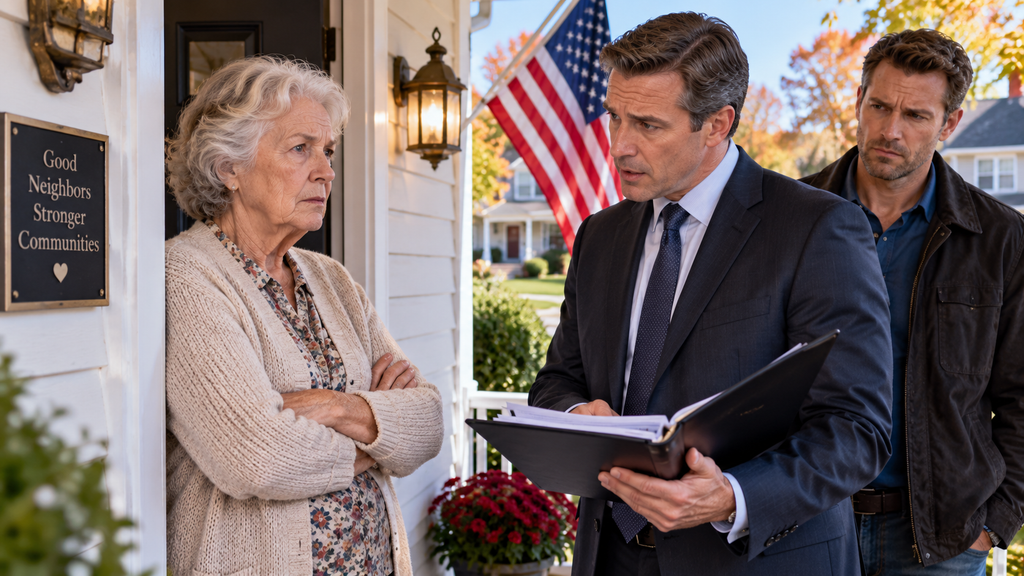
For six years, I quietly paid the water bill for the house next door. Ruth never knew. Her son found out the morning after the funeral, and he showed up at my door with a lawyer and a theory about what I had wanted in return. “Mrs. Doyle,” the lawyer said. “May we come in?” “You may stand there,” I said.
My name is Margaret Doyle. I am seventy-one years old, and by the time Gerald Hayes came to my porch with a lawyer, I had already lived on Maple Street for forty-three years.
Long enough to know which house made too much noise in winter.
Which neighbors salted the sidewalk before dawn.
Which children grew up and left.
Which ones came back only when someone died.
Ruth lived next door.
She was eighty-four when she passed.
She had been in that house since Eisenhower.
Same kitchen.
Same hydrangeas.
Same cracked birdbath beside the driveway.
Her husband, Frank, died in 2009.
After that, things changed slowly.
The lawn got a little longer every summer.
The porch light stopped coming on at dusk.
The curtains stayed closed some mornings.
Nothing dramatic.
Age rarely announces itself dramatically.
It just removes little things until one day you realize somebody has stopped doing half the life they used to do without thinking.
I noticed the water shut-off notice in the spring of 2019.
Bright orange.
Taped to Ruth’s front door.
Anybody walking past could read it.
ACCOUNT PAST DUE.
SERVICE SUBJECT TO DISCONNECTION.
I hated the color of it.
That sounds ridiculous, but I did.
There was something humiliating about orange paper shouting somebody’s financial trouble to the street.
I took it down.
Not because I planned anything.
Not because Ruth had asked me.
Because I knew Ruth.
If I knocked on her door with that notice in my hand and offered money, she would have stood straighter, thanked me politely, and refused until the water actually stopped running.
She had been raised by people who considered accepting help a character defect.
So I went home.
Called the county utility office.
Asked whether a third party could make payment.
The woman said yes.
The balance was sixty-three dollars.
I paid it.
Then I asked the monthly average.
Twenty-nine dollars.
Some months twenty-seven.
Some thirty-two.
I put the account on my card.
Not in my name.
Just the automatic payment.
The county kept billing Ruth.
I quietly paid before the late date.
That was all.
Twenty-nine dollars a month.
I did not tell my daughter.
Did not tell Ruth.
Did not mention it at church.
I did not consider myself generous.
I spent more than that on coffee and birdseed.
The next week Ruth stood by the mailbox and complained about squirrels digging in her flower beds.
She looked me straight in the eye.
No embarrassment.
No gratitude.
Exactly what I wanted.
So I kept paying.
Six years.
Twenty-nine dollars a month.
Sometimes less.
Sometimes more.
I barely thought about it.
Until Gerald found out.
Gerald lived in Charlotte.
About two and a half hours away.
He came at Christmas.
Sometimes July.
Never stayed long.
He always arrived in a clean SUV and parked halfway into the driveway like he was dropping off a package.
He would bring Ruth flowers or a grocery bag.
Stay three hours.
Leave before dinner.
Ruth never complained.
Mothers protect children even from criticism they have earned.
“Gerald is busy,” she would say.
“He travels.”
“He has responsibilities.”
I would say, “Of course.”
That was easier than pointing out that she had spent fifty years making time for his responsibilities.
The year before Ruth died, I started helping more.
Nothing formal.
Mail.
Pharmacy.
Changing light bulbs.
Driving her to appointments when Gerald could not come.
She still cooked.
Still balanced her checkbook.
Still corrected my grammar.
But her memory occasionally slipped.
Names.
Dates.
Where she put the kettle.
Then she would become furious with herself.
“Don’t you start looking at me like I’m helpless,” she told me once.
“I’m not.”
“You are.”
“I’m looking at you like you left your glasses in the refrigerator.”
She stared.
Then laughed so hard she had to sit down.
That was Ruth.
She could forgive age if you made it funny.
Her death was not dramatic.
She had been declining for several months.
Heart failure.
Breathing trouble.
More weakness.
Then one Monday morning, I brought her mail over and found her sitting in her favorite chair.
Still.
Peaceful.
The television was on low.
Her hands rested in her lap.
I knew before I touched her shoulder.
The paramedics came.
Then the funeral home.
Then Gerald.
He arrived that afternoon with his wife and two suitcases.
I stood in my driveway while he unlocked Ruth’s house.
He looked shattered.
Whatever else is true about a person, grief can still be real.
He hugged me.
“Thank you for looking after her.”
“I was her neighbor.”
“You were more than that.”
I almost told him about the water then.
I am glad I didn’t.
The funeral was three days later.
Small church.
White flowers.
Ruth had chosen the hymns years before because she said funerals were too important to leave to relatives with bad musical taste.
Gerald cried during the second hymn.
I cried during the first.
Afterward we ate ham biscuits in the fellowship hall.
Then I went home.
The next morning at 9:10, Gerald knocked on my door.
He was not alone.
The man beside him wore a dark suit and carried a leather folder.
That was when I knew gratitude had expired.
“Mrs. Doyle,” the lawyer said. “My name is Stephen Vance. I represent Mr. Hayes regarding his mother’s estate.”
“You may stand there.”
Gerald looked annoyed.
“Margaret, we need to talk.”
“Then talk.”
The lawyer took over.
“Mr. Hayes recently discovered that you paid certain household expenses for Mrs. Hayes over an extended period.”
“Her water bill.”
“For approximately six years?”
“Yes.”
“Without reimbursement?”
“Yes.”
“Without a written agreement?”
“Yes.”
“Without informing her son?”
“He never asked.”
Gerald’s jaw tightened.
“You understand how this looks.”
“Tell me.”
“Six years of unexplained payments to an elderly woman with early cognitive decline.”
“Twenty-nine dollars a month.”
“That isn’t the point.”
“Then what is?”
He glanced at the lawyer.
“And then a will that gets changed in 2021.”
That stopped me.
“Ruth changed her will?”
“Don’t.”
His face hardened.
“Please don’t do the surprised thing.”
I looked at him for a long moment.
“Gerald, when did you last speak to your mother?”
“That’s not relevant.”
“June.”
His expression shifted.
“You called on her birthday. You stayed on the phone four minutes because I was sitting in the room and watched the clock.”
The lawyer looked at Gerald.
He said nothing.
“She fell in February,” I continued. “Did you know?”
His face changed.
“What?”
“She was on the kitchen floor about forty minutes before I came over with the mail.”
“She never told me she fell.”
“No.”
That hurt him.
I saw it.
“She didn’t.”
“Why?”
“Maybe she was embarrassed.”
“Why didn’t you tell me?”
“I asked her if I should.”
“What did she say?”
“No.”
He looked furious.
“So you decided that?”
“No. She did.”
“She was confused.”
“Not that day.”
The lawyer cleared his throat.
“Mrs. Doyle, our concern is whether financial support may have created influence over Mrs. Hayes’s estate planning.”
I laughed.
Not because it was funny.
Because the phrase was so much bigger than twenty-nine dollars.
“What did Ruth leave me?”
Gerald stared.
I looked at the lawyer.
“What did she leave me?”
He did not answer.
That told me something.
Maybe nothing.
Maybe everything.
Gerald said, “We’ll be filing for undue influence.”
The lawyer continued carefully.
“Any transfers of value from you to the decedent create a pattern of financial entanglement.”
“Twenty-nine dollars a month.”
“It establishes a relationship.”
“We lived next door forty years.”
“Yes.”
“So did the fence.”
The lawyer almost smiled.
Gerald did not.
Then I said, “All right.”
I stepped inside.
“Wait here.”
Gerald called after me.
“What are you doing?”
“Getting the rest of it.”
I came back carrying a manila envelope.
I had kept it in the top drawer of my dining-room buffet for eleven days.
Ruth gave it to me in October.
Five months before she died.
She had come over after lunch carrying the envelope and a grocery bag with canned peaches.
She sat at my kitchen table.
“Margaret.”
“What?”
“If Gerald ever appears with a lawyer, give this to the lawyer.”
I stared.
“What have you done?”
“Nothing interesting.”
“Ruth.”
“You are nosy.”
“You came into my house carrying legal instructions.”
“Do not open it.”
“What’s inside?”
“Enough.”
“For what?”
She looked at me then.
Very clearly.
“To keep people honest.”
I remember joking.
“Should I be frightened?”
“No.”
Then she took my hand.
“But promise me.”
So I promised.
I did not open it.
Not once.
Now I held it toward Stephen Vance.
“Ruth asked me to give this to you.”
Gerald reached for it.
I moved my hand.
“Not you.”
His face flushed.
“She specifically said if you showed up with a lawyer, give it to the lawyer.”
Stephen took it.
He looked at Gerald.
“Do you want me to open this now?”
Gerald laughed bitterly.
“Apparently the whole street gets to participate in my mother’s estate, so go ahead.”
Stephen opened the envelope.
First page.
He read it.
Then again.
His expression changed.
Not dramatically.
Lawyers train their faces.
But the color left around his mouth.
He pulled out another page.
Then another.
Gerald said, “What?”
Stephen did not answer immediately.
Then:
“Gerald.”
His voice had become careful.
“Did you have signing authority on your mother’s accounts?”
Gerald blinked.
“What?”
“You heard me.”
“For emergencies.”
“When?”
“After Dad died.”
“Full power?”
“I don’t know. Whatever Mom signed.”
Stephen pulled out copies of bank statements.
I could see columns of numbers.
Gerald’s face changed.
“What is that?”
“Transfers.”
“What transfers?”
Stephen looked at him.
“You tell me.”
Gerald stepped closer.
Stephen turned the pages slightly away.
“Over a period of approximately thirty-two months, funds were transferred from your mother’s savings account to an account ending in 7714.”
Gerald said nothing.
“Is that your account?”
Silence.
The porch seemed too small.
Finally Gerald said, “Mom helped us with some things.”
Stephen looked down.
“Eighty-six thousand four hundred dollars?”
My stomach tightened.
I had not known the amount.
I had not known any of this.
Gerald’s face went red.
“It wasn’t like that.”
“How was it?”
“She told me to take what I needed.”
“Written authorization?”
“I had power of attorney.”
“That is not the same thing.”
Gerald snapped, “You are my lawyer.”
Stephen’s expression hardened.
“Yes. Which is why I am asking before we make accusations against someone else.”
Silence.
I leaned against my doorframe.
The second document, Stephen explained later, was a letter from Ruth.
Not to me.
To her attorney.
It listed dates.
Transfers.
Conversations.
Amounts.
Apparently, she had noticed money missing after a bank representative called to confirm an unusually large withdrawal.
Ruth did not confront Gerald immediately.
She changed her accounts.
Revoked his access.
Then changed her estate plan.
The letter said:
My son believes helping me with paperwork gives him ownership of what I have. It does not.
Stephen continued reading.
Gerald stared at the ground.
“You knew?”
I asked.
He looked up sharply.
“Knew what?”
“That she caught you.”
“I did not steal from my mother.”
“I didn’t say stole.”
His mouth closed.
That told me enough.
Stephen pulled out one more document.
“Gerald, there is also a statement from a geriatric physician dated two weeks before the will execution.”
Gerald stared.
“What?”
“Capacity evaluation.”
“Why would she get that?”
Stephen answered calmly.
“Probably because she expected a challenge.”
I nearly smiled.
That sounded exactly like Ruth.
The revised will had been signed in 2021.
Independent witnesses.
Her longtime attorney.
Medical confirmation that she understood her property, her relationships, and the effect of changing her estate plan.
She was not leaving things to chance.
Gerald asked the question he had been avoiding.
“What does the will say?”
Stephen exhaled.
“I don’t have the full probate file yet.”
“But?”
“There is a copy here.”
Gerald looked at me.
Hatred.
Fear.
Something else.
“Read it.”
Stephen did.
Ruth left Gerald twenty-five thousand dollars.
A specific bequest.
Not nothing.
Not forgotten.
The rest of her liquid estate went to a local senior-assistance foundation.
And the house?
Placed in trust.
Its eventual sale proceeds would support emergency utility payments for elderly homeowners in the county.
I sat down on the porch chair.
Gerald looked stunned.
“What did she leave her?”
He pointed at me.
Stephen read again.
“Nothing.”
Gerald stared.
“Nothing?”
“No cash. No property. No percentage interest.”
I almost laughed.
“So this is the grand scheme?”
He did not answer.
I said, “Six years of twenty-nine-dollar water bills, and I managed to influence Ruth into leaving me exactly nothing.”
Stephen looked at me.
Then at Gerald.
“Mrs. Doyle had no financial benefit under the revised will.”
Gerald looked broken.
Not angry now.
Broken.
“That doesn’t make sense.”
I said softly, “It makes perfect sense.”
He looked at me.
“Why would she leave the house to strangers?”
“They weren’t strangers.”
“What?”
“The foundation helped your mother once.”
He frowned.
“When?”
“After Frank died.”
Ruth had told me years earlier.
The furnace failed that first winter.
She had little accessible cash because Frank handled most accounts and probate dragged on.
A county senior program paid for the emergency repair.
Ruth never forgot.
“I’ll repay them someday,” she told me.
Apparently she had.
Gerald walked down one porch step.
Then back up.
“My mother loved that house.”
“Yes.”
“She said it should stay in the family.”
“When?”
He opened his mouth.
Nothing came out.
I said, “When you were fifteen?”
His face tightened.
“She was my mother.”
“Yes.”
“So you think I deserve this?”
“No.”
That surprised him.
I continued.
“I think you deserved a mother while she was alive.”
He stared.
“You had one.”
“That’s easy for you to say.”
“No.”
My voice softened.
“I watched her defend you every week.”
He looked away.
“She loved you more than was probably good for either of you.”
Stephen closed the envelope.
He looked at Gerald.
“I would advise against filing an undue-influence action before we fully review these materials.”
Gerald laughed bitterly.
“You mean because I’d lose.”
“I mean because our factual theory has materially changed.”
Lawyers.
Even disasters become sentences.
Gerald looked at me.
“Why did you pay the water?”
Because finally, after all the papers and accusations, that question mattered.
I said, “There was an orange shut-off notice.”
“That’s it?”
“Yes.”
“Why not call me?”
“I didn’t have your number.”
“You could have asked her.”
“She would have been humiliated.”
“That gave you the right to interfere?”
I looked at him.
“Water is not an inheritance.”
He said nothing.
“She needed running water.”
“Why six years?”
“Because bills keep coming.”
His eyes filled.
He hated that.
I could tell.
Simple kindness is unbearable when somebody has arrived prepared to uncover a conspiracy.
He sat on the porch step.
The lawyer remained standing.
For several minutes, nobody spoke.
Then Gerald asked:
“Did she talk about me?”
I could have punished him.
I could have said no.
Instead:
“All the time.”
His head came up.
“What did she say?”
“That you were busy.”
He laughed once through his nose.
“She always said that.”
“Yes.”
“What else?”
“She was proud of your promotion.”
He swallowed.
“She knew?”
“You told her at Christmas.”
“I forgot.”
“She didn’t.”
He looked down again.
“What else?”
“She hated your beard.”
That startled him into a laugh.
“She always hated it.”
“She called it wilderness on your face.”
He wiped his eyes.
Stephen looked uncomfortable.
Good.
Lawyers should occasionally witness humanity.
Gerald asked, “Was she angry about the money?”
I answered honestly.
“I don’t know.”
“You were with her all the time.”
“Not all the time.”
“Did she ever say?”
“No.”
That surprised him.
“She knew though?”
“Apparently.”
He covered his face.
For a moment he looked much younger.
Then he said something I did not expect.
“I was in trouble.”
Stephen turned.
“Gerald.”
He ignored him.
“My business almost collapsed during COVID. Then Emily needed surgery. College bills. I took some money.”
I said nothing.
“I was going to put it back.”
Everybody who takes money says that eventually.
Maybe some mean it.
“I did put some back.”
Stephen asked, “How much?”
Gerald glared.
“This isn’t the time.”
“It may become relevant.”
Gerald stood.
“I’m done.”
He walked toward the driveway.
Stephen gathered the papers.
Then stopped.
“Mrs. Doyle, we may need a formal statement later regarding the water payments and your relationship with Mrs. Hayes.”
“You know where I live.”
“Yes.”
He hesitated.
“For what it’s worth, I’m sorry for arriving like this.”
I looked at Gerald’s back.
“You came with the client you had.”
He almost smiled.
Then followed him.
The lawsuit was never filed.
I learned that from Ruth’s estate attorney two weeks later.
Stephen Vance withdrew the threatened challenge after reviewing the records.
The estate entered probate.
There were questions about Gerald’s old transfers.
I stayed out of them.
That was between him, the estate, and whatever laws apply when children begin confusing access with ownership.
The water bill stopped.
For the first time in six years, twenty-nine dollars did not leave my account.
I noticed immediately.
Funny.
You can ignore something for seventy-two months and miss it the first time it disappears.
Ruth’s house sat empty through summer.
The lawn service came every other Thursday.
Her hydrangeas bloomed without her.
I kept expecting to see her standing at the mailbox.
Grief is mostly expecting.
Then correcting yourself.
Expect.
Correct.
Expect.
Correct.
In September, Gerald returned.
Alone.
No lawyer.
No suit.
Jeans.
Old sneakers.
He stood on my porch holding nothing.
I opened the door.
“Hello.”
“Can I come in?”
I looked at him.
Then stepped aside.
That was different.
We sat at my kitchen table.
The same table where Ruth had once left the envelope.
I made coffee.
Gerald wrapped both hands around the mug.
For several minutes he said nothing.
Then:
“I paid the estate back.”
I looked at him.
“All of it?”
“As much as the accountant determined I owed.”
“How much?”
He smiled without humor.
“More than eighty-six.”
Interest.
Other withdrawals.
Apparently there had been more.
I did not ask.
He said, “My wife is furious.”
“At whom?”
“Me.”
“That seems efficient.”
He laughed.
Then his face changed.
“I didn’t come to talk about money.”
“Good.”
He stared into the coffee.
“I wanted to ask you something.”
I waited.
“Did she know I loved her?”
The question landed differently than he intended.
Not did she love me.
Did she know I loved her?
I thought about Ruth’s birthday.
The four-minute call.
Christmas flowers.
All her excuses.
I chose my words carefully.
“Yes.”
He looked up.
“She did?”
“Yes.”
His shoulders dropped.
Then I added:
“She just wished you had shown her while she was alive.”
That hurt him.
I saw it.
“I know.”
“No.”
He shook his head.
“I do.”
He looked toward the window.
“My daughter asked me last week why we didn’t visit Grandma more.”
I said nothing.
“I told her we were busy.”
There it was again.
Busy.
The family prayer.
He laughed bitterly.
“She said, ‘Too busy every weekend?’”
Children ask what adults avoid.
“What did you say?”
“Nothing.”
He looked at me.
“I spent years thinking Mom was fine because she never complained.”
“She was proud.”
“I know.”
“I think she also knew complaining wouldn’t bring you more often.”
His eyes filled.
“I hate that.”
“You should.”
He looked surprised.
I softened.
“Not forever.”
He nodded.
Then asked about the fall.
February.
The kitchen floor.
I told him.
How I found her.
How she insisted nothing was broken.
How embarrassed she was.
How I sat with her afterward.
“She didn’t want me to call you.”
“Because she thought I wouldn’t come?”
I could not answer for Ruth.
So I said:
“She said you were busy.”
Gerald cried then.
Quietly.
I let him.
Afterward, he walked next door.
I watched from my window.
He stood on Ruth’s porch for a long time before unlocking the door.
The trust had not sold the house yet.
The foundation planned to list it in spring.
Gerald spent three days going through his mother’s things.
On the fourth day, he came over holding a small box.
“These were in her desk.”
Photographs.
Mark from kindergarten through middle age.
Gerald at six in a baseball uniform.
Gerald graduating.
Wedding.
His children.
Stacks of printed emails.
Christmas cards.
Every postcard he had ever mailed.
“She kept everything.”
“Yes.”
He sat beside me.
There was one envelope marked with his name.
Unopened.
Ruth had apparently written it shortly before her death.
He looked at me.
“Should I read it?”
“Why would you ask me?”
“I don’t know.”
“Because you’re afraid.”
He nodded.
“Then read it.”
He did.
I never asked what it said.
Some things should remain between a mother and her son, even after one of them is gone.
But when he finished, he cried harder than I had ever seen a grown man cry.
In spring, the house sold.
A young couple bought it.
They had two little girls.
They painted the front door yellow.
At first, I hated it.
Ruth would have called it “mustard trying to be sunshine.”
Then one afternoon, the younger girl drew chalk flowers all over the sidewalk.
I decided the yellow could stay.
The Ruth Hayes Senior Utility Fund began that same year.
That was the foundation’s name for it.
I laughed when I saw the announcement.
Ruth would have hated having her full name on anything.
But she would have liked the purpose.
Small emergency grants.
Water.
Electric.
Heat.
Nothing glamorous.
The sort of bills that become catastrophes when you are old and proud and living on fixed income.
The first annual report said they helped sixty-eight households.
I read every page.
Then wrote a check.
Twenty-nine dollars.
Exactly.
No more.
No less.
I enclosed a note.
For Ruth.
I still send twenty-nine dollars every month.
Automatic.
Like the old water bill.
Gerald found out eventually.
He called me.
“Seriously?”
“Yes.”
“You’re impossible.”
“I learned from your mother.”
He laughed.
Then said, “I started giving too.”
“How much?”
“That’s rude.”
“You called me.”
We had become something strange.
Not family.
Not friends exactly.
But connected by a woman we both loved differently.
Gerald visits Ruth’s grave now.
Brings his daughters when they are home.
Calls me every few months.
Sometimes asks about the neighborhood.
Sometimes says nothing important.
I prefer those calls.
I have thought a lot about the morning he came to my porch with a lawyer.
About what he expected to find.
A greedy neighbor.
A manipulated old woman.
A plot.
Maybe because conspiracies are easier than guilt.
If I had tricked Ruth, then Gerald’s absence would matter less.
If I wanted her house, then he could be angry instead of ashamed.
But the truth was smaller.
Twenty-nine dollars.
That is all.
Not because I was generous.
Because water should run when you turn the tap.
Because an eighty-year-old widow should not have to choose between dignity and basic utilities.
Because sometimes helping someone means making sure they never have to thank you.
Ruth never knew.
At least, I thought she did not.
One day, months after Gerald’s visit, Stephen Vance stopped by.
Without Gerald.
He had been working with the estate lawyer on final records.
He handed me a photocopy.
“What is this?”
“Something Ruth wrote.”
On the page, dated 2022, were three sentences.
Margaret thinks I do not know about the water.
Let her think that.
Some kindnesses deserve the dignity of pretending not to see them.
I sat down.
Stephen said nothing.
I read it again.
Ruth knew.
Maybe she had known for years.
Maybe the county told her.
Maybe she saw something in a statement.
Maybe she was simply smarter than I was.
Probably that.
At the bottom she had written:
If Margaret ever learns I knew, tell her I paid her back every Tuesday by pretending her coffee was drinkable.
I laughed until I cried.
That woman.
For six years, I thought I was protecting her dignity.
Turns out she had been protecting mine too.
That is how I remember Ruth now.
Not frail.
Not confused.
Not alone.
Sharp-eyed.
Proud.
Funny.
Sitting at my kitchen table criticizing my coffee while quietly knowing more than anybody gave her credit for.
People like to think aging means becoming simple.
It does not.
Old people still keep secrets.
Still notice things.
Still forgive badly.
Still love children who disappoint them.
Still make plans.
Still understand humiliation.
Still deserve to make decisions that other people may not like.
Ruth changed her will because she wanted to.
She knew what she owned.
She knew what Gerald had done.
She knew what I had done.
And she made choices.
The lawyer had come to my house believing twenty-nine dollars a month might prove I controlled an elderly woman.
Instead, the evidence proved exactly the opposite.
Ruth had controlled her own ending.
And for a woman everyone was beginning to describe as confused, that was probably the final victory she wanted.
THE END! THANKS FOR READING!❤️🙏