
 Reading Time: 18 minutes
For six years, I secretly paid my eighty-four-year-old neighbor’s water bill. Twenty-nine dollars a month. Sometimes twenty-seven. Once thirty-three. I never told her. I was certain Martha Sterling had no idea. Then Martha died.
The morning after her funeral, her son appeared at my front door with a lawyer, accused me of manipulating a vulnerable elderly woman, and demanded to know what I had expected in return.
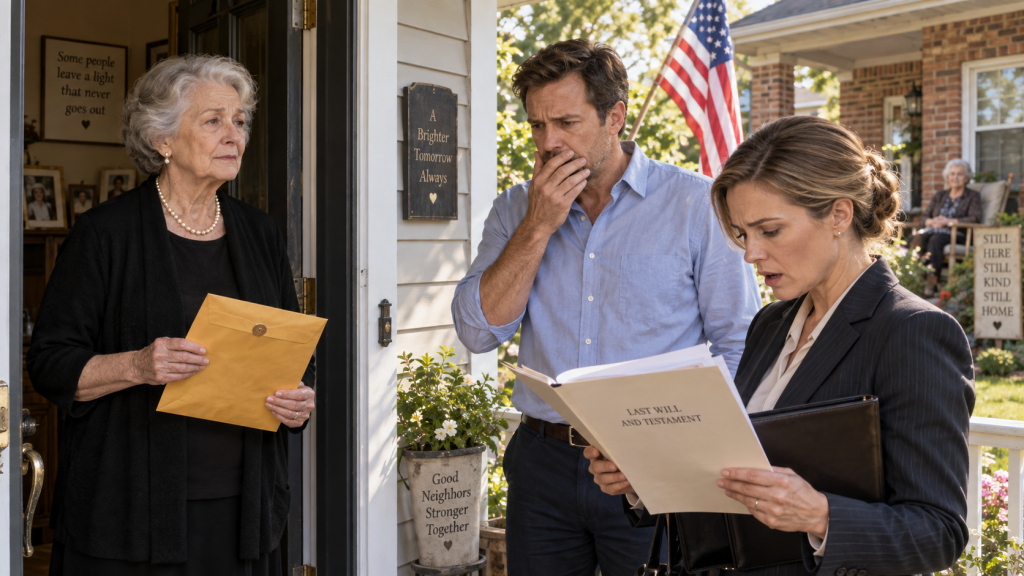
That was when he mentioned Martha had changed her will.
I quietly went into my house, retrieved the sealed envelope Martha had ordered me never to open, and handed it directly to his attorney.
The lawyer read the first page.
Then read it again.
Finally, he looked at Martha’s son and asked one question that wiped every trace of anger from his face.
“Arthur, did you have financial authority over your mother’s accounts?”
My name is Clara Jenkins.
I was seventy when Martha died.
By then, we had been neighbors for almost thirty-two years.
Our houses stood side by side on a quiet street in Richmond, Virginia.
Mine was pale yellow.
Hers was faded brick with blue shutters that needed repainting for at least a decade.
Martha had lived there since 1972.
She raised three children in that house.
Buried one husband.
Hosted countless Thanksgiving dinners.
Watched grandchildren run through the yard.
And then slowly watched nearly everyone move farther away.
Her husband, Walter, died in 2009.
That was when the house began changing.
Not suddenly.
Age rarely arrives suddenly.
The roses grew wild because Martha stopped kneeling in the garden.
The porch steps sagged because Walter was no longer there to repair them.
The light beside the front door stopped working, and Martha decided she did not need it because she rarely went out after dark anyway.
But she remained fiercely independent.
She still walked to the mailbox every morning.
Still ironed pillowcases.
Still clipped coupons from the Sunday newspaper even after learning that most stores had stopped accepting half of them.
She also had opinions about everything.
Television.
Politics.
Neighbors’ dogs.
The proper thickness of pancake batter.
Nobody could spend ten minutes with Martha and mistake her for helpless.
That was why I never told her about the water bill.
It began in April 2019.
I was walking over with a container of chicken soup when I saw a bright orange notice taped to her door.
FINAL NOTICE.
PAST DUE.
SERVICE SUBJECT TO DISCONNECTION.
I stopped on the walkway.
There is something cruel about those notices.
Not because companies should not collect money.
Because humiliation does not need fluorescent paper.
Anybody walking past could read it.
The mail carrier.
A delivery driver.
Neighbors.
Martha herself.
I looked through the window.
She was sitting in her recliner watching an old detective show.
I removed the notice.
Put the soup down.
Went home.
Then called the city utility department.
I explained that I wanted to pay another person’s account without changing ownership.
The woman told me about their guest-payment system.
The overdue balance was $61.42.
I paid it.
Then I asked what the normal monthly bill usually was.
“About twenty-nine dollars.”
That seemed almost insulting.
Twenty-nine dollars.
A dinner out.
Two bags of decent coffee.
A few unnecessary things from the drugstore.
For Martha, apparently, it had become the difference between having running water and not.
So I put the account on automatic payment.
I did not tell her.
That was the whole point.
If I had knocked on her door with money, she would have refused.
If I had insisted, she would have become embarrassed.
Then every future conversation at the mailbox would have changed.
She would have wondered whether I was thinking about the bill.
I would have watched her try to repay me with casseroles or cash she could not spare.
No.
I wanted Martha to keep one thing untouched.
Her dignity.
The next morning, she met me outside.
“Clara, did you know squirrels are digging up my geraniums?”
I almost laughed.
“No.”
“Criminal animals.”
That was it.
No mention of water.
I thought my secret was safe.
For six years, money quietly left my account.
Twenty-nine dollars.
Twenty-nine dollars.
Twenty-nine dollars.
I barely noticed.
Some months I forgot completely.
Meanwhile, Martha’s son Arthur lived in Charlotte.
He was fifty-eight when she died.
Successful.
Good suits.
Expensive SUV.
Owned a residential renovation company that had done well for years.
At least that was what Martha told people.
Arthur visited twice a year if schedules cooperated.
Christmas.
Sometimes her birthday.
He called more often, but even those conversations rarely lasted long.
Martha always defended him.
“Arthur is busy.”
“He has employees depending on him.”
“He travels constantly.”
“He has a family of his own.”
I never criticized him to her.
What purpose would that serve?
Parents already know when their children are absent.
Pointing it out only makes the empty chair louder.
Martha’s daughter Laura lived in Florida.
Her younger son, Michael, had not spoken to the family regularly in years after some old argument nobody could remember clearly enough to solve.
So most ordinary things fell to me.
Mail.
Pharmacy pickups.
Changing ceiling bulbs.
Driving to appointments.
Checking on her after storms.
I never considered myself her caregiver.
Martha would have hated that word.
I was her neighbor.
Sometimes her friend.
Frequently her unwilling card-game opponent.
She cheated at gin rummy.
Shamelessly.
“You had three queens five minutes ago,” I once told her.
“You’re imagining things.”
“I watched you put one under your newspaper.”
“Then you should have stopped me.”
That was Martha.
Sharp.
Stubborn.
Funny.
She did become forgetful.
There is no reason to pretend otherwise.
Once she put her glasses in the refrigerator.
Another time she called me because she could not find her purse.
It was hanging from her shoulder.
We laughed until she had tears in her eyes.
But forgetfulness is not the same thing as incompetence.
That distinction became very important later.
In February of her final year, Martha fell in the kitchen.
I found her because I had accidentally received one of her magazines with my mail.
I knocked.
No answer.
Tried the door.
Unlocked.
“Martha?”
Then I heard:
“Back here.”
She was lying beside the kitchen table.
Not injured badly.
Embarrassed more than anything.
“How long have you been down?”
“Five minutes.”
The clock told me that was a lie.
Her tea was cold.
The kettle had cooled.
Probably forty minutes.
I helped her sit up.
Called her doctor.
Stayed with her.
When I asked if she wanted me to call Arthur, her answer was immediate.
“No.”
“He should know.”
“He’ll start talking about assisted living.”
“Martha.”
“No.”
She pointed one crooked finger at me.
“My floor. My hip. My decision.”
So I did not call.
That decision would be used against me later.
By summer, Martha was weaker.
Still mentally herself most days.
Physically tired.
She slept more.
A home nurse came twice a week.
Arthur called on her birthday.
June 18.
I remember because I was there.
Martha had bought a small chocolate cake from the grocery store.
Three candles.
“I am not setting eighty-four candles on fire in my dining room,” she said.
Arthur called at 7:12.
I know because Martha looked at the clock and said:
“There’s my boy.”
She put the phone on speaker because her hearing was poor.
“Happy birthday, Mom.”
“Thank you, darling.”
“How are you?”
“Old.”
Arthur laughed.
They talked about the weather.
His company.
His daughter’s college application.
Then Arthur said:
“Mom, I’m boarding soon. I’ll call this weekend.”
“Of course.”
“Love you.”
“You too.”
Call ended.
7:16.
Four minutes.
Martha held the phone for a little while after the screen went dark.
Then she put it down.
“He’s very busy.”
I cut the cake.
“Yes.”
She looked at me.
“You don’t have to say it like that.”
“Like what?”
“Like you swallowed a lemon.”
We laughed.
But it hurt me.
Not because Arthur was evil.
Because he had no idea how valuable those four minutes were to his mother.
In October, Martha came to my house carrying a manila envelope.
That was unusual already.
She rarely walked farther than her mailbox by then.
“What are you doing here?”
“Visiting.”
“You hate visiting.”
“I do not.”
“You complain whenever anyone comes to your house.”
“Because they move things.”
She sat at my kitchen table.
The envelope rested in her lap.
After coffee, she pushed it toward me.
“Keep this.”
“What is it?”
“Something boring.”
“Martha.”
“Do not open it.”
That got my attention.
“Why am I keeping something I’m not allowed to open?”
“Because I trust you not to.”
“What’s inside?”
“Papers.”
“What kind?”
“The kind that make lawyers stop talking nonsense.”
I stared.
She smiled.
Then became serious.
“Clara, if Arthur ever comes to your door after I’m gone with an attorney because he doesn’t like something I did, give the envelope directly to the attorney.”
My stomach tightened.
“What did you do?”
“I made decisions.”
“What decisions?”
“Mine.”
That was all she would say.
I asked if she had spoken to an estate lawyer.
Yes.
Was she changing her will?
She looked at me.
“None of your business.”
Fair enough.
I put the envelope in the top drawer of my dining-room cabinet.
And forgot about it.
Almost.
Martha died the following March.
Quietly.
Her home nurse found her one morning in bed.
No crisis.
No ambulance.
She had apparently gone to sleep and never woken.
Arthur arrived that afternoon.
I watched him stand in his mother’s driveway for almost ten minutes before going inside.
That moment changed how I saw him.
Because he looked devastated.
Grief complicates judgment.
The person who failed to call enough can still love deeply.
The person who stayed away can regret every mile.
At the funeral, Arthur cried through the first hymn.
His wife held his arm.
Laura flew in from Florida.
Michael did not come.
The service was modest.
Martha had planned most of it herself.
She had even chosen the flowers.
No lilies.
“They smell like funeral homes,” she once told me.
Afterward, Arthur hugged me.
“Thank you for everything you did for Mom.”
“She was my friend.”
“You were more family to her than most of us.”
I thought he meant it.
Maybe he did in that moment.
Then the will arrived.
The morning after the funeral, there was a knock at my door.
Arthur stood outside.
Beside him was a man in a navy suit holding a leather folder.
“Mrs. Jenkins?”
“Yes?”
“I’m David Brooks. I represent Mr. Sterling regarding his mother’s estate. May we come inside?”
Something in Arthur’s expression stopped me.
“You may stand on the porch.”
Mr. Brooks remained polite.
Arthur did not.
He held up an old utility statement.
My name was written across the top.
Beneath it was handwriting I recognized immediately.
Martha’s.
Clara has paid this since 2019. She will deny doing anything special. Do not embarrass her by arguing.
My throat tightened.
“She knew?”
Arthur stared at me.
“You tell me.”
“I didn’t know she knew.”
“Really?”
“Yes.”
He laughed bitterly.
“Convenient.”
“What exactly are you accusing me of?”
Mr. Brooks stepped forward.
“Mrs. Jenkins, Mr. Sterling recently learned that his mother revised her estate plan in 2021.”
“I didn’t know that.”
Arthur shook his head.
“Please don’t pretend to be surprised.”
“I’m not pretending.”
“You secretly paid her bills.”
“One bill.”
“For six years.”
“Yes.”
“Why?”
“Because she needed water.”
“That simple?”
“Yes.”
His anger sharpened.
“You expect me to believe you spent thousands supporting an elderly woman for no reason?”
I almost laughed.
“Thousands?”
Twenty-nine dollars a month for six years was a little over two thousand dollars.
To Arthur, apparently, this was impossible generosity.
To me, it was twenty-nine dollars.
Mr. Brooks said:
“We are evaluating whether Martha’s final estate documents were influenced by someone she depended on.”
I looked at Arthur.
“So this is about the will.”
“Yes.”
“What did she leave me?”
He hesitated.
“What?”
“If I manipulated your mother, what exactly did I get?”
“That is what we intend to determine.”
I studied him.
“Arthur, when did you last speak to your mother?”
He stiffened.
“That is irrelevant.”
“June 18.”
His expression changed.
“You called on her birthday at 7:12 p.m. You hung up at 7:16.”
Mr. Brooks glanced toward him.
Arthur said:
“I was traveling.”
“She fell in February. Did you know?”
“No.”
“She was on her kitchen floor around forty minutes.”
“Why wasn’t I called?”
“She asked me not to.”
“Why?”
“Because she knew you would start discussing assisted living.”
“She was eighty-four!”
“That was her age.”
I stepped closer.
“It was not her identity.”
Arthur looked furious.
Mr. Brooks tried to calm things.
“We are simply establishing facts.”
“Good.”
I turned toward the door.
“Then you should have all of them.”
I went inside.
Opened the dining-room cabinet.
There was the envelope.
Still sealed.
I carried it back outside.
Arthur saw his mother’s handwriting.
His face changed.
FOR THE ATTORNEY ARTHUR HIRES IF HE CHALLENGES MY DECISIONS.
He stared at me.
“You planned this.”
“No.”
I handed the envelope past him to Mr. Brooks.
“Martha planned it. I stored stationery.”
The lawyer opened it carefully.
He read the first page.
Then read it again.
He removed several documents.
His forehead tightened.
Finally, he looked up.
“Arthur.”
“What?”
“Did you have financial authority over your mother’s accounts?”
Arthur’s anger vanished.
“What does that have to do with Clara?”
“Please answer.”
“She gave me temporary authority after her hip surgery.”
“When?”
“2020.”
Mr. Brooks flipped through the papers.
“This authority was revoked in August 2021.”
“I know.”
“The revocation states that Martha discovered unauthorized transfers.”
Arthur looked toward the yard.
“Mom became paranoid as she got older.”
The lawyer pulled out bank statements.
“Transfers totaling eighteen thousand six hundred dollars went from Martha’s savings to Summit Renovations.”
Silence.
Mr. Brooks continued.
“You own Summit Renovations.”
Arthur’s jaw tightened.
“They were loans.”
“Where are the agreements?”
“She was my mother.”
“That does not answer my question.”
“She knew my company had cash-flow problems.”
“Did she approve the transfers before they occurred?”
Arthur looked at me.
Not at the lawyer.
At me.
As though somehow I had caused this.
“I intended to repay her.”
Mr. Brooks waited.
“Did you?”
No answer.
The irony was almost too large to understand.
Arthur had come to my house ready to transform a $29 utility bill into evidence of exploitation.
Meanwhile, his mother had preserved records showing thousands moved from her account into his company.
“I didn’t steal from her,” he said finally.
Nobody had used the word steal.
Mr. Brooks responded professionally.
“We need to understand the transactions.”
Arthur turned toward me.
“You filled her head with this.”
“No.”
“She trusted you.”
“Yes.”
“You were around constantly.”
“Yes.”
“So don’t act innocent.”
I felt anger rise.
Then stopped it.
“Martha once stored her glasses in the refrigerator.”
Arthur blinked.
“She forgot the day of the week sometimes.”
I continued.
“She called me Laura twice.”
His expression softened slightly.
“But when it came to her money, her house, or the way people treated her, she was not confused.”
“You barely knew her.”
That sentence hurt more than he intended.
I looked toward Martha’s blue shutters.
I knew she hated thunderstorms after Walter died.
I knew she kept peppermints by the door because she believed bad news tasted less terrible with sugar.
I knew she disliked oatmeal.
Loved detective shows.
Cheated at cards.
Slept with the television on when lonely.
I knew which knee hurt before rain.
I knew how she took coffee.
I knew the sound of her laugh from my kitchen.
I looked back at Arthur.
“You’re right.”
He seemed surprised.
“I did not know her the way a son should know his mother.”
He flinched.
I regretted the cruelty immediately.
Truth and cruelty can occupy the same sentence.
Mr. Brooks returned to the papers.
There was a capacity evaluation from a geriatric specialist.
Signed two weeks before Martha changed her will.
She understood her property.
Knew her heirs.
Understood the legal consequences.
There was also a statement from her estate attorney confirming she met privately, without me.
Another document showed she revoked Arthur’s account authority immediately after discovering the transfers.
Martha had prepared for exactly this challenge.
Then Mr. Brooks found the letter.
Addressed:
Arthur.
He handed it over.
Arthur hesitated.
Then opened it.
He began reading silently.
His face changed before he reached the second paragraph.
“What does it say?” I asked.
He did not answer.
Mr. Brooks said gently:
“Would you like privacy?”
Arthur shook his head.
“No.”
Then, surprisingly, he read aloud.
“Son,
“If Clara is standing nearby when you receive this, then you have probably already accused her of wanting something from me.”
His voice broke slightly.
He continued.
“You inherited your father’s certainty and my stubbornness. Unfortunately, you also inherited our talent for being wrong loudly.”
Despite everything, I smiled.
That sounded exactly like Martha.
Arthur swallowed.
“Clara never asked me for one penny.
“She paid my water because she believed I didn’t know.
“I knew.”
I covered my mouth.
Arthur stopped.
I whispered:
“She knew?”
He looked at me.
For the first time that morning, no anger remained.
Just confusion.
He continued reading.
“I learned about it after the second month when the utility office mailed me a receipt. I called them and asked who paid.
“They would not give me her full information, but I knew.
“Clara has always been terrible at minding her own business.”
I laughed through tears.
Arthur almost smiled.
Then read on.
“I never confronted her because she was trying to protect my dignity.
“So I protected hers.
“Some kindness deserves the dignity of pretending not to notice.”
I sat down on the porch chair.
For six years I thought I had carried a secret.
Martha had carried it too.
Arthur continued.
“I changed my will because of your choices, not Clara’s.
“When you moved money from my account without asking, I was less hurt by the amount than by the assumption.
“You believed being my son made my money partly yours.
“It did not.”
Arthur’s hand trembled.
“I knew your business was struggling.
“If you had asked, I probably would have helped.
“But you did not ask.
“You took.”
He stopped reading.
The porch became very quiet.
Then:
“I waited for you to tell me.
“You never did.
“So I removed your authority.”
Arthur wiped his eyes.
“My final estate plan is not punishment.
“It is instruction.”
Mr. Brooks listened without interrupting.
Arthur continued.
“You will receive a fixed inheritance.
“The eighteen thousand six hundred dollars you transferred, plus documented interest, will be deducted from that amount.”
Arthur stared at the page.
“The rest?”
He read.
“My house will be sold.
“Most of the proceeds will establish an emergency utility fund for elderly residents of Richmond who are at risk of losing water, heat, or electricity.”
My chest tightened.
Then:
“Laura will receive my jewelry and family photographs.
“Michael will receive the trust established for him years ago.
“Arthur will receive the amount stated in the attached schedule.
“Clara receives no money.
“No house.
“No property.
“She receives my blue teapot because hers is ugly.”
I started laughing.
Crying too.
“My teapot is not ugly.”
Arthur lowered the letter.
For the first time, he laughed.
Barely.
But he did.
Then he finished.
“Clara gave me help without asking for gratitude.
“If you learn anything from my death, learn this:
“People do not become less deserving of respect because they become old.
“And family does not become ownership simply because death is approaching.
“I loved you every day.
“Even when I was angry.
“Especially then.
“Mom.”
Arthur folded the letter.
He sat down on the porch step.
No accusation now.
No lawyer.
Just a son sitting outside his dead mother’s house.
After a long silence he asked:
“She really knew?”
I nodded.
“Apparently.”
“All six years?”
“Looks like it.”
He laughed weakly.
“Why didn’t she tell you?”
“Because apparently my dignity needed protecting too.”
Mr. Brooks closed his folder.
Then looked at Arthur.
“Based on these materials, I do not recommend pursuing an undue-influence claim against Mrs. Jenkins.”
Arthur stared at the yard.
“No.”
The lawyer continued.
“The estate documents appear carefully prepared. The medical capacity evidence is strong. And Mrs. Jenkins has no beneficial interest under the will.”
Arthur nodded.
“I understand.”
Mr. Brooks turned toward me.
“Mrs. Jenkins, I apologize for arriving under these circumstances.”
“You were doing your job.”
He gave a small nod.
Then left us alone.
Arthur stayed on my porch.
After several minutes he said:
“I thought she was confused.”
“Sometimes she was.”
“She forgot my daughter’s birthday last year.”
“Yes.”
“She once called me Walter.”
“She called me Laura.”
He looked at me.
“So how could she keep track of all this?”
“People are complicated.”
That was the simplest truth I had.
Memory does not fail in a straight line.
A person can forget where they placed their glasses and remember exactly who betrayed their trust.
Arthur looked at Martha’s house.
“I was scared.”
“Of what?”
“Her getting hurt.”
I waited.
“And money.”
There it was.
“My company nearly failed during the pandemic.”
“I gathered.”
“I took the first transfer intending to replace it in two weeks.”
“But you didn’t.”
“No.”
“Then another?”
He nodded.
“I kept telling myself it was temporary.”
I said nothing.
“What do you think of me?”
He asked.
That surprised me.
“I barely know you.”
He laughed bitterly.
“Fair.”
Then I added:
“But Martha loved you.”
His eyes filled.
“How do you know?”
“Because every time someone wondered why you didn’t visit, she defended you.”
Arthur lowered his head.
That was when he cried.
Not loudly.
No dramatic collapse.
Just a grown man sitting on a porch step, finally understanding how often his mother had protected him in conversations he never heard.
I went inside.
Made coffee.
Brought him a cup.
He took it.
“Black?”
“Yes.”
“How did you know?”
“Your mother said you ruined coffee by drinking it that way.”
He laughed.
Then cried again.
Arthur did not challenge the will.
The estate attorney contacted me several weeks later to confirm it.
Martha’s house was eventually listed for sale.
Before that happened, Arthur spent several days cleaning it out.
I helped once.
Only once.
Grief makes every drawer dangerous.
We found Walter’s old fishing hat.
Christmas cards.
Receipts from 1987.
A jar containing buttons nobody remembered saving.
Inside Martha’s nightstand were dozens of photographs of her children.
Arthur as a baby.
Arthur at graduation.
Arthur holding his daughter.
Arthur standing beside Martha at Walter’s funeral.
She had kept everything.
Even the birthday cards he had mailed.
There was also an old envelope containing printed emails from him.
Arthur sat on the edge of the bed holding them.
“She saved my emails?”
“Apparently.”
“I barely remember writing these.”
“She remembered receiving them.”
He looked destroyed.
That afternoon, before he left, he asked:
“Did she ever say she was angry with me?”
“Yes.”
His head lifted.
“When?”
“Frequently.”
That almost made him smile.
“She called you pigheaded.”
“That sounds like Mom.”
“She also called you her handsome boy.”
His face collapsed again.
Grief can be cruel that way.
Two weeks later, Arthur came back alone.
No attorney.
No folder.
Jeans and an old sweatshirt.
He stood at my door.
“I need to ask you something.”
“Come in.”
This time, I let him.
We sat at my kitchen table.
The same one where Martha had given me the envelope.
Arthur held his coffee but did not drink.
“Did she ever say she loved me?”
The question startled me.
“Arthur.”
“I know what the letter said.”
He stared down.
“But did she say it when I wasn’t around?”
I thought about all the excuses.
Arthur is busy.
Arthur works hard.
Arthur loves his family.
Arthur will call.
Arthur meant to visit.
“Yes.”
His shoulders dropped.
“She loved you constantly.”
He nodded.
Then I said the difficult part.
“She just wished you had shown her before she ran out of time.”
Arthur closed his eyes.
“I know.”
We sat in silence.
Then he said:
“My daughter asked why we didn’t visit Grandma more.”
“What did you tell her?”
“That we were busy.”
“What did she say?”
He gave a painful smile.
“She asked, ‘Every weekend?’”
Children are efficient judges.
“What did you answer?”
“Nothing.”
Months later, Martha’s house sold.
A young couple bought it.
Two children.
They painted the blue shutters dark green.
I hated it for almost a week.
Then one afternoon, their little girl drew a row of chalk flowers across the sidewalk.
I decided Martha would approve.
The sale funded the Martha Sterling Emergency Utility Assistance Program.
The name made me laugh.
Martha hated having attention drawn to herself.
But the program mattered.
Water bills.
Electricity.
Heating emergencies.
Small amounts that could become enormous problems for older people living alone.
The first year, they helped seventy-three households.
I received their annual report because the estate attorney thought I might like to see it.
I read every page.
Then I mailed a donation.
Twenty-nine dollars.
Exactly.
The next month, I sent another.
Eventually, I set up automatic payments.
Twenty-nine dollars.
Like before.
Arthur found out because his family foundation later contributed to the program.
He called me.
“You’re still paying the water bill.”
“Technically, many water bills.”
“You’re impossible.”
“Your mother said worse.”
We laughed.
That was the beginning of an odd friendship.
Arthur began visiting Richmond more often.
At first to handle estate matters.
Later because his daughter attended college nearby.
Sometimes he stopped for coffee.
Sometimes he brought flowers for Martha’s grave.
Once he repaired my porch railing without asking.
I stood outside with my arms crossed.
“What are you doing?”
“Repaying twenty-nine dollars.”
“That railing cost more than twenty-nine dollars.”
“Interest.”
Martha would have liked that.
About a year after her death, Mr. Brooks—the lawyer who had first stood on my porch—called me.
“I found something you may want.”
He came by with a photocopied page from Martha’s personal notebook.
There were three lines.
Clara believes I don’t know about the water.
Let her.
Some kindness deserves the dignity of pretending not to see it.
Below that, Martha added:
If she ever learns I knew, tell her I repaid her every Tuesday by drinking that terrible coffee she makes without complaining.
I laughed so hard I had to sit down.
“That woman hated my coffee?”
Mr. Brooks smiled.
“Apparently.”
“She drank three cups some Tuesdays.”
“Maybe she liked suffering.”
I framed that note.
It hangs in my kitchen now.
Not because I need credit for the water.
Quite the opposite.
It reminds me that kindness rarely travels in one direction.
For six years, I thought I was protecting Martha.
Turns out she was protecting me too.
She let me believe my secret had worked because she understood why I needed it to remain a secret.
She understood that sometimes giving is easiest when nobody is forced to perform gratitude.
Arthur eventually repaid the estate everything the accountants determined he owed.
More than the original $18,600 because of interest and additional discrepancies.
His company survived.
He later told me he had finally admitted the transfers to his wife.
It almost ended their marriage.
Maybe honesty came late.
Late is still better than never.
He visits his mother’s grave now.
On her birthday.
Christmas.
Sometimes for no reason.
He sends me photographs occasionally.
Flowers beside the stone.
Once he texted:
She would say these cost too much.
I answered:
She would.
He replied:
Bought them anyway.
That made me smile.
I am seventy-three now.
Three years since Martha died.
My own knees are worse.
My daughter has started asking annoying questions about whether I should move somewhere smaller.
I tell her I am perfectly capable of falling down in a smaller house too.
She does not appreciate that joke.
Sometimes I think about the morning Arthur came to my porch with a lawyer.
He believed he needed a villain.
I understand that now.
If I had manipulated Martha, then the changed will was my fault.
If I had been greedy, then his mother’s choices did not have to mean anything about him.
Anger is easier than guilt.
A conspiracy is easier than regret.
But Martha left him no easy escape.
She documented everything.
Her capacity.
The transfers.
Her reasoning.
My water payments.
Even her knowledge of my secret.
For a woman people were beginning to describe as confused, she controlled her ending remarkably well.
That may have been her final joke.
People often assume old age makes someone simple.
It does not.
Older people still have pride.
Secrets.
Resentments.
Humor.
Legal rights.
Bad habits.
Good judgment.
Poor judgment.
Contradictions.
Martha was occasionally forgetful.
She was also capable of understanding exactly what had happened to eighteen thousand six hundred dollars.
Both things were true.
She needed help.
She was not property.
Both things were true.
She loved Arthur.
She was angry with him.
Both things were true.
That is what families struggle with.
We want one clean truth.
Good son.
Bad son.
Helpless mother.
Manipulative neighbor.
But people rarely cooperate.
Arthur was not a monster.
He was a son who made a selfish financial choice, avoided his mother too often, and arrived too late to fix things while she was alive.
He was also a grieving man who eventually faced what he had done.
Martha was not a helpless elderly woman.
She was also not invincible.
She needed someone to notice an orange notice on her door.
I was not a saint.
Twenty-nine dollars did not make me one.
I simply saw something small I could fix without making another person feel small.
That is all.
Maybe that is why the lesson lasted.
Big kindness gets photographed.
Small kindness often disappears.
A ride.
A meal.
A repaired porch light.
A utility bill.
Sitting beside someone on their birthday while they wait for a four-minute phone call.
Those things rarely look important while they are happening.
Until the person is gone.
Then suddenly you would pay almost anything to do one ordinary Tuesday again.
I still keep peppermints beside my front door.
Martha did that.
When somebody arrives upset, I offer one.
Most people look confused.
I tell them:
“Problems taste better with sugar.”
That was Martha’s line.
Her blue teapot sits in my kitchen too.
She was right about mine.
Mine was ugly.
Some mornings, I make tea in hers, look through the window at the house next door, and remember the woman who knew my secret the entire time.
For six years, I thought I was quietly paying Martha Sterling’s water bill.
I know better now.
I was buying myself the privilege of seeing her at the mailbox without shame between us.
And Martha, stubborn woman that she was, quietly let me.
Maybe that was her gift to me.
Not money.
Not property.
Permission to believe kindness can remain private and still matter.
Every month, twenty-nine dollars still leaves my account.
It no longer goes to the house next door.
It goes to strangers I will probably never meet.
People whose names I do not know.
People who may never know Martha’s.
That feels appropriate.
Because the best thing about that first $29 payment was never that Martha knew.
It was that I thought she didn’t.
And the best thing about Martha was that she understood exactly why.
THE END! THANKS FOR READING!❤️🙏