
 Reading Time: 28 minutes
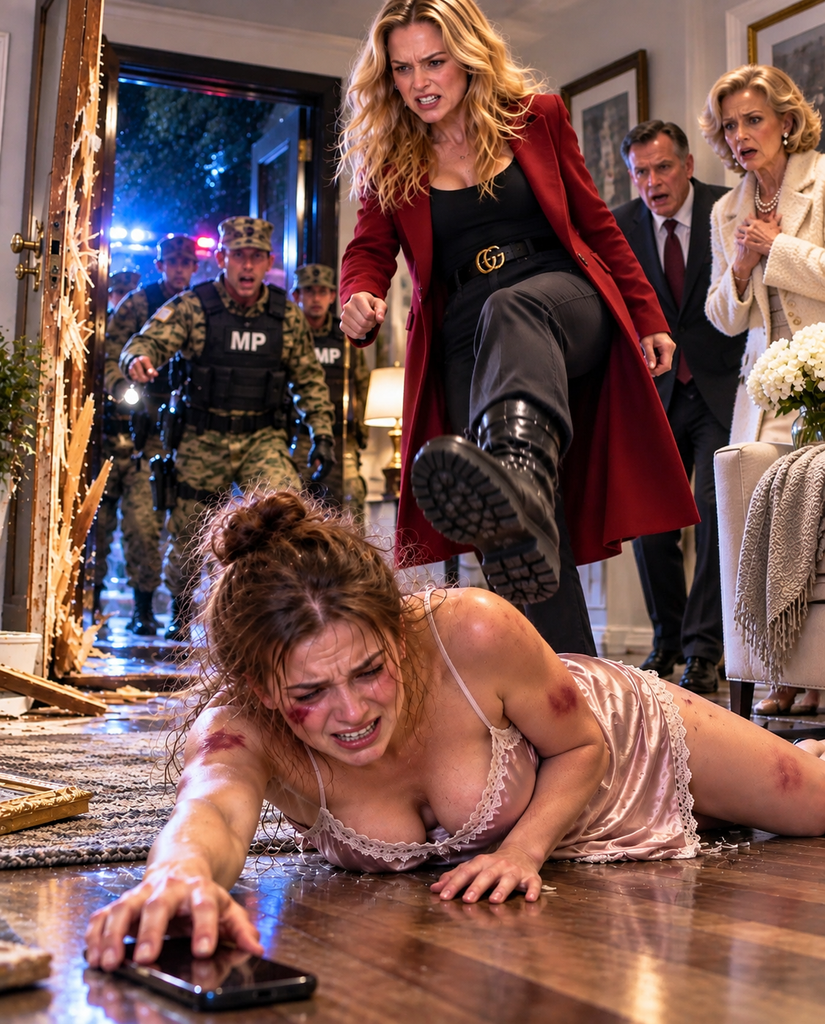
My father said nothing. That was becoming his specialty. Within minutes, the small living room filled with people. An ambulance crew checked my ribs while military police separated everyone into different rooms.
My neighbors stood outside beneath the covered walkway, speaking quietly among themselves. I hated knowing they had heard everything. Then I hated myself for caring.
One of the medics crouched beside me.
“Can you take a full breath?”
“Not comfortably.”
“Any dizziness?”
“A little.”
He examined my side carefully.
“No obvious instability.
We’ll still get imaging.”
Across the room, an officer was photographing the broken lock.
Another picked something up near the doorway.
A leather folder.
Brown.
Expensive.
Lenora saw it too.
For the first time since the officers arrived, she moved abruptly.
“That belongs to me.”
The officer looked at her.
“Please stay where you are.”
“It contains private financial documents.”
“Then you can explain that during your statement.”
Something passed across her face.
Not fear exactly.
Calculation.
I watched her stare at the folder.
And suddenly I knew why they had come.
Not the whole reason.
But enough to understand that this had never been a spontaneous family visit.
Nobody carried prepared financial documents to someone’s house at two in the morning unless they expected signatures.
The realization settled over me slowly.
Brooke had not driven more than two hours through a thunderstorm because she was angry that I had stopped answering family calls.
Lenora had not come because she missed me.
And my father had not traveled all that way merely to stand silently in my living room.
They wanted something.
An hour later, I sat in a treatment room at the base clinic with an ice pack pressed against my side.
Nothing was broken.
The doctor called it severe bruising and told me the next few days would feel worse before they felt better.
I almost laughed.
That sentence could have described most of my childhood.
A knock came at the open door.
Staff Sergeant Ana Ruiz leaned around the frame.
“You look terrible.”
“Thank you.”
“I thought honesty was important in friendship.”
“It is.
Just not before sunrise.”
She came inside carrying two paper cups.
Ana and I had met six years earlier during a training course in California.
She had an annoying habit of appearing whenever my life became difficult and then pretending she had done so accidentally.
She handed me coffee.
“I heard there was an incident.”
“That’s one word for it.”
“I also heard your front door has become abstract art.”
Despite myself, I smiled.
She sat beside the bed.
For several minutes, she said nothing.
That was one reason I trusted her.
Ana did not demand explanations simply because she cared.
Eventually she asked, “Was it your family?”
I stared into the coffee.
“Yes.”
“All of them?”
“My stepsister.
My stepmother.
My father.”
Ana’s expression changed slightly at the last word.
She knew about Daniel.
Not everything.
But enough.
“He came with them?”
“Yes.”
“And he didn’t stop it?”
“No.”
The word seemed to take something out of me.
Ana leaned back.
Outside the treatment room, nurses moved quietly through the corridor.
Finally she said, “What do you need?”
I almost gave the answer I always gave.
Nothing.
Instead I surprised myself.
“I don’t know.”
“That’s allowed.”
“I’m supposed to know.”
“According to whom?”
I had no answer.
Ana nodded toward my coffee.
“Start with drinking that before it becomes terrible.”
“It already is.”
“Then it can’t disappoint you.”
I laughed, and my ribs immediately protested.
“Ow.”
“That’s what you get for criticizing government coffee.”
By six in the morning, the storm had moved east.
A pale gray light spread over the base.
I gave my statement twice.
The second time, an investigator named Lieutenant Harris sat across from me in a small interview room.
He was calm and meticulous.
“Did you invite any of them into your residence?”
“No.”
“Did you know they were coming?”
“No.”
“Have they previously threatened to come here?”
I thought about that.
“Not directly.”
“Indirectly?”
“My stepmother has been leaving messages for weeks.
She kept saying we needed to discuss family property.”
“What property?”
“I don’t know.”
He glanced at his notes.
“Do you own property jointly with members of your family?”
“Not that I’m aware of.”
Harris was silent for a moment.
“Are you familiar with a residence at 418 Bellweather Road?”
My hand stopped around the coffee cup.
“Yes.”
“What is it?”
“My grandmother’s house.”
My grandmother June had died seven months earlier.
I had attended the funeral.
I had stood in the back row of the church because Lenora had filled the first two pews with relatives and acquaintances I barely knew.
After the service, my father had hugged me stiffly.
Brooke had told me there was no reason to stay for the family gathering because everyone was tired.
So I had returned to base that evening.
No one had contacted me about the estate.
I assumed there was nothing to contact me about.
Grandma June’s house had been in the Mercer family for nearly fifty years.
I imagined my father had inherited it.
Lieutenant Harris turned a folder toward me.
It was not Lenora’s leather folder itself, but photocopies of several documents recovered from it.
My name appeared on the first page.
Mara Elise Mercer.
I stared.
“What is this?”
“A proposed transfer of interest.”
“I don’t understand.”
He pointed to a paragraph.
“This document appears to request that you relinquish an ownership interest in the Bellweather Road property.”
“I don’t have an ownership interest.”
“That may be something you should verify with an attorney.”
I read further.
There was a signature line at the bottom.
Mine.
Blank.
Below it was another sheet.
An email printout.
The sender appeared to be a law office.
The email was addressed to Lenora.
I read the first sentence twice.
Mrs.
Mercer, as previously explained, Ms.
Mara Mercer must consent personally to any sale involving her interest in the property.
My mouth went dry.
“I was never told.”
Harris watched me carefully.
“About the property?”
“About any of this.”
That afternoon, Ana drove me to temporary quarters because my house could not be secured until the frame was repaired.
I barely spoke.
The photocopies sat inside an envelope on my lap.
At a red light, Ana glanced toward me.
“Still reading?”
“I keep thinking maybe the words will change.”
“Any luck?”
“No.”
“You called a lawyer?”
“Legal assistance gave me a referral.”
“And?”
“I have an appointment tomorrow.”
Ana nodded.
Then, very gently, she asked, “What did your grandmother mean to you?”
I looked out the passenger window.
Buildings rolled past beneath a sky washed clean by rain.
“She was the only person in that house who never acted like loving me was complicated.”
Ana waited.
“When Lenora married Dad, Grandma June tried to make things normal.
Sunday dinners.
Birthday cakes.
Christmas mornings.
She never said anything bad about Lenora in front of me.”
“Did they get along?”
“No.”
That answer came quickly.
I remembered Grandma June standing in our kitchen when I was fifteen.
Lenora had been furious because I wanted to attend a summer science program.
“It costs too much,” Lenora had said.
Grandma had calmly placed a check on the counter.
“Then it’s fortunate I’m paying.”
Lenora had looked at her with absolute contempt.
Grandma had looked back without blinking.
I attended the program.
It was the first time I understood that another life might exist beyond the walls of our house.
“She helped me believe leaving wasn’t betrayal,” I said.
Ana looked at me.
“Maybe the house is part of that.”
The attorney I met the next morning was named Samuel Pike.
He was nearly seventy, with silver hair, old-fashioned glasses, and the habit of removing them whenever he said something important.
His office smelled faintly of cedar and coffee.
When I gave him my name, his expression changed.
“Mara Mercer.”
“Yes.”
He stood.
“I have been trying to reach you for six months.”
The sentence landed harder than I expected.
“What?”
“We sent letters to your last known civilian address.
We called the number provided by your grandmother’s records.
Eventually the calls stopped connecting.”
“My phone number changed when I transferred.”
“Yes.
Unfortunately, your grandmother did not have your current duty information.”
I sat down slowly.
“Why didn’t my father give it to you?”
Samuel hesitated.
“That is one of several questions I cannot answer.”
He opened a thick file.
“Your grandmother left very specific instructions.”
He slid a copy of the will toward me.
The Bellweather Road house had been divided into three interests.
Sixty percent to me.
Twenty percent to my father.
Twenty percent to Brooke.
I stared at the page.
“That doesn’t make sense.”
“It was intentional.”
“Why would she leave Brooke anything?”
Samuel smiled faintly.
“Because she considered Brooke her granddaughter too.”
That sounded like Grandma.
Even when she disliked someone’s behavior, she rarely withdrew affection.
“And why sixty percent to me?”
Samuel looked toward the file.
“She included a letter explaining that.”
He removed an envelope.
My name was written across it in my grandmother’s careful handwriting.
I knew immediately that it was genuine.
My throat tightened.
Samuel pushed it toward me.
“She asked that you receive it personally.”
I opened the envelope.
Mara, If you are reading this, then I have finally run out of Sundays to tell you things myself.
That sentence blurred.
I looked away until I could continue.
Grandma wrote about the house.
About the maple tree I used to climb.
About the kitchen drawer where she kept peppermint candy.
About the bedroom where I stayed whenever things at home felt too crowded.
Then I reached the paragraph that explained everything.
A home should never be used to decide who belongs and who does not.
You spent too many years believing your place could be taken from you if you disappointed someone.
I want you to own enough of this house that no one can ever tell you that you must leave it.
I pressed my lips together.
Samuel quietly turned toward the window.
Grandma continued.
Do not misunderstand me.
A house cannot repair a family.
Wood and brick do not forgive, apologize, listen, or change.
People must do those things.
But sometimes a door that is truly yours gives you enough courage to decide which people you will open it for.
I read that paragraph three times.
Then came something strange.
There is another matter.
Your father knows what I mean.
Ask Daniel about the blue box.
Do not let him tell you it was lost.
I lowered the letter.
“What blue box?”
Samuel turned back.
“I was hoping you could tell me.”
“I’ve never heard of it.”
He removed his glasses.
“Then I believe you should speak to your father.”
“I’m not sure I want to.”
“That is entirely your decision.”
I looked at the estate papers.
“Were they trying to sell the house?”
“Yes.”
“Without telling me?”
“They could not legally complete the sale without you.
I repeatedly explained that.”
“Why was Lenora communicating with you?”
“She claimed to be assisting your father.”
Samuel’s careful tone told me there was more.
“And?”
“And she became increasingly frustrated when I refused to treat her as someone with authority over your share.”
I leaned back.
Suddenly the pieces fit.
The late-night arrival.
The papers.
Lenora’s anger.
Brooke’s accusation that I thought I was better than them.
They had wanted me frightened.
Confused.
Off balance.
The same conditions under which I had spent most of my adolescence agreeing to whatever kept the peace.
“They thought I would sign.”
Samuel did not answer.
He did not have to.
Later that day, Lieutenant Harris called.
My father had requested permission to pass a message through investigators.
I almost refused.
Then curiosity won.
“What did he say?”
Harris read from a note.
“He said: ‘Tell Mara the blue box is still in the attic at Bellweather Road.
Her grandmother knew.
I should have told her years ago.’” I sat completely still.
“Did he say what’s inside?”
“No.”
The Bellweather house had been sealed as part of the estate process, but Samuel arranged access the next morning.
Ana came with me.
The house looked smaller than I remembered.
White siding.
Green shutters.
A wraparound porch with one loose board near the steps that Grandpa had promised to fix for fifteen years.
Inside, the air smelled like dust, cinnamon, and old furniture.
For the first time since Grandma’s funeral, I let myself stand in the entryway and simply miss her.
Ana wandered toward the living room.
“Where’s the attic?”
“Upstairs.”
We climbed slowly because my ribs still hurt.
At the top of the narrow attic staircase, sunlight spilled through a round window.
Boxes were stacked beneath sloping rafters.
Christmas decorations.
Old coats.
Books.
Photo albums.
Ana found the blue box behind a cedar chest.
It was small.
Metal.
Faded navy paint.
A piece of masking tape had been placed across the top.
MARA.
My hands began trembling.
“Do you want me to stay?”
Ana asked.
“Yes.”
I opened it.
Letters.
Dozens of them.
Some in white envelopes.
Some yellowed with age.
All addressed to me.
The return address on the first one belonged to a woman named Evelyn Hart.
I knew that name.
My mother.
The woman I had been told had walked away when I was eight years old and never looked back.
I picked up the earliest envelope.
It was dated twenty-one years ago.
Then another.
And another.
Birthdays.
Christmases.
The first day of school.
My thirteenth birthday.
My sixteenth.
My graduation year.
My breath caught.
“These were never sent?”
Ana asked.
I turned one over.
The envelope had been opened.
Not by me.
Every envelope had been opened.
Inside the final one was a note in Grandma June’s handwriting.
Mara, Your mother never stopped writing.
Daniel knows why you never saw these.
I am sorry I did not discover them sooner.
I think you deserve the truth from him, not from a dead woman’s guess.
But whatever explanation he gives you, remember this: Being loved and being told you are loved are not always the same thing.
You should have had both.
I sat down on the attic floor.
Around me lay twenty-one years of unopened conversations.
Birthdays I had believed forgotten.
Christmases I had believed ignored.
Questions I had stopped asking.
Ana lowered herself beside me.
Neither of us spoke for a long time.
Finally, I picked up the newest envelope.
Unlike the others, it had been mailed only nine months earlier.
My mother had still been writing.
Nine months ago.
After more than two decades.
I turned the envelope over.
There was a current return address.
And beneath it, in my grandmother’s handwriting, was a phone number.
For twenty-one years, I had believed my mother had chosen silence.
Now I was holding proof that someone else had chosen it for her.
And only one person could tell me why.
PART 3
I did not call my father that day.
I did not call my mother either.
For twenty-one years, I had imagined what I would say if Evelyn Hart ever appeared again.
Most versions began with Why?
Some were colder.
Some were angry.
A few, during the lonelier years, began with Mom.
Now that I had her number in my hand, I discovered that imagination was much easier than reality.
I took the blue box back to temporary quarters.
That evening, I arranged the letters across the small dining table in chronological order.
Ana sat on the sofa reading a magazine without turning a page.
“You know you don’t have to babysit me,” I said.
“I know.”
“You’ve been here five hours.”
“I like government furniture.”
“No one likes government furniture.”
“Then maybe I’m staying because you keep staring at twenty-one years of mail like it might explode.”
I looked at the envelopes.
“That too.”
She set the magazine aside.
“Have you opened one?”
“No.”
“Why?”
I thought about it.
“Because right now they can still say anything.”
Ana nodded.
It was exactly the right response.
If I opened them, imagination would end.
My mother might have written apologies.
Excuses.
Ordinary updates about weather and jobs and birthdays.
Maybe she had tried desperately to find me.
Maybe she had not tried hard enough.
Maybe every answer would create another question.
At nine that night, my phone rang.
Samuel Pike.
“I hope I’m not calling too late.”
“No.”
“There has been a development regarding the house.”
My stomach tightened.
“What happened?”
“Your father has formally withdrawn his consent to the proposed sale.”
I frowned.
“I didn’t know he had given it.”
“He had.”
“Why did he withdraw?”
“He did not say.”
I walked toward the window.
Beyond the glass, rows of base housing lights glowed beneath a clear sky.
“What about Lenora?”
“She is not a beneficiary and has no legal interest in the property.”
That sentence had probably become Samuel’s favorite sentence in recent months.
“And Brooke?”
“She has not withdrawn her consent, but without yours the sale cannot proceed regardless.”
I rubbed my forehead.
“Samuel, did my grandmother know my father had those letters?”
“I believe she discovered them shortly before she became ill.”
“Why didn’t she call me?”
“She tried.”
I closed my eyes.
“She did?”
“She asked me to locate you.
By the time I obtained the correct forwarding information from an old record, she had already entered the hospital.
Your father asked us to delay contacting you because he claimed you were deployed somewhere communication would be difficult.”
“I wasn’t deployed.”
“I know that now.”
A quiet anger rose inside me.
Not the sharp kind.
The exhausted kind.
“How many times can one person choose the easier lie?”
Samuel did not pretend to have an answer.
The next morning, Lieutenant Harris told me my father wanted to provide a supplemental statement.
This time, I agreed to hear it.
Not because I was ready to forgive him.
Because I was tired of constructing explanations for his silence.
Daniel and I met in a conference room under arrangements that kept everything formal.
He sat across from me with his hands folded.
He looked older than he had three days earlier.
For the first time in my life, that did not make me feel responsible for comforting him.
“Hello, Mara.”
“Tell me about the letters.”
His mouth tightened.
No greeting.
No small talk.
No opportunity to hide.
He looked down.
“Your mother wrote after she left.”
“I know.”
“She wanted contact.”
“I know.”
“She asked to see you.”
“I know.”
He raised his eyes.
There were tears in them.
Once, that would have changed everything.
Now it changed nothing.
“Why didn’t you give them to me?”
He took a long breath.
“When your mother and I separated, everything became a contest.
Money.
The house.
Time with you.
We were both angry.”
“Did she abandon me?”
“No.”
The answer came softly.
But immediately.
Something inside me went still.
“No?”
“She left the marriage.”
“Did she leave me?”
Daniel shook his head.
“No.”
I had expected the answer.
The letters had already told me.
Still, hearing him say it felt like discovering a staircase where I had believed there was a wall.
“Then why did you tell me she did?”
“At first, I didn’t.”
“You did.”
“Not in those words.”
I laughed once.
It sounded bitter even to me.
“You told an eight-year-old girl that her mother had chosen a new life and there wasn’t room for her in it.
What exactly would you call that?”
He looked away.
“I was angry.”
“For twenty-one years?”
“No.”
“Then what happened after the anger?”
“Fear.”
I waited.
He rubbed his palms together.
“Your mother moved several states away after the divorce.
She was struggling financially.
She wanted shared custody arrangements changed.
I convinced myself stability meant staying with me.”
“That explains a court argument.
It doesn’t explain hiding birthday letters.”
“No.”
He swallowed.
“The first year, I kept telling myself I would give them to you when things settled down.
Then Lenora came into our lives.”
I almost interrupted.
He continued.
“She believed Evelyn was disruptive.
She said every letter reopened the wound.
She said you were finally adjusting.”
“And you believed her?”
“I wanted to.”
There it was.
Not helplessness.
Not confusion.
Convenience.
“You wanted a quiet house.”
“Yes.”
“At my expense.”
“Yes.”
He did not defend himself.
Strangely, that made the conversation harder.
I had spent years preparing arguments against excuses.
I had not prepared for agreement.
“What about Grandma?”
“She found the box last year.”
“How?”
“I had moved it to her attic during renovations at our house.
I forgot it was there.”
Twenty-one years of letters.
Forgotten.
The word made me grip the edge of my chair.
“She confronted me,” he continued.
“She told me to call you immediately.”
“But you didn’t.”
“No.”
“Why?”
“Because by then I knew there was no explanation that would make what I’d done understandable.”
“So you chose another silence.”
“Yes.”
I studied him.
“When did Lenora learn Grandma found them?”
“The same week.”
“And the will?”
“After Mom died.”
“Did Lenora want the house sold?”
“Yes.”
“Why?”
Daniel hesitated.
“There are debts.”
“Whose?”
“Ours.”
That explained something.
Not everything.
“Is that why you came to my house?”
He closed his eyes for a moment.
“Yes.”
“You expected me to sign away my share.”
“I told myself we were going to ask you.”
“At two in the morning?”
His face tightened.
“I knew it was wrong before we left.”
“Then why did you get in the car?”
“I don’t have an answer that makes me look better.”
“I’m not asking for one that makes you look better.”
He nodded slowly.
“I was afraid that if I opposed Lenora, my marriage would end.
I was afraid of the debt.
Afraid of losing the house we live in.
Afraid Brooke would blame me.
Afraid you would learn everything.”
He gave a small, broken laugh.
“I was afraid of every possible consequence except the one I should have feared most.”
“What was that?”
“Becoming someone my daughter could no longer trust.”
For several seconds, neither of us spoke.
Then I asked the question that had followed me since that night.
“When Brooke came at me, why didn’t you stop her?”
Daniel’s face changed.
“I froze.”
“You stepped behind Lenora.”
He looked at the table.
“Yes.”
“That wasn’t freezing.”
“No.”
The room felt painfully quiet.
“I need you to understand something,” I said.
He lifted his eyes.
“I spent years believing you were trapped between people.
Grandma.
Lenora.
Mom.
Me.
I made excuses for you because it hurt less than accepting that you kept choosing the person who made the most noise.”
He nodded once.
“I know.”
“No.
I don’t think you do.”
My voice stayed calm.
“That night in my house changed something.
Not because I suddenly stopped loving you.
I wish it were that simple.”
His eyes filled again.
“It changed because I stopped confusing love with trust.”
Daniel pressed his lips together.
“What happens now?”
“For me?”
“Yes.”
“I don’t know.”
“And for us?”
“I don’t know that either.”
He nodded.
This time he did not ask me to decide faster.
Before I left, he reached inside his coat.
“I have something.”
I stiffened.
He placed a photograph on the table.
It showed my mother standing beside a red station wagon.
She was young.
Maybe thirty.
I was beside her holding a stuffed rabbit.
I remembered the rabbit.
I did not remember the photograph.
“Your grandmother kept a copy,” he said.
I picked it up.
On the back, in blue ink, my mother had written: Mara insists we are going to the moon.
I told her we should start with Ohio.
A laugh escaped me unexpectedly.
Then came tears.
Not many.
Just enough to blur the handwriting.
Daniel stood.
“I’m sorry.”
I did not answer.
He paused at the door.
“For what it’s worth, Lenora and I are separating.”
I looked up.
“Because of what happened?”
“Because I finally stopped pretending what happened was separate from everything else.”
Then he left.
Two days later, I opened the first letter.
Dear Mara, Your father may not give you this.
I am writing anyway because someday I hope you will know that I thought of you today.
I read another.
Then another.
My mother wrote about ordinary things.
Her new apartment.
A job at a library.
A neighbor’s ridiculous dog.
The daffodils she planted and accidentally drowned.
She asked about my school.
My friends.
Whether I still hated peas.
Every few letters contained some version of the same sentence.
I hope you know I did not leave because I stopped being your mother.
By midnight, I was crying too hard to continue.
Ana silently placed tissues beside me.
“She sounds funny,” she said.
I laughed weakly.
“She killed three tomato plants.”
“Some people shouldn’t be trusted with agriculture.”
“She kept trying.”
“That’s either admirable or evidence of poor judgment.”
I looked at the letters.
“She kept trying.”
The next afternoon, Brooke contacted me through an attorney.
She wanted to send a letter.
I almost declined.
Then I remembered Grandma leaving her twenty percent.
Grandma had believed Brooke belonged too.
I agreed.
Brooke’s letter was four pages.
The handwriting grew messier as it continued.
She did not excuse what she had done.
She wrote that Lenora had told her I planned to take the entire property and leave Daniel with debts he could not pay.
She admitted she wanted to believe it because she had spent years resenting the way Grandma defended me.
Then came a sentence I did not expect.
I think I was jealous that Grandma could disagree with you and still love you.
Mom made disagreement feel like betrayal, and I learned that language too well.
I stopped reading.
That was the most accurate description of our family I had ever seen.
Brooke wrote that she would accept whatever legal consequences followed.
She also wrote that she no longer wanted the house sold.
Her twenty percent, she said, could remain exactly where Grandma had put it.
The letter ended simply.
I am not asking you to forgive me.
I am asking you not to believe that I still think what I said about you was true.
You were never a parasite.
I was angry at a story I had been given, and instead of checking whether it was true, I became part of it.
I folded the letter.
Ana looked over from the kitchen.
“Bad?”
“No.”
“Good?”
“I don’t know.”
“Those are allowed too.”
I smiled.
“You say that about everything.”
“Because you keep trying to turn feelings into inspection checklists.”
That evening, I finally entered my mother’s number into my phone.
Then deleted it.
Then entered it again.
I sat on Grandma June’s porch with the blue box beside me.
Repairs had begun on the loose board near the steps.
Samuel had given me the keys that morning.
Technically, the house belonged to three people.
But when I opened the front door, I heard Grandma’s letter in my mind.
A door that is truly yours gives you enough courage to decide which people you will open it for.
The sun lowered beyond the maple tree.
I pressed call.
It rang once.
Twice.
Three times.
A woman answered.
“Hello?”
My throat closed.
The voice was unfamiliar.
And somehow not unfamiliar at all.
“Hello?” she repeated.
I nearly ended the call.
Instead I said, “Is this Evelyn Hart?”
Silence.
“Yes.”
I gripped the phone.
“My name is Mara.”
Nothing happened for several seconds.
Then I heard a sharp inhale.
Not dramatic.
Not theatrical.
Just human.
“Mara?”
“Yes.”
When she spoke again, her voice trembled.
“I don’t know what I’m supposed to say first.”
That surprised a laugh out of me.
“Neither do I.”
She laughed too.
And suddenly, across twenty-one missing years, there was one small thing we were doing together.
Neither of us knew what came next.
“I found your letters,” I said.
A long silence.
“All of them?”
“I think so.”
“Oh.”
That one word carried more feeling than a speech could have.
“I thought you stopped writing,” I said.
“I never stopped.”
“I know that now.”
Another silence.
Then my mother asked, very carefully, “Are you all right?”
I looked at the quiet porch.
The maple tree.
The blue box.
The house my grandmother had refused to let anyone take away from me.
“I’m getting there.”
“I’m glad.”
I closed my eyes.
There were a thousand questions.
Why didn’t you come for me?
Why didn’t you fight harder?
Did you remarry?
Do I have siblings?
Did you know I joined the Marines?
Did you remember every birthday?
But none felt like the right first question.
So I chose something smaller.
Something possible.
“What happened to the tomato plants?”
There was a pause.
Then Evelyn laughed.
A warm, astonished laugh.
“You read that one?”
“You murdered them.”
“I overwatered them.”
“Three years in a row.”
“I was optimistic.”
For almost forty minutes, we talked about nothing important.
Gardening.
Weather.
Books.
Coffee.
The strange things people did in grocery-store parking lots.
And somehow those ordinary subjects mattered more than explanations.
They proved we could occupy the same conversation without the past consuming every inch of it.
Before we hung up, Evelyn said, “Mara?”
“Yes?”
“If you ever decide you want to meet, I’ll come wherever you choose.”
I looked through the open front door of Grandma’s house.
At the hallway where my childhood height marks were still penciled into the trim.
At the room where Grandma had taught me to sew a crooked button.
At the dining table where she had once told me that courage rarely felt courageous while you were doing it.
“I think I know the place,” I said.
After the call ended, I remained on the porch until the sky became dark.
My phone buzzed.
A message from Samuel.
Daniel had signed documents confirming he would not contest Grandma’s will or seek to force a sale.
Another message followed.
Brooke had done the same.
For the first time since the night they broke into my home, there was no decision waiting to be forced out of me.
The house could stay.
The letters were mine.
The next conversation would happen when I chose it.
PART 4
My mother arrived on a Saturday afternoon carrying a small green suitcase and a potted tomato plant.
I saw both through the front window.
For several seconds, I remained completely still.
Ana stood beside me.
“Is that her?”
“Yes.”
“You’re sure?”
“She brought evidence.”
Ana followed my gaze to the plant.
“That’s either confidence or a threat.”
I laughed.
My mother waited at the bottom of the porch steps.
She did not walk toward the door.
She did not assume she was welcome inside.
That mattered.
I opened the screen door.
Evelyn Hart looked older than the photographs in the blue box.
Of course she did.
So did I.
Her hair was cut to her shoulders, brown threaded with gray.
She wore jeans, a navy cardigan, and the expression of someone trying very hard not to frighten a wild animal.
For one absurd second, I noticed we had the same eyebrows.
Then she held up the tomato plant.
“I thought it might demonstrate personal growth.”
I laughed before I could stop myself.
Evelyn smiled.
The smile was familiar.
I had seen it in my own mirror all my life.
“Hello, Mara.”
“Hi.”
Neither of us moved.
Finally she asked, “Would a hug be all right?”
The question nearly undid me.
Not the hug.
The asking.
“Yes.”
She came up the steps slowly.
When her arms went around me, I did not suddenly become eight years old.
I did not feel missing decades rush back into place.
There was no magical repair.
There was only the warmth of another person holding me carefully.
And the strange recognition of fitting against someone whose body remembered me before my own memories began to fade.
Evelyn pulled away first.
“You’re taller than I expected.”
“You knew my height?”
“I asked your grandmother.”
“You talked to Grandma?”
“For years.”
That stopped me.
“What?”
Evelyn looked toward the house.
“Maybe we should sit down.”
Ana immediately pointed toward the kitchen.
“I have suddenly remembered that I promised to buy supplies.”
“You promised no such thing.”
“I promise many things internally.”
She grabbed her keys.
Evelyn smiled.
“I like her.”
“She’s impossible.”
“I heard that,” Ana called from the hallway.
Once she left, Evelyn and I sat on Grandma’s porch.
The tomato plant rested between us like a chaperone.
“You talked to Grandma?”
I asked again.
“Not regularly.
At first she wouldn’t speak to me.”
“That sounds like her.”
“She loved your father.”
“She loved everybody.
In very inconvenient ways.”
Evelyn smiled.
“Yes.
She did.”
She folded her hands.
“A few years after the divorce, she called me.
She said she had begun to suspect you weren’t receiving my letters.”
“Why didn’t she tell me?”
“She didn’t know for certain.
Your father told her you didn’t want contact.”
My stomach tightened.
“He said that?”
“Yes.”
Evelyn watched my face.
“I believed him longer than I should have.”
The words could have been an accusation.
She directed them at herself instead.
“I kept thinking that if you wanted me, eventually you would answer.
When you became a teenager, I convinced myself forcing contact would make things worse.”
“Didn’t you ever come to the house?”
“Twice.”
I stared at her.
“When?”
“The first time you were eleven.”
I tried to remember.
Nothing.
“Your father met me at a restaurant.
He said you were doing well.
He said seeing me would confuse you.”
“And the second time?”
“You were fourteen.”
Something moved in my memory.
A rainy afternoon.
Lenora closing the front curtains even though it was barely four o’clock.
My father telling me not to answer the telephone.
A woman’s voice on the answering machine.
Then nothing.
“I think I remember.”
Evelyn’s eyes filled.
“I stood across the street for almost an hour.”
“Why didn’t you knock?”
“I was told you were frightened of me.”
I looked away.
That was the tragedy of our family.
Not one enormous lie.
A thousand smaller ones.
Each designed to make the next conversation less likely.
“I wish you had knocked,” I said.
“I do too.”
There was no accusation in my voice.
Only truth.
Evelyn nodded.
“I should have.”
That became the pattern of our weekend.
Questions.
Answers.
Pauses.
Sometimes laughter.
Sometimes silence.
I learned that Evelyn had remarried when I was twenty-three.
Her husband, Michael, was a high-school music teacher.
I had a seventeen-year-old half brother named Noah.
Evelyn showed me his photograph only after asking whether I wanted to see it.
He had her eyes.
My eyebrows.
A ridiculous amount of curly hair.
“He knows about me?”
“Always.”
That answer hurt and comforted me at the same time.
“What does he know?”
“That he has an older sister named Mara.
That she joined the Marines.
That his mother made mistakes she wishes she could repair.”
I studied the photograph.
“Does he want to meet me?”
“Very much.”
“Is he angry?”
“At whom?”
“Dad.”
Evelyn shook her head.
“I never told Noah to carry anger that belonged to adults.”
I looked at her.
There were many things I wished my childhood had been.
That sentence was one of them.
We did not solve twenty-one years in one weekend.
We did something better.
We began.
On Sunday morning, Evelyn made pancakes in Grandma’s kitchen.
She burned the first batch.
“You claimed you improved.”
“With tomatoes.”
“That improvement has not transferred.”
“You are extremely judgmental for someone accepting free breakfast.”
By noon, we were laughing.
It felt strange.
Then less strange.
Before she left, we planted the tomato in a large pot beside the porch.
“What happens when you go back to base?” she asked.
“I’m only about two hours away.”
“You’re keeping the house?”
“I think so.”
“For sentimental reasons?”
“Partly.”
“And the other part?”
I looked at the windows.
“I haven’t decided what it becomes yet.”
Evelyn nodded.
“You don’t have to decide everything immediately.”
Apparently, everyone in my life had formed a committee dedicated to reminding me of that.
Three weeks later, my front door on base was replaced.
The new frame looked ordinary.
That pleased me.
I did not want a monument to the worst night I had spent there.
I wanted a door.
Something functional.
Something that opened and closed when I chose.
The case involving the break-in moved forward quietly.
I did not attend every procedural meeting.
I did not need to.
Brooke accepted responsibility through the legal process, agreed to counseling and the restrictions placed on contact with me, and began dealing with consequences without asking me to make them easier.
Lenora did the same, though her communications remained formal.
I did not receive an apology from her.
Eventually I realized I no longer needed one in order to move forward.
The absence of apology told me what kind of relationship was possible.
None.
That was information.
Not tragedy.
My father moved into a small apartment across town from the house he had shared with Lenora.
For the first month, he did not contact me.
Then a letter arrived.
Not a demand.
Not an explanation.
A letter.
Mara, I have rewritten this six times because every version began with reasons.
You have had enough of my reasons.
So I will only say what I know now.
I taught you that keeping peace mattered more than telling the truth.
I taught you that silence was kindness.
I taught you that love could exist without courage.
Those were terrible lessons.
I cannot ask you to unlearn them quickly simply because I finally understand what I did.
I am in counseling.
I have moved out.
I am taking responsibility for the debts I helped create.
I do not expect any of that to earn me access to your life.
If someday you want coffee, I will come.
If you do not, I will still be your father, and I will still be sorry.
Dad I folded the letter.
Then I put it in the blue box.
Not with my mother’s letters.
In a separate compartment.
A beginning should not pretend to be a repair.
Two months passed before I called him.
We met at a coffee shop near Bellweather Road.
Daniel was already there when I arrived.
He stood instinctively.
Then looked uncertain.
“Hi.”
“Hi.”
I sat.
He sat.
For the first ten minutes we discussed coffee.
Then traffic.
Then weather.
It was astonishing how difficult ordinary conversation could become after a lifetime of avoiding important ones.
Finally he said, “How is Evelyn?”
“Good.”
His face tightened slightly.
Not jealousy.
Regret.
“I’m glad.”
“You mean that?”
“Yes.”
I watched him.
“She told me you met her when I was eleven.”
He nodded.
“And fourteen.”
Another nod.
“You lied to both of us.”
“Yes.”
I waited for the familiar explanation.
It did not come.
He simply sat with the truth.
That mattered too.
“I don’t forgive you yet,” I said.
“I understand.”
“I might someday.”
He looked surprised.
“I don’t want you to treat that like a promise.”
“I won’t.”
“And even if I forgive you, things won’t go back to the way they were.”
“I don’t want them to.”
That was the first thing he said that made me believe change might be possible.
Because the old relationship had depended on my silence as much as his.
Neither of us should want it back.
We drank coffee for almost an hour.
When we left, he asked, “Can I call next month?”
I thought about it.
“Yes.”
His eyes watered.
He looked away quickly.
“Okay.”
“Dad?”
He turned.
“One call.”
He gave a small smile.
“One call.”
Brooke was harder.
Not because I loved her more.
Because I understood her less.
She had been nine when Lenora married my father.
For years, I had thought of her as the favored daughter.
The wanted one.
Only gradually did I understand that being favored inside an unhealthy family system did not mean being free.
Sometimes it meant being recruited.
Four months after the incident, Brooke sent another letter.
This one contained no defense of herself.
She wrote about counseling.
About recognizing how often she had treated disagreement as rejection.
About how desperately she had competed with me for approval neither of us should have had to earn.
Near the end, she wrote: Grandma left me twenty percent of the house.
At first I thought that meant she believed I deserved part of what you had.
Now I think she was telling me something else.
She was leaving me a place where I could belong without taking yours.
I cried when I read that.
Then I became annoyed that Brooke had made me cry.
Then I laughed because Grandma would have enjoyed the entire sequence.
A month later, I agreed to meet Brooke.
We chose a public café.
She arrived early.
Her hair was shorter.
She looked nervous.
Good.
I was nervous too.
“Mara.”
“Brooke.”
For several seconds, we stared at each other.
Then she said, “I’m sorry.”
I sat down.
“I know.”
“I practiced a longer version.”
“Of course you did.”
“It was twelve minutes.”
“That sounds unbearable.”
She laughed unexpectedly.
Then immediately looked guilty for laughing.
I almost smiled.
“Brooke.”
“Yeah?”
“We’re allowed to have a normal conversation.”
Her shoulders lowered.
“Right.”
“But normal doesn’t mean what happened disappears.”
“I know.”
I believed her.
That surprised me.
She wrapped both hands around her tea.
“I hated you for leaving.”
I frowned.
“You told me to leave.”
“I know.”
“Repeatedly.”
“I know.”
“Once you packed my things into garbage bags.”
She winced.
“I remember.”
“So explain that.”
She looked toward the window.
“You leaving proved something I didn’t want to know.”
“What?”
“That leaving was possible.”
The answer silenced me.
“Mom always said family loyalty meant staying,” Brooke continued.
“Then you joined the Marines.
Grandma was proud of you.
Dad bragged about you when Mom wasn’t around.”
“He did?”
“All the time.”
That was new.
Brooke gave a sad smile.
“I thought you escaped and still got to be loved.”
I leaned back.
“And you thought I had stolen something.”
“Yes.”
“What?”
“Permission.”
I understood then.
Not forgiveness.
Understanding.
The two were different.
“I never had permission,” I said.
Brooke looked at me.
“I just left anyway.”
She nodded.
“I know that now.”
When we finished our drinks, she did not ask when she could see me again.
She only said, “Thank you for coming.”
Outside, we stood beside our cars.
“Brooke.”
She turned.
“I’m fixing the porch at Grandma’s next Saturday.”
Her expression changed.
“Do you need help?”
“I need someone who knows how to use a paint scraper.”
“I can use a paint scraper.”
“You once painted a window shut.”
“I was twelve.”
“You painted the glass.”
“I was artistic.”
I laughed.
She smiled.
“Saturday?”
“Ten.”
“I’ll be there.”
That Saturday became another Saturday.
Then another.
We repaired porch rails.
Repainted shutters.
Cleaned the attic.
Ana arrived one weekend with sandwiches and announced that none of us could be trusted with power tools.
Evelyn visited twice.
The second time, she brought Michael.
The third time, Noah came too.
Meeting my brother was easier than meeting my mother.
He walked up the porch carrying a ridiculous bouquet from a grocery store and said, “I wasn’t sure what people give sisters they meet twenty-nine years late.”
I looked at the flowers.
“Apparently carnations.”
“They were discounted.”
“We may actually be related.”
He grinned.
By autumn, Bellweather Road had changed.
Not dramatically.
The loose porch board was fixed.
The shutters had fresh paint.
The maple leaves turned gold.
The tomato plant produced exactly four tomatoes, which Evelyn considered an agricultural miracle.
I still owned sixty percent.
Brooke still owned twenty.
Dad owned twenty.
But we stopped talking about the house only as property.
One evening, the three of us sat around Grandma’s dining table with Samuel Pike.
“I’ve been thinking,” I said.
Samuel adjusted his glasses.
“That is usually when paperwork begins.”
Brooke smiled.
Dad looked nervous.
I placed a folder on the table.
“I want to keep my share.”
“No objection,” Samuel said.
“I don’t want to live here full-time.”
Brooke tilted her head.
“What are you thinking?”
I looked around the room.
At Grandma’s china cabinet.
At the marks on the doorframe.
At the photograph of her standing beneath the maple tree twenty years earlier.
“There’s a veterans’ transition program near here looking for temporary housing partnerships.”
Dad looked up.
“For service members?”
“And families.
Short stays.
People relocating, starting new jobs, getting settled.”
Brooke slowly smiled.
“You want the house to be used?”
“Yes.”
Samuel nodded.
“That can be structured.”
I looked at Dad.
“Grandma said houses can’t repair families.”
He gave a small smile.
“She was right.”
“But maybe they can give people somewhere safe to start.”
Brooke reached across the table.
She did not touch my hand.
She simply rested hers nearby.
“I want my share to stay.”
Dad nodded.
“Mine too.”
For once, agreement did not feel like surrender.
It felt like choice.
A year after the night my family forced their way into my home, I stood on Grandma’s porch watching people arrive for dinner.
Ana came first, carrying dessert.
“You bought that,” I said.
“Prove it.”
My mother and Michael arrived next.
Noah followed with a guitar no one had asked him to bring.
Brooke drove up five minutes later.
Dad came separately.
That was important.
His life no longer revolved around keeping someone else satisfied.
He looked healthier.
Quieter in a different way.
Not silent.
Peaceful.
He stopped beside me on the porch.
“Need help?”
“Plates are inside.”
He nodded.
Then paused.
“Mara?”
“Yeah?”
“I’m glad you kept the house.”
I looked through the windows.
Brooke was arguing with Noah about music.
Ana was stealing strawberries from the dessert tray.
Evelyn was moving plates because Dad had placed them in the wrong cupboard.
It was not the family I had grown up imagining.
It was stranger.
More complicated.
More honest.
“Me too,” I said.
Dad started toward the door.
“Dad.”
He turned.
For months, I had wondered whether forgiveness arrived as a feeling.
Some sudden release.
A clean ending.
It didn’t.
At least not for me.
It arrived as smaller decisions.
Answering one phone call.
Agreeing to one coffee.
Allowing one Saturday.
Believing changed behavior more than promises.
I looked at him.
“I forgive you.”
His expression crumpled slightly.
I raised a hand.
“That doesn’t erase anything.”
“I know.”
“It doesn’t mean I trust you the way I used to.”
“I know.”
“And I’m still going to tell you when I’m angry.”
“I hope you do.”
I smiled.
“Good answer.”
He laughed softly.
“Thank you.”
“For forgiving you?”
“For giving me the chance to become someone you can tell the truth to.”
Inside, Noah struck a terrible guitar chord.
Brooke shouted, “Absolutely not.”
Ana shouted louder, “I support him.”
Evelyn called through the screen door.
“Are you two coming inside or planning to become porch furniture?”
Dad looked at me.
I opened the door.
“Come on.”
Dinner lasted three hours.
No one raised their voice except over a debate about whether pineapple belonged on pizza.
Brooke argued yes.
Ana argued that Brooke had suffered enough consequences in life without adding pineapple.
My mother laughed so hard she nearly dropped a plate.
Afterward, while everyone cleaned up, I stepped outside alone.
The evening air was cool.
Across the yard, the maple tree moved gently in the wind.
I thought about the woman I had been one year earlier.
On the floor of my base housing.
Waiting for my father to defend me.
Believing that moment would determine what family meant for the rest of my life.
It hadn’t.
That was the secret no one had taught me when I was young.
Other people could fail you.
They could lie.
Stay silent.
Misunderstand you.
Even love you badly.
But they did not receive permanent authority over what your life became afterward.
Behind me, the screen door opened.
Brooke stepped onto the porch.
“You hiding?”
“Resting.”
“From us?”
“Obviously.”
She leaned against the railing.
For a while, we watched the street.
Then she said, “Grandma would be insufferably pleased with herself.”
I laughed.
“She absolutely would.”
“She knew.”
“Knew what?”
Brooke gestured toward the house.
“That if she made all three of us own it, eventually we’d have to talk.”
I considered that.
“She always was manipulative.”
Brooke looked horrified.
“You cannot say that about Grandma.”
“She bribed us with peppermint candy.”
“That was strategic affection.”
“Exactly.”
We laughed.
Inside, Dad called for help finding serving bowls.
Brooke sighed.
“He lived in this house for eighteen years.”
“I know.”
“He still doesn’t know where anything is.”
“I know.”
She opened the door.
“You coming?”
“In a minute.”
When she disappeared inside, I remained beneath the porch light.
The front door stood open.
A year earlier, a broken door had marked the moment I finally understood that belonging could not be demanded.
Now another open door meant something different.
Choice.
Trust built slowly.
Boundaries that did not require bitterness.
Forgiveness that did not require forgetting.
And a family that had stopped pretending love was enough without honesty.
I reached for the screen door.
Before going inside, I looked once more at the house Grandma June had left behind.
She had been right.
Wood and brick could not repair a family.
People had to do that themselves.
One truthful conversation at a time.
I stepped inside and closed the door gently behind me.
This time, no one had forced it open.
💬THE END! THANK YOU FOR READING! ❤️🙏