
My son finally asked, “Did I do something wrong, Grandma?” The words were so quiet that I almost convinced myself I had imagined them. Almost.
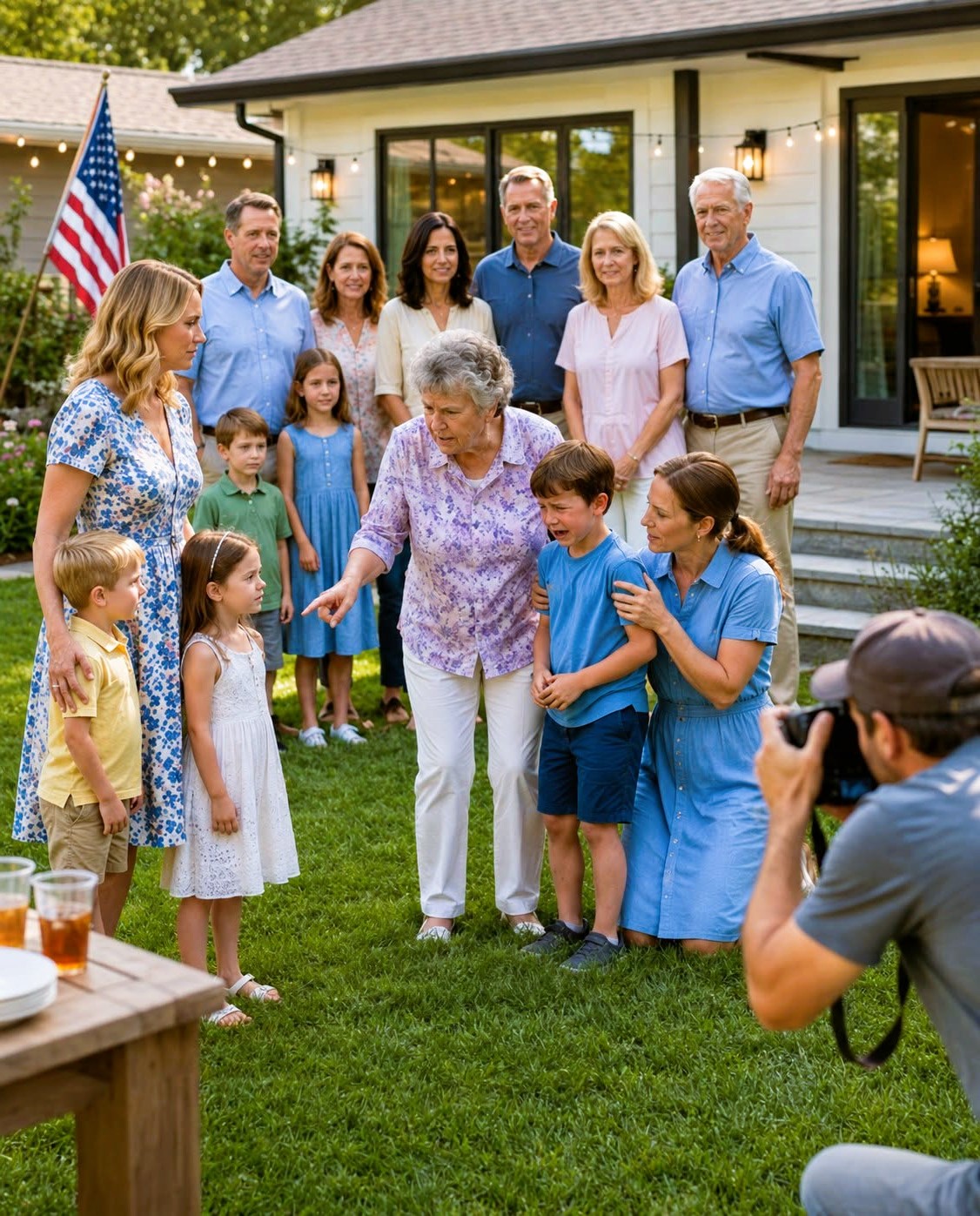
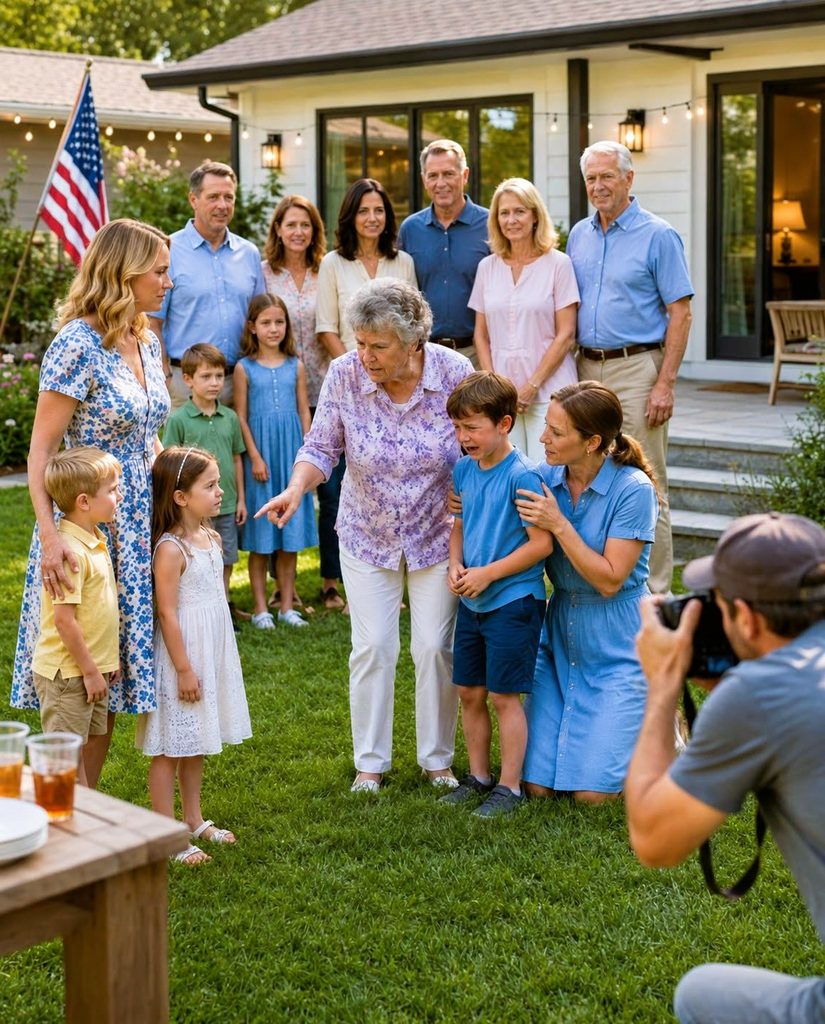
We were standing in my mother’s backyard beneath a white canopy she had rented for our annual summer family gathering. The grass had been freshly cut, blue and silver balloons were tied to the fence, and a long table near the patio was covered with sandwiches, fruit trays, cupcakes, and sweating paper cups filled with lemonade.
Everyone had been laughing five minutes earlier. My mother had hired a photographer because she wanted, as she had repeated at least a dozen times, “one beautiful picture of all the grandchildren together.”
My son, Noah, was eight.
He had spent most of the afternoon trying to stay out of everyone’s way.
That was something he had learned to do around my mother.
When the photographer called the grandchildren toward the large maple tree at the edge of the yard, Noah had followed his cousins.
My sister Emma’s children, Lily and Mason, were immediately placed in the center.
My brother Daniel’s daughters stood on one side.
Two younger cousins were positioned on the other.
Noah hovered near the end of the row, uncertain.
“Where should I stand?” he asked.
My mother ignored him.
The photographer adjusted his camera.
Noah tried again.
“Grandma?”
She sighed loudly.
He looked at the other children, then at me.
I had started walking toward him when he finally asked the question.
“Did I do something wrong, Grandma?”
Instead of answering, my mother grabbed his shoulder.
She pulled him completely out of the group.
“Stop ruining everyone’s day.”
Noah stumbled backward.
For one terrible second, he looked more confused than hurt.
Then his face collapsed.
He burst into tears in front of the entire family.
The photographer lowered his camera.
Ice shifted inside the paper cups on the backyard table, but nobody reached for them.
No one spoke.
I crossed the yard so quickly that I barely remembered moving.
I knelt beside Noah and pulled him against me.
His face was hot.
His fingers twisted the bottom of his T-shirt into a tight knot.
“Can we go home?” he whispered.
Before I could answer, Emma stepped out from behind the photographer.
“Lily. Mason. Come here.”
My mother frowned.
Emma’s children immediately left the arranged picture.
Lily was eleven.
Mason was nine.
They crossed the grass and stood beside Noah.
“If he doesn’t belong,” Emma said, “neither do we.”
My mother stared at her.
“What are you doing?”
Emma folded her arms.
“Exactly what I should have done a long time ago.”
“Put those children back,” Mom snapped. “You’re turning this into a spectacle.”
Emma stared at her.
“You planned the spectacle.”
Then she pulled out her phone.
She tapped the screen several times and held it where everyone could see.
The message had been sent that morning.
Come early. I want the grandchildren picture finished before they arrive.
Beneath it was another message.
Keep your kids in the middle. I’ll handle him if he makes a scene.
My stomach dropped.
Noah lifted his head from my shoulder.
He could read.
Not every word from where he stood, perhaps, but enough.
Definitely enough to understand that “him” meant him.
His crying stopped.
That somehow hurt worse.
He stared at my mother.
“This had nothing to do with anything he did today,” I said.
My mother’s expression hardened.
“He always looks miserable in pictures. He wanders around. He distracts the other children. Every gathering becomes more difficult when he’s here.”
“He asked where to stand.”
“I wanted one decent family photograph. Is that really such a terrible thing?”
She looked around as though expecting someone to agree.
No one did.
“He asked where to stand,” I repeated. “You answered by dragging him away.”
Lily walked over and took Noah’s hand.
“He is family.”
Mason moved beside them without being asked.
My mother rolled her eyes.
“Oh, for heaven’s sake. Children don’t need to be involved in adult disagreements.”
Emma laughed once, but there was nothing amused about it.
“You involved them when you decided one of them was disposable.”
Mom’s lips tightened.
I was suddenly exhausted.
Not physically.
It felt deeper than that.
For years, I had argued with my mother about little comments, changed seating arrangements, forgotten invitations, birthday presents that were somehow always more expensive for the other grandchildren, holiday traditions Noah never seemed to hear about until afterward.
Every incident had an explanation.
Every explanation had made me feel unreasonable for noticing.
So I stopped arguing.
I looked at Noah instead.
“Do you want to stay?”
He shook his head immediately.
“No.”
I stood.
“Then we’re leaving.”
Mom’s face changed.
“You are seriously leaving because I asked him to step out of one picture?”
“No. We’re leaving because you deliberately planned to exclude my son and humiliated him when he noticed.”
“I did not humiliate him.”
“You grabbed him.”
“Oh, don’t exaggerate.”
“I watched you.”
My voice was strangely calm.
Maybe because something inside me had finally snapped into place.
“You will not see Noah again until you apologize directly to him. Not to me. Not through Emma. Not in the family group chat. To him.”
Her jaw tightened.
“Anyone who walks out over this should not expect to come back for the holidays.”
Emma gathered her children’s jackets from a chair.
“Okay.”
Mom blinked.
“What?”
“You heard her,” Emma said. “We’re leaving too.”
My mother had expected me to go.
I saw that clearly.
She had probably already prepared whatever story she planned to tell after I left.
I was sensitive.
Noah was difficult.
I had overreacted.
That was how these things always worked.
What she had not expected was Emma.
Emma was Mom’s favorite daughter.
And Lily and Mason were unquestionably her favorite grandchildren.
Their photographs covered her hallway.
Their school portraits were framed beside the television.
Their handmade ornaments stayed on the Christmas tree every year.
When Lily was born, Mom had taken two weeks off work to help Emma.
When Noah was born three years later, she visited us for forty-five minutes.
Now Emma was helping Mason put on his jacket.
Mom’s voice softened instantly.
“Emma, don’t be ridiculous.”
Emma did not respond.
“This has nothing to do with your children.”
“It does now.”
“Think about what you’re doing.”
“I am.”
“You’re punishing Lily and Mason.”
Emma looked up.
“No. I’m teaching them that being favored doesn’t mean staying silent while someone else is treated badly.”
Lily squeezed Noah’s hand.
My mother’s face went pale.
We started toward the driveway.
That was when Emma caught my arm.
“You need to know something before we go.”
Something in her expression made me stop.
“What?”
She glanced toward Noah.
Then she lowered her voice.
“This isn’t the first family picture she tried to keep him out of.”
I stared at her.
“What do you mean?”
“Get in the car.”
We drove three blocks before Emma pulled into the parking lot of a small neighborhood park.
The children climbed out and sat at a picnic table where Emma gave them snacks from her bag.
Noah stayed close to Lily.
I watched him laugh weakly at something she said.
Only then did Emma open a folder on her phone.
“There’s something I should have told you a long time ago.”
She showed me photographs from birthdays.
Christmas dinners.
Easter brunches.
Thanksgiving.
A family reunion I had missed because Noah had been sick.
At first, I did not understand what I was looking at.
Then I saw it.
Noah was always on the edge.
Or blocked behind someone taller.
Or cropped out.
In several photographs, everyone else was looking at the camera while Noah appeared to be walking toward the group from somewhere outside the frame.
“This could be coincidence,” I whispered.
Emma gave me a sad look.
“That’s what I told myself.”
She swiped again.
Christmas two years earlier.
Mom sat beside the fireplace surrounded by grandchildren.
Lily was on her lap.
Mason leaned over her shoulder.
Daniel’s daughters sat beside her.
Noah was nowhere.
“I remember this,” I said. “He was upstairs looking for his sweater.”
Emma nodded.
“Because Mom sent him upstairs.”
The memory returned.
Mom had suddenly insisted Noah needed the green sweater she had bought him because his blue shirt “looked terrible against the decorations.”
I had helped search for it.
By the time we returned downstairs, everyone was eating dessert.
“She took the picture while we were upstairs?”
“Yes.”
My throat tightened.
Emma swiped again.
Another photograph.
Another missing Noah.
“I heard her tell the photographer to take one ‘real grandchildren’ picture after you went upstairs.”
I stared at her.
“When?”
“That Christmas.”
“And you said nothing?”
Emma lowered the phone.
“I know.”
“How long have you known?”
“Long enough that I should have told you.”
I looked away.
There was anger in me.
Not just at Mom.
At Emma.
At everyone who had seen something and decided silence was easier.
“Why didn’t you?”
“Because every time I thought about saying something, Mom gave me an explanation. Noah moved at the wrong time. Noah didn’t want to smile. Noah was tired. You left early. The camera battery died. There was always some reason.”
“You believed her?”
“At first.”
“And later?”
Emma swallowed.
“Later I was a coward.”
That answer stopped me.
She did not defend herself.
She did not tell me I was overreacting.
She simply looked ashamed.
“Last year I started saving screenshots,” she said.
“Screenshots of what?”
She opened another folder.
A group chat.
The title at the top was Family Planning.
My name was not in it.
Neither was my husband’s.
Mom was there.
Emma.
Daniel.
My aunt Patricia.
Two cousins.
And several other relatives.
I looked at Emma.
“There’s a family group chat without me?”
“It started because Mom claimed she wanted to plan your surprise birthday dinner three years ago.”
“My birthday dinner was three years ago.”
“I know.”
She handed me the phone.
The group had remained active.
Hundreds of messages.
Some ordinary.
Potluck arrangements.
Holiday schedules.
Gift ideas.
Then I saw my son’s name.
Mom had written two weeks earlier:
We need to start making the family albums look consistent.
A cousin asked what she meant.
Mom replied:
Noah is old enough to notice eventually, so be subtle.
Someone responded with a laughing emoji.
My stomach turned.
“Who sent that?”
Emma took the phone and scrolled.
My brother Daniel.
I felt something inside my chest go cold.
“He knew?”
“He thought Mom was joking.”
“That makes it better?”
“No.”
Emma looked toward the picnic table.
“There’s more.”
I almost told her I did not want to see it.
But I needed to.
She showed me a message from the previous Easter.
Mom had written:
Someone keep Noah busy during the porch picture.
Daniel replied:
Give him the tablet. Works every time.
Another message from Thanksgiving:
Can Sarah arrive after four? I want pictures while everyone still looks decent.
Aunt Patricia had replied:
Just tell her dinner starts later.
Then last Christmas:
Don’t post the mantle picture publicly if Noah is missing. Sarah watches everything.
I had not known.
But everyone else had.
Maybe not every relative understood the full pattern.
Maybe some thought it was harmless.
But enough people had participated.
Enough people had stayed quiet.
I sat at the picnic table across from my son and suddenly remembered every time he had asked me a question I had dismissed.
“Why doesn’t Grandma have my school picture?”
“Why did Grandma take everyone to the zoo when we were busy?”